In 1918, a meeting “directed toward men” was held in Stockholm, Sweden. The topic of the meeting, which was arranged by Carl Alm (1861–1928), was “Men's duties in the work for God's kingdom.” Alm concluded his introductory remarks by stating that: “Our [men's] souls are as precious as women's, and we men also belong to the kingdom of God.”Footnote 1 These words led to the establishment of an organization called the Brethren of the Church (Kyrkobröderna) later in the same year.Footnote 2 The aim of the organization, which was only open to men, was to gather the male laity of the Church of Sweden—the Lutheran state church—and thereby, in collaboration with the clergy, awaken the male population's interest in church work. In focusing on the interwar years, this paper thus investigates the early and formative years of the movement, before it reached its peak in the early 1960s with some 25,000 members in almost 1,000 local chapters.Footnote 3
The Brethren of the Church were different from other contemporary Christian associations in Sweden in the sense that the aim of the former was more or less limited to engaging more laymen in church life. They had no theological, liturgical, or pastoral program and they were not involved in any social-ethical issues before the 1960s. In the early twentieth century, gender polarization and separation were in many contexts the rule rather than the exception; the list of strictly homosocial establishments in merely a Protestant setting included Boy and Girl Scouts, Boys’ and Girls’ Brigades, as well as the YMCA and the YWCA, to mention only a few comprehending and internationally renowned examples. To a larger extent than the other Christian associations in Sweden, the Brethren were engrossed with issues of gender. This also characterized the material that they produced; lectures, articles, and events virtually always dwelt on what it meant to be a Christian (lay)man. Therefore, analyzing the material from a gender perspective is necessary if we want to understand the aims, functions, and consequences of the Brethren's work and, by extension, that of other similar organizations throughout the world.
By sketching the activities of the Brethren of the Church during the interwar years, this essay aims to show why the establishment of a homosocial lay organization was perceived as necessary by its members. In doing so, it will shed light on the construction of a specific “Christian masculinity” and in turn, how it corresponded with other contemporary masculinities.
The Brethren have left a vast number of sources behind, and the above questions can be answered using minutes from local, regional, and national meetings and other events, as well as the association's own journal, Kyrkobröderna, which has been published since 1925. Due to its role as the Brethren's official organ, the latter will work as the main source in the following. Evident from the journal and other material is the fact that the members of the organization saw themselves as soldiers in a battle between good and evil. The Church of Sweden had been losing ground since the latter part of the nineteenth century; church attendance was decreasing, members of the labor movement questioned the role of religion, and major scientific advances were seen by many as proof that religion was a phenomenon belonging in the unenlightened past.Footnote 4 According to the Brethren, the “feminization” of the Church of Sweden and of religion per se was a contributing factor to the “dechristianization” of the country. Hence, we must first ask what this feminization, which the Brethren were so eager to fight, actually entailed and how it can be assessed historically.
I. Feminization, Homosociality, and the “Crisis” of Masculinity
In 1974, historian Barbara Welter introduced what later came to be known as the “feminization thesis.” She argued that American religion during the first half of the nineteenth century became domesticated, emotional, soft, and accommodating, while politics and economics became associated with stereotypically “masculine” characteristics such as competitiveness, aggressiveness, force, and strength.Footnote 5 Welter's theory was later acknowledged and widened by the literary scholar Ann Douglas, who claimed that the Victorian era amounted to a feminization of the entire American culture.Footnote 6 The feminization thesis was subsequently introduced and modified by European scholars, especially in German and French contexts, where the theological feminization has been linked with a corresponding statistical one.Footnote 7
In recent years, the feminization thesis has been subject of due criticism. Church historian Bernhard Schneider and historian Olaf Blaschke both question the statement that churches were statistically feminized in the nineteenth century.Footnote 8 Further, the essentialist concept of a feminine piety has been called into question, stressing that the fluid terms “masculine” and “feminine” must be seen in their historical and cultural context. The historian Susan Juster, for instance, argues that the image of a loving and compassionate Christ was not considered feminine by nineteenth-century Christians.Footnote 9
The critique of the feminization thesis has been brought to its head by historian of religion Ann D. Braude, who argues that the claimed feminization of religion in Victorian America is an assertion which is not based on “demonstrable demographic or institutional shifts,” but which is instead a reflection of “historians’ and churchmen's anxieties about the role of religion in American society, anxieties closely tied to women's numerical dominance in churches, synagogues, and temples.”Footnote 10 According to Braude, the focus on the absence of men, which she considers ubiquitous in research, is a reiteration of concerns expressed within Reformed Protestantism, but from a historical point of view, the theme of women's presence is more appropriate.Footnote 11
Braude even goes so far as to say that the established stories of declension, feminization, and secularization in American religious history are nothing but “narrative fictions.”Footnote 12 They are fictions in the sense that neither of them are based on empirical findings, but rather on an “assumption that the public influence of the Protestant clergy is the most important measure of the role of religion in America [sic] society.”Footnote 13 In this sense, feminization and secularization have similarly been understood as a decline in the impact of religion in the public sphere, which is associated with men. If, at the same time, the religious impact in the private sphere, which is associated with women, is constant or even increasing it is deemed irrelevant. Rather than demographic realities, declension, feminization, and secularization should, according to Braude, be understood as discursive constructs by people who believe that they have occurred or will occur in the future. On the above grounds, Braude blames both Welter and Douglas for using the concept of feminization in a way that “expresses a nostalgia for a religious landscape that never existed.”Footnote 14
Even though the actuality of nineteenth-century feminization can be discussed, men within the church hierarchies perceived it as a threat in the early parts of the twentieth century. Indeed, a discursive feminization was at hand. In order to prevent this perceived feminization, religious organizations for men were established throughout Europe and North America.Footnote 15 Thus, an explicit form of homosociality was considered to be a solution to the “problem” of feminization. Homosociality refers to social relations between people of the same sex (especially men), and when sociologist Jean Lipman-Blumen introduced the concept in the 1970s, she defined it as “the seeking, enjoyment, and/or preference for the company of the same sex.”Footnote 16
Due to the fact that the Brethren experienced a “threat” of feminization, they had to convince people that Christianity was something for “real men.” By claiming that essential components of Christian life demanded stereotypically “manly” traits, it was possible to challenge the discursive feminization of Christianity.Footnote 17 Olaf Blaschke has identified a number of strategies of “re-masculinization” in the Roman Catholic context of Germany around 1900.Footnote 18 The most significant of these, according to Blaschke, was a re-coding of attributes considered masculine and feminine. He claims that:
Many men did not think that attending church required anything like male courage. Their wives and children went, so why would it be brave for them to do so? It took nerve to duel with another student or to march to war; going to a priest or praying were nothing like as impressive, and did not guarantee a positive response from their male peer group. In the face of mainstream opinion, church authorities set out to re-code attitudes, actions, and attributes usually counted as feminine, weak, and submissive as masculine, strong, and heroic—and vice versa. Joseph of Nazareth and prayer were militarised. The tenderly loving Christian paterfamilias was transformed into a soldier fighting for the rights of Christ. The man who refused to attend church should no longer be admired as an independent, free character but should be disdained as a man insufficiently courageous to go to church—the one who was more feminine than his pious fellows.Footnote 19
As all-male communities are established, at least partly, in order to maintain men's superior position over women, homosociality must be analyzed in the light of power relations. Gender theorist Eve Kosofsky Sedgwick claims that “in any male-dominated society, there is a special relationship between male homosocial (including homosexual) desire and the structures for maintaining and transmitting patriarchal power: a relationship founded on an inherent and potentially active structural congruence.”Footnote 20
There are, however, further aims and functions of homosociality. One important feature of homosociality identified by sociologists Nils Hammarén and Thomas Johansson is intimacy, which is a vital component in the idea of a Christian brotherhood, discussed below. Hammarén and Johansson argue that there is a “horizontal”—as opposed to a “vertical/hierarchical”—homosociality, which is based less on privilege and more on “emotional closeness, intimacy, and a nonprofitable form of friendship.”Footnote 21 They point to contemporary developments and contexts where men interact in a homosocial setting to achieve not only intimacy, but also gender equality.Footnote 22 Johansson argues elsewhere that because spontaneous endearment between men is considered taboo, a homosocial context in which such expressions are ritualized can give legitimacy to an intimacy which without and outside the homosocial context would be difficult to realize.Footnote 23
The fin de siècle saw the establishment of numerous all-male Christian organizations in western Europe and North America. Historians have identified this period as one characterized by a “crisis” of masculinity, a concern which was principally a middle-class phenomenon. According to historian Thomas Winter the “possibility of a secure, uncontestable concept of masculinity” in the mid-nineteenth century was abruptly interrupted by the end of the century because of “social and economic changes, including urbanization, the transition from entrepreneurial to corporate capitalism, the rise of bureaucratic structures, and changing career paths for middle-class men.” This challenge was reinforced by the growing women's rights movement, which “challenged men's sole control over the public sphere.” In order to counter this perceived threat, constructing a new masculinity—which emphasized fortitude and physicality—was considered crucial.Footnote 24
However, the notion of a “crisis” of masculinity in a specific period of time has been reviewed in more recent historical research. In The Power of Character: Middle Class Masculinities, 1800–1900, David Tjeder challenges the assertion that the late nineteenth and early twentieth centuries were times of particular crisis for masculinity. He shows that “to moralists throughout the [nineteenth] century, masculinity was always problematic.” The attempts to restore a masculinity which had been lost in history were, in other words, not isolated to the latter parts of the nineteenth century.Footnote 25
Tjeder's argument is elaborated further by Lucy Delap in her study about the Church of England Men's Society. She claims that even though there were certain differences between the ideals of masculinity prevailing within the Church of England during the nineteenth and twentieth centuries respectively, labeling this turn a “crisis” would conceal the continuity which was at hand. Similar to Tjeder, Delap insists that “the making of masculinities is an anxious process, never gaining much stability or closure.”Footnote 26 There is, indeed, a constant crisis of masculinity.
II. Establishing a Homosocial Organization
In connection with the establishment of the Brethren of the Church on October 22, 1918, provisional statutes for the association were ratified. They described the aim of the organization as two-fold: on the one hand, it was to promote “Christian brotherhood” among the members in order to engender and strengthen their inner lives and on the other, the association was to assemble laymen in “purposeful work in the Church of Sweden in order to carry the kingdom of God into effect in the life of individuals and the society.”Footnote 27 These two aims were described as the inward and outward lines of work, where the former focused on spiritual growth among the brethren and the latter targeted social work in the service of the church.
To facilitate the carrying out of these tasks, the association was organized on three different levels, which coincided with the structure of the Church of Sweden: the national level, the regional (diocesan) level, and the local (parish) level. The bulk of the work was to take place on the parish level where the Brethren set up so-called “corps” of seven or more members. Every diocese that had seven or more corps was to gather in a diocese assembly where each corps had one representative. On the national level, there was the General Assembly where the dioceses were represented by one or two members from each diocese assembly. Further, the ex-officio president of the association, that is, the archbishop of the Church of Sweden, was to elect one member to the General Assembly as well as in each diocese assembly.Footnote 28
The Brethren of the Church can be seen as part of a wider movement in Swedish society which wanted to democratize the Church of Sweden by giving the laity greater influence in church life. The interwar era, in which the organization was established and consolidated, was characterized in Sweden by the strengthened position of the free church movement.Footnote 29 The latter incorporated a model of work which was also important to its corresponding social movements: common participation.Footnote 30 It was this modern work model that the Brethren and similar organizations wanted to implement in the Church of Sweden.
Although gender polarization was the rule rather than the exception in interwar Sweden, the Brethren found it necessary to elaborate on their homosocial structure. In an article published in 1919, a member of the corps in Uppsala, Fredrik Clason (1865–1954), accounted for the reasons behind the establishment of an all-male lay organization. He listed two reasons: First, women had a statistical advantage with regard to church attendance and other activities in the parishes. Second, men had to gather in a homosocial setting in order to awaken their specific gifts, which were presumed to be different from those of women.Footnote 31 Thus, to use the words of historian Callum G. Brown, men were identified as “the religious problem”Footnote 32 and an underlying essentialist view that men and women are fundamentally different was central to the Brethren's construction of gender.
The reason behind the establishment of the organization might also be seen in light of what ethicist L. Dean Allen in the North American context has called a “perceived moral crisis.” He argues that the Men and Religion Forward Movement, which was an evangelical lay organization founded in 1910, can be seen as a response to what its members interpreted as a moral crisis in society. This crisis was partly due to the fact that women were extending their presence in the public world of business and politics, thus challenging the Victorian ideology of separate spheres. Women also appeared to extend their influence in church life, which was viewed as statistically proven when a 1906 report from the United States Census Bureau showed that the members of the Protestant churches in the country consisted of twice as many women as men.Footnote 33 Similar figures could be identified in Sweden. In the diocese of Västerås, where the Brethren at an early stage would gain a large number of members, Ernst Enochsson has shown that there were parishes where up to 75 percent of the participants in the Holy Communion in 1910 were women.Footnote 34 That this was a “new” phenomenon can, however, be questioned since the figures were similar in some Stockholm parishes as early as the eighteenth century.Footnote 35 That the ideology of separate spheres was dissolving also in Sweden and in Swedish Christianity can be seen in the free church movement of the time. An illustrative example of this is the Salvation Army where women were allowed to preach publicly. Nevertheless, the gender ideals of the Salvation Army were somewhat ambiguous, since women—in accordance with contemporary understanding—were depicted as physically and psychologically frail and were responsible for household chores.Footnote 36
Both the Men and Religion Forward Movement and the Brethren of the Church argued that a female dominated participation would have a demoralizing influence on the church. In an article introducing the Brethren's work, member Tuve Fredrikson (1887–1958) argued that the clergy adapted their sermons to the recipients. In a service with mainly female participants, the result would be a sermon with a “pronounced feminine character” which risked infusing a “false sentimentalism” into the clergyman.Footnote 37 Since men and women were perceived as in essence different, the statistical edge women had would also affect the theology, causing it to become feminized.
From the above, it could be argued that, in spite of the Brethren's desire to constitute a common and democratizing organization, the result was in part an upholding of the male hegemony within the Church of Sweden. One potential reason behind this was that they wanted to defend not only their own position but also the church's position within society. The perceived statistical domination of women in worship and parish life and what was seen as a feminized theology were leading elements in the Brethren's view that Christianity was threatened. An arena dependent on women—a feminized arena—risked losing its legitimacy and its influence.Footnote 38
As Tine Van Osselaer argues, we must, however, stress that the emphasis at the time on homosociality and masculine religion cannot only be seen from an oppositional perspective. Much like the different European Sacred Heart movements which Van Osselaer has studied, the Brethren constituted an exclusively religious movement. In this way, they were different from North American movements such as the Men and Religion Forward Movement and Muscular Christianity which focused on business and sport in order to attract men. The emphasis on masculinity was not only a way of battling a perceived feminization but also a way of uniting Christian men irrespective of their social and political status. By gathering and uniting in this way, they wanted to uphold the position of the Church of Sweden in society.Footnote 39
III. Performing Masculinity among Brethren
Throughout and beyond the interwar years, the most important part of the Brethren's inward line of work was their Bible study. The continuous meetings of the corps around the country, usually taking place on a monthly or semiweekly basis, were largely based on studying different texts from scripture, often the readings for an upcoming Sunday. The Bible study was, however, supplemented in many corps by the organizing of lectures on topical subjects, commonly delivered by a brother or a priest in the corps’ parish. The lectures ranged over a vast theological spectrum, illustrating the unifying stance that the Brethren wanted to represent within the Church of Sweden. Regularly, these lectures dealt with questions of gender and, more specifically, how men were to attain a more prominent position within the church.Footnote 40 One way of doing this was to emphasize historical figures to create what can be called a confessional masculine historiography. In the following, I will show how this historiography was constructed in lectures and articles published in the Brethren's journal.
The Brethren claimed that Christianity was innately “masculine,” but that the modern man had lost touch with Christianity's manly roots. In a published version of a lecture, delivered at one of the Brethren's conferences in Stockholm in 1930, Ernst Killander (1882–1958) called for “a manly Christianity, such as Christianity is by nature, something for fighters and men, like Jesus himself, the man above all men.”Footnote 41 Using Christ as an ideal of combative manliness was a common feature in a number of Christian settings in the nineteenth and early twentieth centuries. For example, in 1879, the famous proponent of Muscular Christianity Thomas Hughes (1822–1896) published a book entitled The Manliness of Christ where in the first chapter, Jesus was introduced as “the great captain” of the “battle field” which the Holy Land constituted.Footnote 42 According to theologian Maria Södling, representatives of the Church of Sweden during the interwar years accentuated the courage and physical strength of Jesus, presenting him as a heroic soldier while attempting to thwart the image of the Savior as weak, tender, and soft.Footnote 43 In the same manner, the Brethren could refer to Christ as “the master of all masters and the hero of all heroes . . . the ‘lion of the tribe of Judah.’”Footnote 44
Jesus was also, as in Germany during the Third Reich era, described as a führer. In a notice published in the Brethren's journal in 1937, Erik Timelin (1886–1944) compared Hitler and Jesus, as had been done earlier in the 1930s by Konrad Algemissen (1889–1964) and other German theologians.Footnote 45 Timelin wrote: “Also we Christians have a dictator, a Führer. Even if he is completely different from the man in our neighboring country south of the Baltic Sea who carries those titles, he is indeed our Führer, yes, our dictator. His name is Jesus Christ, and in contrast to all other empires, his is perfect, eternal, and imperishable.”Footnote 46
The suggested manliness of Christ was, however, also nuanced by some of the Brethren. In 1939, Erik Timelin, who by that time was the editor of the organization's journal, claimed that the “manly” traits of Jesus Christ—among them willpower, energy, clarity, courage, and drive—were undermined because of the emphasis on his supposedly ‘feminine’ attributes. Nevertheless, Timelin did not renounce the perceived effeminate traits of Jesus but instead attributed nuanced versions of them to him, arguing that he was soft but not weak, sensitive but not sentimental, and filled with love but not negligent toward evil.Footnote 47 In this way, the humility of Christ and his followers could be stressed without emasculating them, as it were.
Christ was not the only historical role model the Brethren presented for Christian men. The vicar Harald Dahl (1897–1956), at an event marking the tenth anniversary of a corps in Stockholm, asserted that the Church of Sweden was losing ground because modern Christian men were not able to effectuate the “real” Christian masculinity, which was characterized by power and courage. These virtues were, according to Dahl, notably implemented by the apostle Paul, who, in spite of his dependence upon God, was a “man of power.” In other words, Dahl was denouncing the ideal of self-sufficiency; a “real man” had to humbly acknowledge that he, just like Paul, and even Christ himself, was in a position of dependence to God.Footnote 48
Another important figure of Christian manliness presented by the Brethren was Martin Luther. On the one hand, Luther himself was presented as an ideal man, a courageous hero who stood up against the pope and other potentates.Footnote 49 On the other hand, the ideals of masculinity presented by the association had a partly confessional impress; Lutheran theology was per se described as “manly” in this way. This was made clear primarily in the recurring discussions about the doctrine of the priesthood of all believers.
Arguments for the organization's explicitly homosocial structure are often found in articles where the role of the laity within the Church of Sweden is discussed. The various overt aims for organizing laymen were interrelated: to counter what was described as the “dechristianization” of Swedish society, to relinquish a church structure where the ordained were the only people active in parish life, and to incorporate Luther's idea of the priesthood of all believers.Footnote 50 These aims are interesting to consider from a gender perspective. The observation that men were becoming decreasingly involved in worship and other parish activities was described as the downfall of the church and the prime reason behind the perceived dechristianization. To the Brethren, the feminization of the Church of Sweden was equal to the dechristianization of Sweden. It is worth noticing that the Brethren in no way scapegoated their male ancestors for the feminization of church life. On the contrary, the mantra of the organization was to reinstate the “church of our fathers.” As they saw it, the problem lay within the men of their own time.
The leaders of the organization defined the members’ mission within the movement and within the church as a whole based on the doctrine of the priesthood of all believers. Their interpretation of the doctrine implied that each baptized person—or at least, each baptized man—had a responsibility to work actively for the church in his everyday life. An early and illustrative example of how the leadership articulated this can be found in a speech held by Gustaf Garde (1895–1985) during an event in Stockholm in 1926, where he claimed that:
We belong to a Lutheran church—we are proud and grateful for that and thus do not want that to change—but Martin Luther has also in the spirit of Christ given us the word about the “priesthood of all believers.” Therefore, we carry the responsibility for the work of the church and for our people's joyful future and it is our duty “to bear one another's burdens,” as the words of the apostle read. The consciousness thereof has again awakened among the laymen, and we have started to realize that the responsibility and the burdens no longer can be laid merely on the preachers of the word—this is indeed convenient, but not Lutheran, and not to the liking of Jesus.Footnote 51
The keywords in Garde's and the Brethren's understanding of the priesthood of all believers were, indeed, responsibility and activity. These concepts were closely linked to the contemporaneous hegemonic understanding of masculinity, why Lutheranism was depicted as a particularly “manly” confession. The doctrine was described as if it was gender specific and it therefore became, in the context of the organization, a doctrine which concerned men exclusively and from which women were discursively omitted.Footnote 52 Rather than promoting a priesthood of all believers, the Brethren promoted a priesthood of all male believers.
This is not the place to historically or theologically discuss the doctrine of the priesthood of all believers at length. Important to note, however, is the fact that an interpretation of the doctrine which focuses on the active part of the laity in church life was not unchallenged or obvious at the time. As historian Cyril Eastwood asserts in his 1960 examination of the doctrine, it was a recent historical development “that the doctrine of the priesthood of all believers should not be confined to doctrinal formularies but should be more and more translated into the active life of the Church Militant.”Footnote 53 A possible reason why the Brethren adopted this interpretation and emphasized this specific perspective of the doctrine is that they saw it in accordance with a hegemonic image of masculinity.
IV. An Intimate but Unsentimental Brotherhood
As argued above, a potential objective of homosociality could be to reach an enhancement of intimacy. This aspect was evident in the case of the Brethren, and again, their identity as a Lutheran lay organization was key. An important motif in the establishment of the association was the need for fellowship between men. In a gathering arranged by the Brethren in Stockholm in 1925, Otto Bolling (1879–1964) argued that men wanted an additional, “more free and unconstrained brotherhood” than the one found in the life of worship.Footnote 54 Bolling, and plenty of his fellow Brethren, referred to Luther when discussing the role of brotherhood in the organization. The most common reference was to the Smalcald Articles where Luther lists “the mutual conversation and consolation of brethren” as an “aid against sin.”Footnote 55 Further, the members sang and printed hymns by Luther and Swedish reformer Olaus Petri (1493–1552) which depicted Christ as the brother of the people, demonstrating how brotherhood leads to loving and self-sacrificing relationships.Footnote 56 Using these kinds of references, the Brethren constructed their notion of fellowship and accentuated their call for mutual care between the members of the association.
The ritualized intimacy explained above played a notable part in the establishment of the Brethren of the Church. When the association was formally founded in October 1918 in the residence of the archbishop of the Church of Sweden, the meeting was closed by Archbishop Nathan Söderblom (1866–1931) who led the group in prayer during which, according to the minutes, “those present grabbed each other by the hands to form a sealed chain as a symbol of the brotherhood that the established organization should constitute.”Footnote 57 Subsequently, it became common that the members of a corps would imitate this ritual during their meetings and form what they called “the chain of brethren” to symbolize the intimacy and brotherhood characteristic to the association.Footnote 58
The intimate fellowship was, not surprisingly, described by the Brethren as “brotherly love”; a love that, by extension, should manifest itself in all human relations.Footnote 59 What did this love consist of and how was it expressed? As has been hinted above and as will be evident below, sentimentality and what the Brethren considered exaggerated acts of affection were seen as objectionable, which is why they had to express love in a different, more “manly” way. This love was not only supposed to describe the relationship between the members but also the members’ relationship to society. Accordingly, one aim of the association was to work for “the realization of the commandment of love in civic life and personal life.”Footnote 60
By emphasizing that it was a commandment, the Brethren were able to present love as something which, in the Christian context, lacked emotional dimensions. This focus is evident from a 1929 lecture given by Anton Fridrichsen (1888–1953), professor of New Testament exegesis, and published in the Bretheren's journal, where he claimed that “love . . . is a commandment (‘you shall love thy neighbor . . .’), a duty, not a feeling.” Christians had, according to Fridrichsen, received the mission to represent faith, love, and hope in an evil and sinful world: “The church has inherited after Jesus the battle against sin, suffering, and death.”Footnote 61 In this way, the Christian conception of love was construed as a commandment, a duty, and an aspect of the battle against evil (note the militaristic imagery) and hence, it correlated to the Brethren's image of men as unsentimental and emotionally restrained. When love was mentioned outside the context of the commandment of love, the authors were careful to give the concept a “manly” frame; love was surrounded by militaristic imagery and traits such as courage, strength, and drive.Footnote 62
In earlier research, historian Anna Prestjan has shed light on how Swedish clergy were presented in obituary notices in the early twentieth century. The authors often described the clergymen in accordance with what Prestjan calls “contemporaneous, general ideals of masculinity”—having traits such as industriousness, dutifulness, and integrity. She argues that this was a strategy to “neutralize” the Christian values that were obvious in the genre.Footnote 63 In the same way, the Brethren frequently compensated for virtues such as obedience, humility, and love with stereotypically “manly” traits such as heroism, power, and chivalry.
From the above, the Brethren can also be investigated from a history of emotions perspective. Using the concept of historian Barbara H. Rosenwein, the Brethren can be researched as an “emotional community,” aiming at uncovering what she calls “systems of feeling” within the association.Footnote 64 The results of such an analysis can appear contradictory since the members on the one hand sought brotherhood and intimacy but on the other hand rejected exaggerated acts of affection. The nature of the affective bond between the members was clearly supposed to be characterized by love but not a love which was deemed sentimental. Just like Claire Langhamer has observed for male politicians when it comes to postwar capital punishment, the Brethren represent “a distinctly masculinist discourse of emotional restraint.”Footnote 65
V. Active and Humble Soldiers of Christ
In the following, the Brethren's construction of a Christian masculinity will be sketched through a number of ideals and countertypes,Footnote 66 highlighting what Olaf Blaschke calls a strategy of re-coding. The first and possibly most essential ideal within the association was that of the active Christian man. The emphasis on creating active laymen has been stressed above and was a decisive aim within the organization, but what were the activities advocated by the Brethren and how were these activities important in their way of doing gender?
The provisional statutes from 1918 stipulated what assignments the Brethren had in the outward line of work. These included, but were not limited to, the arranging of public meetings for Christian revival, supporting missionary endeavors, representing Christian interests and opinions in the press and in the social movements, as well as devoting oneself to countering social and economic evils.Footnote 67 In other words, the Brethren emphasized that the public sphere was an arena where their efforts were required. During the period investigated here, however, the main share of activities could be considered part of the inward line of work. The annual reports from the 1920s indicate that the work in many corps amounted to nothing more than Bible study meetings and lectures. This was brought to the fore in the general secretary's report to the 1928 General Assembly, where he concluded that the Brethren's social work “with one or two exceptions is limited or non-existing.”Footnote 68 This was, in fact, indicative of the attitude toward social work within Swedish and Nordic Christianity at the time. The preoccupation with social work, which was a characteristic of Anglo-Saxon Christianity in the late nineteenth and early twentieth centuries, was, with the exception of the growing deaconess movement and some revivalist movements, not at hand in Scandinavia.Footnote 69 During the 1930s, however, the Brethren's outward line of work became a more prominent feature.
In addition to the traditional lack of interest in social work in Nordic Christianity, one potential reason behind the limited social engagement in the early years was that the Brethren lacked strength in numbers. In his 1938 account of the organization's twenty years of existence, Erik Timelin identified three separate periods in the Brethren's early history: the critical years (1918–1921), the stabilizing years (1921–1928), and the expansive years (1929–1938).Footnote 70 Initially, the Brethren experienced major difficulties in recruiting new members. Being asked to establish a corps in his parish, one correspondent expressed this in a manner that probably caused recognizing nods among the early members: “If you were looking for sisters of the church, you would have seven and even seventy at your disposal here—but men!”Footnote 71 There are no exact numbers for the first critical years, but Timelin's estimate was that there were thirty-three active corps in the country when the Brethren held their first General Assembly in March 1921, a majority of them based around Stockholm and neighboring Uppsala.Footnote 72 By 1927, there were approximately 800 members divided between thirty-six corps and in 1939, there were 3,900 members in 170 corps. By that time, under 5 percent of the corps and only 4 percent of the members could be found in Stockholm, while a majority of the Brethren lived and acted in smaller urban areas.Footnote 73 This trend is confirmed by the fact that by 1953 only 8 percent of the members lived in and around the three largest cities—Stockholm (including the whole diocese), Gothenburg, and Malmö—which were inhabited by almost a fifth of the total population.Footnote 74
The annual reports throughout the 1930s indicate that the Bible study was still the foundation on which the corps were built, but they also reveal that public events were becoming an increasing feature in the work of many corps. Throughout the country, corps started arranging and participating in what were known as “parish evenings,” which were social events for the inhabitants of a parish and often included lectures and discussions on theological and church-related subjects. Also of importance to the Brethren in the 1930s were the recurrent conferences for churchwardens and parish council members which they arranged. These were meant to inspire further lay participation in and influence on church life, which was also the principal ideal of the organization itself. The Brethren were not only involved in their parishes as churchwardens and members of parish councils but were also active as leaders in other areas, for example Sunday schools, youth work, and boy scouting.Footnote 75 Even if the outward line of work at times was neglected or limited in the everyday work of the corps, it was always an integral part of the Brethren's statutes and constituted an important part of the association's “manly” identity, not least because it situated the activities of the members in the public sphere. This was also the case when it came to social work, which became increasingly important to the corps and their members throughout the 1930s.
The statutes are not the only source of evidence to suggest that the Brethren saw social work as pivotal. The different talks held during the interwar years, which appeared regularly in printed form in the organization’s journal, also demonstrate this fact, with titles such as “Christianity and the Social Needs of the Present Day” and “The Brethren of the Church and the Social Work.”Footnote 76 Social work was not found in all corps, but a number of them had initiatives to help people in need. Apart from fundraising for different groups in distress, work was also done for unemployed sailors and vagrants and some of the corps visited hospitals and geriatric care centers and arranged events for the poor and the elderly.Footnote 77 With regard to gender, the aspect of care is interesting because social work was considered by many to be a feminine sphere. As Anna Prestjan has shown, however, Christian men's participation in social work in the early twentieth century could be used discursively as a “masculinizing strategy,” stressing traits such as activity, brave determination, vigor, activism, and drive.Footnote 78 In the same manner, the Brethren saw their social activities as a part of their work in the public sphere, which gave the duties a masculine signature.
Living a life of prayer, confessing one's faith openly, and attending church were also considered important parts in the life of the active Christian man. An issue of the Brethren's journal from 1930 featured an article written by Bishop G. D. Björck (1806–1888) in the 1850s about the power of prayer. In the article, prayer was described as a holy obligation which should be characterized by persistent gravity, diligence, and endurance.Footnote 79 Further, the Brethren understood standing up for and confessing your Christian faith to be a form of activism. Similar to other parts of an active pious life, they argued that it took courage and manliness to confess your faith. A figure from history was again used to underscore the masculine nature of Christianity when Teodor Holmberg (1853–1935) brought out the example of the apostle Peter. He described Peter as “a strong man, a rock-solid man” who at Pentecost, as a result of his “courageous and manly” testimony, was able to establish the first Christian congregation.Footnote 80 According to Erik Neuman (1883–1959), who had prominent roles in the organization in the 1920s, Christian men of the day had to “manly profess oneself as Christian” in the same way as Peter, something which demanded courage.Footnote 81 Finally, the public life of worship was presented as dependent on a “manly” contribution. For example, the members were encouraged to contribute in the strengthening of the hymn singing; they were to sing “as only men could sing.”Footnote 82 Taking part in the Holy Communion was also portrayed as important, and in a historical account of the association, one member claimed that the Brethren, during their first forty years of existence, constituted a Eucharistic revival.Footnote 83 The expressions of faith introduced above were recurrently described by the members as parts of an “ecclesiastical military service” and in a lecture with that title, K. G. Fellenius (1882–1939) asserted that “devoted participation in the ecclesiastical ceremonies”—that is hymn singing, Holy Communion, and other parish activities—was decisive in this service.Footnote 84
The second ideal is connected to the militaristic imagery presented by Fellenius and others, namely that of the Christian soldier. In a text published in the Brethren's journal in 1925, Teodor Holmberg depicts the laity as “the servants, workers, and soldiers of the kingdom of God” without which the clergy is a “general staff without an army.”Footnote 85 In an article published a few years later, the same Holmberg calls for “a young army of Christian heroes that fully equipped goes in the forefront of the Lord's battle.”Footnote 86
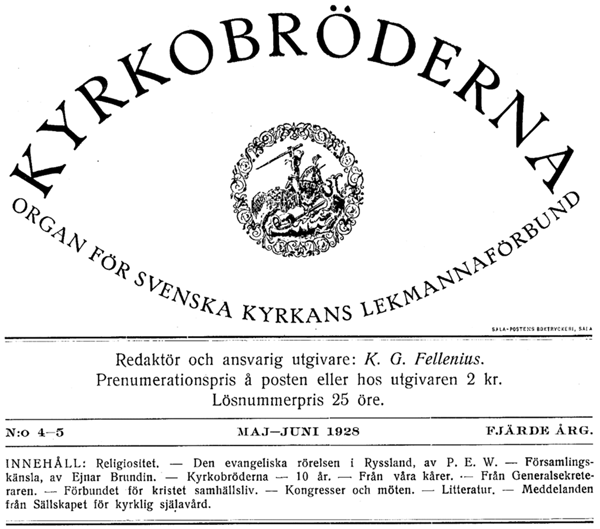
The militaristic imagery was further reinforced by the fact that the Brethren's journal itself throughout the 1920s was adorned with a front cover illustration of St. George's battle with the Dragon, as seen in the figure below (fig. 1). The emblem was described as “an expression of the insecure battle that . . . all Christian life purports.”Footnote 87 Even though the illustration was omitted from the cover of the journal in 1929, the militaristic metaphors persevered.
Example of the masthead used in the Brethren’s journal, Kyrkobröderna, between 1925 and 1928.

The imagery appeared in lectures and in published articles throughout the investigated period. For example, in 1939, Simon Forshem (1902–1975) published an article where he wrote that men had received a mission to “live on the offensive of the frontline of the church,” but that it was mainly women who “in sporadic columns or patrols, or as solitary observers go to ‘the war of the Lord.’” The fact that women represented Christ in this war was, according to Forshem, an anomaly since men were psychologically more prone to battle and Christianity was, accordingly, more suitable for men.Footnote 88
Historically, the military metaphors in Christianity can be traced as far back as the New Testament, where they are primarily associated with Paul's metaphor of the armor of God in Ephesians 6:11–17. The imagery, which since then has been passed down through history, is known as militia Christi. As scholar of religion Betty A. DeBerg argues, the use of such metaphors in the early twentieth century should not be seen as a way to discuss Christian ethics about war but rather as an expression of how men saw their male identities as threatened in what they described as a feminized church.Footnote 89 The Brethren's use of militaristic language coincided with that of similar movements in Europe and North America; in addition to DeBerg, Olaf Blaschke has investigated the use of them in the German Männer-Apostolat, historian Lucy Delap in the Church of England Men's Society, and L. Dean Allen in the Men and Religion Forward Movement in the United States.Footnote 90
A common denominator between these movements was the idea that this battle was fought between two separate sides, between good and evil. This dualistic conception requires a countertype representing evil. In the case of the Brethren, this countertype mainly consisted in characteristics deemed inferior. Manfred Björkquist (1884–1985), who was one of the founding members of the organization and who later became the first bishop of the diocese of Stockholm, identified sentimentality as a perilous enemy in a speech held during the Brethren's General Assembly in 1927.Footnote 91 In connection to other similar events, speakers proclaimed selfishness, “unmanly comfort,” cowardice, bashfulness, rootlessness, indecency, and vanity as other negative consequences of the modern globalized world and as traits that signified “the Other.”Footnote 92 The dualistic approach was elucidated when Teodor Holmberg juxtaposed faith and disbelief, claiming that people had to choose between the Holy Spirit and the unholy spirit. According to Holmberg, the latter was characteristic of the working-class and the contemporaneous literature, art, and world politics. To fight this unholy spirit, “courageous soldiers in full armor” were needed. The author emphasized that men were important in the combat between good and evil; leaving this battle to women was an absurd idea.Footnote 93
The third and final ideal that will be analyzed here is that of the humble Christian man. Unlike many of the stereotypical ideals of masculinity presented above, the Brethren also challenged the hegemonic masculinity of the time by advocating ideals which in some cases even were considered effeminate by their contemporaries. Elements of destitution and shortcoming prevail in Christianity, but in a society where self-sufficiency was a sign of manliness, insufficiency became a sign of unmanliness. This appreciation of every man's own capacity was primarily evident in the ideal often referred to as the “self-made man.” Historian David Tjeder has analyzed the introduction and the solidification of this ideal in Sweden during the second half of the nineteenth century. The basis was that every man, through hard work, could be successful, not least economically. The advice manuals that Tjeder has studied continuously emphasized independence, while dependence on others was presented as a sign of weakness.Footnote 94 Presenting oneself as imperfect or sinful, or as dependent on God to accomplish something in this world, was in glaring contrast to the ideal of the self-made man. Nevertheless, as will be made clear below, the perceived imperfect man was also given hegemonic “manly” traits by the Brethren, composing what could be described as a compensatory masculinity.
Above, Harald Dahl's emphasis on the fact that a Christian man has to be dependent on God was brought to the fore. At the same time, however, Dahl underscored that a true Christian man is also independent. Standing up for your dependence upon God—in the same way that Christ, the manliest of men, did—was a sign of strength and courage rather than weakness. Defying God and interpreting that stance as a token of independence was, according to Dahl, a false illusion.Footnote 95 In this way, dependence was presented as a prerequisite of independence. By praising and reinterpreting the concept of independence and by accentuating the position of dependence toward God, Dahl contested the ideal of the self-made man and provided an alternative masculinity based on a Christian outlook.
The ideals presented by the Brethren were often based, both explicitly and implicitly, on the catalogues of virtues found in the New Testament. For example, in an address, Vicar Josef Källander (1861–1934) referred to Galatians 5:22–23 where Paul lists love, joy, peace, patience, kindness, generosity, faithfulness, gentleness, and self-control as the “fruits of the Spirit.”Footnote 96 Similarly, a report from one of the corps was opened with a quote from 1 Peter 3:8: “Finally, all of you, have unity of mind, sympathy, brotherly love, a tender heart, and a humble mind.”Footnote 97 These virtues were important to the Brethren and are of special interest since many of them were regarded as feminine in early twentieth-century Sweden. Particularly, humility was of high esteem among the Brethren. In a speech held during one of the monthly meetings with the corps in Ludvika in 1927, Reverend Kleofas Brandt (1889–1964) stressed that the obedient relationship to God and the spirit of self-sacrifice—both key components in the Brethren's construction of masculinity—fostered humility and patience. Illustratively, Brandt added that being obedient to God also resulted in fearlessness and manliness.Footnote 98 When the founding father of the association, Carl Alm, passed away, K. G. Fellenius, in a similar fashion, connected humility and strength to each other in his obituary notice: “Personal and humble in his Christian faith, he was strong when it came to promoting the success of God's kingdom.”Footnote 99 Frequently, humility was connected to more stereotypically “manly” characteristics, such as strength, courage, and a fighting spirit.Footnote 100
VI. Conclusion
The Brethren of the Church constructed a specific Christian masculinity which at the same time both corresponded to and deviated from the hegemonic masculinity of interwar Sweden. According to the Brethren, a Christian masculinity could not exist without qualities such as humility and love, and by continuously bringing out these virtues, the members of the association challenged the image of a “real man” which was upheld by many in the surrounding society. In order to legitimize such traits, however, they needed to be fenced, as it were, with more hegemonic traits of manhood; a brother was supposed to be active, warrior-like, and brave. This in turn allowed a combination of a hierarchical and vertical homosociality. On the one hand, strong and courageous men were required in order to uphold the position of the Church of Sweden in society; their presence was presented as more important than that of women. On the other hand, “brotherly love” was supposed to be a hallmark of the organization, and an intimate relation between the members was an important aspect of its establishment. In other words, the homosocial structure of the organization facilitated both a patriarchal order and a non-oppositional intimacy between men.
In their attempt to construct a Christian masculinity, the Brethren established a historiography which was designed to portray Christianity as “manly” by nature. Reformers, apostles, and, more importantly, Jesus Christ himself, were depicted as brave soldiers who had fought assiduously against evil. The Brethren's contemporaries, on the contrary, were perceived as shy, unobtrusive, and even cowardly, and the only way to rescue society from dechristianization was if men returned to the ideals of these great men of history. By using what Blaschke calls a strategy of re-coding, praying, confessing one's faith, and going to church were understood as activities which demanded the traits of figures such as Luther, Paul, and Jesus.
The Brethren were part of a contemporary current in Western Christianity which can be said to have adopted a certain use of history. In the Brethren's historical consciousness, Christianity had its roots in a culture and in people who were essentially manly. This historical consciousness, in turn, was important in their way of using history and historical characters. As historian Klas-Göran Karlsson has argued, there is a moral use of history which is often utilized by groups who experience themselves as marginalized and who, by making historically grounded claims, want to rehabilitate or restore the situation that was prevalent before the unsatisfactory state of things.Footnote 101 Thus, the Brethren can be said to have employed a moral use of church history, with the important observation that they did not see themselves as victims.
The Brethren's identity as a Lutheran lay movement was important to their construction of masculinity. Their interpretation of Lutheranism emphasized that it was a confession that stressed activity—all aspects of religion were characterized by doing, rather than reflecting. A faith without deeds was to be condemned. Even if theological knowledge was praised—which is evident from the central position of the Bible study—this proficiency was to find expression in an active Christianity. The inward line of work needed to be connected to that of the outward line. Focusing deeds in this way might be seen as paradoxical in an organization which stressed its Lutheran identity. Arguably, it was part of a strategy to engage more men in Christianity because the Brethren were convinced that men's interest in the church would increase if they were given practical assignments to carry out.