In a recent article published in this JOURNAL, Jun Seong Ho, James Lewis, and Kang Han-Rog described the seventeenth, eighteenth, and nineteenth centuries in the Korean economic history as periods of expansion, stability, and decline, respectively. Without clarifying whether it is the aggregate or per capita output that they claim to have expanded, stabilized, and then declined, the authors further argued that the trend is explicable in terms of productivity, which was in turn attributed primarily to policy measures affecting irrigation, security of property rights, and famine relief.Footnote 1 Productivity remains a term imprecisely defined in the article. In the article, Jun, Lewis, and Kang spend no time discussing evidence on factor and asset prices. Such data is readily available. In fact, the authors have published such series themselves.Footnote 2 The evidence on factor and asset prices indicate that the marginal productivity of land and labor declined consistently, rather than expanded, stabilized, and then declined in the precolonial centuries.
Jun, Lewis, and Kang inferred productivity trends from the movement in commodity prices. Having claimed that the relative price of cotton cloth declined from the mid-eighteenth to mid-nineteenth century, they interpreted the alleged decline as an indication of falling productivity in rice farming. Of the eleven observations on the relative price in the two centuries in Figure 1 (on p. 254), the last three appear to have been made after 1876, the year when cotton textile imports from Britain began to depress cotton textile prices in Korea. The remaining eight—five for the eighteenth century and three for the nineteenth century—data points hardly justify the claim of rice having risen vis-à-vis cotton cloth after 1800. Moreover, even if one chooses to believe so, the perception could equally be interpreted as showing faster productivity growth in cotton textile production.
The other evidence presented to support the claim of falling productivity is the rise in the rice price in terms of copper coin in the second half of the nineteenth century (figure on p. 255). However, in all likelihood, the inflation from 1876 onward was a consequence of the opening of port in 1876. In the following decades, agricultural exports expanded rapidly, causing not only the rice price, but also prices of dry field products to surge. The figure also shows that the rice price in terms of silver did not start to rise until 1876, which suggests that the rice price inflation in the third quarter
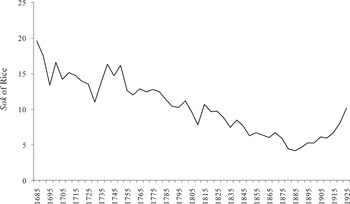
RICE RENTS FROM A TURAK OF PADDY FIELD

of the nineteenth century was driven by expanding supply of copper coins. While money supply remains a variable overlooked by Jun, Lewis, and Kang, a rough estimate of copper cash stock derived by adding up recorded amounts of coinage indicates that significant acceleration in money supply did occur in the third quarter of the nineteenth century.Footnote 3
Since the price of a commodity is affected by factors other than productivity in the sector producing the commodity, one does not normally attempt to infer productivity trend from price movement alone. Instead, there are two standard ways to measure total factor productivity. The primal approach requires reliable figures on input and output, which are unavailable for precolonial Korea. The dual approach derives total factor productivity growth as a weighted average of growth rates of factor prices, a procedure which can be adopted for late dynastic Korea, given the availability of recorded observations on the land rent and wage.Footnote 4
There exist data on rents from paddy field in fifteen different places for different parts of the two and half centuries from the 1680s. Kijoo Park regressed the rent data on location and 5-year period dummies to calculate the national average using the estimated coefficients of the hedonic regression. The national average, shown in Figure 1, fell as a matter of trend for two centuries from 1685.Footnote 5
On the other hand, efforts made so far to collect wage information proved less productive, generating only four different wage data sets. Yongchul Yun first published a collection of wage figures found in government regulations (ŭikwe) from 1630-1903. Although it remains unknown whether the stipulated wages refer to amounts actually paid to laborers employed by the public sector, Myung Soo Cha converted the wage data into rice wages and used them as a part of the evidence for his claim that the real wage fell as a matter of trend in the eighteenth and nineteenth centuries.Footnote 6 Digging further in ŭikwe documents, Yitaek Pak made a far larger number of wage data available, which were standardized with rice prices by Chŏngsu Lee and Hŭiho Kim to confirm the declining wage trend from 1689-1893.Footnote 7
A market wage series was first made available by Woo Youn Lee, who showed that rice wages of agricultural workers in Yechŏn fell consistently during the second half of the nineteenth century. Subsequently, another market wage series published by Kuen-Tae Kim indicated that rice wages earned by outdoor workers in Yŏng'am fell in the early and mid-nineteenth century.Footnote 8 To estimate wages, both Lee and Kim drew on records of employment by private agents, which specified not only total labor expense, but also the number of workers hired and the number of days worked. The account books used by Kim also include entries recording total labor costs only. Jun and Lewis drew on such records to produce an alternative wage series for Yŏng'am, which contained a downward trend during the nineteenth century.Footnote 9
Compared to commodity and factor prices, farmland and slave prices are available in greater abundance from surviving records of transaction in the two assets. Paper having been an expensive item in precolonial Korea, the relative wealth of existing records of asset prices does not necessarily imply that asset markets were better developed than goods or factor markets in precolonial Korea. A large number of transaction records in farmland and slaves survived, probably because they served as documents proving ownership. Cha and Hunchang Lee analyzed more than ten thousand records to find that the value of paddy field in terms of rice in southern Korea remained stable in the eighteenth century and then declined in the nineteenth century.Footnote 10 The stability of real paddy field price and contraction in rent from paddy land (as seen in Figure 1) in the eighteenth century need not be mutually contradictory, because the rate of interest was on the decline during the century.Footnote 11
Slaves are estimated to have accounted for about one-third of the population of Chosŏn Korea (1392-1910), which led James Palais to make a controversial characterization of the country as a “slave society.”Footnote 12 Most became slaves by birth, but free peasants could choose to sell themselves and their families permanently into
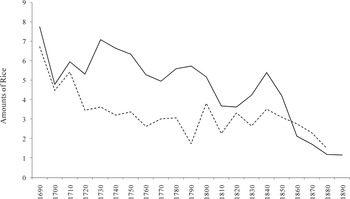
UNSKILLED MALE WAGES AND MALE SLAVE PRICES IN TERMS OF RICE

slavery. Records of slave sales have attracted scholarly attention since Sŏkchong Chŏng published in 1983 his collection of about 150 slave transactions records. Adding more than 80 records to the collection, Chŏngsu Lee and Hŭiho Kim calculated annual averages of the slave prices found in the sales documents to identify a downward trend in slave price expressed in terms of rice price from 1689-1893. Price figures found on slave sales documents refer not infrequently to the sum paid to buy a whole slave family including parents and children, with age information not always being provided. To estimate the price of an adult slave using such data, Lee and Kim chose to assume that a group of slaves sold as a lot consisted of an equal number of working age adults and their dependents, and that working age slaves were one third more expensive than either younger or older slaves. Considering these assumptions as unwarranted and the number of price observation used as insufficiently large, Cha and Woo Youn Lee collected further sales documents to increase the number of available slave price observations to more than seven hundred and analyzed them by running hedonic price regressions. Confirming the downward trend as identified by Lee and Kim, the real slave price estimated also indicated that the decline started from as early as the 1660s. Assuming maintenance costs of slaves to have remained stable from the late seventeenth to the late nineteenth centuries, the falling trend in slave price in terms of rice would imply that real wages were also being diminished. Given that the rate of interest was on the decline in the eighteenth century, wages would have been falling faster than slave prices.Footnote 13Figure 2 presents ŭikwewages and male slave prices, the two available indices of laborers' income spanning the eighteenth and nineteenth centuries. To facilitate visual comparison, nominal wages and slave prices were standardized with prices of different units of rice. The wages as found in ŭikwes fell at about the same pace as slave prices during two centuries from the 1690s. Although not shown in Figure 2, the decline was preceded by a surge in both the ŭikwe wages and slave prices during the first three decades of the seventeenth century, when the population was decimated by the wars with Japan (1592-1598) and China (1627-1637). These indicate that the ŭikwe wages reflected demand and supply shifts in the labor market.
In sum, contrary to the claims by Jun, Lewis, and Kang for expansion, stabilization, and decline, available data on asset and factor prices indicate that productivity and living standards declined consistently from the late seventeenth to the end of the nineteenth century.