Introduction
Directly after Germany's defeat in the Great War, Max Planck – probably the best-known German scientist of the day – spoke in the Berlin Academy of Science on the Fatherland, the military, and Germany's outlook: “When our enemies have deprived our fatherland of its military and might, when severe crises hit the interior and probably even more severe ones are approaching, there is one thing that no exterior nor interior enemy has ever taken: it is the standing that German science holds” (Planck Reference Planck1918). Similarly, representatives from politics, industry, and finance considered science to be the only asset left to the Germans that allowed them “to rise from humiliation,” to be able to “once again carry our heads high” (von Schwabach Reference von Schwabach1927, 369), or claimed that “although it can be questioned whether we still amount to a great power, the Germany of the future must in any case survive as a great power of intellect and knowledge” (Schreiber Reference Schreiber1922, 8). Therefore, “We have to devote every Groschen we can spare to science. It is the best-invested capital we own” (Duisberg Reference Duisberg1923, 614).Footnote 1
In a country that had to invent a new political system after the war was lost, the monarchy overturned, and borders redrawn, and after the country was no longer allowed to unite itself behind army and militarism, science became the rallying cry. Cultivating Germany's scientific legacy meant first of all to ensure that all institutions engaged in science maintain as much continuity as possible. The strong system of secondary education and universities was reformed only cautiously, and research laboratories like the Kaiser Wilhelm Institutes, which had been founded just before the war, kept their names and mission. Accordingly, popular science in lectures, newspaper articles, journals, and books was not revolutionized either, but evolved on the strong basis of established models. Now, however, it carried much greater discursive weight as it served as a substitute power in intellectual, political, and popular spheres. A good example for this is the response in 1919 to the awarding of three Nobel Prizes to German scholars, Max Planck, Fritz Haber, and Johannes Stark, which was hailed as a “German victory” and broadly publicized and discussed in the press (Metzler Reference Metzler1996; Friedman Reference Friedman2001).
Like classical music, art, or literature, science came naturally to the Germans, a fact historians have explained by “specific German conditions and traditions” that were exhibited, for instance, in the process and rhetoric of German unification in the nineteenth century, and in Kaiser Wilhelm II's obsession with technology at the turn of the century (Nipperdey Reference Nipperdey1990, 602; König Reference König2007).
After World War II, when science and its technological application had demonstrated their destructive potentials even more emphatically, a number of parallels are still striking when it comes to popular science. Even before the Allied Forces were able to establish the beginnings of a Western, more pragmatic and less philosophical view on science and technology in occupied Germany in the West, and the Soviets a socialist interpretation of the scientific rules of power in the Eastern occupation zone, the leading organs of popular science had reappeared in all of Germany.
The foundation of two German states in 1949 with the establishment of a socialist political system in the East and a capitalist one in the West did not immediately entail two different understandings of popular science; indeed, the early postwar editors struck familiar chords, celebrating popular science as a cultural value not to be tainted by politics, and the Iron Curtain was still permeable for science in print. Only by the end of the 1950s and the early 1960s did the American influence in the West and the socialist interpretation of the political role of science in the East result in gradually divergent reorganizations and hence separation of the kinds of popular science in newspapers, journals, and on the air (Gruhn Reference Gruhn1979; Zimmermann Reference Zimmermann1994; Warnecke Reference Warnecke, Heinze and Kreutz1998; Heumann Reference Heumann, Stöckel, Lisner and Rüve2009).
For a rather long time, popular science in Germany – and more generally, the ways of thinking and interpreting Wissenschaft (which is both science and humanities) – followed established patterns charged with cultural meaning, and these prevailed across deep political upheaval and profound social crises well into the post-World War II era. It is this cultural continuity in the twentieth century that, despite all talk of “Weimar culture” or “Nazi science,” needs deeper scrutiny; this paper attempts to elucidate this phenomenon for the field of science communication.
Cultural continuities and political breaks: The workings of a German cultural dispositif?
For historians periodization serves as the basic framework of national histories and is a fundamental part of the trade; thus, the above observation of continuities may seem to complicate things in asserting that political breaks and war times do not adequately delineate the sequence of cultural periods. Although historians of German popular science have put forward different interpretations of the main periods into which the overall development could be divided, there is consensus that the revolutions of 1848 in the German states, which demanded civil liberties and national unity and which was driven by intellectuals and commoners, marked a starting point of a bourgeois culture of science popularization. In the aftermath, when the conservative aristocracy had defeated the revolution, many liberally minded revolutionaries were, if not exiled, at least excluded from state employment and had to find work elsewhere. One possibility was to sell scientific knowledge to the public, and in this way the popularization of science became a project of the aspiring middle class, interwoven with ideas of national unification, liberalism, and the freedoms of press and speech (Daum Reference Daum1998; Schwarz Reference Schwarz1999; Kretschmann Reference Kretschmann2002). As a consequence, the process towards German unification in 1870/71 was a political development that did not change popular science, aside from fostering it further. In this way a specific kind of popularization prospered, at least until the emergence of mass media. At the turn of the century, these new media created a new visuality enabled by technical progress, which allowed, in particular, pictures to be included in greater numbers and higher quality, and also made production much more affordable.
In my interpretation, a period of science popularization ended around 1900 when, besides the changes in media, more importantly, different interests in science and attitudes towards its nature and application also became predominant. This new period “after popularization” may be called the period of science communication, as it became more dialogical and less missionary (Schirrmacher Reference Schirrmacher2008). Interestingly, major changes in the production of popular science literature, and with it changes in attitudes towards science in general, which often have been explained as results from the experience of the Great War and Weimar culture, actually began well before 1914. As I will show below, practically all popular science journals survived the war, and not even the political revolution in 1919 touched this field directly. It was rather the times of the economic crisis and hyperinflation in 1923 that severely affected many publications of popular science simply for economic reasons, while neither the beginning of the Great Depression in 1929, nor the Nazi seizure of power in 1933, nor did even the beginning of World War II in 1939 influence this sector to any comparable degree. As a consequence, it was only sometime in the second half of the twentieth century that the understanding of the relationship between science and the public underwent another transformation. This has been widely discussed as the rise of the “knowledge society,” in which the position of the scientists and the public discourse about science became further democratized (Lane Reference Lane1966; Böhme and Stehr Reference Böhme and Stehr1986; Funtowicz and Ravetz Reference Funtowicz, Ravetz and von Schomberg1993; Weingart Reference Weingart2001; Szöllösi-Janze Reference Szöllösi-Janze2004; Bensaude-Vincent Reference Bensaude-Vincent2009).
More precisely, I date the relevant transition back to the end of the 1950s, when in West Germany protest against nuclear armament brought scientists to address the public at demonstrations (or as experts testifying to the parliament), particularly in the years 1957 and 1958 (Schirrmacher Reference Schirrmacher2007). Unmistakably, an American influence was at work here: The best-selling journal Bild der Wissenschaft, for example, founded in 1964, was edited by the German physicist and Disney author Heinz Haber (Haber Reference Haber1956), who also presented science broadcasts on German television from 1959 on. But in East Germany things changed as well. An interest in science became an integral and propagandistic part of “Socialist man,” especially after the stabilization of the regime in the early 1960s. The previous period had seen some struggles over control of public science publications, but in 1962, soon after the erection of the Berlin wall in 1961, the colorful popular postwar journal Wissen und Leben, established by political fiat in 1956 to monopolize the field to the disadvantage of traditional, more independent publications, became obsolete and disappeared in this form. As such, it appears that the main transformations of popular science do not coincide with the general political periodization.
The main question this paper addresses is the following: Why did the two German catastrophes of the twentieth century not entail greater transformation in the popular discourse on science, and how can it be explained that the time between the turn of the century and the end of the 1950s turned out to be a rather stable period for a specific ensemble of kinds, agents, producers, and distributors of popular science in Germany, all of which evolved rather steadily? The answer, I would like to suggest, hinges on an analysis of the structures, resources, conditions, and uses (or misuses) of speaking and writing on science that occurred in a culturally defined space, which, in fact, depended to a great extent on media and economy as well as opportunities for participation. Historians and sociologists have long emphasized the cultural interpretation of popular science (see e.g. Whalen Reference Whalen1981; Cooter and Pumfrey Reference Cooter and Pumfrey1994; Gregory and Miller Reference Gregory and Miller1998; Bauer et al. Reference Bauer, Shukla and Allum2011). One aspect concerns the individual scientist who presents, incorporates, or lets resonate his or her insights with larger scientific or non-scientific audiences and hence experiences a cultural context. More importantly, however, it is the question as to how processes of institutionalizing scientific, scientifically inspired, and even pseudo-scientific and other kinds of popular knowledge take place in a wider setting, and what factors determine or limit their respective cultural impacts. When we describe the production and consumption of popular science by means of an ensemble of elements, rules, conditions, and costs that generate, maintain, stabilize, or restrict the discourse on scientific knowledge, and which may in its own right create popular knowledge, we have to deal not only with authors and readers (source and recipients) but also with entities like publishers, agencies, libraries, and state regulations. They have the power to define the practices, rules, and economies of popular science that actually apply between authors and readers and beyond.
The naive “linear model” of popularization was unmasked long ago as a means to define the popular discourse in ways to support (hidden) strategic aims of scientists such as money, prestige, or influence (Shinn and Whitley Reference Shinn and Whitley1985; Hilgartner Reference Hilgartner1990). Now, more complex frameworks in terms of resource exchange between science and public, “knowledge in transit,” and approaches originating from systems theory, which employ discursive links between science, politics, economy, and media have been suggested (Ash Reference Ash and Büschenfeld2001 and Reference Ash, Ash and Stifter2002; Secord Reference Secord2004; Weingart Reference Weingart2001 and Reference Weingart2005; Weingart et al. Reference Weingart, Carrier and Krohn2007). As I completely agree that the relationship between science and public (or rather sciences and publics) is a complex one with many elements, and that the communication, or rather negotiation processes, deal with various kinds of scientific, popular-scientific, or even pseudo-scientific knowledge or knowledge claims that may convey interest and knowledge in many ways, in this article I would like to focus not on the complexity of specific discourses, but rather on the question of the conditions of the discourses. I will ask: what is the machinery of popular science and what infrastructures can explain the continuities in the German case. And in order to do this, I will borrow a term from Michel Foucault. Taking up his distinction between “discours” and “dispositif,” I will try to characterize the cultural dispositif, which explains the rules and restriction of the discourses and which, at the same time, reminds us to consider the questions of power and the kinds and boundaries of knowledge of a certain epoch.Footnote 2
In Foucault's own words, a dispositif is “a thoroughly heterogeneous ensemble consisting of discourses, institutions, architectural forms, regulatory decisions, laws, administrative measures, scientific statements, philosophical, moral and philanthropic propositions,” or rather, “the net one can establish between these elements” (Foucault et al. Reference Foucault and Gordon1980, 194; French original Foucault et al. Reference Foucault1977, 62f.).Footnote 3 For Foucault it is the nature of these connections which lies at the center of his analysis. He identifies as a “major function” of a dispositif that, “at a given historical moment,” it may be “responding to an urgent need” and hence has a strategic nature, which renders it “inscribed in a play of power” as well as “linked to one or many bounds of knowledge.”Footnote 4 In English translation the closest equivalents to dispositif are found to be “machinery,” “apparatus,” or, more precisely, “social apparatus.” While in Gilles Deleuze's reading a dispositif is a certain “multilinear ensemble” composed of “lines” of different nature which determine the visibility of topics and problems, the ability of their enunciation, the power associated with knowledge claims, and the subjectivity related to this (Deleuze Reference Deleuze and Armstrong1992, 159ff.), scholars writing on popular science have used the term more recently in a rather general way to capture social apparatuses at work, for example, in evaluating or “benchmarking” science or in determining modes of public participation in technological choices (e.g. Bensaude-Vincent Reference Bensaude-Vincent2009, 364; Reference Bensaude-Vincent2012, 87f.).
In the following sections, it is not the popularized, vulgarized, communicated, or translated science itself that is at the center of attention, as it necessarily would be in the case in a discourse analysis, but rather the ensemble of institutions that define the conditions of this science communication. The term cultural dispositif thus serves, firstly, to identify major parts of the ensemble of discursive and non-discursive elements, which may be seen as the infrastructures of scientific knowledge in society and its communication. Clearly, there are “institutions” of popular science. There are publishers, broadcasting boards, associations of science writers and journalists, etc., and in most cases these are associated with economies of money, mission, and prestige. Among the “architectural forms” we can count images, diagrams, pictures or frames like title pages, or radio fanfare and other forms of presentation used in science communication. The fact that instances of scientific progress were identified as cultural contributions, which newspapers printed in the feuilleton, the culture section – while advances in technology were mostly reported as business news –, exhibits that there are also some “philosophical propositions and moral judgments” that played a role. Furthermore, there are “laws” both in a judiciary sense, for example, requiring all radio scripts to be approved by a politically run committee, and in a moral sense, which, for instance, deemed sensationalism inappropriate in Germany while elsewhere it drove the public's interest in scientific topics. While “scientific statements” are already at the center of the discourses themselves, there are still philosophical and theological statements on a “world picture,” a term often promoted, for instance, by Max Planck, which influenced the discourses on science. In this way, quite a number of elements from Foucault's list can be identified. And, secondly, the notion cultural dispositif describes the interactions among these elements, or rather its net (réseau), which provides a basic stability, reconfiguring and, in this way, giving rise to (long-term) dynamics. This part concerns the workings of the dispositif, which will be expounded in the following sections.
On the infrastructures of science communication
Starting from the material media of popular science, this section proceeds from products to producers and to the production environment of popular science, and finally addresses the dynamics of popular discourses on science. Journals and newspaper articles were long the dominant media communicating science, and by focusing on them in particular, but also on the rules governing the publishing business of popular science, and on the political and societal influences and constraints, an infrastructure of popular science in Germany is sketched that reflects some essential qualities of the entire epistemic and cultural machinery. The chosen historical perspective will expose this apparatus to be very much a cultural dispositif that underlies the cultural interpretation of science in Imperial Germany, just as it did in the Weimar Republic, and which even remained powerful in the Third Reich and persisted in the early periods of both postwar German states.
Looking at media – mainly print media like newspapers, journals, books, and book series, but also radio and film – the criteria that seem to describe the contours of popular science are number; publication frequency; size; number of pages; use of drawings, photos and color; and even paper quality (at least the popular science journal Umschau was printed in two versions, one of them the “luxury” copy). Besides format and quality, more economic factors like circulation, distribution (e.g. subscription vs. newsstand vending), and pricing exhibit key properties of a basic machinery underlying popular science. Next, it is important to characterize the different audiences and discourses (or discourse arenas) appropriately, especially since the middle classes diversified over the course of the twentieth century into various groups and layers, thus splitting up the audiences that had been addressed more uniformly under the popularization paradigm of dissemination in the nineteenth century. And finally, from the many questions these elements and their interactions may raise, I will focus on four topics: an (epistemological) order of publics for science, an economic order of audiences, the sociocultural definition of target groups (also for advertisement), and a cultural economy of prestige.
(1) My first observation is that the above mentioned indicators do not occur arbitrarily, but may be explained to large extent as reflecting an order of audiences or publics, which can be reached by communications on science and which reflect its economical weight and cultural impact. It is particularly important to realize that there is a full hierarchy, which can be ordered roughly into magnitudes of powers of ten. In this way a crude scheme emerges, which is reflected by the typical circulation numbers of print material including both science publications and popular material. Using distinctions between “esoteric” and “exoteric” circles (Fleck [1935] Reference Fleck1979), “attentive” and “non-attentive” or “interested” and “residual” publics (Almond Reference Almond1950; Miller Reference Miller1983), as well as “mass publics” or a “broad” public (Weingart Reference Weingart2005), one can distinguish at least five levels (I) to (V) (for detail cf. Schirrmacher Reference Schirrmacher2008 and Reference Schirrmacher, Carson, Kojevnikov and Trischler2011). Two of these are part of science and three differentiate what usually is conflated as “the public.” A “research science” (I) or a group of scientists within a certain discipline (or an even more specialized field) communicates its findings in specialized science journals that typically have a circulation in the order of hundreds. A more interdisciplinary audience was served by Die Naturwissenschaften, which consistently reached some thousand scientists or a “scientific public” (II).
The concept of an “attentive public” (III) has been used in various aspects of politics and science policy in an attempt to identify that part of the public that plays the greatest role, e.g. in political decisions, and hence constitutes the most “powerful” public. Here it describes those outside the scientific profession who still try to follow new developments in a field rather closely. As circulation numbers of typically around one or a few ten thousands show, this specialized audience was still rather small when compared to the mass market. The latter was served mainly by newspapers and illustrated weeklies, some of which carried quite a lot of stories on scientific and technical issues, like the million-selling Berliner Illustrirte (Deilmann Reference Deilmann2004). Between the levels of attentive public (III) and a mass or “broad public” (V), a further intermediate level is discernible: an “interested public” (IV). This is often less striking from the levels of circulation numbers, which lay somewhere in the middle ground between ten thousands of the “attentive public” and the millions of the new mass media, than from the quality and attitude of articles presenting science to an audience that is interested in only certain aspects of science, and in most cases only occasionally. Here the reader had to be convinced at the newsstand, from week to week or from month to month, that exciting and entertaining news or valuable knowledge should not be missed. Members of the attentive public, in contrast, were generally regular subscribers to a journal.
Clearly, specific ways of writing on science and technology correspond to each of these five levels of popularity. They differ, first of all, in terms of technicality: in their use of different kinds of illustrations and genres of presentation like derivation, description, narration, and discussions of potential impacts. This fully developed hierarchy of audiences and organs appears to be a property specific to the German case, and hence shows a crucial part of the machinery of science communication in a particularly complex way, with its workings acting on various levels, and with different speeds and power.
(2) The second point concerns a similar observation taken from the point of view of the producers of popular science media, and hence of certain institutions that are also elements of the dispositif. The layered structure of magnitudes is not only a feature of science communication, but can also be identified with respect to its position within an economy, not only of production and money, but also an economy of the reading public's attention and, consequently, also within the variety of publications offered by a typical publishing house. What we find is an economically determined market of science communication publications.
The Ullstein Press is a good example of a major German institution producing and distributing various forms of public knowledge. Ullstein Verlag was a family-owned enterprise, which grew from the middle of the nineteenth century on over generations, rising from a paper-selling business into one of Gemany's top three press imperia, rivaled only by Scherl and Mosse, two publishing houses of similar origin. They transformed the German capital into a “newspaper city” with a central newspaper district. The amount of paper transmuted into news media skyrocketed tenfold between 1900 and 1930, putting Ullstein alone in need of 4,500 freight cars full of printing paper a year. Illustrated weekly magazines and newspapers sold on the street, which were generally allowed only from 1904 on, were soon in high demand; inexpensive books followed a few years later. Expropriated and put under direction of the National Socialist party in 1934, the family enterprise was reinstated after 1945 but ran into problems ten years later, and was eventually taken over (de Mendelssohn Reference de Mendelssohn1982, 178; Freyburg and Wallenberg Reference Freyburg and Wallenberg1977).
Fig. 1 shows the print output of Ullstein Press, revealing the following picture. Various quality newspapers and their supplements can be seen in the top section, along with tabloid newspapers. Below we find large-format illustrated magazines, both general ones like the Berliner Illustrirte, a weekly launched in the 1890s that became the first mass medium in Imperial Germany – and which remained the most visible cover at the German newsstands and most popular general interest magazine during the Weimar Republic, and those for specialized audiences, in particular for women. Next come literary, critical, and popular science journals of smaller format, while at the very bottom there are specialized technical journals on traffic and building construction as well as printed registers and timetables. The message of this illustration, which was meant to show the production of Ullstein to advertising clients, is that each product in this ensemble represents an audience, a market, and an advertising opportunity, although the items differ dramatically in the number of readers, the frequency of production, the kind of illustrations, pricing, size, etc. They also provide very different amounts of space to cover scientific knowledge and popular treatment thereof. However, from the quality paper Vossische Zeitung (top right), a newspaper read mostly by the liberal elites with a long tradition dating back to the seventeenth century, and the best-selling Berliner Illustrirte (center) to the colorful popular science journal Koralle, which first appeared in 1925 after the period of hyperinflation, down to Verkehrstechnik and Bauwelt, somewhat older titles presenting specialized information on transport and construction technology, at least four levels of discourse on scientific knowledge can be discerned.
Collection of Ullstein newspapers, illustrated magazines, more specific popular journals as well as specialized publications [Source: Ullstein Berichte 1927].

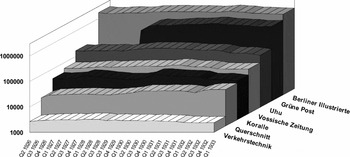
Interestingly, this corresponds in a rather surprising way to the orders of audiences described above in powers of ten: As fig. 2 shows, on the level of millions of copies sold, illustrated weeklies like Berliner Illustrirte (popular with the urban population) and Grüne Post (an equivalent for the rural population launched in 1927) ranked highest. On the level of some tens of thousands we find Querschnitt, a literary magazine; Koralle, the popular science journal mentioned above; and Uhu, an eclectic magazine with a saucy mix of cultural criticism, literary snippets, erotic pictures and curiosities – including some science and technology. Critical writers like Heinrich Mann and Erich Kästner provided the texts, often combined with at times provocative images. While Uhu attracted mainly a younger male readership, women were served by two brands of their own, Die Dame and Blatt der Hausfrau, each offering a different kind of female role model (fig. 1). Then came the more specialized journals on transportation and construction that only sold in thousands, so again we can recognize a roughly logarithmic hierarchy.
Circulation of selected Ullstein journals, illustrated magazines, and newspapers during the years 1926–1933 (logarithmic scale) [Source: Ullstein Berichte].

In order to characterize the level to which Ullstein's Koralle, a prototype of a Weimar period popular science journal, penetrated the market, I have also included in the diagram the quality daily newspaper Vossische Zeitung. This paper was also well known for its good coverage of technology; from 1896 to 1917 a special weekly supplement was included, while later the main part of the paper incorporated a science and technology section (Stummvoll Reference Stummvoll1935; Schirrmacher Reference Schirrmacher, Carson, Kojevnikov and Trischler2011). The Vossische was a means used by scientists like Max Planck, Erwin Schrödinger, and Max Born (to name just a few physicists whose articles appeared in this newspaper around 1930) to speak occasionally to a larger audience.
(3) The advertisement market also tells much about a third point. While historical studies on science popularization have often focused on the particularly interested or attentive public, which typically subscribed to popular science magazines, the more occasional reader, who might buy a journal at the newsstand from time to time when the title page piqued his or her interest in a particular issue – for the same reason he would visit a science museum or an exhibition –, already will have been subjected to a much richer context in which the scientific content is embedded. A telling expression of this context can be found in the advertisements placed in the journals, for – in contrast to the more specialized publications – these were the major economic factor in the success of a publishing enterprise.
A certain degree of insight into the economics of popular science publishing can be gained from the Ullstein Berichte, a free circular intended mainly to inform prospective advertising customers. Koralle is portrayed here as “the most beautiful popular science monthly magazine. Advertisements that should reach a cultivated, critical and technically interested audience appear first and foremost in Koralle” (Ullstein Berichte, April 1927, 12). From this we can infer that a cultivated, critical, and technically interested audience now had emerged that was not yet available or not of sufficient size at the beginning of the century, much less in the nineteenth century. At least this idealized picture of the modern reader coincided with some success for the publication. Although not quite as strong as its sister publication Uhu, Koralle demonstrated that its readers were of comparable value to Ullstein. According to the Ullstein Berichte, Uhu offered well-funded customers and promised to be “bright,” “unique,” “amusing,” and “full of fun” (Ullstein Berichte, Oct. 1928, 14). Popular science, like literary criticism and other middlebrow periodicals, was part of a considerable prestigious culture within which knowledge, mass consumption, and the individual's self-image were closely associated with an understanding of science and technology as important building blocks of the German nation and its power, and thus also contributing to national welfare.
With the rising number of white-collar workers in Germany, often in technological industries or modern businesses, and with their individualist urban attitudes accompanied by prosperity and leisure time, interest in luxury goods like cigarettes, chocolate, cameras, and cars – to name some typical products advertised in Koralle and Uhu – reading and talking about popular science was also a means of sociocultural positioning; in other words, knowledge, consumption, and standing mingled in a joint discourse within the boundaries defined by the cultural dispositif.
(4) Besides numbers, market segments, and advertising target groups, it is thus possible to identify another infrastructure of popular science with respect to the content of the print media. Not, however, in the sense of distinguishing scientific fields, but rather in recognizing a cultural economy of prestige, which is important to readers, publishers, and writers. In my analysis of the processes that influence the possibilities and limit the subjects and genres of twentieth-century science communication, three notions turn out be central to characterizing this economy: relevance, resonance, and reputation. Particularly in the market-driven media of science communication, content has to exhibit relevance to the reader. Clearly, there is a wide variety of ways to attain relevance, be it a connection to readers’ experiences, the promise of usefulness and empowerment, or the appeal to cultural values. A real interest is, however, rarely generated without any resonance of the scientific knowledge to be communicated and some stock of knowledge (not necessarily scientific) already present in the public. As typical examples for this one can identify X-rays around 1900 and vitamins in the 1920s, as well as the discussion of strange rays, parapsychological effects, and the belief in the existence of panacea or an elixir of life (Schirrmacher and Thoms Reference Schirrmacher, Thoms, Nikolow and Schirrmacher2007). Finally, great differences can be made out in the style of presentation of science for different audiences. A discomfort with sensationalist types of writing was widespread not only among German scientists, but also among popularizers and specialized journalists. The fear of damaging one's reputation with colleagues is a determining factor of the history of science communication, and one which is often underrated.Footnote 5
There is even an economy of reputation such that many science popularizers coming from a science background had to balance positive and negative factors in their accounts.Footnote 6 While the more interested and attentive audiences longed for authoritative accounts by writers with clear scientific qualifications, the science world did often not reward popular writing. At this point one can see how the economy of prestige and authority, when combined with values from the scientific community and the expectations of audiences, implicitly defined rules and boundaries for the possible discourses. This is an example for the workings of the cultural dispositif, whose very rules, which are not necessarily visible on the surface, imply the power to shape, restrict, or obviate discourses.
Science communication in Germany in the 1920s and 1930s
In returning to the introduction, where I stressed the role of science for German national identity after the lost Great War, and in returning to the question of breaks and continuities in the history of popular science, I will now deal with the Weimar period in some detail. Figure 3 presents the available data on circulation of the major German popular science journals, once more reproducing a typical multileveled structure, in particular for the period of the 1920s. It thus suggests that certain infrastructures underlie the nature of popular science in Germany, and I interpret the emergent pattern as a footprint, or rather, a signature of those agencies of popular science which are elements of the cultural dispositif.
The main German popular science journals, 1901–1941 (circulation in 1,000s, logarithmic scale). Missing points merely indicate a lack of available data; lines interpolate. Data collected from various sources, mainly Sperlings Zeitschriften-Adressbuch (Sperling 1902–47).

In the 1920s the journal Die Naturwissenschaften sold a few thousand copies, while Umschau, a kind of precursor to Kosmos, yet slightly more technical and slightly less commercial as it was edited by a university instructor, and Technische Monatshefte, the technology sister journal to Kosmos from the same publisher,Footnote 7 both achieved a circulation of around ten thousand. Kosmos, in turn, stabilized at a circulation of an unprecedented two hundred thousand copies. Three further journals coexisted between the last two levels, Urania, Koralle, and Wissen und Fortschritt, each of which sold some ten thousand copies. All of these journals can be understood as specific elements linking science and technology on the one hand, and popular interests and attitudes on the other.
Only few of these publications, however, reflected anything that might be seen as a Weimar type of popular science, and even these examples point in very different directions. The dramatic political change from monarchy to democracy had hardly redefined popular science. The only exception was Urania, which represented a socialist interpretation of the role of science and technology in a society that was linked to the political strength enjoyed mainly by the social democratic party (SPD) and to a lesser extent by more radical communist political parties (USPD, KPD) in the 1920s.Footnote 8 Besides this creation of a “socialist popular science” (Hopwood Reference Hopwood1996) of a considerable, but hardly predominant influence, which was meant to recruit workers to participate in discussions about the perspectives and uses of science to improve society, Koralle aligned much more with a capitalist interpretation of the modern man. To whom, as we have already seen, science readings carried more symbolic value and prestige, as did the luxury goods that were advertised on adjacent pages of the journal. Wissen und Fortschritt also tended in this direction, combining it, however, with a critical assault on a prevailing “Americanism” in science and technology in favor of a self-confident German alternative (Schirrmacher Reference Schirrmacher, Carson, Kojevnikov and Trischler2011, 446). Similarly, in the years before the Great War, too, a small number of journals had already tried to create a kind of ideological Kaiserreich science popularization. These were published by the secular Monist League and the anti-Darwinist Kepler Association (Daum Reference Daum1998, 210ff.). Again, these publications found an audience in the middle levels but never dominated.Footnote 9
More important than these specific voices of popular science (or rather of the instrumentalization of science to ideological ends), however, was the larger group of constant agencies of science communication and the ensemble in general. Fig. 3 visualizes very well the congruence of the pattern for the decade from 1905–1915 with that of 1920–1930, only that the pattern is shifted by roughly a factor of two in total numbers – very clearly so for Kosmos, Technik für Alle, and Umschau.Footnote 10 Reading these patterns in the graphical representation as a signature of the cultural dispositif, which is discernible in the same way for the years before World War I as it is for the Weimar period, and with some blurring in the second half of the 1930s as well, it appears that the dispositif ensures a continuity in the discourses on science across stark political and economic crises like the world economic crisis in the late 1920s and the takeover of power by the National Socialists in 1933. Science communication was supported primarily by the ideals and interests of the German Bürgertum, the middle classes, which adapted ever more to a consumer society after the turn of the century, while cherishing scientific knowledge as a cultural asset. This view, or rather this hegemonic discourse, helped to marginalize alternative popular discourses on science that related to political, religious, or ideological aims.
For the times of the Weimar Republic, the graph clearly shows that this was a period of unprecedented consumption of popular science writing in journals, newspapers, and books, roughly double the level of both the period before the Great War and the years after the end of the first German democracy in 1933 (and even long after World War II). At the same time, however, the ensemble of organs and hence audiences remained surprisingly constant. One of the differences was that the greater variety of small journals that appeared in the Kaiserreich was now replaced by a larger number of publications on the middle level in the interwar years. The impact of fascist policies was limited, however, and resulted in centrifugal forces, which saw circulation of one publication skyrocket, here Koralle, which increasingly became a general interest illustrated magazine without its previous focus on science, while others were decimated, like Wissen und Fortschritt, which in 1937 sold merely a seventh of the almost fifty thousand copies it had printed in its strongest period around 1930. But again, Kosmos and Umschau, as well as Die Naturwissenschaften and, though to lesser degree, Technik für Alle still maintained most of their readerships even into the first year of World War II.
Given this pattern of different levels of audiences and speakers of science and their different interests and uses of scientific knowledge, the relation between “science” and “the public” in the twentieth century developed a variety of multiple linkages of various kinds and strengths. Just consider the many possibilities, for example, of a research scientist writing an overview article in a newspaper, or a science writer on a specific experiment in a middlebrow popular science monthly, and so on. So far I have simply argued on the basis of available circulation numbers and hence the corresponding audiences. But since the previous section suggested that various respective links to an economic market of science, to socioculturally defined target groups, not to mention to a cultural economy of prestige and power linked with writing and reading (speaking and listening) about popular science, must be taken into account in the same way, we arrive at a whole network of relations and linkages within a (social) apparatus, whose elements may move in different but coordinated ways – this is what constitutes a dispositif – but which also possesses the propensity for gradual transformation.
Testing the resilience of the dispositif: discursive shifts
With help of a bibliography of newspaper articles from the German language quality press, it is possible to present some statistics characterizing the changes in the main topics and keywords of articles on science and technology, at least for the longer articles from the period covered by the bibliography. This gives us a glimpse of how the cultural dispositif provided some general stability for the discourses, while at the same time allowing for gradual transformations. I will consider a sample of newspaper articles on science and technology from the quality press that reached roughly the same quantitative level of audiences as the journals. In the context of political, economic, cultural and other news, however, the articles – and in particular their titles – had to address the more general scope of readers’ interest than was the case for the more specialized journals. In particular, they had to use the appropriate terminology. This analysis of the titles of popular science newspaper articles may therefore serve only as a first step towards a content and discourse analysis. Any deeper investigation into the role, reception and reverberation of popular science in twentieth-century culture must consider the content of the communications sooner or later. As this paper focuses on the interplay of elements Foucault comprised into the notion of a dispositif, stressing its role with respect to the conditions of science communication, detailed case studies of specific content (or of authors, journalists, individual reading experiences etc.) are beyond the scope of this paper. However, I still argue that titles of newspaper articles serve as a good indication for changes in the terminological frames of reference of the publishing sector, thus indicating some shifts in the culture of popular science. Some of these shifts relate to specific political and economic contexts, while others show more general and long-term changes of constant reconfiguration in a nonetheless durable cultural dispositif.
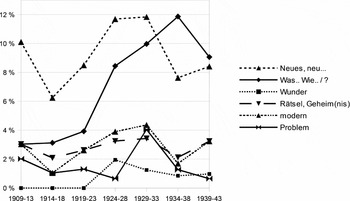
From a sample of roughly 1,400 articles reporting on innovations in basic science and technology (Dietrich 1908–44),Footnote 11 an analysis of the titles was performed not with respect to scientific subfields, but rather according to the way the relevance of the news was coded, which can be identified by the frequency of certain terms and words. For obvious reasons, the percentages were aggregated into five-year periods, selected to roughly coincide with political and economic eras as well as periods of war (see fig. 4).
Title words in quality newspapers of articles on basic science innovations (sample of c. 1,400 articles. [Source: Bibliographie der deutschen Zeitschriften-Literatur]. Percentage of total articles for five-year periods.

As the most frequent label, we find the term “new” (neu or Neues), which was in widespread usage over the period of 35 years considered. Approximately 10 per cent of all articles in the sample emphasized the novelty of the reported scientific content. On first sight, it appears awkward that articles in a newspaper have titles like “Something new about X-rays” or “New information on submarine construction,” while the superlative “newest,” as in “The chemistry of atoms: Newest advances in atomic fragmentation,” may express some special relevance (although the discovery of nuclear fission had already been reported eight months before in Die Naturwissenschaften).Footnote 12 As one rarely finds the term in scientific journals, the reason for its usage must have to do with the place of science in the newspaper. Here it was often part of the so-called “little feuilleton,” as distinct from the larger articles of literary criticism and cultural reflection, a section of the newspaper that did not focus primarily on the latest events (Groth Reference Groth1928, 899f.). Another host of articles uses “new” in the sense of novel theories that overthrow old doctrines. Particularly frequent was the talk of “new physics,” as in the case of Einstein, or in the case of reports on and excerpts of Max Planck's speeches on the “World picture of the new physics.”Footnote 13 Moderate changes in the use of “news” and “new” amount to a decline during both the Great War and the Third Reich, while the so-called golden years of science in the Weimar period are characterized by a particularly frequent use of this marker of novelty.
During the Kaiserreich, qualifications like “modern” and “mystery,” or “secret” (Rätsel, Geheimnis) were less frequent, and the term “miracle” (Wunder) did not occur in the sample until 1925. “Mystery” was frequently found in matter and atoms, for example, “Mystery of matter” and “Mystery of the atom,” “Mystery of the atomic interior,” and “Mystery of the atomic nucleus.”Footnote 14 “Secrets,” however, were discovered more often with respect to heredity than to atoms and matter.Footnote 15
While the talk of secrets of nature did not vary much in quantity, the use of the label “modern” quadrupled from World War I to the late 1920s and early 1930s, only to drop sharply after the Nazi takeover, thus suggesting an understanding of science as part of a “modern” period in German history. Again, “modern physics” was the most frequent combination, making up almost half of the “modern” articles selected for the sample. However, these were found only from 1924 on, suggesting that a public discourse on modernity in physics was linked with the discussions on quantum mechanics and its implications on causality and “world picture”; some of the articles were authored by prominent scientists like Bertrand Russell and Werner Heisenberg.Footnote 16 Further fields that were labeled “modern” included heredity theory, X-ray technology, and chemistry. The use of the term “problem” also mirrors a correlation, this one between scientific problem solving and the political or economic problems that affected the whole basis of German society during the global economic crisis, demonstrated by a clear peak during these years. As the contemporary understanding of problem predominantly referred to the scientific procedure as such,Footnote 17 the increased discussion of problems can be interpreted as growing attention to scientific procedures. Articles such as on “Problems of ship building from steel-reinforced concrete” and “New problems of heredity research” convey that, although some old questions have just been answered, the work is actually still in progress.Footnote 18 Interestingly, the alternative term “result” (Ergebnis) which does not necessarily imply further open questions, is absent from popular science newspaper headlines up to 1926, at least in my sample, becoming more frequent in the 1930s, e.g. “Results from the theory of human heredity” and “New results in medical X-ray technology.”Footnote 19
Just as it may not seem surprising that the words “new,” “modern,” and “problem” occurred less frequently after 1933, it is most interesting to see that the explosion of titles asking questions or explaining “what” (was) something scientific or technical actually is and “how” (wie) it works, respectively. These range from questions on the nature of phenomena like “What are X-rays?”; “What is an electron?”; and “What is matter?” to questions like “How is physics possible as a science?”; “How does one prove the existence of hormones?”; and “How do hereditary factors act?”Footnote 20 The strong statistical signal in this case, in contrast to the other examples, signifies a more general, long-term shift in the public understanding of scientific and technological issues as reflected in their presentation by newspapers.
In the case of newspapers, where popular science was presented along with political, economic, and other fields of topical interest, science writers may have changed the wording of headlines to give new connotations to various terms mentioned, especially those related to political language, in order to avoid prompting negative reactions. For instance, in the early years of Nazi rule, “modern” was a term that would not necessarily be understood as positive, given the way much progressive art and literature was maligned. Still, fig. 4 demonstrates an impressive elasticity of the discursive ensemble: there is dynamics, but overall the variation in the frequencies of the key words remains within a certain range; for instance, “new” occurs in 6 to 12 per cent and “modern” in 1 to 3 per cent of all headlines in the sample.
Similar results may be found for the related media of science communication, namely journals and books and the somewhat mixed category of book series. The last of these media constituted a huge market in the first half of the twentieth century as inexpensive popular primers on all kinds of knowledge. Ullstein publishing house, for example, was also very active in this field. The series of inexpensive Wege des Wissens (ways of knowledge) books included almost a hundred titles issued within the five years between 1924 and 1928, covering various fields of science, technology, and the humanities, which amounted to roughly a million books on German shelves from this series alone.Footnote 21
Media changes
As a second test of the resilience of the machinery of popular science, one can analyze its reaction to the incorporation of new media, which created both new institutions of popular science and new discursive transformations. The major new channel of science communication in Weimar Germany was radio, and its broadcast format introduced a “secondary orality” (Ong Reference Ong1982, 133), while abandoning the visuality of the print media. German radio started in 1923 and quickly reached ever larger audiences, which thus can be incorporated into the hierarchy developed to portray the print media. The new medium and its ways of dealing with science had to adapt to a rather different setting of cultural, political, and economic forces, however, at least in Germany. Within five years, listening to regional radio stations became quite a natural habit in German households, so that radio soon reached audiences larger than any popular science journal might have hoped for. But in terms of its organization, programming, and business, radio was not a private enterprise, aside from the technical equipment necessary for broadcasting. German radio operated under official control, and state boards strongly enforced an educational mission for the new medium, which included a prominent role for science programming. Here, the power of the state was able to act directly to shape science communication through regulatory power. Controlled in this way, all regional stations as well as the Deutsche Welle, a nationwide station for pedagogical, vocational, and general educational programs established in 1926, further amplified the dose of popular science for the German public – interestingly, without detriment to the print media.
Some crucial features of science on the air were quite novel, however, and went well beyond the possibilities science enjoyed in print. First of all, it is striking to observe that science broadcasts were aired mainly during prime time, and that they relied mostly on authoritative personnel identified as university professors, engineers, or high-ranking civil servants. Secondly, radio was financed not by advertising but by listeners’ fees and thus did not compete economically with print. Direct adaptions of print formats like the “Kosmos lectures,” which were organized by a society related to the journal Kosmos, were the exception. Long and controversial discussions on the appropriate audio formats of science communication on the air led to much experimenting by the various local stations. The fact that radio magazines were soon published, supplying not only program listings, but also rich text and visual material related to the broadcasts they announced, is a third important feature of science on the radio. In some ways the opportunities of multimedia were exploited, although the asynchronicity of visual and audio information remained a problem.
Finally, there were also direct political and cultural influences on programming. On the one hand Deutsche Welle, for example, had a sophisticated structure and oversight, which created a very balanced program on a superficial level, covering all topics ranging from history, law, and philosophy to science, technology, and medicine (Schubotz Reference Schubotz1928). On the other hand, there was a kind of “hidden systematics” in science programming, “which only became apparent in the course of the events: Just recall the lectures on ‘race research,’ ‘the cell and heredity,’ ‘the theory of descent,’ ‘race elements of the German people’ . . .” (Roeseler Reference Roeseler1927, 2).
Although one can find hardly anybody on the control boards or radio staff promoting race theories in a propagandist way, radio nonetheless amplified a discourse that was already widespread in print. This is an example where the rather mechanical picture of an apparatus or machinery at the heart of Foucault's notion of dispositif comes into play. It allows us to understand how even completely unforeseen and unintended effects are produced by the apparatus.Footnote 22 Radio in the Weimar Republic – according to its high cultural aspirations – excluded politics and propaganda as widely as possible and controlled this with a strong infrastructure of laws and oversight. Precisely this setting turned out to be predestined for abuse as a propaganda infrastructure, especially after 1932 when radio became fully centralized and state-owned (Führer Reference Führer1997; Dussel Reference Dussel2004). This, however, affected popular science and technology to a lesser degree than one might expect.
In summary, German radio extended the infrastructures of popular science considerably, given the central role allocated to pedagogical, vocational, and general educational broadcasts in its programming. It can hence be seen as an institution for providing “state-controlled multimedia education for all” (Schirrmacher Reference Schirrmacher2012), although at the end of the day Weimar science radio did not live up to the possibilities of the new medium, but rather established an additional new organ and model that contrasted, but did not compete, with private enterprise print formats. Typically enough, science communicators, in particular professional ones, were largely split between (established) science in print and (experimental) science on the air; to a large extent this was merely a matter of the generation to which the given communicator belonged. In any case, the overall presence of science and technology in the general culture was much more pervasive than before the advent of radio, which coincided with the end of the era of hyperinflation, and no signs of a supposed general hostility towards the work of physicists and mathematicians, occasionally proclaimed in the literature, can be found (Forman Reference Forman1971; Carson et al. Reference Carson, Kojevnikov and Trischler2011). Popular science had become an even stronger part of German culture. To this extent Planck's 1918 appeal to use science as a leverage for national reconstruction had proved successful.
Was there a popular science specific to the Third Reich?
The continuous rise and final takeover of fascist powers in Germany in the early 1930s, which were linked to technocratic and inhuman policies that resulted in broad and well-orchestrated preparation for war and mass extermination, have been the subject of considerable historical analysis extending beyond simplistic explanations attributing responsibility to a single dictator or a collective national aberration. The extent to which a cultural interpretation can explain the technological side of this catastrophe remains disputed, as theses of an influential “reactionary modernism” closely linked to the unstable political situation of the Weimar Republic, or even a general deviant “German thinking” radically different from some “‘Western’ mentalities and sensibilities” have been put forward repeatedly, yet without conclusive corroboration in more specific case studies (Herf Reference Herf1984, Reference Herf and Kaufmann2000; Rose Reference Rose1998). While research on the roles of scientific and technological elites in Nazi Germany has been rather extensive in recent years (e.g. Beyerchen Reference Beyerchen1977; Mehrtens and Richter Reference Mehrtens and Richter1980; Macrakis Reference Macrakis1993; Meinel and Voswinckel Reference Meinel and Voswinckel1994; Kaufmann Reference Kaufmann2000; Maier Reference Maier2002) and the popular culture of the Third Reich has also found attention (Wulf Reference Wulf1989; Dietz and Fessner Reference Dietz, Fessner and Maier1996; Würmann and Warner Reference Würmann and Warner2008), research on popular science in this period is scarce. On the basis of an analysis of Kosmos and Neue Welt it has been suggested that adaptation to both mass taste and political system helped Kosmos to remain successful, while adherence to fastidious programs like the marriage of science and religion in the Neue Welt, a journal of the Kepler Association, was doomed to failure, primarily because it ignored the rule to avoid political debate in times of authoritarian power (Müller Reference Müller, Würmann and Warner2008).
General writings incorporated science and technology to some extent in Nazi Germany, but more on a level of symbolic importance, like, for example, in widespread technologically inspired fiction about developments in the near future (hence not really works of science fiction), and often in terms of heroic tales about victories of German technology and engineers (Härtel Reference Härtel, Würmann and Warner2008). However, this literature did not belong to the field of popular science as discussed so far, nor did it entail many changes in the way publications on science communication (between levels of science and the public audience) and popular science dealt with knowledge.
A look at the journal Technik für Alle, the technology sister publication of the Franck publishing house's Kosmos, shows that even in the emblematic field of technology the reach of Nazi propaganda was comparatively weak. Neither did the standard topics and their balance change much – rail, air, ship, and car transport, mechanical and electrical engineering, materials etc. – nor did openly ideological or propagandistic articles appear, at least not before 1938. With the beginning of World War II, in particular, some reflections on the (national) role of science and technology began cropping up. In the editorial of the April 1942 issue, for example, one can read that within the community of the German nation (Volksgemeinschaft) even the men of technology have to take on leadership duties (Führeraufgabe), for which they must prepare. Simple allegiance would not suffice, however: “Only a man who considers his surroundings with open senses and is able to examine and judge in an unbiased and critical manner should be allowed to lead others.” Especially in times of war, the engineer “has to keep track of things and has to find a critical differentiation between those tasks that have to be solved and those problems that can be deferred.” The journal pledged to contribute to this end (Technik für Alle, 1942/43, 1). Three months later, the same journal ran a discussion of the “traditional values of German technology,” arguing that the superiority of German weapons was due to the broad basis on which the technological achievements rested. And this basis, it was implied, was cultural: “Although we are not yet so far that the entire German nation, and not only the active engineers, thinks truly and fundamentally in a technical way, we are well on our way there . . .” If it were only a matter of tinkering, the Briton, American, or Bolshevik could also manage this. “But they lack the tradition of technology” (Technik für Alle, 1942/43, 113). Nonetheless, a regular column in the journal was entitled “Technology of the World.”
Even this cursory analysis reveals that many lines of continuity can be found besides those of personnel and of genres. There are further continuities with respect to the long tradition of German science and technology, to the critical and independent viewpoint of the scientist and engineer, and the plea for accurate presentation of scientific and technological knowledge. This was characteristic at least of organs of popular science that reached out to an attentive or interested audience, and this was also true for radio programs, which often were more demanding than entertaining.
While German fascism eroded the social role of the middle class to large extent, the middle-class mentality did survive in its cultural sphere (Bürgerlichkeit), at least as far as the cultural understanding of science and technology was concerned, and this safeguarded the role of the cultural dispositif. Understanding science first and foremost as culture remained a German disposition long after the end of Nazi rule, but eventually lost its sway when American and Soviet influences gained ground in the early 1960s.
Therefore it remains questionable in what sense a specific Third Reich popular science can be defined, although this is so obvious for political commentary and many other fields. Clearly, the political system had a major impact on popular science articles dealing with the fields of heredity, anthropology, and other topics closely related to National Socialist ideology; however, this was not true in the case of technology, which was otherwise just as susceptible to political influence. At least part of the answer to this peculiarity lies in a certain function popular science served to fulfill, which has been characterized as the break room (Pausenraum) or regeneration space (Regenerationsraum) the regime granted in an ideologically rather innocuous field (Würmann and Warner Reference Würmann and Warner2008). Did popular science serve as a means of rest and recovery for a nation at total war? The mere fact that many kinds of popular culture – cinema, music, light reading, various journals and illustrated magazines – were more or less widely available to the German people, despite war restrictions, suggests this. Many recollections of military war routine, in fact, stress these qualities of escapist readings on ingenious rationality and pure knowledge. Here, again, science may have played an important role for German self-consolidation, be it in the battle trenches or before the academy after a lost war.
Science communication in the postwar Germanies
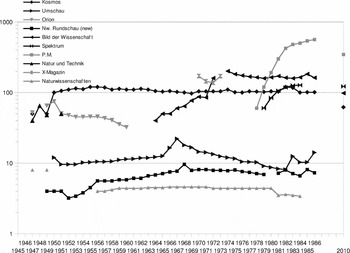
When we consider the footprint of popular science journals in the second half of the twentieth century in terms of quantity (fig. 5), the known signature appears again (as in musical notation, where the chord appears familiar although the key signature has changed). With Kosmos and Umschau two constants of a century-long German tradition of popular readings prevailed; however, these did not reflect any of the stark changes in the understanding and experience of science and technology in this age of its unprecedentedly pervasive application, visibility, and symbolic value. While Umschau at least displayed a space-age bump during the Apollo program in the late 1960s, Kosmos neither drew more readers from any such event, nor did it lose many. Exactly the same development can be found on the lower-selling levels that were occupied with the old organ of inner-specialist communication Die Naturwissenschaften and the new journal (though with an old name) Naturwissenschaftliche Rundschau, which was closer to Umschau, although it never caught up with this traditional journal, dating back to the late nineteenth century.
The main West German popular science journals, 1945–1986 and 2010 (circulation in 1,000s, logarithmic scale). Missing points merely indicate a lack of available data; lines interpolate. Data collected from various sources, mainly Stamm Leitfaden durch Presse und Werbung (Stamm Reference Stamm1947-).

Only the immediate postwar years show some dynamics and some efforts toward a new start. In occupied Germany the American military government licensed Erich Lasswitz's Orion in April 1946, as did the French roughly a year later with Natur und Technik, a journal edited by Franz zur Nedden (1881–1954), a state-employed engineer in the interwar period who became prominent by organizing the second World Power Conference in Berlin in 1930.Footnote 23Natur und Technik briefly became the best-selling popular science journal in Germany, even topping Kosmos in 1948; however, it did not survive the aftermath of the currency reform beyond 1950. Orion fared better, at least until 1960, and thus occupied a niche that had been filled by Koralle in the interwar years. The way these new publications introduced themselves to readers – or rather did not – spoke volumes. Stressing its mission of communicating knowledge instead of “cheap popularization,” only at the end of the first year did Natur und Technik tell its audience that the “editorial staff had deliberately refrained from speaking on its own behalf in past issues despite requests to the contrary from the readership” (Natur und Technik 1947, 523).
A silent consensus seems to have existed, which identified popular science as basic food for the (German) mind, and its supply had to be restored without much ado. In the same vein Orion, which emulated the uncontroversial qualities of Weimar science journals, aimed at supplying “the immense need in the knowledge of the individual as of the community.” It also emphasized a recurrent quality of popular science: Like the beautiful constellation “in the past nights of blackout and darkness,” now the popular science journal Orion shall “brighten the darkness a bit and lead us into the bright kingdom of knowledge” (Orion 1946, 1). Kosmos and Umschau, however, greeted their readers with less pathos, or rather less apologetically, after the involuntary interruption, which had lasted less than two years in the case of Kosmos. They emphasized the constant need for objective reporting on the advances of science instead, and the only new situation they saw was that one had to fill an information gap caused by the war.
The turn to ethereal realms of knowledge, culture, and philosophy was, in fact, a typical strategy in postwar Germany. With so many (civilized) connections deliberately broken between society, politics, culture, science, technology, and other spheres during the Nazi era, popular science – like other great themes from literature, art, and music that were regarded as great German achievements – served to hold things together. A renaissance of classical literature, in particular of Goethe, talk of the Abendland (Occident), and an emphasis on the philosophical and world-view role of science attempted to gloss over hard questions about ideology, involvement, and perpetration (Hürten Reference Hürten and Langner1985; Schildt Reference Schildt1999). In West Germany Werner Heisenberg was to become the emblematic figure reinterpreting collaboration as a tactical concern, like spreading the myth that work for a German atomic bomb during war times was actually work on nuclear energy for a later peace (Walker Reference Walker1995). Although he did not become a science communicator in the narrower sense of writing many popular articles, he still very much defined the general image of science and scientists in his talks, addresses, and radio appearances (Carson Reference Carson2010).
In the Soviet occupation zone Georg Schneider (1909–1970), a Marxist and Lyssenkoist who had emigrated to the Soviet Union in 1931, became an official of the Communist Party and director of the Ernst Haeckel Institute in Jena in the beginning of 1947. He was the driving force behind reviving the kind of socialist popular science from the Weimar period. The first new issue of Urania was numbered volume 10, since volume 9 had been the last of its predecessor in 1933. As Schneider was not very successful in finding the journal's old staff, and since it proved difficult to recruit old readers, the continuity was largely symbolic. In any case, this strategy allowed for condemnation of the fascist period and rendered philosophical gloss superfluous. Interestingly, this enterprise was not much to the liking of the official party organizations, as it still demonstrated a noted “tendency to scientific neutrality” unsuitable for a community that wanted to put science to the service of a greater political good (Schmidt-Lux Reference Schmidt-Lux2008, 242). For the most part Urania emulated the more independent Weimar model of popular science and abstained from a truly political agenda.
A first “attack” against the (still bourgeois) “fortress of science” called for in 1951 by the Freie Deutsche Jugend (FDJ), the official Socialist youth movement of the German Democratic Republic, led to the rival publication of Wissenschaft und Fortschritt, which was intended mainly to improve vocational qualifications. The popularization of science was meant to serve economy first, and culture second, by covering the “feats and inventions” of the “most advanced research of the world: Soviet science.” The reader should be enabled to “apply profitably” this knowledge as “all questions would be addressed that are of importance for the development of society . . . from the evolution of nature and mankind to problems with the five-year plan, from questions of electrical engineering to the teachings of Michurin and Lyssenko” (Wissenschaft und Fortschritt 1981, 5; 1951, 1–2). Still, a truly popular – not only popularizing and widely sponsored – journal was missing, one to which readers would turn without exhortation.
A Society for the Dissemination of Scientific Knowledge (Gesellschaft zur Verbreitung wissenschaftlicher Kenntnisse), was founded in 1947, modeled on the Soviet All-Union Society for the Dissemination of Political and Scientific Knowledge, which was supposed to become the party branch for “popular scientific propaganda.”Footnote 24 This organization tried hard to take over the Urania project, but to no avail. In a 1955 report the co-founder and first secretary of the society Werner Rothmaler (1908–1962), who was trained as a botanist and spent time as an explorer, declared that there was simply no popular science journal in the German Democratic Republic. Therefore, he argued, one should be established. Still in 1957, when a history of science popularization was written, both the Weimar and the postwar Urania journals were ignored outright (Rothmaler Reference Rothmaler1955; Schlösser Reference Schlösser1957).
Twelve years after this part of Germany had come under Soviet influence, key agencies of popular science were still not operating in concert with the new political powers, exhibiting once more the perseverance of the old culturally determined model. The problem was recognized, at least internally (Mädicke Reference Mädicke1956). According to the official view, however, Wissen und Leben became the first popular science journal in the GDR, with the goal to “empower the workers to fulfill their duties in the socialist project quicker and better” (Bibrack Reference Bibrack1956). Given the tight network of political organizations, which included the Society for the Dissemination of Scientific Knowledge, it was generally a top-down execution of political command that would now define GDR science communication, especially after Urania was eventually brought into line. The society organized talks on popular science and politics in the factories, agricultural collectives, and administrative offices in order to provide a Socialist general education. Later it would actually incorporate Wissen und Leben once it had played its part in creating Socialist popular science. In 1962, shortly after the erection of the Berlin wall stopped qualified workers from turning their back on the regime, one central organ appeared sufficient: the now tamed Urania. In 1966 Urania became the name of the society and later of the science television programs it produced as well (Urania 1979; Zimmermann Reference Zimmermann1985; Schmidt-Lux Reference Schmidt-Lux2008).
In the East party politics took over the organization of radio in the same way, eventually yielding a centralist structure controlled by the Society for the Dissemination of Scientific Knowledge, which produced the public science programs for the radio of the GDR. Here it was not a few philosopher scientists but armies of science workers – at least rhetorically – who took charge, trying to paint a positive picture of the scientific potential of the Socialist project.
Science also remained an integral part of the general program at all federal stations in West Germany, only it moved ever further from prime time toward late-night slots and – to no surprise – merged with philosophy and discussions of world view. The scientists on the air in the West celebrated their universal knowledge – untainted by inferior politics. It would take until roughly 1960 for radio to turn to science as a process and the worker in the laboratory when a more critical approach eventually came to the fore. In general the dominant state control in the case of radio and television linked its opportunities much more closely to political influence, precluding the unreactive posture practiced by print media in the West.
From the perspective of the machinery of popular science, however, the two German offerings exhibited a rather similar mechanics, which, in addition, opened a natural field for competition, as airwaves moved more freely than printed paper. A typical format both sides aired was the radio university, with weekly broadcasts of talks on select fields. Particularly in times of intensified confrontation, e.g. after Sputnik, more programmatic lecture series were launched. In the East, for example, Berliner Rundfunk (Radio Berlin) started its series “Science at the service of peace” in January 1958, which drew weighty speakers from abroad like John Bernal, Linus Pauling, Leopold Infeld, and Abram Joffe. A few months later Sender Freies Berlin (Radio Free Berlin) countered this with its own series on “Atomic research – its influence on science and politics,” starring Carlo Schmid (a respected German constitutional lawyer and social democratic politician taking Bernal's role) and scientists of matching weight like Victor Weißkopf and Wolfgang Gentner, to name a few. As pompous as both series appeared, it was fare only for the culturally alert and sophisticated as they were aired late at night, at 10:40 and 11:15 p.m., respectively. This fact reminds us again of a specific German quality of radio (and television): its non-commercial nature, which remained intact until the 1980s. For this reason, two main factors that characterized the Weimar conditions, the economic forces, and the interplay of knowledge and prestige, now affected only the case of print media in West Germany.
In the East, entrenched state control blocked much dynamics for a further evolution of science communication in all media, while West German popular science eventually developed a closer resemblance to the American example. I mentioned Heinz Haber and his role for modernizing popular science in West Germany in the introduction. His popular journal Bild der Wissenschaft adapted his American experience to German interests, and his presence on the television screen defined a new genre of German science reporting (Heumann Reference Heumann, Stöckel, Lisner and Rüve2009; Ludes et al. Reference Ludes, Schumacher and Zimmermann1994). The picture of science Haber drew became the dominant one over a period of ten years, and for the first time his journal was able to achieve the level of popular science in the print media that had been established in Germany in the 1920s. The relation of the journal's success to the expansion of the education system in the 1960s in Germany may seem obvious; the fact that old-fashioned Kosmos remained unaffected, less so. A considerable part of the German public still subscribed to the interpretation of science as a cultural asset embodied in this long-selling publication and remained true to an understanding of knowledge as a cultural value.
The fact that new print media established new levels of even broader audiences, which can be observed in the 1960s and 1980s in particular, corresponds to the development in the early years of the twentieth century. It is about new audiences, new links between the public and science, and new genres that extend the machinery of science communication, without, however, leading to predatory competition. At the same time, however, national particularities in the types of science communication increasingly began to disappear. Scientific American started selling its articles in customized national editions in the 1970s and has since presented science in all major languages. In this sense the success of the German edition of Scientific American, which quickly surpassed Kosmos and later even beat Bild der Wissenschaft, signifies a new era of popular science. Furthermore, in the 1980s P. M. (short for “Peter Mossleitner's interesting magazine”), a more sensationalist magazine, which addressed the young generation in particular, reached out for the next level of popularity. For a younger audience popular science and technology turned into a matter of having fun and playing with gadgets. Entertaining items, quickly read and just as quickly forgotten, replaced the desire for deep knowledge. As such, the cultural value attributed to science vanished ever more rapidly.
Conclusion
When the aged, frail Max Planck was the only German allowed to participate in the Newton tricentennial in London in 1946, which fell in the immediate postwar era, he could not be introduced to the illustrious congregation as an honorable scientist from the host's fiercest enemy, Germany. Rather, due to broad reverence for the icon of modern science, the president of the Royal Society declared that Planck came “from the world of science” (Heilbron Reference Heilbron1986, 197). Nothing could have been truer to Planck's role in shaping the understanding of science as the sincere quest for a “world picture.” In his influential and often reprinted talks on “The unity of the physical world picture” from 1908, and in particular “The world picture of the new physics” of 1929, he provided an interpretation of science as a highly cultural asset, more or less untainted by earthly affairs. As quantum mechanics had proven, the world picture had developed such that it “moved ever further away from the world of perception and, correspondingly, is approaching the real, in principle unrecognizable world.” It therefore had to be “purged of all anthropomorphic elements,” to preclude that any notion be employed that “is related in any way to the skills of human ways of measurement” (Planck Reference Planck1909; Planck Reference Planck1929, 45).
This message resonated well with the convictions and expectations of an (attentive) public. Planck's 1929 talk saw four editions in the years of 1929 and 1930 alone, was reprinted five times during the Third Reich and four more times in the first ten years after World War II.Footnote 25 It encoded a philosophical proposition, which may have been subjected to some reinterpretation with the further developments of science and ideological claims on it, yet in principle it remained a key element of the Germans’ common understanding of science.
At the same time Planck was welcomed in London, the British were demanding that the Kaiser Wilhelm Society be reorganized and renamed. This society had been founded in 1911 and had since established leading institutions of basic research; however, some of these had played crucial roles in German war efforts in both world wars (while much involvement in Nazi crimes became public only much later). In this situation Max Planck acquiesced to suggestions to name the society after him, as he may have realized – just as in 1918 – that science was one of the few assets left for Germany to regain some standing as a cultural nation, and that his name had the currency to promote this perspective.
After the war Germany became a test case of how a deeply rooted cultural dispositif would adjust when exposed to two externally induced political orders. As mentioned, both American and Soviet brands of popular science did not fully take the lead until the 1960s – just recall Urania's initial lack of party line in the East and Orion's distinct continuity before Bild der Wissenschaft in the West. Instead, a German version survived and lasted, with only gradual adjustments, for more than a decade in both German states. This tradition went back to the beginning of the century, when the differentiation of audiences and uses of popular science were developing an ensemble of organs and institutions, all of which were linked, in one way or another, to cultural values attributed to science. This was still visible, for example, in the Planck celebrations on the occasion of his 100th birthday in 1958, when parallel events in East and West Berlin vied for attention, with each side claiming to offer the true interpretation of German science in the context of politics and culture (Hoffmann Reference Hoffmann and Abir-Am1999).
If one compares the program listings of East and West German radio and television of the 1950s and 1960s, again, science and technology occupied much the same spots in the program and time slots. What we saw in the case of the radio university and highbrow late-night lecture series also holds for early television documentaries (Zimmermann Reference Zimmermann1994; Warnecke Reference Warnecke, Heinze and Kreutz1998; Ilsmann and Kirpal Reference Ilsmann, Kirpal, Hoffmann and Lesske2005). In the longer run, however, the propaganda use of Socialist science and the discrepancy between this concept and technological competitiveness with the West made popular science of the East German variety stale and implausible. It lost even its escapist qualities, which had allowed readers a break from propaganda.
After the fall of the Iron Curtain and German reunification in 1990, the months of publication were numbered for both Urania and Wissen und Fortschritt. But at the same time other qualities of German popular science – like its standing as a national asset, cultural value, and rejection of sensationalism – were gradually disappearing in the West as well. P. M. tapped new and larger reservoirs of young readers, who subscribed not to those old qualities, but to what has come to be known as “edutainment.” Umschau had ceased publication in 1986, and Kosmos was merged with a 1980s environmentalist magazine Natur in 1999, so both icons of German twentieth-century popular science constancy fell just short of completing their century of popular science. But who would have guessed that they would come so close at all; that one could create and entertain a culturally pervasive idea of science popular with so many and so enduring?
Acknowledgments
Research for this paper was supported by a fellowship at the Max Planck Institute for the History of Science and a grant from the European Science Foundation, which allowed me to discuss my work within an ESF exploratory workshop at the Humboldt University in Berlin. I am especially indebted to Jürgen Renn for his interest and support during the fellowship and I am grateful to Alexandre Métraux, as well as the two reviewers, for their comments and criticism.