Since 2007, the financial crisis has affected most European countries leaving a significant number of individuals at a higher risk of social isolation that, in turn, can be translated into poorer health outcomes (Eisenberger & Cole, Reference Eisenberger and Cole2012). Several studies have examined the impact of the current international crisis on housing and health (Fowler, Gladden, Vagi, Barnes, & Frazier, Reference Fowler, Gladden, Vagi, Barnes and Frazier2015; Gili, Roca, Basu, McKee, & Stuckler, Reference Gili, Roca, Basu, McKee and Stuckler2013; McLaughlin et al., Reference McLaughlin, Nandi, Keyes, Uddin, Aiello, Galea and Koenen2012; Novoa et al., Reference Novoa, Bosch, Díaz, Malmusi, Darnell and Trilla2014; Osypuk, Caldwell, Platt, & Misra, Reference Osypuk, Caldwell, Platt and Misra2012; Pevalin, Reference Pevalin2009). Most of these studies were conducted in the US and UK where the crisis has been less intense and widespread than in Spain. Spain has three characteristics that explain the greater increase in the number of families affected by foreclosure and home eviction, compared to that in other countries: (a) a high proportion of people who, prior to the crisis, opted for having home ownership due to a political strategy based on housing development and easy granting of mortgages to families -a quarter of the population had long-term mortgages in 2006 (Fernández Durán, Reference Fernández Durán2006)-, (b) a high unemployment rate as a consequence of the crisis (26.26% of the population in 2013, according to the National Institute of Employment), and (c) a legal system that does not allow debt settlement with the banks by payment in kind (nonrecourse debt). The consequence has been a dramatic rise in the number of foreclosures and home evictions, estimated at 646,681 foreclosures and 448,324 home evictions between 2008 and 2015 (source: Banco de España, 2015).
The link between home foreclosure and risk for both physical and mental health problems was early advanced by Bennett, Scharoun-Lee, and Tucker-Seely (Reference Bennett, Scharoun-Lee and Tucker-Seeley2009) in the context of the current financial crisis. Their rationale stemmed from considering house eviction as a stressful life event that begins with payment arrears and eventually ends with house repossession, having potential effects on physical and psychological wellbeing. This hypothesis was subsequently confirmed in a study by McLaughlin and colleagues (2012), where an increase of symptoms of major depression and generalized anxiety disorder (GAD) was observed in a sample of 1547 evicted individuals, even after controlling for confounding factors such as socio-demographics, lifetime history of psychiatric disorder, and exposure to other financial stressors.
In Spain, a recent study has reported an increase in the proportion of people suffering from anxiety, mood, somatoform, and alcohol-related disorders since the financial crisis began, especially among unemployed individuals and people experiencing mortgage difficulties (Gili et al., Reference Gili, Roca, Basu, McKee and Stuckler2013). However, it is surprising that, despite the high proportion in the number of foreclosures and home evictions executed in Spain since the beginning of the crisis and the known link between house eviction and poorer mental health outcomes shown in other countries, studies exploring this association in Spain remain scarce.
The goal of the present study was to explore whether the process of home eviction is currently affecting evicted individuals’ mental health. The process of home eviction is defined in this study as the situation extending from the beginning of difficulty paying the mortgage to the moment when the family is evicted from the house. Because this process can be considered a prolonged period of traumatic stress that may affect the physical and psychological integrity of people (Eagle & Kaminer, Reference Eagle and Kaminer2013; Ramis-Pujol, Reference Ramis-Pujol2014), our investigation specifically examined whether people undergoing the process of eviction show symptomatology of post-traumatic stress disorder (PTSD), in addition to higher indices of perceived stress, anxiety and depression.
Method
Participants
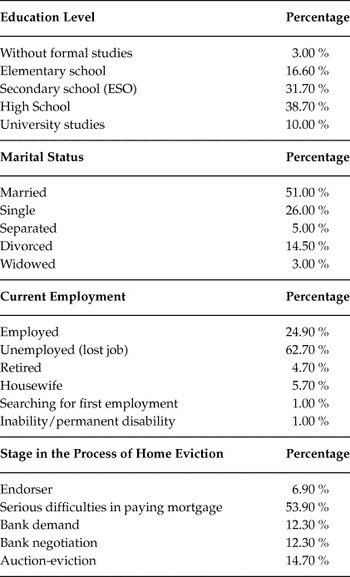
The present study was approved by the Ethics Committee for Research of the Andalusian School of Public Health (Escuela Andaluza de Salud Pública). Participants were 205 people, one per family affected by the process of home eviction, who had attended, at least on one occasion, to the weekly assemblies of the platform Stop-Desahucios (Stop-Eviction) in the metropolitan area of the Spanish city of Granada and who agreed to participate voluntarily in the study. This platform is a non-partisan social movement launched in 2009 in order to advocate for the right to decent housing in Spain. It is organized by assemblies in which volunteers provide professional advice and support to affected people. Of the 205 participants, 83 were men (M = 42.14, SD = 10.60), and 122 were women (M = 42.48, SD = 10.86). The age range was from 25 to 73 years old. No significant age differences were found between men and women. Table 1 shows education, employment, and marital status of participants. As the table shows, 38.70% of participants had a high school education level, 51.00% were married, and 62.70% were unemployed.
Percentage of participants according to education level, employment, marital status, and stage in the process of home eviction

Assessment instruments
Structured interview
A questionnaire was elaborated that included information on where participants were in the process of home eviction at the moment of the time of the interview and their household characteristics, as well as a set of questions related to physical and psychological health variables, drug consumption, health-related habits, and the use of health services and support networks. The results concerning this questionnaire are reported in Bolívar Muñoz et al. (Reference Bolívar Muñoz, Bernal Solano, Mateo Rodríguez, Daponte Codina, Escudero Espinosa, Sánchez Cantalejo and Vila Castellar2016).
Symptom Severity Scale of Post-traumatic Stress Disorder (Echeburúa, Corral, Amor, Zubizarreta, & Sarasua, 1997)
This is a Spanish hetero-administered assessment scale comprising 17 items, based on DSM-IV diagnostic criteria for PTSD. An initial question asks if the event was experienced with fear, helplessness, or horror. Only people who answer yes to this question are administered the scale. Items refer to three clusters of symptoms (re-experiencing, avoidance, and activation). Total score is the sum of the three clusters. The scale has appropriate psychometric properties concerning internal consistency and validity (Echeburúa et al., Reference Echeburúa, Corral, Amor, Zubizarreta and Sarasua1997). It also provides normative data for a group of 175 patients suffering from PTSD who were attending health care centers and a group of 463 healthy people matched in age and sex. The scale refers the items to ‘the event’ (the traumatic event). Our version of the scale replaced the word ‘event’ with the words ‘home eviction’.
Perceived Stress Scale (Cohen, Kamarck, & Mermelstein, 1983; Remor, 2006; Remor & Carrobles, 2001)
This is a 14 items self-assessment questionnaire that measures the degree to which situations in one’s life are appraised as stressful. The Spanish version of the questionnaire has appropriate psychometric indices of internal consistency, reliability, and validity (Remor, Reference Remor2006).
Symptom Check List-90-R (de las Cuevas, González de Rivera, Henry & Gracia, 1991; Derogatis, 1994)
This is a 90-item self-assessment questionnaire that measures nine primary dimensions of psychopathological symptoms (somatization, obsessive-compulsive, interpersonal sensitivity, depression, anxiety, hostility, phobic anxiety, paranoid ideation and psychoticism). Our study used only the anxiety (10 items) and depression (13 items) scales. The Spanish version of the scale presents appropriate indices of internal consistency, reliability and validity (de las Cuevas et al., Reference de las Cuevas, González de Rivera, Henry and Gracia1991).
Procedure
The assessment of participants took place between 2013 and 2015. Participants were contacted prior to the beginning of the assemblies that they were attending, and given a brief explanation on the purpose of the study. Those willing to participate were asked for a contact phone number. Then, the participants were contacted by phone, and an interview was scheduled to occur 90 minutes before the subsequent assembly at the same location. At the beginning of the face-to-face interview, participants were given an official letter presenting the study and requesting their informed consent. Interviews were performed at 7 different assemblies within the metropolitan area of the city of Granada. The interviewers were all professionals from the Andalusian School of Public Health and trained undergraduate and graduate students from the Faculty of Psychology. The three assessment questionnaires used in the study were incorporated into the structured interview, which were presented after the general questions.
Statistical analysis
Data were first analyzed using independent t-tests to examine gender differences in the mean score of the dependent variables: PTSD symptomatology (total score, re-experiencing, avoidance, and activation), anxiety, depression, and perceived stress. Then each dependent variable was analyzed comparing the score of our group with the score of the normative groups provided by each assessment instrument using either single sample t-tests or percentile comparisons. PTSD symptomatology and perceived stress were analyzed using single sample t-tests. In the Symptom Severity Scale of Post-traumatic Stress Disorder, the comparison groups were the PTSD group and the healthy group of the Echeburúa et al.’s study (1997). In the Perceived Stress Scale, the comparison groups were the male and female groups of the Remor’s study (2006). For the SCL-90-R, the analysis was performed in terms of percentage of participants who scored above the 80th percentile of the Spanish normative groups on the anxiety and depression scales (Derogatis, Reference Derogatis1994). In this questionnaire, scores over the 80th percentile are considered to indicate ‘severe psychopathology’. Due to missing data the number of participants was reduced in some questionnaires as shown in Tables 2–3. Finally, we applied a logistic regression analysis using perceived stress as the dependent variable, and examining PTSD, anxiety, and depression, together with socio-demographic variables (age, gender, marital status, employment status, education level, and stage in the eviction process), to determine whether there are any distinct correlates of perceived stress that might help to explain the observed mental health symptomatology and its potential causes. We developed three models. In Model 1 we included PTSD, anxiety, and depression as the independent variables. In Model 2 we added age and gender. And in Model 3 we added the rest of socio-demographic variables. Except PTSD and age, all variables included in the analysis were categorical: perceived stress (high/low, defined as over/below a standard deviation above the mean score), anxiety (high/low, defined as over/below the score of the 80th percentile), depression (high/low, defined as over/below the score of the 80th percentile), gender (male/female), marital status (married/single/divorced-separated-widowed), employment status (employed/unemployed/retired-disable-housewife), education level (no studies/up to secondary school/high school/university), stage in the eviction process (endorser/serious difficulties in paying mortgage/bank demand/bank negotiation/auction-eviction). For PTSD, a quantitative scale -the total score of the questionnaire- was used due to reduced number of participants with no PTSD symptomatology. All analyses were performed using SPSS software package. Level of significance was set at p < .05.
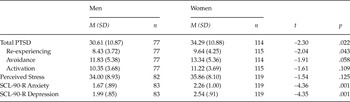
Scores for men and women in the process of home eviction in the Symptom Severity Scale of Post-traumatic Stress Disorder, Perceived Stress Scale, Anxiety, and Depression: Mean and Standard Deviation scores together with number of participants per group (N) and t-test of gender differences

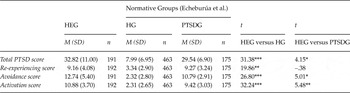
Symptom Severity Scale of Post-traumatic Stress Disorder: Mean and Standard Deviation scores for the whole sample of participants in the process of home eviction and for the normative groups of the validation study together with number of participants per group (n) and t-test of group differences

Note: HEG: Home Eviction Group. HG: Healthy Group. PTSDG: Post-traumatic Stress Disorder Group.
*p < .05; **p < .01; ***p < .001.
Results
Post-traumatic stress disorder symptomatology.
The initial question indicating if participants experienced the process of home eviction with fear, helplessness, or horror was answered positively by 95.10% of participants. Table 2 shows the mean and standard deviation of the scores in PTSD symptomatology (total score, re-experiencing, avoidance, and activation) obtained by participants who responded positively this question. In general, women showed higher scores than men in all dimensions, the differences being significant in the total score and in the dimension of re-experiencing.
Table 3 shows the scores in PTSD symptomatology obtained by our participants and by the PTSD and healthy groups of the Echeburúa et al.’s study (1997). As the table shows, people affected by home eviction scored significantly higher in total score and in symptoms of avoidance and activation than did both the healthy and the PTSD groups. In symptoms of re-experiencing, participants scored significantly higher than only the healthy group. An additional analysis in terms of participants who complied with DSM-IV symptom criteria for PTSD, with scores of 2 (2–4 times per week) or 3 (almost always) in at least 1 re-experiencing symptom, 3 avoidance symptoms, and 2 activation symptoms) revealed that 72.50% of participants who experienced the home eviction process with fear, helplessness, or horror (68.30% of all participants) met the symptom criteria for PTSD.
Perceived stress
Table 2 shows the mean and standard deviation of the scores in perceived stress of our men and women participants. No significant gender differences were found. Both men and women in the process of home eviction scored significantly higher than men and women of the normative groups in Remor’s study (men in normative group: M = 23.60, SD = 7.80, n = 195, t = 10.55, p < .001; women in normative group: M = 26.60, SD = 8.10, n = 240, t = 12.61, p < .001).
Anxiety and depression
Table 2 shows the mean and standard deviation of the scores in anxiety and depression of the participants. Women affected by home eviction scored significantly higher in both anxiety and depression than did men. In addition, an analysis in terms of percentage of our participants who scored above the 80th percentile of the Spanish normative group on the anxiety and depression scales revealed that 88.20% scored above the 80th percentile on the anxiety scale and 91.20% above the 80th percentile on the depression scale.
Regression analysis
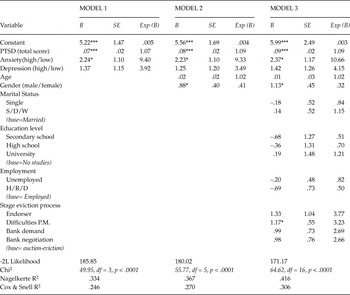
Table 4 presents the summary of the logistic regression results. As can be observed, the three models reveal significant regression functions with increasing statistical significance (χ2 from 49.95 to 64.62) and percentage of explained variance (Nagelkerte R 2 from .334 to .416). PTSD is the major predictor of perceived stress (p < .001), followed by gender (p < .05), stage in the process of home eviction (p < .05), and anxiety (p < .05), in this order. PTSD and anxiety are significant predictors of perceived stress in all three models. Adjusting for sociodemographic factors, process stage, anxiety, and depression, the likelihood of having “high” perceived stress increases about 9% with each additional point of the PTSD score (OR = 1.09; 95% CI [1.04 – 1.14]). For those reporting high anxiety, this likelihood increases more than ten times, compared to those with low anxiety (OR = 10.66; 95% CI [1.07 – 106.0]). Odds ratio for depression is relatively high (OR = 4.15; 95% CI [.35 – 48.74]), but does not reach statistical significance. Gender (being male) appears as significant predictor in model 2 and model 3, whereas being in one of the earliest stages in the eviction process (having serious difficulties in paying the mortgage) appears as significant contributor in model 3. The rest of socio-demographic variables (age, marital status, unemployment, and education level) were not significant predictors in any of the models.
Results of the logistic regression

*p < .05; **p < .01; ***p < .001.
Note: S/D/W: Separated, divorced, widowed. H/R/D: Housewife, retired, disable. P.M.: paying mortgage.
Discussion
The present data indicate that in Spain the process of home eviction is impacting seriously on the mental health of affected people. More than 95% of participants in the study reported to be experiencing the process of home eviction with fear, helplessness, or horror. This high proportion of people also scored significantly higher in PTSD symptomatology than did a group of healthy people (in symptoms of re-experiencing, avoidance, activation, and total score) and a group of PTSD patients (in symptoms of avoidance, activation, and total score). Gender differences were also observed in this subsample of participants, with women scoring higher than men in symptoms of re-experiencing and total score. In addition, 72.50% of this subgroup (68.30% of the whole sample) met DSM-IV symptom criteria for PTSD. Our study also examined indices of perceived stress, anxiety, and depression. Participants scored significantly higher in these three indices than did the comparative groups. Gender differences were also observed in these indices with women scoring significantly higher than men in anxiety and depression.
The higher incidence of PTSD symptomatology, together with higher symptoms of anxiety and depression, in women than in men is consistent with previous findings on gender differences in these disorders (McHenry, Carrier, Hull, & Kabbaj, Reference McHenry, Carrier, Hull and Kabbaj2014; Ngun, Ghahramani, Sánchez, Bocklandt, & Vilain, Reference Ngun, Ghahramani, Sánchez, Bocklandt and Vilain2011; Tolin & Foa, Reference Tolin and Foa2006). Similarly, the high incidence of PTSD symptomatology in people affected by home eviction is consistent with previous findings (Desmond, Reference Desmond2012; Gili et al., Reference Gili, Roca, Basu, McKee and Stuckler2013; Ramis-Pujol, Reference Ramis-Pujol2014). The present study adds new evidence, specific to the process of home eviction, showing that the process of home eviction in Spain is impacting seriously on the mental health of affected people producing in most of them symptoms of PTSD. This conclusion is supported by the results of our logistic regression analysis, which helps to answer the question of whether the pattern of symptoms reported by affected people can be understood as true symptoms of post-traumatic stress disorder or just as symptoms of adjustment disorder. The major difference between PTSD and adjustment disorder is the higher intensity of the stressor in PTSD and the presence of mild depressive and anxiety symptoms in adjustment disorder (APA, 2013; Robles Ortega, Reference Robles Ortega, Caballo, Salazar and Carrobles2014). The finding that PTSD symptomatology is the main predictor of perceived stress, instead of anxiety or depression, seems to favor the interpretation of the symptoms in terms of true PTSD symptomatology.
How to explain the association between home eviction and mental health problems? This association is likely to depend on the same mechanism by which social isolation and social exclusion negatively affects health outcomes. The mechanism by which social support positively affects and social exclusion negatively affects health outcomes has been the subject of many studies in the last few years. Recent neuroscience research has examined the effects of both the positive and negative aspects of the social environment on genetic expression, physiological functioning, and brain activity. It has been reported, for instance, that having a loving and caring family reverses the negative effects of a type of polymorphism associated with depression and other forms of psychopathology (Way & Taylor, Reference Way and Taylor2010). In terms of physiological functioning, it has been found that viewing faces of loved ones induces a marked inhibition of defensive reactions such as the startle reflex to the burst of an unexpected white noise (Guerra, Sánchez-Adam, Anllo-Vento, Ramírez, & Vila, Reference Guerra, Sánchez-Adam, Anllo-Vento, Ramírez and Vila2012). In terms of brain activity, several studies have consistently found that perceived social isolation and social exclusion reduce activation in brain reward areas while simultaneously increasing activation in areas involved in the defense system (Cacioppo, Norris, Decety, Monteleone, & Nusbaum, Reference Cacioppo, Norris, Decety, Monteleone and Nusbaum2009; Eisenberger et al., Reference Eisenberger, Master, Inagaki, Taylor, Shirinyan, Lieberman and Naliboff2011; MacDonald & Leary, Reference MacDonald and Leary2005).
Thus, the link between the process of home eviction and mental health problems is likely to depend on the neurophysiological mechanisms underlying reward and defense reactions. The process of home eviction may act as threatening cues that simultaneously inhibit the reward system and activate the defense system, inducing intense stress responses than negatively impact on the mental health of affected people (Bennett et al., Reference Bennett, Scharoun-Lee and Tucker-Seeley2009; McLaughlin et al., Reference McLaughlin, Nandi, Keyes, Uddin, Aiello, Galea and Koenen2012). This mechanism may explain the observed symptomatology of PTSD in our participants, together with symptoms of anxiety, depression, and perceived stress. However, further research incorporating psychophysiological indices of the reward and defense systems will be needed to support this conclusion. Moreover, our study has methodological limitations that may affect the strength and extension of our findings. First, our comparative groups were not control groups recruited for the present study and matched in relevant socio-demographic variables. And second, our sample of participants was heterogeneous not only in terms of age, education, marital status, and employment, but also in terms of stage within the process of home eviction.
Taking into account these limitations, the present study provides evidence on the negative impact that the process of home eviction is having on individuals’ mental health. The data reveal an alarming incidence of PTSD symptomatology together with symptoms of anxiety, depression, and perceived stress in people affected by the process of home eviction in Spain. These findings have important clinical, social, and political implications calling for urgent measures to care for the mental health of affected people and simultaneously to implement effective policies to find alternative solutions to the final stage of the home eviction process: the loss of the family house.