


Introduction
Delusional infestation is at the interface of hallucinations (tactile and visual) and delusions (Baker et al., Reference Baker, Cook and Winokur1995). Historically, it has been referred to as ‘delusional parasitosis’ or ‘Ekbom’s syndrome’. Delusional infestation is not an individual diagnosis within the International Classification of Diseases or the Diagnostic and Statistical Manual, but (depending on aetiology) it meets criteria for delusional disorder/organic hallucinosis (ICD-11; World Health Organization, 2018), or delusional disorder-somatic type (DSM-V; American Psychiatric Association, 2013). Individuals with this condition hold the fixed and false belief that they are internally or externally infested with either parasites or other organisms (often including mites, worms, insects, spiders, or other unknown small creatures). This belief is unshakeable, despite a lack of objective evidence.
The disorder can be a primary delusional infestation, for which there is not necessarily a known cause, or it can be secondary to a number of conditions including substance abuse (especially cocaine), dopaminergic medications and anti-biotics, or other conditions affecting mental health such as dementia, delirium, depression, schizophrenia, menopause or stroke (Lepping et al., Reference Lepping, Huber and Freudenmann2015). The disorder can also occur secondary to other medical conditions that cause pruritus (chronic itching caused by nerve damage or stroke), although it is still rare in neurological settings (Ramirez-Bermudez et al., Reference Ramirez-Bermudez, Espinola-Nadurille and Loza-Taylor2010). A meta-analysis of 1223 case studies (Trabert, Reference Trabert1995) suggested that delusional infestation is more common in older adults and has a mean symptom duration of 3 years (±4.6; median 1 year) prior to diagnosis. Historically, this condition has been of particular interest to psychiatry, with 73.5% of published articles written by psychiatrists, 16% by dermatologists, and 6.7% by physicians (Trabert, Reference Trabert1995). Despite psychiatric interest, it is uncommon for affected individuals to present to mental health services, and they are most commonly seen in dermatology and tropical disease departments, bringing matchboxes of ‘specimens’ for examination (usually dust and fibres).
Lepping et al. (Reference Lepping, Huber and Freudenmann2015) note in their management guidelines that currently there is ‘no evidence base upon which to recommend any psychological intervention’ (p. 3). However, an article by O’Connell and Jackson (Reference O’Connell and Jackson2018) highlights that there is a significant role for psychological engagement, case formulation and intervention for individuals experiencing delusional infestation. Psychological implications of the disorder include extreme distress and pre-occupation, limited social and occupational function, damaging behaviours including excoriations, destruction of household items (believed to harbour organisms), and the use of harmful chemicals either on the skin or in the environment (washing with bleach, insect fumigation bombs). A study by Shah et al. (Reference Shah, Taylor and Bewley2017) in a dermatology clinic found that ‘81% [of 138 affected individuals] had a poor quality of life; 52% with anxiety, 41.6% with depression and 49% with appearance-related concerns’ (p. 99). O’Connell and Jackson (Reference O’Connell and Jackson2018) provide a summary of pre-disposing, precipitating and maintaining factors (p. 3) based on the delusional disorder literature and case studies describing delusional infestation.
Cognitive behavioural theory
There is little in the way of theorising and testing the origins and maintenance of delusional infestation, most likely because pharmacological treatments are the only intervention studied. Although the disorder-specific content of the delusions and hallucinations in delusional infestation are striking, the mechanisms involved may occur in a transdiagnostic manner, as in a range of psychoses and mental health difficulties (O’Connell and Jackson, Reference O’Connell and Jackson2018). For example, once an individual begins to interpret their experience as ‘I am [or my environment is] infested’, there are consequently reinforcing behavioural, physiological, emotional and environmental cycles, which would be drawn upon in cognitive behavioural therapy (CBT) for other conditions. Specific mechanisms or processes important to maintenance include reasoning biases and faulty appraisals, selective attention, the attribution of emotional distress to external sources, safety seeking behaviours, avoidance, worry, rumination, high levels of negative affect and poor sleep (Brookwell et al., Reference Brookwell, Bentall and Varese2013; Freeman and Garety, Reference Freeman and Garety1999; Jacobsen et al., Reference Jacobsen, Freeman and Salkovskis2012; Reeve et al., Reference Reeve, Emsley, Sheaves and Freeman2018; Salkovskis, Reference Salkovskis1991; Veckenstedt et al., Reference Veckenstedt, Randjbar, Vitzthum, Hottenrott, Woodward and Moritz2011).
Collerton and Dudley (Reference Collerton and Dudley2004) outline a cognitive behavioural model for the treatment of distressing visual hallucinations in older people. The key maintenance components are drawn from (and are common to) other cognitive therapies, but there are some specific treatment recommendations including hallucination control techniques, education and cognitive reappraisal. Collerton and Dudley also suggest that the effect of various complex organic illnesses involved in the hallucinatory experiences of older adults mean that treatment response is hard to predict, and an element of ‘trial and error’ is required. Additionally, they suggest that involvement of carers may also help in understanding and management. Although ‘older adults’ are a heterogenous population, becoming more so with age and comorbid conditions, there is guidance on general adaptations for therapy; for example, a slower pace, condsideration of memory or sensory impariments, a concrete communication style, medical review, understanding limits set by illness, and the involvement of family or carers (James, Reference James2010). Clients who have experienced stroke require additional consideration and adaptations. A treatment framework for post-stroke CBT for emotional disorders presented by Kneebone (Reference Kneebone2016) suggests that, depending on the severity of post-stroke impairment, adaptations may be required such that the approach is more behavioural. Where cognition or communication is more severely impaired the focus would be on methods that are more concrete, require more involvement, and include environmental management. As mentioned above, this is a heterogenous group requiring consideration on a case-by-case formulation basis.
The following single case expermental design aimed to assess the use of a CBT assessment, formulation and intervention with an older adult experiencing delusional infestation. The participant’s self-reported distress level and conviction in his belief were rated during a 3-week baseline no treatment period, throughout assessment and intervention, and at a 3-month follow-up.
Method
Design
A single case experimental design was employed. The participant rated his distress and the conviction of his belief using self-report diaries. Ratings were conducted during a 3-week baseline period (A) and throughout the CBT intervention (B). The intervention was completed over eight sessions spanning 17 weeks. The participant completed follow up measures 3 months after the intervention ended.
Participant
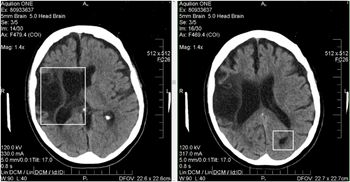
‘Tom’ (pseudonym) presented to his GP 6 months prior to the beginning of the intervention. He reported florid hallucinations that he knew were not real (robots and cartoon animals) but was more troubled by an infestation of insects in his body and bedroom. The GP referred Tom for dermatological investigations, which revealed no skin abnormality, so he was then referred to the Community Mental Health Team (CMHT). Dementia and progressive brain disease were ruled out using multiple time point cognitive assessments, during which no cognitive decline was apparent. Tom had an extensive and complex medical history. He suffered his first major heart attack at the age of 48 and had had severe cardiovascular ill health since then. An MRI scan from 12 years ago showed damage from a large right middle cerebral artery (MCA) stroke which had led to some left-side paralysis. A CT scan, which was requested when Tom presented to the CMHT, revealed an additional established left posterior parietal lobe infarct (Fig. 1), which may have accounted for perceptual disturbances and changes in visual interpretation. Tom was trialled on anti-psychotic medications (olanzapine, risperidone and amisulpride) but he could not tolerate these (he reported that they made him feel ill and dizzy) and his wife, ‘Sarah’, requested psychological support. Ethical review was not required for this case report, but Tom and Sarah consented for the details of this case and intervention to be published under pseudonyms, and some details of the case history have been omitted to anonymise the account.
Computed tomography (CT) scan (identifying information blacked out). The damage from the earlier middle cerebral artery stroke with ex vacuo dilation of the right lateral ventricle can be seen on the left image. The image on the right highlights the more recent stroke in the posterior parietal region, which may have contributed to perceptual disturbance.

Assessment
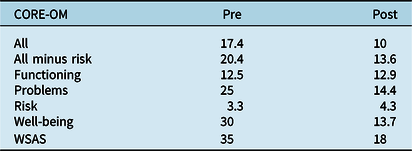
Measures used were part of the service specified routine outcome measures, with established psychometric validity and reliability, and included the 34-item Clinical Outcomes in Routine Evaluation-Outcome Measure (CORE-OM; Evans et al., Reference Evans, Mellor-Clark, Margison and Barkham2000) and the Work and Social Adjustment Scale (WSAS; Mundt et al., Reference Mundt, Marks, Shear and Greist2002). See Table 1 for psychometric scores. These are completed during the initial assessment and on completion of an intervention. Tom was in the clinical range for all subscales except functioning and risk. His WSAS was also in the severe range. This reflected multiple difficulties with physical health as well as mental health, and it was not possible to disentangle the individual impact of the presenting problem on the psychometric scores. The Montreal Cognitive Assessment (Nasreddine et al., Reference Nasreddine, Phillips, Bédirian, Charbonneau, Whitehead, Collin and Chertkow2005), a screening measure for cognitive impairment, was administered by a member of the CMHT when Tom was referred. He scored 23/30 on first assessment, losing points on visuospatial and executive tasks, fluency and orientation. An alternate form of the assessment was repeated 6 months later, and Tom scored 27/30, again losing points for visuospatial executive tasks. This increase in performance was unexplained, but it is possible that anxiety played a role in the first assessment. Although this score is above the cut-off for mild cognitive impairment (26), the reliability in the visuospatial and executive task difficulty is noteworthy, especially given the presentation.
Psychometric scores

CORE-OM, Clinical Outcomes in Routine Evaluation-Outcome Measure (Evans et al., Reference Evans, Mellor-Clark, Margison and Barkham2000); WSAS, Work and Social Adjustment Scale (Mundt et al., Reference Mundt, Marks, Shear and Greist2002).
The assessment and treatment sessions also gathered subjective units of distress (SUDs) which were specifically due to insects, and ratings of the intensity of the belief that the insects were real on a session-by-session basis, beginning with the 3-week baseline over the assessment period. A score of 8–10 represented a level of distress in which Tom would damage himself extracting insects, and above 5 Tom felt that he was unable to sleep.
Procedure
Tom started treatment after the 3-week baseline, during which he was seen once for an assessment session. He was then offered 16 sessions over 17 weeks and attended eight appointments. Eight sessions were cancelled, mostly due to ill health. In addition to the face-to-face sessions, there were weekly telephone calls to the couple to monitor progress and discuss strategies. The sessions were conducted at the home with both Tom and Sarah involved. Each session lasted for 1.5 hours on request from the client, to accommodate a slower pace and fewer contacts.
The intervention phase began with two sessions of further assessment and formulation (B1–B2) in which an ideographic formulation was developed with Tom and Sarah. Tom saw small, cream-coloured moths in his environment and had hallucinations of these crawling out of the wounds caused when he was trying to extract them from his skin. His beliefs were that the insects were malicious and hungry and would try to steal his food. He felt fear and disgust towards them which interrupted his sleep and also caused difficulty around meal times. He did not believe that he was mentally ill. He regularly used insecticide and had used an insect fumigation bomb.
The formulation included perpetuating factors of selective attention and hypervigilance (scanning the environment and body for signs of insects, bites, unusual skin colour or tone), worry and rumination at bed time, poor sleep, and safety seeking behaviours (insect spray always at hand). Tom’s stroke had likely caused some changes to his visual interpretations. Given the area of damage highlighted by the CT scan and the reliable difficulty in visual interpretation highlighted by the MOCA, it was probable that the cause of the hallucinations was organic. Changes in Tom’s visual interpretation of small changes in contrast (for example, excoriation scabs, freckles, spots, veins, seeds in bread and regularly pieces of tobacco and cigarette ash) triggered hallucinatory experiences, which then reinforced his delusional beliefs that he was witnessing and infested with insects. The initial formulation and intervention (B1–B4) focused on behavioural and hallucination control methods such as stopping the search for insects, preventing further excoriations by wearing jackets, long sleeves and hats, and reducing scanning of and visual attention to food while eating. The formulation was discussed verbally with Tom and Sarah, with some simple maintenance cycles drawn out on paper. Guided discovery was used to then suggest various hallucination control measures in keeping with the formulation. Tom saw the majority of the insects at night while reading in low light in a cluttered bedroom. He was encouraged to read only in good light outside of his room and sleep hygiene information, relaxation prior to bedtime, and stimulus control was introduced. Session B4 included behavioural experiments targeting safety seeking behaviours (reliance on insecticide and setting up ‘traps’ with food to catch the insects). Sessions B5–B8 involved challenging the belief that the insects were real. Psychoeducation about how neurological changes can affect the visual system were discussed and Tom was shown his own brain scans post-stroke for the first time to highlight the areas of damage. This was intended as an educative intervention and to provide an alternative model to explain the experience of the insects. This concrete, visual evidence proved to be a powerful intervention for both Tom and Sarah. It was a point at which Tom first considered and held in mind that his stroke damage might be responsible for his experiences, and Sarah experienced a new understanding and empathy for Tom. Visual illusions were used to demonstrate that the brain can see things in a way which differs from objective reality and this was built into the ‘theory A/theory B’ model. Sarah took an active role in this and was involved in reality testing with Tom and in developing and encouraging positive coping statements. Having completed eight sessions it was mutually agreed that, as Tom’s goal of reducing distress had been met, the sessions would come to an end. A follow-up was scheduled for 3 months later.
Results
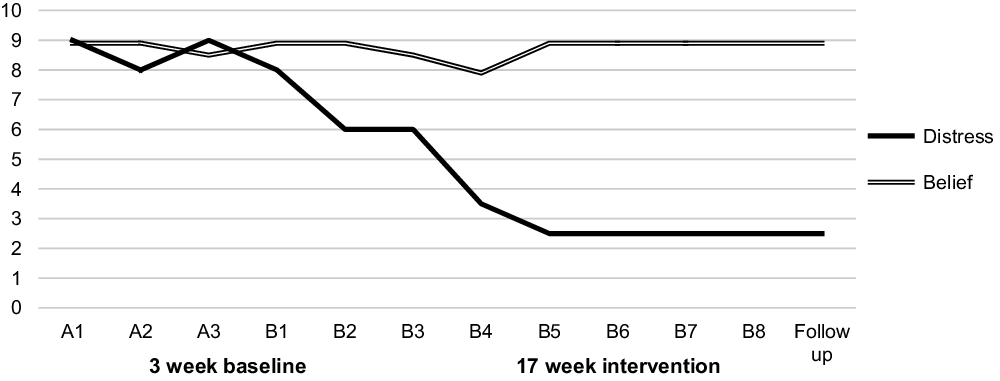
Figure 2 depicts the weekly average ratings of distress and conviction of belief. These were collected through self-report diaries and verbal reports. Visual inspection shows a reduction in distress during the intervention phases, which plateaued at session B5.
Baseline and intervention scores for distress and strength of belief. Distress was recorded through diary ratings (each point representing the previous week) and averaged across intervention weeks, and strength of belief was also rated on each contact (rated as a percentage and divided by 10 to fit the graph). Follow-up was conducted at 3-month post-intervention.

The hallucination control methods resulted in large reductions in distress. Tom reported that the frequency of his seeing the insects had reduced. Table 1 shows the pre- and post-psychometric measures; although Tom remained within the clinical range on the CORE-34, his scores demonstrate reliable improvement (Barkham et al., Reference Barkham, Connell, Stiles, Miles, Margison, Evans and Mellor-Clark2006) and his WSAS score had reduced from severe to significant functional impairment.
Behaviourally, Tom had stopped extracting insects from his body, no longer used insect spray or fumigation items, stopped setting ‘traps’ and was less distressed around meal times. Sarah reported that she had greater empathy for Tom’s experiences and a better understanding of how changes in his brain had led to this outcome. She reported that she was able to accept that Tom’s reality differed from hers without agreeing with him. She had some techniques to use in order to correct Tom’s perceptions (e.g. ‘I see that as a piece of ash/dust/bruise’) rather than responding with frustration, and was able to try to distract him when his vision could not be corrected. Sarah’s support was critical as she ensured that all the behavioural and environmental adaptations were made, and that Tom was following the sleep advice, filling in the diary and had access to reminders.
Discussion
The aim of this single case design was to establish the potential for the use of a CBT intervention for delusional infestation. Tom, the client, was an older adult who had suffered a stroke and had severe cardiovascular problems. He was referred for psychological therapy as anti-psychotic medication was not acceptable to him. The results of the study suggest that the intervention was successful in treating the emotional distress associated with the hallucinatory experiences, but did not shift the delusion. The treatment was split into two phases; the first was the development of a shared formulation and the introduction of behavioural interventions and hallucination control measures (based on the model by Collerton and Dudley, Reference Collerton and Dudley2004). The second involved the application of specific cognitive therapy techniques including behavioural experiments and ‘theory A/theory B’. A therapeutic alliance was built upon during phase 1, which allowed the reality testing interventions to be introduced in an acceptable way in phase 2. The intervention came to an end when the goal to reduce distress had been met, and the improvements in this area were maintained at 3-month follow up.
The Collerton and Dudley (Reference Collerton and Dudley2004) model was an appropriate fit for Tom’s hallucinatory experiences, and the hallucinatory distress was reduced during phase 1 of the intervention. The adaptations to the therapy included longer sessions, specific focus on relationship building, active involvement of the ‘carer’ (Tom’s wife), between-session telephone calls, letters and reminders. There was an interesting dissociation between the conviction of Tom’s belief and his emotional distress; while distress reduced, the delusional belief did not shift. There are a number of potential reasons for this. Some of the usual cognitive therapy techniques were not accessible to Tom (e.g. regular written thought records and homework) and behavioural recommendations needed to be sensitive to Tom’s level of impairment. His partial paralysis and poor physical health seriously limited the extent to which he could pursue valued activities and distract himself independently. It was likely that Tom’s posterior parietal stroke damage precipitated the visual changes that triggered hallucinations. It was also possible that neurocognitive alterations post-stroke influenced the rigidity of his belief (e.g. a lack of cognitive flexibility). Individuals with organic psychosis are often excluded from treatment trials (Howard et al., Reference Howard, Rabins, Seeman and Jeste2000) and it is unclear as to whether delusional beliefs are qualitatively different in such cases, and thus respond differently to psychological therapy. Further study in this area is important as post-stroke neuropsychiatric symptoms occur in at least 30% of survivors and are a major predictor of poor outcomes (Chemerinski and Robinson, Reference Chemerinski and Robinson2000; Hackett et al., Reference Hackett, Köhler, O’Brien and Mead2014). While there is evidence for the use of CBT in post-stroke emotional disorder (Wang et al., Reference Wang, Wang, Zhang, Wu, Ng, Ungvari and Xiang2018), the evidence base for the treatment of post-stroke psychosis is under-developed (Stangeland et al., Reference Stangeland, Orgeta and Bell2018).
Although this study shows promise for the application of a psychological treatment model to delusional infestation, it cannot conclude that CBT is an effective treatment for this condition as a whole. The client described herein illustrates an interface between complex comorbid difficulties and treatment considerations including older adult, post-stroke, psychosis, neurocognitive changes, and delusional infestation. Such individuals would probably be excluded from treatment trials, but smaller studies employing a multiple baseline design or case series could provide enhanced evidence for the use of specific therapeutic techniques, even in such complex cases. This study has also raised questions for future research studies. It would be useful to further explore the application of behavioural versus cognitive techniques in post-stroke psychosis, to question whether post-stroke neurocognitive changes impede the use of more cognitive techniques, or if interventions designed to improve post-stroke executive skills would enhance treatment outcomes.
This is the first published account of the use of a psychological model (Collerton and Dudley, Reference Collerton and Dudley2004) to treat delusional infestation. This single case study shows that the use of psychological therapy was feasible in reducing distress in this debilitating and unusual condition. A defining characteristic of delusional infestation is the sufferer’s belief that they are not mentally ill; the Collerton and Dudley (Reference Collerton and Dudley2004) model, which initially targets the risk and maintaining factors for hallucinatory experiences and emotional distress, is likely to be more acceptable to clients.
Acknowledgements
We would like to extend a special thank you to the client and his wife discussed herein.
Conflicts of interest
We have no conflicts of interest to disclose.
Financial support
This research received no specific grant from any funding agency, commercial or not-for-profit sectors.



Comments
No Comments have been published for this article.