Introduction
Many studies have reported deficits in neuropsychological function in adults with major depressive disorder (MDD; Veiel, Reference Veiel1997; Elliott, Reference Elliott1998). However, the chronicity of these deficits and their relationship with clinical and adaptive outcome has seldom been examined. There is now an increasing acknowledgement that defining recovery from depression simply in terms of an improvement in symptom load is insufficient and that indicators of remission must include a consideration of the individual's function at home, in their relationships, and in their vocation (Furukawa et al. Reference Furukawa, Takeuchi, Hiroe, Mashiko, Kamei, Kitamura and Takahashi2001). Unfortunately there is currently little empirical data concerning these factors in early-onset depression.
Research in late-life depression has suggested a role for cognitive measures in predicting those at risk for poor outcomes (Kalayam & Alexopoulos, Reference Kalayam and Alexopoulos1999; Alexopoulos et al. Reference Alexopoulos, Meyers, Young, Kalayam, Kakuma, Gabrielle, Sirey and Hull2000; Kiosses et al. Reference Kiosses, Klimstra, Murphy and Alexopoulos2001). Specifically, poorer initiation/perseveration on the Mattis Dementia Rating Scale at admission predicts non-response to antidepressant medication (Kalayam & Alexopoulos, Reference Kalayam and Alexopoulos1999), an increased risk of relapse in people who were in remission from MDD (Alexopoulos et al. Reference Alexopoulos, Meyers, Young, Kalayam, Kakuma, Gabrielle, Sirey and Hull2000) and more functional dependence (Kiosses et al. Reference Kiosses, Klimstra, Murphy and Alexopoulos2001). Based on these well-replicated findings, Kiosses et al. (Reference Kiosses, Klimstra, Murphy and Alexopoulos2001) recommended that an evaluation of executive function be included in routine assessments for depression in this age group.
Only two previous studies have examined the relationship between cognitive function and outcome in younger persons with MDD. Dunkin et al. (Reference Dunkin, Leuchter, Cook, Kasl-Godley, Abrams and Rosenberg-Thompson2000) conducted a small study of the relationship between executive function and clinical response to selective serotonin reuptake inhibitors (SSRIs) in 14 subjects with MDD; average age 41.9 years. Only the domain of executive function distinguished between medication responders and non-responders after controlling for differences in depression severity at baseline. Follow-up analyses identified specific deficits for non-responders on the Wisconsin Card Sorting Test (categories completed, perseverative responses and percentage conceptual level responses) and Stroop Colour Word Test interference trial. This study suggests that poor executive performance prior to treatment could be a marker for poor response to the SSRI class of drugs in younger people with MDD. Majer et al. (Reference Majer, Ising, Kunzel, Binder, Holsboer, Modell and Zihl2004) examined a larger sample of 68 subjects with MDD (mean age 45.6 years) and found that a measure of divided attention at intake was significantly related to treatment response at follow-up. However, these findings require replication as the attrition rate in this study was above 70%.
Apart from executive function, there is evidence that a range of other cognitive functions is compromised in younger samples with MDD. Deficits in digit span associated with depression have been reported in some studies (Martin et al. Reference Martin, Oren and Boone1991; Fossati et al. Reference Fossati, Amar, Raoux, Ergis and Allilaire1999; Moritz et al. Reference Moritz, Birkner, Kloss, Jahn, Hand, Haasen and Krausz2002) although these findings are not consistent (Franke et al. Reference Franke, Maier, Hardt, Frieboes, Lichtermann and Hain1993; Ilsley et al. Reference Ilsley, Moffoot and O'Carroll1995; Austin et al. Reference Austin, Mitchell, Wilhelm, Parker, Hickie, Brodaty, Chan, Eyers, Milic and Hadzi-Pavlovic1999). With regard to long-term memory, Massman et al. (Reference Massman, Delis, Butters, Dupont and Gillin1992) reported that a sample with depression performed worse on most of the measures from the California Verbal Learning Test compared with non-depressed controls. These authors noted that the memory deficits of some of their depressed sample were consistent with compromised subcortical function and recommended longitudinal studies to resolve the issue of the association between the subcortical system and deficits of cognition in depression. Austin et al. (Reference Austin, Mitchell, Wilhelm, Parker, Hickie, Brodaty, Chan, Eyers, Milic and Hadzi-Pavlovic1999) and Reischies & Neu (Reference Reischies and Neu2000) reported similar findings using the Rey Auditory Verbal Learning Test (RAVLT). Prospective memory performance has also been reported to be impaired in a young sample with clinical depression (Rude et al. Reference Rude, Hertel, Jarrold, Covich and Hedlund1999).
Thus, previous research with late-life MDD has supported the proposal that measures of executive function during the acute stage are useful for predicting response to pharmacotherapy and disability. However, this pattern has not been clearly established in younger samples with MDD where age-related cognitive changes can be excluded, and where memory function is known to be compromised in the acute phase of MDD. The two studies of younger people with MDD that are available both have methodological shortcomings: very small samples (Dunkin et al. Reference Dunkin, Leuchter, Cook, Kasl-Godley, Abrams and Rosenberg-Thompson2000) and very high attrition (Majer et al. Reference Majer, Ising, Kunzel, Binder, Holsboer, Modell and Zihl2004). The present study presents a longitudinal investigation of the usefulness of a comprehensive battery of cognitive function measures as predictors of clinical and functional outcome in younger adults with multiple social, family and occupational roles. From previous research with late-life MDD it is expected that measures of executive function will be significant predictors of clinical and functional outcome in younger adults with depression.
Method
Participants
A total of 98 persons admitted to large Sydney hospitals were screened for this study. Inclusion criteria were: diagnosis of MDD according to DSM-IV criteria; age 20–60 years; Hamilton Depression Rating Scale (HAMD) score ⩾17. Exclusion criteria were: serious imminent suicide risk; co-morbid Axis I diagnosis; current diagnosis of DSM-IV MDD with postpartum onset; DSM-IV diagnosis of bipolar disorder, or history of a manic, hypomanic or mixed episode; history of head injury or neurological disorder; history of DSM-IV substance abuse disorder or significant drug and/or alcohol use; current treatment with electroconvulsive therapy or in the 6 months prior to the study; current treatment with tricyclic antidepressant medication; colour-blindness; insufficient English language to complete the cognitive assessment. Using these criteria, 34 people were excluded, primarily due to co-morbid Axis I diagnosis and/or current alcohol/substance abuse with one case of suspected early onset dementia. A further 11 people declined to participate. The study was approved by the Ethics Committees of the Royal North Shore Hospital, Northside Clinic, and the University of Sydney and all participants gave informed consent prior to entering the study.
The final sample comprised 52 subjects (35 female) with MDD assessed at admission, 48 of whom were available for re-assessment approximately 4 months later after discharge and clinical remission; an attrition rate of 7.7%. Remission was defined as an improvement of at least 50% from admission Hamilton Depression Rating Scale score and no longer meeting syndromal criteria (Frank et al. Reference Frank, Prien, Jarrett, Keller, Kupfer, Lavori, Rush and Weissman1991). Two subjects had relapsed and were not re-interviewed (since they had had an incomplete initial remission and had been readmitted to hospital), one was excluded due to subsequent treatment with tricyclic antidepressant medication and one could not be contacted. At baseline assessment, 27 subjects were medicated with either an SSRI or a serotonin norepinephrine reuptake inhibitor (SNRI). One of these persons was also receiving a short-acting benzodiazepine and one was receiving atypical antipsychotic medication. While in hospital, all 52 subjects were treated with SSRIs or SNRIs with one also receiving a short-acting benzodiazepine and one receiving atypical antipsychotic medication. At follow-up, 43 subjects had continued with their treatment regimen as stated above whilst five had discontinued their medications. The sample for this study comprised 48 subjects with MDD who were assessed at admission and follow-up.
Materials and procedure
Structured clinical interviews were conducted on three occasions; at admission, at discharge and approximately 3 months after discharge. The interview collected information concerning demographic characteristics, medical history and current medication. Clinical scales and questionnaires were also administered. The clinical interview consisted of the following:
Hamilton Depression Rating Scale (HAMD; Hamilton, Reference Hamilton1960). The 17-item version of this scale was used
The HAMD is the most commonly used scale to assess the severity of depression in clinical practice and research (Pancheri et al. Reference Pancheri, Picardi, Pasquini, Gaetano and Biondi2002; Demyttenaere & De Fruyt, Reference Demyttenaere and De Fruyt2003).
Frontal Systems Behaviour Scale (FrSBe; Grace et al. Reference Grace, Stout and Malloy1999)
This is a 46-item scale which evaluates apathy, disinhibition/emotional dysregulation and executive dysfunction (Absher & Cummings, Reference Absher and Cummings1995). Each item is rated on a five-point frequency scale with a higher rating reflecting greater behavioural disturbance (Grace et al. Reference Grace, Stout and Malloy1999). Scores for the self-rated version on each of the three sub-scales were used in this study.
DSM-IV Social and Occupational Functioning Assessment Scale (SOFAS; Goldman et al. Reference Franke, Maier, Hardt, Frieboes, Lichtermann and Hain1992; APA, 1994)
This is a clinician-rated outcome scale that considers social, occupational and interpersonal functioning in light of mental and physical health problems. The SOFAS score is a global rating that ranges from 0 to 100, with higher scores reflecting better function. In a study of 97 subjects admitted to a psychiatric ward, the SOFAS had better predictive validity and concurrent validity than both the Global Assessment of Functioning and the Global Assessment of Relational Functioning Scale and also correlated with the 36-item Social Functioning Scale (Hay et al. Reference Hay, Katsikitis, Begg, Da Costa and Blumenfeld2003).
Baseline testing was performed between 36 and 72 h after the person was admitted to minimise the effects of stress resulting from the admission. A brief clinical discharge interview was conducted between 36 and 72 h prior to discharge. The follow-up examination took place approximately 3 months after the date of discharge. All interviews were conducted in the hospital where the person was initially admitted.
The cognitive assessment was conducted on two occasions only; at admission and at follow-up. Assessments were performed approximately 4 months apart for all participants. All testing was carried out in the morning and the cognitive assessment was performed prior to the clinical interview to prevent the assessor being biased by awareness of the clinical status of the participant. The only exception to this was that the HAMD was undertaken prior to the cognitive assessment at admission. As noted above, participants were excluded from the follow-up assessment if they experienced relapse in the time between discharge and re-testing. The cognitive assessment consisted of the following:
National Adult Reading Test – Crawford Revision (Crawford, Reference Crawford, Crawford and Mckinlay1992)
This relatively brief test was included as an index of premorbid intelligence quotient (IQ) and was used only once. The measure was taken at follow-up to reduce the effects of depression on performance. The correlation of the National Adult Reading Test with Wechsler Adult Intelligence Scale Revised full scale IQ is 0.77 (Nelson & O'Connell, Reference Nelson and O'Connell1978). In the Crawford revision, the eight least reliable words from the original National Adult Reading Test have been replaced.
Donders Computerized Simple Reaction Time Task (Donders, Reference Donders1969)
Reaction time was determined as the time from the stimulus onset to the key-press response. The score used in this study was the average time in ms for each trial with a higher score indicating slower reaction time.
Digit span sub-test of the Wechsler Memory Scale – Revised (Wechsler, Reference Wechsler1987)
Digit Span Forwards is used as a measure of attention and phonological storage in working memory whilst Digit Span Backwards also draws on mental flexibility and is regarded as a measure of executive function (Lezak, Reference Lezak1995; Baddeley & Hitch, Reference Baddeley and Hitch2000). The scores used in this study were the maximum total numbers recalled for two consecutive trials in each direction.
California Verbal Learning Task (Delis et al. Reference Delis, Kramer and Kaplan1987)
This test assesses learning processes and long-term verbal memory function and is modelled on the RAVLT. Scores were calculated for words recalled in trial 1, total words recalled in trials 1–5, long delay recognition, long delay free recall and long delay cued recall.
Prospective Memory Task (PM; Harris & Menzies, Reference Harris and Menzies1999)
This task assesses delayed free recall and event-based prospective memory. A list of 60 words is presented with four target words embedded within the list, being two from each of the categories ‘a part of the human body’ and ‘an article of clothing’. Participants are instructed to write down a semantic association to each of the words as they are read aloud and to draw a cross next to the relevant number when they hear one of the target words. Following this instruction, the participant fills in self-report clinical scales to create a delay prior to commencing the semantic task. About 10 min after the instructions have been given the participant is given the semantic association task. The prospective memory instruction is not repeated. Finally, the participant is asked to turn the paper over and write down as many of the stimulus words as possible (free recall). Scores used for this study were delayed free recall of stimulus words (retrospective memory) and number of semantic category items identified (event-based prospective memory).
Stroop Colour Word Test (Golden, Reference Golden1978)
This task measures selective attention, freedom from distractibility and response inhibition (Lezak, Reference Lezak1995). Three 45 s trials were used in this task and an interference score was calculated by subtracting trial 1 (naming colour words) from trial 3 (stating the colour in which the word is printed), a higher score indicating greater interference.
Shortened Wisconsin Card Sorting Test (S-WCST; Axelrod et al. Reference Axelrod, Henry and Woodard1992)
The S-WCST is a measure of concept formation, abstraction, working memory, shifting set and the ability to utilise feedback (Lezak, Reference Lezak1995, Spreen & Strauss, Reference Spreen and Strauss1998). The shortened 64-card version was used to reduce fatigue and frustration among people who may have poor motivation (Lezak, Reference Lezak1995, Spreen & Strauss, Reference Spreen and Strauss1998). Scores on the shortened version correlate well with the full version (range 0.70 to 0.91; Robinson et al. Reference Robinson, Kester, Saykin, Kaplan and Gur1991). Two measures were used: categories completed (number of trials completed correctly with a maximum score of three) and number of perseverative errors (continued incorrect sorting despite negative feedback where a higher score indicates worse performance). These measures have been shown to account for most of the variance in performance on this task (Heaton, Reference Heaton1981; Lezak, Reference Lezak1995).
Controlled Oral Word Association Test (Benton & Hamsher, Reference Benton and Hamsher1978)
Verbal fluency tests are used to measure organised searching and the use of self-generated strategies by requiring a participant to search his or her semantic memory for appropriate category matches (Daigneault et al. Reference Daigneault, Braun and Whitaker1992). The average number of correct words produced for each of three letters (phonemic fluency) and the total number of animals named for the category task (semantic fluency) were recorded.
Modified Six Elements Test (SET; Shallice & Burgess, Reference Shallice and Burgess1991)
The SET assesses planning, self-monitoring, multi-tasking and prospective memory and requires intact supervisory control processes for successful completion (Shallice & Burgess, Reference Shallice and Burgess1991). The SET requires participants to attempt, but not complete, six open-ended tasks in a period of 10 min. The emphasis of this task is not on the performance of the individual tests but rather that all components are attempted with no rule breaks. This task differs from most tests of executive function because it is relatively unstructured and open-ended, with high ecological validity (Garden et al. Reference Garden, Phillips and Macpherson2001). The score derived from the SET was the number of sub-tasks attempted minus the number of rule-breaks. The SET has not been used with a depressed sample, but appears to be a sensitive indicator of executive function in studies with schizophrenia and brain injury (Evans et al. Reference Evans, Chua, McKenna and Wilson1997; Chan et al. Reference Chan, Chen, Cheung and Cheung2004).
Statistical analyses
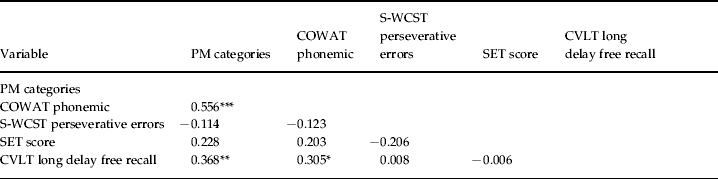
A Pearson correlation matrix with two-tailed significance was computed for the five cognitive variables. Paired samples t tests were used to examine change in clinical scores across the period from admission to follow-up. Hierarchical regression was employed to examine whether cognitive variables at admission improved the prediction of clinical outcome (i.e. HAMD score at follow-up) beyond that afforded by examining depression severity at admission. This analysis was repeated for psychosocial outcome using SOFAS scores. As employment status was an ordinal variable, an ordinal regression was used to examine predictors of employment status. Predictors were chosen according to past literature and with consideration given to multicollinearity (see Table 1). In order to account for multiple comparisons, a Bonferroni correction was used for t test data and the Benjamini and Hochberg false discovery rate correction was applied to all regression analysis data (Benjamini & Hochberg, Reference Benjamini and Hochberg1995).
Correlation matrix of cognitive variables

PM, Prospective memory; COWAT, Controlled Oral Word Association Test; S-WCST, Wisconsin Card Sorting Test; SET, Six Elements Test; CVLT, California Verbal Learning Test.
Pearson correlations reported with two-tailed significance:
* p<0.05, ** p<0.01, *** p<0.001.
Results
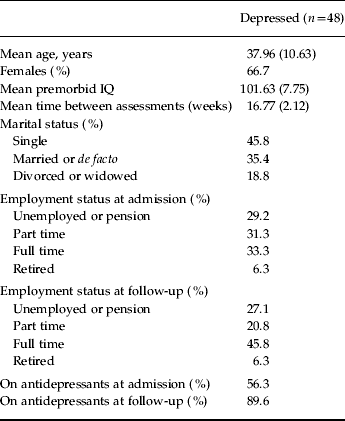
The characteristics of the sample are presented in Table 2. The average age of the participants was 37.96 years (s.d.=10.63). Almost two-thirds of the sample reported being single, divorced or widowed, with the remainder living with a partner. The mean estimated premorbid IQ for the sample was average (mean=101.63, s.d.=7.75). Approximately two-thirds of the sample (64.6%) were working either full time or part time when admitted for treatment. At follow-up one participant who was unemployed at admission was working on a part-time basis and a further six had moved from part-time to full-time work.
Characteristics of the sample at admission

IQ, Intelligence quotient.
Values are given as mean (standard deviation) or percentage.
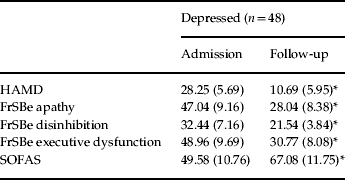
As shown in Table 3, the participants with MDD were in the moderately to severely depressed range at admission. Self-reported executive dysfunction and apathy were also prominent in this sample at admission, with disinhibition less commonly reported. The differences between admission and follow-up scores in Table 3 were all significant [t(47)=24.41, p<0.001; t(47)=16.10, p<0.001; t(47)=13.94, p<0.001; t(47)=14.51, p<0.001; t(47)=14.58, p<0.001 for HAMD, FrSBe apathy, FrSBe disinhibition, FrSBe executive dysfunction, and SOFAS respectively]. Scores on all measures improved from admission to follow-up.
Mean HAMD and FrSBe subscales and SOFAS scores at admission and at follow-up

HAMD, Hamilton Depression Rating Scale; FrSBe, Frontal Systems Behaviour Scale; SOFAS, Social and Occupational Functioning Assessment Scale (DSM-IV).
Values are given as mean (standard deviation).
* p<0.001. Bonferroni corrected significance value p=0.01; i.e. 0.05/5.
Prediction of depression severity at follow-up from admission data
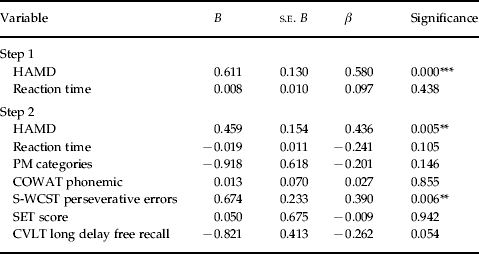
Results of the hierarchical regression performed to predict depression severity at follow-up are presented in Table 4. After step 1, with both HAMD score and reaction time score at admission in the equation, R 2=0.38 (adjusted R 2=0.35), F inc(2, 44)=13.28 (p<0.001). After step 2, with the five cognitive function variables also in the equation, R 2=0.55 (adjusted R 2=0.47), F inc(7, 39)=6.79 (p<0.001). The addition of these variables to the equation thus reliably improved the ability of this model to predict clinical outcome as measured by HAMD score. S-WCST perseverative errors and California Verbal Learning Test long delay free recall were significant predictors of HAMD score at follow-up, although the latter became non-significant after applying the Benjamini–Hochberg correction (p=0.07).
Results of hierarchical regression analysis for HAMD score at follow-up (n=48)

HAMD, Hamilton Depression Rating Scale; s.e., standard error; PM, prospective memory; COWAT, Controlled Oral Word Association Test; S-WCST, Shortened Wisconsin Card Sorting Test; SET, Six Elements Test; CVLT, California Verbal Learning Test.
Significance following Benjamini–Hochberg correction:
** p<0.01, *** p<0.001.
Prediction of SOFAS at follow-up from admission data
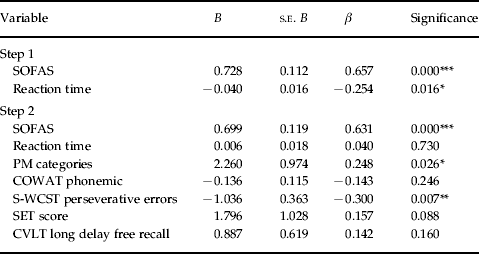
Results of the hierarchical regression performed to predict SOFAS at follow-up is presented in Table 5. After step 1, with both SOFAS score and reaction time score at admission in the equation, R 2=0.57 (adjusted R 2=0.55), F inc(2, 44)=29.51 (p<0.001). After step 2, with the five cognitive function variables now in the equation, R 2=0.72 (adjusted R 2=0.67), F inc(7, 39)=14.59 (p<0.001). The addition of these variables to the equation hence improved this model which predicted psychosocial outcome according to SOFAS score. The two significant cognitive predictors were S-WCST perseverative errors and PM categories identified. SET score did not reach the criterion for significance (i.e. p=0.09).
Results of hierarchical regression analysis for SOFAS score at follow-up (n=48)

SOFAS, Social and Occupational Functioning Assessment Scale (DSM-IV); s.e., standard error; PM, prospective memory; COWAT, Controlled Oral Word Association Test; S-WCST, Shortened Wisconsin Card Sorting Test; SET, Six Elements Test; CVLT, California Verbal Learning Test.
Significance following Benjamini–Hochberg correction:
* p<0.05,
** p<0.01,
*** p<0.001.
Prediction of employment status at follow-up from admission data
As is evident in Table 2, employment status changed between admission and follow-up. Employment status is clearly an important indicator of occupational functioning. When those who were retired at admission were eliminated from the analysis (n=3), employment status was coded as an ordinal variable (0=unemployed, 1=part time, 2=full time). The SPSS ordinal regression procedure with simultaneous entry of variables was used to examine the independent contribution of reaction time, cognitive variables and employment status at admission to predicting employment status at follow-up. With all variables in the equation, pseudo R 2=0.66 [χ2(7)=37.90, p<0.001]. The only significant cognitive predictor was the SET score (parameter estimate 1.25, s.e. 0.59, Wald 4.50, p=0.034) although this did not remain significant after the Benjamini–Hochberg correction was applied (p=0.068).
Discussion
This study examined the usefulness of measures of cognitive function in predicting clinical and psychosocial outcome in a sample of relatively young adults hospitalized for moderate to severe MDD. It was found that cognitive variables measured at admission were valid predictors of outcome approximately 4 months later. Specifically, the addition of the S-WCST perseverative errors score significantly improved the prediction of HAMD score at follow-up above the contribution afforded by considering depression severity at admission. Similarly, S-WCST perseverative errors and the prospective memory score significantly improved the prediction of SOFAS score at follow-up above the contribution afforded by considering SOFAS score at admission. These measures are both indices of executive function, as prospective memory reflects a memory function under executive control (Mateer, Reference Mateer1999). These results are consistent with studies in late-life depression (Alexopoulos et al. Reference Alexopoulos, Meyers, Young, Kalayam, Kakuma, Gabrielle, Sirey and Hull2000; Kiosses et al. Reference Kiosses, Klimstra, Murphy and Alexopoulos2001), which have shown that poorer performance on tests of executive function can predict those with poorer functional outcomes.
Perseveration is typically regarded as a sign of frontal-striatal dysfunction since it represents an inability to terminate a previous action or response and thus a loss of executive control (Joseph, Reference Joseph1999; Lombardi et al. Reference Lombardi, Andreason, Sirocco, Rio, Gross, Umhau and Hommer1999). Perseveration might be a proxy indicator of those people with more brain dysfunction such as frontal-subcortical white matter hyperintensities. This has been reported in late-onset depression and has been associated with a poor clinical response to antidepressant treatment (Simpson et al. Reference Simpson, Baldwin, Jackson and Burns1998). This may explain the relationship between perseveration and poorer clinical outcome in this study. A combined neuroimaging and neuropsychological study in early-onset depression would help to clarify this issue. More perseverative errors were also associated with poorer SOFAS score at follow-up. Shallice (Reference Shallice1988) describes perseveration as an executive failure to adapt a lower-level response selection system when faced with the need for a novel response. This lack of mental flexibility could contribute to dysfunction in activities in daily living since demands at work and home are often fluid and constantly changing. Perseveration would create difficulty in adapting to these demands.
Prospective memory also predicted functional outcome in this study. This is consistent with an understanding of prospective memory as a construct that entails the skills of planning, monitoring of both self and output and the retention of task and relevant cues (Dobbs & Reeves, Reference Dobbs, Reeves, Brandimonte and Einstein1996). These skills all relate to performance of activities of daily living and to successful post-discharge rehabilitation. Prospective memory function may be improved through the use of external environmental supports such as diaries and reminders (Mateer, Reference Mateer1999). This finding may suggest a common deficient neuroanatomical pathway with perseveration, as prospective memory has also been correlated with activity in the prefrontal cortex and cingulate gyri (Okuda et al. Reference Okuda, Fujii, Yamadori, Kawashima, Tsukiura, Fukatsu, Suzuki, Ito and Fukuda1998; Burgess et al. Reference Burgess, Veitch, De Lacy Costello and Shallice2000).
One methodological constraint of this study is the use of the SOFAS to measure outcome. This is a clinician-rated scale which ranks overall performance on a single scale from 0 to 100. The SOFAS represents an improvement over the earlier Global Assessment of Functioning which has been criticised for being a single axis score which is too sensitive to psychological disturbance; the SOFAS on the other hand considers function in view of mental health issues. As noted above, the SOFAS has been shown to correlate with more comprehensive measures of social function including the Social Adjustment Scale Self-Report – Modified and the 36-item Social Functioning Scale in a sample of people with psychiatric diagnoses (Hay et al. Reference Hay, Katsikitis, Begg, Da Costa and Blumenfeld2003). Since the sample in this study comprised people admitted to hospital with moderate to severe depression who were reassessed as out-patients, this change could have impacted artificially upon the SOFAS scores. In the present study, SOFAS score was highly correlated with the 17-item HAMD, a measure of depression severity, both at admission (r=−0.65) and at follow-up (r=−0.74). This suggests that there may be some confounding effect of depression on this scale. The use of a more comprehensive scale, such as the World Health Organization disability assessment schedule or the Medical Outcomes Study survey may provide more information about the extent of psychosocial dysfunction. However, the results of the hierarchical regression involving the SOFAS were broadly consistent with the ordinal regression predicting occupational function. The consistency of these analyses suggests that the results may be reliable.
Although larger than the sample reported by Dunkin et al. (Reference Dunkin, Leuchter, Cook, Kasl-Godley, Abrams and Rosenberg-Thompson2000), the sample size in the present study was not large. However, the attrition rate in the present study was much smaller than that reported by Majer et al. (Reference Majer, Ising, Kunzel, Binder, Holsboer, Modell and Zihl2004). It is clearly important to replicate these findings in a larger group. However, the consistency between the findings of the present study and those reported by other researchers using different indices, such as the Mattis Dementia Rating Scale, is encouraging.
It would have been interesting to have investigated the associations between baseline cognitive function and relapse and treatment discontinuation since cognitive impairment could herald more severe depression and/or less insight with poorer treatment-seeking behaviour. In this sample, only two subjects relapsed prior to follow-up and five had discontinued their medications, which precluded us from comparing the groups statistically. A larger study with a longer period of follow-up would help in order to investigate this.
Overall, the results of this study suggest that poorer executive function may be a marker for poorer long-term function in younger people with depression, both in terms of symptom severity and social and occupational outcome. This may allow for the identification of ‘at-risk’ individuals at the time of admission through the use of a brief cognitive screen. This is important since follow-up studies suggest that people with depression spend a considerable proportion of their time in illness (Angst, Reference Angst and Helgason1988; Judd et al. Reference Judd, Akiskal, Maser, Zeller, Endicott, Coryell, Paulus, Kunovac, Leon, Mueller, Rice and Keller1998; Wittchen et al. Reference Wittchen, Holsboer and Jacobi2001). Problems with executive function, in particular perseveration, and prospective memory might be indicative of problems with seeking out and utilising post-discharge rehabilitation and/or of more brain pathology. This also provides some direction for targeted treatment, and problem-solving therapy has been shown to have some efficacy in treating late-life depression among people with executive impairment (Alexopoulos et al. Reference Alexopoulos, Raue and Arean2003). Cognitive interventions may thus benefit these individuals and may lessen future disability.
Acknowledgements
The authors thank all of the participants who donated their time to this study. The authors are also grateful to the staff at the Northside Clinic and Royal North Shore Hospital. We also thank Teresa Lee and Rob Heard for their assistance.
Declaration of Interest
None.