INTRODUCTION
Sleep disorders are common in cancer patients. Some 30 to 52% of newly diagnosed cancer patients have difficulty sleeping (Owen et al., Reference Owen, Parker and McGuire1999; Savard & Morin, Reference Savard and Morin2001; Davidson et al., Reference Davidson, MacLean and Brundage2002; Fiorentino & Ancoli-Israel, Reference Fiorentino and Ancoli-Israel2007), which is a significantly higher prevalence rate than in healthy adults or noncancer patients (Owen et al., Reference Owen, Parker and McGuire1999; Davidson et al., Reference Davidson, MacLean and Brundage2002; Vena et al., Reference Vena, Parker and Allen2006; Le Guen et al., Reference Le Guen, Gagnadoux and Hureaux2007). In clinical practice, however, sleep is not assessed by healthcare professionals (Savard & Morin, Reference Savard and Morin2001). In a study of 982 patients with various cancers—including breast, gastrointestinal, genitourinary, gynecological, lung, and nonmelanoma skin cancers—the prevalence of several manifestations of sleep disturbance was highest or second highest in lung cancer patients, with an average prevalence in all cancer patients of 30.5 versus 36.8% in those with lung cancer (Davidson et al., Reference Davidson, MacLean and Brundage2002). In Japan, despite the high prevalence and status of lung cancer as the most common type of cancer diagnosed (Ministry of Health, Labour, and Welfare, 2011), few studies have examined sleep disturbance in lung cancer patients.
Sleep disturbance impairs quality of life (QOL) (Fortner et al., Reference Fortner, Stepanski and Wang2002) and results in a range of psychological and somatic conditions, such as increased fatigability and irritability, cognitive impairment, mood change, poor coordination, psychomotor retardation, and decreased pain tolerance (Chuman, Reference Chuman1983).
A new diagnosis of cancer has been associated with the onset of sleep disturbance (Davidson et al., Reference Davidson, MacLean and Brundage2002). Patients experience stress related to the ongoing series of medical events they are subjected to, such as diagnosis, hospital admission, surgery, and treatment, which in turn may induce psychological distress. The relationship between psychological symptoms and sleep therefore warrants evaluation.
Several studies have reported that the combined occurrence of sleep disturbance, pain, fatigue, anxiety, and psychological distress can occur together in a phenomenon termed “symptom clusters” (Donovan et al., Reference Donovan and Jacobsen2007; Theobald, Reference Theobald2007; Dirksen, Reference Dirksen, Epstiein and Hoyt2009; Cheng, Reference Cheng and Lee2011). Clinician consideration of not only sleep disturbance but also psychological distress and other symptoms should improve the overall quality of life of patients; however, few studies have investigated the prevalence of sleep disturbance and its association with psychological distress, fatigue, pain, and QOL in lung cancer patients in Japan.
In the present study, we evaluated the prevalence of sleep disturbance in lung cancer patients in Japan and compared patients with and without sleep disturbance in regard to psychological distress, QOL, pain, and fatigue. In addition, we also examined the association between sleep disturbance and psychological distress, QOL, pain, and fatigue.
METHOD
Participants
Subjects were recruited at the Center for Pulmonary Diseases at the National Hospital Organization at Tokyo National Hospital. They were interviewed for assessment of the following enrollment criteria: (1) diagnosis of lung cancer (including recurrence of cancer), (2) 20 years of age or older, (3) no history of depression (as assessed by medical chart review), (4) no serious cognitive difficulties, and (5) ability to complete the questionnaire. Subjects consisted of consecutive admissions to the hospital or were inpatients who met the enrollment criteria. The study was approved by the ethics committee of the National Hospital Organization at Tokyo National Hospital. All patients provided written informed consent.
Measures
Sleep Disturbance
Sleep disturbance was measured using the Athens Insomnia Scale (AIS) (Soldatos et al., Reference Soldatos, Dikeos and Paparrigopoulos2000), a self-administered instrument that consists of eight items and has shown good internal reliability and validity (Soldatos et al., Reference Soldatos, Dikeos and Paparrigopoulos2003). The Japanese version of the AIS has also been validated (Okajima et al., Reference Okajima, Nakajima and Kobayashi2011). The first five items assess difficulty with sleep induction, waking during the night, early morning waking, total sleep time, and sleep quality. The last three items pertain to the next-day consequences of insomnia, such as problems with sense of well-being, functioning capacity, and sleepiness during the day. Each item of the AIS is rated on a 0-to-3 scale, with 0 corresponding to “no problem at all” and 3 to a “very serious problem.” Patients were requested to give a positive rating if they had experienced the item at least three times a week during the last month. The total score on these eight items ranged from 0 to 24, with a score ≥6 considered to represent sleep disturbance.
Psychological Distress
Psychological distress was measured using the Hospital Anxiety and Depression Scale (HADS) (Zigmond et al., Reference Zigmond and Snaith1983). The HADS consists of 14 items and has two subscales: anxiety (7 items) and depression (7 items). Each item of the HADS is rated from 0 to 3, and the total score ranges from 0 to 42, with a higher score indicating severe depression and anxiety. A total score equal to or greater than 11 was set as the cutoff for psychological distress (Kugaya et al., Reference Kugaya, Akechi and Okuyama1998). HADS has also been validated in a cancer population (Herrmann, Reference Herrmann1997).
Quality of Life, Pain, and Fatigue
Quality of life, pain, and fatigue were measured by the European Organization of Research and Treatment Quality of Life Questionnaire–Cancer 30 (EORTC QLQ–C30), version 3 (Aaronson et al., Reference Aaronson, Ahmedzai and Berman2008). The QLQ–C30 consists of 30 items that assess 5 functional domains (physical, role, emotional, cognitive, and social functioning), 8 cancer-related symptoms (including pain and fatigue), financial difficulty, and global health status. Scores for each item range from 1 (not at all) to 4 (very much) and are then transformed to a range of from 0 to 100. Higher scores for global health status show a better quality of life, while lower scores for the eight symptom items and financial difficulty show a better status. The Japanese version of the QLQ–C30 was used for our study. Quality of life, pain, and fatigue were used as outcome variables.
Statistical Analysis
Patients were divided into two groups (poor sleepers: AIS ≥6, good sleepers: AIS <6), and the means and standard deviations of the HADS score, QOL, fatigue, and pain of the two groups were calculated. The cutoff score on HADS was set at 11 based on the Japanese version of HADS, and patients with a total HADS score of 11 or greater in this version were identified as having potential adjustment disorder and major depression (Kugaya et al., Reference Kugaya, Akechi and Okuyama1998).
In order to examine the relationship between chemotherapy and sleep disturbance, patients were divided into a chemotherapy group and a nonchemotherapy group, and sleep disturbance was analyzed. The mean and standard deviation for each item of the AIS score and total AIS score were then calculated.
Differences in scores between the two groups were compared using the Mann–Whitney U test. Significance was set at p < 0.05 for all analyses. Correlations among AIS score, HADS score, QOL, fatigue, and pain were calculated employing Spearman's rank correlation coefficient. All statistical procedures were performed using PASW statistics software, version 18.
RESULTS
Patient Characteristics
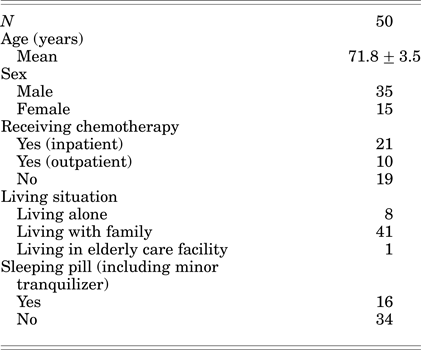
A total of 50 lung cancer patients participated in our study. The characteristics of the study population are presented in Table 1. It has been reported that the average age of Japanese lung cancer patients is 68 years old (n = 15,185) (Kawaguchi et al., Reference Kawaguchi, Matsumura and Fukai2010). In our study, the mean age was 71.8 ± 3.5 years, which is almost representative for Japanese lung cancer statistics. More than half of the patients received chemotherapy. In all patients, the prevalence of sleep disturbance (AIS ≥6) was 56% (n = 28), and major psychological distress (HADS ≥11) was 60% (n = 30). A high rate of sleep disturbance was observed, which is consistent with previous findings (Kaye et al., Reference Kaye, Kaye and Madow1983; Malone et al., Reference Malone, Harris and Luscombe1994; Engstrom et al., Reference Engstrom, Strohl and Rose1999; Davidson et al., Reference Davidson, MacLean and Brundage2002).
Characteristics of the study population

Questionnaire responses indicated sleep disturbance in 32% of patients (n = 16), who were accordingly prescribed sleeping medications (e.g., triazolam, brotizolam, zolpidem, and etizolam). The duration of effect for these sleeping pills generally ranges from 2 to 6 hours.
AIS values (average value ± SD) for all participants were 0.88 ± 0.75 for sleep induction, 0.52 ± 0.65 (waking during the night), 0.84 ± 0.71 (early morning waking), 0.66 ± 0.59 (total sleep time), 0.74 ± 0.69 (sleep quality), 0.54 ± 0.68 (well-being during the day), 0.92 ± 0.67 (functioning capacity during the day), and 1.10 ± 0.42 (sleeping during the day).
Comparison of AIS Scores for Outcome Variables
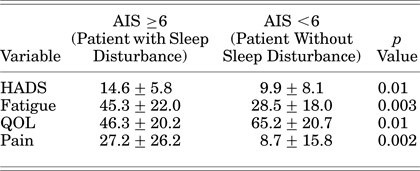
Table 2 compares outcome variables between the AIS ≥6 and AIS <6 groups. For each parameter, patients with sleep disturbance (AIS ≥6) had the following scores: total HADS, 14.6 ± 5.8; fatigue, 45.3 ± 22.0; QOL, 46.3 ± 20.2; and pain, 27.2 ± 26.2. In contrast, patients without sleep disturbance (AIS <6) had the following scores: total HADS, 9.9 ± 8.1 (p < 0.05); fatigue, 28.5 ± 18.0 (p < 0.01); QOL, 65.2 ± 20.7 (p < 0.05); and pain, 8.7 ± 15.8 (p < 0.01). Patients with sleep disturbance had significantly higher scores for HADS, fatigue, and pain, and a significantly lower score for QOL than those without sleep disturbance, showing that both the physical and psychological states of patients with sleep disturbance were worse than that of those without.
Comparison of AIS scores (AIS ≥6 and AIS <6) for outcome variables

Data represent mean ± SD.
Association of Chemotherapy and Sleep Disturbance
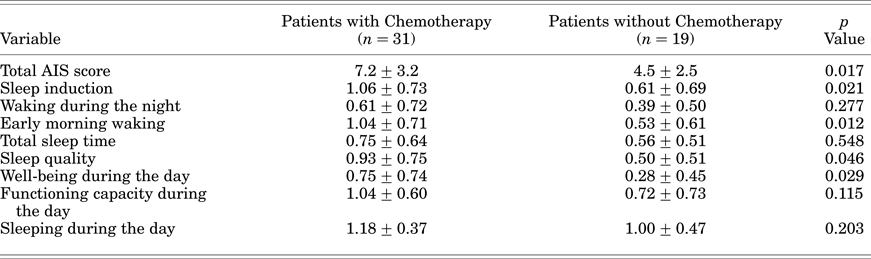
To demonstrate the association of chemotherapy and sleep disturbance, both the total score and the score on each item of the AIS were compared for patients with and without chemotherapy (Table 3). There was a significant difference between patients with and without chemotherapy regarding total score and AIS scores on sleep induction, early morning waking, sleep quality, and well-being during the day.
AIS items of patients with or without chemotherapy

Correlation Among Predictive Factors
The correlations among AIS score and predictive factors were calculated to determine which predictive factors were associated with sleep disturbance, (Table 4). The AIS score significantly correlated with all other predictive factors, with Spearman's rank correlation coefficients ranging from 0.405 to 0.466 at absolute value. Significant correlations were also seen among predictive factors, with correlation coefficients ranging from 0.452 to 0.562 at absolute value.
Correlation of AIS score and predictive factors

**p < 0.01.
Correlation Between HADS Score and Individual Factors in the AIS
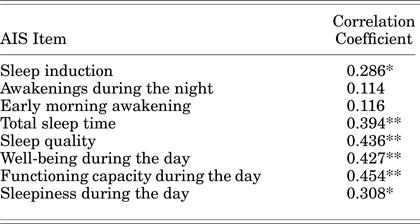
Correlations between HADS score and the eight items of the AIS are presented in Table 5. Six items of the AIS were significantly associated with HADS score, with a correlation coefficient ranging from 0.286 to 0.454. In contrast, no correlation was observed for waking during the night and early morning. Furthermore, the correlations observed in Table 5 show an association of psychological status with not only quality of sleep but also daytime functioning.
Correlation of HADS score and AIS items

*p<0.05; **p < 0.01.
Association of Sleep Medication and Sleep Disturbance
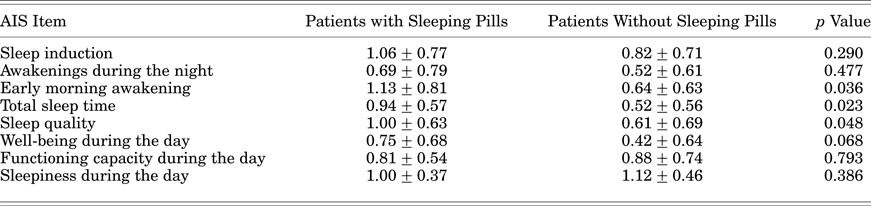
To demonstrate the association of sleeping pills and sleep disturbance, each item of the AIS was compared for patients taking and not taking sleeping pills (Table 6). In the first five items related to sleep, the AIS scores for sleep induction and waking during the night did not significantly differ between those patients taking and those not taking sleeping pills. In contrast, AIS scores were statistically significant for early morning waking, total sleep time, and sleep quality. This result demonstrates that only the AIS scores for sleep induction and waking during the night in patients with sleeping pills were not statistically different from those without, meaning that sleeping pills improved sleep induction but not to a sufficient level.
AIS items of patients with or without sleeping pills

Data represent mean ± SD.
DISCUSSION
In this study, we observed that more than half of lung cancer patients (28 of 50) had sleep disturbance. Further, patients with sleep disturbance exhibited worse psychological and physiological symptoms compared to those without.
The average age of patients in our study was 71.8 ± 3.5 years. This may explain the higher prevalence of sleep disturbance compared to previous studies, given the higher prevalence in elderly people, which can be up to 25% in those in their 60s and 33% in those in their 70s (Foley et al., Reference Foley, Monjan and Simonsick1999).
Nocturnal polyuria is common in the elderly (Fultz et al., Reference Fultz and Herzog1996) due to the urinary symptoms associated with vesical dysfunction in patients with prostatic involvement. In this study, however, the AIS scores on each item indicated that the main cause of sleep disturbance was not nocturnal polyuria, given the lower score for waking during the night, but rather sleepiness during the day due to both tumor- and chemotherapy-related effects (Davidson et al., Reference Davidson, MacLean and Brundage2002). Table 3 shows that the AIS scores for the chemotherapy group were significantly different from those without in the items of total score, sleep induction, early morning sleep quality, and well-being during the day. This prevalence of excessive daytime sleepiness and daytime dysfunction in our patients with lung cancer is consistent with previous reports (Ginsburg et al., Reference Ginsburg, Quirt and Ginsburg1995; Cronin et al., Reference Cronin, Keifer and Davies2001; Davidson et al., Reference Davidson, MacLean and Brundage2002) and indicates that chemotherapy contributes to sleep disturbance. However, the severity of side effects is considered to be dependent on the drug. For example, patients treated with Gefitinib have a better QOL than those taking paclitaxel (Oizumi et al., Reference Oizumi, Kobayashi and Inoue2012). In our study, the rate of patients being treated with molecularly targeted drugs was 20% (n = 6), and the rate was increased. The relationship between type of drug and sleep disturbance was therefore not due to small study size.
Pain medications have side-effect profiles that potentially disrupt sleep (Cronin et al., Reference Cronin, Keifer and Davies2001). Opioids or nonsteroidal antiinflammatory drugs (NSAIDs), commonly used for pain relief in cancer patients, can decrease the quality of sleep. In particular, opioids significantly decrease slow-wave sleep and rapid eye movement sleep, which is associated with fatigue or decreased sleep quality (Cronin et al., Reference Cronin, Keifer and Davies2001; Caldwell et al., Reference Caldwell, Rpoport and Davis2002). Aspirin and ibuprofen increase waking during the night and decrease sleep efficacy (Trenkwalder et al., Reference Trenkwalder, Hening and Montagna2008), while NSAIDs suppress the production of melatonin during the night (Murphy et al., Reference Murphy, Badia and Myers.1994). In our study, opioids were not prescribed and NSAIDs were prescribed for only 18% of patients.
Sleep disturbance has been shown to correlate with psychological distress, fatigue, and pain. In the present study, sleep disturbance was also significantly associated with psychological distress, fatigue, and pain, and with similar correlation coefficients. Results indicated that patients with sleep disturbance had a lower QOL. Regarding the relationship between pain and sleep disturbance, sleep loss has been found to lead to decreased pain threshold (Roehrs et al., Reference Roehrs, Hyde and Blaisdell2006), and increased pain has been related to sleep disturbance (Fortner et al., Reference Fortner, Stepanski and Wang2002; Mercadante et al., Reference Mercadante, Girelli and Casuccio2004). In addition, pain may interfere with the mechanisms of induction and maintenance of sleep.
Previous studies have reported that psychological distress is associated with sleep disturbance (Mystakidou et al., Reference Mystakidou, Tsilika and Parpa2005; Fava et al., Reference Fava, McCall and Krystal2006; Chen et al., Reference Chen, Yu and Yang2008). We therefore focused on the relationship between psychological distress and each AIS item. Psychological distress was significantly associated with all items, except for “awakenings during the night” and “early morning awakening,” and particularly affected daytime impairment. Concerning daytime impairment, many patients with sleep disturbance experience a strong sense of fatigue and pain. This in turn leads to increased psychological distress and decreased QOL, and thereby exacerbates the original sleep disturbance.
The rate of sleep disturbance in our study was greater than 50%, and sleeping pills were prescribed to 30% of patients, which is similar to that reported by previous investigators (21.5%) (Davidson et al., Reference Davidson, MacLean and Brundage2002). All sleeping pills prescribed were short-acting compounds, which improved items such as “sleep induction” and “awakenings during the night” but did not improve maintenance of sleep. Therefore, longer-acting compounds are needed to improve both induction and maintenance of sleep, depending on the requirements of the individual patient.
In addition, the combination of sleeping pills and antidepressants has been reported to cause a more rapid improvement in the symptoms of depression and a greater magnitude of antidepressant benefit than antidepressants alone (Price et al., Reference Price, Zachariae and Butow2009). The effective treatment of anxiety and depression was also reported to lead to an improvement in symptoms related to both sleep and pain (Chung & Tso, Reference Chung and Tso2010). Due to confirmation of the association of sleep disturbance and psychological distress, the combination of sleeping pills and antidepressants is a possible treatment for improvement of symptoms.
Our study has several limitations that should be noted. First, our purpose was to collect data on the prevalence of sleep disturbance in a wide range of lung cancer patients. We therefore included patients who were diagnosed at different times, at different stages of lung cancer, receiving or not receiving chemotherapy, and inpatients and outpatients. Some patients had a recurrence of cancer, and it was difficult to define their stage. This limits the generalizability of our findings and the ability to show causality. Second, we did not evaluate the association between severity of illness or performance status and sleep disturbance. Third, many study variables were assessed with one or a very limited number of items that do not take into account the multidimensional aspects of these symptoms. Finally, the study design was longitudinal in nature and therefore does not provide information about the course of sleep disturbance over time or in relation to temporal events.
We found that more than half of the patients (28 of 50) had sleep disturbance, which was higher than previously reported (Malone, Reference Malone, Harris and Luscombe1994; Herrmann, Reference Herrmann1997; Davidson et al., Reference Davidson, MacLean and Brundage2002; Aaronson et al., Reference Aaronson, Ahmedzai and Berman2008). We also identified a correlation with the presence of an association between AIS, HADS, fatigue, QOL, and pain scores. It is therefore important that clinicians be aware that lung cancer patients can suffer from sleep disorder symptoms, especially patients undergoing chemotherapy, and to consider the treatment and selection of medication depending on the symptoms of individual patients.
ACKNOWLEDGMENTS
This study was supported by the National Hospital Organization, Tokyo National Hospital, in Japan.