


Introduction
Type 2 diabetes mellitus (T2DM) is a condition characterized by high blood sugars due to increasing insulin resistance and insufficient insulin production to match the digested carbohydrate load. Management of the condition requires control of blood sugars (glycaemic control) through behaviour change, medication or the use of insulin injections. Poor glycaemic control results in vascular damage that in turn leads to a range of end organ damage that either accelerates natural ageing processes prematurely or the development of diabetes specific complications most commonly, but not exclusively, ophthalmic, renal, cardio- and cerebrovascular, and peripheral nerve damage (Tidy and Kenny, Reference Tidy and Kenny2013). This can result in disability, early reduction of working life, and reduced quality of life (Lin, Reference Lin, Rutter, Katon, Heckbert, Ciechanowski and Oliver2010; Egede and Ellis, Reference Egede and Ellis2010). T2DM is rapidly escalating in prevalence and is predicted to do so further according to Diabetes UK. Recent figures suggest that 3.2 million people in the UK have been diagnosed with T2DM, with an estimated further 0.5 million currently undiagnosed (Diabetes UK, 2014). An additional aspect to consider is the economic cost of T2DM. As a result of the prevalence, as well as complications associated with the condition, research has shown that T2DM consumes approximately 10% of the NHS budget (Hex et al., Reference Hex, Bartlett, Wright, Taylor and Varley2012).
The fundamental principle of holistic diabetic care is that lifestyle behaviour underpins the effectiveness of all other medical treatments. The first intervention before oral hypoglycaemic agents is to adopt a low sugar diet, adopt a low fat diet for people who are overweight and engage in regular activity as necessary for weight loss, and reduce or stop unhealthy behaviours such as tobacco smoking (NICE, 2014). Patients are also encouraged to check their feet regularly. This is because patients with diabetes are more susceptible to infection generally, the feet and ankles are more susceptible to delayed healing due to general poorer circulation, and people with progressive diabetes often lack the ability to sense when they damage their feet, meaning foot ulcers are likely to be missed. Assuming healthy medical lifestyle behaviours is also important, including taking regular medication, most commonly as either tablets or injectables (including insulin). Such interventions are generally offered in primary care settings, by GPs and/or diabetes nurses, sometimes in the form of a group education programme such as X-Pert Diabetes Programme (Deakin et al., Reference Deakin, Cade, Williams and Greenwood2006). Patient focused care and supporting self-management remains the central founding principle of optimizing diabetic control with a current focus on markers of physical health and continual annual screening for early detection of complications.
Anxiety and depression are common in people with T2DM, and can act as a barrier to self-care and management. Research has suggested that the rate of depression in people with T2DM is about twice that of the background rate (Ali et al., Reference Ali, Stone, Peters, Davies and Khunti2006; Anderson et al., Reference Anderson, Freedland, Clouse and Lustman2001) and a third of people with T2DM experience ‘mild to severe’ anxiety (Collins et al., Reference Collins, Cocoran and Perry2009). It is recognized that dealing with common mental health issues such as depression and anxiety are important in supporting people with T2DM (Diabetes UK, 2010; Snoek et al., Reference Snoek, Welch, Pouwer and Polonsky2000; PCDS, 2011). Furthermore, it is proposed that treating depression and anxiety in people with long-term physical illness has an economic benefit in reducing physical healthcare usage (Layard and Clark, Reference Layard and Clark2014). A systematic review by Molosankwe et al. (Reference Molosankwe, Patel, Gagliardino, Knapp and McDaid2012) concluded that there is an association between co-morbid diabetes and depression/anxiety, and increasing health service utilization and cost.
There is debate as to whether interventions should focus on depression and anxiety in isolation to self-management or focus also on self-management itself, with Lustman's group concluding that ‘depression in diabetes cannot be managed as if it is an entity isolated from the medical illness’ (Lustman and Clouse, Reference Lustman and Clouse2002). It has been suggested that psychological interventions that are effective in improving blood markers, as well as psychological distress, not only focus specifically on depression and anxiety, but include a range of approaches such as motivational interviewing, couple therapy, attitudes around diabetes, and often with other disciplines such as behaviour modification by a nutritionist/clinical nurse specialist, and input from an exercise psychologist (Alam et al., Reference Alam, Sturt and Winkley2009; Ismail et al., Reference Ismail, Winkley and Rabe-Hesketh2004; van der Feltz-Cornelis et al., Reference van der Feltz-Cornelis, Nuyen, Stoop, Chan, Jacobsen and Katon2010). Lustman's position is further strengthened by the fact that there is little research evidence supporting the argument that psychological work focusing specifically on depression and anxiety is effective in the management of T2DM. In a systematic review, Markowitz et al. (Reference Markowitz, Gonzalez, Wilkinson and Safren2011) demonstrated that whilst showing improvements in depression, the efficacy of interventions focusing on depression (including cognitive behavioural therapy) in improving glycaemic control was mixed. It is possible therefore that, as part of holistic care in supporting behaviour change, interventions are required to focus not only on depression and anxiety, but on other barriers to behaviour change, such as illness beliefs, which are key elements of health psychology models (Leventhal et al., Reference Leventhal, Benyamini, Brownlee, Diefenbach, Leventhal, Patrick-Miller, Robitaille, Petrie and Weinman1997). It is likely then that inclusion of a clinical health psychology approach is necessary for psychological interventions to be effective in terms of behaviour change around management of the condition.
The Department of Health, UK proposed a four-year plan to integrate the treatment of people with long-term physical illness into the national primary care psychology programme known as ‘IAPT’ (‘Increasing Access to Psychological Therapies’) (Department of Health, 2011). IAPT services offer stepped care evidence-based therapies for people with anxiety and depression (with or without co-morbidity of long-term health conditions), with the least intensive intervention at step 2, such as guided self-help or 6-session wellbeing groups; and more intensive intervention (up to 16 individual sessions), including group interventions, at step 3. This stepped care model has shown success in delivering efficient and cost-effective psychological services on a large scale nationally. Given the debate around the efficacy of interventions focusing on depression and anxiety for people with T2DM, it is fundamental to understand whether evidence-based interventions such as cognitive behavioural therapies for depression and anxiety are effective for people with long-term health conditions such asT2DM in terms of depression and anxiety; as well as in terms of the management of the long-term physical illness, adjustment and healthcare cost. A previous paper suggested that provision of a standard IAPT group intervention on depression and anxiety did not impact on glycaemic control (Wroe et al., Reference Wroe, Rennie, Gibbons, Hassy and Chapman2015). Furthermore, this service development pilot work which preceded the current research (Wroe et al., Reference Wroe, Rennie, Gibbons, Hassy and Chapman2015) found that attendance rates were low, outcome measures suggested no improvements in anxiety and depression, and that there was no change in management of T2DM when applying the standard group inervention to patients with T2DM. The paper reports a series of adaptations that were made, using additional psychological competences, to develop an intervention that was effective in terms of both mood and management of T2DM, yet still boundaried in evidence-based, low-intensity (step 2) interventions (NICE, 2009a,b; NICE, 2011a,b). Furthermore, the modified group intervention potentially demonstrated some improvement in glycaemic control. It was concluded that the psychological intervention is effective only when practitioners were ‘upskilled’ in competences in working with people with T2DM through clinical skills training and clinical supervision (offered by a GP and a clinical health psychologist), and when the intervention was specifically tailored to issues around living with T2DM. The standard intervention, focusing only on depression and anxiety, was effective neither in terms of mood nor management of T2DM. However, the findings are limited due to small numbers of participants. The aim of this current study is to evaluate systematically the effectiveness of this modified group intervention as reported by Wroe et al. (Reference Wroe, Rennie, Gibbons, Hassy and Chapman2015), compared with the standard group intervention, among adults with T2DM, in terms of primary outcomes of symptoms of anxiety and depression, and secondary outcomes of management of diabetes [as measured by self-report scale, and glycaemic control (HbA1c)], adjustment and subsequent healthcare utilization.
Method
Procedure and participants
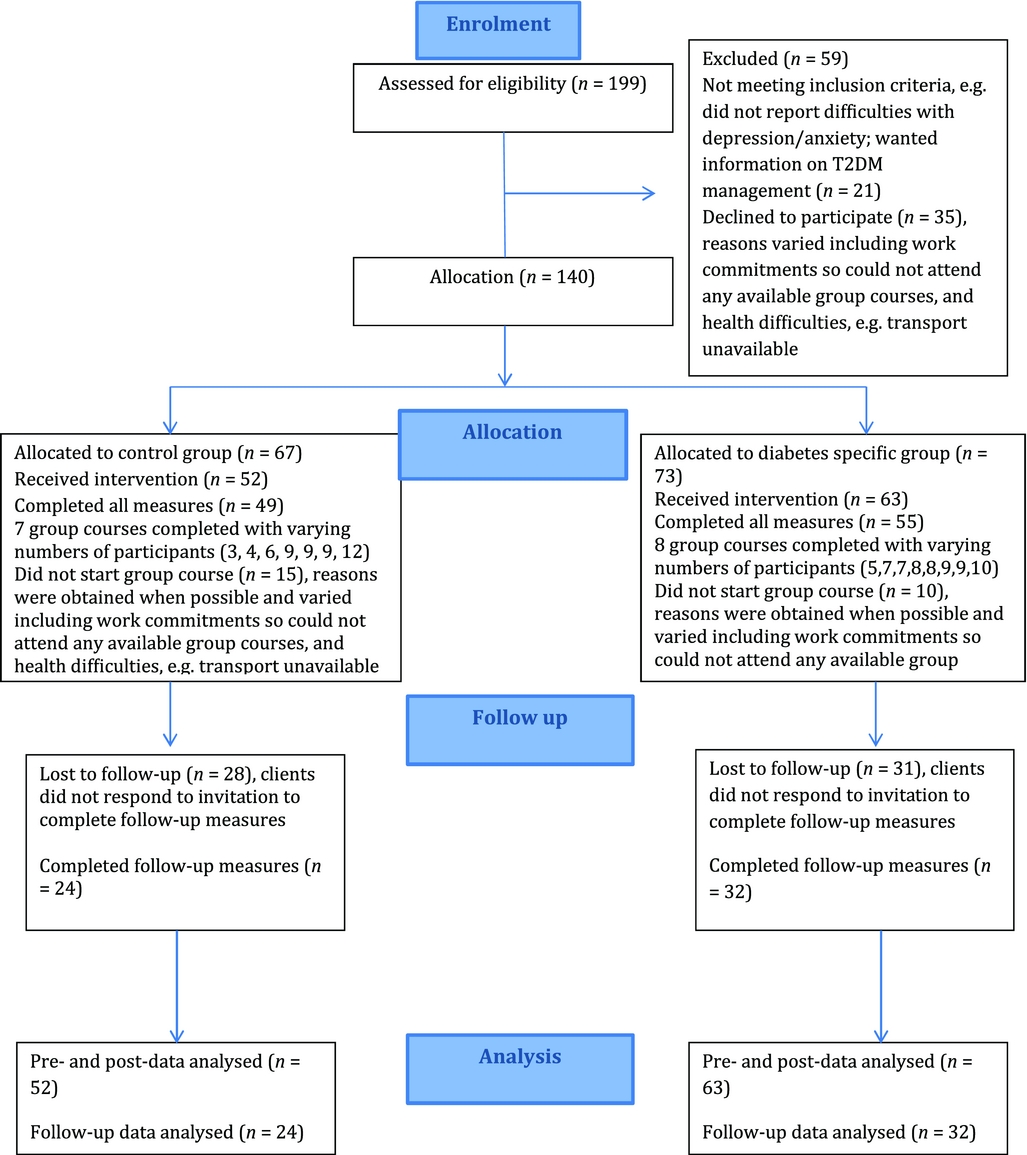
Forty-six per cent (n = 8113) of the Berkshire West GP patient population (Jamie, 2013) who had T2DM, from 21 Berkshire surgeries, were sent a letter inviting them to take part in research in managing low mood and worry (from March 2012 to June 2013), being run across Berkshire West. In the letter, individuals were informed that if they took part in the research, they would be allocated to either a group who received an intervention that had been modified, or to a standard group (control condition). 199 individuals contacted the IAPT service by telephone and were booked for a telephone triage with a practitioner who had been specifically trained in helping clients to think about links between low mood and worry, and difficulties with managing T2DM. In order to be eligible to take part in the research, individuals were required to have diagnosis of T2DM, presenting with symptoms consistent with depression or anxiety, or both, as indicated by either PHQ-9 score of 10 or above, or GAD-7 score of 8 or above, and a clinical assessment that indicated a presentation of depression or anxiety. Potential participants were excluded if their goals for therapy were not related to an improvement in depression or anxiety, e.g. those looking for more information on management of diabetes. Potential participants were excluded if their presentation was not suitable for primary care mental health services, e.g. those in receipt of secondary care mental health services. Out of the 199 people who attended the telephone triage, 140 people were invited to take part in the research, with the remaining 59 people presenting with specific reasons for not taking part (see Fig. 1).
Flowchart indicating method of recruitment

After triage and opting to take part in the research, participants were allocated to control condition (n = 67) or diabetes specific treatment condition (n = 73). The project was divided into five cohorts over a period of 10 months, with each cohort consisting of both a control group and diabetes specific treatment group that were run in parallel, and matched overall by location and time of day. After the triage, once participants had opted to take part in the research and gave verbal consent, they were asked to note the days, times of day and locations that they could attend sessions. The dates of the intervention and control groups had been pre-arranged, and the practitioner offering triage was aware of these dates and locations, but not aware which groups were the experimental condition and which were control condition. The participant's name was added to the group that suited them. When there was more than one group that suited their needs, the allocation was determined by block size such that individuals were allocated to the group with fewer people. The allocation procedure included randomization at this point such that if there was no difference, the name is randomly allocated to either group on a random 1 in 2 basis. The participants were not informed as to whether they had been allocated to intervention or control group.
Following verbal consent before allocation of the group course, participants gave written consent to take part in the research after the group was allocated (participants were not aware of the condition at this point). A proportion of the participants were invited, but did not attend any sessions of the groups (15 in the control group and 10 in the intervention group), leaving a total of 52 who attended control group sessions and 63 who attended sessions in diabetes specific treatment condition group (ratio 1:1.2). Based on previous research (Wroe et al., Reference Wroe, Rennie, Gibbons, Hassy and Chapman2015), which found a change in depression and anxiety with an effect size of 0.69 and 0.84 respectively, a sample size of 35 per group would provide a significant effect in terms of primary outcome of depression and anxiety. Based on findings of that study around glycaemic control, with an effect size of 0.63, a sample size of 50 participants would be required to obtain significant change from pre- to post-intervention. Participants were sent questionnaires 3 months after their group was completed. Follow-up data were obtained for 56 individuals (24 in the condition and 32 in the diabetes specific treatment condition). The remaining 60 participants who attended the groups either did not return follow-up questionnaires or declined providing further feedback.
Measures
Primary outcome measures were around depression and anxiety. The PHQ-9 (Kroenke et al., Reference Kroenke, Spitzer and Williams2001) was selected to measure symptoms of depression, and GAD-7 (Spitzer et al., Reference Spitzer, Kroenke, Williams and Löwe2006) was used to measures symptoms of anxiety. Both measures were obtained every session as is routine practice in the service, in order to have a minimum of outcome measures for individuals who did not attend every session. Reliable improvement was assessed using Jacobson and Truax's (Reference Jacobson and Traux1991) reliable change criteria. The measure of reliability used for the PHQ-9 and the GAD-7 was Cronbach's α, taken from the validation studies of the measures (Kroenke et al., Reference Kroenke, Spitzer and Williams2001; Spitzer et al., Reference Spitzer, Kroenke, Williams and Löwe2006). To be considered reliable, pre–post change on the PHQ-9 needed to exceed 5.55, and on the GAD-7 the comparable value was 4.02.
Secondary outcomes included measures of management of T2DM, firstly using a self-report scale, ‘Disinhibited Eating, and Summary of Diabetes Self-Care Activities’ questionnaire (SDSCA) (Toobert et al., Reference Toobert, Hampson and Glasgow2000). This asks about that person's recommended regimens, and then measures the numbers of days per week that the person adheres to a range of aspects of potential regimen, if that aspect has been recommended for that individual person: general diet (a healthy eating plan), specific diet (a diet high in fruit and vegetables and low in high-fat foods), exercise, blood sugar testing, medication and foot care. This measure was obtained only in the first and last session, as it was deemed too time consuming to complete every session, raising concerns about potential burden on participants. It is therefore only available as an outcome measure for individuals who attended the first and the last session of the groups.
As objective measures of T2DM management, secondary outcome measures included physiological measures such as glycosylated haemoglobin (HbA1c) measured by international federation of clinical chemistry standard (IFCC) measures of mmol/mol. HbA1C is the indicator for the last three months glycaemic control and the main predictor of diabetic complications. The reporting method was standardized and adopted during this study in 2012 and as such the latest international standard was used throughout converting old previous measures. As patients are sometimes tested only every 6–12 months by their GP, and due to the mandatory 3-month time lag between making any changes to diabetes management and changes in HbA1c measures, any readings obtained between 3 and 9 months after the end of the group were used. If there was more than one reading within this time frame, the first measure was used.
Secondary outcome included adjustment, which was measured by the Work and Social Adjustment Scale (WSAS) (Mundt et al., Reference Mundt, Marks, Shear and Greist2002). This was used every session as a measure of the adjustment in relation to work, home management, social leisure, private leisure and personal/family relationships.
Finally, secondary outcome measures included healthcare utilization, which was recorded as standard for every patient treated by the NHS, and includes planned hospital admissions, planned hospital out-patient appointments, unplanned emergency admissions, and Accident and Emergency attendance. The database was accessed via the health informatics department to obtain costs 0–6 months pre-group, and 6–12 months post-group.
The measures (PHQ, GAD, SDSCA and WSAS) were repeated 3 months after the end of the group.
Statistical analyses
The data were analysed using SPSS (version 13.0) with an a priori alpha level of 0.05 used for all statistical tests. Missing data were imputed using expected means, if data were found to be missing at random [using MCAR (missing completely at random) test]. Repeated measures analyses of variance were conducted for measures that met the criteria for parametric tests (normal distribution which was not skewed), to test the difference between the modified group and control group. Any interaction was further analysed using t-tests and paired t-tests. All measures met the test for normality apart from SDSCA frequency of taking medication, in which case non-parametric tests were conducted (Wilcoxon signed rank test). Due to the skewness of the post-groupHbA1c measures, these scores were transformed using a log transformation, which resulted in a normal distribution that was not skewed. These data were then analysed using paired t-tests.
Intervention
Individuals with T2DM were invited to attend a ‘Wellbeing Group’ focusing on low mood and worries. The groups ran weekly for 6 weeks (1.5 hours per session), with the number of people invited to each group ranging from 6 to 12. All groups were run by Step 2 IAPT practitioners who were skilled in running standard Wellbeing Groups that have shown to be effective regarding mood (PHQ and GAD) and adjustment (WSAS). The modifications in the diabetes specific treatment condition were based on the findings from the pilot study (Wroe et al., Reference Wroe, Rennie, Gibbons, Hassy and Chapman2015), and remained within the boundaries of IAPT Step 2 interventions, focusing on goal setting, behavioural activation, problem solving, cognitive restructuring, exposure therapy and sleep hygiene. The practitioners running the diabetes specific treatment group had training from a specialist clinical health psychologist and GP on working with T2DM, and received weekly clinical health psychology supervision. In total, 10 therapists delivered the interventions, with four therapists delivering the control groups and six therapists delivering the experimental groups. The reason for six therapists delivering the experimental group was because of therapist availability, with one of the therapists working part time. All six therapists were Psychological Wellbeing Practitioners (PWPs) with similarities in level of experience in both the experimental and control group. Each group had two PWPs with significant experience post-qualification (more than 2 years). The main adaptations were in the areas of engagement and the ‘language’ of the work. Practitioners who ran the diabetes specific treatment groups were trained in health psychology models (Leventhal et al., Reference Leventhal, Benyamini, Brownlee, Diefenbach, Leventhal, Patrick-Miller, Robitaille, Petrie and Weinman1997) in order to help them think about illness beliefs, and were also trained in using socratic questioning as opposed to didactic teaching, as is more commonly used in the standard wellbeing groups. This was selected as an additional technique necessary in this intervention, based on findings from the service development phase of this work (Wroe et al., Reference Wroe, Rennie, Gibbons, Hassy and Chapman2015). It was suggested that this technique supported clients in moving from exploring their experiences of living with T2DM to identifying thoughts, feelings and behaviours that are relevant to their maintaining cycles of low mood or anxiety, and therefore to help participants develop their own idiosyncratic understanding of the link between their mood and T2DM management.
The research followed the procedure approved by The National Research Ethics Service (NRES) Southampton A 12SC0103 initially for one year and granted a further year's extension for follow-up. Potential harm of the intervention was not assessed systematically. However, risk issues were monitored as a standard part of the service. As is standard in the service, individuals were contacted between sessions if they scored 2 or more on item 9 of the PHQ-9 (which asks about thoughts of harming oneself) to assess and monitor risk. The research was funded by the Department of Health, executed through the National IAPT Team.
Results
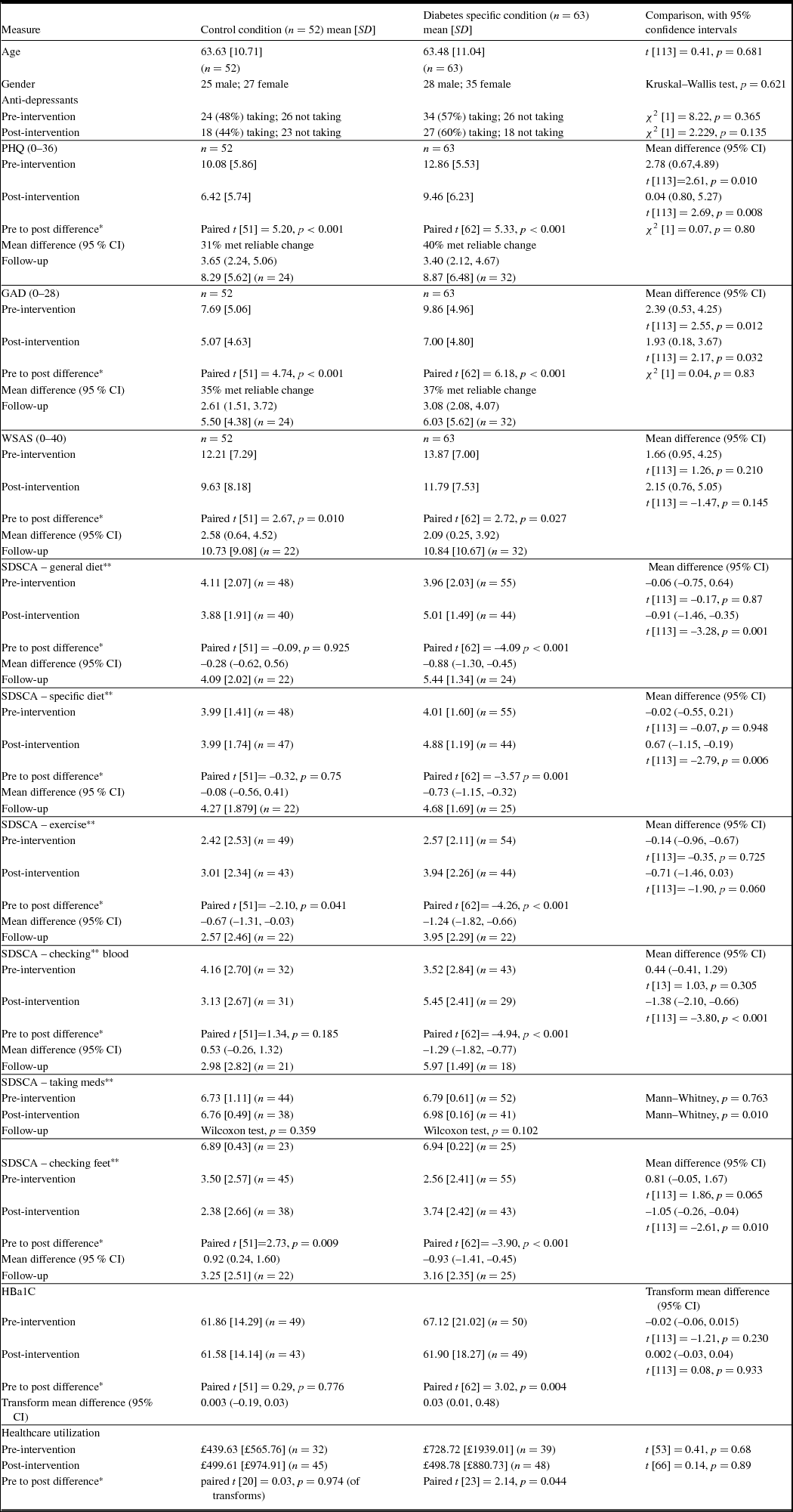
There were no significant differences in age or in scores. Pre-group measures also showed no differences between conditions (see Table 1).
Pre-group measures and condition comparisons include post and follow-up data

*Statistical tests of the pre to post difference include imputed data where relevant. The pre and post interventions means shown in the table for each measure include only participants who completed that measure. **Number of days of the week (0–7) this regimen was adopted (if recommended).
In the control condition, 37 people (71.2%) attended at least four sessions. This was comparable to the diabetes specific treatment condition in which 42 people (66.7%) attended at least four sessions. As PHQ, GAD and WSAS are obtained every session, these are available for all clients; all participants who attended any sessions were therefore included in these analyses. For clients who did not attend sessions 1or 6, pre- or post-group measures of the SDSCA are not available.
Measures of mood
There were no significant interactions between time point and conditions regarding scores on PHQ (F [1,113] = 0.94, p = 0.787) or scores on the GAD (F [1,113] = 0.39, p = 0.533) (see Table 1). Both measures showed significant main effect of time (PHQ F [1,113] = 55.32, p < 0.001; GAD F [1,113] = 58.82, p < 0.001), demonstrating improvements from pre- to post-intervention in both conditions. There was also a main effect of condition (F [1,113] = 8.66, p = 0.004) for PHQ such that the intervention condition had higher scores than the control group, and no main effect of condition for GAD (p > 0.05). Due to significant pre-intervention differences between the conditions, ANCOVA was used, demonstrating no effect of condition (PHQ: F [1,114] = 1.72, p = 0.193; GAD: F [1,114] = 0.37, p = 0.542). There was also no difference between the groups in the proportion of participants who made a reliable improvements: PHQ (χ2 [1] = 0.07, p = 0.80); GAD (χ2 [1] = 0.04, p = 0.83).
Measure of Work and Social Adjustment
Repeated measures ANOVA for WSAS demonstrated no significant interaction between time-point and condition (F [1,113] = 0.13, p = 0.715) and no main effects of condition (p > 0.05), but a main effect of time point (F [1,113] = 12.13, p < 0.001) due to an improvement in scores in both conditions (see Table 1).
Self-report measures of Diabetes Management (SDSCA)
Data were found to be missing at random (MCAR test, χ2 between 28 and 30, p > 0.07 in all cases). Expected neans imputation process was then used to impute missing data.
-
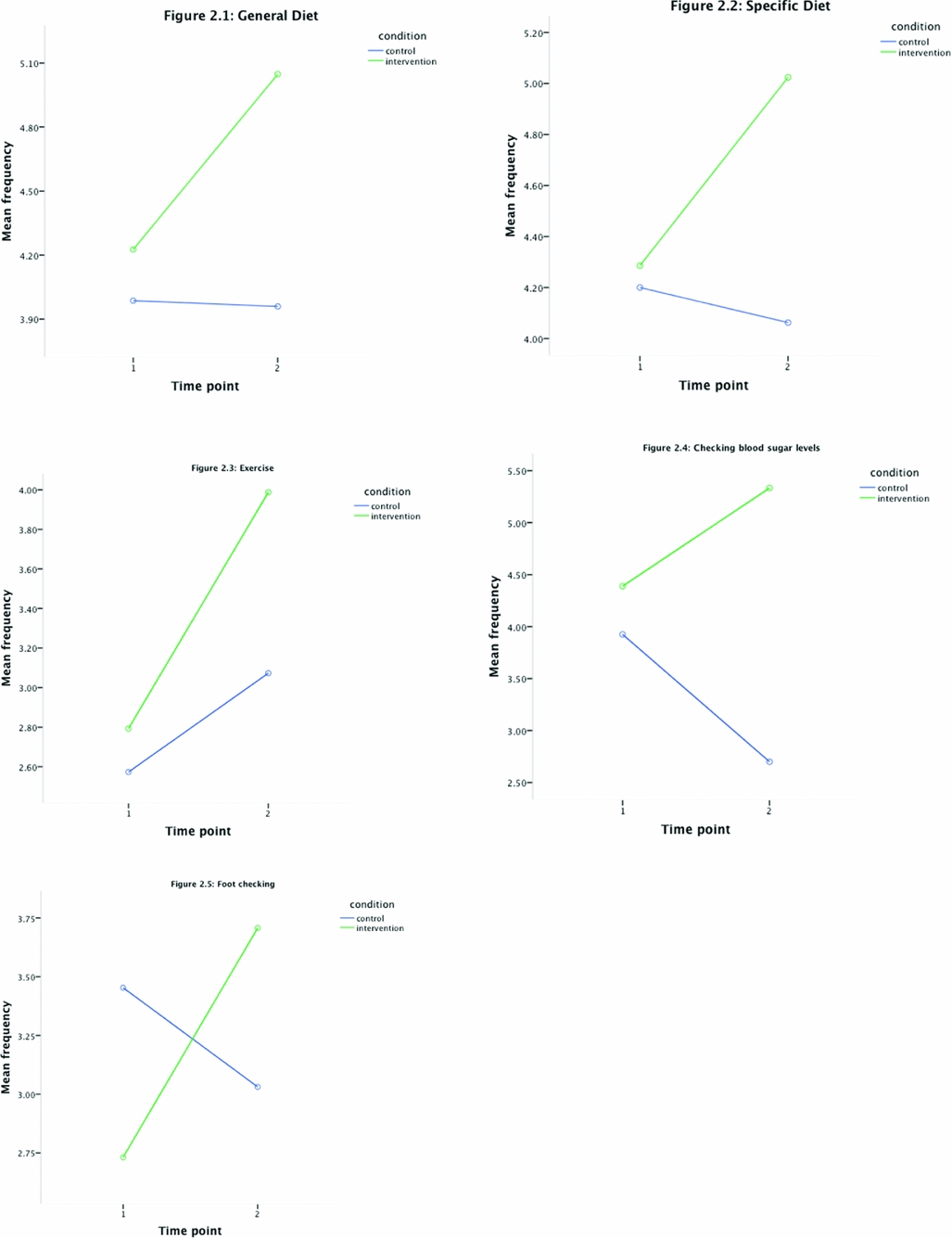
(I) Repeated measures ANOVA for general diet demonstrated a significant interaction between time-point and condition (F [1,113] = 5.68, p = 0.019) (analyses conducted without imputed data demonstrated significant interaction: F [1,77] = 4.15, p = 0.045). Post-hoc analyses demonstrated a significant improvement in the diabetes specific treatment condition and no significant change in the condition (see Fig. 2.1).
-
(II) Repeated measures ANOVA for specific diet demonstrated a significant interaction between time-point and condition (F [1,113] = 4.33, p = 0.040) (analyses conducted without imputed data demonstrated significant interaction: F [1,80] = 4.48, p = 0.037). Post-hoc analyses demonstrated a significant change improvement in scores in the diabetes specific treatment condition compared with no significant change in the control condition (see Fig. 2.2).
-
(III) Repeated measures ANOVA for frequency of exercise demonstrated no significant interaction between time-point and condition (F [1,113] = 1.73, p = 0.191) and no main effect of condition (F [1,113] = 1.70, p = 0.195). However, there is a main effect of time (F [1,113] = 19.52, p < 0.001) (analyses conducted without imputed data demonstrated significant interaction: F [1,80] = 1.70, p = 0.195). Paired t-tests demonstrated significant improvements in both groups (see Fig. 2.3).
-
(IV) Repeated measures ANOVA for frequency of testing sugar levels demonstrated a significant interaction between time-point and condition (F [1,113] = 15.73, p < 0.001) (analyses conducted without imputed data demonstrated significant interaction: F [1,45] = 9.26, p = 0.004). Post-hoc analyses demonstrated a significant improvement in the diabetes specific treatment condition and no significant change in the control condition (see Fig. 2.4).
-
(V) Wilcoxon signed rank test for frequency of taking medication showed no significant change in the diabetes specific treatment condition (p = 0.359) or control condition (p = 0.102).
-
(VI) Repeated measures ANOVA for frequency of checking feet demonstrated a significant interaction between time-point and condition (F [1,113] = 21.02, p < 0.001) (analyses conducted without imputed data demonstrated significant interaction: F [1,71] = 6.25, p = 0.015). Post-hoc analyses demonstrated a significant improvement in the intervention condition and no change in the control condition (see Fig. 2.5).
Graphs to show changes in self-management of diabetes in the control condition and diabetes specific treatment condition (of individuals who completed both pre- and post-measures)

Glycaemic control
Due to skewed data, the HbA1c scores were transformed using a log transformation. Using imputed data for missing variable, repeated measures ANOVA demonstrated a non-significant interaction between time-point and condition (F [1,113] = 3.02, p = 0.085) (analyses conducted without imputed data demonstrated significant interaction: F [1,90] = 5.08, p = 0.027). Post-hoc analyses demonstrated significant improvements in the diabetes specific treatment condition and no significant change in the control condition (see Table 1).
Healthcare utilisation
Due to failure to meet tests of normality and skewness, scores were transformed using log 10. Missing data were not imputed due to a high proportion of missing data (38% of pre-data). Repeated measures ANOVA demonstrated no significant interaction between condition and time point (F [1, 42] = 2.52, p = 0.119) and no main effects of time (F [1,43] = 2.39, p = 0.130) or of condition (F [1,42] = 0.24, p = 0.624). Exploratory analyses were conducted to investigate this further, and whilst there was no change in costings of the control group (t < 1), there was a non-significant reduction in costings of the intervention group (t [23] = 2.14, p = 0.054) from £728.72 in the 6 months before the group was conducted, to £498.78 during the period 6–12 months after the group was conducted.
Follow-up measures
Follow-up measures were obtained (n = 56, 49%) 3 months after the groups were completed. Of these, 24 were in the control condition and 32 in the diabetes specific treatment condition. Due to high frequency of missing data, this was not imputed. In the control condition, there were significant improvement from pre to follow-up measures of PHQ-9 (t [21] = –2.79, p = 0.010) and GAD-7 (t [23] = 3.14, p = 0.005), and no significant differences in other measures. In the intervention group, there were significant improvements from pre to follow-up measures in PHQ-9 (t [31] = 3.47, p = 0.002), GAD-7 (t [31] = 3.99, p < 0.001) general diet (t [23] = –3.71, p = 0.001), exercise (t [21] = 3.56, p = 0.046) and frequency of checking blood sugars (t [17] = –3.51, p < 0.001), and no changes in other measures (see Table 1).
Discussion
Whilst both the standard control group and the modified intervention were effective in improving mood scores, and work and social adjustment, results demonstrate that the modified intervention is more effective with regard to the management of T2DM, compared with the control group. This finding is consistent between self-report measures of T2DM management and the objective measures of glycaemic control measured 3–9 months following the end of treatment. Findings also suggest a trend in terms of benefits in terms of the secondary (hospital related) care costs. However, the sample size is small. Furthermore, improvements in mood and management of T2DM in terms of general diet, exercise and frequency of checking blood sugar levels were maintained at the 3-month follow-up for the modified group. The proportion of participants in the current research who met reliable change on measures of mood is comparable to the proportions found across the National Health Service (Gyani et al., Reference Gyani, Shafran, Layard and Clark2013). However, the standard interventions are not effective in terms of improving management of T2DM. In order to show improvement regarding such measures, as well as improvement in glycaemic control, it was necessary to modify the intervention with specialist input and regular supervision, namely a GP and clinical health psychologist, so that it was specifically tailored to T2DM and its management. This is consistent with recent work by Roth and Pilling (Reference Roth and Pilling2015) stating specific competences required when working psychologically with people with physical health conditions.
These findings are key given the expansion in UK primary care (IAPT) services to work with people with long-term physical illness (Department of Health, 2011). If such services are to offer effective interventions, it is necessary to understand the specific competences required to work psychologically with such clients, without which it is unlikely that clients will engage with therapy (Wroe et al., Reference Wroe, Rennie, Gibbons, Hassy and Chapman2015), and as demonstrated in this work, will not benefit in terms of improved management of the condition. The facilitators (practitioners) developed these additional competences by attending teaching sessions from a GP on T2DM and its management, and attending clinical skills training and supervision from a clinical health psychologist around engagement, the role of illness beliefs, the use of socratic questioning, and an ability to help clients understand the link between mood and management of their T2DM.
A strength of the study is the way the intervention was run in an IAPT setting, which means that it can be generalized to other IAPT services. Practitioners in this study were invited to attend weekly supervision as frequently as possible dependent on their heavy workload and work schedule. Furthermore, although continuity of care was provided when possible, some groups did not have the same facilitator at each session. Sessions in the intervention group were always covered by a practitioner who was ‘upskilled’ and running other intervention groups. Likewise, sessions in the control group were covered by practitioner who was not ‘upskilled’. The potential impact of this was not measured. These challenges were felt to be typical of a busy IAPT setting, and so realistic issues that would need to be taken into account when considering the results found in this study. Furthermore the intervention is generalizable to other IAPT service in that the modified intervention stayed within the boundaries of Step 2 IAPT interventions for mild to moderate anxiety/depression in line with NICE guidelines (NICE, 2009a,b; NICE, 2011a,b), which was a key objective for this study. Another strength of the study is that scores on the PHQ, GAD and WSAS were obtained every session. This ensured that outcome variables were available for all clients, even if they did not attend the final session.
It is worth noting a potential limitation of the findings of this study. Participants entered the service following the standard procedure, and were then flagged to have a ‘modified’ diabetes triage. Although the triage was the same format and length as a standard triage, it was modified in a way that was found to be helpful in the previous research in terms of engagement and attendance of sessions (Wroe et al., Reference Wroe, Rennie, Gibbons, Hassy and Chapman2015) and was conducted by an ‘up-skilled’ practitioner who introduced the concept of linking mood with management of T2DM. It is interesting to note that, in the current research, the attendance rates were no different between the modified group and the control group. This is not consistent with previous findings (Wroe et al., Reference Wroe, Rennie, Gibbons, Hassy and Chapman2015). It is likely that the engagement process started at the point of triage, such that the findings of the control condition may be improved compared with a protocol in which the standard triage was offered. In both groups, about 70% of participants attended at least four sessions. This figure is comparable to previous findings in a general IAPT service. For example, in the IAPT demonstration site in Doncaster, Clark et al. (Reference Clark, Layard, Smithies, Richards, Suckling and Wright2009) found that of those offered low-intensity treatments for depression and anxiety, 34% dropped out of treatment or discontinued. It would be helpful in future research to allocate individuals to conditions before triage.
A further limitation is around the allocation process. The process was as close to randomization as possible, within the limitation of the service set up. This meant that people were allocated to condition based on suitability of groups on the basis of time and location, and on size of groups, and only if there were still options at that point, on 1 in 2 randomization. The participants were not aware, at that point, as to whether the group course was intervention or control. However, once the group course commenced, it is likely that they could make assumptions based on the content of the group course.
It is also worth noting that there may be differences between the groups based on particular therapists; therapists completed either modified intervention or standard intervention, and therefore the groups were facilitated by different individuals. This protocol was used as it was judged that it would be difficult for upskilled practitioners to stick to the standard intervention. Several therapists conducted group courses in each condition, thus diluting the effects of any potential individual differences. Furthermore, the therapist competence was not measured. Adherence to the protocol and relevant adaptations was also not systematically assessed. However, this was discussed regularly in supervision.
It is not possible to know whether changes may have been due to changes in anti-depressant medication. However, this possibility was limited by the use of the control condition. Furthermore, there were no differences in the start of therapy or post-intervention in the proportions of individuals in each condition who were taking anti-depressant medication.
The findings regarding healthcare usage are limited. It may be that modified psychological interventions that support patients in terms of depression and anxiety and management of their T2DM, could also reduce healthcare usage. It is likely that a larger sample is required to demonstrate any effect, and a longer follow-up period. A previous study, investigating the healthcare effectiveness of a depression intervention run by specialist nurses, with 329 participants, found savings of $1100 per person in the period up to 24 months after therapy began (Simon et al., Reference Simon, Katon, Lin, Rutter, Manning, von Korff, Ciechanowski, Ludman and Young2007). The findings are limited and further research is required to evaluate this. Analysis of the cost of psychological therapy compared with any savings to other healthcare costs is required to support arguments that psychological therapy for people with long-term physical illness offers an economic benefit through reduction of physical healthcare usage (Layard and Clark, Reference Layard and Clark2014).
These findings lend some support to the argument that psychological work focusing specifically on depression and anxiety may be effective regarding diabetes management (e.g. Lamers et al., Reference Lamers, Jonkers, Bosna, Knottnerus and van Eijk2011; Snoek et al., Reference Snoek, van der Ven, Twisk, Hogenelst, Tromp and van der Ploeg2008), but with the pre-requisite that interventions focusing on depression and anxiety are tailored to the T2DM and its management, and that the facilitators are skilled in competences around working with T2DM, as well as in focusing on depression and anxiety. Based on the competency framework (Roth and Pilling, Reference Roth and Pilling2015) which states the importance of engagement, role of illness beliefs, and importance of the link between depression/anxiety and conditions management, it is possible that the adaptations noted in this research are necessary in offering interventions focusing on depression and anxiety in the context of long-term physical illnesses, and further research is required to address this.
The main question addressed by this paper is whether evidence-based IAPT interventions for the treatment of mild to moderate depression and anxiety can be effective for people with long-term physical illness in terms of both mood and condition management. These findings support previous research (Wroe et al., Reference Wroe, Rennie, Gibbons, Hassy and Chapman2015, pp. 424) suggesting that in order for standard psychological interventions to be effective, ‘adaptations need to be made such that the interventions are specifically tailored to the condition in question, with practitioners attending specific training in working with people with long-term physical illness and with input from health professionals with expertise in the medical condition, in this case a GP and a specialist clinical health psychologist.’
Acknowledgements
The authors would like to thank all of the clients who attended the groups, and their invaluable feedback. Special thanks are due to the five participating Berkshire general practices (Theale, Milman Road, Potteries Tilehurst, Brookside and Parkside surgeries) who allowed their patients to be written to and invited, as well as providing sites from which the groups ran.
Financial support: The research was funded by the Department of Health, executed through the National IAPT Team.
Ethical statement: The research followed procedures approved by the National Research Ethics Service (NRES) Southampton A 12SC0103, initially for one year and granted a further year's extension for follow-up.
Conflicts of interest: Abigail L. Wroe, Edward W. Rennie, S. Solesse, J. Chapman and A. Hassy have no conflicts of interest with respect to this publication.



Comments
No Comments have been published for this article.