Introduction
Recent empirical studies have demonstrated clear differences between speakers with different native languages in a variety of cognitive domains, including color (e.g., Davidoff, Davies & Roberson, Reference Davidoff, Davies and Roberson1999; Roberson, Reference Roberson2005), time (e.g., Boroditsky, Reference Boroditsky2001), space (e.g., Levinson, Reference Levinson1996; Majid, Bowerman, Kita, Haun & Levinson, Reference Majid, Bowerman, Kita, Haun and Levinson2004), and grammatical number (e.g., Lucy & Gaskins, Reference Lucy and Gaskins2003). Overall, these studies lend support to the idea that speakers of different languages are influenced by their language-specific linguistic patterns to make different types of evaluations and observations of the world (Whorf, Reference Whorf1956). This hypothesis, known as the linguistic relativity hypothesis, suggests that a speaker's language directs him or her to perceive various cognitive domains differently than speakers of other languages, thus resulting in speakers’ different perceptions. Although the idea of the validity of linguistic relativity has been a source of lively debate in the fields of linguistics and psychology for the last few decades, recent research has provided cogent evidence that various language-encoded concepts, including lexical and grammatical features, affect speakers’ different cognitive processes, such as classification, categorization, and similarity judgments.
In addition, revived interest in cross-linguistic influence has also pushed bilingual research to explore the effects of knowing and using two languages, thus contributing to the expansion of the scope of linguistic relativity. For example, the effect of using two or more languages on the structuring of one's cognitive domains has been carefully examined in relation to bilingualism's associated factors, such as age of onset, frequency of language use, and language proficiency. More specifically, studies have sought to answer the following two questions: If a speaker's second language (L2) contains different grammatical and lexical properties than the first (L1), how might the two languages interact and influence the speaker's categorization and conceptualization patterns? Will the L1 preferences maintain dominance or will the influence of the L2 result in cognitive restructuring? The current study adds to the growing body of bilingual research (Athanasopoulos, Reference Athanasopoulos2006, Reference Athanasopoulos2007, Reference Athanasopoulos2009, Reference Athanasopoulos2011; Athanasopoulos & Kasai, Reference Athanasopoulos and Kasai2008) examining whether bilinguals’ categorical perception remains in a static state, formed and maintained by the speaker's L1, or whether the learning of lexical and grammatical features in a new language results in cognitive restructuring in the bilingual mind. Using an experimental design, this research seeks to investigate the use of spatial domains (i.e., containment and support) by Korean–English adult bilingual speakers in comparison to those of Korean and English monolinguals. By examining various factors that influence conceptual restructuring, this study aims to offer a more complete account of the influence of novel language acquisition on the bilingual mind.
Categorical concepts of monolingual speakers
Cross-linguistic research in L1 acquisition has demonstrated that languages may differ in the way they interpret and categorize different conceptual domains such as quantification, color, and space (Choi & Bowerman, Reference Choi and Bowerman1991; Levinson, Reference Levinson1996, Reference Levinson2001). For instance, speakers of languages that make a clear distinction between count and mass nouns, such as English, were found to be more likely to make similarity judgments based on common shape, while speakers of languages that quantify all nouns as mass nouns, such as Japanese or Yucatec, were more prone to base similarity judgments on material properties (Imai & Gentner, Reference Imai and Gentner1997; Imai & Mazuka, Reference Imai and Mazuka2003; Lucy, Reference Lucy1992; Lucy & Gaskins, Reference Lucy and Gaskins2001). In Lucy and Gaskins (Reference Lucy and Gaskins2001, Reference Lucy and Gaskins2003), the findings indicated that adult English and Yucatec speakers categorized non-solid substances in a similar manner. However, when presented with triads containing solid substances in a similar judgment task, the English speakers matched items based on shape while the Yucatec speakers matched items based on material. This difference in categorization was attributed to the fact that English has count nouns that encode individuality, which is best conceptually represented by shape, whereas Yucatec does not. Due to the absence of count nouns in Yucatec, speakers’ attention is drawn to other conceptual representations, such as material. The authors concluded that these linguistically specific categorization patterns are formed in childhood, and vary between different languages.
Another cognitive domain that has been the focus of recent bilingual research is that of color perceptions. A number of studies have suggested that speakers of different L1s divide the color spectrum differently and demonstrate different lexical coding of color. For instance, speakers of Russian are able to distinguish between shades of blue more quickly and with finer distinctions than English speakers. Such conceptual differences can be explained by the inherent differences in the color properties of the speaker's L1: Russian has a required lexical distinction between light and dark shades of blue, while English does not make a lexical distinction between these color shades (Roberson & Davidoff, Reference Roberson and Davidoff2000; Winawer, Witthoft, Frank, Wu, Wade & Boroditsky, Reference Winawer, Witthoft, Frank, Wu, Wade and Boroditsky2007).
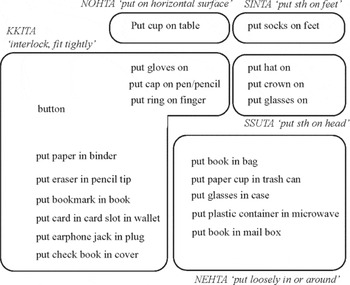
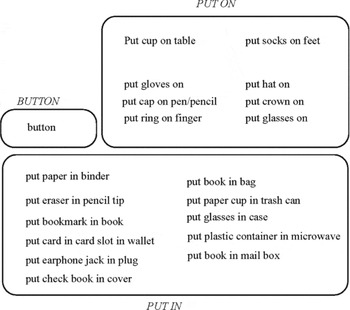
The influence of language-specific input on cognition has also been confirmed in cross-linguistic studies on spatial domains (Levinson, Reference Levinson1996; Talmy, Reference Talmy and Kimball1975, Reference Talmy and Shopen1985), suggesting that languages also differ in the way they semantically structure space. For example, L1 research (e.g., Bowerman, Reference Bowerman1996; Bowerman & Choi, Reference Bowerman and Choi2001, Reference Bowerman and Choi2003; Choi & Hattrup, Reference Choi and Hattrup2012; Choi, McDonough, Bowerman & Mandler, Reference Choi, McDonough, Bowerman and Mandler1999; McDonough, Choi & Mandler, Reference McDonough, Choi and Mandler2003) has shown that both child and adult speakers of Korean and English differ significantly in grouping and partitioning various types of containment and support relations. Their findings indicate that children learning English as their first language make a distinctive semantic contrast between the spatial particles in and on based on whether the relation involves containment or support, respectively. On the other hand, Korean children acquire a path verb kkita, which cuts across the English “on–in” contrast; that is, what English considers to be unified categories (e.g., put on and put in) are subdivided into tight-fitting and loose-fitting categories for speakers of Korean. Tight-fitting events can be described as kkita irrespective of support or containment, while verbs vary respectively with close containment and support (see Figure 1). Although Lucy and Gaskins (Reference Lucy and Gaskins2001, Reference Lucy and Gaskins2003) stated that language-specific representations are formed around the ages of seven to nine, Choi and her colleagues have shown that children as early as 18 months old understand nonlinguistic spatial categorization in a language-specific way (Choi et al., Reference Choi, McDonough, Bowerman and Mandler1999). These findings clearly demonstrate that the semantic organization of a speaker's language plays a significant role in shaping his/her nonlinguistic spatial concepts, as well as the fact that these conceptual organizations may be formed during early childhood.
Categorical concepts in the bilingual mind
Overall, cross-linguistic research suggests that language and conceptual cognition are connected, and that linguistic influence on one's mind is evident from a very early age. As interest in bilingual cognition research has grown, the topic of linguistic relativity has been more extensively discussed in relation to bilinguals. Given that speakers of different languages evaluate the perceptual attributes of their reality in different ways, recent research has been concerned with the issue of how learning and using two languages, particularly when they contain different grammatical and lexical categories, affects conceptual categorization within the bilingual mind. Pavlenko (Reference Pavlenko2011a) suggests that the bilingual mind undergoes different processes of cognitive shift depending on where the speaker falls on the continuum of monolingualism and bilingualism. As speakers learn and use an L2, novel perspectives and frames of reference from the L2 may be internalized, leading to the restructuring of the frames and categories of the speaker's L1. This cognitive change, represented as transformations in speakers’ linguistic categories, can be manifested in the bilingual mind in a number of ways.
One of the processes that the bilingual mind may experience is what Pavlenko (Reference Pavlenko2011a) refers to as co-existence, in which bilinguals maintain the categories unique to each language and use them in agreement with the constraints of specific languages. Sachs and Coley (Reference Sachs, Coley and Pavlenko2006) provided evidence for co-existence through their investigation of Russian–English bilinguals’ emotional conceptualizations of envy and jealousy. Results indicated that bilinguals tested in English perceived envy and jealousy like English monolinguals, while bilinguals tested in Russian categorized the emotions similar to Russian monolinguals. These findings offer support for the idea that bilinguals are capable of using native-like conceptualization patterns in both L1 (i.e., Russian) and L2 (i.e., English) emotional categorization tasks, and that these patterns can be conveniently accessed by bilingual speakers depending on their language environment.
Another process that bilinguals commonly experience is the influence of the L1 on the L2 (Pavlenko, Reference Pavlenko2011a). During this process, bilingual speakers’ L2 performance is guided by L1 properties, preferences, categories, and frames of reference. Bilinguals experiencing L1 influence may be thinking in their L1 in order to drive performance in the L2, although this reliance may be imperceptible even to the speaker. Empirical evidence supporting conceptual transfer has been found mainly in studies examining object categorization, particularly in unbalanced bilinguals of beginning and intermediate L2 proficiency. In Athanasopoulos (Reference Athanasopoulos2006), in which the grammatical representation of number in intermediate and advanced Japanese–English bilinguals was examined, findings confirmed that proficiency could be a significant factor in shaping bilinguals’ conceptual cognition. Results indicated that the intermediate bilinguals continued to match stimuli based on changes in the number of Animals, adhering to a more L1-Japanese–based conceptual representation, rather than matching stimuli based on the number of Implements or Substance, considered to be a more L2 English representation. This suggests that the stronger influence of the L1 on the bilinguals’ L2 performance is more evident with bilinguals of lower L2 proficiency. Furthermore, these findings support Pavlenko's (2005) claim that bilingual cognition is susceptible to the influence of language development.
The third process, and the most relevant to the current research, is the convergence of L1 and L2 categories, whereby a unitary conceptual category distinct from both L1 and L2 concepts emerges. Since the new category does not fully resemble either an L1-based or L2-based category, the change is also deemed divergent (Jarvis & Pavlenko, Reference Jarvis and Pavlenko2008). During this phase, bilinguals demonstrate conceptualization patterns that are between those of monolingual speakers of both languages, exhibiting what is called “in-between performance” (Pavlenko, Reference Pavlenko2011a, p. 247). Bilinguals’ conceptualization patterns may contain some features similar to L1 monolinguals and some features similar to L2 monolinguals, but they would not completely match one particular language-specific pattern. Such L1–L2 integration has been identified in a number of cognitive domains, including color (Jameson & Alvarado, Reference Jameson and Alvarado2003) and object naming (Cook, Basetti, Kasai, Sasaki & Takahasi, Reference Cook, Bassetti, Kasai, Sasaki and Takahashi2006). In addition, Hohenstein, Eisenberg and Naigles’ (Reference Hohenstein, Eisenberg and Naigles2006) study of early- and late-onset Spanish–English bilinguals also provided evidence supporting the process of convergence in the domain of motion. Using twelve videos depicting different motion events, the researchers examined whether the use of manner or path verbs in Spanish or English was affected by the acquisition of English as an L2. After viewing the videos, participants were interviewed about the actions represented in each video. Results indicated that bilinguals’ in-between performance in conceptualizing motion was reflected in their token frequency of manner verbs: in their Spanish descriptions, bilinguals used fewer manner verbs than the English monolinguals, but more than the Spanish monolinguals. Conversely, participants also used more manner verbs than the Spanish monolinguals, but fewer than the English monolinguals, in their English descriptions. The bilinguals’ divergence from both L1 and L2 patterns clearly reveals that Spanish–English bilinguals’ conceptualization of motions no longer aligned with that of either monolingual group, suggesting convergence of L1 and L2 categories. However, convergence of the L1 and L2 is not always manifested in the form of in-between performance. Bassetti and Cook (Reference Bassetti, Cook, Cook and Bassetti2011) state that convergence also consists of patterns that do not necessarily represent concepts that are in-between the two languages. Thus, concepts that are completely different from either language could be seen as evidence of convergence since they diverge from the classification preferences of the monolingual groups.
Convergence can also be interpreted as evidence of cognitive restructuring, or the restructuring of a speaker's mental representations of different concepts (Jarvis & Pavlenko, Reference Jarvis and Pavlenko2008) in the bilingual mind. As bilinguals learn and use their L2, their conceptual patterns may begin to diverge from the initial L1 pattern, changing to represent more closely the patterns of the L2. Evidence of cognitive restructuring can be seen in recent work in the domain of color (Athanasopoulos, Reference Athanasopoulos2009) and object categorization (Athanasopoulos, Reference Athanasopoulos2006, Reference Athanasopoulos2007; Athanasopoulos & Kasai, Reference Athanasopoulos and Kasai2008). Athanasopoulos and Kasai (Reference Athanasopoulos and Kasai2008) sought to answer whether English–Japanese bilinguals would match objects based on color or shape. Using triads consisting of color illustrations of novel objects in a similarity judgment task, participants were required to match the standard with one of the two alternate illustrations. Results indicated that advanced bilinguals performed more like monolingual speakers of their L2, while intermediate bilinguals performed in a similar manner to speakers of their L1. These findings demonstrate L1 influence on the L2 for the intermediate speakers, and convergence, or cognitive restructuring in the direction of the L2, for the advanced speakers.
The degree to which bilingual speakers’ conceptualization patterns may be affected is influenced by a variety of factors, including age of onset (Bylund & Jarvis, Reference Bylund and Jarvis2011; Hohenstein et al., Reference Hohenstein, Eisenberg and Naigles2006; Pavelenko & Malt, Reference Pavlenko and Malt2011), length of stay in the L2-speaking country (Athanasopoulos, Reference Athanasopoulos2007, Reference Athanasopoulos2009; Cook et al., Reference Cook, Bassetti, Kasai, Sasaki and Takahashi2006), and proficiency (Athanasopoulos, Reference Athanasopoulos2009; Athanasopoulos & Kasai, Reference Athanasopoulos and Kasai2008). Other studies have demonstrated that the L1 may be subject to restructuring of linguistic conceptualizations and attrition depending on environmental factors, such as context and frequency of use. For instance, Athanasopoulos, Damjanovic, Krajciova and Sasaki (2011) reported that Japanese–English bilinguals who used English more often than Japanese were more likely to identify shades of blue like English monolinguals. That is, the color perceptions of Japanese–English bilinguals were most significantly influenced by the amount of L2 use in their daily lives. Overall, the degree of influence of linguistic and extra-linguistic factors on bilinguals’ cognitive shift remains unclear, with more research needed to clarify the most robust predictors of bilinguals’ conceptual change.
Seeking to expand the scope of studies concerning cognitive change, the current research sets out to investigate the conceptualization of space in Korean–English bilinguals. Extending the work of Choi and Bowerman (Reference Choi and Bowerman1991), this study will examine whether Korean–English bilinguals’ conceptualization of space is divergent from that of Korean and English monolinguals. Specifically, the use of the Korean path verb kkita among Korean–English bilinguals will be investigated to promote better understanding of cognitive change in the bilingual mind. In addition, the current study aims to clarify the influence of linguistic and extra-linguistic variables commonly associated with bilingualism, such as age of onset and arrival, proficiency, and frequency of use, on the cognitive restructuring of adult Korean–English bilingual speakers. Despite the fact that bilingual research on cognitive change has become more productive in recent years, more research is warranted to understand the role of different linguistic and extra-linguistic factors on various conceptual domains, such as space, in the bilingual mind. The three research questions of the current study are as follows:
-
1. Do Korean and English adult monolinguals and Korean–English adult bilinguals categorize spatial concepts differently?
-
2. If so, how are their spatial conceptualizations different?
-
3. What is the relationship between bilinguals’ spatial conceptualizations and linguistic and extra-linguistic variables associated with bilingualism (e.g., language proficiency, frequency of language use, age of arrival, and age of onset)?
On the basis of previous cross-linguistic studies (e.g., Choi & Bowerman, Reference Choi and Bowerman1991; Choi & Hattrup, Reference Choi and Hattrup2012; Lucy & Gaskins, Reference Lucy and Gaskins2001; McDonough et al., Reference McDonough, Choi and Mandler2003) that have provided evidence for the different conceptual categorizations of adult speakers of different languages, it is hypothesized that Korean and English adult monolingual speakers will follow the spatial conceptualization patterns of Korean and English children, respectively, as documented in Choi and Bowerman (Reference Choi and Bowerman1991). Moreover, we expect Korean–English bilinguals in the current research to display evidence of cognitive change, which will be manifested as L1–L2 convergence in the experiment. Their cognitive shift may be significantly influenced by age-related or language-related variables, such as L2 proficiency, frequency of use, and age of onset and arrival, as supported by previous studies (Athanasopoulos, Reference Athanasopoulos2009; Athanasopoulos & Kasai, Reference Athanasopoulos and Kasai2008; Athanasopoulos et al., Reference Athanasopoulos, Damjanovic, Krajciova and Sasaki2011; Hohenstein et al., Reference Hohenstein, Eisenberg and Naigles2006; Pavlenko & Malt, Reference Pavlenko and Malt2011).
Method
Participants
The final sample consisted of 76 adults in Seoul, Korea, and in Arizona and Washington, D.C. in the U.S., ranging in age from 18 to 69 years old. The mean age of the 17 Korean monolingual speakers was 39.88 (SD = 14.29), while the mean age of the 28 monolingual speakers of English, all undergraduates at a mid-size university, was 20.13 (SD = 2.78). The mean age of the 31 Korean–English bilinguals, who were either temporary or permanent residents of the D.C. area, was 26.35 years (SD = 3.68). For the current study, bilingualism has been operationalized as the alternate use of two languages that are equivalent in terms of the speaker's proficiency (Romaine, Reference Romaine1995). Monolingual speakers had been minimally exposed to any foreign language, and their dominant language in everyday life was their native language. Following Bialystok (Reference Bialystok2006), and Bialystok, Craik and Ruocco (2006), language proficiency was self-reported in a questionnaire. Proficiency levels were based on the Common European Framework and potential ratings ranged from complete beginner to native speaker. Participants rated their current Korean and English proficiency in reading, listening, speaking, and writing on five-point Likert-type scales, with the sum of the four ratings calculated to approximate overall proficiency in each language (proficiency score range: 1–20). The scores for the native-like proficiency level ranged from 17 to 20, the advanced level from 13 to 16, and the high-intermediate from 9 to 12. Participants also reported their current age (AoT), age of onset of L2 acquisition (AoO), and age of arrival in the U.S. (AoA) in the language background survey. Among the bilingual participants, who were recruited through flyers posted at Korean churches in Centreville and Herndon, Virginia, 23 bilinguals rated themselves as native-like (17–20 points), five bilinguals as advanced (13–16 points), and three bilinguals as high-intermediate (12 points). To gauge participants’ Korean and English language use, weekly average estimates of language use were reported in hours. Participants indicated the number of hours they spent performing a list of activities (e.g., talking on the phone, texting, browsing the internet, watching TV, interacting socially, etc.) in each language.
Korean monolingual participants were recruited from universities and churches in Seoul, Korea, through the posting and distribution of flyers. Since the researchers were not onsite in Korea, English instructors and teacher trainers with experience in conducting linguistics research were trained to serve as recruiters and proctors for the study. Although a monolingual speaker is by definition an individual who speaks only one language, following the precedent set in previous research (Athanasopoulos, Reference Athanasopoulos2009, Reference Athanasopoulos2011; Athanasopoulos et al., Reference Athanasopoulos, Damjanovic, Krajciova and Sasaki2011; Brown & Gullberg, Reference Brown and Gullberg2011), a more relaxed operationalization of the term has been adopted for the current study since most Koreans start receiving English education from a very early age. Therefore, Korean monolinguals recruited for the current study were functional monolinguals with minimum English proficiency. Also, it is noteworthy to mention that the mean age for the Korean monolingual group was higher than the other groups given that Korean speakers in the age range from 20 to 30 years generally have been exposed to English language experience throughout their secondary and post-secondary education. For English monolingual participants, composition instructors at the university where the participants were recruited were trained as proctors for the study. English monolingual participants’ prior language experience was also examined to ensure that they had minimal exposure to any additional language, including Korean. Although the original sample included 88 participants, twelve English monolingual participants had their data discarded due to their experience with a second or third language, and two of the bilingual participants were eliminated from the sample for not completing the tasks and introspective measures correctly. Descriptive statistics for age and language variables of the three groups are presented in Table 1.
Descriptive statistics for participants’ age and language variables. Means are reported with standard deviations (SDs) in parentheses.

AoT = Current Age; AoA = Age of Arrival; AoO = Age of Onset of English; Korean use = total use of Korean (hrs/week); English use = total use of English (hrs/week)
Materials
Materials for the current study have been designed following Bowerman and Choi (Reference Bowerman and Choi2003), which examined the different spatial categorizations of English and Korean monolingual children. Twenty spatial events were used for Tasks 1 and 2, and 22 pictures were created by the researchers to illustrate these concepts. Given the findings of previous literature (Bowerman & Choi, Reference Bowerman and Choi2003; Choi & Hattrup, Reference Choi and Hattrup2012; Choi et al., Reference Choi, McDonough, Bowerman and Mandler1999; McDonough et al., Reference McDonough, Choi and Mandler2003), it was predicted that the Korean and English monolinguals would categorize spatial events as represented in Figures 1 and 2.
Categorization of some spatial events in Korean (adapted from Bowerman & Choi, Reference Bowerman and Choi2003).

Categorization of some spatial events in English (adapted from Bowerman & Choi, Reference Bowerman and Choi2003).

Experimental tasks
The two experimental tasks used in the current study have been adopted from Sachs and Coley (Reference Sachs, Coley and Pavlenko2006), and were utilized as nonverbal measures of participants’ conceptualization of space. Instructions and tasks were administered to both monolingual groups in their native language by a native speaker of that language, while bilin-gual participants were randomly assigned to receive instructions and tasks in either Korean or English. The language of instruction (i.e., language in which the experiment is performed) was counterbalanced to avoid an instruction effect. Photographs used for both tasks were extensively piloted with Korean and English monolinguals and Korean–English bilinguals to confirm that spatial concepts from each language were accurately represented. To ensure that both tasks measured participants’ nonverbal categorization as opposed to verbal categorization, any word that may trigger linguistic processing (e.g., think, come up with, remember, represent, etc.) was avoided in the verbal and written instructions. Therefore, participants received jargon-free instructions that asked them to examine the picture based on the action taking place and make choices accordingly. In addition, the task was strictly timed in an attempt to restrict participants from engaging in analytic thinking, which occurs more often when the allotted time is uncontrolled.
Task 1: Triad matching task
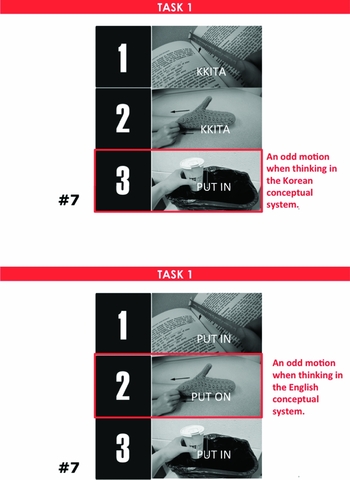
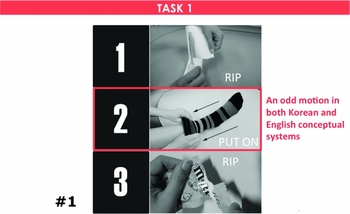
Participants were presented with 40 sets of picture triads, consisting of 29 critical item sets and 11 distractor sets, which were administered using PowerPoint presentations on individual computers. Each set consisted of two photographs describing the same spatial concept and one photograph referring to a different spatial concept. Within the given time of seven seconds per set, participants were asked to select the image that did not match the other two images in spatial concept.Footnote 1 Critical item sets were designed to yield two different interpretations so that participants’ answers would vary depending on how each individual conceptualized space. For example, reliance on the Korean conceptual system would prompt participants to choose an answer that was different from those participants adhering to the English conceptual system. Thus, Korean and English monolinguals were expected to behave differently in critical item sets while distractor sets allowed only one answer for both monolingual groups. Examples of expected categorizations by Korean and English monolinguals in each set are shown in Figures 3 and 4.
Critical item set in Task 1: Expected categorization by Korean and English monolinguals.

Distractor set in Task 1: Expected categorization by Korean and English monolinguals.

Participants were asked to indicate their answers for each triad on the provided answer sheet. In order to prevent participants from basing their decision on other aspects of the pictures (i.e., the similarities in color or type of the object), they were encouraged to focus on the action depicted in each picture. Arrows were included in some of the images to highlight motions in the pictures. Since Task 1 was intended to measure bilinguals’ intuitive responses, as opposed to their well thought out answers, the task was timed (7 seconds per set), and backtracking was not allowed during the task.
Task 2: Free sort task
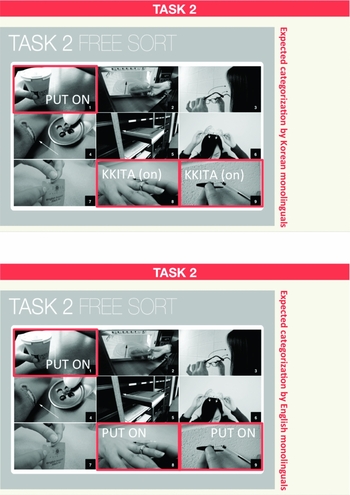
Participants were presented with nine photographs of different spatial concepts using PowerPoint presentations and individual computers. They were instructed to sort the pictures into as many groups as they liked according to the kind of spatial concept represented in the image.Footnote 2 The number of items for Task 2 was smaller than Task 1 given that the nature of Task 2 was more cognitively challenging; that is, instead of providing participants with options to choose from as in Task 1, Task 2 required them to create their own categories and sort items accordingly. Of the nine pictures, eight were critical items and one was a distractor item. The eight critical items consisted of four complex items that were designed to be categorized differently by Korean and English monolinguals (i.e., items referring to tight-fitting events that can be described as kkita),Footnote 3 and four simple items that would be classified in the same way by both monolingual groups (i.e., items referring to loose-fitting events). Critical items described the concepts of put in, put on, or kkita, while the distractor item illustrated an irrelevant concept (i.e., rip). The detailed information regarding the nine items is shown in Appendix A. The maximum time limit for this task was three minutes to ensure that participants based their decisions on an intuitive response rather than a calculated response, thus providing more accurate representations of their nonverbal conceptualizations. Examples of expected categorizations by Korean and English monolinguals are shown in Figure 5.
Task 2: Expected categorization by Korean and English monolinguals.

Procedure
Bilingual participants met either individually or in small groups with the researcher(s) to complete the tasks. During the experiment, participants completed informed consent paperwork and the two experimental tasks, which were each preceded by a short practice task. In addition, Task 2 was followed by a short debriefing questionnaire (see Appendix B) designed to obtain additional information about their decision-making processes during the second task. For instance, the debriefing questionnaire asked participants to label the categories created during Task 2 (no modification of the existing categories allowed) and to indicate the difficulty level of each item (easy vs. confusing). Labels were used as a reference to better understand and evaluate participants’ nonverbal categorizations. If items were indicated as difficult to categorize, participants were asked to explain the reasons for their difficulty. These questions were designed to elicit information regarding the participants’ categorization processes. Following the completion of the two tasks, all bilingual participants were required to complete an online questionnaire addressing their language background, language use, and educational experience. Those who did not complete the survey were excluded from the final sample pool.
The same tasks and debriefing questionnaire were administered to the Korean and English monolingual participants. Since the researchers were not onsite at the locations where the English and Korean monolingual participants were recruited, English instructors and teacher trainers were trained to serve as proctors for the task administration. Following completion of the experiment, monolingual participants also participated in an online background survey measuring language background and educational experience.
Scoring
Each triad set in Task 1 consisted of three pictures, with the possibility of three unique answers. Participants could select a picture that described a different spatial concept in the Korean conceptual system or in the English conceptual system. However, there was also a third picture that would not be considered an odd spatial concept in either the Korean or English categorization, but could still be potentially chosen as an answer. For each critical triad set (N = 29), one point was given to one of the three categories (Korean, English, and Other) depending on participants’ choices of a different action. For instance, if a participant chose a picture that described a different spatial concept in the Korean conceptual system, one point was given to the Korean category. Participants’ selections were analyzed by calculating the proportion of times they categorized pictures in the Korean, English, or Other way. The possible maximum points that each conceptual category could earn were 29 points and the minimum was zero. The three scores for each participant were then converted to a percentage score to facilitate between group comparison.
For Task 2, the same scoring measure was utilized with an addition of a subjective measure. For the interest of the present study, participants’ categorization of the four complex itemsFootnote 4 (Items #3, 4, 8, 9 in Appendix A), i.e., the items that could potentially be categorized in either a Korean or English manner, were coded in order to account for similar conceptual categories and to identify language-specific conceptual categorizations. First, participants’ answers were carefully analyzed with their category labels, which they were asked to indicate in the debriefing questionnaire. However, since the current study focused on the restructuring of non-linguistic concepts as opposed to linguistic concepts, category labels alone did not play a decisive role in scoring. For instance, if a participant created two distinct categories for “put on” and “place on”, they were merged into one category since the main focus of the study was on distinguishing the “on”–“in” difference rather than on identifying the exact main verb for the spatial concept. Next, the created categories were examined to determine whether they represented Korean, English, or Other way of categorization. On the basis of previous research on spatial categorization of Korean and English monolinguals (Bowerman & Choi Reference Bowerman and Choi2001, Reference Bowerman and Choi2003; Choi & Hattrup, Reference Choi and Hattrup2012; Choi et al., Reference Choi, McDonough, Bowerman and Mandler1999; McDonough et al., Reference McDonough, Choi and Mandler2003), Korean monolinguals were expected to classify the four complex items into a single category (potentially labeled as kkita), while English monolinguals were expected to categorize them into two separate categories (Items #3, 8, 9 in one category potentially labeled as “put on”; item #4 in another category potentially labeled as “button”). If participants failed to conceptualize the motion according to the English or Korean spatial conceptual system, and therefore categorized an item in a way that adhered to a different spatial concept independent of its related items, it would be considered as the “Other” way of categorization. For example, if a Korean speaker put Items #3, 4, 8 in one category labeled “kkita”, and created another category for Item #9 with a label that represents neither Korean nor English conceptualization, he/she received three points for the Korean category and one point for the Other category. Each category received as many points as the number of complex items in the category. The possible maximum score that each category (i.e., Korean, English, and Other categories) could earn was four points and the minimum was zero. The three category scores for each participant were then converted to percentage scores to facilitate between-group comparison.
Results
Task 1
Participants’ responses to Task 1 were converted to percentage scores and the mean score for each language group in each of the three conceptual categories was calculated. Table 2 shows the mean percentage scores and standard deviations of the Korean, English, and Other conceptual categories for each language group in Task 1.
Descriptive statistics for participants’ spatial conceptualization scores in Task 1.

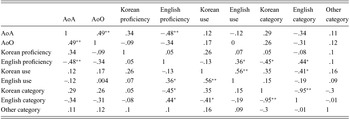
Since the Task 1 scores did not meet the underlying assumptions for normality, separate Kruskal-Wallis non-parametric tests were used to examine the mean scores of the Korean, English, and Other conceptual categories across the three groups. Although there were no significant differences in the Other category, H(2) = 2.94, p = .230, results showed a significant difference between the three groups in both the Korean, H(2) = 62.68, p < .001, and the English categories, H(2) = 62.82, p < .001. Separate Mann-Whitney U-tests were then conducted to examine which groups were statistically significant from one another. The results indicated that there were significant differences between the Korean and English monolinguals in the Korean category, U = .00, p < .05, as well as in the English category, U = .00, p < .05. Korean–English bilinguals significantly differed from Korean monolinguals (in the Korean category, U = 10.50, p < .05; in the English category, U = 7.50, p < .05) and English monolinguals (in the Korean category, U = 16.50, p < .05; in the English category, U = 17.50, p < .05) in both the Korean and English categories. To explore the relationship between participants’ categorization and variables associated with bilingualism (e.g., language proficiency, frequency of language use, age of arrival, and age of onset), correlational analyses were conducted. Table 3 shows a correlation matrix of the variables that were examined in Task 1.
Results of Pearson's correlation coefficient for the variables examined in Task 1.

* p < .05, **p < .01
AoA = Age of Arrival; AoO = Age of Onset; Korean use = total use of Korean (hrs/week); English use = total use of English (hrs/week)
Pearson's correlation coefficient indicated significant correlations between English proficiency and bilinguals’ Korean category scores (r = –.45, p < .05), as well as between English proficiency and English category scores (r = .44, p < .05). Moreover, bilinguals’ total Korean use negatively correlated with English category scores (r = –.41, p < .05). Both age of onset (r = –.34, p = .064) and age of arrival (r = –.31, p = .095) approached significant correlations with participants’ English category, while total Korean use approached significance with bilinguals’ Korean category (r = .35, p = .056). Total English use and Korean proficiency were not significantly correlated with the English or Korean categories.
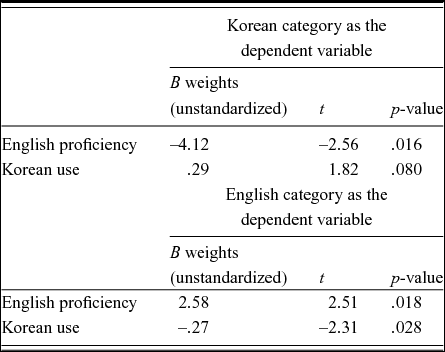
Following the correlational analysis, the independent variables of English proficiency and total Korean use were entered into a simultaneous multiple regression analysis. The overall regressions for both the Korean category, F 2,28 = 5.62, p < .05 (R 2 = .29), and the English category, F 2,28 = 6.70, p < .05 (R 2 = .32), were statistically significant. Table 4 shows unstandardized Beta weights and significance values for the Korean and English categories, respectively.
Results of multiple regressions applied to identify outcomes related to the Korean/English categories for Task 1.

Note: For Korean as the dependent variable, R2 = .29; for English, R2 = .32.
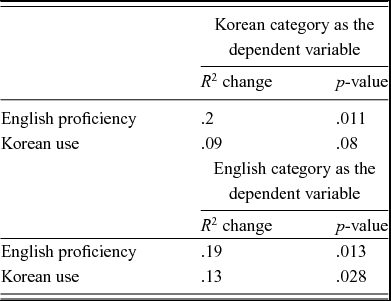
English proficiency and total Korean use emerged as significant predictors for both Korean and English categories. Next, separate hierarchical regressions were conducted on both Korean and English categories in order to partial out the effects of the predicting factors identified in the simultaneous regressions. The key factors entered into the hierarchical regressions were English proficiency and total Korean use. English proficiency was introduced as the primary variable due to its high correlation and Beta value, followed by total Korean use. Table 5 summarizes the results of the hierarchical regression model for the Korean and English categories, respectively.
Results of hierarchical regressions applied to identify outcomes related to the Korean/English categories for Task 1.

The results demonstrated that English proficiency emerged as the only significant variable, accounting for approximately 20% of the variance in the Korean category. Total Korean use did not show significant levels, but it increased the percentage of variance explained by the model by 9%. As for the English category, English proficiency and total Korean use showed significant levels, with English proficiency accounting for approximately 19% of the variance and total Korean use accounting for approximately 13% of the total variance. These findings suggest that English proficiency was predictive of bilingual speakers’ performance on the English and Korean categories, while total Korean use was only predictive of their performance on the English category.
Task 2
Quantitative analysis
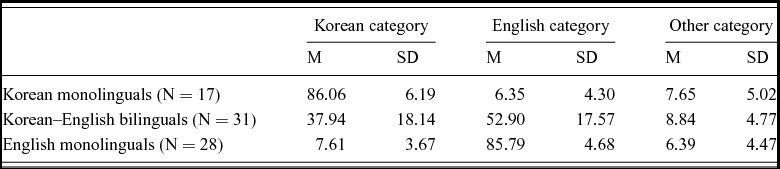
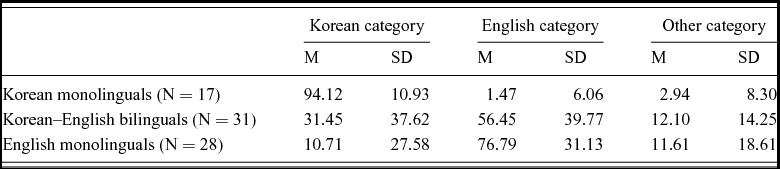
Following the conversion of participants’ Task 2 scores to percentage scores, mean scores of the three categories were calculated for each language group. Table 6 shows the descriptive statistics of the Korean, English, and Other categories for all three language groups in Task 2.
Descriptive statistics for participants’ spatial conceptualization scores in Task 2.

Task 2 scores did not meet the underlying assumptions for normality, necessitating the use of separate Kruskal-Wallis non-parametric tests to examine the mean scores of the Korean, English, and Other conceptual categories across the three groups. Results indicated significant differences between the three groups in the Korean category, H(2) = 49.08, p < .001, the English category, H(2) = 40.02, p < .001, and the Other category, H(2) = 10.74, p < .05. Separate Mann-Whitney U-tests indicated that there were significant differences between the Korean and English monolinguals in the Korean category, U = .50, p < .05, in the English category, U = .00, p < .05, and in the Other category, U = 129.00, p < .05. Similarly, Korean–English bilinguals significantly differed from Korean monolinguals (in the Korean category, U = 28.00, p < .05; in the English category, U = 34.00, p < .05) as well as from English monolinguals (in the Korean category, U = 167.00, p < .05; in the English category, U = 240.00, p < .05; in the Other category, U = 219.00, p < .05). These findings suggest that the bilinguals demonstrate different categorization patterns from the two monolingual groups, confirming the results of Task 1. Furthermore, these findings provide cogent evidence that the bilingual group had formed distinct spatial conceptualizations due to the convergence of the Korean and English linguistic systems.
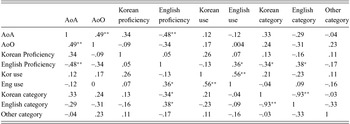
Pearson's correlation coefficient indicated a significant correlation between English proficiency and bilinguals’ English category scores, r = .37, p < .05. Although not significant, age of onset approached significance, r = –3.14, p = .09, for the English category, while age of arrival (r = .33, p = .07) and English proficiency (r = –.34, p = .07) were shown to approach significance for the Korean category. Table 7 shows a correlation matrix of the variables examined in Task 2.
Results of Pearson's correlation coefficient for the variables examined in Task 2.

* p < .05, **p < .01
AoA = Age of Arrival; AoO = Age of Onset; Korean use = total use of Korean (hrs/week); English use = total use of English (hrs/week)
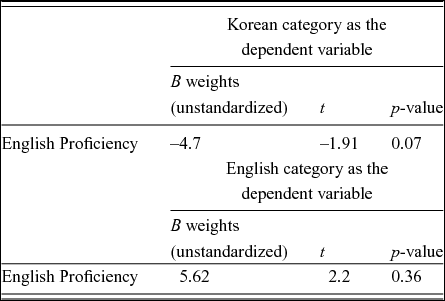
On the basis of the significant variable that emerged from the correlational analysis, English proficiency was entered into a simple linear regression analysis as the only predictor variable. The results demonstrated that English proficiency contributed to 11% of the explained variance for the Korean category, F 1,29 = 3.67, p = .07 (R 2 = .11), but the regression model did not reach significance at the .05 level. On the other hand, the overall regression model for the English category was statistically significant, F 1,29 = 4.86, p < .05 (R 2 = .14). Table 8 shows the unstandardized Beta weights and significance values for the Korean and English categories, respectively.
Results of simple linear regressions applied to identify outcomes related to the Korean/English categories for Task 2.

Note: For Korean as the dependent variable, R2 = .11; for English, R2 = .14.
Overall, results from the regression analyses support previous research, with proficiency (Athanasopoulos, Reference Athanasopoulos2006, Reference Athanasopoulos2007) accounting for a significantly large proportion of the variance in the Korean and English categories of spatial relations. These outcomes indicate that there is a significant relationship between bilinguals’ categorization and their L2 proficiency. That is, the higher the bilingual's proficiency in English is, the more likely it is for his/her classification preferences to pattern with English monolinguals.
Qualitative analysis
A qualitative analysis was conducted with Task 2 in order to provide a more fine-grained account of how spatial categorizations created by bilinguals differed from those of monolinguals. On the basis of previous L1 literature (e.g., Bowerman, Reference Bowerman1996; Bowerman & Choi, Reference Bowerman and Choi2001, Reference Bowerman and Choi2003; Choi & Hattrup, Reference Choi and Hattrup2012; Choi et al., Reference Choi, McDonough, Bowerman and Mandler1999; McDonough et al., Reference McDonough, Choi and Mandler2003), Korean monolinguals were expected to categorize four complex items (i.e., critical items that can be categorized in two different ways) into one single category that refers to the tight fit of the spatial motion. In contrast, English monolinguals were predicted to provide two separate categories for items that represent support (i.e., the verb put on) and the motion “to button”. The high mean percentages for (a) the Korean category for Korean monolinguals (94.14%) and (b) the English category for English monolinguals (76.79%) in Table 6 suggest that each monolingual group categorized complex items more in line with the semantics of their language. Examining the labels that participants created for each category during the debriefing questionnaire also supported the conclusion that language was the primary guide to their spatial categorization. Korean monolinguals labeled the category that represents tight fit with the verbs kkita or kkiwuta (rough English translation: “to fit in”, “to insert”, respectively), which is another verb that expresses tight fit containment and support. There were several Korean speakers who labeled a complex item with the verb cipenehta, which translates into the English verb insert. If they had placed this item in the cipenehta category along with other motions of containment (Items #2 and 5), such a classification was considered to be in line with the English categorization, as “insert” suggests “to put in in a controlled way (e.g., because the space is small)” (Choi & Bowerman, Reference Choi and Bowerman1991, p. 94). However, if participants had created the cipenehta category in addition to the kkita and put in categories (total number of categories created for the four complex items = 3), the complex item in this particular category would be coded as belonging to the Other category as this shows that the speaker's conceptualization of spatial relations was not based on either the “on–in” contrast in English or the “tight-fit” relation in Korean. As for the English monolinguals, they categorized spatial concepts differently from the Korean monolinguals, following the manner predicted by previous research (Bowerman & Choi, Reference Bowerman and Choi2003; Choi & Hattrup, Reference Choi and Hattrup2012; Choi et al., Reference Choi, McDonough, Bowerman and Mandler1999; McDonough et al., Reference McDonough, Choi and Mandler2003). Most of them did not create categories or category labels in relation to the tight-fit motion, but relied heavily on the “on–in” contrast. The most common labels for the categories created by the English monolinguals include place on, put on, place down, and put down for support and button, insert, fasten, put in, and put through for the buttoning motion. Interestingly, there were three English monolingual speakers who created categories based on the “tight-fit” relation and categorized all four complex items into one “fit” category. These atypical categorizations may have contributed to the variations in mean and standard deviation values. However, despite the variability observed, the examination of participants’ labels in Task 2 also suggests that the two monolingual groups were guided by their L1 to categorize spatial concepts in a specific manner.
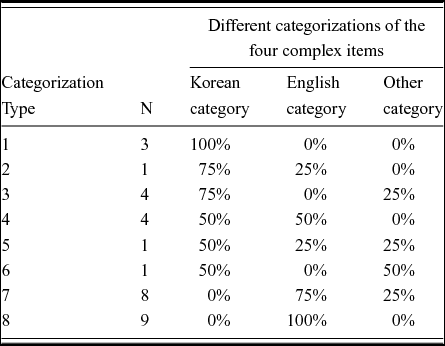
Examining bilingual speakers’ classification in Task 2 demonstrated that they exhibited three different categorization patterns. First, there were some bilingual speakers who mirrored the categorization patterns of either Korean or English monolinguals. Three bilingual participants classified the four complex items in one single category according to the “tight-fit” relation (Categorization Type #1 in Table 9), while nine of them created two separate categories following the “on–in” contrast (Categorization Type #8 in Table 9). As can be seen in Table 9, the remaining 19 bilingual participants (who created Categorization Types #2–7) diverted from both Korean and English categorizations, exhibiting much more variety in classifying complex items. This suggests that their conceptualizations did not fully resemble either monolingual group and that a new conceptual category had been created in the bilingual mind.
Frequency of different categorizations created by Korean–English bilinguals.

Note: Frequency (N) refers to the number of bilingual participants who created different types of categorizations.
The second pattern observed among the bilingual participants is what Jarvis and Pavlenko (Reference Jarvis and Pavlenko2008, p. 164) call “a hybrid or amalgam” of the two language-specific categories. Six bilingual speakers received points in both Korean and English categories (Categorization Types #2, 4, 5 in Table 9), indicating that their categorizations were guided by both languages. For instance, four bilingual speakers (Categorization Type #4) classified Items #4 and 8 as kkita, and Items #3 and 9 as put on. Participants accordingly received two points for the Korean category and another two for the English category. These findings show that bilinguals combined characteristics of both Korean and English semantic features, providing evidence of in-between performance in their nonverbal conceptualization. The third pattern displayed by 13 bilinguals (Categorization Types #3, 6, 7) is a type of divergence that does not necessarily combine both L1-mediated and L2-mediated concepts. Rather, these participants’ classifications seem to have been influenced by an alternative criterion that is irrelevant to either language-specific semantics. For instance, two bilinguals in Categorization Type #3 classified Items #3, 4, and 8 together as kkita and Item #9 as cover. While it could be predicted that the former category was guided by their L1-mediated concept, it is uncertain what motivated the bilinguals to single out Item #9 from the rest of the complex items. In cases like this, the three items in the kkita category received three points for the Korean category, and one point was awarded to the Other category. Notwithstanding that this type of categorization pattern is not characterized as in-between performance, it is still deemed evidence of convergence as it represents a unique category that is neither an L1-based nor L2-based concept (Bassetti & Cook, Reference Bassetti, Cook, Cook and Bassetti2011).
In the debriefing questionnaire, participants were asked to indicate the degree of difficulty (e.g., easy vs. confusing) for each item and explain why certain items were more challenging than the others. The number of participants who reported each item to be challenging was counted and converted to a percentage score. Table 10 shows participants’ perceived difficulty scores for all nine items.
Descriptive statistics for participants’ perceived difficulty on each item in Task 2.

Note. Number represents percentage.
With the Korean monolinguals, there was no observable difference in their perceived difficulty between simple and complex critical items. Their responses indicated that most of the difficulties were either related to comprehending the action represented in the pictures (e.g., some of the arrowheads were not clear enough) or irrelevant to the nature of the actions presented. The English monolinguals, however, indicated that one particular complex item (Item #4 to button) was more challenging than the other items. According to their responses in the debriefing questionnaire, the difficulty mainly arose from the dilemma of whether to classify Item #4 separately from items that refer to the phrasal verb put in. There were also several participants who indicated that Item #4 caused trouble because it did not belong to either category that they had created (which were later labeled by the participants as put on and put in). These findings suggest that for the English monolingual speakers, there was a tendency to group Item #4 with other items referring to the verb put in. Given that in English a major distinction in spatial categorization is governed by containment relationships (i.e., the “on–in” contrast) (Choi & Harttrup, Reference Choi and Hattrup2012), it is not surprising that English monolinguals were inclined to merge the concept of buttoning, which essentially involves “putting” a button “inside” the hole, with the concept of put in, and classify the items representing these concepts into a single category.
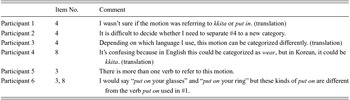
Results of the Korean–English bilinguals’ questionnaires demonstrated that all four complex critical items caused more confusion and categorical difficulty than the other items (i.e., simple critical items and the distractor) in Task 2. Table 11 summarizes some of the comments that were repeatedly reported by the bilinguals in the debriefing questionnaire.
Bilinguals’ comments about the items perceived as difficult in Task 2.

Note: The bilinguals were asked to fill out the debriefing questionnaire in the language of their preference. The comments written in Korean have been translated into English by the researcher who is a native speaker of Korean.
These comments indicate that for bilinguals, nonverbal spatial categorization is especially challenging when their two languages employ different semantic categories for spatial motions. Furthermore, some of the bilinguals were able to identify the source of the problem (see e.g., comments from Participants 3 and 4 in Table 11) when asked to reflect on the task. They reported that their two languages differed semantically in the use of spatial relations, leading to their categorical difficulty. However, as this piece of information was collected via post-task questionnaires, it does not necessarily mirror the complete process that participants may have experienced during the task, suggesting that their reflections on linguistic differences should be interpreted with caution.
Discussion
The first research question addressed whether Korean and English adult monolingual speakers would categorize spatial concepts in different ways. Previous L1 studies examining Korean and English spatial categorization (e.g., Bowerman, Reference Bowerman1996; Bowerman & Choi, Reference Bowerman and Choi2001, Reference Bowerman and Choi2003; Choi & Hattrup, Reference Choi and Hattrup2012; Choi et al., Reference Choi, McDonough, Bowerman and Mandler1999) have consistently shown that spatial perceptions are formed from infancy to early stages of language learning and that developmental patterns of spatial categorization are susceptible to language-specific semantics. While infants learning Korean were found to distinguish spatial concepts in terms of tight fit, English-speaking infants were inclined to categorize spatial relations based on containment. Findings from the current study provide clear evidence that adult Korean and English monolinguals exhibit similar categorization behavior as their infant counterparts, suggesting that nonverbal spatial categorization patterns formed in infancy are maintained when the primary language environment stays unchanged. The Korean monolinguals performed near ceiling levels on the Korean category in both Tasks 1 and 2, indicating that their decisions were made using fit properties (“tight fit”, “loose fit”). Likewise, the English monolinguals displayed the strongest preference for the English category in both tasks, suggesting that they classified spatial events based on their L1-specific semantics, i.e., containment (“put in”, “put on”). The conceptual differences observed between the two monolingual groups support the Whorfian view that linguistic structure influences non-linguistic cognition and conceptualization (Levinson, Reference Levinson1996; Lucy, Reference Lucy1992; Lucy & Gaskins, Reference Lucy and Gaskins2001). However, the fact that three English monolingual speakers in Task 2 categorized the complex items according to the concept of tight-fit reveals that sensitivity to the tight fit and loose fit distinction also exists among English monolinguals. This suggests that monolinguals of different languages display a preference towards certain concepts not because they lack other concepts in their language. Choi (Reference Choi2006) and Choi and Hattrup (Reference Choi and Hattrup2012) attest that both Korean and English monolinguals display the perceptual salience for tight-fit and containment. Among various ways to segment motions into different categories, monolingual speakers are likely to be guided by concepts that are often represented in their language and used when speaking in that language. In this way, language highlights a certain way of thinking, playing an important role in shaping habitual thought (Bassetti & Cook, Reference Bassetti, Cook, Cook and Bassetti2011; Boroditsky, Reference Boroditsky2001).
The second research question examined the differences in spatial concepts between Korean–English bilinguals and Korean and English monolinguals. The bilinguals’ conceptualizations of space were significantly different from those of the two monolingual groups in both Tasks 1 and 2, with their patterns largely displaying convergence of L1 and L2 conceptual domains. The qualitative analysis of their responses in Task 2 demonstrated that three types of classification patterns emerged: (a) complete L1 or L2 resemblance, (b) in-between performance, and (c) patterns that did not resemble either L1-related or L2-related concepts. Approximately two thirds of the bilingual speakers (19 out of 31) exhibited patterns (b) and (c), which suggests that the bilinguals created a new unitary category that is distinct from either monolingual group. In pattern (b), bilinguals combined characteristics of both language-specific semantic distinctions to form hybrid, in-between performance, while others displayed patterns that do not lie between their L1 and L2 conceptual patterns in pattern (c). These results indicate that the use of two languages in one's everyday life may result in the adjustment of bilinguals’ sensitivity to the degree of fit and containment that they initially formed as infants. Furthermore, the findings lend support to the claim that the bilingual mind undergoes cognitive restructuring as a result of using two different languages (Athanasopoulos, Reference Athanasopoulos2011). Although some studies have reported that bilinguals maintain two separate categories relevant to both L1 and L2, accessing the language-specific concepts of each language in accordance with the constraints posed by one's environment (Sachs & Coley, Reference Sachs, Coley and Pavlenko2006), the results of the current study provide contrary evidence for this hypothesis. The convergence of the bilinguals’ conceptual systems found in the results does not provide support for the “Modular” view that contends that cognition is unaffected by language-specific semantics (e.g., Malt, Sloman, Gennari, Shi & Wang, Reference Malt, Sloman, Gennari, Shi and Wang1999; Papafragou, Massey & Gleitman, Reference Papafragou, Massey and Gleitman2002). Instead, our results are more consistent with the Whorfian view, which argues for the influence of language on thought.
While two-thirds of bilinguals demonstrated convergence, the remaining one-third patterned with either L1-based or L2-based concepts when categorizing spatial motions: three bilingual participants mirrored Korean categorization patterns, and nine of them adhered to English classification preferences. Although pattern (a) does not lend support for unique bilingual patterns of spatial concepts, the correlational analyses provide additional insights into the process the bilingual mind may undergo. The negative correlation between English proficiency and the Korean category, together with the positive correlation observed between English proficiency and the English category suggests that the shift from L1-based conceptual patterns to L2-based conceptual patterns is mediated by English proficiency. This reflects the dynamic nature of the bilingual mind, showing that the restructuring of bilingual systems is an ongoing, developmental phenomenon (Brown & Gullberg, Reference Brown and Gullberg2013; Pavlenko, Reference Pavlenko2011) as opposed to a finite outcome (e.g., Ameel, Malt, Storms & Van Assche, Reference Ameel, Malt, Storms and Van Assche2009). The L1–L2 convergence observed among the bilinguals in the current study, then, should not be viewed as a permanent status, but rather as “intermediate stages in development” (Brown & Gullberg, Reference Brown and Gullberg2013, p. 14). As the current findings suggest, spatial concepts in the bilingual mind do not seem to be fixed once and for all, but rather seem to be influenced and even restructured by the acquisition of novel conceptual categories.
The final research question examined whether there is any relationship between bilinguals’ categorization and linguistic and extra-linguistic variables. In both Tasks 1 and 2, English proficiency was the most robust predictor of bilinguals’ use of both Korean and English categorization patterns. In contrast, Korean proficiency was not found to be predictive of bilinguals’ performance in either task. It is possible that the observed lack of correlation between Korean proficiency and bilinguals’ categorization patterns is attributed to bilinguals’ inaccurate reporting of their Korean proficiency. While reporting L2 proficiency occurs frequently with bilinguals living in the L2 context, they are rarely asked to rate their L1 proficiency in these circumstances. In addition, self-report surveys have been questioned by scholars as a valid measuring tool (Dörnyei, Reference Dörnyei2001; Schunk, Pintrich & Meece, Reference Schunk, Pintrich and Meece2008), as participants may under or over report. The inherent challenges associated with self-report measures, as well as the insufficient experience of self-assessing one's own L1 proficiency, may have affected participants’ reporting of their Korean proficiency, resulting in less precise information.
In addition to English proficiency, total Korean use appeared to be the second most effective predictor of bilinguals’ use of English conceptualizations in Task 1. However, it did not affect either Korean conceptualizations in Task 1 or both Korean and English conceptualizations in Task 2. Since overall language use for both Korean and English rarely emerged as a significant predictor, the current findings suggest that language use may not be a robust predictor of bilinguals’ categorization. Considering that language use was found to be predictive of bilinguals’ performance in Athanasopoulos et al. (Reference Athanasopoulos, Damjanovic, Krajciova and Sasaki2011), the current findings may seem contradictory to their results at first. However, it is important to note that L2 proficiency in Athanasopoulos et al. (Reference Athanasopoulos, Damjanovic, Krajciova and Sasaki2011) was kept constant while more variability was observed with L2 proficiency in the current study (see the Participants section). Therefore, the difference in the variability of L2 proficiency in the two studies makes it difficult to claim that their results concerning language use are contradictory to one another. What this rather suggests is that it is yet too early to make any conclusive remarks on the role of language use in bilinguals’ conceptualization based on these two studies. Thus, more research on the role of language use in various contexts is warranted before any definitive conclusions can be made about this variable. Another factor that must be taken under consideration regarding language use is the potential for inaccurate reporting. Since bilinguals’ language use was obtained by self-report, there is always a possibility that they might have either over- or under-reported the amount of language use. The lack of correlation observed between total Korean use and Korean proficiency also raises concerns over the validity of the language use scores, suggesting that a more cautious approach must be taken when interpreting the results concerning language use.
Another influential variable that has been frequently discussed in relation to bilingualism is age of onset. Although age of onset in successive bilingualism has been found to be the single most important factor (e.g., Meisel, Reference Meisel, Kail and Hickman2010), the effect of age of onset on bilingual conceptualization has been deemed rather controversial in the past. While some studies have found it to be a strong predictor of bilinguals’ cognitive shift (Boroditsky, Reference Boroditsky2001), others have reported the opposite outcome (Athanasopoulos, Reference Athanasopoulos2009; Cook et al., Reference Cook, Bassetti, Kasai, Sasaki and Takahashi2006). The current results side with Athanasopoulos and his colleagues in that no significant effect for age of onset was found. However, we cannot completely eliminate the predictive value of age of onset provided that it marginally approached significance in correlational analyses in both tasks. More research is thus warranted to examine the role of age factors on bilingual conceptualization before making any conclusive statements about its effect.
Overall, the current study contributes to the existing knowledge on the categorization of spatial motions at several levels. First, we sought to extend previous L1 research on language-specific semantics and spatial cognition by examining the minds of adult monolingual speakers. Confirming previous research (Choi & Hattrup, Reference Choi and Hattrup2012; McDonough et al., Reference McDonough, Choi and Mandler2003), the current study also lends support to previous findings indicating that language-specific encoding of space acquired in infancy is maintained over time. Second, the issue of language-specific semantics and cognition was brought into the context of bilingualism to examine the role of bilingualism in spatial cognition. The results indicated that bilinguals in the current study showed categorization patterns distinct from either monolingual group, suggesting convergence of the two language systems. However, it is necessary to acknowledge that there are several limitations to the study. As previously mentioned, utilizing self-reports to measure bilinguals’ language proficiency and language use may have yielded less accurate estimates of these variables. Moreover, the relatively small sample size of the bilingual population may have contributed to the lack of significance for the variables that marginally approached significance in correlational analyses (e.g., age of onset and age of arrival). A larger sample size may provide opportunities for more fine-grained analyses of these potentially predictive variables. Future research can also benefit from investigating a wider range of proficiency levels, including beginner and intermediate level L2 speakers, in order to obtain more information regarding the role and impact of proficiency on bilinguals’ cognitive restructuring. Another limitation of this study concerns the design of the triad-matching task used in Task 1. In Task 1, participants were presented with three triad images at the same time, and they were asked to select one image that did not match the other two images in terms of the motion represented. Critical item sets were carefully designed so that two monolingual groups would yield different answers. That is, a participant relying on the Korean tight fit relationship would choose Image 1 as the odd motion, and a participant employing the English “on–in” contrast would choose Image 2. However, it seems that some of the participants were not able to perceive the motions correctly and, as a result, subscribed to neither conceptual system by selecting Image 3 as the odd motion. The three groups’ mean scores for the Other category indicate that a moderate number of participants selected Image 3 as their answer. As it has been found that having this third option for choice makes it difficult for participants to perceive motions correctly and for researchers to clearly examine participants’ categorization pattern, future studies may consider using a different similarity task to conduct research. One alternative is to require participants to determine which of two items most resembles the target item (Athanasopoulos, Reference Athanasopoulos2006, Reference Athanasopoulos2007; Athanasopoulos & Kasai, Reference Athanasopoulos and Kasai2008). Using this type of methodological design will eliminate the potentially confounding variable of the unrelated third choice, and thus provide a clearer picture of bilinguals’ L1 and L2 conceptual patterns of space. The free sort task in the study could also be improved by including motions that refer to “tight put-in” as well as “tight put-on”. In order to examine English monolinguals’ categorization, it would have been ideal to include critical complex items that represented both types. However, since Task 1 necessitated more items to create 40 triads, the limited number of “tight put-in” items were all included in Task 1. Lastly, to ensure that the tasks employed are measuring bilinguals’ nonverbal spatial categorization, future studies may consider conducting a post-experiment survey to ask participants about whether they were engaged in verbal thinking during the tasks (Choi & Hattrup, Reference Choi and Hattrup2012). Such self-report data will help the researchers to make stronger claims about the nature of the tasks.
Conclusion
The current study sought to examine whether adult Korean–English bilinguals categorize spatial concepts concerning containment, support, and contact differently from Korean and English monolinguals. The findings indicate that the bilingual participants performed differently from both Korean and English monolingual speakers, showing distinct categorization patterns of spatial concepts. This can be attributed to the convergence of their L1 and L2 categories, which reflects the ongoing conceptual restructuring that is taking place in the bilingual mind. These results confirm previous research that has demonstrated the effect of novel language acquisition on cognitive restructuring in bilinguals (Athanasopoulos, Reference Athanasopoulos2011; Athanasopoulos et al., Reference Athanasopoulos, Damjanovic, Krajciova and Sasaki2011; Athanasopoulos & Kasai, Reference Athanasopoulos and Kasai2008). Linguistic variables such as L2 proficiency and L1 use were found to play significant roles in conceptual restructuring in the direction of the L2. These results also add to the growing body of research (e.g., Athanasopoulos, Reference Athanasopoulos2006, Reference Athanasopoulos2007, Reference Athanasopoulos2009, Reference Athanasopoulos2011; Athanasopoulos & Kasai, Reference Athanasopoulos and Kasai2008; Brown & Gullberg, Reference Brown and Gullberg2011, Reference Brown and Gullberg2013) demonstrating the influence and effects of language on cognition. However, continued investigations into the factors influencing the cognitive restructuring of bilinguals in domains other than space are needed in order to generalize findings of the current study. The effects of linguistic categories on cognition may be domain-specific, and additional research is needed to further clarify the effect of language on bilinguals’ cognition.
Appendix A. The full list of nine items used in Task 2

Appendix B. Task 2 debriefing questionnaire