Introduction
Exposure to environmental stress during childhood is associated with increased risk for a broad range of psychopathology, including mood, anxiety, and substance use disorders (Green et al. Reference Green, McLaughlin, Berglund, Gruber, Sampson, Zaslavsky and Kessler2010). However, while ELS is reported for nearly 40% of individuals worldwide (Kessler et al. Reference Kessler, McLaughlin, Green, Gruber, Sampson, Zaslavsky, Aguilar-Gaxiola, Alhamzawi, Alonso, Angermeyer, Benjet, Bromet, Chatterji, de Girolamo, Demyttenaere, Fayyad, Florescu, Gal, Gureje, Haro, Hu, Karam, Kawakami, Lee, Lepine, Ormel, Posada-Villa, Sagar, Tsang, Ustun, Vassilev, Viana and Williams2010), a relatively small number of exposed individuals experience subsequent mental health problems. Identifying biological markers of individual differences in relative vulnerability or resiliency promises to uniquely inform the etiology of stress-related psychopathology and contribute to the development of more efficacious strategies for prevention and treatment.
Consistent with cross-species research suggesting that adversity can disrupt hedonic capacity as well as related neural circuit function (Anisman & Matheson, Reference Anisman and Matheson2005; Rygula et al. Reference Rygula, Abumaria, Flügge, Fuchs, Rüther and Havemann-Reinecke2005; Krishnan et al. Reference Krishnan, Han, Graham, Berton, Renthal, Russo, LaPlant, Graham, Lutter, Lagace, Ghose, Reister, Tannous, Green, Neve, Chakravarty, Kumar, Eisch, Self, Lee, Tamminga, Cooper, Gershenfeld and Nestler2007; Bogdan et al. Reference Bogdan, Santesso, Fagerness, Perlis and Pizzagalli2011; Pechtel & Pizzagalli, Reference Pechtel and Pizzagalli2011; Porcelli et al. Reference Porcelli, Lewis and Delgado2012), stress-related psychopathology such as depression and substance use disorder is frequently characterized by both blunted reward-related corticostriatal circuit reactivity and anhedonia (Diekhof et al. Reference Diekhof, Falkai and Gruber2008; Hopper et al. Reference Hopper, Pitman, Su, Heyman, Lasko, Macklin, Orr, Lukas and Elman2008; Sailer et al. Reference Sailer, Robinson, Fischmeister, König, Oppenauer, Lueger-Schuster, Moser, Kryspin-Exner and Bauer2008; Pizzagalli et al. Reference Pizzagalli, Holmes, Dillon, Goetz, Birk, Bogdan, Dougherty, Iosifescu, Rauch and Fava2009). By contrast, individuals characterized by positive affect and optimism have increased corticostriatal reactivity to positive stimuli (Sharot et al. Reference Sharot, Riccardi, Raio and Phelps2007) and display more adaptive responses to stress (Tugade & Fredrickson, Reference Tugade and Fredrickson2004; Ong et al. Reference Ong, Bergeman, Bisconti and Wallace2006). Collectively, these data have led to speculation that robust reward-related neural circuit function may confer relative resilience to stress-related anhedonia and associated psychopathology (Feder et al. Reference Feder, Nestler and Charney2009); this theory has recently received empirical support in preclinical (Krishnan et al. Reference Krishnan, Han, Graham, Berton, Renthal, Russo, LaPlant, Graham, Lutter, Lagace, Ghose, Reister, Tannous, Green, Neve, Chakravarty, Kumar, Eisch, Self, Lee, Tamminga, Cooper, Gershenfeld and Nestler2007) and human (Nikolova et al. Reference Nikolova, Bogdan, Brigidi and Hariri2012) studies.
Using data from the ongoing Duke Neurogenetics Study (DNS), which assesses a wide range of behavioral, experiential, and biological phenotypes, the present study examined whether reward-related ventral striatum (VS) reactivity moderates the relationship between retrospectively-reported early life stress (ELS) and anhedonic symptomatology in 820 young adult university students. Further, in light of evidence that deficits in positive affect precede the development of other depressive symptoms (Bijttebier et al. Reference Bijttebier, Raes, Vasey and Feldman2012), we assessed whether the interaction between reward-related VS reactivity and ELS is indirectly associated with other depressive symptoms via the mediating role of anhedonia. Second, based on a developing literature linking anhedonic symptoms to substance-related coping, which has, in turn, been linked to problematic substance use (Cooper et al. Reference Cooper, Frone, Russell and Mudar1995; Grant et al. Reference Grant, Stewart and Mohr2009; Mezquita et al. Reference Mezquita, Ibáñez, Moya, Villa and Ortet2014), we assessed whether the interaction between reward-related VS reactivity and ELS is indirectly associated with self-reported problematic alcohol use via the mediating role of anhedonic symptoms and coping behavior. We hypothesized that individuals with relatively blunted VS reactivity and elevated exposure to ELS would report increased anhedonia. Moreover, we posited that stress-related anhedonia would indirectly link relatively blunted reward-related VS reactivity and elevated ELS exposure to other increased depressive symptoms as well as problematic alcohol use via drug-related coping.
Method
Participants
Neuroimaging data were available from 906 participants who completed the ongoing DNS by 13 December 2013. The DNS assesses a wide range of behavioral, experiential, and biological phenotypes among young-adult (range 18–22 years) college students. All participants provided written informed consent in accord with Duke University guidelines and were in good general health. For completing the study, each participant received $120 remuneration. Study exclusion criteria included: (1) medical diagnoses of cancer, stroke, diabetes requiring insulin treatment, chronic kidney or liver disease, or lifetime history of psychotic symptoms; (2) use of psychotropic, glucocorticoid, or hypolipidemic medication; and/or (3) conditions affecting cerebral blood flow and metabolism (e.g. hypertension). Diagnosis of current DSM-IV Axis I and select Axis II disorders (antisocial personality disorder and borderline personality disorder) was assessed with the electronic Mini International Neuropsychiatric Interview (Sheehan et al. Reference Sheehan, Lecrubier, Sheehan, Amorim, Janavs, Weiller, Hergueta, Baker and Dunbar1998) and Structured Clinical Interview for the DSM-IV (SCID; First et al. Reference First, Spitzer, Gibbon and Williams1996). These disorders were not exclusionary, as the DNS seeks to establish broad variability in multiple behavioral phenotypes related to psychopathology.
The final sample of the present study included 820 participants who had reward-related VS reactivity data available after data-quality screening. Participants were excluded for the following reasons: incidental structural brain abnormalities (n = 4), significant movement outliers in functional magnetic resonance imaging (fMRI) data (n = 38; see preprocessing description below), scanner artifacts in fMRI data (n = 6), technical difficulties during fMRI data collection (e.g. coil problems; n = 3), incomplete data collection (e.g. subject fell asleep; n = 9), or poor behavioral performance (i.e. less than 60% appropriate feedback during VS reactivity task; n = 25). One additional participant was excluded from analyses because they did not complete the scale used to assess ELS (Childhood Trauma Questionnaire; n = 1). A total of 86 (9.49%) participants were excluded after fMRI data-quality screening and availability of all self-report questionnaires was taken into account.
Self-report questionnaires
Participants completed a battery of self-report questionnaires to assess past and current experiences and behavior. The following were used for the present analyses: the Childhood Trauma Questionnaire (CTQ; Bernstein et al. Reference Bernstein, Stein, Newcomb, Walker, Pogge, Ahluvalia, Stokes, Handelsman, Medrano, Desmond and Zule2003); Life Events Scale for Students (LESS; Clements & Turpin, Reference Clements and Turpin1996); the anhedonic depression (AD) and general distress depression (GDD) subscales of the Mood and Anxiety Symptom Questionnaire – short form (MASQ-SF; Watson & Clark, Reference Watson and Clark1991); the Positive Affect subscale of the Center for Epidemiological Studies – Depression Scale (CES-D; Radloff, Reference Radloff1977) the brief COPE Inventory substance use subscale Carver (Reference Carver1997); and the Alcohol Use Disorders Identification Test (AUDIT; Saunders et al. Reference Saunders, Aasland, Babor, De La Fuente and Grant1993).
The CTQ is a 28-item, retrospective screening tool used to detect the occurrence and frequency of emotional, physical, and sexual abuse as well as emotional and physical neglect before the age of 17 (α = 0.613 for total scale). The instrument's five subscales, each representing a type of abuse or neglect, have robust internal consistency and convergent validity with a clinician-rated interview of childhood abuse as well as with therapists’ ratings of abuse (Scher et al. Reference Scher, Stein, Asmundson, McCreary and Forde2001). The MASQ-SF is a 62-item scale that includes four subscales: general distress anxious symptoms, general distress depressive symptoms, anxious arousal and anhedonic depression. The 22-item AD subscale is an instrument assessing low levels of positive affect and other factors that represent depression specifically (i.e. not general negative affect; Hughes et al. Reference Hughes, Heimberg, Coles, Gibb, Liebowitz and Schneier2006). One item was excluded from this questionnaire in our sample (‘thoughts about death or suicide’) to be compliant with the Duke University IRB (α = 0.899 for anhedonia subscale). The GDD subscale includes 12 items (α = 0.930 for GDD subscale) reflecting negative affect that occur in both depression and anxiety disorders (Watson et al. Reference Watson, Clark, Weber, Assenheimer, Strauss and McCormick1995). The substance use subscale of brief-COPE is comprised of two items (‘I've been using alcohol or other drugs to make myself feel better’ and ‘I've been using alcohol or other drugs to help me get through it’; α = 0.920) that assess how frequently an individual uses drugs or alcohol as a coping mechanism; it is predictive of problematic alcohol use in trauma survivors (Ullman et al. Reference Ullman, Filipas, Townsend and Starzynski2005, Reference Ullman, Filipas, Townsend and Starzynski2006). The AUDIT is a 10-item scale developed by the WHO to screen for hazardous or dependent alcohol use patterns by assessing the frequency and nature of consumption. While the AUDIT was originally developed to screen for alcohol use problems and high-risk drinking in primary-care settings, evidence suggests that it is a valid assessment for college student populations as well (Kokotailo et al. Reference Kokotailo, Egan, Gangnon, Brown, Mundt and Fleming2004) and showed good reliability within this sample (α = 0.771 for total scale).
Last, to further test our previously reported recent life stress × VS reward-related reactivity interaction (Nikolova et al. Reference Nikolova, Bogdan, Brigidi and Hariri2012) in an expanded sample, we used the CES-D Positive Affect subscale (α = 0.829 for Positive Affect subscale) and Life Events Scale for Students (Kuder-Richardson Formula 20α = 0.643; LESS). In this modified version of the LESS participants are asked to indicate if they have experienced different types of common stressful life events within the past 12 months (e.g. moving home, pregnancy, failing a course). The CES-D is a widely used (Murphy, Reference Murphy, Tsuang and Tohen2002) 20-item scale designed to measure current depressive symptoms (Radloff, Reference Radloff1977). Based on previous factor analysis studies (Shafer, Reference Shafer2006) and confirmatory factor analysis in the current sample, two subscales were computed for non-anhedonic depression (16 items) and positive affect (four items) (see Supplementary material).
VS reactivity task
To elicit VS reactivity, participants completed a blocked design number-guessing paradigm, consisting of three blocks of predominantly positive feedback (80% correct guess; gain feedback), three blocks of predominantly negative feedback (80% incorrect guess; loss feedback) and three control blocks (displaying a yellow circle after each response) (Delgado et al. Reference Delgado, Nystrom, Fissell, Noll and Fiez2000; Hariri et al. Reference Hariri, Brown, Williamson, Flory, de Wit and Manuck2006). Blocks are presented in pseudo-random order and are composed of five trials each. During each trial of the positive and negative feedback blocks, participants are given 3 s to guess via button press whether the value (between 1–4 or 6–9) of a card presented face-down is higher or lower than 5 (Supplementary Fig. S1). The numerical value of the card is then presented for 500 ms, followed by an arrow indicating positive (green upward-facing arrow) or negative (red downward-facing arrow) feedback for 500 ms. Finally, a neutral crosshair is presented for 3 s, such that the total trial length is 7 s. One incongruent trial (e.g. a negative-feedback trial within a predominantly positive block) was included within each block to maintain task engagement and motivation and prevent participants from anticipating trial feedback. Three control blocks are interleaved between the six experimental card-guessing blocks, during which participants are instructed to make button presses during the 3-s presentation of an ‘x,’ which is then followed by an asterisk and a yellow circle (presented for 500 ms each). Participants were unaware of the fixed outcome probabilities and were led to believe that their performance would determine their net monetary gain. All subjects received $10 upon completion of the task.
Blood oxygen level-dependent (BOLD) fMRI data acquisition
A research-dedicated GE MR750 3 T scanner equipped with high-power, high-duty cycle 50-mT/m gradients at 200 T/m/s slew rate and an eight-channel head coil for parallel imaging at high bandwidth up to 1 MHz was used to acquire brain images at the Duke University of North Carolina Brain Imaging and Analysis Center. A semi-automated, high-order shimming program was used to ensure global field homogeneity. A series of 34 interleaved axial functional slices aligned with the anterior commissure–posterior commissure (AC–PC) plane were acquired for full-brain coverage using an inverse-spiral pulse sequence to reduce susceptibility artifact (TR/TE/flip angle = 2000 ms/30 ms/60; FOV = 240 mm; 3.75 × 3.75 × 4 mm voxels; interslice skip = 0). Four initial RF excitations were performed (and discarded) to achieve steady-state equilibrium. To allow for spatial registration of each participant's data to a standard coordinate system, high-resolution three-dimensional structural images were acquired in 34 axial slices co-planar with the functional scans (TR/TE/flip angle = 7.7 s/3.0 ms/12; voxel size = 0.9 × 0.9 × 4 mm; FOV = 240 mm, interslice skip = 0).
BOLD fMRI data analysis
The general linear model of Statistical Parametric Mapping 8 (SPM8; http://www.fil.ion.ucl.ac.uk/spm) was used for whole-brain image analysis. Individual subject data were first realigned to the first volume in the time series to correct for head motion before being spatially normalized into the standard stereotactic space of the Montreal Neurological Institute (MNI) template using a 12-parameter affine model. Next, data were smoothed to minimize noise and residual differences in individual anatomy with a 6 mm FWHM Gaussian filter. Voxel-wise signal intensities were ratio normalized to the whole-brain global mean. Then the ARTifact Detection Tool (ART) was used to generate regressors accounting for images due to large motion (i.e. >0.6 mm relative to the previous time frame) or spikes (i.e. global mean intensity 2.5 standard deviations (s.d.) from the entire time series). Participants for whom more than 5% of acquisition volumes were flagged by ART (VS: n = 38) were removed from analyses. An ROI mask (i.e. 5 mm spheres centered around MNI coordinates, left: x = −12, y = 8, z = −10; right: x = 12, y = 10, z = −8) was used to ensure adequate VS coverage for the number-guessing task; no participants demonstrated less than 90% coverage of the VS region of interest.
After these preprocessing steps, whole-brain analyses with a statistical threshold of p < 0.05, family-wise error whole-brain corrected with 10 contiguous voxels were employed to identify brain regions activated by the positive feedback > negative feedback contrast. The bilateral maximal voxels in whole brain analyses, which were within the VS, exhibiting a main effect of task were extracted using the volume of interest tool in SPM8 and imported into SPSS (SPSS Inc., USA) for further analyses. Extracting parameter estimates activated by our paradigm, rather than voxels specifically correlated with our independent variables of interest, precludes the possibility of any regression coefficient inflation that may result from capitalizing on the same data twice (Viviani, Reference Viviani2010). This conservative strategy has been used in previous reports (Bogdan et al. Reference Bogdan, Williamson and Hariri2012).
Statistical analyses
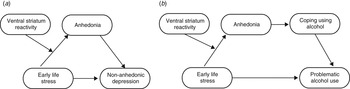
Extracted neuroimaging data values were winsorized (to ±3 s.d.s; left VS: n = 9; right VS: n = 9) to maintain variability while limiting the influence of extreme outliers before being analyzed in PASW Statistics (version 19; SPSS Inc.). A regression-based moderation model was tested using the process macro for SPSS (Hayes, Reference Hayes2013) to examine main and interactive effects of ELS (i.e. CTQ score) and reward-related VS reactivity (i.e. positive reward > negative loss) on anhedonia (i.e. MASQ-SF AD scale score). Based on evidence that anhedonia may predict other depressive symptoms (Gorwood, Reference Gorwood2008; Bijttebier et al. Reference Bijttebier, Raes, Vasey and Feldman2012) as well as substance use problems (Hatzigiakoumis et al. Reference Hatzigiakoumis, Martinotti, Giannantonio and Janiri2011; Mezquita et al. Reference Mezquita, Ibáñez, Moya, Villa and Ortet2014), we implemented structural equation models (SEM). Using MPlus (v. 7.11), we tested whether the interaction between ELS and reward-related VS reactivity was indirectly associated with non-anhedonic depression symptoms (i.e. MASQ-SF GDD scale score) as well as problematic alcohol use (i.e. AUDIT scores) via anhedonia and substance-related coping behavior (i.e. substance use brief COPE subscale scores; Fig. 1a, b ). All interaction predictor variables (i.e. CTQ scores and VS reactivity BOLD parameter estimates) were mean-centered prior to analyses. Unstandardized indirect effects were computed for each of 5000 bootstrapped samples, and the 95% confidence interval was computed by determining the indirect effects at the 2.5 and 97.5 percentiles. Model goodness of fit was assessed using root mean square residual (RMSEA < 0.05), standardized root mean square residual (SRMR < 0.05), and comparative fit index (CFI > 0.90) (Schermelleh-Engel et al. Reference Schermelleh-Engel, Moosbrugger and Müller2003). In an attempt to make the χ2 test less dependent on sample size, we used the relative χ2, which is calculated by dividing the χ2 fit index by the degrees of freedom. Congruent with prior literature (Schumacker and Lomax, 2004 ), if this ratio was <5 we deemed the model to have good fit.
Structural equation models examining the indirect effect of early life stress and left ventral striatum reactivity to reward on (a) non-anhedonic depressive symptoms, and (b) problematic alcohol use through anhedonic symptoms and substance-related coping.

Sex, age, psychiatric diagnosis (excluding depression and alcohol abuse diagnosis in the depression and problematic alcohol use SEMs respectively), and self-reported ethnicity were entered as covariates in all analyses. Sex was added as a covariate in all models due to previously documented sex differences in VS reactivity to reward stimuli (e.g. Spreckelmeyer et al. Reference Spreckelmeyer, Krach, Kohls, Rademacher, Irmak, Konrad, Kircher and Grunder2009). Because previous studies have identified a marked decrease in VS reactivity to reward in stress-exposed individuals (Bogdan et al. Reference Bogdan, Santesso, Fagerness, Perlis and Pizzagalli2011; Porcelli et al. Reference Porcelli, Lewis and Delgado2012; Casement et al. 2014) self-reported recent life stress was also included in all models. Additionally, due to evidence delineating race/ethnic differences in rates of stress and trauma exposure, self-reported race/ethnicity was included in all models (Roberts et al. Reference Roberts, Gilman, Breslau, Breslau and Koenen2011). Moreover, consistent with recent recommendations (Keller, Reference Keller2014), all pathways in which interactions were present included the interaction between all mean-centered covariates and predictor variables as covariates (e.g. CTQ × sex, VS × sex, etc.). Consistent with our previous report (Nikolova et al. Reference Nikolova, Bogdan, Brigidi and Hariri2012) the moderation models included self-reported depression symptoms as a covariate to ensure that the effect of the interaction between ELS and VS reactivity was specific to anhedonic symptoms. Additionally, a dichotomous age variable (under 21 and over 21 years) was added as a covariate in the problematic alcohol use moderated mediated model to account for legal drinking age.
Ethical standards
The authors assert that all procedures contributing to this work comply with the ethical standards of the relevant national and institutional committees on human experimentation and with the Helsinki Declaration of 1975, as revised in 2008.
Results
Sample demographics
The final sample included 820 participants [age: 19.63 ± 1.24 years; 464 (56.58%) female; ethnicity: 373 (45.4%) European/European American, 223 (27.2%) Asian/Asian-American, 88 (10.7%) African/African-American, 52 (6.3%) Hispanic, 84 (10.2%) multiracial or other]. While the majority of participants were healthy (81.82%), some of our sample met criteria for one or more Axis I disorders (18.17%) according to a diagnostic interview (Supplementary Table S1). Based on normative data (Boschen & Oei, Reference Boschen and Oei2007) 10.2% and 7.8% of our participants demonstrated scores comparable to those observed in depression clinical samples for the depression and anhedonic depression scales respectively. Additionally 2% of our sample self-reported AUDIT scores equal to or above clinical samples who meet criteria for alcohol dependence (Donovan et al. Reference Donovan, Kivlahan, Doyle, Longabaugh and Greenfield2006).
Associations with sample demographics
As in prior studies, women reported greater depression symptoms (Kessler, Reference Kessler2003) while men reported more problematic alcohol use (Hasin et al. Reference Hasin, Stinson, Ogburn and Grant2007) and had higher bilateral reward-related VS reactivity to positive feedback (Spreckelmeyer et al. Reference Spreckelmeyer, Krach, Kohls, Rademacher, Irmak, Konrad, Kircher and Grunder2009; Nikolova et al. Reference Nikolova, Bogdan, Brigidi and Hariri2012); Supplementary Table S2). Age was associated with self-reported substance-mediated coping as well as problematic drinking, where those in the legal North Carolina age group (i.e. over 21) reported more substance-related coping and problematic usage. Ethnicity predicted self-report measures of depression, stress, and alcohol use (Supplementary Table S3).
Reward-related VS reactivity and ELS interact to predict anhedonia
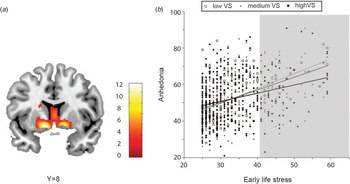
As previously reported (Delgado et al. Reference Delgado, Nystrom, Fissell, Noll and Fiez2000; Hariri et al. Reference Hariri, Brown, Williamson, Flory, de Wit and Manuck2006; Forbes et al. Reference Forbes, Brown, Kimak, Ferrell, Manuck and Hariri2009; Nikolova et al. Reference Nikolova, Bogdan, Brigidi and Hariri2012) the card-guessing paradigm reliably elicited reward-related (i.e. positive > negative feedback) bilateral VS reactivity (Fig. 2a ). Consistent with our hypotheses, a significant interaction between VS and ELS was associated with anhedonic symptoms when no covariates were included (left VS: ΔR 2 = 0.0057, b = −0.6600, p = 0.0195; right VS: ΔR 2 = 0.0046, b = −0.5460, p = 0.0356). Importantly, this interaction remained significant in the left VS even after accounting for sex, age, ethnicity, other depressive symptoms (as measured by the MASQ GDD scale), diagnosis of any psychiatric disorder, and recent life stress (as measured by the number of events reported on the LESS), as well as two-way interactions between these covariates with VS reactivity and CTQ scores (left VS: ΔR 2 = 0.0046, b = −0.7659, F 1,789 = 6.52, p = 0.0108; right VS: ΔR 2 = 0.0018, b = −0.4146, F 1,789 = 2.56, p = 0.1099). Post-hoc analyses revealed that those with relatively reduced left VS reactivity to reward (low VS: t = 2.16, p = 0.0311; medium VS: t = 1.17, p = 0.23; high VS: t = −0.019, p = 0.9842) and increased retrospectively reported ELS (Johnson–Neyman significance for CTQ values >41.32) self-report increased anhedonic symptoms (See Fig. 2b and Supplementary Table S4 for regression table).
(a) Statistical parametric map illustrating bilateral ventral striatum (VS) activation clusters for the contrast ‘positive reward > negative loss’ overlaid onto a canonical structural brain image Montreal Neurological Institute coordinates and statistics (p < 0.05, family-wise error whole-brain corrected and ≥10 contiguous voxels): left hemisphere: x = −12, y = 8, z = −10, t = 13.59, p < 0.001; right hemisphere: x = 12, y = 10, z = −8, t = 12.63, p < 0.001. (b) Left VS reactivity moderates the relationship between early life adversity anhedonic symptoms (Left VS: ΔR 2 = 0.0045, b = −0.7552, F 1,789 = 6.35, p = 0.0119). Data plotted are raw values. Lines represent participants with low VS reactivity (light grey; −1 s.d.), medium VS reactivity (grey; average), and high VS reactivity (black; +1 s.d.). Shaded area represent Johnson–Neyman area of significance (CTQ score >41.56).

Structural equation models
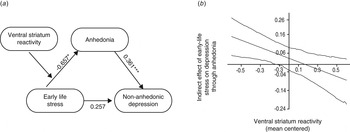
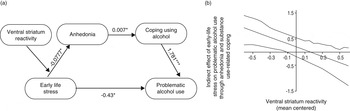
SEMs demonstrated that ELS and left VS reactivity to reward indirectly predict other depression symptoms and problematic alcohol use via the mediating effects of anhedonia and substance-related coping. Specifically, decreased reward-related left VS reactivity and elevated ELS was associated with increased anhedonia (b = −0.657, p = 0.047), which, in turn, was associated with elevated levels of non-ahedonic depression symptoms (MASQ-SF GDD: b = 0.361, p < 0.0001). The SEM demonstrated good fit (normed χ2 = 1.89, RMSEA = 0.033, SRMR = 0.007, CFI = 0.976) with bootstrapped 95% confidence intervals reflective of a significant indirect effect (Fig. 3). A second model showing good fit (normed χ2 = 2.68115, RMSEA = 0.045, SRMR = 0.013, CFI = 0.919; Fig. 4) demonstrated that relatively higher anhedonic symptoms were also associated with elevated levels of substance-mediated coping (b = 0.007, p = 0.019) and consequently the likelihood of problematic drinking (b = 1.781, p < 0.0001). Similarly bootstrapped 95% confidence intervals suggest a significant indirect effect (Fig. 4b ). There were no direct effects of the interaction between ELS and left VS reactivity on either general distress depression (b = 0.249, p = 0.214) or problematic alcohol use (b = 0.077, p = 0.330), suggesting a key indirect pathway through anhedonia. Both SEMs were also significant without the addition of covariates providing evidence that these results are not contingent upon their inclusion.
Early life stress-related anhedonia is dependent on left ventral striatum (VS) reactivity to reward and is associated with other depressive symptoms. (a) Structural equation model examining the indirect effect early life stress and left VS reactivity to reward on other depression symptoms via the mediating effects of anhedonia (* p < 0.05, *** p < 0.001). (b) Indirect effect of early life stress on depression via anhedonia as a function of VS reactivity. Middle line indicates effect size parameter estimate, curved lines reflect the bounds of the 95% confidence interval (CI) (the regions in which the 95% CI does not cross 0 are considered to be the values at which the indirect effect is significant).

Early life stress-related anhedonia is dependent on ventral striatum (VS) reactivity to reward and is associated with problematic alcohol use. (a) Structural equation model examining the indirect effect childhood adversity and left VS reactivity to reward on problematic alcohol use via the mediating effects of anhedonia and substance-related coping (* p < 0.05, *** p < 0.001). Paths are marked with unstandardized coefficients. (b) Indirect effect of early life adversity on problematic alcohol use via anhedonia and substance use-related coping as a function of VS reactivity. Middle line indicates effect size parameter estimate, curved lines reflect the bounds of the 95% confidence interval (CI) (the regions in which the 95% CI does not cross 0 are considered to be the values at which the indirect effect is significant).

Recent life stress
In a prior report on a subsample (n = 200) of the DNS (Nikolova et al. Reference Nikolova, Bogdan, Brigidi and Hariri2012), we found evidence that recent life stress interacted with right VS reactivity to predict positive affect (as assessed via the CES-D). In this larger sample, left VS reactivity in interaction with recent life stress exposure was significantly positively associated with MASQ-SF anhedonic depression scores (ΔR 2 = 0.0047, b = −1.5303, F 1,816 = 3.86, p = 0.0496) and positive affect as measured by the CES-D at a trend level (ΔR 2 = 0.0038, b = −0.2934, F 1,816 = 3.18, p = 0.0747). The direction of these interactions is consistent with our prior report, and is independent of ELS exposure (MASQ anhedonic depression: ΔR 2 = 0.0047, b = −1.5273, F 1,815 = 4.46, p = 0.0349; CES-D positive affect: ΔR 2 = 0.0038, b = −0.2928, F 1,815 = 3.57, p = 0.059). However, the strength of these effects were reduced with the inclusion of sex, age, ethnicity, and diagnosis of any psychiatric disorder excluding depression as covariates in the models (MASQ anhedonic symptoms: p = 0.0633; CES-D positive affect: p = 0.1015) and the further addition of all covariate recent life stress and covariate VS reactivity interactions (MASQ-SF anhedonic symptoms: p = 0.1171; CES-D positive affect: p = 0.6634). A similar pattern emerged in interaction with right VS reactivity; however, this association was not significant (MASQ anhedonic symptoms: p = 0.2126; CES-D positive affect: p = 0.3644).
Discussion
In this study we examined whether the effects of ELS on anhedonic symptoms were moderated by individual differences in reward-related VS reactivity in young adults. We further examined whether the interaction of VS reactivity and ELS indirectly predicted other depressive symptoms through its effects on anhedonia as well as problematic alcohol use through anhedonia and substance-related coping. Three primary findings emerged. First, after accounting for other depressive symptoms and recent stressful life events among other covariates, a VS × ELS interaction arose; individuals with relatively blunted VS reactivity to reward and elevated exposure to ELS reported greater anhedonic symptoms (Fig. 2). Second, we found that this interaction indirectly predicted other depressive symptoms as well as problematic alcohol use (Figs 3 and 4) suggesting that susceptibility to stress-related anhedonia may have transdiagnostic implications. Third, we found additional evidence in an expanded sample that even after accounting for ELS, recent stressful life events and reward-related VS reactivity is associated with anhedonia, consistent with our prior report (Nikolova et al. Reference Nikolova, Bogdan, Brigidi and Hariri2012); of note, however, after accounting for covariates this relationship was reduced to a trend and was not present in the right hemisphere as previously reported.
Building upon epidemiologic work linking ELS to psychopathology (Green et al. Reference Green, McLaughlin, Berglund, Gruber, Sampson, Zaslavsky and Kessler2010), the present results suggest that this association may be, at least in part, dependent upon individual differences in reward-related VS reactivity, and mediated through stress-related anhedonia. Consistent with literature suggesting that blunted behavioral and neural reward processing may confer vulnerability to transdiagnostic psychopathology (Feder et al. Reference Feder, Nestler and Charney2009; Geschwind et al. Reference Geschwind, Peeters, Jacobs, Delespaul, Derom, Thiery, van Os and Wichers2010), the present data suggest that ELS is only associated with increased anhedonic symptoms in individuals with blunted VS reactivity to reward. Prospective longitudinal studies are needed to determine whether such differences in VS reactivity to reward predate exposure to adversity, consistent with a rich literature suggesting that genetically conferred differences in reward responsiveness may leave individuals vulnerable to stress-related psychopathology (Myerson, Reference Myerson1922; Meehl, Reference Meehl1975; Klein, Reference Klein, Clark and Fawcett1987; Bogdan et al. Reference Bogdan, Nikolova and Pizzagalli2013). Alternatively, but not mutually exclusive, individuals who develop stress-related anhedonia may be more susceptible to stress-induced changes in reward-related VS response (Pizzagalli, Reference Pizzagalli2014).
Blunted reward-related VS reactivity indirectly conferred risk for non-anhedonic depressive symptoms through stress-related anhedonia. This finding is congruent with prior epidemiologic work indicating that depression is frequently preceded by ELS (Monroe & Hadjiyannakis, Reference Monroe, Hadjiyannakis, Gotlib and Hammen2002; Heim et al. Reference Heim, Newport, Mletzko, Miller and Nemeroff2008; Heim, Reference Heim, Bradley, Mletzko, Deveau, Musselman, Nemeroff, Ressler and Binder2009; Heim & Binder, Reference Heim and Binder2012) and research linking major depressive disorder to blunted striatum reactivity to reward (Epstein, Reference Epstein2006; Steele et al. Reference Steele, Kumar and Ebmeier2007; McCabe et al. Reference McCabe, Cowen and Harmer2009). Evidence suggesting that anhedonia precedes the development of depression (Dryman & Eaton, Reference Dryman and Eaton1991) and that hedonic impairments can be induced by stress (Pizzagalli, Reference Pizzagalli2014) provide further support for this model. Moreover, recent evidence demonstrating that self-reported positive, but not negative, emotion regulation prospectively predicts later depression symptoms in those exposed to high levels of stress (Bijttebier et al. Reference Bijttebier, Raes, Vasey and Feldman2012) highlights the key role of reward pathways in stress-related psychopathology.
Importantly, stress-related anhedonia was not exclusively associated with depression; blunted reward-related VS reactivity was also indirectly associated problematic alcohol use through stress-related anhedonia and substance-related coping behavior. This indirect association is consistent with previous work demonstrating that coping-related substance use, including alcohol, is predictive of later substance problems (Cooper et al. Reference Cooper, Frone, Russell and Mudar1995; Grant et al. Reference Grant, Stewart and Mohr2009; Mezquita et al. Reference Mezquita, Ibáñez, Moya, Villa and Ortet2014) as well as a wealth of addiction literature linking substance use disorders to blunted VS reactivity to non-drug-related reward (Koob & Le Moal, Reference Koob and Le Moal2001; Volkow et al. Reference Volkow, Fowler, Wang and Swanson2004; Koob & Volkow, Reference Koob and Volkow2010). The data presented here build on recent models suggesting childhood adversity increases alcohol-related problems via coping-related substance use (Mezquita et al. Reference Mezquita, Ibáñez, Moya, Villa and Ortet2014) by documenting that VS reactivity to reward moderates this relationship. That this relationship is associated with both depressive symptoms and problematic alcohol use is consistent with recent work suggesting that a comprehensive one-dimensional vulnerability factor best accounts for risk to develop common forms of psychopathology including mood, anxiety, and substance use disorders as well as thought disorders (Lahey et al. Reference Lahey, Applegate, Hakes, Zald, Hariri and Rathouz2012; Caspi et al. Reference Caspi, Houts, Belsky, Goldman-Mellor, Harrington, Israel, Meier, Ramrakha, Shalev, Poulton and Moffitt2014).
It is important to note that these associations were only observed in left VS after accounting for covariates Although, some studies have found decreased VS reactivity in response to positive stimuli in depressed patients solely in the left hemisphere (Pizzagalli et al. Reference Pizzagalli, Holmes, Dillon, Goetz, Birk, Bogdan, Dougherty, Iosifescu, Rauch and Fava2009), others have found diminished reactivity bilaterally (Epstein et al. Reference Epstein, Pan, Kocsis, Yang, Butler, Chusid, Hochberg, Murrough, Strohmayer, Stern and Silbersweig2006). There is limited understanding of VS laterality leaving us unable to speculate about this laterality finding.
Our study is not without limitations. First, our sample is composed of relatively high-functioning university students. Although about 18% of our sample met criteria for one or more psychiatric disorders, the majority of participants were healthy thereby limiting variability in dimensional symptom measures. It is particularly important to consider this limitation in the context of alcohol use and exposure to ELS. With regard to alcohol use, epidemiological data suggest that alcohol use is heaviest in young adult years (Fillmore et al. Reference Fillmore, Hartka, Johnstone, Leino, Motoyoshi and Temple1991; Naimi et al. Reference Naimi, Brewer, Mokdad, Denny, Serdula and Marks2003) with problematic usage tapering off in the majority of individuals when they reach their mid-20s (Jackson et al. Reference Jackson, Sher, Gotham and Wood2001). As such, it is unclear whether the present data are predictive of long-term alcohol use problems that extend beyond the college years. However, given that problematic usage in college is predictive of later alcohol use disorder (Schulenberg et al. Reference Schulenberg, Maggs, Long, Sher, Gotham, Baer, Kivlahan, Alan Marlatt and Zucker2001), these data, at minimum, identify important individual difference factors (i.e. VS reactivity and ELS) and mechanisms (i.e. stress-related anhedonia and coping) contributing to risk for problematic drinking in college, which may then promote future alcohol use disorders.
With regard to ELS, CTQ total scores in this sample (i.e. mean = 33.46) were comparable to other community (e.g. metropolitan Memphis, Tennessee, area, n = 1.007, mean = 31.7; Scher et al. Reference Scher, Stein, Asmundson, McCreary and Forde2001) and college samples (e.g. UCSD; n = 949, mean = 35.2; Wright et al. Reference Wright, Asmundson, McCreary, Scher, Hami and Stein2001), but are considerably lower than those typically observed in clinical samples (e.g. alcohol-dependent inpatients, n = 100, mean = 42.8; Schäfer et al. Reference Schäfer, Reininghaus, Langeland, Voss, Zieger, Haasen and Karow2007, and major depression disorder and bipolar outpatients, n = 40, mean = 47.8; Watson et al. Reference Watson, Owen, Gallagher, Hearn, Young and Ferrier2007). The present results suggest that the moderating effect of reward-related VS reactivity on anhedonia arises at low to moderate levels of ELS (i.e. 41.32, see Johnson–Neyman area of significance in Fig. 2). However, this relatively high-functioning college student population may have had other protective factors that may have counteracted the effects of ELS. Moreover, whether this linear pattern continues at extremely high levels of stress requires further validation by studies with a large number of individuals who have experienced extreme adversity during childhood (Goff et al. Reference Goff, Gee, Telzer, Humphreys, Gabard-Durnam, Flannery and Tottenham2013).
Second, because this study is cross-sectional, we are unable to establish chronological relationships which could be leveraged to inform whether blunted reward-related VS reactivity predates early life adversity exposure or whether this exposure may have long-lasting effects on VS development and function. Thus, it is important to note that although mediational models may suggest a direction of effect, due to the cross-sectional design of the current study we are unable to determine if variability on one variable precedes variability in another. Notably, we did not observe a direct association between ELS and VS reactivity to reward (left VS: p = 0.31; right VS: p = 0.84; bilateral VS: p = 0.72), which is inconsistent with prior literature showing direct associations between early life adversity and blunted neural response to reward (e.g. Dillon et al. Reference Dillon, Holmes, Birk, Brooks, Lyons-Ruth and Pizzagalli2009; Mehta et al. Reference Mehta, Gore-Langton, Golembo, Colvert, Williams and Sonuga-Barke2010). This inconsistency may arise from the experience of less extreme trauma in the present sample as well as different imaging tasks and regions of interest.
Third, we must consider the limitations of our phenotypic assessments. With the exception of reward-related VS reactivity measures, all other variables relied upon self-report. It is particularly important to note that retrospective recall of stress, occurring either recently or early in life, may encompass errors or be influenced by current mood or perception (Monroe, Reference Monroe2008). However, reports have shown convergent validity between CTQ scores and clinician-rated childhood abuse interviews (Scher et al. Reference Scher, Stein, Asmundson, McCreary and Forde2001). Another consideration is that while our blocked fMRI paradigm increases power to measure VS reactivity, it does so at the cost of specificity (e.g. separating anticipation of reward from outcome). This is particularly important in light of observations that reward processing is not a monolithic phenomenon (Berridge et al. Reference Berridge, Robinson and Aldridge2009) and can be dissected into anticipatory, consummatory, and learning components. As such, we are unable to ascertain whether these effects may be predominantly the result of differences in specific phases of reward processing or reward learning.
These limitations notwithstanding, the present study suggests that blunted VS reactivity to reward may render individuals vulnerable to stress-related anhedonia, which, in turn, confers risk for other depressive symptoms as well as substance-related coping and problematic alcohol use. While these findings shed light on potential mechanisms underlying relative risk or resilience for stress-related psychopathology, longitudinal research is needed to more clearly define specific roles of these mechanisms in the onset and course of psychopathology. Last, in light of the independent effects of recent life stress effects from ELS, as well as work demonstrating that acute stress can induce hedonic deficits (Berenbaum & Connelly, Reference Berenbaum and Connelly1993; Bogdan & Pizzagalli, Reference Bogdan and Pizzagalli2006) and influence reward-related neural circuitry (Bogdan et al. Reference Bogdan, Santesso, Fagerness, Perlis and Pizzagalli2011; Porcelli et al. Reference Porcelli, Lewis and Delgado2012; Lewis et al. Reference Lewis, Porcelli and Delgado2014), it will be important to examine how ELS may influence reward-related reactivity following recent/acute stress to predict psychiatrically relevant brain function and behavior.
Supplementary material
For supplementary material accompanying this paper visit http://dx.doi.org/10.1017/S0033291715000525.
Acknowledgements
The Duke Neurogenetics Study is supported by Duke University and the National Institutes of Health (NIDA R01-DA033369). A.R.H. receives additional support from the National Institutes of Health (NIDA R01-DA031579). N.C.S.F. was supported by NIMH (T32-MH014677). Y.S.N. was supported by HHMI international student fellowship. D.A.A.B. was supported by NIMH (T32-GM008151). R.B. was supported by the Klingenstein Third Generation Foundation and receives additional support from the National Institutes of Health (NIA R01-AG045231). We are grateful to the Duke Neurogenetics Study (DNS) participants. We also thank F. Ahs, B. Brigidi, J. Carré, C. Davis, K. Faig, E. Goetz, A. Gorka, S. Jacobson, A. Knodt, K. McNealy, J. Minkel, and V. Sochat for assistance with data collection and processing.
Declaration of Interest
None.