On 13 July 2005, the Bursa edition of the Turkish daily Hürriyet announced the inauguration of a clock tower in the small Anatolian town of Çınarcık. The clock tower, which stands thirteen meters (roughly forty-three feet) tall, comprises a square-sectioned, white-colored, and fluted Classical column atop which a cube with four yellow-rimmed clock dials sits. Metal pennants, also colored white, project from the corners of the cube. Despite its questionable aesthetic qualities, the town's mayor, Murat Erdoğan, claims it “beautified” Çınarcık. Erdoğan further explains that Çınarcık had sorely needed a clock tower and that the city is happy to have finally built one.
To be certain, the need to which Erdoğan refers is not a practical one, for almost everyone wears wristwatches nowadays. However, I do not intend to cast doubt on the mayor's motivations. Because its construction must have expended valuable funds, the tower was indeed needed at some visceral level. What, then, might the aspects of this need be? The newspaper article already suggests that aesthetics is one aspect. Are clock towers also perceived as symbols of progress and modernity? Could they symbolize supremacy of the secular over the religious? Do they function as tools for imposing social order? Furthermore, were these perceptions different in the 19th century, when clock towers began to proliferate in Anatolia in earnest? How did a predominantly Muslim populace receive these “adornments”? Did their association with church towers (especially because many Anatolian clock towers also chimed) change over time?
THE OTTOMAN EMPIRE
Instruments for telling time were not new phenomena in 19th-century Anatolia. In his Osmanlı Güneş Saatleri, Nusret Çam dates the earliest known sundial in the region to 1409.Footnote 1 However, because sundials were known to the Egyptians and Babylonians, it is likely that they existed there in much earlier periods. Regardless, with the arrival of Islam, their proliferation accelerated. The concern with telling time in Islamic societies derives from the tight rapport between its daily rituals and the sun's movement through the sky. Muslims pray five times a day, at times that are precisely defined,Footnote 2 and fasting is required from dawn to sunset during the month of Ramadan. The Ottomans devised various means of catering to these requirements. In addition to the large number of sundials in Ottoman cities, muvakkithanes (“timekeeper houses”) were to be found, usually as part of mosque complexes.Footnote 3 Here, the mosque's astronomer monitored the sun's position to establish the times of the daily prayers.
In Europe, the earliest mechanical clocks were public ones: they were typically built for churches, monasteries, or towns. In the Ottoman Empire, by contrast, they first became common in private households and houses of worship, including mosques.Footnote 4 Starting in the 16th century, well-to-do individuals were able to purchase clocks imported from Europe. A survey of 18th-century inheritance records, in fact, reveals that clocks were more common household items in the Ottoman Empire than pistols and muskets.Footnote 5 After the mid-19th century, many mosques were also fitted with grandfather clocks or at least wall-hung clocks that faced the congregation.Footnote 6 It must be emphasized, however, that Ottomans did not set their clocks to the standard time that became widespread (beginning with the west) in the latter half of the 19th century.Footnote 7 For centuries, Ottomans used Islamic time.Footnote 8 This measure of time divided the day into two twelve-hour segments. The nocturnal segment, with which the new day began, started at sunset. Twelve hours later, the diurnal segment began and ran until sunset. At sunset, the clock would be reset to make sure it remained at 12:00.
The latter point deserves amplification. As Uğur Tanyeli notes, the Ottomans’ “adoption” of clocks in the 16th century did not radically change the tempo of social life, because “the essential punctuation of everyday life in a traditional Islamic society was by definition not secular but strictly religious.”Footnote 9 Thus, the Ottomans constructed a consensus between the religious sociotemporal order—still dependent on the natural rhythm of the sun—and the abstract, mathematical hours of the mechanical clock. This, to use Tanyeli's terms, was the alla Turca, or Islamic time. Its use in the empire lasted for almost four centuries and demonstrates the dialectic and interactive process through which new ideas are typically adopted.Footnote 10 Time and space were not transformed, to borrow Anthony Giddens's terms, into “empty dimensions” in the Ottoman Empire until later in the 19th century.Footnote 11 It was only after Islamic time became a clear obstacle to modernization—of the central administrative apparatus in particular—that it was abolished. Even then, it was only relinquished reluctantly, at least by the public.
One of the earliest encounters of the Ottomans with standard time took place during the preparations for the Crimean War (1853–56); this was part of Ottoman efforts to coordinate with the French and the British against the common enemy, Russia.Footnote 12 Military alliances, however, were by no means the only catalyst for the adoption of Western time. With the declaration of the Tanzimat decree in 1839, the central government embarked on a project of modernization, slowly expanding its duties to encompass all aspects of daily life. Among other changes, this modernization project entailed the establishment of a host of new governmental institutions—which had formal hours of operation—and the introduction of services such as telegraphic communication and rail and ferry service.Footnote 13 All of these changes forced Ottomans to be more punctual. Yet punctuality, or to be more precise, synchronicity, was difficult to achieve with Islamic time. Islamic time was strictly local in that it followed true solar time. Thus, two locales longitudinally separated even by a modest distance used different time settings, resulting in an inordinate number of local times. Under such a system, departure and arrival times of intercity trains or ferries, for example, were especially difficult to coordinate. Moreover, accelerated interactions with Europe had rendered Western time a part of Ottoman life. Thus, Western time began to be used concomitantly with, and later replaced outright, the Islamic time of which the Ottomans were so fond.Footnote 14
The rise of standard, and the concomitant fall of local, time can also be seen within the framework of what James C. Scott refers to as the “project of legibility” of early modern governments. This post-Enlightenment administrative ordering of society entailed sedentarization, establishment of cadastral surveys and population registers, creation of permanent last names, and standardization of weights of measures, as well as the establishment of a universal measure of time. Such moves made “the [governed] terrain, its products, and its workforce more legible—and hence manipulable—from above and from the center.”Footnote 15
Having rudimentarily discussed the modernization of time in the Ottoman Empire, a brief aside must be taken here to redress the scholarly tendency to view all changes undergone by the Ottomans in this period as symptomatic of imitating the West. In the dominant narrative of Ottoman history, all modernization efforts, and indeed what Deringil has termed the Ottoman “project of modernity,”Footnote 16 are commonly explained away by the problematic paradigm of Westernization. This was allegedly the result of over a century of “stagnation” that was to lead to the empire's decline and eventual downfall. However, one must take issue with the notion that the Ottoman Empire suddenly took notice of the West in the 18th century and began to emulate its ways. “To regard the 18th century as a turning point in Ottoman interaction with Europe,” asserts Shirineh Hamadeh, “is to ignore over two centuries of virtually continuous cultural and artistic contact. It is also to accept the fallacy of a fundamental polarity between the two geocultural entities, whereby cultural encounter can occur only in situations of unequal power and in the form of ‘influence.’”Footnote 17 One must also take seriously Cemal Kafadar's question as to whether a decline lasting three and a half centuries, and for more than half the life of an empire, is possible.Footnote 18
This is not to deny that by the beginning of the 19th century the system of hierarchies that had characterized the Ottoman world order were under strain and that the Ottoman Empire indeed was in search of a new identity. Yet, despite many contemporary critics’ view that these changes amounted to the breakdown of social order and the decline of the empire, they can also be seen as symptomatic of what is known as the modern period. Thus, greater physical and social mobility among the empire's classes, the erosion of traditional marks of distinction, changing consumption, recreation, and cultural habits, and increasing material wealth came to exemplify the 18th and 19th centuries.Footnote 19 At the same time, the Ottoman ruling elite's “project of modernity” did not come without its own set of social demands. New expectations that the state brought to bear on its subjects (most notably, in the form of taxationFootnote 20) created new strains on society, leading to what Jürgen Habermas has termed a “legitimation crisis.”Footnote 21 In the face of such a crisis, the Ottoman government resorted to diplomatic, and occasionally military, interventions with regard to the empire's population.
These interventions intensified during periods of most acute crisis, such as the thirty-three-year sultanate of Abdülhamid II (1876–1909). Although Abdülhamid's reign, in many ways, is regarded as a culmination of the Tanzimat reforms, bringing to fruition, as it did, the administrative centralization efforts so crucial for the Tanzimat, it was also “disruptive of much of the traditional fabric of society, as the state now came to demand not passive obedience but conformity to a unilaterally proclaimed normative order.”Footnote 22 It was against this backdrop that Abdülhamid II, on his silver jubilee in 1901, decreed that all provincial cities should build a clock tower in his name.Footnote 23 The construction of these clocks may be seen, if one translates Carol Gluck to a late-Ottoman context, as part and parcel of “the grammar of ideology by which hegemony was expressed.”Footnote 24 That clock towers were but a small part of this expression of hegemony does not render them less important in terms of the impact they had on their respective urban environments.Footnote 25
The construction of clock towers was also part of what Deringil has called the empire's “colonial project,” even if this might be less of an issue in Anatolia than in other regions of the empire. Sometime in the 19th century, Deringil argues, the Ottoman Empire began to perceive its own periphery as a colonial setting.Footnote 26 The main target of this perception was the last Ottoman foothold in North Africa—present-day Libya. In a memorandum drafted by Sultan Abdülhamid II regarding the future of this province, the sultan stipulated, besides various urban amenities, “the construction of a clock tower in a suitable position which will show western time and automatically chime the hours.”Footnote 27 Although the memorandum is undated, Deringil deduces from context that it was probably penned sometime in the 1890s.Footnote 28 It thus seems that by the last decade of the 19th century, clock towers had become, in the eyes of the ruling elite, instruments with which to advertise the central government's power in the provinces.
Further confirmation of the governmental character of clock towers comes from the fact that they were typically built in the proximity of government buildings or central city squares.Footnote 29 Of the fifty-two extant clock towers that Acun lists in his compilation, Anadolu Saat Kuleleri, thirty-two are located near government buildings or in or around the city's main square. If a central location is not chosen, the tower is typically located on a prominent hilltop overlooking the city. As Kemal Özdemir notes, one reason for locating clock towers close to government buildings was to facilitate the organization of work hours for government employees according to Western time.Footnote 30 The clock tower of Adana, for instance, “chimed every half hour, and public officials began and ended work” according to its tintinnabulations.Footnote 31 Incentive for using a precise timekeeper was thus also born of a wish to organize the daily life of urban populations, particularly with respect to the working day.
Of course, the case could be made, and often was, that these chiming clocks would help announce the daily times of prayer. It is hardly surprising, therefore, to find the following verses in a poem by Fani Efendi commemorating the erection of the Adana clock tower:
Yet Abdülhamid II had specifically decreed that clock towers be set to standard time and not Islamic time, which was tied more closely to the sun's movement in the sky (and hence Muslim prayer times).Footnote 33 Furthermore, Muslims already had a very effective means of announcing the time of prayer: the call to prayer from mosque minarets. The chimes of a clock tower set to the “time of a foreign land”Footnote 34 could hardly be accepted as an aid to determining times of prayer. If anything, the chimes were evocative of the means used by Christians to summon their faithful to prayer—a sound that, because Ottoman-Islamic law forbade Christians to chime church bells, had not been heard in Ottoman lands for quite some time. The stated purpose of announcing the times of prayer seems to have been a cover for instating visual and auditory confirmations of the central government's sovereignty. In what Dumont and Georgeon call the “struggle between state power and the local communities,” it was a means for tipping the scales in favor of the former.Footnote 35 As Deringil explains,
“specifically secular monumental architecture” represented by a clock tower highlighted the confrontation between Qur'anic [Islamic] time punctuated by the call to prayer from the minarets, and conversion to a new economic order “founded on the conjoining of time to labour.” Thus particularly in Anatolia and the Arab provinces, these buildings . . . served as markers of a new concept of time and power.Footnote 36
The secular character of clock towers is also suggested by Tanyeli. What limited the number of clock towers in the Ottoman Empire, according to Tanyeli, was
the semiological priority of the minaret itself. Perhaps the clock tower was regarded as an architectural and symbolic rival of the minaret, the very “concretization” of the sociotemporal order. The clock tower, however, was the concretization of a different, more secular, sociotemporal order, and for this reason, Ottomans built clock towers in the second half of the nineteenth century, when they intended to “secularize” the routine of daily life along with the newly emerging consciousness moving toward complete social modernization.Footnote 37
Another clue to the way clock towers were perceived is found in the common reference to these edifices as “clocks of the motherland” (memleket saatleri) during the 19th century.Footnote 38 For the Ottomans, “nationalism” was both a problematic concept and a strived-for goal in the 19th century. On the one hand, the empire was trying to counter the centrifugal forces of various nationalisms that were ripping away chunks of its territory (and also forming the crux of what was known in Europe as the “Eastern Question”), and, on the other hand, the empire was trying to formulate a viable Ottoman nationalism to counter these centrifugal forces. The philosophical debate regarding the direction in which the empire should be headed revolved around the concepts of Ottomanism (a common tie to the “homeland” and the abstract notion of an Ottoman state regardless of ethnicity or faith, i.e., Ottoman nationalism), Islamism (a reversion to the basic principles and thus the “golden days” of Islam), and Turkism (the reincarnation of Turkish culture of pre-Ottoman Anatolia), as well as “the Tanzimat concept of a multinational empire living in peaceful harmony.”Footnote 39 It is clear that clock towers provided ideological propping for the Tanzimat concept as well as perhaps the concept of Ottomanism. What is more surprising is that clock towers may have provided propping for Islamism. As noted previously, Abdülhamid II was careful to portray clock towers as elements serving Islam. This, as will be discussed, seems to have been successful, at least in the context of certain examples, in persuading the Muslim population of Anatolia to accept clock towers as contemporary versions of timekeeper houses.
However, let us first play devil's advocate and entertain the thought that clock towers could potentially be perceived as anti-Islamic. The first clock tower in Anatolia was built in the Aegean town of Manisa at the beginning of the 19th century. As Özdemir notes, the tower—which no longer stands—was built “to the right of the Ulu (Great) Mosque's north gate” and had no dials: it told the time by chiming at the top of each hour.Footnote 40 Because it lacked dials, it probably looked similar if not identical to a belfry, and the hourly chiming of its bells might have augmented this image. In a land where non-Muslims were second-class subjects and where the supremacy of Islam was impressed upon them in not so subtle ways,Footnote 41 could a Christian symbol be tolerated on a Muslim house of worship?
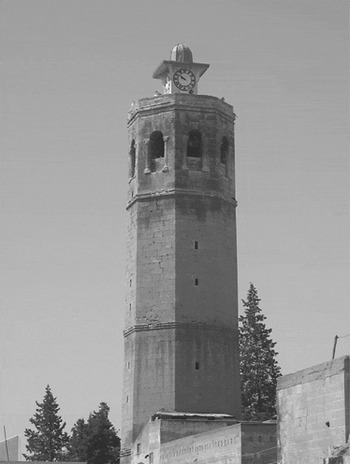
The Manisa Ulu Mosque is not an isolated example. The clock tower of Urfa, too, is part of the main mosque's complex. According to Acun, the Grand Mosque of Urfa was built on the ruins of “an old church dating from the crusades.”Footnote 42 During its conversion, it seems that the church's tower was preserved and incorporated into the northwest corner of the mosque's courtyard. A clock was installed on this tower at a later, but unknown, date (Figure 1). A similar case exists in the town of Ayvalik. The Hagios Yannis Church in this town was converted into a mosque after Greek forces were expelled from western Anatolia following the Turkish War of Independence (1919–22). As part of the conversion, which took place in 1928, a minaret was added to the building, and its bell tower was turned into a clock tower. The building is now known as Saatli Cami, or the Mosque with a Clock.Footnote 43 In a similar vein, the clock tower of Erzurum also doubles as the minaret of the adjacent noncongregational mosque (mescid).Footnote 44 Thus, despite the potentially problematic nature of locating a chiming clock tower next to a mosque, it seems to have taken place on more than one occasion in 19th- and early 20th-century Anatolia.
The Urfa clock tower. Source: Photo courtesy of Nazli Evrim Şerifoğlu (2006).

As we will see, towers with chiming bells were fairly offensive to a Muslim populace, but there is evidence to suggest that clock towers, when built in the proximity of mosques, seem to have been mentally associated with timekeeper houses. Hence, despite their formal and auditory similarities with church towers, they seem to have been accepted as “modern” versions of the time-honored institution of timekeeper. Evidence of this tendency is found in the rhymed chronogram of the Muğla Clock Tower (1884); İsmail Hakkı, the chronogram's author, refers to the edifice as a timekeeper house:
Cases where clock towers are located in the proximity of mosques, but not as part of the mosque complex, are even more numerous in Anatolia. It is clear that this was in part because “. . . meydans, the open spaces in the Ottoman city, were always attached to the mosques located in dense residential quarters,”Footnote 47 and because there was a tendency to build clock towers in city squares, they were often located close to mosques. Indeed, cases where clock towers were built in proximity of mosques exist in Izmir, Samsun, and Burdur, among other cities. However, although the Ottomans had no qualms about building clock towers in the proximity of mosques, care seems to have been taken to ensure that they were not taller than minarets. Thus, despite the very real challenge they posed to minarets as the sole vertical elements in most Ottoman cities (barring the occasional pre-Ottoman tower often in a ruinous state or, later, watchtowers built to spot ever-increasing fires), clock towers were “respectful” acquaintances of these religious landmarks. Yet, as I will argue, this hierarchy will come to be challenged in the republican period and in certain instances be tipped in favor of the clock tower.
Despite the acceptance of clock towers in certain contexts, as elements compatible with Islam, in other cases the association between these urban features and Christianity became more direct. In the south Anatolian town of Mersin, for example, the city's clock tower, located on İstasyon Street, is also the bell tower of the adjacent Italian Catholic church. In the case of the Hagia Fotini Church in Izmir, too, the clock tower doubled as the church's bell tower.Footnote 48 These were not isolated cases. Scrutiny of early 20th-century government records reveals that building church towers under the guise of clock towers was a common practice in this period—a practice that elicited considerable Muslim reaction. In a document dated 1909, for example, the Ministry of the Interior noted that the request to erect a clock tower on the (Armenian) Sulu Monastery in the Samatya neighborhood of Istanbul had been denied; yet this tower, and a similar one on the (Greek-Orthodox) Hagia Dimitri Church in the city's Sarmaşık Quarter, were near completion.Footnote 49 Hence, the ministry sent a notification to the Greek and Armenian patriarchates to “deal with these issues,” probably meaning to have them torn down. The fact that neither church has a clock tower today indicates that the patriarchates, or perhaps other institutions, were successful in removing the clock towers sometime between 1909 and the present day. In a similar vein, two documents from 1909 and 1910, respectively, note that the Muslim wardens of King David's tomb in Jerusalem (which had been converted into the Nebi Davud Mosque after the Ottoman conquest of the city) complain of the newly built “German Church” (the Dormition Abbey) nearby, which had a clock tower with chiming bells.Footnote 50 The wardens request that these bells be removed.Footnote 51 The second document decrees that the bells on the clock tower of the same church, which were hung for the occasion of the German prince and princess’ visit, should be removed.Footnote 52 These documents suggest that there was dissatisfaction with the proliferation of clock towers that were perceived as thin guises for erecting church towers. The negative connotations attached to chiming bells in Anatolia can also be found in a poem titled “Bell Chimes” by Necip Fazıl Kısakürek—an Islamist Ottoman poet of the early 20th century:
In addition, although its temporal distance to the period under scrutiny is admittedly large, an example from present-day Turkey confirms that chiming bells are found offensive in Anatolia: as reported by the web-based news portal Ensonhaber, authorities have postponed fixing the chiming mechanism of the Erzurum clock tower because the public finds it evocative of Christianity, and hence offensive.Footnote 54
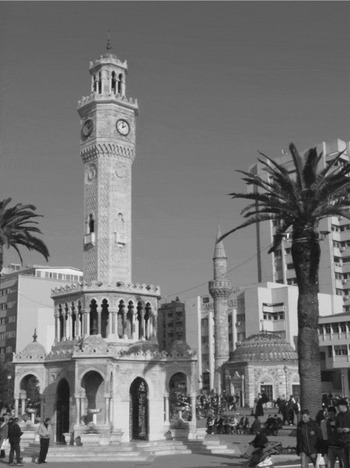
Besides being used by the central—and, to some extent, local—governments to advertise their sovereignty and by Christian minorities to erect, in effect, church towers, clock towers were also instruments of rapprochement for foreign governments. This is perhaps seen most clearly in the case of the Izmir clock tower (Figure 2). Although the tower was built with local resources, its clock mechanism was a gift from Emperor Wilhelm II of Germany—a step that hearkens back to Wilhelm's goal of pursuing a weltpolitik (world policy) and Germany's decision to nach Osten dringen (drive toward the East), both attempts to avoid being squeezed out of world markets and to acquire resources for the burgeoning German industrial sector.Footnote 55
The Izmir clock tower. Source: Photo courtesy of Didem Boyacioglu (2006).

By the second decade of the 20th century, enough momentum seems to have been created in building clock towers in Anatolia that it became a race between cities. According to a document dated 1917, municipalities had begun using funds on clock towers at the expense of sanitary infrastructure. The document decrees that providing for the sanitary requirements of cities should be given precedence over such “second-degree services.”Footnote 56 Given that World War I was nearing its end, one finds it odd that municipalities had the funds to erect clock towers. However, as I hinted previously, clock towers had also become instruments of social transformation for local governments. They were used, to invoke Ali Cengizkan's words, as “a means to bridge the gap between public and private space”; they were instruments with which to establish auditory communication between the city square and the residential neighborhood or even private residences.Footnote 57
To sum up, the last century of the Ottoman Empire witnessed an intense move to build clock towers in Anatolia due to the convergence of several trends. These trends were the central government's increasing desire to advertise its sovereignty in the provinces; a means for Christians to erect church towers, which hitherto they had been forbidden to do; a means for the central government to popularize twenty-four-hour time, an agent of modernization, in Anatolia; and a tool of rapprochement between foreign governments and the Ottoman Empire. This move, as we will see in the next section, was to continue at a slower pace and in a new guise following the proclamation of the Turkish Republic.
THE TURKISH REPUBLIC
The Republic of Turkey was founded in 1923 with the final overthrow of the Ottoman Empire after World War I and the Turkish War of Independence. The central figure during this period was Mustafa Kemal Atatürk—the leader of the independence movement and the republic's first president. Atatürk believed the Ottoman Empire had brought about its own demise by failing to participate in the processes of enlightenment and modernization initiated by Europe. His aim was to bring Turkey into the arena of civilized nations. However, in order to become serious competitors in the modern world, Turks had to liberate themselves of their imperial burden—prerepublican institutions and attitudes—and make a clean start by severing ties with the Ottoman past.Footnote 58 To achieve this goal, Atatürk initiated an era of intense reform. Although many of his reforms had fairly solid antecedents in the Ottoman period, the haste and zealousness with which Atatürk and the coterie of republican elites undertook them was unprecedented.Footnote 59
In order to free itself of the shackles of religious dogma, the Turkish Republic “had to be fiercely irreligious, embodying all the virtues of tradition without its vices: ready and willing to be injected with positivism and progress.”Footnote 60 Thus the high culture of Islam was relegated to a marginal position, as were prerepublican attempts at modernization, because they constituted attempts to accommodate modernity within tradition or were simply undertaken to please Western states. The republic was also nationalistic, having adopted and expanded upon the late Ottoman concept of “Turkishness” (Türkçülük). However, therein lay numerous contradictions. The Ottoman Empire harbored a large number of minorities—Greeks, Armenians, and Jews, among others—who had now become de jure citizens of the Turkish Republic. However, the government neither knew how nor had the desire to incorporate them into the “republican project.”Footnote 61 Decades of economic dominance by the minorities, as well as anticolonial sentiment, had rendered these citizens personae non grata, and the republic made it an undeclared policy to weed them out. An ethnicity-based definition of nationhood, however, was not feasible because minorities outnumbered Turks in certain key areas, nor could a geographic definition be used because Turks were relative latecomers to Anatolia. Thus, despite its avowed secularism, the republic resorted to a partly religious definition of nationhood, with Islam providing ideological propping for Turkishness.Footnote 62
Despite the philosophical problems inherent in the republican project, Atatürk and his coterie pushed forward. As part of their project of modernity, considerable effort was directed toward making the physical environment more “modern” on the assumption that once the environment was altered, the behavior of individuals would follow suit. Thus urban planning and architecture were used during the early years to advertise and consolidate the republican project and to create the setting in which modern life was to take place. This project included the reconstitution of time according to the worldview and desires of the state. Thus, in 1926, the Adoption of Western Time and the Gregorian Calendar Act was passed.Footnote 63 Although the intent of this act may seem similar to prior attempts by the Ottomans to introduce standard time, the zeal with which it was applied and the punitive measures for offenders were unique. It thus constitutes the culmination of the long process of adoption of Western time begun in the 19th century. Islamic time, from then on, was relegated to the realm of timekeeper houses, and even those, as we will see, were on their way to extinction.
Despite this similar, if more fervent, attitude toward the adoption of Western time, the republican elite's modus operandi for the physical expression of the attitude was different (at least as far as projects sponsored by the central government were concerned; local governments, to a certain extent, continued to erect clock towers). Although clock towers were still apt tools to modernize the way in which the passage of time was measured for the republic, they were associated too closely with the ancien regime to be palatable urban elements. During the Ottoman period, the formal vocabulary used in the design of clock towers was essentially historicist. They were typically free-standing, built in or near city squares, and adorned with details from two or more historic periods. Yet, as Bozdoğan notes, young Turkish architects had adopted, as the most appropriate outward expressions of the nation's modernist ideals, the aesthetic canon of the so-called Modern Movement.Footnote 64
Locations chosen for clock towers during the Ottoman period were also problematic. As noted previously, Ottoman clock towers were generally located in and around city squares. Here, they typically became one of the most dominant elements. Yet in the early republican period, city squares were to become, to use Henri Lefebvre's terms, the most important “representational spaces.”Footnote 65 They were spaces where the experience of life in the new republic, with all its associated images and symbols (such as monuments for instilling national pride and statues commemorating Atatürk), could be most powerfully felt.Footnote 66 There was no room for monuments reminiscent of the ancien regime in city squares.
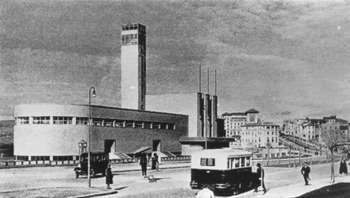
In the West, meanwhile, clock towers with clean, uncluttered lines were already being incorporated into Modern, or to be more specific, Art Deco buildings, and these were not necessarily located near city squares.Footnote 67 Eager to imitate, the Turkish architects also began designing Modern/Art Deco buildings with clock towers. Thus, clock towers in the republican period were not located in city squares but instead were attached to buildings that advertised and consolidated the republican project. In addition, because these buildings were designed in an essentially modern style, their towers, too, carried the entrapments of the modern. Among buildings that featured clock towers in this period are the Ankara Exhibition Hall (1933–34), the water filtration station of the Çubuk Dam (1935), and the Ankara Railroad Terminal Restaurant (1935–37; see Figures 3 to 5). No doubt the clock towers also served as landmarks, making these otherwise horizontally delineated buildings much more prominent. This utility of clock towers is confirmed by Ali Cengizkan's poem “Bitpazarı”:
Ankara Exhibition Hall (1933–34) by Sevki Balmumcu. Source: Reproduced from Sibel Bozdoğan, Modernism and Nation Building: Turkish Architectural Culture in the Early Republic (Seattle and London: University of Washington Press, 2001), 180. With permission.

Water filtration station of the Çubuk Dam (1935) by Hochtief Incorporated. Source: Reproduced from Bozdoğan, Modernism and Nation Building, 180. With permission.

Ankara railroad terminal restaurant (1935–37) by Sekip Sabri Akalin. Source: Reproduced from Bozdoğan, Modernism and Nation Building, 180. With permission.

In such a period of revolutionary zeal, the construction of clock towers in the “old style” was relegated to the realm of local governments—judging by the document dated 1917,Footnote 69 a trend that had begun in the late Ottoman period. In addition, even here, the number of towers built is not too great. Of the fifty-two extant clock towers that Acun lists in his compilation, only seven were built in the republican period, and at least three of these were to replace fallen clock towers. Acun also includes eight “recently built” clock towers in his compilation. (He does not define “recent,” but judging by the dates he provides, he seems to refer roughly to the decade prior to the book's publication, 1984–94). Offsetting this number, there are also nineteen clock towers that were either willfully demolished or that fell due to neglect or natural causes.
These demolitions may have stemmed from a desire to erase the physical traces of the ancien regime; they may also be attributed, in part, to the unpopularity of minorities (Christians in particular) in the Turkish Republic. The early years of the republic witnessed a period of “demographic engineering” when mandatory population exchanges between Turkey and Greece and forced relocations uprooted many minority communities. Properties of departed minorities—including their houses of worship—were seldom treated kindly.Footnote 70 Thus, clock towers—mistaken for church towers—were often demolished or at best left to decay. One such example is found in the town of Maden near Elazığ. As Çelepçıkay notes, the Maden clock tower was entered into the National Register of Historic Places as a “church tower” and was later listed as a “demolished historic property” despite the fact that the building was standing.Footnote 71 Other clock towers were less fortunate: the clock tower of Amasya, for example, was demolished in 1940 by the region's governor, who promised to build a new one but never kept his promise; the clock towers of Konya and Kütahya were demolished by the cities’ municipalities in 1921 and sometime before 1975, respectively, and the clock tower of Edirne was “dynamited” in 1953.Footnote 72 Others fell due to natural causes. There are also clock towers in Acun's list for which no specific reason of demolition is provided.
To be fair, some clock towers that fell due to natural causes were rebuilt. Among these, the clock towers of Burdur, Van, and Manisa can be listed. The new towers typically bore little resemblance to those they replaced. Burdur's rebuilt clock tower,Footnote 73 however, is poignant because the new tower, in all likelihood, was considerably taller than the one it replaced; because the tower was located next to a mosque, problems with regard to hierarchy arose. As mentioned previously, the Ottomans seem to have ensured that clock towers were not taller than minarets. Yet Burdur's clock tower overshadows the adjacent Ulu Mosque's minaret. Standing “roughly 30–35 meters [98–115 feet] tall,”Footnote 74 the sturdy tower of sandstone dominates the small central square in Burdur's historic Alacapazar District. Given the republican elites’ dislike of Islam and their desire to stamp out its influence, the move can be seen as part of their plan to demote the status of mosques (alongside more direct actions such as closing down—and effectively allowing the decay of—mosques that did not meet certain criteria).Footnote 75
Meanwhile, new excuses to tinker with existing clock towers presented themselves. With the adoption of Latin letters in 1928 (replacing the Arabic alphabet), clock towers with eastern Arabic numerals on their dials had at least one dial changed to display westernized Arabic numerals.Footnote 76 From a document dated 3 February 1928, we learn that the task of “setting alaturka [Islamic] clocks to alafranga [standard] time” was still ongoing; the document also requests that “hiring for posts [related to this task] should not be undertaken without consent of the central authorities.”Footnote 77 The latter provision suggests concern on the part of the central state that individuals who were incompetent or, more problematically, less than enthusiastic about the exclusive adoption of standard time might come to occupy posts that were deemed critical.
Although the specific issue of clock towers is generally absent from government records in the republican period, the topic of regulating work hours of government employees figure into the records of the digitized Başbakanlık Archive no fewer than thirty times between 1920 and the 1950s.Footnote 78 Given this, there is no doubt that the utility of time as an agent for imposing greater social order was recognized by republican reformers. The following observations by Scattergood, made in the relatively distant context of Western Europe, must have held true for early republican-era Turkey as well:
The development of the mechanical timekeeper . . . brought with it a heightened sense of time and privileged virtues such as regularity, constancy, punctuality, exactness. It enhanced the sense—on a spiritual, social, and personal level—of the value of time. It also suggested ways in which one might organize one's life by dividing it up into compartments—so much time for work, so much time for study, so much time for recreation and the rest.Footnote 79
Equally pertinent are government records related to the funding, or rather the lack thereof, of timekeeper houses. One such example, dated 30 October 1926, declares that “funds will no longer be made available to fix the old and broken clocks in timekeeper houses.”Footnote 80 It is interesting that this document was issued less than a year after the law to adopt Western time was passed. Timekeeper houses, by nature of their attachment to mosque complexes, typically followed Islamic time. As such, they constituted a clear impediment to the adoption of 24-hour time in Turkey. If their funding was cut, they could be relegated to a nonintrusive position and allowed to “die out.” That many timekeeper houses today in Turkey are either abandoned or have been adaptively reused is indicative of the success of the early republican policy.
However, among the clock towers in Anatolia, the clock tower of Izmir holds a special place in the republican period, because it was accepted, if grudgingly, as a symbol for the city it adorns. Because clock towers could be perceived as European in terms of origin, Christian by way of religious association, and Ottoman by nature of the period in which they were built, they were unwanted symbols at multiple levels. In the case of the clock tower of Izmir, however, these concerns seem to have been brushed aside and the tower instated as the city's symbol. The clock tower thus emerges, both in popular and official sources, as a symbol for the city.Footnote 81
CONCLUSION
This study has attempted to trace the appearance and development, in the 19th and early 20th centuries, of a hitherto foreign urban feature in Anatolia: the clock tower. Despite the hasty proliferation of these instruments of time measurement, it is likely that the average Ottoman in the 19th century did not need to know the time with any degree of precision. The calls to prayer from a nearby mosque and the naturally visible manifestations of the day's passage must have provided ample clues regarding the time of day. Although the practicality of clock towers in certain contexts cannot be denied, the previous reasons render their use value somewhat suspect in provincial Anatolia: their speedy proliferation in the 19th century has to be explained by other means. A scrutiny of various governmental and local sources, in fact, reveals that Anatolian clock towers were either instruments with which to advertise the central government's sovereignty in the provinces, thin guises for erecting church towers, tools with which to promote standard time, agents of modernization and secularization, or a contemporary version of the time-honored institution of the timekeeper.
To be sure, such a complex and seemingly contradictory layering of meanings is unusual for many building types. Yet for clock towers in the Ottoman Empire, not only did this layering occur quite casually but also, in the minds of their sponsors (and perhaps also observers), the transition from one meaning to the next took place rather fluidly. Hence, the criteria according to which the towers evoked one set of meanings versus another were difficult to delineate. Although there is no doubt that clock towers were sometimes perceived as symbols of Christianity, it seems that this only became problematic insofar as they were built near churches or as outright church towers. Clock towers were often built in proximity of mosques in the 19th- and 20th-century Ottoman Empire, and there the oft-chiming edifice seems not to have caused problems with regard to Christian imagery. Hence, it seems that these associations were fluid and firmly dependent upon context.
In a similar vein, the question as to when clock towers were transformed from agents advertising the central government's authority to instruments of secularization and modernization à la Atatürk is worth asking. I am cognizant that there was considerable overlap in the 19th century between the government's desire to consolidate its influence in the provinces and its mission to modernize the same periphery. Yet clock towers were often portrayed as Islamic elements, being associated, as they were, with timekeeper houses. There must have been a line, however, beyond which clock towers could not be perceived as Islamic symbols but became instruments advertising the “time of a foreign land.” When and how did this shift in perception occur? Again, this is not a question for which the present article has an immediate answer, but it is a query that must be made.
After the proclamation of the Turkish Republic, “Ottoman-style” clock towers lost their importance as agents of modernization. In fact, due to their association with the Ottoman regime and, through their similarity to church towers, with Christian minorities, they became rather unpopular. This is not to say, however, that time was not an important concept for the republican elite—quite the contrary. Laws were passed for the adoption of Western time and the government took it upon itself to microregulate the working hours of its employees. In addition, clock towers slowly began to appear under a new guise: modern-style clock towers attached to republican showcase buildings began to punctuate the skylines of Anatolian cities—Ankara in particular. Not only did these towers urge the “civilizing” populace of Anatolia to be more punctual but also they served as landmarks, marking the locations of the buildings to which they were attached.
To conclude, if one is to reject the problematic concept of Westernization and accept the Ottoman experience with modernization as a genuine process that was brought about as much by internal pressures as by external ones, the appearance of an essentially Western form in Anatolia such as the clock tower must be explained in terms other than a simple imitation of the West. Indeed, a close reading of primary and secondary sources discloses a host of reasons, from the sultan's desire to consolidate his grip on the provinces to the need to switch to standard time for the coordination of intercity rail and ferry services and long-distance telegraphy, that were genuine in character and far from simple imitation. Thus, analyzing the appearance and development of clock towers in the Ottoman Empire and Turkey provides us with a glimpse into the very unique and local experience with modernization that these two societies underwent.
Studying the development of clock towers is also important because it sheds light on current debates regarding religion and secularity both within Turkey and without. Symbols, from the obvious Islamic veil or the trimmed beard to the more subtle prayer cap or the Khamsa, have been used to advertise the bearer's creed. Yet the meanings attributed to these various symbols remain fluid and often dependent upon context. Understanding how clock towers—symbols that on the face appear secular or even anti-Islamic—could be perceived in different contexts as symbols of Islam and Christianity may allow us to better understand ongoing debates about, as the controversial French law states, “secularity and conspicuous religious symbols.”Footnote 82