INTRODUCTION
Oceanic island ecosystems are well-defined biotic entities with different but usually high degrees of isolation, evolutionary novelty and biological irreplaceability, shaped by complex interactions between natural and anthropogenic disturbance regimes (Whittaker & Fernández-Palacios Reference Whittaker and Fernandez-Palacios2007; Kueffer & Fernández-Palacios Reference Kueffer and Fernández-Palacios2010; Warren et al. Reference Warren, Simberloff, Ricklefs, Aguilee, Condamine, Gravel, Morlon, Mouquet, Rosindell, Casquet, Conti, Cornuault, Fernández-Palacios, Hengl, Norder, Rijsdijk, Sanmartin, Strasberg, Triantis, Valente, Whittaker, Gillespie, Emerson and Thebaud2015). Islands are not biologically isolated, but dynamically open ecological systems that receive and export living organisms, interacting with other islands and continents (Nunn Reference Nunn1994; Adsersen Reference Adsersen, Vitousek, Loope and Adsersen1995; Walter Reference Walter2004). After major contributions such as the formulation of island biogeography theory (IBT; MacArthur & Wilson Reference MacArthur and Wilson1967), the natural history of islands (Carlquist Reference Carlquist1974) or experimental zoogeography (Simberloff & Wilson Reference Simberloff and Wilson1969), there has been a continuous advancement in the modelling of islands from evolutionary, biogeographical and conservation angles (Diamond Reference Diamond1975b; Ricklefs & Bermingham Reference Ricklefs and Bermingham2002; Whittaker et al. Reference Whittaker, Triantis and Ladle2008; Gillespie & Clague Reference Gillespie and Clague2009; Warren et al. Reference Warren, Simberloff, Ricklefs, Aguilee, Condamine, Gravel, Morlon, Mouquet, Rosindell, Casquet, Conti, Cornuault, Fernández-Palacios, Hengl, Norder, Rijsdijk, Sanmartin, Strasberg, Triantis, Valente, Whittaker, Gillespie, Emerson and Thebaud2015).
An efficient biogeographical approach to conservation cannot undervalue the contribution of humans to loss of island biodiversity. Far from a mere confounding factor in biogeography, human influence is a driving force on island biotas in actual ecological time, with deep consequences in evolutionary time. Island–island and island–continent biotic communication can be complicated, accelerated or interrupted by the intervention of humans (Helmus et al. Reference Helmus, Mahler and Losos2014).
Islands shelter a large proportion of Earth's biodiversity. Despite covering only c. 3% of the emerged lands, they sustain a disproportionately high biodiversity relative to their area, largely due to endemicity (Lomolino & Heaney Reference Lomolino and Heaney2004). This is especially the case with volcanic islands (e.g. Hawaii) and microcontinents (e.g. Madagascar), rather than with land-bridge islands (Whittaker & Fernández-Palacios Reference Whittaker and Fernandez-Palacios2007). Oceanic islands show high rates of speciation, endemism and taxonomic exclusivity (Denslow Reference Denslow2003; Kier et al. Reference Kier, Kreft, Ming, Jetz, Ibisch, Nowicki, Mutke and Barthlott2009; Kueffer et al. Reference Kueffer, Kronauer and Edwards2009), and c. 180,000 islands harbour c. 20% of the world's plant and animal species (Kier et al. Reference Kier, Kreft, Ming, Jetz, Ibisch, Nowicki, Mutke and Barthlott2009).
Compared with continental biotas, oceanic islands have suffered an accelerated loss of species mainly during the last two centuries, and most extinctions of endemic species have occurred on islands (Anderson Reference Anderson2002). At the same time, most cases of biological invasions by new and aggressive foreign species (including humans) are from oceanic islands (Anderson Reference Anderson, Kirch and Hunt1995; Gillespie Reference Gillespie and Levin2001). As a consequence, many species disappear and others continue arriving at and colonizing islands, both naturally and as introductions.
Islands are not, as traditionally depicted, biodiversity sinks or the end of the colonization road (Preston Reference Preston1968) for continental species (Patiño et al. Reference Patiño, Carine, Mardulyn, Devos, Mateo, González-Mancebo, Shaw and Vanderpoorten2015). Oceanic islands play a dynamic role in species evolution, biodiversity and extinction at the global scale, as sparse centres of evolutionary novelty for the continental taxocenosis, as well as for other islands (Losos & Ricklefs Reference Losos and Ricklefs2009). Besides, islands in the Anthropocene can be considered centres of particularly steep increases in species richness due to non-native taxa (Sax et al. Reference Sax, Gaines and Brown2002), which add novel ecological and evolutionary impacts in concurrence with secular landscape disturbance (Thomas Reference Thomas2013).
Interest in the weight of disturbances as shaping forces (either human or natural) of island biotic communities has been repeatedly expressed (Whittaker Reference Whittaker1995; Anderson Reference Anderson2002; Garden Reference Garden2005). A number of both natural and anthropogenic forces interact to trigger or accelerate biological impoverishment of island biotas (Whittaker Reference Whittaker1995; Whittaker et al. Reference Whittaker, Triantis and Ladle2008), and as a consequence, island species numbers tend to depart from biotic equilibrium (Walter Reference Walter2004). Basic equilibrium models of island diversity are being developed in increasingly realistic geographical contexts with deviations towards non-equilibrium systems (Whittaker Reference Whittaker1995; Whittaker et al. Reference Whittaker, Ladle, Araújo, Fernandez-Palacios, Delgado and Arévalo2007, Reference Whittaker, Triantis and Ladle2008). Walter (Reference Walter2004) raised concern about the limitations and limited generalization power of the equilibrium theory of island biogeography (ETIB) as based chiefly on rates of immigration and extinction. Particular island geographic attributes (place, or eigenplace; Walter Reference Walter2004) should be considered to enhance modelling and to determine perspectives of conservation for focal island biodiversity. Both natural (Whittaker Reference Whittaker1995) and anthropogenic (Ficetola & Padoa-Schioppa Reference Ficetola and Padoa-Schioppa2009; Helmus 2014) disturbances interact with background biotic fluxes to and from islands. The island life ontogenesis or geo-biotic life cycle from emergence to final submergence has been integrated with basic ETIB processes of immigration, extinction and speciation to better explain island biodiversity patterns (Whittaker et al. Reference Whittaker, Ladle, Araújo, Fernandez-Palacios, Delgado and Arévalo2007, Reference Whittaker, Triantis and Ladle2008), but to date, insufficient emphasis has been put on the determinant role of human perturbations of island ecosystems. Modern island biogeographical science contrives to analyse the role of humans as a species that is able to irreversibly transform island biotas and evolutionary pathways in a very short period of time (Richardson & Whittaker Reference Richardson and Whittaker2010). Hence, a thorough reappraisal of the human impact in configuring island ecological assemblages is urgently needed.
Our aim in this paper is to review, exemplify and discuss local and global consequences of human perturbation of oceanic island biotic patterns. We focus on anthropogenic impacts, which are largely underrated or avoided by the ETIB corpus, as critical global factors in island biotic assembly. Our specific objectives were: (a) to revise the role of isolation in a globally interconnected island scenario; (b) in attending to the relevance of islands for global biodiversity conservation, we revisit issues in some scarcely evaluated aspects of the effects of focal island landscape configuration, island–continent mutual relationships, size (area) and conservation status of ecosystems, with special interest in smaller islands; and (c) to address causes and explanations for the conventionally accepted inherent vulnerability of island biotas to invasions and other disturbances. Finally, we discuss alternative explanations for determinism, stochasticity and separation of island biotas from equilibrium, as results of anthropogenic interference, driving biodiversity patterns in oceanic islands.
NO TRUE ISLAND ISOLATION IN THE ‘PLANETARY VILLAGE’
In the Anthropocene (Gibbard & Walker Reference Gibbard and Walker2014; Lewis & Maslin Reference Lewis and Maslin2015), islands cannot be considered as sea-isolated entities (Helmus et al. Reference Helmus, Mahler and Losos2014). Distance to the nearest land (isolation) is still an influential variable in natural island colonization patterns for many species (background island colonization and rescue effect); however, distance (isolation) per se seems not to be critical for the array of other human-linked taxa, such as commensal, pathogen or exploitable taxa.
Human population size and range, movement abilities by land, sea and especially by air and the telecommunication and geolocation skills of the satellital era have experienced several-fold increases. Humans have been reaching and thus significantly transforming islands at different technological levels and transport means for the last 5000 years at least (Smith & Davies Reference Smith and Davies2012).
Particularly for remote islands, this involves geomorphological, ecological and evolutionary consequences. For instance, accelerated climate change threatens the integrity of low islands due to sea-level rise, survival of mangrove and coral reef ecosystems and the dynamics of barrier islands and continental margins (Wetzel et al. Reference Wetzel, Kissling, Beissmann and Penn2012). Many formerly remote archipelagos have been connected in order to satisfy global trade, settlement and leisure demands. Propagule traffic has reached a planetary scale in terms of biomass, individuals, populations, species and genes moved in ecological time (c. 3000 species of animals and plants travel daily by this means; GESAMP 1998).
Islands forming archipelagos are more connected than ever, favouring contact amongst individual island biotas. This increases risks of introductions of invasive species from companion islands in a pool and contributes to homogenization of island clusters from formerly distinct assemblages. There is limited published evidence of within-archipelago human-mediated transference of endemic species. Incidental human transport, however, as a factor of increasing colonization probabilities for insular endemics, has been reported for endemic reptiles to continental grounds (Fattorini Reference Fattorini2010).
Some authors argue that, paradoxically, the human capacity to carry species to remote points, human-induced changes in climate and the creation of hybrid landscapes contribute to increase overall biodiversity in the Anthropocene, even when many species are being lost at the same time, with replacement of native island landscapes by alien species in many islands (Chown et al. Reference Chown, Sinclair and van Vuuren2008; Thomas Reference Thomas2013).
LINKS AMONG ISLAND PHYSICAL TRAITS AND HUMAN OCCUPATION PATTERNS
Basic factors affecting island species diversification that are used as predictors of species richness include island age, altitude, area, topographical complexity and distance to mainland or isolation from any source, including other islands (Williamson Reference Williamson, Myers and Giller1988; Whittaker & Fernández-Palacios Reference Whittaker and Fernandez-Palacios2007). As these factors influence resource and space availability and habitability for humans, they are likely to determine patterns of occupation of island ecosystems, which will be affected accordingly.
Scarce information exists on how coastal occupation by exotic species and urban areas could prevent settlement of naturally dispersing propagules on islands, thus interfering or mixing with ongoing colonization processes. The ecological and genetic effects of such transport of alien taxa are foreseeable at the receptor islands. Sampling effects and the aspect of the island to prevailing winds respectively determine species and probable main routes for propagule dispersal from mainland. In the Canary Islands, capital cities are set favourable locations that are relatively protected from prevailing trade winds, and most operating harbours are on leeward coasts. These slopes are the most anthropogenically altered, and those facing the African coast, the nearest mainland source at c. 96 km from the archipelago, would be the first recipients of spontaneous propagules. Lower probabilities of propagule establishment, however, are expected for these island slopes, at least for vagrant birds, reptiles and even mammals such as bats, as well as some plants. The structure of the island biota is thus influenced by topographical aspects (windward versus leeward), prevailing winds and oceanic currents helping to channel the dispersal of propagules. However, potential propagule receptor areas, such as coastlines facing North Africa, are already occupied by intensive urbanization (Otto et al. Reference Otto, Krüsi and Kienast2007) and may become inadequate terrain for effective colonization. These urban areas also act as human-modified sources of alien taxa (Otto et al. Reference Otto, Arteaga, Delgado, Arévalo, Blandino and Fernández-Palacios2014).
Low- to mid-level elevations can shelter the largest proportion of an island's endemicity (Otto et al. Reference Otto, Krüsi and Kienast2007, Reference Otto, Barone, Delgado, Arévalo, Garzón-Machado, Cabrera-Rodríguez and Fernández-Palacios2012), and hence are susceptible to heavier biodiversity losses from human settlement. Steinbauer et al. (Reference Steinbauer, Otto, Naranjo-Cigala, Beierkuhnlein and Fernádez-Palacios2012) found that the percentage of single island endemics was higher in the mid-elevation thermophilous scrub, the most negatively affected vegetation belt in the Canary Islands (Otto et al. Reference Otto, Barone, Delgado, Arévalo, Garzón-Machado, Cabrera-Rodríguez and Fernández-Palacios2012). However, the Canarian lowlands, especially on leeward slopes, are even more profoundly affected by urbanization and infrastructure. Leeward areas of Tenerife have gentler slopes and a mild climate, attracting tourism and commercial activity. A great proportion of plant and animal endemics are sheltered in this semiarid, Euphorbia-dominated ecosystem ring situated from the littoral zone to c. 300 m altitude. The Canarian net of protected natural spaces covers c. 40% of the territory, but for most of the remaining 60% of legally unprotected land, dispersed, poorly planned development has been consuming natural areas at a dramatic pace.
The frequency and intensity of disturbance often drop with increasing land area, while species diversity increases (McGuinness Reference McGuinness1984). Vulnerability to anthropogenic disturbances can indeed be higher in smaller islands, which are the most abundant at a global scale, and remote, smaller and lower islands are especially prone to species extinctions driven by abiotic and anthropogenic disturbance (e.g. Schoener et al. Reference Schoener, Spiller and Losos2001 for Bahamian reptiles; Ficetola & Padoa-Schioppa Reference Ficetola and Padoa-Schioppa2009 for resident reptile species in 212 Mediterranean and Atlantic islands).
Island size and environmental fragility have an inverse relationship: the smaller the island, the greater the impacts of human activities and synergies among them and natural phenomena such as sea-level change, extreme weather events (droughts), earthquakes and hurricanes (Maul Reference Maul and Schwartz2005; Bunce et al. Reference Bunce, Mee, Rodwell and Gibb2009). In addition to intrinsic population fluctuations, such events can accelerate extinction rates of island species, as for El Niño–Southern Oscillation events and the giant Galápagos tortoise (Loire et al. Reference Loire, Chiari, Bernard, Cahais, Romiguier, Nabholz, Lourenço and Galtier2013). Generally lacking other resources or the possibility to exploit them, humans on small islands have tended to rely more on tourism. These habitats have then experienced heavy impacts derived from population pressures (Maul Reference Maul and Schwartz2005). The effects of natural catastrophic events added to those of local human populations are the main threats to inhabited smaller island ecosystems (Baine et al. Reference Baine, Howard, Kerr, Edgar and Toral2007).
Island ecological fragility may depend on the intensity of particular activities. The main human disturbances to biotas of small, remote and scarcely populated islands come from exploitation interests of powerful economies combined with a shift in the type of relationships between native populations and land uses (Pretto et al. Reference Pretto, Celesti-Grapow, Carli and Blasi2010). Geopolitical issues have contributed to setting the ecological fate of many oceanic island communities through politically driven reclamation, building of artificial islands, oil prospecting, nuclear waste storage and militarization (e.g. air bases, harbours and weapon tests), as ongoing international conflicts within the Asia–Pacific region demonstrate (Valero Reference Valero1994).
Nevertheless, the effects of the human presence on archipelagos could still be positive for smaller islands with more effective protection from further human impacts. They can sustain smaller human populations and have fewer resources, harsher environments and limited opportunities for human habitation (e.g. space, water and food), transportation structure or exploitation (Enoch & Warren Reference Enoch and Warren2008). Smaller islands can also shelter rare ecosystems or endemic species of global concern, and/or are assumed to be more ecologically fragile, attracting international protective and research efforts (Fernandes & Pinho Reference Fernandes and Pinho2017). These peculiarities of small islands would have the opposite effect to that expected by the disturbance hypothesis in the long term.
La Palma, El Hierro and other smaller islands in the Canaries are good examples. As western islands, El Hierro and La Palma are less affected by the major erosive processes that cause soil loss than larger and more eastern islands: El Hierro and La Palma have 6% and 8% of their island areas affected by this impact, respectively, compared with c. 40–60% eroded land of Fuerteventura, Gran Canaria and Tenerife (Rodríguez Reference Rodríguez, Fernández-Palacios and Martín Esquivel2001). La Gomera is exceptional: although similar in size to La Palma and El Hierro, and with a large amount of forested area, it is older and has had no volcanic construction activity for the last million years, and its erosion rate is nearly 50% of the affected area (Rodríguez Reference Rodríguez, Fernández-Palacios and Martín Esquivel2001).
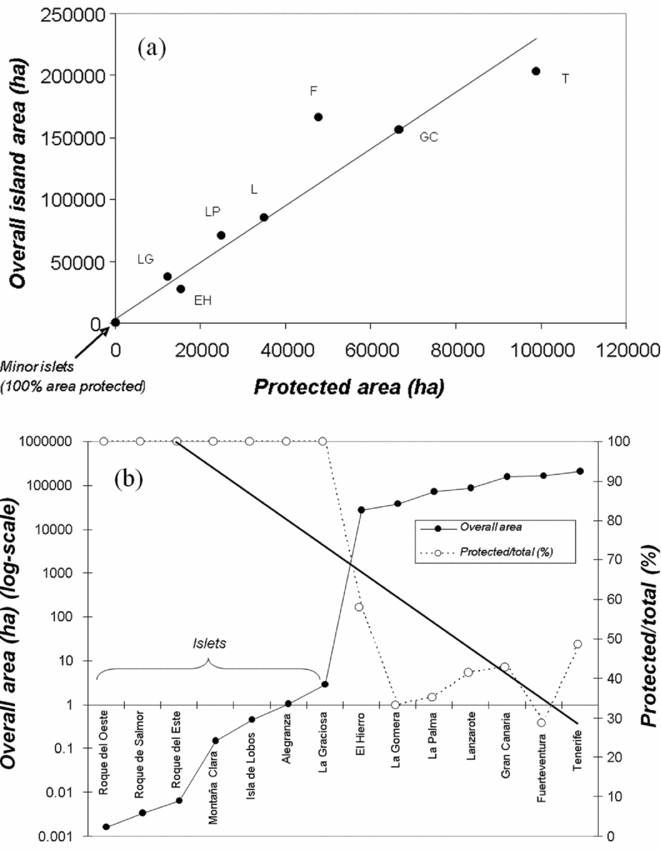
El Hierro is geologically young (1.1 million years old; 14,000–13,000 years after being partially dismantled by massive landslides); its area, habitat availability and complexity, mature forest cover and hence terrestrial biodiversity are lower than for the other western islands including Tenerife, La Gomera and La Palma. Its human population density is accordingly low and, to a certain extent, constant, whereas the other larger islands of the archipelago tend to have growing populations. Unlike in most of the other islands, the El Hierro human population is distributed along or near the coast, but is also sparsely distributed at mid-range elevations. Furthermore, El Hierro is legally protected in various ways (c. 58.1% of the island area) and is considered to be a Biosphere Reserve (Fig. 1). Although there is a strong positive association between area and amount of protected space per island (R 2=0.9425; Fig. 1(a)), the proportion that is protected is greater for smaller islands and islets (R 2=0.7489; Fig. 1(b)).
Relationship between island area and proportion of area protected for the Canary Islands. (a) Relationship between island area and protected area. (b) Relationship between overall area (black line) and the ratio of protected/total island area. The fitted regression function (black line) in (b) is for values of the ratio of protected/total island area. Note: only one of the islets – La Graciosa – is inhabited. LG=La Gomera; EH=El Hierro; LP=La Palma; L=Lanzarote; F=Fuerteventura; GC=Gran Canaria; T=Tenerife.

The disturbance hypothesis (Gotelli Reference Gotelli, Lomolino, Sax and Brown2004) supposes that small islands tend to suffer greater disturbance than large islands. If legal protection of islands is taken as a proxy for actual island ecosystem conservation (although this is untrue for Canarian coastal habitats), then some of the smaller islands do not necessarily have to suffer greater disturbances than larger islands, at least from direct human activities. If extinction is an inverse function of area, then extinction rates should be generally higher on small islands than on large islands or continents. However, this tendency may vary among archipelagos. Lord Howe Island has almost the same number of alien plants (230 species) as native plants (241 species), and 9 out of 15 native bird species have been directly or indirectly driven extinct by humans (Hickman & Hickman Reference Hickman, Hickman, Gillespie and Clague2009). Lord Howe Island is not a drastic paradigm of human transformation compared to other Pacific islands, but provides another example of extinction in historical times in a location of high endemic diversity and recent control of human activities having positive conservation outcomes.
Also in Macaronesia, the Azores are a more extreme case of habitat loss than that of the Canaries. The Azores have lost 97% of their native habitats since European colonization 600 years ago (Terzopoulou et al. Reference Terzopoulou, Rigal, Whittaker, Borges and Triantis2015). Single island endemic beetles were more prone to extinction than those that were endemic to several islands, and species of narrow geographic range and greater body size experienced greater risk of extinction (Terzopoulou et al. Reference Terzopoulou, Rigal, Whittaker, Borges and Triantis2015). However, it has been found that increases in alien richness did not promote the homogenization in assemblages of Azorean epigeous arthropods (Florencio et al. Reference Florencio, Cardoso, Lobo, Azevedo and Borges2013). Some aliens were revealed as habitat specialists forming new and heterogeneous communities in anthropogenically altered sites (Florencio et al. Reference Florencio, Lobo, Cardoso, Almeida-Neto and Borges2015). Current epigaeic communities are complex products of the interaction between the historical extinction of native species and the emergence of invader alien specialists who have become integrated within the island biotas (Rigal et al. Reference Rigal, Whittaker, Triantis and Borges2013; Florencio et al. Reference Florencio, Lobo, Cardoso, Almeida-Neto and Borges2015).
EXPLANATIONS FOR ISLAND VULNERABILITY
The greater fragility of insular biotas compared with continents is often assumed. However, the theoretical framework of ecology does not provide concrete arguments for greater susceptibility of islands compared with that of continents (Simberloff Reference Simberloff1995; Sol Reference Sol2000). The biotic rarity and vulnerability of smaller islands are linked most commonly to limited geographical extents, elevation–area ratios and remoteness (Whittaker & Fernández-Palacios Reference Whittaker and Fernandez-Palacios2007). Small size, isolation and rarity combined with human fondness for islands and global transport capacity (Helmus et al. Reference Helmus, Mahler and Losos2014) are favourable conditions for a greater disturbance pressure. The fact that exotic species can invade and displace native species that are well adapted to local environments is an intriguing paradox (Sax & Brown Reference Sax and Brown2000) that has yet to be resolved. In proportion to their area, islands probably lose more native and endemic taxa to human-induced extinction than continents, due to spatial confinement, resource limitation, species rarity, small population size or behavioural vulnerability to invading competitors, predators and pathogens and new ecological pressures (i.e. land use changes) (Simberloff & Levin Reference Simberloff and Levin1985; Richardson & Whittaker Reference Richardson and Whittaker2010).
Higher proneness to invasion by exotics may be explained by disproportionate ecological pressure (in terms of limited area occupied) and intrinsic patchy character compared to continental zones of comparable extent. Spatial constriction puts an inherently higher human population density (such as on many small- to medium-sized islands) in close vicinity with vulnerable biota. Islands shelter 20% of all plant, reptile and bird species on only 3% of the Earth's surface (da Fonseca et al. Reference da Fonseca, Mittermerier and Mittermeier2006), and in 2006, the world's islands sheltered c. 10% of the human population (550–650 million people) and held 13.1% of the UNESCO's World Heritage sites (Baldacchino Reference Baldacchino2006). Moreover, the human population in biodiversity hotspots is growing at a faster rate than the planet's average (Cincotta et al. Reference Cincotta, Wisnewski and Engelman2000).
Human capabilities to reach remote islands are affected by island geographical configuration, distance to human source populations and geometric properties (Keegan & Diamond Reference Keegan and Diamond1987). Island ecosystems are more physically restricted and functionally constrained than those of continents in terms of biomass production and population-level movements. Spatial limitations on islands imply that many of the smaller islands are not much larger than the ecosystems they contain; there are more rigid and sharply limited ecological niches on islands than on continents, because ecological interactions are geographically restricted (Walter Reference Walter2004), in addition to intrinsic functional restrictions (i.e. movement and dispersal needs and trophic needs). Using the eigenplace concept of Walter (Reference Walter2004), taxa of smaller islands are differentially more prone to extinction because they are inherently limited in geographical range, so pressures towards further contraction (and also expansion) may be adverse. Under accelerated human encroachment of island ecosystems, many island species with restricted ranges can be readily displaced or extirpated.
For remote islands, lack of communication with continents or other islands is another factor affecting niche definition. Such communities are not well prepared for the pace and type of landscape change that are forced by human occupation, and these communities exhibit small tolerance to exotic competitors. Island assemblages have a very restricted geographic space for drifting or readapting when forced to compete with alien species. The ecological space available in order to successfully undergo character displacement and to avoid high levels of competition with foreign invasive species is more limited in small, insular areas than in those of large islands or continents (Brown & Wilson Reference Brown and Wilson1956; Grant Reference Grant1994; Losos Reference Losos2000; Walter Reference Walter2004; Muchhala & Potts Reference Muchhala and Potts2007; Smith & Rausher Reference Smith and Rausher2008). This coincides with the fact that territory overlap is more common in insular than in mainland populations (Blondel & Aronson Reference Blondel and Aronson1999).
More important than the absolute size of islands is the coherence between island size and the spatial manifestation of the amplitudes of ecological oscillation of which the arriving species are capable. The amplitude of ecological oscillation of species from continental taxocenosis may be many times greater than that of island endemics, which evolved within constrained ecosystems. This is in agreement with the evidence of natural selection that Darwin found in the Galápagos Islands. For example, a span of 22 years of coexistence between Geospiza fortis and Geospiza magnirostris (two species of Darwin's finches) was enough to produce significant interspecific differentiations in beak size and diet that are unobservable under allopatric conditions (Grant & Grant Reference Grant and Grant2006). However, reinforced oscillatory behaviour due to insularity also implies large fluctuations of abundance, which are typical of insular populations that are strongly influenced by island size. If the arrival of an invasive species coincides with a situation in which there is a noteworthy local minimum of abundance of autochthonous species due to their intrinsic behavioural plasticity, the advantage will most probably be for the alien species. The accelerated rate of evolutionary change in island biotas has a cost regarding their differential susceptibility to invasions, a collateral risk of the reinforcement of the limited niche plasticity within any small set of isolated ecosystems.
DETERMINISM AND STOCHASTICITY IN AN ISLAND ASSEMBLY UNDER HUMAN INFLUENCE
Pivoting paradigms such as adaptive radiation, taxon cycle, assembly rules and equilibrium and meta-population models apply differently to the specific configuration of archipelagos (Whittaker & Fernandez-Palacios Reference Whittaker and Fernandez-Palacios2007). Some limitations to generalizations from the ETIB have been identified (Shugart Reference Shugart2004; Walter Reference Walter2004): (1) considering individual species as interchangeable units ignores unique aspects of particular species, which may in turn influence the fate of remaining and potentially interacting species; (2) species turnover on islands is difficult to determine empirically – long-term lists of changes in island biotas are often lacking and problematic to create, and there is incomplete (although improving) fossil evidence of recent human-caused extinctions and monitoring data for detecting newly acquired exotics; and (3) it is unclear whether islands continue to gain and lose species and, if so, how, once a certain diversity of species is attained.
These limitations are perhaps mostly intrinsic, but in part they could be caused, in the present context of biotic homogenization, by the impact of human intervention on all components of island life. Both isolation and area alone can indeed explain island species diversity and how islands gain and lose species in some instances (e.g. Borges & Hortal Reference Borges and Hortal2009). The passive sampling hypothesis implies that area (through target effect) and isolation (through rescue effect) respectively increase and decrease diversity (Burns et al. Reference Burns, Berg, Bialynicka-Birula, Kratchmer and Shortt2010).
For an archipelago of 34 islands in British Columbia, both deterministic (assembly rules) and stochastic (passive sampling) processes played non-exclusive roles in determining conifer community structure (Burns et al. Reference Burns, Berg, Bialynicka-Birula, Kratchmer and Shortt2010). However, assembly rules explain the abundance of individuals of a species on an island as a function of the number of other similar species (competing or facilitating) already present. Following Diamond's (Reference Diamond, Cody and Diamond1975a) assembly rules, particularly the rule of forbidden species combinations (Whittaker & Fernandez-Palacios Reference Whittaker and Fernandez-Palacios2007), the number of species should be a function of the degree of niche overlap or other measure of competence among the existing taxa pool. It can be gathered from Darwin's naturalization hypothesis that naturalization of introduced alien species on islands can be significantly inhibited by overlap between the ecological niches of related natives and aliens (Richardson & Whittaker Reference Richardson and Whittaker2010).
Non-equilibrium biotas are assumedly unsaturated with species (Whittaker Reference Whittaker1995). On remote islands, cladogenesis and hence diversification is provided by open niches being filled by speciation from basal native taxa (Warren et al. Reference Warren, Simberloff, Ricklefs, Aguilee, Condamine, Gravel, Morlon, Mouquet, Rosindell, Casquet, Conti, Cornuault, Fernández-Palacios, Hengl, Norder, Rijsdijk, Sanmartin, Strasberg, Triantis, Valente, Whittaker, Gillespie, Emerson and Thebaud2015). Exotic species increase effective island species richness (Sax et al. Reference Sax, Gaines and Brown2002), but many of these imported taxa do not occupy empty (or artificially emptied) niches, instead occupying new niches created by human activities. Formerly empty niches in remote islands can thus be suddenly filled with relocated exotics. Such occupation could hamper or reduce cladogenesis and hence in situ speciation, but also could act as a selective pressure in evolution.
The evolution of island area, elevation, shape and relief, from island emergence through to the acquisition and building of its biota to its submergence, can be drastically changed by land use and extractive industries. Patterns of conifer diversity in islands of the Barkley Sound (British Columbia) were not consistent with ETIB predictions (Burns et al. Reference Burns, Berg, Bialynicka-Birula, Kratchmer and Shortt2010); instead, passive sampling (an aleatory process) and assembly rules (a deterministic process) might have operated as synergistic rather than mutually exclusive forces to shape island tree assemblages. Species–area curves deviated from a perfect rank-correlation for New Zealand and Aegean island bird faunas (Simberloff & Levin Reference Simberloff and Levin1985); some species did not conform to species-specific minimum area requirements in their patterns of island occupation. Habitat differences between islands and anthropogenic extinctions emerged as the most probable causes, instead of equilibrium turnover. Logged native forest in the Solomon Islands showed incomplete recovery due to the persistence of pioneer tree species at least 50 years after disturbance (Katovai et al. Reference Katovai, Sirikolo, Srinivasan, Edwards and Laurance2016). The availability of potentially apt refuges for species may now depend directly on patterns of space use and intensity of exploitation, which vary within and among islands and depend heavily on assemblage resilience (Katovai et al. Reference Katovai, Sirikolo, Srinivasan, Edwards and Laurance2016).
EQUILIBRIA VERSUS DISEQUILIBRIA IN HUMAN DISTURBANCE
Rather idiosyncratic and contingent patterns occur and should be studied island by island, due to the nature of technological pervasiveness and augmented biological communication through human transport. A human presence may alter the sequence of events of the island cycle from emergence to submergence. The destruction of habitats of previously extant species takes place at the same time that newly created habitats generate the conditions for the naturalization of introduced species. Before an island reaches the final stage of its evolution (terminal disappearance), human activities interact with (or take over) the inherent processes of geological dismantling. The concepts of vacant niche space and carrying capacity (K) would be better defined in the context of the amount of island niche space and the resource pool actually available for species to colonize after ecosystem deletions being triggered by humans.
Human impacts might perpetuate non-equilibrium states in disturbed island communities; they might extend the pre- or post-equilibrium phase of an island life cycle, depending on island age (Whittaker Reference Whittaker1995; Shugart Reference Shugart2004; Whittaker et al. Reference Whittaker, Ladle, Araújo, Fernandez-Palacios, Delgado and Arévalo2007). Some human activities have a great capacity to reset and simplify island species diversity, perpetuating non-equilibrium conditions (Whittaker et al. Reference Whittaker, Triantis and Ladle2008). Although, in reality, island ontogeny does not have to change appreciably, the final stages of island evolution – those involving irreversible decreases in K due to the transformation of island ecosystems – would become more unpredictable than anticipated (Whittaker et al. Reference Whittaker, Ladle, Araújo, Fernandez-Palacios, Delgado and Arévalo2007). On the other hand, with changes in K, realized species richness, and possibly speciation rate, would potentially decrease. The natural, background rates of immigration and extinction are also disturbed under this human domain. Immigration may be modified if impacts in coastal source areas (both mainland and source islands), which are heavily transformed by development (especially coastal), alter the spontaneous rate of dispersal of propagules to recipient island ecosystems (disturbance of background passive sampling).
Exotic species presence on islands will be increasingly determined by forced connectivity amongst islands and continents by means of human transportation (Helmus et al. Reference Helmus, Mahler and Losos2014). However, the variance due to noise from alien species contributions and from other direct impacts is expected to be large and can a priori be explained by geographic factors such as island area, isolation (greatly overcome by global transport), topography and disturbance (Ficetola & Padoa-Schioppa Reference Ficetola and Padoa-Schioppa2009; Helmus et al. Reference Helmus, Mahler and Losos2014). Thus, using actual species richness could add bias because a greater richness can be attained simply by adding aliens to the overall figure of natives and endemics.
On the other hand, it is often assumed that declines in native island plant species could be partly affected by introduced aliens. However, there is still little consensus on the causality of native plant extinctions by aliens. Many cases of positive correlations between alien and native plant diversity have been reported, whereas neat negative effects have barely been acknowledged (Caujapé-Castells et al. Reference Caujapé-Castells, Tye, Crawford, Santos-Guerra, Sakai, Beaver, Lobin, Vincent-Florens, Moura, Jardim, Gómes and Kueffer2010). Negative impacts may often depend on the facilitation effect of the disturbed island landscape for alien taxa.
Introduction is not necessarily equivalent to invasion or biotic homogenization in the case of exotic plants in oceanic islands (Kueffer et al. Reference Kueffer, Daehler, Torres-Santana, Lavergne, Meyer, Otto and Silva2010). Species introduced by humans on islands can remain locally confined without necessarily becoming invasive or incorporated into the local flora. However, post-introduction processes and particular disturbance profiles in the recipient territory can determine invasion success and therefore the composition of exotic flora and the effects on native species and communities (Pretto et al. Reference Pretto, Celesti-Grapow, Carli and Blasi2010).
Moreover, some insularity parameters traditionally put forward in the IBT become diluted in this multivariate anthropogenic context. For example, Kueffer et al. (Reference Kueffer, Daehler, Torres-Santana, Lavergne, Meyer, Otto and Silva2010) could not explain alien species richness per group of islands (for a total of 30 groups) in terms of island area, latitude or distance to the continent (nor previous presence of other aliens or richness of native flora). Instead, their models were best supported by indicators of human development and diversity of habitats, island age or the oceanic region. In addition, these parameters could be dependent, to some extent, on the degree of landscape transformation of oceanic islands by humans, and perhaps also an unexplored inherent susceptibility to invasion (i.e. island age-related resistance, or even type of island origin – volcanic or continental fragments).
CONCLUSIONS
Further steps in generalizing the IBT would refine projections of how island biodiversity and species composition will behave after including human disturbance parameters in the models. The mechanisms underlying anthropogenic effects (such as those which induces alien invasion success) as factors shaping island communities remain poorly understood. Integrating natural and anthropogenic disturbances has a clear need for further research. Island biogeography might have experienced a sharp shift (Helmus et al. Reference Helmus, Mahler and Losos2014); after millions of years of being mostly shaped by area, isolation and natural disturbances (see Whittaker Reference Whittaker1995), island biogeography is now and will be increasingly governed by pervasive global connectedness, forced by ubiquitous humans. However, disturbance regimes and geographical conditions vary greatly from island to island. This opens new research scenarios for IBT and raises new and complex conservation issues. Hence, following Walter's (Reference Walter2004) eigenplace notion, human determinants of species richness should be approached on a more realistic, geographically explicit, per-island basis. Island biogeography could gain in functionality from a conservation perspective if multifactorial anthropogenic change is dynamically integrated with basic parsimonious island biogeography.
The main theoretical consequences for IBT of human disruption of the equilibria and biotic structuring of islands we have discussed in this work are thus:
-
(1) Human activities on islands introduce new and underrated stochasticity that could either enhance or hamper ongoing biogeographical processes. The sign of the effect would be dependent on the taxa and environmental conditions affecting their dispersal, establishment and reproductive outputs. Frequent ecological reset of natural disturbances to oceanic islands cannot be equated to the chronic alteration of landscape by humans. The former involves recurrence in island biotic assembly, whereas the latter implies permanent (often irreversible) seclusion or erasing of assemblages. The time or stability to attain equilibria for vulnerable, long-lived larger island taxa are insufficient under chronic human disturbance. A growing number of biogeographers even doubt whether there is true species turnover in human-impacted islands.
-
(2) Speciation rates in human-occupied habitats on small islands are as difficult to measure as naturally occurring speciation; human pressure is itself a selective force with evolutionary consequences for island biotas.
-
(3) Propagule source areas are altered irreversibly and passive sampling processes suffer disruption. Human-forced landscape changes at continental margins affect islands and vice versa. The synergistic effects of coastal development and degradation alter natural patterns of propagule dispersal between source and receptor areas at both global and local island scales.
-
(4) Vulnerability is due to the interacting intrinsic physical and ecological attributes of islands and their species, and to contingent landscape use patterns by humans. Despite being mostly contingent, island geographical location, aspect to prevailing abiotic drivers (e.g. wind and current) and shape factors should help to predict which basal island landscapes will receive maximum impacts and experience higher biodiversity loss.
-
(5) The most vulnerable island ecosystems are being biotically homogenized. This is a sort of continentalization process (i.e. a dilution of the rarity and diversity of the island biota, which tends to resemble that of the continent). Homogenization amongst islands may also occur. Colonization rates are being artificially increased for a limited set of introduced exotic generalists, which are succeeding regardless of natural isolation. Homogenization also occurs due to effective areal encroachment of native taxa by human development and exotic competitors, precluding further speciation. The area threshold for in situ speciation is artificially lowered by human impacts. Such new ecological pressures also enhance extinction rates of native taxa.
-
(6) Smaller islands can receive more protective efforts than large ones. Larger islands have greater unprotected areas compared to the smaller islands, and it is in these unprotected natural spaces where biodiversity losses are significantly larger.
All of these synergistic processes are contributing to the homogenization and masking of both species–area and species–isolation relationships at a global scale (Helmus et al. Reference Helmus, Mahler and Losos2014), as synergies between the human disturbance of island territories and exotic taxa introductions speed up. Isolation is becoming a rare exception in biogeography: it is a function of the socioeconomic isolation of islands, and there is need to define and contextualize isolation in biogeography. In general, species richness of small and remote islands located in areas of economic interest may be increasing after all, against ETIB basal predictions, at unprecedented rates. Nevertheless, small and remote islands in the intertropical region harbour the bulk of island endemicity and biodiversity, compared to the vast number of islands occurring along the continental margins at higher latitudes. This implies a gain in richness at the individual island scale, at the cost of losing native and endemic biodiversity globally.
ACKNOWLEDGEMENTS
We would like to thank the editors and one anonymous reviewer for improving this work. We also thank Professor Paulo A.V. Borges (Azorean Biodiversity Group) for his suggestions and valuable references contributing to the manuscript.
Supplementary material
To view supplementary material for this article, please visit https://doi.org/10.1017/S0376892917000236