INTRODUCTION
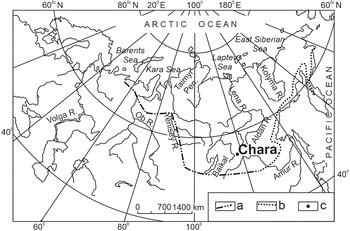
The syngenetic ice wedges exposed in the gravel sands of Northern Transbaikalia’s Chara River basin are the subject of the study (Figure 1). This outcrop was studied previously (Klimovsky and Naprasnikov Reference Klimovsky and Naprasnikov1967; Romanovsky et al. Reference Romanovsky, Zaitsev, Volchenkov, Volkova, Lisitsina and Senneset1988), previous studies of the authors of the present study obtained 14C data of peat and wood from first terrace spanning from 11,950 cal BP to 8400 cal BP (Vasil’chuk et al. Reference Vasil’chuk, Vasil’chuk and Stanilovskaya2018). However, due to the lack of direct dating of ice wedge and scarce isotope data, additional chronological and isotopically studies are required for the paleotemperature reconstructions. The study’s objectives are to estimate the approximate mean January air temperature, compile all available oxygen isotope data of the Holocene ice wedges in the Chara River valley, and determine the radiocarbon age of organic microinclusions that have been directly collected from the ice wedges.
Southern boundary of known (a) and estimated (b) ice wedge distribution in Eurasia (from Vasil’chuk Reference Vasil’chuk2013), and Chara ice wedge site (c).

MATERIALS AND METHODS
Field Studies and Sampling
Field studies of wedge ice were carried out by the authors three times between 1985 and 2023. The study area is located in the Kalarsky region of Transbaikalia. The key site is located in the valley of the Chara River, in its middle course, 8 km southwest of Novaya Chara settlement, at the confluence of the Belenky Creek and Chara River (56°45'38.72''N, 118°11'30.12''E). The first alluvial terrace is composed of Holocene channel and floodplain sands, often with gravel. In the upper part of the section, oxbow, marsh, sandy loam, and peat are revealed. Plant cover is dominated by light forests of Cajander larch (Larix cajanderi) with an undergrowth of splayed birch (Betula divaricata) and dwarf pine (Pinus pumila). Soil cover is characterized by Gley Soils, which are divided into cryogenic-ferruginous cryoturbated permafrost and cryogenic-ferruginous post-pyrogenic permafrost. The climate in the study region is sharply continental; according to the data from the weather station “Chara,” the mean annual air temperature increased from –8.1 to –6°С between 1959 and 2019 (Sergeev Reference Sergeev2020).
The mean January air temperature increased from –34°С (1930-1966) to –33°С (1967–2000) and to –32°С in 2001–2017 (Vasil’chuk and Surkova Reference Vasil’chuk and Surkova2021). In recent 6 years (2018–2023), the mean January air temperature was about –31.5°С (www.pogodaiklimat.ru). For the Chara basin, both areas without permafrost and permafrost with a thickness of about 450 m are described. Within watershed areas of mountain ranges, permafrost thickness reaches 900 m. Ground temperature in the study area varies in different landscapes from –7 to +2°С (Sergeev Reference Sergeev2020).
Using a Bosch GSR 36 VE-2-LI drill with a steel crown 51 mm in diameter, samples of ice were taken from the ice wedges (IW) along vertical and horizontal profiles at a step of 10 cm. After being placed in double polyethene bags, the ice samples were allowed to melt at room temperature before being transferred into 30 ml HDPE vials and covered with parafilm to prevent evaporation.
Radiocarbon Dating
Radiocarbon dating of microinclusions of organic material extracted directly from ice wedges carried out at the “Laboratory of Radiocarbon Dating and Electron Microscopy” of the Geography Institute of the Russian Academy of Sciences and the Center for Applied Isotope Studies, University of Georgia (USA) were carried out on the 500 kV NEC 1.5SDH-1 pelletron (CAMS). Organic microinclusions for 14C AMS analysis were extracted from 5 samples. 14C ages of enclosed sediments were previously obtained at the Institute of Geology RAS (lab code GIN) and Institute of Geology of the Estonian Academy of Sciences (lab code Tln). All obtained radiocarbon dates were calibrated using OxСal 4.4 based on the IntCal20 data set and given as yrs cal BP (Bronk Ramsey Reference Bronk Ramsey2021; Reimer et al. Reference Reimer, Austin, Bard, Bayliss, Blackwell, Bronk Ramsey and Butzin2020).
Stable Water Isotope Analyses
Measurements of the stable oxygen and hydrogen isotope composition in ice were carried out using a Picarro L 2130-i laser infrared spectrometer at the Resource Center “X-ray Diffraction Research Methods” of the Science Park of St. Petersburg State University. International reference materials V-SMOW-2, GISP, SLAP, USGS-45, and USGS-46 were used for the calibration. The values are presented in δ-notation in per mille (‰) relative to the Vienna Standard Mean Ocean Water (VSMOW). The analytical precision was ±0.02‰ for δ18О. In total, 84 samples of wedge ice were analyzed for their stable isotope composition.
January Paleotemperature Reconstructions
Particularly in high-latitude areas, stable isotope ratios (δ18O and δ2H) in precipitation provide as accurate indicators of air temperature (Vasil’chuk Reference Vasil’chuk1991; Brezgunov et al. Reference Brezgunov, Esikov, Ferronskii and Sal’nova1998; Opel et al. Reference Opel, Meyer, Wetterich, Laepple, Dereviagin and Murton2018; Vasil’chuk and Surkova Reference Vasil’chuk and Surkova2020). Since ice wedges are primarily composed of snow meltwater, they may provide a winter paleoclimate record since they retain the stable isotope signature of winter precipitation for millennia. It has been determined that the main factor influencing δ18O\ fluctuations in precipitation in the Siberian Arctic throughout the winter is air temperature. There is a slight impact from additional mechanisms and processes, such as changes in moisture sources, air transport, and snow evaporation in the winter (Meyer et al. Reference Meyer, Opel, Laepple, Dereviagin, Hoffmann and Werner2015; Opel et al. Reference Opel, Meyer, Wetterich, Laepple, Dereviagin and Murton2018).
Since Prof. Vasil’chuk first proposed a regression equation (Vasil’chuk Reference Vasil’chuk1991) to calibrate the stable isotope composition of ice wedges to winter air temperatures in most regions of the Russian permafrost zone, including the continental areas of Central Yakutia and Transbaikalia, stable oxygen isotope values of ice wedges have been used as a basis for winter paleotemperature reconstructions. The following formula is used to get the mean paleotemperature for January:
 $${{\rm{T}}_{{\rm{mJ}}}} = 1.5{\delta ^{18}}{{\rm{O}}_{{\rm{iw}}}}(\pm 3^\circ {\rm{C}})$$
where TmJ and δ18Oiw are mean January air temperature and δ18O values in modern ice veinlets, respectively. Prof. Vasil’chuk deduced with this type of equation (which has an acceptable error of ±3°C but no free term) after analyzing mean January air temperatures for over 250 weather stations in Russian permafrost regions and stable oxygen isotope values for modern ice veinlets (not older than 60–100 years). It should be emphasized that this kind of equation includes the natural variability of the mean January air temperature and provides approximate paleotemperature values with an acceptable error of ±3°C.
The validity of δ18O data for paleotemperature reconstructions is verified using the δ2H–δ18O ratio and deuterium excess (dexc) values if coupled isotope data (δ18O and δ2H) are available. dexc = δ2H – 8δ18O is the formula for deuterium excess (Dansgaard Reference Dansgaard1964). Indicating the meteoric nature of water (usually snowmelt) forming ice wedges and the negligible impact of kinetic fractionation on the isotope composition of snow and snowmelt before filling frost cracks. The slope of the δ2H–δ18O ratio line in the study area is close to 8 (i.e., close to that of the global meteoric water line, GMWL) or, in some cases, close to the slope of the local meteoric water line (LMWL).
RESULTS AND DISCUSSION
Cryogenic Structure, 14C Age and δ18O Values of the Studied Ice Wedges
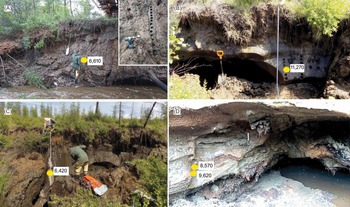
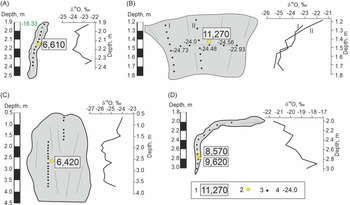
IW-1. It is exposed in the outcrop of the left bank of the Belenky creek, about 300 m from the place where the creek flows into the Chara River (56°45'32.28''N, 118°11'12.07''E). The ice wedge was exposed at the depth of 1.8 m from the surface (Figure 2A). The visible portion of the ice wedge measured roughly 1.0 m in height and ranged in breadth between 10 and 15 cm. The oxygen isotope data was obtained for 12 ice samples, δ18O values vary from −24.05 to −16.33‰ (Table 1).
Ice-wedge sampling in the Chara River valley: (A) IW-1; (B) IW-2; (C) IW-3; (D) IW-4. AMS 14C dates (cal years BP) are also shown in the white boxes.

δ18O values in ice wedges in the Chara River valley.

The highest value, −16.33‰, was obtained only for one sample (that probably resulted from the admixture of isotopically enriched segregated ice); all other samples are characterized by δ18O values less than −22.5‰ (Figure 3A). IW-2. It was exposed on the right side of a shallow, wide thermo-erosion gully, perpendicular to the Chara River channel (56°45'38.86''N, 118°11'19.95''E). The ice wedge was exposed at a depth of 1.2 m from the surface (Figure 2B). The length of the visible part is about 0.7 m. δ18O values range from –25.41 to –21.75‰, most values are less than –23‰ (Figure 3B).
δ18O plots and AMS 14C dates for the ice wedge in the Chara River valley: (A) IW-1; (B) IW-2; (C) IW-3; (D) IW-4. 1—AMS 14C dates (cal years BP) of organic matter microinclusions from the ice wedges; 2—points of ice sampled for AMS 14C dating; 3—points of ice sampled for stable isotope analysis; 4—δ18O values in IW-2 sampled from along the horizontal profile.

IW-3. It was exposed near the IW-2 (56°45'38.84''N, 118°11'29.26''E). The ice wedge was exposed at a depth of 1.0 m from the surface (Figure 2C). The length of the visible part is about 5 m. The width of the almost frontally exposed right part is about 2 m. δ18O values for the ice vary in a narrow range from −25.94 to −24.05‰ and were the lowest for the four studied ice wedges (Figure 3C).
IW-4. It is exposed on the steep left bank of the Belenky Creek, about 250 m from its mouth (56°45'32.87''N, 118°11'11.83''E). The ice wedge was exposed at a depth of 2.0 m from the surface (Figure 2D). The length of the visible part of the ice wedge was about 2 m, and the width 0.15–0.3 m. The δ18O values vary in a wide range from −21.6 to −17.61‰; high isotope values were obtained in the tail part and are probably explained by the admixture of segregated ice from the enclosing sediments sampled together with the ice wedge (Figure 3D).
AMS Radiocarbon Age of Ice Wedge
The radiocarbon age of the ice wedge was determined with a high degree of accuracy due to direct AMS 14C dating of organic microinclusions in the ice wedges (Table 2).
Radiocarbon ages of ice wedges in the Chara River valley.

a The resulting 14C ages were calibrated using the IntCal20 calibration curve (Reimer et al. Reference Reimer, Austin, Bard, Bayliss, Blackwell, Bronk Ramsey and Butzin2020) and the Oxcal version 4.4.4 program (Bronk Ramsey Reference Bronk Ramsey2021).
According to the obtained dates, IW-2 is the oldest of the studied ice wedges; it was dated to 11,270 ± 42 cal BP at a depth of 1.48–1.6 m; IW-1 and IW-3 are the youngest; the dates 6610 ± 40 cal BP and 6420 ± 37 cal BP were obtained at a depth of 2.12–2.16 m in IW-1 and at a depth of 2.52–2.78 m in IW-3. The age of IW-4 was obtained from two subsequent 14C dates: 8570 ± 32 cal BP at a depth of 2.7 m and 9620 ± 53 cal BP at a depth of 2.8 m.
The oldest ice wedge is dated to the early Greenlandian stage of the Holocene (Walker et al. Reference Walker, Head and Lowe2019; Budantseva Reference Budantseva2022) with 11,270 ± 42 cal BP, and the youngest one is dated to the middle of the Northgrippian stage with 6420 ± 37 cal BP.
Radiocarbon Dating of the Enclosing Sediments
To estimate the age of alluvial terrace sediments enclosing studied ice wedges, organic remains were sampled during the 1985 and 1988 field seasons, with the following radiocarbon dating (Table 3).
Radiocarbon ages from the organic plant material in the terrace sediments enclosing the ice wedges (Vasil’chuk et al. Reference Vasil’chuk, Vasil’chuk and Stanilovskaya2018).

a The resulting 14C ages were calibrated using the IntCal20 calibration curve (Reimer et al. Reference Reimer, Austin, Bard, Bayliss, Blackwell, Bronk Ramsey and Butzin2020) and the Oxcal version 4.4.4 program (Bronk Ramsey Reference Bronk Ramsey2021).
All 19 dates obtained for the host sediments fall into the range of 11.9 to 8.4 cal ka BP. This period corresponds to the first half of the Holocene optimum for the continental Siberia regions (Vasilchuk and Vasil’chuk Reference Vasil’chuk and Vasil’chuk1995) and to the Greenlandian–early Northgrippian stages of the Holocene as well. The lack of gaps in the dating of the wood remains indicates that woody vegetation was present during the entire period of the terrace formation. It was marked by a direct dependence of the 14C age of the organic matter vs. the sampling depth; the deeper the peat and wood remain, the older they are (Vasil’chuk et al. Reference Vasil’chuk, Vasil’chuk and Stanilovskaya2018).
Isotope Composition of Previously Studied Ice Wedges and Palaeotemperature Reconstructions
A series of ice wedges were previously studied by the authors (1985, 1988, 2006, 2007) and sampled for stable oxygen isotope analysis (IW-1prev to IW-6prev., Table 4). The sampling of the ice wedge was carried out according to a unified methodology. All earlier obtained δ18O values are very close to the newly obtained, and for the majority of ice wedges, δ18O values vary in a range between –19.34 and –25.7‰, while mean δ18O values range from –21.4 to –25.1‰ (see Table 4).
The δ18O values in previously studied ice wedges (prev) near the Chara settlement (from Vasil’chuk et al. Reference Vasil’chuk, Vasil’chuk and Stanilovskaya2018)

The obtained results allow us to consider active and widespread syngenetic permafrost aggradation in the Northern Transbaikalia in the Holocene, including the optimum period, which is supported by data obtained for both neighboring and distant regions. For example, ice wedges in the Holocene deposits were studied by Popp et al. (Reference Popp, Diekmann, Meyer, Siegert, Syromyatnikov and Hubberten2006) in the coastal outcrop of the upper Tumara River, central Yakutia and by Vasil’chuk et al. (Reference Vasil’chuk, Vasil’chuk and Budantseva2023) in northwestern Siberia.
In the Tumara River valley, the ice wedge dissected a thick layer of peat and penetrated the underlying alluvial sand and gravel deposits. Organic remains from the underlying sandy deposits at a depth of about 2.5 m were dated to 8539 ± 44 BP (KIA–19144) (9560–9460 cal BP, median age 9520 ± 30 cal BP), which indicates that the studied ice wedge was formed in the first half of the Holocene optimum, synchronously with the ice wedges in the Chara River valley. Stable isotope data for the ice wedge in the Tumara River valley (mean δ18O value is –25.94‰) is close to the mean δ18O values obtained for the ice wedges in the Chara River valley and therefore points to similar winter temperature conditions. These data also indicate that both in Central Yakutia and Northern Transbaikalia, ice wedges actively grew during the Holocene optimum, even in sandy gravel deposits, due to rather severe winters. A 14C age of 7.46 cal ka BP was identified in the peat above the ice wedge near Seyakha village on the eastern coast of the Yamal Peninsula, and a 10.49 cal ka BP age has been identified near the ice wedge’s “tail”. Here, ice wedges were formed following the late Greenlandian to early Northgrippian stages of the Holocene (Vasil’chuk et al. Reference Vasil’chuk, Vasil’chuk and Budantseva2023).
Equation (1) was used to determine the mean air temperature in January during the growth of IWs based on the δ18O values. In the sampled IWs, the mean dexc values range from 4.3 to 6.6, while the slope of the δ2H-δ18O ratio line varies from 6 to 8.5. These results suggest that fractionation occurring prior to melting and filling frost cracks may modify the isotopic composition of snow to some extent. Higher dexc values were found in the research region with new snow (Vasil’chuk et al. Reference Vasil’chuk, Vasil’chuk and Stanilovskaya2018). Modern ice veinlets sampled in the Chara River terrace exposure yielded δ18O values ranging from –20.7‰ to –22.4‰. Equation (1) shows that these values are in good agreement with the region’s current mean January air temperature (from –31.5 to –34°С) in the study area.
Therefore, the obtained new δ18O data can be used for approximate paleotemperature reconstructions with a mandatory error of ±3°C.
The obtained isotope data indicates that during the Greenlandian-Northgrippian stages of the Holocene, from 11.27 to 6.42 cal ka BP, the mean January air temperature in the Chara region ranged from –28 to –30°C during the warmer periods, but it was mostly close to –33, –35°C, which is about 1°C lower than the modern one. In the coldest periods, the mean January air temperature dropped to –38°C (i.e., it was 4–6°C lower than the modern one recorded since the 1930s).
If consider the dynamics of the temperature regime on the example of the largest IW-4prev, then we can conclude that frost cracking and the growth of IW-4prev started at the water level. The formation of ice in the “tail” of IW-4prev occurred in more severe climatic conditions (based on the δ18О values of –22.2 and –23.5‰) at the mean January air temperature about –35°С. Than the ice wedge slowly grew syngenetically, in milder climatic conditions (δ18О = –20…–20.7‰) at the mean January air temperature of about –31°C. It can be concluded that winter temperature conditions during IW-4prev growth were close to the modern one, but in some periods mean January air temperatures were lower by 1–2°C.
CONCLUSIONS
The syngenetic ice wedge geochronology in the Transbaikalia valley of the Chara River can be estimated due to the newly obtained radiocarbon data. With the application of direct AMS 14C dating of organic microinclusions from the ice wedges, it is possible to estimate the January air paleotemperature for the selected time intervals with an accuracy of ±3°C. Previous 14C dates on the enclosing sediments only roughly allowed to propose the syngenetic growth of ice wedges.
-
1. Between 11.27 and 6.42 cal ka BP, or during the Greenlandian and Northgrippian stages of the Holocene, ice wedges in the Chara River valley formed syngenetically.
-
2. The mean δ18O values in ice wedges vary by more than 8‰, ranging from –25.5‰ to –18.8‰; nevertheless, they generally vary between –25 and –22‰.
-
3. The mean δ18O value for the ice dated to the early Greenlandian stage, 11.3 cal ka BP, is −24.0‰, which allows us to reconstruct the average air temperature during this period in January at −36°C.
-
4. The mean δ18O values for the ice, which is dated to the early Northgrippian stage (9.6 to 8.6 cal ka BP), are −19.1‰ and −18.9‰. This suggests that the average air temperature in January was −28.5°C and −28°C.
-
5. The wedge ice that dates to the termination of the Northgrippian stage (6.6−6.4 cal ka BP) displays mean δ18O values of −25.5‰ and −23.6‰, indicating a mean air temperature in January during this time between −38°C and −35°C.
-
6. It was previously implied that winter temperatures at the Holocene thermal maximum were severe than they are currently. According to new results, the early Holocene can be divided into three periods when severe climate conditions (in terms of mean January air temperature) were alternated by milder ones.
ACKNOWLEDGMENTS
We would like to express our gratitude to L. Lyutaya, Dr. V. Zaizev, V. Palamarchuk, and Dr. D. Sergeev for their field assistance and also to Dr. Elya Zazovskaya for her help in radiocarbon analyses. We thank Dr. S. Wetterich for his thoughtful and constructive comments. The research was financially supported by the Russian Science Foundation (grant No. 23-17-00082).
DATA AVAILABILITY STATEMENT
Original data are available at: Vasil’chuk YK., Vasil’chuk AC, Stanilovskaya JV. (2020): Early Holocene climate signals from stable isotope composition of ice wedges in the Chara Basin, northern Transbaikalia, Russia. PANGAEA, https://doi.org/10.1594/PANGAEA.915943
Vasil’chuk YK, Vasil’chuk AC, Stanilovskaya JV. (2020): Radiocarbon ages from the organic plant material from the ice wedge surrounding deposits in the Chara Basin, northern Transbaikalia, Russia. PANGAEA, https://doi.org/10.1594/PANGAEA.915926
CONFLICT OF INTEREST
The authors declare no conflicts of interest.
DECLARATION OF COMPETING INTERESTS
The authors state that they have no competing interest.