1. INTRODUCTION
On 16 January 1682 Paul Rutter stepped to the bar at the Old Bailey in London to face a charge of murder. Rutter, a ‘French Doctor’, was accused of poisoning his mistress's husband, Robert Morgan, in November of the previous year. As the good doctor was a foreigner he requested a trial de medietate lingue, as was his right under English law. Following the standard procedure in all such cases, a ‘party jury’ composed half of Englishmen and half of foreigners was duly sworn and testimony began. The witnesses for the king related that Rutter had discovered that his mistress's husband had an estate worth 50 pounds per annum which would pass to his wife upon his death. Seeing a chance to strike it rich the doctor contrived to meet Morgan one morning and begged him to ‘take his Morning Draught with him’, an offer which the unsuspecting Morgan readily accepted. On returning home, however, Morgan ‘fell exceedingly ill, vomiting up black matter and complaining the Doctor had Poysoned him’. Four days later Morgan was dead. Unfortunately for Rutter, Morgan's death was thought suspicious enough to warrant an autopsy which found ‘a Black Potion … settled in his Stomach’. Despite this evidence, the jury evidently remained unconvinced by the story spun by the king's witnesses and acquitted Rutter. If Rutter and the half-English, half-foreign jury were satisfied with the verdict, clearly the judges were not and blamed the favourable outcome on the unusual nature of the jury. ‘The Jury being half French and half English, he was Acquitted; but upon the Court's being dissatisfied, forc'd to give in Security for his Good Behavior.’Footnote 1
One of the fundamental tenets of the Anglo-American legal system is the right to a trial by a jury of one's peers. In the early modern world, because jurors were selected with gender, status and property qualifications in mind it was rare for an ordinary defendant to be judged by his or her peers in a strict sense. However, in one extraordinary instance the English legal system went to great lengths to ensure that defendants who may have otherwise received prejudicial treatment from an ordinary jury were protected from the vagaries of a trial by a jury made up of men who could hardly be considered their peers. Foreign residents have always been at greater risk of unfair and unequal treatment in the legal system. With this in mind, English law had prescribed that any foreign resident charged in court with a crime could request a trial de medietate lingue. Known as a party jury in the common parlance, a trial de medietate lingue stipulated that the defendant be tried before a jury consisting of equal numbers of Englishmen and foreigners so as to mitigate the possibility of unfair or harsh treatment of foreigners by an unfavourably disposed jury unable to relate to the experiences of an alien defendant.
Although the practice had been in place since the middle ages, it was not until the early modern period, when successive waves of religious and political refugees flocked to England, that the trial de medietate lingue became a regular, if still infrequent, aspect of English court procedure. This article will examine the theory and practice of trials de medietate lingue in the years immediately preceding and following one of the great waves of migration to England in the early modern period. This wave was the direct result of the revocation of the Edict of Nantes in France in 1685. As London was one of the primary destinations for refugees and other foreign immigrants in the early modern period, this study will focus primarily on the records of 147 foreign defendants in London's central criminal court, the Old Bailey.Footnote 2 In so doing, it will attempt to answer whether or not the theoretical protection offered by a mixed jury in fact mediated the possibly harsh treatment of foreign residents in the criminal courts. It will also investigate whether or not the prosecution of foreign residents had any relation to a variety of stresses in the period between the end of the third Anglo-Dutch War in 1674 and 1750.
The article will begin with a brief exploration of the size and nature of the foreign community of London in the late seventeenth and eighteenth centuries, followed by an explanation of the legal origins of mixed juries in the middle ages. After establishing the medieval roots of the party jury, the focus will shift to an examination of early modern perceptions of the trial de medietate lingue in both the learned treatises of legal experts and in the popular press. Finally, the article will turn to the practical application of the mixed jury in the court records of the Old Bailey. This section will seek to illuminate the general patterns of foreign residents' experiences with the early modern courts as well as to ascertain the effects of trials de medietate lingue on foreign defendants more specifically.
2. THE FOREIGN COMMUNITY IN LONDON
In his An analysis of the laws of England, William Blackstone divided those people resident in England into two legal categories. ‘The people are either Aliens, that is, born out of the Dominions, or Allegiance of the crown of Great Britain; or Natives, that is, born within it.’Footnote 3 Legally, the key distinction between aliens and natives was that because of the reciprocal relationship between a prince and his people, a native's rights and duty of allegiance were deemed to be ‘natural and perpetual’ while an alien's allegiance and rights were ‘local and temporary only’.Footnote 4 This dichotomy held unless an alien was made a denizen by the monarch or naturalised by parliament.Footnote 5 In practice, although the process of naturalisation was not originally overly onerous, few foreign residents in the early modern period officially became denizens. In fact, as the sixteenth century proceeded, the percentage of foreign residents who had achieved denizen status fell from 13 per cent in 1568 to 7 per cent in 1593, a trend that continued in the seventeenth century.Footnote 6 For this reason and for the sake of convenience I will use the terms aliens and foreign residents interchangeably.
The history of immigration in early modern England is closely tied to the wider European religious and political upheavals that characterise the period. The first significant wave of foreign immigration to England began in the second half of the sixteenth century when political and religious violence in France (French Wars of Religion) and the Netherlands (Dutch Revolt) spurred an influx of Protestant refugees from the continent.Footnote 7 These immigrants mostly settled in the southeast of England, especially London and Norwich. Foreign immigration slowed in the early seventeenth century and the foreign population of England decreased as many refugees returned home as a result of waning violence in France and the Low Countries. While the Dutch population in England continued to decline after 1650, by the late seventeenth century renewed politico-religious tensions and the eventual revocation of the Edict of Nantes led to a second wave of French immigration which saw as many as 60,000 French Protestants seek refuge in England.Footnote 8 The early eighteenth century witnessed another influx of continental immigration, this time from German lands, and the Electoral Palatinate in particular, as a result of the destruction and dislocation of the Nine Years War (1688–1697) and the War of Spanish Succession (1701–1714). The hardships caused by these conflicts and a series of poor harvests combined with the promise of free land in England's American colonies resulted in a mass movement of German refugees beginning in 1709. As many as 13,000 German immigrants arrived in England, most settling in London or the fields surrounding the metropolis, especially Blackheath and Camberwell.Footnote 9
Quantifying the precise number of foreign residents in England or London at any given point in the pre-census period is a difficult proposition. Thus, it must be noted that all population figures are estimates. Lien Luu estimates that there were 10,000 foreign residents in London in 1553 or slightly more than 12 per cent of London's total population of about 120,000. According to Luu, the alien population in London remained largely static throughout the rest of the sixteenth century, although the growth of London's overall population meant that the percentage of foreign residents declined from over 12 to around 5 per cent by the end of the century.Footnote 10 By 1635, Roger Finlay estimates that the foreign population of London made up around 1 per cent of the total.Footnote 11 Immigration to London again increased in the late seventeenth century, especially from France, and it has been argued that French refugees made up 5 per cent of the total population of London by 1700 or nearly 25,000 people.Footnote 12 By this time there were also significant, if still small, Jewish and German communities in London each numbering under 1,000 people.Footnote 13 Finally, immigrants from the German lands swelled the foreign population of London by as many as 13,000 in the early eighteenth century, although many of these ‘Poor Palatines’ only stopped in England on their way to the American colonies where they had been promised land.Footnote 14
3. THE LAW
The legal basis for trials de medietate lingue was created in the middle ages and most likely developed out of the law merchant.Footnote 15 As early as the thirteenth century the Jewish community of England was allowed the privilege, in certain cases, of being tried before a jury composed half of Jews and half of Englishmen. According to J. M. Rigg, the rules of the thirteenth-century Exchequer of the Jews stipulated that Jews resident in England had the right ‘to trial by a panel “de medietate” when impleaded by a Christian upon a cause of action arising within the Jewry’.Footnote 16 By at least the mid-fourteenth century the privilege of trial by a mixed jury had come to apply to foreign residents in general. In 1354 an Act of Parliament stipulated that ‘In all Manner of Inquests and Proofs which be to be taken amongst Aliens and Denizens … the one half of the Inquest or Proof shall be denizens and the other half of Aliens.’Footnote 17 In the middle ages not only was it the right of a foreigner to be tried before a jury of this nature, but every effort was to be made to ensure that the foreign contingent of the jury was made up of the defendant's fellow countrymen, and, if possible, residents of the same city.Footnote 18
Although at first glance it may seem that the reason for such privileged treatment of foreign defendants arose out of concerns that a foreign defendant could only receive a fair trial if some of the jury spoke his or her native language, the evidence suggests that the inability to speak English was clearly not the only explanatory factor in the rise of the party jury. For instance, Scottish and Welsh defendants, even when they spoke Welsh or Gaelic rather than English, were denied access to mixed juries. As will be explained more fully below, the logic given for the exclusion of the Scots and the Welsh was that as subjects of the English crown they were expected to be familiar with the laws of England and thus did not require any special considerations.
Instead of a simple inability to speak English, it seems the reason for allowing foreign defendants mixed juries was also foreigners' relative ignorance of the law as well as a more amorphous concern for fair play. First of all, if the exclusion of Scottish and Welsh defendants from trials de medietate lingue was explained by their being subjects of the English crown and thus aware of English law, it follows that foreigners from the continent were, at least in part, allowed the privilege of a mixed jury because they lacked knowledge of English law.
In addition to a concern over foreign residents' ignorance of the law, it seems there was some concern that a foreign resident could not hope to receive a fair trial at the hands of an all-English jury. As early modern trials were often as much about the character of the defendant as the examination of facts, it would be reasonable to conclude that a fair and proper assessment of a foreign defendant could not be possible without a mixed jury. J. Thayer argued along these lines that the jury de medietate lingue ‘was founded on considerations of policy and fair dealing, rather than a wish to provide a well-informed jury’.Footnote 19 James Oldham agrees with this reading, and contends that the party jury was ‘perhaps never viewed as a jury of experts’ but rather ‘emerged to ensure a jury able to understand the point of view of the alien party’.Footnote 20 Thus, at least theoretically, the importance of having a mixed jury was that half the jury would have some knowledge of the defendant's language, culture and circumstances of life, which the English half of the jury would not.Footnote 21
Party juries differed from other types of juries in a number of interesting ways. First of all, grand juries could not be de medietate lingue. Second, whereas English jurors were subject to a property qualification that sought to ensure that jurors were men of substance, standing and credit in their communities, foreign jurors in cases of mixed juries were not so bound.Footnote 22 The only requirement for a foreign member of a mixed jury was that they be male and not English. The third way in which party juries differed from regular juries was that party juries were not allowed in cases of treason. Because they did not owe allegiance to the English monarch, it was felt that foreigners were not able to decide what did and did not constitute treason. According to Blackstone, the right to a mixed jury ‘does not hold in treasons, aliens being improper judges of the breach of allegiance to the King’.Footnote 23 Finally, English law stipulated that foreign residents could only be jurors in cases involving a party juror. As a French observer, the Comte de Mirabeau noted in the eighteenth century, ‘foreigners cannot be jurors unless in a trial de medietate linguae’.Footnote 24
Originally, in the middle ages, the right to a trial de medietate lingue was intended to apply to all foreign residents. By the early modern period, however, the law had changed to exclude some types of foreign residents. It seems logical to assume that, at least until the union of the crowns of Scotland and England under a single monarch in 1603 or the act of formal union between the nations in 1707, Scots were considered aliens and thus accorded the right to a party jury. This, however, was not the case. From at least the mid-sixteenth century, Scots had been denied the right to a trial de medietate lingue. In 1571, a Scot charged with rape in the Court of Queen's Bench requested his right as an alien to a mixed jury. The justices of both benches weighed the matter and came to the same conclusion: the defendant should not be allowed a trial de medietate lingue.Footnote 25 They cited three reasons for denying the defendant's right to a mixed jury. First, they argued that ‘a Scot was never here accounted an alien, but rather a subject’.Footnote 26 This was probably a result of the English monarchy's long, if often illusory, claim to overlordship of Scotland. Second, the justices argued that ‘the Scottish language is not a strange tongue, but mere English’.Footnote 27 If one of the raisons d’être for the trial de medietate lingue was the protection of defendants who could not speak English, Scots who spoke English did not require such protection. Finally, the justices declared that the trial had proceeded beyond the point at which a defendant could request a party jury and as such the request could be dismissed out of hand.Footnote 28
The ruling of the Queen's Bench justices in 1571 seems to have been followed for the rest of the early modern period, and later legal treatises confirm the fact that Scots were not eligible to request a party jury.Footnote 29 I have thus far found no cases of Scottish residents either requesting or being granted a trial de medietate lingue in the Old Bailey records between 1675 and 1750. Although I know of no case similar to the 1571 case mentioned above involving an Irish defendant, the records of the Old Bailey again demonstrate that Irish men and women were not in practice allowed the right to a trial before a mixed jury. As with Scottish defendants, no Irish defendants requested or were granted a party jury at the Old Bailey between 1675 and 1750.
One other group was excluded from the right to a trial de medietate lingue in the early modern period. Gypsies, referred to as Egyptians in the parlance of the times, were expressly denied the privilege of being tried before a mixed jury. Blackstone informs us that gypsies first became a concern in Europe in the early sixteenth century and shortly thereafter the first English legislation directly targeting them was enacted. A statute of 1530 stated that recently an ‘outlandish people calling themselves Egyptians’ had been wandering the English countryside existing not by means of a craft or merchandise but rather by ‘subtle and crafty means’ such as palmistry and fortune telling.Footnote 30 Due to this type of deception and other ‘heinous felonies and robberies’ committed by gypsies they were directed by the statute ‘to avoid the realm, and not to return under pain of imprisonment, and forfeiture of their goods and chattels; and, upon their trial for any felony which they may have committed, they shall not be entitled to a jury de medietate linguae’.Footnote 31 The seemingly generous protections afforded foreign residents in England clearly had limits, and these limits did not remain static.
The early modern law relating to party juries had changed in some other fundamental ways as well. Perhaps most importantly, as opposed to the medieval practice which sought to produce a jury half composed of the defendant's fellow countrymen, by the early modern period the law stipulated that the jurors in a mixed jury did not have to be from the same country of origin. A legal manual of the day charged that, ‘It is not necessary in a medietate lingue that the jury should be all of the same country that the foreigner is of, who is to have trial; so that they be foreigners, and every man of a several nation, it is sufficient.’Footnote 32 This relaxation of the rules regarding mixed juries seems to be borne out by the court records of the period. Although there are some cases in which the foreign half of a mixed jury is specifically noted as being of the same nationality as the defendant, in most cases it is simply noted that half the jury is composed of ‘foreigners’ or ‘aliens’ of no specific origin. Indeed, in 1691 Lewis Rantzau, a Frenchman, and S- F-, a Dutchman, were both tried for the same murder by the same mixed jury despite being from different countries.Footnote 33 It was not necessary, or perhaps even usual, for the foreign contingent of a mixed jury to be of the same nationality as the defendant. However, the numerous examples of entire mixed juries whose nationality matched that of the defendant confirmed that in some cases an effort was made to provide such a jury. For example, in 1697 Margaret Martell, a French woman, was tried before a half-English half-French jury. She was not alone in her luck in being tried by her countrymen, but cases like Martell's were the exception rather than the rule.Footnote 34 If one of the original purposes of allowing a foreign defendant a party jury was to ensure that a portion of the jury would speak the same language as the defendant, one may well wonder whether the early modern trial de medietate lingue, composed as it often was of jurors from a multiplicity of lands, was any protection at all against the possible discrimination of a foreign jury. The efficacy of the party jury trial in the early modern period will be more fully addressed below.
Although it is likely that the practice of trials de medietate lingue developed out of the law merchant in the middle ages, by the early modern period the mercantilist concerns of the English state were such that the law regarding party juries had to be altered. In the period, the right to a trial de medietate lingue was restricted so as to remove the right from defendants in certain cases relating to overseas trade. The law now stated that ‘in cases of a suit upon law concerning tonnage and poundage or ships or goods due to be forfeited by reason of unlawful importation or exportation there shall not be any party jury’.Footnote 35
The procedure of a trial de medietate lingue differed very little from a regular jury trial, but there were some crucial differences. A contemporary legal handbook outlines the procedure as follows: ‘In all cases where an alien is plaintiff or defendant, the trial, whether Civil or Criminal, ought to be per medietatem Linguae, and a suggestion to be made upon the Record to that purpose; and when jurors appear they swear one English and one Foreigner, and so on till they have a full jury.’Footnote 36 As has been mentioned previously, the foreign members of a mixed jury were not subject to a property qualification as native jurymen were. The foreign party had to request a trial de medietate lingue before any of the common jurymen were sworn or it would have been deemed that he or she had ‘passed the advantage’ and the trial would proceed as if both parties were native.Footnote 37
4. PARTY JURY IN LEARNED AND POPULAR LITERATURE
Few people today are aware of the practice of the mixed jury, but given that such a legal protection is only valuable if people are aware of its existence, it is important to know how widespread knowledge of this rather unique legal procedure was in the early modern period. We can be relatively certain that the right to a party jury was well known among legal scholars and officials, both amateur and professional. Trials de medietate lingue were discussed in many of the major legal commentaries and treatises of the day such as Blackstone's Analysis and Commentaries, John Lilly's The practical register and the law dictionaries of Thomas Blount and John Cowell.Footnote 38 The concept and rules of party juries were also discussed in less refined legal handbooks and guides intended for the use of amateur legal officials and jurors. John Bond's A complete guide for JPs tells its readers, amateur legal officials, that, ‘Foreigners are to have a peculiar way of Tryal, de medieatate lingue, six English and six Foreigners … but the Party must pray such Jury.’Footnote 39 Similarly, the anonymous The complete juryman, a guide intended to help potential jurors make informed legal decisions, states that, ‘All manner of Inquests and Proofs which be to be taken or made amongst Aliens and Denizens … the one half of the Inquest or Proof shall be of Denizens, and the other Half of Aliens.’Footnote 40 Most contemporary guidebooks for legal officials and jurors cover trials de medietate lingue. In fact, an advertisement for The complete juryman in The General Advertiser in 1752 listed, among a mere handful of topics, trials de medietate linguae as one of the concepts that the work covered.Footnote 41 That information on trials de medietate lingue could be used as a selling point for a legal handbook suggests that such trials were not an entirely unimportant, obscure or obsolete legal practice, at least among the office-holding classes.
If we can be relatively certain that most conscientious legal officials would have been aware of the possibility of mixed juries, it is more difficult to say with any certainty whether or not knowledge of party juries was more general or widespread. The concept of the party jury does, however, crop up beyond the esoteric realm of legal commentary and the more mundane but still circumscribed world of guides for officeholders. The wonderfully titled Full and Whole Proceedings of the New High-Court of Justice: or The Non-such Commission of the Peace, and Oyer and Terminer, held at the Capital City of the High and Mighty Prince Eagle of 1691 presented a satirical account of the trial of two notorious criminals, ‘Magpie’ and ‘Blackbird’, in ‘Aviarium, or the Kingdom of Birds’; justices ‘Hawk’, ‘Cuckow’ and ‘Batt’ presiding.Footnote 42 As the criminals were an ‘Albanian’ and ‘Scotian’, respectively, ‘there was appointed a Party Jury half Birds and half Beasts’ to try the case.Footnote 43 The details of this topical political satire are immaterial to our present purposes; however, the mention of a party jury in this pamphlet suggests that its author thought the concept familiar enough to warrant inclusion and not so foreign a concept as to confuse his readers. This is not to argue that the practice of party juries was common knowledge, but it is clear that a literate metropolitan audience at least could be expected to have some familiarity with the concept.
Other contemporary works that aspired to some level of popular consumption mention party juries as well. Works as varied as James Heath's 1676 chronicle of the Civil Wars and Gideon Harvey's popular medical treatise The art of curing disease mention trials de medietate lingue in passing without much explanation of the concept.Footnote 44 Reports of actual trials de medietate lingue also appear in contemporary newspapers and published collections of trials, both of which aspired to mass consumption.Footnote 45 As with the aforementioned political satire, these works and reportage were obviously aimed at a literate and somewhat educated audience, but the fact that they mention party juries as a matter of common knowledge demonstrates that they were more than an obscure point of legal arcana.
The comments of the Comte de Mirabeau mentioned above demonstrate that the practice was remarkable enough to warrant a mention from a foreign traveller. If it is clear that some popular knowledge of the trial de medietate lingue existed, it seems to have been relatively restricted. The level of awareness within the foreign communities themselves is less apparent and thus the efficacy of the protections provided by the law is subject to question. To answer this question we must turn to the courts themselves.
5. FOREIGN DEFENDANTS AND THE TRIAL DE MEDIETATE LINGUE IN PRACTICE
In the years between 1674 and 1750 a total of 147 foreign residents can be reliably identified as defendants in the records of the Old Bailey.Footnote 46 This number may seem small, but out of a total foreign population in London ranging from a just few thousand in the beginning of the period to over 25,000 at the height of Huguenot immigration, the number is not insubstantial.Footnote 47 Although they came from a variety of places, it is perhaps unsurprising that an overwhelming majority of the foreign defendants came from France and the Netherlands. While Germans and Italians made up 6.5 and 4 per cent of the total, respectively, and Turks and Danes made up less than 1 per cent each, defendants identified as Dutch made up roughly 40 per cent and French defendants 46 per cent of the total.Footnote 48 This state of affairs makes some degree of sense given the high proportion of French residents in London in the late seventeenth and early eighteenth century relative to other nationalities. As a result of the massive influx of Huguenot refugees beginning in the 1680s, by 1700 French immigrants made up perhaps as much as 5 per cent of the total population of London; therefore it is unsurprising that French defendants were the most numerous foreign defendants at the Old Bailey in the period.Footnote 49 Despite a general decline in Dutch residents and immigration after 1650, Dutch defendants retained a significant presence in the Old Bailey records throughout the period, a phenomenon which will be more fully explored below.Footnote 50 Immigrants from the German lands were perhaps under-represented in court records given the wave of German immigration in the early eighteenth century and their poverty relative to many Huguenot refugees. This under-representation is perhaps explained by the fact that many, if not most, German refugees were merely passing through on their way to other destinations, namely the American colonies.Footnote 51
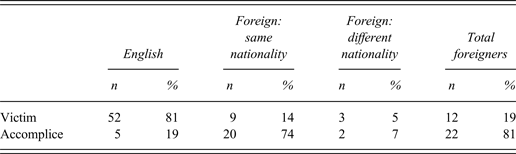
While the nationality of the victims of these foreign defendants is not always listed and the evidence of names alone is not always reliable, it is safe to say that the vast majority of the victims, over 81 per cent of victims whose nationality is reliably known, were native English (see Table 1). Only 12 of the victims are specifically identified as foreign in the records while perhaps another 5 to 10 could possibly be foreign on the basis of name alone.Footnote 52 When the victim was a foreigner they tended to be of the same nationality as the defendant, as was the case in 75 per cent of cases involving non-English victims. When the defendants had accomplices whose nationality can be identified, the accomplices were overwhelmingly of the same nationality as the defendant (approximately 74 per cent). For example, in 1688 two Frenchmen, John Lehay and Francis Maneer, were indicted together for grand larceny and in 1711 Katharine Tilman and Elizabeth Sayling, both Dutch, were tried together for theft.Footnote 53 When the accomplices did not share a country of origin with the defendant the accomplice was much more likely to come from Britain (approximately 19 per cent) than from a different continental country (a mere 7 per cent).Footnote 54
Nationality of victims and accomplices of foreign defendants in Old Bailey trials, London 1674–1750

Source: Old Bailey Sessions Papers Online, April 1674–July 1749 (www.oldbaileyonline.org, version 7.0 May 2011–April 2012).
This is interesting when one considers the settlement patterns of foreign residents in early modern London. Perhaps unsurprisingly, foreign immigrants tended to cluster together with their fellow countrymen in specific wards and parishes while avoiding others: French immigrants in St Thomas and St George, and Dutch immigrants in St Olave. On the whole, foreign immigrants tended to cluster in wards near to or outside the walls of the City, in part because guild regulations were weaker or non-existent.Footnote 55 Given that foreign immigrants tended to reside near their countrymen or co-linguists, it is unsurprising that defendants and accomplices tended to be from the same place of origin.
If it can be said that a large percentage of the foreign defendants in the Old Bailey came from two countries, France and the Dutch Republic, it is also true that a large proportion of the cases involving foreign defendants are clustered in two periods on opposite ends of our chronological scope. Of the cases, 36 per cent occurred in the years between 1688 and 1698.Footnote 56 A second mid-eighteenth century spike occurred in the years between 1741 and 1750 during which 19 per cent of all cases involving foreign defendants occurred.Footnote 57 Despite their relative poverty compared with immigrants from the Low Countries and France in the previous centuries, and the controversy and party debate over immigration surrounding the ‘Act for the Naturalization of Foreign Protestants’ in 1709, there is no evidence of a spike in prosecutions related to the influx of German immigrants from 1709. Nor is there any evidence of a spike in prosecutions surrounding other events that may have triggered an increase in anti-immigrant tensions such as the Hanoverian Succession, the Jacobite Rebellion of 1715 or the influx of refugees from Salzburg in 1735.Footnote 58
London, although always a relatively diverse city, experienced a pronounced influx of immigrants in the 1680s. With the revocation of the Edict of Nantes, England, and London in particular, experienced one of the greatest waves of foreign immigration in the whole of the early modern period. In 1685 Louis XIV revoked the Edict of Nantes which had provided limited tolerance for French Protestants since it was enacted in 1598. Fearing a renewal of the persecution and civil strife that had preceded the Edict, large numbers of French Protestants fled to Protestant countries such as the Dutch Republic, Prussia and England.Footnote 59 England alone received as many as 8,000 to 10,000 Huguenot refugees between 1650 and 1680 and another approximately 40,000 to 50,000 French immigrants after 1680, many of whom settled in London.Footnote 60 Despite this influx of Huguenot refugees in London, there is little evidence in the records of the Old Bailey to suggest that there was a concomitant rise in prosecutions of Huguenots or crimes committed by them. Rather, the spike in prosecutions of foreign residents in the Old Bailey in the late 1680s and early 1690s was largely the result of a substantial increase in the prosecution of Dutch residents, seemingly unrelated to the proportions of French and Dutch residents in London in the period. First of all, the spike in foreign defendants in the Old Bailey occurred between 1688 and 1698 (36 per cent of all cases and 24 per cent of all cases between 1688 and 1692), years after the beginning of the initial wave of refugees following the revocation of the Edict of Nantes in 1685. Additionally, although French residents in London substantially outnumbered Dutch residents in the late seventeenth century, Dutch residents outnumbered French residents as defendants in the records of the Old Bailey by a factor of about two to one in the years between 1688 and 1698. In fact, Dutch defendants made up approximately 59 per cent of all foreign defendants tried at the Old Bailey in those years.Footnote 61 This state of affairs is probably explained not by the relative populations of French and Dutch residents in London or the proportion of new arrivals, but rather in popular attitudes towards Huguenot refugees and Dutch occupiers that arose out of the political context of the 1680s and 1690s.
As Steven Pincus has convincingly demonstrated, popular opinion in England shifted from predominately anti-Dutch to predominately anti-French in the 1670s as a result of Louis XIV's expansionist foreign policy and fears that he aspired to universal monarchy (a charge previously applied to the Dutch).Footnote 62 The Huguenots, as fellow Protestants and fellow opponents of Louis XIV's Catholic universal monarchy, were likely to be viewed in a sympathetic light (even if the pro-French James II opposed their settling in England).Footnote 63 The proliferation of pro-Huguenot pamphlets in the 1680s such as An Apology for the Protestants of France, in Reference to the Persecutions they are under at this Day and An Earnest Exhortation to charity for the Relief of the French Protestants and Objections against it Answered, is testament to the fact that many in England empathised with the plight of their Huguenot brethren, especially when they considered their similar struggles against absolutism.Footnote 64 In addition, many Huguenots were far from being a ragtag refugee rabble, but instead possessed skills that were lacking or valued in the English economy and marketplace.Footnote 65 While this may have been seen as unwelcome competition by some, by and large Huguenot refugees were relatively well received.Footnote 66 This sympathetic stance may go a long way toward explaining why despite their large and growing numbers in London, French residents were under-represented in the Old Bailey in the late seventeenth century.
Despite the fact that anti-Dutch sentiment had been replaced by anti-French sentiment after the third Anglo–Dutch war in 1674, and the fact that the resident Dutch population was falling throughout the seventeenth century, there was a significant increase in prosecutions of Dutch residents at the Old Bailey in the late 1680s and early 1690s. Possible explanations for this phenomenon include more Dutch residents committing crimes in the late seventeenth century than before or after, and, second, popular attitudes towards Dutch residents in the wake of the Glorious Revolution resulting in increased paranoia or prosecuting zeal on the part of the populace at large.
When considering the possible causes of the spike in Dutch prosecutions after 1688, it is important to remember that, despite the traditional view of the Glorious Revolution as a bloodless and popular affair, William of Orange and his largely Dutch army did occupy London for the better part of two years between 1688 and 1690.Footnote 67 William took pains to ensure that the occupying soldiers were not a cause for resentment, but many in London complained of their high-handed, disruptive or violent behaviour. Others, mostly supporters of the Williamite regime, contended that the occupying Dutch soldiers were well behaved, at least compared with James's troops, some going so far as to claim that the Dutch soldiers had led to a reduction of crime in the city.Footnote 68 If it is unclear whether or not the presence of a foreign occupying army increased or reduced crime in London overall, it is clear that the Dutch occupation of London coincided with the increased prosecution of Dutch residents between 1688 and 1692. Indeed, in four cases, Dutch soldiers were indicted at the Old Bailey for killings during the Dutch occupation of London, and it is likely that there were other soldiers who either escaped conviction or were not listed as soldiers in the court records.Footnote 69 Although the occupying soldiers were probably responsible for some crime and violence in London, considering that the indictment of Dutch defendants at the Old Bailey remained disproportionally high for years after the end of the Dutch occupation of London, it is more likely that their most important role in the wave of Dutch prosecutions was in their contribution to the general anti-Dutch sentiment that pervaded London from at least 1689.Footnote 70 Given that most of the Dutch residents indicted at the Old Bailey were not Dutch soldiers, that the charges included not only homicide (41 per cent) but also such crimes as seditious words (8 per cent), deception (8 per cent) and property crimes (41 per cent), and that the unusually high rate of prosecutions continued after William's Dutch regiments left London, it seems reasonable to conclude that the spike in prosecutions mentioned above was the result of anti-Dutch sentiment stirred up by the events of 1688 and the subsequent occupation of London.
The more modest spike in prosecutions between 1741 and 1750 is more difficult to explain, but it was probably related to the combined pressures of the War of Austrian Succession, which England entered in 1743, and the Jacobite Revolt of 1745. Contrary to initial appearances, the rise in the number of foreign defendants between 1741 and 1750 does not coincide with the crime wave that J. M. Beattie found in Surrey following the War of Austrian Succession. Beattie's data show that there was a modest increase in indictments between 1736 and 1739, followed by a decline in indictments during the war itself and a dramatic increase after 1748 which continued until 1753.Footnote 71 The evidence of indictments of foreign residents, however, indicates an increase between 1741 and 1744 followed by a gradual decline between 1745 and 1750.Footnote 72 Thus, it seems likely that the increase in indictments of foreign residents was not tied to a general increase in crime, but possibly to the heightened tensions in the years preceding the War of Austrian Succession and the Rebellion of 1745.
Although most or all of the 147 foreign defendants tried at the Old Bailey in our period should have been eligible to receive a party jury, only 31 per cent of them did.Footnote 73 One can only speculate as to the reasons why so many foreign defendants were not tried by a mixed jury, but since the defendant was responsible for requesting a trial de medietate lingue before any jurors were sworn, it is most likely that many defendants were not aware of their right to a party jury or failed to request one at the proper time. In this respect, it is perhaps necessary to conclude that the law's attempt to protect vulnerable foreign residents had failed, if only because the legal protection afforded them was not widely known or because foreign defendants were not informed by the legal authorities of their rights.Footnote 74 But what of the third of foreign defendants who were savvy or lucky enough to request a trial de medietate lingue? How did they fare in comparison with the unfortunate majority who did not receive a mixed jury? Was the theoretical protection afforded by the trial de medietate lingue a valuable protection in practice?
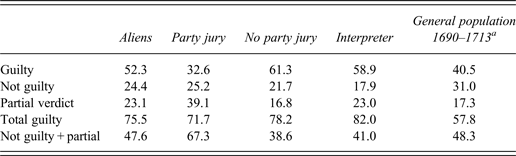
Overall, of the 147 foreign defendants tried at the Old Bailey between 1674 and 1750, 77 (52 per cent) were found guilty of the original charge, 34 (23 per cent) were found guilty of a lesser offence and 36 (24 per cent) found not guilty (see Table 2). In total, 75.5 per cent were found guilty of some offence and 47.6 per cent were found not guilty or guilty of a lesser, usually non-capital, offence.Footnote 75 This compares with a conviction rate of 37.6–40.1 per cent guilty, 31–44.6 per cent not guilty and 15.4–17.3 partial verdicts for property offences for the general population at the Old Bailey between 1663 and 1714.Footnote 76 When we separate those foreign defendants who were tried de medietate lingue from those who were tried by an all-English jury, however, the differences in trial outcomes become more stark and remarkable. Fully 61 per cent of those foreign defendants tried without a party jury were found guilty of the original charge, while 17 per cent were found guilty of a lesser offence and 22 per cent found not guilty. Thus, 78 per cent of foreign defendants who did not receive a party jury were found guilty of some charge while a mere 38.6 per cent were found not guilty or guilty of a lesser offence.Footnote 77 If it seems that these foreign defendants were treated harshly in the courts, this harshness is further underlined when viewed in comparison with the trial outcomes of those who were tried de medietate lingue. Of those foreign defendants who received a trial de medietate lingue, 32.6 per cent were found guilty of the original charge, 39.1 per cent were found guilty of a lesser offence and 25.1 per cent were found not guilty. Thus, 71.7 per cent were found guilty of some offence while a remarkable 67.3 per cent were either found not guilty or guilty of a lesser offence.Footnote 78
Trial outcomes of foreign defendants at the Old Bailey, London 1674–1675 (%)
a Statistics for property offences at the Old Bailey produced in J. M. Beattie, Policing and punishment in London 1660–1750: urban crime and the limits of terror (Oxford, 2001), 340. These are the rates for property offences only. However, as property offences made up the vast majority of cases at the Old Bailey overall and the majority of cases involving foreign defendants, the conviction rates for all crimes was probably similar to the rates for property offences provided by Beattie.
Source: Old Bailey Sessions Papers Online, April 1674–July 1749 (www.oldbaileyonline.org, version 7.0 May 2011–April 2012).
From this comparison a number of conclusions become evident. Those foreign defendants lucky enough to be tried by a party jury were much less likely to be found guilty of the original charge (32.6 per cent versus 61.3 per cent) and much more likely to be found guilty of a lesser charge (39.1 per cent versus 16.8 per cent) than those foreigners who were tried before an all-English jury. This is especially significant given that finding a defendant guilty of a lesser offence in the period was often an example of ‘pious perjury’.Footnote 79 Frequently juries found defendants guilty of lesser offences because although the defendant was thought to be guilty, the jury wished to mitigate the harshness of capital sentences by finding the defendant guilty of a lesser offence, even if it was strictly speaking untrue.
For example, in May 1727, Bernard Kentye Massip was indicted at the Old Bailey for the theft of a ‘Cloth Coat and Waistcoat, Shirt, Stock and Hankercheif, to the value of 34 shillings’ from a Crispin Tomlinson. As Massip was Italian and claimed not to understand English, ‘he desired (by the mouth of a Gentleman in Court) that he might have the Privilege which is granted by the merciful Laws of England in such cases, i.e. When a foreigner not having the Advantage of our Speech, stands upon his delivery before any Court of Judicature, he may have the Liberty of a Jury chosen for that purpose, consisting of six English Men and Six Foreigners’. Massip's request was granted and a mixed jury was sworn.Footnote 80 Although the value of the stolen goods was clearly stated and sufficient to make Massip's crime a capital offence, the mixed jury saw fit to find the defendant guilty only of theft of goods to a value of 10 d., a misdemeanor. This clearly falsified verdict saved Massip from the gallows and the court record makes clear that it was thought that the party jury had been largely responsible for this leniency. ‘It appeared he was not so great a Stranger to our Language as he pretended to be; but it's possible he might flatter himself with hopes, that by such dilatory Proceedings he might tire out the Patience of the Court, and be discharged, to prevent a great deal of Trouble which must necessarily be the Consequence, if he was arraigned and convicted in such Manner as the Law directs on these Occasions: But though he found more Mercy than he could have expected, yet as the Fact was plainly proved upon him, he is not altogether to escape from Justice, for the Jury brought him in guilty to the value of 10 d.’Footnote 81
Although this pattern of pious perjury was repeated in many cases involving English defendants and foreigners alike throughout the period, it seems that this informal means of mitigation was especially common in cases involving a party jury. If we concede that finding a defendant guilty of a lesser offence was often a means of protecting the defendant from the full force of the law, the efficacy of a trial de medietate lingue becomes clear. It is not that a much higher percentage of foreign defendants tried before a party jury were found not guilty (25 per cent of those tried by mixed jury versus 23 per cent of those tried by a regular jury), but rather that a much higher proportion of those tried by a party jury were found guilty of a lesser offence.
According to Peter King the incidence of partial verdicts was related to the character of the defendant and women, the young and those with families to support ‘were much more likely to be given partial verdicts’.Footnote 82 The relative frequency of partial verdicts given to these types of defendants was a result of the belief that they were in need of special protection. The law regarding trials de medietate lingue was similarly created to provide protection for another potentially vulnerable group, namely foreign residents. The records of the Old Bailey show that mixed juries did indeed employ partial verdicts at a much higher rate than non-party juries, a fact which suggests that foreign residents were considered by jurors to be in need of special protection in the same way as women and the young. Furthermore, frequency of partial verdicts in trials de medietate lingue demonstrates that the protection provided to aliens by the law was real.
Based on this evidence, it seems clear that while a mixed jury did not help those who were guilty to escape conviction completely, it did frequently mitigate the harshness of the law and make a capital sentence much less likely. The difference between the trial outcomes of those tried with and without a mixed jury seems so stark that one must reasonably conclude that the legal protection intended by the trial de medietate lingue was in practice remarkably effective. Indeed, because the foreign members of mixed juries were exempt from the property qualifications that restricted English jurors to the ‘better sorts’, it is possible that foreign defendants tried de medietate lingue were insulated to some degree from both the national and class prejudices of a normal English jury. As such, it may be that foreign defendants tried before a party jury were more favourably treated by English juries than both foreigners and natives.
Another possible factor in the outcome of trials of foreign residents must be addressed, namely recourse to interpreters. About one-third of foreign defendants at the Old Bailey are recorded as having had interpreters present to expedite communication between defendant, witnesses, judge and jury.Footnote 83 Nearly 59 per cent of foreign defendants who had an interpreter present were found guilty of the original charge while 23 per cent were found guilty of a lesser offence and 17.9 per cent were found not guilty. In sum, approximately 82 per cent were found guilty of some offence while 41 per cent were found not guilty or guilty of a lesser offence.Footnote 84 The conviction rates of those defendants who used an interpreter fit roughly with those tried without a party jury. Thus, it seems that the presence of an interpreter was not sufficient to appreciably alter the outcome of trials of foreign defendants.
6. CONCLUDING REMARKS
The evidence of the trials of foreign residents at the Old Bailey between 1674 and 1750 shows that, although unusual, the trial de medietate lingue did indeed provide some measure of protection to foreign defendants. Whereas foreign defendants in general were more likely to be found guilty and less likely to receive a partial verdict than the general population, those foreign defendants who were tried by a mixed jury were not only convicted at a lower rate than the general population, but, perhaps more significantly, were far more likely to receive a partial verdict. The potential protection of the party jury was probably needed most in the years after the Glorious Revolution of 1688 and the years surrounding the War of Austrian Succession and the Jacobite Rebellion when the number of foreign residents tried at the Old Bailey skyrocketed. The records of the Old Bailey suggest that anti-foreigner or anti-immigrant sentiment caused by a combination of domestic and international political events, not any particular influx of foreign refugees, fuelled the increase in prosecutions of foreign residents. Thus, it seems clear that foreign defendants had both a real need for protection from the possible prejudices or misunderstandings of English juries and that the protection afforded to foreign defendants in English law by means of the party jury was significant.
We have become accustomed to viewing history as an ineluctable, if often shaky, march towards modernity. However, as the study of trials de medietate lingue has shown, sometimes the past can seem more modern and progressive than the present. Although in many cases the idea of a jury of one's peers in the early modern world was the reserve of a lucky few, it could be argued that in the case of foreign defendants, the protections given by English law were far more generous than those provided by modern societies. That the protections provided by the trial de medietate lingue were real is borne out in the cases in which the right was claimed. Sometimes it seems that the treatment of foreign defendants in the criminal courts of England were more humane and more fair than our own systems of judgment. It can be debated whether or not England was a xenophobic society, but what cannot be debated is the fact that the English legal system, although often brutal, unequal and unjust, sought to protect its foreign residents from the vagaries of its own population. To some small degree it seems they succeeded.
ACKNOWLEDGEMENTS
I would like to thank, Lucy Kaufman, Keith Wrightson and the anonymous readers for their insightful comments and suggestions. I would also like to acknowledge the generous support of the Jack Miller Center, the Yale Center for the Study of Representative Institutions and the Whitney and Betty MacMillan Center for International and Area Studies at Yale