Introduction
The concept of a left–right dimension has permeated political discourse in many countries, allowing a spatial understanding of issue positions by political parties and mass publics alike. This means of organizing the contents and simplifying the complexities of political information facilitates both orientation for individual voters and communication for the whole political system (Inglehart and Klingemann, Reference Inglehart, Klingemann, Budge, Crewe and Farlie1976; Fuchs and Klingemann, Reference Fuchs, Klingemann and Kent Jennings1989). Many works based on survey data report high percentages of publics recognizing the left–right schema, as evidenced by respondents’ ability to locate themselves along this spectrum (e.g. Klingemann, Reference Klingemann and Barnes1979; Dalton, Reference Dalton1996; Knutsen, Reference Knutsen1998). This holds true not only in advanced democracies, but also in a number of newly democratized societies where political competition along ideological lines represents a relatively recent phenomenon (e.g. McAllister and White, Reference McAllister and White2007).
Trends indicating a decline of traditional cleavages as determinants of ideological disposition and voting behavior (Franklin, Reference Franklin, Franklin, Makie and Valen1992) do not render the left–right discourse obsolete, since these semantics assume no fixed definitions revolving around a particular axis of conflict. Instead, the left–right dimension can be seen as an ‘amorphous vessel’ containing meanings that vary with political and economic conditions in different societies (Huber and Inglehart, Reference Huber and Inglehart1995: 90), thus constituting ‘a universal solvent’ absorbing all major political conflicts (Barnes, Reference Barnes, Lichbach and Zuckerman1997: 131). Under the premise that the left–right schema remains valid due to its ability to assimilate new cleavages, what factors structure publics’ understanding of left and right merits comparative analysis, particularly among countries with divergent historical trajectories and at different stages of democratic development.
As the language of left and right first appeared in the political lexicon during the French Revolution (Laponce, Reference Laponce1981: 47), one would expect its prevalence both within Europe and in nations influenced by European political traditions. Not surprisingly, almost all literature examining the meaning, salience, and impact of left and right has focused on these cases (e.g. Inglehart, Reference Inglehart, Dalton, Flanagan and Allen Beck1984; Converse and Pierce, Reference Converse and Pierce1986; Huber, Reference Huber1989; Evans et al., Reference Evans, Heath and Lalljee1996; Knutsen, Reference Knutsen1997, Reference Knutsen, Marthe Narud and Aalberg1999; Gunther and Montero, Reference Gunther, Montero, Nikiforos Diamandouros and Gunther2001; Van der Eijk et al., Reference Van der Eijk, Schmitt, Binder and Thomassen2005; Freire, Reference Freire2008). However, as more countries in other parts of the world, often with trajectories of historical and economic development very different from the west, embark on the journey toward democratic consolidation, the diffusion of left–right semantics also follows (Coppedge, Reference Coppedge1998; Evans and Whitefield, Reference Evans and Whitefield1998; Dalton and Tanaka, Reference Dalton and Tanaka2007). While publics in a number of new democracies display even higher levels of left–right recognition than their counterparts in more established democracies (Dalton, Reference Dalton2006), the question of what meanings these citizens attribute to labels of left and right has received relatively scarce attention.
The present study seeks to fill a part of this gap by examining factors that structure public understanding of left and right in four East Asian democracies – Japan, South Korea, the Philippines, and Taiwan – using their two ‘western’ neighbors, Australia and New Zealand, as points of reference. Empirical results show that utility of the left–right schema is not limited to western contexts, as ideological orientations in Japan are also meaningfully structured. Instead, the main distinction lies between older and newer democracies; while publics in the three newly democratized countries can readily place themselves on the left–right scale, their ideological orientations are less influenced by attitudes and issue preferences than citizens in Australia, New Zealand, and Japan. Possible explanations accounting for the difference between these two groups of countries include levels of economic development, party system dynamics, and the length of democratic experience.
The paper is organized as follows. The next section reviews relevant literature on issue contents comprising the left–right schema, including changes in recent decades. Section 3 elucidates two broad sets of factors – identity and beliefs – that shape left–right orientations; the former consists of demographic and organizational variables, while the latter covers socio-economic and religious views, post-modern values, and attitudes toward democracy. Section 4 tests these hypotheses and presents results that shed light not only on cleavage patterns in each country, but also the utility of the left–right schema in meaningfully anchoring how publics perceive political competition over a wide range of issues. The final section offers alternative explanations of these differences and discusses possible implications for democratic consolidation.
Political cleavages and the left–right schema – a literature review
By virtue of forming a continuum containing a central position and lending itself to simple visualization, the left–right schema is comprehensible and translatable across cultures (Laponce, Reference Laponce1981: 24–7). Highlighting its utility, Inglehart states that ‘the Left–Right image is an oversimplification, but an almost inevitable one, which in the long run tends to assimilate all important issues’ (Reference Inglehart1990: 292). While political conflicts in any given society rarely revolve solely around a single issue, concepts of left and right offer a framework capable of incorporating multiple issue dimensions.Footnote 1 Thus, according to Inglehart and Klingemann, ‘the left–right dimension is more often than not used by political elites and mass communication to label the most important issues of a given era’ (Reference Inglehart, Klingemann, Budge, Crewe and Farlie1976: 244, original italics). These ideological labels can serve as useful guides to both voters with specific policy preferences and others who simply wish to reduce the cost of information gathering, leading Sigelman and Yough to assert that ‘party systems throughout the world can meaningfully be profiled in terms of polarization along the left–right continuum’ (Reference Sigelman and Yough1978: 356).
The extent to which left–right semantics convey political meaning and influence vote choice has received empirical confirmation. Fuchs and Klingemann identify three fundamental features of this schema: ‘The semantic space of left–right is inhabited by a limited repertory of generalized meaning with largely binary associations’ (Reference Fuchs, Klingemann and Kent Jennings1989: 233; original italics). In a seminal article examining nine European countries, Inglehart and Klingemann distinguish partisan and ideological components of the left–right dimension, and emphasize the greater impact of party affiliations on publics’ left–right self-placement than that of issue preferences (Reference Inglehart, Klingemann, Budge, Crewe and Farlie1976: 260). However, analyzing results from a three-nation survey, Fuchs and Klingemann note a trend toward value-related rather than partisan basis of left–right identification (Reference Fuchs, Klingemann and Kent Jennings1989: 232). Knutsen (Reference Knutsen, van Deth and Scarbrough1995) builds on these findings to demonstrate that values and party choices are highly correlated, and concludes that left–right orientations derive from a compound function of both value orientations and partisanship. In other words, these semantics have analytical value independent of party attachments, and may come to play a greater role with increasing partisan de-alignment.
Having established the value of the left–right schema as a useful and meaningful device structuring political orientation, it is natural to ask what these labels stand for. To this question, Lipset offers the classic answer: ‘More than anything else the party struggle is a conflict among classes . . . in virtually every economically developed country the lower-income groups vote mainly for parties of the left, while the higher-income groups vote mainly for parties of the right’ (Reference Lipset1960: 223–4). Changes in the next quarter century prompted Inglehart to revise slightly what defines left and right as ‘whether one supports or opposes social change in an egalitarian direction’ (Reference Inglehart, Dalton, Flanagan and Allen Beck1984: 37). While the underlying issue animating conflict between left and right remains the struggle over equality, it is notable that the basis of competition has shifted from group identities to individual beliefs.
An important feature underpinning the relationship between identities and beliefs on the one hand and left–right orientations on the other is the causal linkage leading from the former to the latter. Whereas individuals can take demographic characteristics and organizational affiliations as given, and respond to questions soliciting views on specific issues, comprehending ideological notions requires a higher level of conceptualization that challenges most citizens’ cognitive aptitude (Converse, Reference Converse and Apter1964; see also Klingemann, Reference Klingemann and Barnes1979). In short, publics have a greater capacity for identifying with concrete rather than abstract objects. Thus, one can logically expect that insofar as citizens possess a coherent ideological conception, it is who they are and what they believe in that would affect where they place themselves along the left–right spectrum, rather than vice versa.
Lipset and Rokkan's (Reference Lipset, Rokkan, Lipset and Rokkan1967) influential work elucidating four social cleavages and proposing a ‘freezing hypothesis’ that links these cleavages to the formation and stability of western Europe party systems has generated numerous studies and debates (e.g. Knutsen, Reference Knutsen1989; Dix, Reference Dix1989; Mair, Reference Mair, Karvonen and Kuhnle2001; McAllister, Reference McAllister2007). While earlier works stress the importance of religion and social hierarchy (Laponce, Reference Laponce1972; Rose and Urwin, Reference Rose and Urwin1969), more recent studies note the decreasing salience of class conflict as both a basis of party competition (Franklin, Reference Franklin, Franklin, Makie and Valen1992; Thomas, Reference Thomas1979) and a defining element undergirding the left–right schema (Huber and Inglehart, Reference Huber and Inglehart1995).Footnote 2 Instead, Inglehart proposes that ‘western politics are coming to polarize according to social class less, and according to values more’ (Reference Inglehart1990: 261), highlighting issues of post-materialism as a new axis demarcating opposite sides of political conflict. Similarly, Kitschelt argues that structural changes in postindustrial societies have induced a shift in the main axis of competition from left versus right to left-libertarian versus right-authoritarian (Reference Kitschelt1995a: 15).
In response to concerns that a linear spectrum is inadequate for capturing emerging issues, cross-cutting its more traditional components, Budge and Farlie offer the assurance that ‘most evidence on the dimensionality of the space of party competition is broadly compatible with Downs’ spatial framework’ (Reference Budge and Farlie1977: 144). Indeed, Downs's analysis is grounded in the assumption that a position along the left–right axis consists of weighted averages of positions on each particular issue (Reference Downs1957: 132–3). Instead of decreasing relevance, Inglehart foresees that ‘the new axis of polarization . . . may be assimilated into a new synthesis’ (Reference Inglehart, Dalton, Flanagan and Allen Beck1984: 68), and Fuchs and Klingemann also ‘consider it likely that the left–right schema will be retained even if the conflict structures of advanced industrial societies are changing’ (Reference Fuchs, Klingemann and Kent Jennings1989: 234). In short, shifts in issue salience may alter the components, but do not obviate the applicability, of left–right semantics.
The left–right dimension beyond western democracies
While the subjects of analysis in most of the works cited thus far focus on advanced western democracies, cleavages defining left and right are by no means limited to this group of nations. Taking a global perspective, Dalton (Reference Dalton2006) examines the factors that influence how publics understand left and right in different regions of the world, and finds that while ideological dispositions are driven by economic and religious questions in both western and post-communist countries, different issues are at work in other continents.Footnote 3 More specifically, Kitschelt (Reference Kitschelt1995b), Evans and Whitefield (Reference Evans and Whitefield1998), Tóka (Reference Tóka1998), and Whitefield (Reference Whitefield2002) all noted the importance of cleavages for party choice in post-communist Central and Eastern Europe. McAllister (Reference McAllister2007) and Lee (Reference Lee2007) conducted a comparative analysis of the relationship between cleavages and party support in East Asia, and Flanagan (Reference Flanagan and Flanagan1991) and Lee and Glasure (Reference Lee and Glasure1995) carried out similar studies for Japan and Korea, respectively.Footnote 4
McAllister's (Reference McAllister2007) study of four East Asian countries, along with Australia and New Zealand, provides both a theoretical and empirical starting point for the present paper. Testing Lipset and Rokkan's four cleavages – center–periphery, church–state, land–industry, and capital–laborFootnote 5 – as well as demographic controls, he finds that while socioeconomic factors, particularly trade union membership, significantly differentiate supporters of different parties in Australia and New Zealand, the most important explanations of partisan support in Japan, Korea, and Taiwan lie in demographic variables such as age, gender, and education.Footnote 6 In other words, social cleavages that underlie political competition in advanced western democracies seem to exert relatively little impact in structuring political competition in East Asia.
Alternatively, Lee (Reference Lee2007) tests the impact of new issue dimensions on party preference using the authoritarian–libertarian (A–L) scale developed by Flanagan and Lee (Reference Flanagan and Lee2003), which encompasses the following components: deference–autonomy, conformity–openness, and austerity–self-betterment. Results from Taiwan, the Philippines, and Indonesia show that neither economic nor A–L cleavages influence party preferencesFootnote 7, and only in Japan do value cleavages have a direct effect on partisanship. She concludes from these findings that the impact of cleavages and issues on party choice is positively associated with a society's level of modernization and democratic development. A related factor for the structuring of left–right orientations is the degree of party system institutionalization. Stable party systems, characterized by the consistency of party labels offered to voters in consecutive elections as well as moderate levels of volatility, fosters better programmatic representation, and provides the electorate with more well-defined short-cuts (Mainwaring and Zoco, Reference Mainwaring and Zoco2007).
Using a series of dichotomous party comparisons as dependent variables, McAllister (Reference McAllister2007) concentrates on identities in the form of traditional social divides and demographic factors, while Lee (Reference Lee2007) looks into beliefs centered around authoritarian versus libertarian values. The remainder of this paper will explore how elements within these two broad categories of independent variables – elucidated in the next section – affect publics’ left–right orientations in Japan, Korea, Taiwan, and the Philippines, along with their two Australasian neighbors as examples of ‘western’ cleavage structures to provide comparative perspective.
Data and hypotheses
Data for this study are taken from the World Values Survey (WVS), conducted during the period 1995–2001.Footnote 8 Percentages of respondents able to place themselves along the left–right spectrum in each countryFootnote 9 are as follows: Japan, 75.6%; South Korea, 100%; the Philippines, 95.7%; Taiwan, 96.9%; Australia, 87.6%; New Zealand, 69.8%. These figures demonstrate emphatically that publics in new democracies express greater familiarity with the left–right schema, a counter-intuitive result in view of constraints on ideological debate imposed by authoritarian regimes during the period when a majority of respondents in these countries were socialized. However, high cognition levels do not necessarily imply firmer anchoring of left–right positions in terms of either identities or beliefs. The extent to which these factors structure left–right orientations will be analyzed below.
As the previous section suggests, sources underlying one's left–right positions may derive from both identities and beliefs. The former comprises of both demographic characteristics and organizational membership, in other words factors that are not intrinsically linked with issue preferences but can contribute to one's political socialization. The latter category covers attitudes concerning traditional socioeconomic and religious cleavages, ‘new politics’ issues, and evaluations of democracy. This last set of factors, which may be especially pertinent in societies that have only recently transitioned from authoritarian rule, warrants some elaboration. Due to conflicts leading up to democratization, in new democracies ‘the democratic–authoritarian dimension may overshadow the classical conflict over issues of economic redistribution and define the central meaning of left and right’ (Moreno, Reference Moreno1999: 2), as ‘democratization of a right-wing dictatorship shifts the masses to the left, while the democratization of a left-wing dictatorship shifts them toward the right’ (Shin and Jhee, Reference Shin and Jhee2005: 394). The following paragraphs set out hypotheses regarding each of these variables.
As mentioned in the literature review, demographic variables constitute important predictors of partisanship in a number of East Asian countries. Similar to patterns found across most advanced democracies, one expects that older generations are more likely to locate themselves toward the right, while younger cohorts lean to the left. In new democracies, age also stands as a proxy for period of socialization, with those growing up under authoritarian rule more likely to identify with the former regimes’ professed ideology (due in part to a truncated left–right spectrum as governments suppressed alternative political views). In three of the cases examined here, the previous regimes were right-wing dictatorships claiming anti-communism as a legitimizing device, which may reinforce right-leaning propensities among cohorts who grew up during their period in power. Thus, one expects age to be a more significant factor for distinguishing left and right in South Korea, Taiwan, and the Philippines, whereas it should play a lesser role in countries with longer democratic histories such as Australia, New Zealand, and Japan.
Neither gender nor education is expected to be significant factors in shaping left–right dispositions in established democracies, while education in particular may be important in new democracies where it is related to opposition to former regimes; in that case, one expects highly educated segments of the population to lean toward the left in reaction to right-wing authoritarian governments. Town size reflects parts of both the traditional land–industry and center–periphery cleavages, though place of residence and occupation are no longer as closely linked today as when these cleavage structures are initially theorized. In addition, this variable does not capture regional divides, such as those in Korea. To the extent that town size differentiates ideological dispositions, one may expect rural residents to be positioned on the conservative side of the spectrum, regardless of the length of democratic experience.
Social class and income continue to be key features distinguishing left and right in many western European polities, even though their importance may have been challenged by ‘new politics’ issues in some cases. The question of whether these variables are influential in defining left and right in East Asian countries has yet to be tested. If they indeed turn out to be significant, one expects that the results will resemble patterns found in western democracies, with those with higher income and class status placed toward the right due to their interest in preserving a status quo that has allowed them to achieve and retain their present privileged positions.
Regarding organizational affiliations, one can infer from the literature that memberships in churches and labor unions are most likely to effect left–right positions. In many established democracies, secularism and working-class interests have long been rallying cries of the left. Even as membership in both churches and labor unions has declined considerably in recent decades in most of these countries, churchgoers continue to identify with the right, and union households with the left. This provides evidence of a persisting influence that these organizations exert on ideological orientations. Yet because these associations reflect social structures deriving from historical trajectories in western societies rather than any qualities intrinsic to democratic political competition, one may question the extent to which similar trends are replicated in East Asia.
Church–state conflicts fundamental to the formation and development of many western states are conspicuous by their absence in the annals of modern East Asian history. This does not mean that citizens in these countries are any less devout or engaged in religious practices – whether Buddhist (Japan, South Korea, Taiwan), Catholic (Korea, the Philippines), Protestant (South Korea), or Taoist (Taiwan) – than in the west, nor does it imply that religious organizations do not play any role in politics.Footnote 10 In contrast to western and even some eastern European countries, however, religious affiliations or values do not seem to inspire East Asian party platforms and appeals.Footnote 11 Therefore one does not expect to find church membership a significant influence on left–right disposition in this region.
Labor movements provided the foundation of, and retain links with, many left-wing parties in western Europe, and their East Asian counterparts share the objective of advancing workers’ rights. However, the latter had long suffered from repression by authoritarian regimes preoccupied with pursuing economic growth, and were often tarred with the communist brush. As a consequence of government restraints, and also due in part to patterns of economic development, company- rather than industry-based unions are not uncommon in parts of East Asia, thus creating a further barrier to peak national organizations, as members are more concerned with the profit margins of their employers. While parties founded on union backing are represented in Japan and South Korea, their seat shares are marginal.Footnote 12 In contrast, labor parties in both Australia and New Zealand have historically been major contenders for power, indicating the salience of issues centering on resource redistribution that are rooted in a class cleavage. In view of this, one expects union membership to be more significant in these two ‘western’ countries than in their East Asian neighbors.
As social modernization progresses, increases in both the availability of information and citizens’ cognitive capacities induce the basis of political orientation to shift from group identities toward individual beliefs (Dalton, Reference Dalton1996). Accordingly, the degree to which attitudes toward ‘pre-industrial’, ‘industrial’, and ‘post-industrial’ factors (Inglehart, Reference Inglehart1977) structure left–right self-placements likely depends on a society's level of economic development. At the same time, this causal linkage may be mediated by the length of democratic experience. Populations in many new democracies display different value orientations compared with citizens in established democracies, an observation at least as attributable to socialization under authoritarian rule as differences in gross domestic products. In addition, clarity of political choices, in the form of stable patterns of party competition and clear programmatic differentiation among parties, may also affect citizens’ ability to form coherent ideological dispositions.
Distinguishing between organizational affiliation and attitudinal orientations, two sets of variables are introduced to capture socioeconomic and religious beliefs. The first measures confidence in labor unions, major companies, and a composite index covering a range of questions constituting the traditional class cleavage such as income inequality, public versus private ownership, and the extent of government responsibility. Where socioeconomic factors form the basis of left–right orientations, one expects respondents expressing greater trust in unions, skepticism toward big business, and favoring a larger role for the government in directing the economy and re-distributing wealth to identify with the left. Religious beliefs comprise of confidence in churches, the extent of respondents’ religiosity, and the importance of God in their lives. If religious factors contribute to influencing left–right positioning, those having greater trust in churches, considering themselves more religious, and assigning a higher place to God in daily life are likely to lean toward the right.Footnote 13
If the ‘new politics’ issues are becoming increasingly salient, one can logically hypothesize that value changes giving rise to these new dimensions of political competition also exert a growing influence in shaping publics’ left–right orientations. Four variables are selected to encapsulate the ‘new politics’ dimension: post-materialism, gender equality, environmental protection, and political activism. While the first three items are largely self-explanatory as indicators of progressive causes, the last warrants some elaboration. This composite index includes a range of direct participatory activities, which require greater initiative than simply casting ballots. These forms of participation, from signing petitions and joining boycotts to taking part in strikes and occupying buildings, reflect a high degree of interest in, and commitment to, certain causes that encourage citizens to go beyond conventional channels of political action. While the divergent array of issues motivating these activities covers the gamut of, and sometimes transcends, the left–right spectrum, their elite-challenging rather than elite-directed nature suggests that actual and potential participants may be more inclined toward the left.
Finally, as explained at the beginning of this section, beliefs in democracy can play a particularly important role in newly democratized countries, since conflicts between supporters and opponents of the former authoritarian regime may continue to shape political identification in the years following transition. This is especially pertinent in cases where one major competitor for power is based on the former ruling party or a successor thereof. The persistence of this ‘regime divide’ has potentially deleterious effects on prospects of democratic consolidation if one side disputes the legitimacy of the new regime. These concerns do not apply to established democracies where the rules of the game have long been accepted by the general public as well as all major political actors, so one expects that attitudes toward democracy would influence left–right orientations only in newer democracies.
Support for democracy can be conceptualized at different levels, ranging from identification with one's political community at the most abstract end, to confidence in the current government at the most concrete. Adopting Norris's (Reference Norris and Norris1999) schema, I use four categories of democratic support, in order of increasing specificity: identification with one's political community, democratic qualities, institutional trust, and confidence in government. The first variable measures respondents’ pride in, and willingness to fight for, their nations; the second consists of appraisals of whether democracies are indecisive, lead to negative outcomes in terms of the economy and public order, and whether respondents regard it as the best form of government despite its shortcomings; the third evaluates respondents’ views toward the parliament and political parties in general; and the fourth assesses how they view political actors currently in power. While the first three items appear most pertinent in new democracies, the last probably distinguishes left and right in all countries, as right-leaning respondents rate a left-wing government negatively, and vice versa. One can hypothesize that system support variables, particularly views on democratic performance and institutions, may influence left–right orientations in transitional societies still coming to terms with legacies of past authoritarian regimes which sought legitimization through ideology (e.g. anti-communism), whereas in established democracies such a divide should no longer exist as all segments of the population come to accept democratic norms.Footnote 14
Returning to the three conditions that are conjectured to influence the relative weights of factors structuring left–right orientations, one expects that: (1) higher levels of economic development increase the importance of ‘new politics’ issues as predictors of ideological dispositions relative to traditional class and religious divides (though some of these Lipset–Rokkan cleavages were less politically relevant in East Asia in the first place); (2) longer democratic experience reduces the salience of democratic support as a predictor of left–right self-placements since the questions over regime type and institutions have gained acceptance from all sides and no longer animate debate (though the importance of current government evaluations may not vary with length of democratic history); (3) more institutionalized party systems, characterized by greater continuity in party names and programs, offer a firmer anchor to citizens’ understanding of what left and right represent, hence resulting in greater variance in left–right positions explained by attitudinal variables.
Results
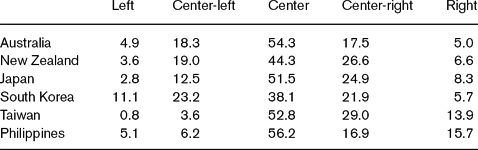
Before analyzing what factors East Asian citizens associate with the terms left and right, it is useful to see where they place themselves along the spatial spectrum. Table 1 displays left–right distributions in the six countries in our sample. In every case, the center category contains the largest number of citizens. One can detect a contrast between Australia, New Zealand, and Japan, where about 10% of respondents fall into the two extreme categories, and the remaining three countries where the equivalent percentages are higher. The preponderance of citizens who identify with the far right in Taiwan and the Philippines is particularly striking. It is probably not coincidental that the two groups of countries correspond to the divide between established and new democracies, since political competition in transitional societies is more likely to involve disagreement over fundamental debates over regime legitimacy and institutional frameworks which establish rules of the game, and thus generate more intense and polarizing conflicts. Whether such issues in fact influence public understanding of left and right will be examined below.
Distribution of left–right self-placements
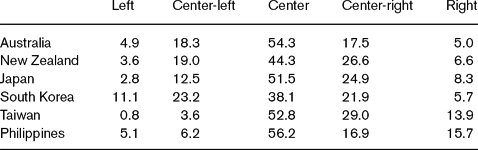
Source: World Values Survey; left-right placement: 1–2 = left; 3–4 = center -left; 5–6 = center; 7–8 = center-right; 9–10 = right.
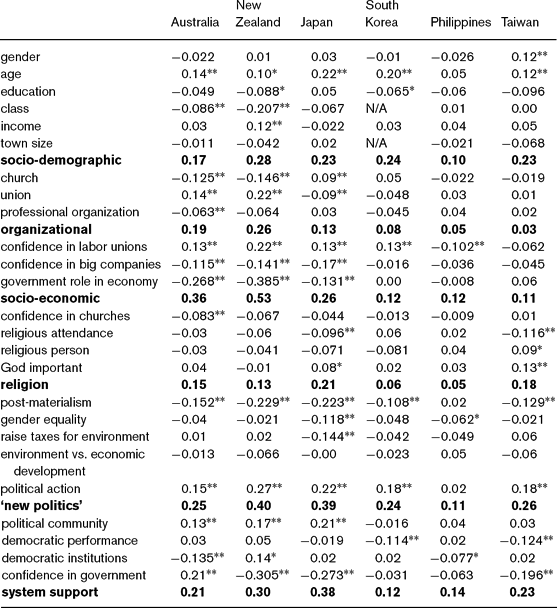
Table 2 shows the explanatory values of each set of factors elucidated above, with respondents’ left–right self-placements as the dependent variable. Using ordinary least squares (OLS) regression, standardized coefficients are shown for each specific independent variable, with Pearson's R for each cluster of variables in bold. This permits comparison among clusters of identity and belief variables hypothesized to influence left–right orientations in each country.
Structuring of left–right orientations – comparing variable clusters
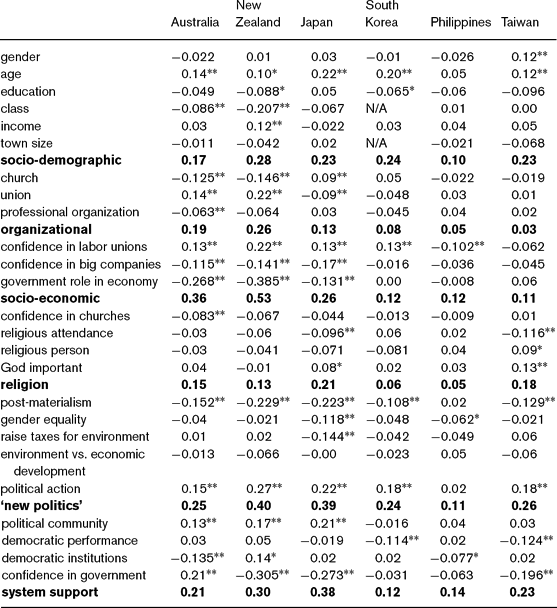
Notes: standardized coefficients shown; **p<0.05; *p < 0.1; bold figures indicate variance (Pearson's R) accounted for by each set of variables immediately above
left–right self-placement: 1 = left, 10 = right
demographics – gender: 1 = male, 2 = female; education: 1 = lowest, 8 = highest; class (subjective): 1 = upper, 5 = lower; income: 1 = lowest, 10 = highest; town size: 1 = smallest, 8 = largest
organizational affiliation – 1 = active member, 2 = inactive member, 3 = non-member (Australia, New Zealand, Taiwan); 1 = member, 2 = non-member (Japan, Korea, Philippines)
socio-economic attitudes – confidence in unions and companies: 1 = a lot, 4 = none at all; government role in economy: composite of income inequality (1 = less equal, 10 = more equal [recoded]), ownership (1 = private, 10 = public), and economic responsibility (1 = individual, 10 = government)
religion – confidence in churches: 1 = a lot, 4 = none at all; religious service attedance: 1 = most often, 8 = never; religious person: 1 = yes, 3 = no (atheist); importance of God: 1 = not at all, 10 = very important
new politics’ – post-materialism: 0 = materialist, 5 = post-materialist; gender equality: composite of prioritize jobs for men (1 = agree, 3 = disagree) and prioritize university placement for boys (1 = agree, 4 = disagree); more taxes for environment: 1 = agree, 3 = disagree; environment versus economic development: 1 = prioritize former, 2 = prioritize latter; political action: composite of signing petition, joining boycott, attending demonstration, striking, occupying buildings (in all cases 1 = have done, 2 = would do, 3 = would never consider)
democratic support – political community: composite of national pride (1 = not proud at all, 4 = very proud [recoded]) and willingness to fight for country (0 = no, 1 = depends; 2 = yes); democratic performance: composite of democracy bad for the economy, indecisive, bad for order (in all cases 1 = agree; 4 = disagree), democracy best system despite its shortcomings (1 = disagree; 4 = agree); institutions: composite of confidence in parliament and parties (in both cases 1 = a lot, 4 = none at all); government: confidence in present government (1 = a lot, 4 = none at all)
In the two ‘western’ democracies, views on socioeconomic issues prove most significant in giving meaning to ideological labels, followed by ‘new politics’ issues. This is readily understandable when one considers the pattern of economic development and level of social modernization in Australia and New Zealand. The class cleavage exerts a powerful influence in shaping ideological dispositions in both countries, confirmed by the high coefficients for both union membership and opinions on the government's role in directing the economy and redistributing wealth. These results also correspond to current party systems, with the main axis of competition between parties forged by the class cleavage (Liberal/National versus Labor in Australia, National versus Labour in New Zealand), while a secondary dimension provides niches for parties such as the Greens.
In contrast, the importance of system support is contrary to expectations, though in both countries the most significant variable in this cluster is evaluation of the current government rather than more abstract dimensions of the political system: that Australian respondents expressing lack of confidence in the government lean to the right, while this coefficient points in the opposite direction in New Zealand, not only accurately reflects the ideological profiles of the incumbent of Labor and National governments at the time of the survey, respectively, but also demonstrates the clarity of these governments’ positions in voters’ minds. This also demonstrates that the confidence in the government variable captures partisan preferences rather than qualities of the political system itself.
Among the four East Asian countries, results in Japan bear the closest resemblance by far to patterns observed in Australia and New Zealand. Similar to its two Australasian neighbors, demographic variables and organizational affiliations are less important than views on socioeconomic and ‘new politics’ issues, as well as democratic support. The smaller coefficients for both union membership and attitudes toward governmental role in the economy suggest lower salience of the class cleavage in shaping left–right orientations. Considering the significance of many ‘new politics’ issues, it is perhaps surprising that the tumultuous shifts in the Japanese party system since the early 1990s did not produce parties basing their appeals and programs along this dimension. Less surprising is the significance of government evaluation in shaping left–right orientations, as respondents expressing low confidence in the Liberal Democratic Party cabinet place themselves toward the left, though one may question whether any major party in the emerging party system truly represents leftist preferences.
There are some close parallels between results for South Korea and Taiwan. In both countries, ‘new politics’ issues turn out to be the most potent predictors of left–right orientations, followed closely by demographic variables.Footnote 15 In contrast to Australia, New Zealand, and Japan, however, post-materialist values make only a weak contribution to defining left and right. Instead, the importance of ‘new politics’ issues lies mostly with propensity toward political activism. While one can attribute this to the elite-challenging nature of unconventional participatory channels, as the literature suggests, an alternative explanation may lie in country-specific contexts, namely the importance of direct political action that led to transitions from authoritarianism in both countries. Only if these findings are replicated in later surveys can one conclude that the significance of the political action variable reflects ‘new politics’ values rather than a legacy of the struggle for democratization. As hypothesized above, assessments of the quality of democracy, which are insignificant in more established democracies, shape left–right dispositions in both Korea and Taiwan; since both previous regimes were right-wing dictatorships, respondents evaluating democratic performance more positively lean toward the left. This points to a persisting regime divide as a politically salient cleavage.
Although confidence in labor unions significantly influences ideological self-placement in South Korea, insignificant coefficients for both union membership and attitudes toward the government's role in the economy suggest the absence of a class cleavage. One major contrast between South Korea and Taiwan is that evaluations of the current government influences left–right orientations in the latter case, but not in the former. One can explain this difference as a consequence of Taiwan's more stable party system pitting a right-wing incumbent Nationalist (KMT) government against a center-left opposition Democratic Progressive Party, whereas in South Korea a series of party mergers and splits hinder the formation of clear programmatic profiles by both government and opposition parties.
Results for the Philippines show that all clusters of variables structuring left–right placements in other countries have relatively little explanatory power. This suggests that Filipino ideological orientations are less firmly rooted in sociological and attitudinal anchors than any other country in our sample. While several ‘new politics’ issues consistently turn out to be important predictors of left–right orientations in both Australasian and other East Asian cases, neither post-materialism nor political activism is significant. If a lower level of economic development explains the former finding, the legacy of the People Power revolution that toppled the authoritarian Marcos regime (and arguably its repetition in overthrowing the Estrada government) leaves the latter a puzzle. Attitude toward unions is one of few significant variables, though to the extent that a party system exists in the Philippines, there are no major parties founded on representation of working-class interests.
One set of factors not touched upon so far concerns religious values. It is notable that, irrespective of the variance explained by attitudes toward religion, this factor carries less weight than both socioeconomic views and ‘new politics’ issues. Whether this is due to ongoing secularization, or because religious organizations rarely play a prominent political role, suffice it to observe here that this cleavage does not provide an important basis for left–right orientations today. One can nevertheless note that, among religious variables, confidence in churches is significant in Australia, while being a religious person and considering God highly important in daily life are significant in Japan and Taiwan. In other words, the former seems to reflect a socially based view, while the latter stresses a more personal belief. The limited number of cases precludes any definite conclusions, though it is interesting to speculate about what this difference suggests about the nature of religious practices in these societies.
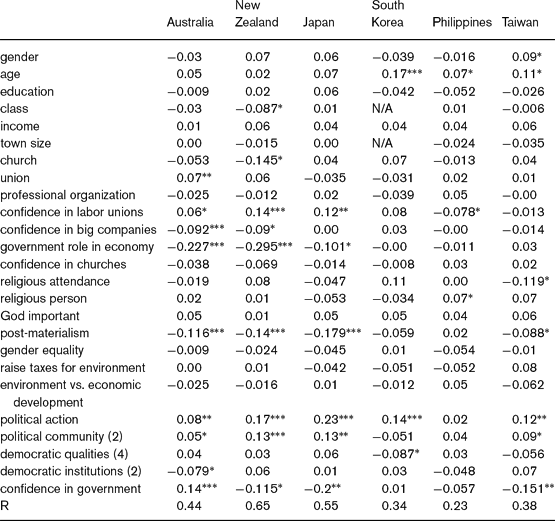
The discussion above provides information about the relative importance of each cluster of factors in structuring left–right orientations in East Asian and Australasian countries, but only a combined multivariate regression can discriminate which specific variables exert the greatest influence. Table 3 displays results from an OLS regression analysis incorporating each of the independent variables discussed above. The six countries fall into two categories, with left–right orientations more firmly anchored in cleavages in Australia, New Zealand, and Japan, than in South Korea, Taiwan, and the Philippines. Definitions of left and right revolve in part around the traditional class cleavage in the former group, particularly in the two ‘western’ cases where views toward the state's role in the economy emerge as the strongest predictor of respondents’ ideological orientations. One should also note the contrast between Australia and New Zealand where attitudes toward big business constitute an anchor opposite to unions on a labor vs. capital cleavage, and Japan where this variable has no effect on ideological positioning. In other words, labor and business organizations are not deemed to represent diametrically contrasting interests in Japan.
Structuring left–right self-placements – full model
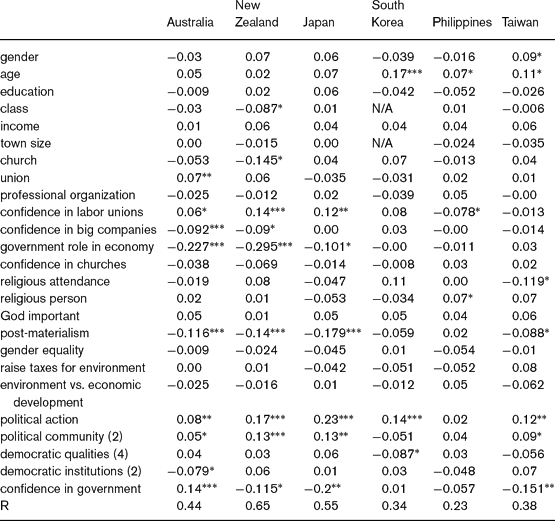
Notes: ***p < 0.01; **p < 0.05; *p < 0.1; variable coding same as in Table 2.
We also observe a strong ‘new politics’ dimension in all three cases, but this is driven largely or entirely by the post-materialist and direct political action variables, while opinions on environmental protection and gender equality are insignificant. It is likely that a broad materialist, or post-materialist, inclination already absorbs the impact of views on these more specific questions. Identification with one's political community is yet another common influence shaping left–right orientations in these three countries, with respondents professing more nationalistic sentiments leaning to the right. Evaluations of the incumbent administration also contribute to left–right dispositions, suggesting that respondents unequivocally perceive governments’ ideological positions, thus generating support from on one side (right in New Zealand and Japan, left in Australia) and disapproval from the other.
One may recall that very high percentages of survey respondents in Korea, Taiwan, and the Philippines are able to locate themselves along the left–right scale, yet Table 3 reveals that this does not imply a more well-defined basis structuring these self-placements. In fact, the variance explained in these countries is notably lower compared with cases discussed in the previous paragraph. There are few common predictors of left–right orientations except age, but it is factors that do not reach significance which warrant attention. In contrast to Japan and the two Australasian countries, no labor versus capital cleavage is discernable, and governments are not perceived to have a clear ideological profile except in Taiwan, so that evaluations of incumbent administrations have no influence in shaping left–right positioning. Unexpectedly, in the only instance where an economic variable reaches statistical significance in the Philippines, respondents expressing greater confidence in labor unions are actually more inclined toward the right. Another stark difference involves the slight (Taiwan) or nonexistent (South Korea, Philippines) impact of post-materialist values as an ideological anchor. The significance of the direct political action variable in South Korea and Taiwan shown in Table 2 finds confirmation in the full model.
In view of persistently salient topics such as tensions between North and South Korea, mainland China and Taiwan, and separatist rebelsFootnote 16 and the central government in Manila, it is perhaps surprising that national pride does not turn out to constitute a key dimension of political conflict. This (non-)finding recalls Inglehart and Klingemann's caveat that ‘questions of national identity are less readily assimilated to a left–right continuum’ (Reference Inglehart, Klingemann, Budge, Crewe and Farlie1976: 247). Finally, assuming that confidence in government reflects contemporary political conditions instead of evaluations of the political system, the insignificance of most system support variables (with the exception of democratic performance in South Korea) suggests the absence of a regime divide. This is notable considering that the surveys were conducted only a decade or so after transition from authoritarianism in each country. One can interpret this as a positive development since democratic rules of the game are no longer a topic of political contestation.
Finally, while socio-demographic characteristics mainly serve as control variables, and rarely exert a major influence on left–right orientations, the impact of age differentiates between the two groups of countries delineated above. Whereas age has no independent effect on respondents’ self-placements in Japan and the two Australasian cases after other factors are accounted for, older cohorts are significantly inclined toward the right in the Philippines, Taiwan, and (especially) South Korea. One plausible explanation involves the socialization experience of older cohorts in these new democracies. Since they grew up under dictatorships that used anti-communist indoctrination as means of legitimizing their rule, it is unsurprising that many of them retain some vestiges of suspicion toward the left even in the absence of misgivings regarding specific leftist policies. Older respondents in the three established democracies also lean to the right, but this relationship is no longer significant when other variables are included in the multivariate equation, meaning that their rightist stance is rooted in attitudinal and issue preferences.
Discussion and conclusion
The preceding pages have examined cleavages rooted in both citizens’ identities and beliefs that underpin left–right orientations in four East Asian countries, along with Australia and New Zealand. Identity variables include demographics and organizational affiliations, while beliefs variables comprise of attitudes toward socioeconomic, religious, and ‘new politics’ issues, as well as support toward various aspects of the political system. Whether analyzing each set of factors separately or in combination, results reveal two distinct groups: on the one hand, Australia, New Zealand, and Japan, where left–right positions reflect both well-structured cleavages in terms of both socio-economic and ‘new politics’ issues, and competition between governing alternatives with clear ideological profiles; and, on the other hand, South Korea, Taiwan, and the Philippines, where more people can locate themselves along the left–right spectrum, yet less can be explained about what motivate them to do so, since ideological dispositions seem to be rooted in few obvious social cleavages.
It would be inaccurate to exaggerate similarities among countries in each group. For example, within the first group, the traditional class cleavage defines the meaning of left and right to a much greater extent in Australian and New Zealand than in Japan, reflecting divergent historical trajectories of both economic and party system development. Within the second group, ideological labels appear least firmly anchored in sociological and attitudinal foundations in the Philippines, while slightly more independent variables, such as proclivity toward political activism, contribute to structuring left and right in South Korea and Taiwan. In fact, political action turns out to be the most commonly shared predictor of ideological underpinning in our sample.
Nevertheless, the most distinct line of demarcation falls between the two aforementioned groups in terms of the variance of left–right orientations explained by all independent variables combined. Disregarding the possibility that these ideological labels do not convey the same connotations when translated into different languages, three alternative explanations appear plausible. First, one may associate left–right orientations more firmly anchored in citizens’ identities and beliefs with more advanced economic development, and cite as evidence that the GDP per capita for countries in the first group is higher than that in the second group.Footnote 17 Yet this statistic for the country where the greatest amount of variance in left–right orientations is accounted for, namely New Zealand, is actually more comparable to South Korea and Taiwan than Australian or Japan. One can conjecture that economic development would be linked with class cleavages only if wealth creation follows a certain, by no means universal, course of industrialization. At the same time, the proposition that sustained prosperity gives rise to concern for ‘new politics’ issues appears to have greater validity, since post-materialist values are found to be highly significant in all three countries that belong to the club of advanced industrialized countries for longer periods of time.
Secondly, the extent to which left–right orientations are rooted in well-defined social cleavages may be a function of processes of interest aggregation and articulation, specifically via the party system. While a wide array of societal differences exist, one may surmise that only those mobilized by party elites become politically salient cleavages that define what the labels of left and right represent. Elite strategy plays a particularly important role in new democracies with nascent or volatile party systems (e.g. Rosas and Zechmeister, Reference Rosas and Zechmeister2000; Zielinkski, Reference Zielinkski2002; Erdmann, Reference Erdmann2007). This is corroborated by the finding that government evaluations are significant predictors of left–right dispositions where the ideology of ruling parties are clearly identified (the Australian Labor Party on the left, Nationals in New Zealand, Liberal Democrats in Japan, and Nationalists in Taiwan on the right), but insignificant where the left–right position of incumbent administrations is more ambiguous (the Kim Dae Jung and Estrada governments in Korea and the Philippines, respectively).
This proposition would be bolstered by evidence that coefficients for government evaluations become significant in the opposite direction after the Liberal/National coalition in Australia, Labour in New Zealand, Democratic Party of Japan, and Democratic Progressive Party in Taiwan came to power in their respective countries. A number of recent studies emphasize that the ideological clarity of choices offered to voters, rather than simply the number of choices, significantly facilitates voting behavior based on left–right proximity (Dalton, Reference Dalton2008; Lachat, Reference Lachat2008). Accordingly, electorates in Australia, New Zealand, Japan, to some extent Taiwan identified the main governing alternatives with either left or right due to a degree of polarization along this dimension, while many voters in South Korea and the Philippines did not, since differences among parties on the ideological scale are minimal (Dalton and Tanaka, Reference Dalton and Tanaka2007).Footnote 18
Thirdly, and perhaps most importantly, democracy itself may strengthen the sociological and attitudinal underpinnings of left–right orientations by allowing articulation and debate of issue positions from across the ideological spectrum (see Shin and Jhee, Reference Shin and Jhee2005). In contrast, authoritarian governments frequently restrict any such expressions except for ones buttressing the regime, and depict alternative ideologies as illegitimate, in effect curtailing the available ideological space open to contestation. This is true for both left- and right-wing dictatorships, though only the latter are found in our sample. For example, successive military regimes in Korea had long portrayed opposition leaders as North Korean sympathizers, and clamped down on the union movement under the pretext of protecting national security.
The importance of the length of democratic experience is highlighted by findings regarding age: while this variable does not shape left–right self-placements after other factors are taken into account in older democracies, it turns out to be a significant predictor where democracy was established more recently. As pointed out in the previous section, this is likely because older respondents in new democracies grew up under authoritarian rule. Given the ideological leanings of the East Asian dictatorships, these cohorts are more likely to place themselves toward the right, due not necessarily to their stances on specific issues, but instead to an imbued suspicion of the left resulting from the environment in which their political socialization took place.
The presence of cleavages defining left and right may be of particular significance in transitional societies, since they can play a role in solidifying ties between parties and the general public, and increase the predictability of political outcomes, thus contributing to the stability of democracy (Lijphart et al., Reference Lijphart, Rogowski, Kent Weaver, Kent Weaver and Rockman1993). Yet authoritarian rule often leaves the legacy of a truncated left–right space, and a long period of constrained ideological debate does not provide fertile ground for the development of issue contestation anchored in concepts of left and right in the immediate aftermath of transition. Thus, one is left with the irony that cleavages based on identities and (especially) beliefs structuring left and right are most crucial to democratic consolidation precisely where such underpinnings are least likely to have deep roots. In this context, both higher levels of economic development and more institutionalized party systems can help to resolve this paradox.
Elaborating on the positive consequences for democracy of clear underpinnings structuring left and right, one may reasonably hypothesize that in countries where this condition is present, competition is more likely to comprise of party appeals, and mobilization based on distinct programmatic preferences, whereas in countries where left and right orientations are less influenced by publics’ identities and beliefs, there is a greater probability that competition would center around candidate charisma or clientelism. While personalism and patronage are unlikely to threaten the maintenance of democratic institutions, they may hamper the cultivation of a democratic political culture. With this in mind, what cleavages contribute the most to democratic stability, what cleavages tend to define left and right in new democracies, and the degree to which answers to these two questions overlap are topics warranting further examination.
About the author
Willy Jou is a post-doctoral researcher at Kansai University. His current research focuses on the contents and implications of the left–right schema in new democracies in East Asia and Eastern Europe. His articles have been published in the Journal of Democracy (co-authored), Japanese Journal of Political Science, Asian Survey, Communist and Post-Communist Studies, International Political Science Review, Party Politics, Journal of Southeast European and Black Sea Studies, and German Politics and Society (co-authored).