Introduction
Oregon is the largest U.S. producer of hazelnuts (Corylus avellana L.), with 99% of the hectarage located in the Willamette Valley ( USDA-NASS 2021). Most orchards are under conventional management, and herbicides are the primary weed and sucker control method (de Souza and Moretti Reference de Souza and Moretti2020; Moretti Reference Moretti2021). Hazelnut growers are significant and frequent users of 2,4-D, with growers reporting an average of three applications per season to 59% and 52% of the bearing hectares in 1991 and 1999, respectively (USDA-NASS 2023). The most common use of 2,4-D in hazelnut is for sucker control, and it may be applied up to four times per season (Anonymous 1996; Larocca de Souza and Moretti Reference Larocca de Souza and Moretti2020). Regionally, 2,4-D and other auxinic herbicides like dicamba are also used in several other crops, including more than 160,000 ha of grass grown for seed in the Willamette Valley. 2,4-D was listed as the second most used pesticide in the Willamette Valley water basin in 2008, accounting for 6% by weight of the total pesticides used (ODA 2009). As 2,4-D use is frequent and abundant in the Willamette Valley, hazelnuts are often exposed to 2,4-D drift from within-field or outside-the-field applications to surrounding crops. In both instances, drift can be primary or secondary. Primary drift refers to the movement of spray particles off-target at the time of application. It depends on environmental conditions and equipment selection and configuration (Felsot et al. Reference Felsot, Unsworth, Linders, Roberts, Rautman, Harris and Carazo2010). Secondary drift refers to herbicide movement occurring after the application is completed, for example, volatilization (Bish et al. Reference Bish, Oseland and Bradley2021). Great attention has been given to 2,4-D drift because of multiple incidences of off-target movement (Bish et al. Reference Bish, Oseland and Bradley2021).
Many studies have described the impact of 2,4-D drift on row crops, including soybean [Glycine max (L.) Merr.] and cotton (Gossypium hirsutum L.) (Egan et al. Reference Egan, Barlow and Mortensen2014). Tolerance to 2,4-D varies among species and is affected by environmental conditions. Generally, greater tolerance to 2,4-D tends to be correlated with reduced translocation (Peterson et al. Reference Peterson, McMaster, Riechers, Skelton and Stahlman2016). Symptoms of 2,4-D injury reported include the inhibition of crop growth and development, tissue swelling, leaf deformation, leaf margin necrosis, leaf cupping, epinasty, uneven ripening of the crop, and reduced yield (Dintelmann et al. Reference Dintelmann, Warmund, Bish and Bradley2020; Ogg et al. Reference Ogg, Ahmedullah and Wright1991; Peterson et al. Reference Peterson, McMaster, Riechers, Skelton and Stahlman2016). In woody perennial crops, the response of grape (Vitis spp.) to 2,4-D drift has been studied the most (Bhatti et al. Reference Bhatti, Al-Khatib and Parker1997; Mohseni-Moghadam et al. Reference Mohseni-Moghadam, Wolfe, Dami and Doohan2016; Ogg et al. Reference Ogg, Ahmedullah and Wright1991). Grape is highly sensitive to 2,4-D and other synthetic auxin herbicides (Dintelmann et al. Reference Dintelmann, Warmund, Bish and Bradley2020); multiple cases of drift in production areas have been studied (Bish et al. Reference Bish, Oseland and Bradley2021; Robinson and Fox Reference Robinson and Fox1978). A simulated drift of various herbicides in ‘Lemberger’ wine grape (Vitis vinifera L.) showed that 2,4-D caused the greatest damage, nearly halving grape pruning weight following three exposures of 2,4-D at 11.2 g ai ha−1 in the spring (Bhatti et al. Reference Bhatti, Al-Khatib and Parker1996). However, when 2,4-D exposure occurred in the fall, the damage was observed in the following spring and accompanied by 42% cane weight reduction (Bhatti et al. Reference Bhatti, Al-Khatib and Parker1997). In pecan (Carya illinoinensis L.), a single simulated drift of 2,4-D at 172 g ha−1 caused dead limbs and dead and deformed foliage and stopped fruit development (Wells et al. Reference Wells, Prostko and Carter2019). Sweet cherry [Prunus avium (L.)] exposed to two consecutive years of simulated drift of 2,4-D (112 g ha−1) developed narrowed leaves and twisted petioles, although normal growth resumed after 65 d (Al-Khatib et al. Reference Al-Khatib, Parker and Fuerst1992).
Hazelnut response to 2,4-D drift has not been documented. Apart from the expected symptoms described previously, an anecdotal report by hazelnut growers suggests prolonged nut retention associated with 2,4-D. There was no consensus on whether this delay resulted from herbicide drift or the recurrent use of 2,4-D without drifting. Delay in nut abscission has a profound impact on the hazelnut harvest. Hazelnuts are monoecious; the female inflorescence base is partially enclosed in two brackets, or husks, attached to the nuts (Elzebroek and Wind Reference Elzebroek, Wind and Elzebroek2008). At maturation (September to October in Oregon), the nut will abscise from the husk’s base, and the husk will senesce and abscise (Kwong and Lagerstedt Reference Kwong and Lagerstedt1976). The hazelnut varieties grown in Oregon have been selected for natural abscission of nuts and husks to facilitate mechanical harvest from the orchard floor. A delay in abscission increases the chances of harvesting during a period of rain and high soil moisture content. Harvesting under wet conditions increases crop cleaning costs and the incidence of mold in the nuts, reducing their quality and prices paid to producers (Pscheidt et al. Reference Pscheidt, Heckert, Wiseman and Jones2019). Therefore, the objectives of this research were to document 2,4-D injury symptoms and to determine the effects of 2,4-D on hazelnut production, quality, and abscission.
Material and Methods
Auxinic Herbicide Symptomology
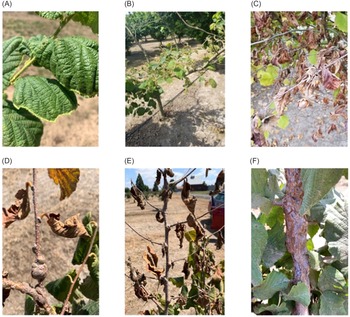
Auxinic herbicides can cause severe crop injury when drifted. We photographed symptoms observed with 2,4-D and dicamba drift in hazelnut to facilitate injury recognition.
Maximum 2,4-D Use Rate
This study evaluated hazelnut sucker control as affected by spray volume and nozzle type and its impact on hazelnut abscission. For further information on sucker control, see de Souza and Moretti (Reference de Souza and Moretti2020). Here we will describe the effect of treatments on hazelnut abscission and quality. The study was conducted in 2017 and 2018 in a commercial ‘Jefferson’ orchard in Amity, OR (42.21°N, 77.99°W). The orchard was located on a Woodburn silt-loam soil (fine-silty, mixed, superactive, mesic Aquultic Argixerolls) with minimal slope, was 10-yr old at experiment initiation, with trees spaced 6 by 6 m and irrigated with a single surface drip line. The sites were maintained weed-free and managed by a commercial farm using standard local practices (Olsen and Peachey Reference Olsen and Peachey2013). Experimental treatments included 2,4-D amine at 1.06 kg ha−1 (Saber®, 456 g ai L−1, Loveland, Products, Loveland, CO 80538) and glufosinate at 1.15 kg ai ha−1 (Rely® 280 SL, 280 g ai L−1, BASF, Research Triangle Park, NC 27709), with both applied as basal-directed treatments four times at 28-d intervals between May and August. This practice mimicked the maximum use rate permitted for sucker control with 2,4-D in hazelnut (Anonymous 1996). An application consisted of a single basal-directed pass to each side of the tree row covering 2 m of width. The 2,4-D and glufosinate treatments included 10 g L−1 ammonium sulfate; 2,4-D treatments included a non-ionic surfactant (Rainier EA, Wilbur Ellis, Aurora, CO 80014) at 0.25% v/v. To study the effect of spray volume, herbicides were applied at 187 and 374 L ha−1 at 275 kPa of pressure with a CO2-pressurized backpack sprayer with four nozzles. Nozzles were positioned so the spray pattern overlapped row middles and covered hazelnut suckers. To evaluate the effect of nozzle type, treatments were applied with extended-range flat-fan nozzles, XR11002 and XR11004 (TeeJet®, Spraying Systems, Wheaton, IL 60187), and with turbo TeeJet® air induction, 11002 and 11004 (TeeJet®), for the 187 and 374 L ha−1 spray volumes, respectively. Manual sucker pruning was performed simultaneously with herbicide treatments as an independent reference treatment. Treatments were applied in 2017 and 2018. The study included four replicates per treatment. Each research plot consisted of eight trees that were each treated as a subsample.
Simulated 2,4-D Drift and Excessive Rates
This study was established in a 10-yr-old hazelnut noncommercial breeding line orchard from the Oregon State University hazelnut breeding program at the Oregon State University Vegetable farm near Corvallis, OR (45.56°N, 123.26°W) and conducted from 2018 to 2020. Trees were planted at 1.5 by 3.8 m in sets of four trees with a 3-m buffer on each side, on a well-drained Chehalis silt loam (fine-silty, mixed, superactive, mesic Cumulic Ultic Haploxerolls) soil under drip irrigation. The field was treated with pendimethalin (6.6 kg ai ha−1) plus glyphosate (1.1 kg ae ha−1) in the winter of 2018 and indaziflam (67 g ai ha−1) plus glyphosate (1.1 kg ha−1) during the dormant season of 2019 and 2020. In late February of each year, hazelnut suckers were pruned flush to the soil surface. All other pest and nutrient management followed standard local practices (Olsen Reference Olsen2013).
The experiment comprised seven basal-directed treatments delivered in four consecutive applications spaced 28 d apart. The number and timing of applications were selected based on the use pattern permitted on the 2,4-D label (Anonymous 1996) and adopted by growers. The applications were conducted between May and August of 2018, 2019, and 2020. The treatments included 2,4-D amine (Saber®, Loveland) at three rates: 1.1, 2.2, and 4.4 kg ha−1. These rates represent 1-, 2- and 4-fold the maximum seasonal use of 2,4-D. Additionally, glufosinate (Rely® 280, BASF) was applied at a rate of 1.1 kg ha−1. A nontreated control was included as a reference. Adjuvants were added according to the methods described in the previous section. Furthermore, two additional treatments were included to simulate drift, explicitly targeting the tree canopy.
Treatment followed the maximum seasonal use of 2,4-D, 1.06 kg ha−1 applied four times as basal direct treatment, plus simulated drift of 2,4-D at 0.011 and 0.11 kg ha−1 (0.06 and 0.6 mg L−1 of 2,4-D). Drift was simulated once yearly in the second half of July when nut filling occurs rapidly (Germain 1992). Simulated drift was included in 2018 and 2019 but not in 2020 to evaluate plant recovery from drift in the following season. Basal-directed treatments and simulated drift were applied at 187 L ha−1 and 275 kPa of pressure using a CO2-pressurized backpack sprayer equipped with four extended-range air-induction 11002 nozzles (TeeJet®). Treatment plots consisted of four trees, and treatments were replicated four times.
Assessments
Fifty and 100 nuts per experimental unit in Amity and Corvallis were marked for monitoring nut abscission, respectively. Nut clusters were located on the outer portion of the canopy at 1.2 to 1.8 m above the ground. Nuts were selected about 30 d before the expected onset of abscission. The nut count was performed every 7 d after marking and every 2 to 3 d after recording the first nut abscission. Plots were harvested 9 (2017) and 13 (2018) times in Amity, and 11 to 13 times each year in Corvallis. Abscission assessments extended for 60 to 70 d yearly.
Plots of both studies were harvested after each assessment event with a push-type nut harvester (Bag-A-Nut®, Jacksonville, FL 32246) beginning in August 2018. Hazelnuts were not harvested in 2017. Whole nuts, including shells and kernels, were cleaned and dried, and weight was recorded for the entire plot at each harvest. The cumulative harvest weight per plot was calculated for each sampling time. Nuts per plot from all harvests were combined, and 200 nuts, approximately 600 to 800 g, were randomly selected for quality evaluations following industry quality standards (USDA 2023). Shells were cracked with a small hammer and visually inspected following standard inspection instructions (USDA 2016). Nuts were classified by defects: blanks−absent kernel, moldy or decayed, and insect injuries or malformed. Kernels not completely developed were classified as undersized. Total defects of any type were combined and deducted from total nuts to be calculated as the percent marketable nuts.
Statistical Analysis
All data analyses were performed using R v. 4.3.0 (R Core Team 2023). Nut abscission counts and cumulative yields were regressed over the cumulative growing degree days (GDD) for the growing season. The GDD value was based on a 10 C minimum temperature threshold and was calculated using the Baskerville-Emin method (Baskerville and Emin Reference Baskerville and Emin1969). Daily average air temperatures were retrieved from the National Oceanic and Atmospheric Administration. Temperature data for GDD began accumulating with the first day of each year. Hazelnut abscission was analyzed with a generalized linear mixed-effects model based on a binomial distribution in the package lme4 using the function glmer (Bates et al. Reference Bates, Mächler, Bolker and Walker2014). The experimental year and treatment were considered fixed effects; the experimental block, a random effect. Statistical effects were compared based on log-likelihood ratio tests and Wald χ2 test using the Anova function in the car package v. 3.1.1 (Fox et al. Reference Fox, Weisberg, Adler, Bates, Baud-Bovy, Ellison, Firth, Friendly, Gorjanc and Graves2022).
The data were fit to two-parameter log-logistic regressions using the drc package v. 3.0.1 (Ritz et al. Reference Ritz, Strebig and Ritz2015), as seen in Equation 1.
 $$Y = {\rm{\;}}{1 \over {1 + {\rm{exp}}\left\{ {b{\rm{\;}}x\left[ {\log \left( {{\rm{GDD}}} \right) - \log \left( {{\rm{GD}}{{\rm{D}}_{50}}} \right)} \right]} \right\}}}$$
where b is the relative slope around the parameter GDD50, which is the number of GDD units required for abscission of 50% of the hazelnuts. The parameters were compared using a pairwise comparison of the compParm function in the drc package.
Hazelnut yield and quality were analyzed in a linear mixed model using R package lme4 and the function lmer (Bates et al. Reference Bates, Mächler, Bolker and Walker2014). The experimental year and treatment were considered fixed effects; the experimental block was a random effect. A three-parameter log-logistic model analyzed the relationship between cumulative yield and GDD for each treatment (drc package). The three-parameter model was selected based on Akaike’s information criterion. Model parameters included the upper yield limit (max), GDD units required to reach 50% (GDD50) of maximum yield, and the slope at GDD50 for each treatment. A pairwise comparison for each parameter was made using the compParm function. A comparison was deemed significant if the P-value was <0.05.
Results and Discussion
Auxinic Herbicide Symptomology
In mild cases, 2,4-D drift in hazelnuts caused symptoms ranging from leaf cupping and crinkling to chlorosis of leaf margins (Figure 1A and 1B). Tissue necrosis and dead limbs were observed with 2,4-D in severe cases (Figure 1C). Only 2,4-D drift at 0.6 mg L−1 resulted in dead limbs. Similarly, dicamba injury symptoms included leaf necrosis, tissue swelling, and cracking (Figure 1D–F). Only dicamba caused tissue swelling and cracking in hazelnuts.
2,4-D and dicamba drift symptoms observed in hazelnuts: (A) leaf cupping and margin chlorosis caused by mild 2,4-D drift; (B) chlorosis and leaf cupping observed following 2,4-D drift; (C) necrosis and limb death observed following severe 2,4-D drift; (D) swelling of tissue and uncontrolled growth following dicamba drift; (E) limb death and tissue swelling after dicamba drift; and (F) hazelnut stem swelling and cracking after dicamba drift.

Maximum 2,4-D Use Rate
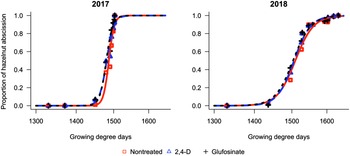
When data from both years were combined into a single data set and analyzed for hazelnut abscission, significant effects of experimental year, GDD, and interaction between herbicide and GDD were observed. When data were analyzed by year, significant effects of GDD and herbicide were noted; the significance of the interaction of GDD and herbicide was noted only in 2018 (Table 1). Only GDD affected yield. The log-logistic parameters were fit independently for each herbicide and year, excluding the carrier volume and nozzle type, as these were nonsignificant factors. In 2017, glufosinate and 2,4-D did not affect hazelnut abscission, as the GDD value required to reach 50% hazelnut abscission was within 7 GDD or fewer of nontreated. GDD50 was estimated at 1,486, 1,480, and 1,479 for nontreated, 2,4-D, and glufosinate, respectively (Figure 2). Nor did glufosinate and 2,4-D affect hazelnut abscission in 2018, as indicated by nut count (Figure 2) and yield, resulting in an average GDD50 of 1,482 GDD and a maximum yield of 6.5 kg nuts plant−1. Treatments did not affect hazelnut yield (Supplemental Figure 1) or quality, with kernel weight averaging 44% of the in-shell weight in 2017 and 42% in 2018 across all treatments. Kernel weights and percent kernel were in line with previously reported values for Jefferson (Mehlenbacher et al. Reference Mehlenbacher, Smith and McCluskey2011). Kernel defects were low in both years, with combined categories falling below 0.5% (data not shown).
Fixed factors for generalized linear mixed model fit by maximum-likelihood logistic regression model for hazelnut abscission in field studies near Amity, OR, USA, in 2017 and 2018.

a Abbreviation: GDD, growing degree days.
b Probability significance (P > χ2) of model factors as: *P < 0.05; **P < 0.01; *** P < 0.001.
Hazelnut fruit abscission over cumulative growing degree days in response to basal treatment with glufosinate and 2,4-D, as well as a nontreated control, in a commercial hazelnut orchard near Amity, OR, USA, 2017 and 2018. The data were regressed using a log-logistic model with three parameters. Parameter estimates can be found in Table 3.

Simulated 2,4-D Drift and Excessive Rates
Study year affected hazelnut abscission and yield response to treatments (P < 0.05). Analysis by experimental year indicates that for abscission and yield, GDD accumulation was significant in all years, and treatment was significant only in 2018 and 2019, when the simulated drift was imposed (Table 2). An interaction between GDD accumulation and treatments was observed for yield in 2019.
Fixed factors for generalized linear mixed model fit by maximum-likelihood logistic regression model for hazelnut abscission, yield, and quality in a multiyear field study near Corvallis, OR, USA, in 2018, 2019, and 2020.

a Abbreviation: GDD, growing degree days.
b Probability significance (P > χ2) of model factors as: *P < 0.05; **P < 0.01; *** P < 0.001.
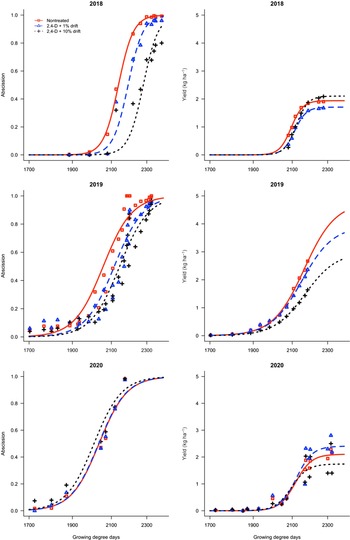
Simulated 2,4-D drift delayed hazelnut abscission in both years (Table 3). In 2018, the GDD50 increased by 54 and 141 units compared with the nontreated control for 0.06 and 0.6 mg L−1 2,4-D drift, respectively, approximately 5 and 15 additional days compared with the control with a GDD50 of 2,138 units. Conversely, GDD50 was not affected by basal applications of 2,4-D at 1.1 (field rate), 2.1 (twice the field rate), or 4.2 kg ha−1 (four times the field rate), averaging 2,143 GDD, or glufosinate (2,143 GDD units). A similar response was observed in 2019, with 2,4-D drift increasing GDD50 compared with the nontreated by 50 GDD units with 0.06 mg L−1 drift and 85 GDD units with 0.6 mg L−1 drift, or approximately 5 and 8 additional days to 50% abscission (Figure 3). The GDD50 of treatments without simulated drift ranged from −17 to +14 GDD compared with the control. Simulated drift was not performed in 2020; nontreated GDD50 was significantly greater than 2,4-D drift GDD50 (0.6 mg L−1). No other treatment affected GDD50.
Regression GDD50 parameter for hazelnut abscission count in response to simulated 2,4-D drift in an orchard near Corvallis, OR, USA, in 2018, 2019, and 2020. a, b

a Abbreviations: Diff, difference to nontreated in GDD to reach 50% abscission; GDD, growing degree days; GDD50, GDD to reach 50% abscission.
b The abscission data were fit to a two-parameter logistic model with a common slope parameter within each experimental year. Significance difference from nontreated control within a column: *P < 0.05; **P < 0.01; ***P < 0.001.
The influence of simulated 2,4-D drift in hazelnut fruit abscission (left) and yield (right) over growing degree days in an orchard near Corvallis, OR, USA, between 2018 and 2020. Data are shown for a nontreated control, a simulated drift of 2,4-D at 0.06 mg L−1, and a simulated drift at 0.6 mg L−1. Data points are the means of four replicates. The data were regressed using a log-logistic model with three parameters. The parameter estimates are provided in Table 4.

Treatment effects on hazelnut yield were less pronounced when comparing regression parameters (Table 4). Maximum yield was not affected by treatments in 2018, ranging from 1.7 to 2.1 kg plant−1. The 2,4-D drift reduced maximum yield by 0.8 (−18%) and 1.8 kg per plot (−37%) for 2,4-D drift at 0.06 and 0.6 mg L−1 compared with the nontreated control in 2019, but it was not statistically different. No treatment effects on maximum yield were observed in 2020. The 2,4-D drift at 0.06 and 0.6 mg L−1 increased GDD50 by 17 and 25 units compared with the control in 2018, but the increase was not statistically different. In 2019 and 2020, no changes were noted in GDD50. The contrast between abscission count and yield might be an artifact of the methodology. The delay in abscission was only observed in tissues directly exposed to the 2,4-D treatment. The volume used (287 l ha−1) for drift simulation covered only the external portion of the canopy where we monitored abscission. However, yield data were collected from the entirety of the tree canopy, including portions sheltered from significant drift treatment, thus masking the drift effects.
Maximum yield (max) and GDD50 parameter for hazelnut yield in response to simulated 2,4-D drift in an orchard near Corvallis, OR, USA, in 2018, 2019, and 2020. a, b

a Abbreviations: Diff, difference to nontreated in GDD to reach 50% abscission GDD, growing degree days; GDD50, GDD to reach 50% abscission.
b The yield data were fit to a three-parameter logistic model with a common slope parameter within each experimental year. Significance difference from nontreated control within a column: *P < 0.05; **P < 0.01; ***P < 0.001.
The average kernel weight (1.72 g kernel−1) was unaffected by the experimental year or treatment. Likewise, kernel weight in relation to nut weight (shell plus kernel) was unaffected by treatment in any experimental year (Table 5). By contrast, 2,4-D drift at 0.6 mg L−1 reduced the percentage of marketable kernels to 72.9% compared with 85.5% in the 2018 control. In 2019, marketable kernels were 75.0% (2,4-D drift at 0.6 mg L−1) compared with 80.5% in the control, but these differences were not significant.
Effect of 2,4-D treatments on kernel weight as percent of total nut weight and proportion of marketable kernels in an orchard near Corvallis, OR, USA, in 2018, 2019, and 2020.

a Means followed by the same letter within a column are not significant different according to Sidak’s test (P < 0.05).
b Significance difference from nontreated control within a column: NS, not significant (P > 0.05); *significant (P < 0.05).
This study confirms that a single simulated 2,4-D drift of 0.06 or 0.6 mg L−1 delayed hazelnut abscission (Table 3). Previous studies have documented that 2,4-D can affect fruit ripening and abscission. Treatment with 2,4-D increased wax apple [Syzygium samarangense (Blume) Merr. & L.M. Perry] flower and fruit retention when applied at 5 to 10 mg L−1 (Khandaker et al. Reference Khandaker, Osman, Hossain, Faruq and Boyce2015). In pear (Pyrus communis L.), 2,4-D and indoleacetic acid inhibited fruit ripening (Frenkel and Dyck Reference Frenkel and Dyck1973). In ‘Temple’ oranges (Citrus nobilis Lour.), foliar treatment with 2,4-D at 18 ppm 6 wk before harvest suppressed fruit abscission, delaying harvest by a month (Zur and Goren Reference Zur and Goren1977). A simulated 2,4-D drift arrested pecan fruit development (Wells et al. Reference Wells, Prostko and Carter2019), and uneven ripening was reported after 2,4-D drift in grape (Haring et al. Reference Haring, Ou, Al-Khatib and Hanson2022; Ogg et al. Reference Ogg, Ahmedullah and Wright1991; Weigle et al. Reference Weigle, Denisen and Sherwood1970).
This study showed that the delay in hazelnut abscission was rate dependent. The simulated drift at 0.06 mg L−1 increased the 50% abscission by 5 d in 2018 and 2019, and the simulated drift at 0.6 mg L−1 delayed 50% abscission by 15 and 8 d in 2018 and 2019, respectively (Table 4). This delay in abscission may increase the chances of harvesting the crop during the rainy season in Oregon, thus increasing the incidence of mold and soil contamination (Pscheidt et al. Reference Pscheidt, Heckert, Wiseman and Jones2019).
The 2,4-D drift at 0.06 and 0.6 mg L−1 did not significantly affect hazelnut yield, but lower yield was observed in 2019, with 18% and 37% yield reduction, respectively, compared with the control (Table 4). The yield of pecan and coffee (Coffea arabica L.) trees was not affected by a simulated drift of 2,4-D (Ronchi et al. Reference Ronchi, Silva, Terra, Miranda and Ferreira2005; Wells et al. Reference Wells, Prostko and Carter2019). Ogg et al. (Reference Ogg, Ahmedullah and Wright1991) reported that 2,4-D drift reduced Concord grape (Vitis labrusca L.) yield (reduction in clusters per shoot and berries per cluster) in the year of the treatment and the following season.
In this study, simulated drift did not consistently affect hazelnut yield or quality. The simulated 2,4-D drift at 0.6 mg L−1 reduced the percentage of marketable nuts in 2018, although the yield was unaffected. In 2019, quality was unaffected, while yield was significantly reduced. In 2020, no differences among treatments were observed, indicating that the simulated drift effects were restricted to a single season in this study.
The timing and number of 2,4-D drift events may also influence the response of hazelnut abscission. Auxin treatments hampered grape ripening, and the greatest delay was observed when 2,4-D and other auxins were applied immediately before veraison (Inaba et al. Reference Inaba, Ishida and Sobajima1974). Repeated applications of naphthalene acidic acid (NAA; a synthetic auxin) caused greater delay of apple fruit abcission than a single application (Marini et al. Reference Marini, Byers and Sowers1993). As labeled for hazelnut, 2,4-D may be applied up to four times per season, up to 45 d before harvest (Anonymous 1996). We expect that drift events closer to harvest would more significantly delay hazelnut abscission for two reasons. First, abscission suppression is rate dependent, and greater 2,4-D tissue concentrations are likely to occur when drift occurs closer to abscission initiation. Second, drier and warmer late-summer environmental conditions may promote 2,4-D drift. Therefore, we recommend that summer applications of 2,4-D to hazelnut be avoided to reduce the chance of drift. Drift-reduction nozzles are effective for hazelnut sucker control (de Souza and Moretti Reference de Souza and Moretti2020). To reduce drift, growers should limit 2,4-D to a single early-spring application and use other herbicides for sucker control after that time.
Supplementary material
To view supplementary material for this article, please visit https://doi.org/10.1017/wsc.2023.43
Acknowledgments
The Oregon Hazelnut Commission supported this work. No conflicts of interest have been declared.