Introduction
Caterpillars of different species are major threats to economically important crops worldwide. Diaphania hyalinata Linnaeus (Lepidoptera: Crambidae) can severely damage Cucurbitaceae species of economic value (Guillaume and Boissot Reference Guillaume and Boissot2001; Gonring et al. Reference Gonring, Picanço, Guedes and Silva2003). This pest may reduce photosynthesis up to 100% leading to heavy yield losses requiring control, including the use of biocontrol agents and insecticides (Pratissoli et al. Reference Pratissoli, Milanez, Barbosa, Celestino, Andrade and Polanczyk2010).
The generalist, gregarious pupal parasitoid Palmistichus elaeisis (Delvare and LaSalle) has potential against caterpillars including D. hyalinata. A single oviposition of this natural enemy allows controlling the vulnerable pupa stage of this pest (Pereira et al. Reference Pereira, Guedes, Serrão, Zanuncio and Guedes2017). Parasitism by P. elaeisis was reported in pupae of different pest species including Eupseudosoma involuta (Sepp) (Lepidoptera: Erebidae), Euselasia eucerus Hewitson (Lepidoptera: Riodinidae) (Delvare and Lasalle), and Dione juno juno (Cramer) (Lepidoptera: Nymphalidae) (Gil-Santana and Tavares Reference Gil-Santana and Tavares2006). Suitable alternative hosts to rear this natural enemy are the yellow mealworm Tenebrio molitor Linnaeus (Coleoptera: Tenebrionidae) (Zanuncio et al. Reference Zanuncio, Pereira, Jacques, Tavares and Serrão2008), and the silk worm Bombyx mori Linnaeus (Lepidoptera: Bombycidae) (Pereira et al. Reference Pereira, Zanuncio, Serrão, Oliveira, Fávero and Grance2009), allowing its efficient mass rearing (Chichera et al. Reference Chichera, Pereira, Kassab, Barbosa, Pastori and Rossoni2012).
Biological control is a priority for sustainable agriculture, however, insecticides are still required (Carmo et al. Reference Carmo, Bueno and Bueno2010), including in vegetable crops in which D. hyalinata is a pest. This may result in negative acute toxicity and sublethal effects on parasitoids (Desneux et al. Reference Desneux, Decourtye and Delpuech2007), requiring their assessment. That is why selective insecticides with reduced impacts on natural enemies and on nontarget arthropods have been sought (Picanço et al. Reference Picanço, Ribeiro, Leite and Zanuncio1997; de Castro et al. Reference de Castro, Corrêa, Legaspi, Guedes, Serrão and Zanuncio2013).
Chlorantraniliprole is an anthranilic diamide insecticide for foliar applications on orchards and vegetables (Brugger et al. Reference Brugger, Cole, Newman, Parker, Scholz and Suvagia2010) efficient mainly against caterpillars (Brugger et al. Reference Brugger, Cole, Newman, Parker, Scholz and Suvagia2010; Smagghe et al. Reference Smagghe, Deknopper, Meeus and Mommaerts2013), such as Diaphania Hübner (Lepidoptera: Crambidae) in Brazil (Agrofit 2018). Chlorantraniliprole acts on ryanodine receptors causing lethargy, muscle dysfunction, paralysis, and feeding cessation (Cordova et al. Reference Cordova, Benner, Sacher, Rauh, Sopa and Lahm2006; Hannig et al. Reference Hannig, Ziegler and Marçon2009).
Selectivity studies with chlorantraniliprole on beneficial insects such as bees (Hymenoptera) (Larson et al. Reference Larson, Redmond and Potter2013; Smagghe et al. Reference Smagghe, Deknopper, Meeus and Mommaerts2013), natural enemies (Campos et al. Reference Campos, Picanço, Martins, Tomaz and Guedes2011; de Castro et al. Reference de Castro, Poderoso, Ribeiro, Legaspi, Serrão and Zanuncio2015; Gontijo et al. Reference Gontijo, Celestino, Queiroz, Guedes and Picanço2015), and insect bioindicators of environmental quality (Rodrigues et al. Reference Rodrigues, Gravato, Quintaneiro, Golovko, Žlábek and Barata2015) provided mixed results. Although harmless to some parasitoids (Brugger et al. Reference Brugger, Cole, Newman, Parker, Scholz and Suvagia2010; Huang et al. Reference Huang, Wu and Ye2011; Liu et al. Reference Liu, Zhang, Gui and Xu2012), there is limited knowledge on the chlorantraniliprole impacts on natural enemies (Huang et al. Reference Huang, Wu and Ye2011) and its subsequent generations. The effect of chlorantraniliprole when combined with adjuvants against natural enemies (Yang et al. Reference Yang, Zhang, Yan, Wang and Yuan2014), especially parasitoids, is also important because these latter compounds are used to maximise insecticide efficacy and may potentially enhance insecticidal impact on nontarget species (Cowles et al. Reference Cowles, Cowles, McDermott and Ramoutar2000; Srinivasan et al. Reference Srinivasan, Hoy, Singh and Rogers2008), which requires attention.
The objective of this study was to assess survival of the pupa parasitoid P. elaeisis and its progeny from hosts treated with chlorantraniliprole used alone or combined with an adjuvant, a nonionic organic surfactant. Offspring quality (F1) was also assessed using insect size as proxy.
Diaphania hyalinata larvae obtained from a laboratory colony were kept in plastic pots (3.0 L) with perforated lids, covered with organza and fed on chayote leaves (Sechium edule (Jacquin) Swartz (Cucurbitaceae)) from egg to the prepupa stage in acclimatised chamber (25±2 °C, 70±10% relative humidity and photoperiod of 12:12 hours). Prepupae were gently transferred with tweezers to plastic pots lined with paper towel until pupation and placed in wooden cages (33×33×33 cm) for adult emergence. These adults were fed a standard diet (nutrient solution; Greene et al. Reference Greene, Leppla and Dickerson1976) placed at the bottom of the Petri dish cage. Pumpkin (Cucurbita pepo Linnaeus (Cucurbitaceae)) leaves, collected from pesticide free plants and placed in plastic pots, were placed inside the cages as oviposition site.
Adults of the parasitoid species P. elaeisis were obtained from a laboratory colony reared in glass tubes (14×2.2 cm) with one honey drop as food in a cotton ball. Tenebrio molitor Linnaeus (Coleoptera: Tenebrionidae) pupae (24–72 hours old) were offered as alternative host to adults of this natural enemy (Zanuncio et al. Reference Zanuncio, Pereira, Jacques, Tavares and Serrão2008). Newly emerged female parasitoids were paired with males (24–36 hours old) for a period of 48 hours before the experiments.
Chlorantraniliprole is registered for Diaphania control in Cucurbitaceae crops in Brazil and its commercial formulation was used in our experiments at its field rate (Premio 200g/L; suspension concentrate; 7.5 mL active ingredient for 100 L of water/ha; DuPont, Barueri Alphaville, São Paulo, Brazil) (Agrofit 2018). The nonionic organic surfactant Agral80 (nonylphenoxypolyethoxyethanol 80%; Syngenta, Holambra, São Paulo, Brazil) was used at the concentration of 0.05%. This adjuvant was selected because of its availability and broad use in agriculture (Coutellec et al. Reference Coutellec, Delous, Cravedi and Lagadic2008).
The treatments were: chrolantraniliprole, chlorantraniliprole+surfactant, and water (control). The D. hyalinata (24 hours old) pupae were immersed for five seconds per solution treatment, dried for two hours at room temperature and exposed for 24 hours to one P. elaeisis female (72 hours old) containing mature oocytes for oviposition (Andrade et al. Reference Andrade, Sousa, Santos, Gama, Serrão and Zanuncio2012) in glass tubes (14×2.2 cm). The tubes were maintained in acclimatised chamber (25±2 °C, 70±10% relative humidity and photoperiod of 12 hours). Twenty replicates were used per treatment. A honey droplet was provided as food source inside the glass tubes (14×2.2 cm) and sealed with a cotton ball. Female parasitoids were recognised based on the morphological characteristics of body size, abdomen width and genitalia peculiarities (Delvare and LaSalle Reference Delvare and LaSalle1993). Host and female parasitoid were individualised in different glass tubes to allow the recording parasitoid reproductive parameters (emergence, total progeny, life cycle duration, female produced, and sex ratio) and the daily record of parental female parasitoid survival. The head capsule width and metatibia lengths were measured as proxies of progeny quality (Ameri et al. Reference Ameri, Rasekh, Michaud and Allahyari2013). Newly emerged females from P. elaeisis exposed to hosts contaminated with chlorantraniliprole alone (n=11), with chlorantraniliprole and surfactant (n=20), and treated with water (n=20) were randomly sampled to perform the head capsule width measurements, which were all performed in the same individuals. From the same progeny cohort, eight, 20, and again 20 newly emerged females from the respective treatments were also sampled for metatibia length measurements. These determinations were performed using a stereomicroscope equipped with an image capture system (MZ 7.5 equipped with a Leica QWin Lite V 2.3 image capture system; Leica, Göttingen, Germany).
Adult survival was followed up until all individuals were dead. Survival analysis using Kaplan–Meyer estimators (P<0.05) was performed using the software SigmaPlot 12.0 (Systat Software, San Jose, California, United States of America). The effect of the treatments on the number of pupa from which at least one parasitoid emerged was performed using generalised linear models in the R software (R Development Core Team 2013) (P<0.05), with emergence as a binomial distribution and the link function logit; Posthoc comparisons were performed by Tukey test using the package multcomp. Progeny total, total female produced and sex ration followed normal distribution and were subjected to one-way analysis of variance with SPSS software (version 25.0; IBM, Armonk, New York, United States of America). As the data on life cycle duration, head capsule width and metatibia length of P. elaeisis progeny (F1) did not follow the assumptions of normality and homoscedasticity, they were subjected to Kruskal–Wallis test (P<0.05) followed by Mann–Whitney test (P<0.05) for intertreatment comparisons, using SPSS software (version 25.0).
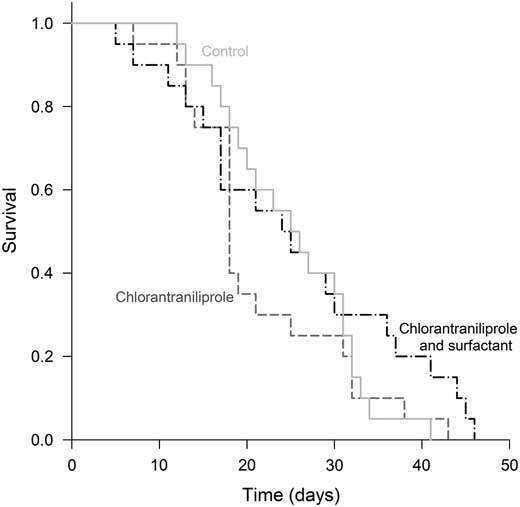
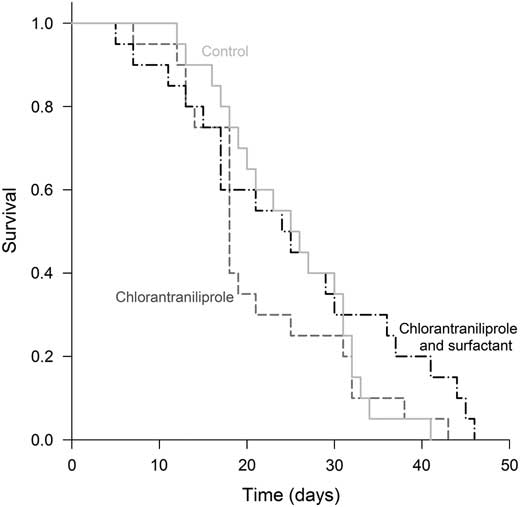
The female parasitoid survival subjected to contact with insecticide-contaminated and uncontaminated hosts did not differ among treatments (Log-rank test, χ 2=2, 377, g.l.=2, P<0.31; Fig. 1). Females survived an average 21.3±2.08, 25±2.8, and 25±1.7 days after exposure to chlorantraniliprole, chlorantraniliprole and surfactant, and water treatments. Therefore, chlorantraniliprole did not exhibit significant lethal toxicity to female parasitoids, regardless of the adjuvant use in the insecticide mixture.
Survival curves of adult Palmistichus elaeisis (Hymenoptera: Eulophidae) females contact exposed to host pupae treated with the insecticide chlorantraniliprole isolated and in combination with a synthetic surfactant.
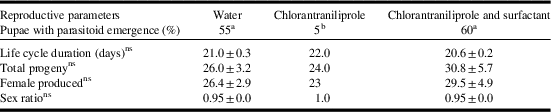
The number of pupae that allowed parasitoid emergence differed among treatments (χ 2 test, P=0.0001). Chlorantraniliprole used alone led to a significantly lower number of pupae with parasitoid emergence compared to control (Tukey test, P=0.012) and chlorantraniliprole combined with surfactant (Tukey test, P=0.007; Table 1). In contrast, the number of hosts untreated or treated with chlorantraniliprole and surfactant that allowed parasitoid emergence was similar (Tukey test, P=0.943; Table 1).
Palmistichus elaeisis reproductive parameters from host pupae treated with water (n=11), chlorantraniliprole (n=1), or its combination with adjuvant (n=12).

Note: a,bMeans with the same letter per line do not differ at 5% probability.
Emergence was assessed by χ 2 test (P<0.05) and statistical significance of each parameter with Tukey test (P<0.05); progeny total, total female produced and sex ration were subjected to one-way analysis of variance (P<0.05) and life cycle duration by Mann–Whitney test (P<0.05).
ns, non significant at 5% probability; ±, ± standard error.
Chlorantraniliprole combined with surfactant and the control provided similar total progeny per pupa (P=0.447), female produced (P=0.447), life cycle duration (P=0.487) and sex ratio (P=0.989), indicating no harmful effect of this insecticide combination on this natural enemy (Table 1). The progeny from chlorantraniliprole alone-exposed females emerged from only a single replicate and it was not included on reproduction assessments performed.
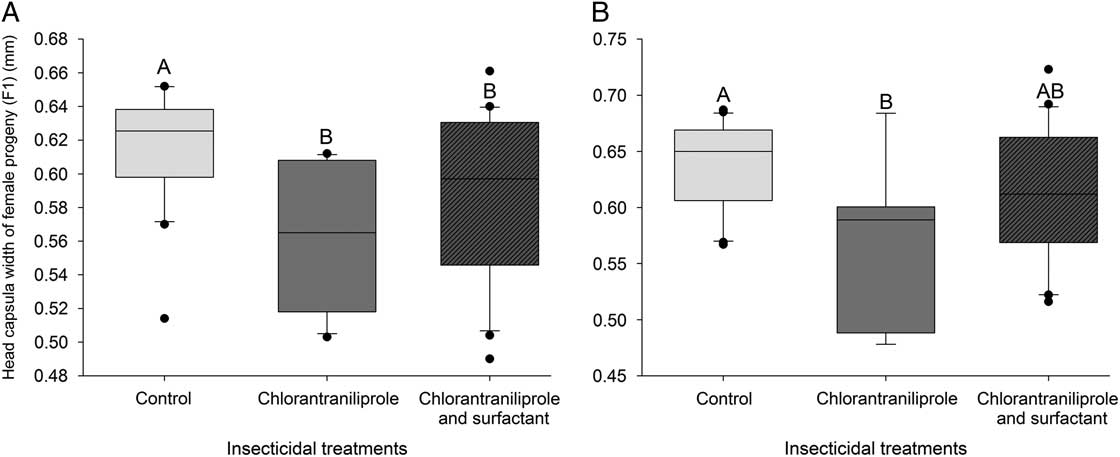
The width of the head capsules of the female progeny varied among the treatments (Kruskal–Wallis test, P=0.002; Fig. 2A). Both chlorantraniliprole and its combination with surfactant reduced the width of the head capsules of the female progeny of exposed adult ones compared to the control (Mann–Whitney test, P<0.001, P=0.035) and did not differ from each other (Mann–Whitney test, P=0.169; Fig. 2A).
Box plot of the median head capsules width (A) and metatibia length (B) of progeny females of the pupa parasitoid Palmistichus elaeisis exposed to chlorantraniliprole. Lower and upper quartiles and extreme values are exhibited, as well as outliers. The box plots topped with the different letters are significantly different by Mann–Whitney test for each pairwise (P<0.05).
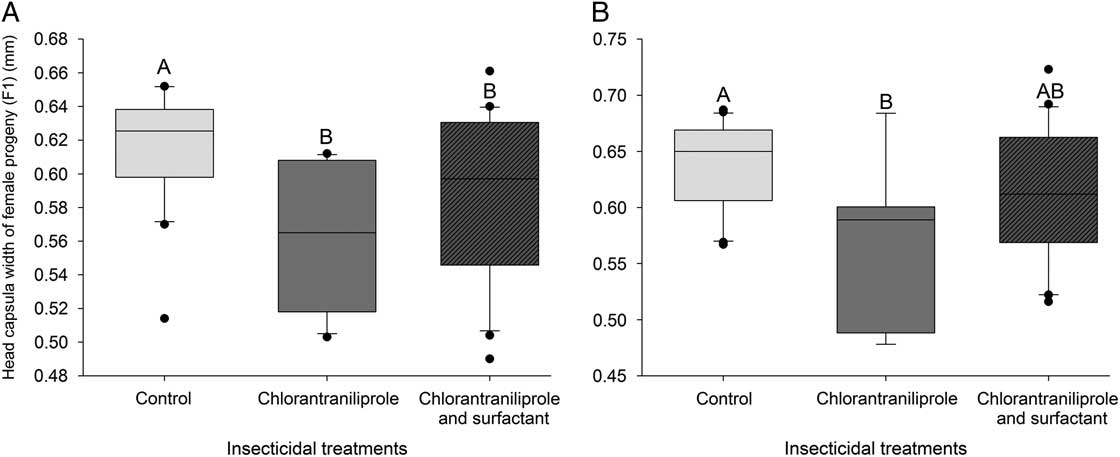
The size of the hind tibia length of progeny was also affected by the treatments (Kruskal–Wallis test, P=0.030; Fig. 2B). Chlorantraniliprole alone also reduced the metatibia length of progeny compared to the control (P=0.013). However, chlorantraniliprole combined with surfactant did not differ statistically from chlorantraniliprole lonely (Mann–Whitney test, P=0.110) neither from the control (Mann–Whitney test, P=0.134; Fig. 2B).
Pesticides with low nontarget impact are crucial in integrated pest management to meet sustainable standards for agriculture production. Thus, the chlorantraniliprole impact and one of its representative adjuvant broadly used in agriculture (Spanoghe et al. Reference Spanoghe, Van Eeckout, Van der Meeren and Steurbaut2004; Coutellec et al. Reference Coutellec, Delous, Cravedi and Lagadic2008) against the pupa parasitoid P. elaeisis were evaluated. The lack of effect of chlorantraniliprole and its combination with surfactant on the survival of P. elaeisis adult parasitoids is consistent with previous studies reporting selectivity of this insecticide to other parasitoids, including Dolichogenidea tasmanica Cameron (Hymenoptera: Braconidae), Diadegma semiclausum Hellen (Hymenoptera: Ichneumonidae), Trichogramma pretiosum Riley, Trichogramma chilonis Ishii, and Trichogramma dendrolimi Matsumura (Hymenoptera: Trichogrammatidae) (Brugger et al. Reference Brugger, Cole, Newman, Parker, Scholz and Suvagia2010). The insecticide–surfactant combination is supposed to improve toxicity to the targeted species, but hopefully not to nontargeted species. Here, chlorantraniliprole combined with surfactant was harmless to the parasitoid and progeny emergence suggesting its safety when used against D. hyalinata with lethality as the toxicological endpoint. This surfactant was also suggested to interfere with plant perception by Liriomyza huidobrensis (Blanchard) (Diptera: Agromyzidae), but it is unlikely to change or block insect olfactory chemoreceptors due to its low volatility (McKee et al. Reference McKee, Levac and Hallett2009), and it did not induce repellence on this insect (McKee et al. Reference McKee, Levac and Hallett2009). An insecticide adjuvant also did not increase the toxicity of three insecticides including chorantraniliprole against a natural enemy and pest species (Yang et al. Reference Yang, Zhang, Yan, Wang and Yuan2014). A possible explanation of the selectivity increase to P. elaeisis with the surfactant could be its antagonistic interaction with chlorantraniliprole. The surfactant Agral 90 attenuated the effect of the herbicide diquat against the snail Lymnaea stagnalis (Linnaeus) (Hygrophila: Lymnaeidae) (Coutellec et al. Reference Coutellec, Delous, Cravedi and Lagadic2008). Howsoever, sub-lethal effects using these surfactants are possible.
Safety to adult females is an important toxicological characteristic of chlorantraniliprole and its combination with surfactant, but their safety to the parasitoid progeny is even more important. Nonetheless, chlorantraniliprole used alone reduced the progeny emergence and body size of the female offspring. The negative effect to the progeny of chlorantraniliprole alone could be explained by the ingestion of residual insecticide from host tissues by parasitoid larvae inside the host pupae. Chlorantraniliprole exhibits systemicity within the insect body and also residual effect allowing the impact on parasitoid via ingestion when feeding in the host (Rhainds and Sadof Reference Rhainds and Sadof2009; Reding and Ranger Reference Reding and Ranger2011). Chlorantraniliprole may also compromise immature mobility leading to feeding cessation (Cordova et al. Reference Cordova, Benner, Sacher, Rauh, Sopa and Lahm2006; Hannig et al. Reference Hannig, Ziegler and Marçon2009), which may have elicited the sublethal effect on the parasitoid progeny. This insecticide also affected other nontarget species, including impairing the development of the nontarget Chironomus riparius Meigen (Diptera: Chironomidae) (Rodrigues et al. Reference Rodrigues, Gravato, Quintaneiro, Golovko, Žlábek and Barata2015), and Bombus terrestris (Linnaeus) (Hymenoptera: Aphidae) after uptake of treated pollen (Smagghe et al. Reference Smagghe, Deknopper, Meeus and Mommaerts2013).
In summary, the isolated use of chlorantraniliprole compromised the emergence and progeny size of the parasitoid P. elaeisis but not adult survival. These findings are not optimum for biological control programmes since, emergence is crucial to maintain a high parasitoid population. Moreover, smaller parasitoid progeny females produce lower egg load, egg size, and number of mature eggs; they can also live shorter and travel shorter distances (Visser Reference Visser1994; Ameri et al. Reference Ameri, Rasekh, Michaud and Allahyari2013), diminishing their chance of mating and finding more oviposition sites. Although selectivity of chlorantraniliprole has been recognised for different parasitoid and predator species (Brugger et al. Reference Brugger, Cole, Newman, Parker, Scholz and Suvagia2010; Broughton et al. Reference Broughton, Harrison and Rahman2014), its effect on the progeny quality of natural enemies has been so far neglected. Our findings indicate that parasitoid emergence and progeny quality may be impaired by chlorantraniliprole, which may compromise its performance as biocontrol agent deserving further attention.
Acknowledgements
The authors gratefully acknowledge the financial support provided by the Conselho Nacional de Desenvolvimento Científico e Tecnológico, Coordenação de Aperfeiçoamento de Pessoal de Nível Superior, Fundação de Amparo a Pesquisa do Estado de Minas Gerais, Fundação de Amparo à Pesquisa do Estado de São Paulo, and “Programa Cooperativo sobre Proteção Florestal/Instituto de Pesquisas e Estudos Florestais”. The authors also wish to thank Roberta Leme dos Santos for the support during the experiments.
Supplementary material
To view supplementary material for this article, please visit https://doi.org/10.4039/tce.2018.49