Introduction
Psychiatric disorders are estimated to affect about 10–20% of children and adolescents worldwide (Levav & Rutz, Reference Levav and Rutz2002). The growing recognition of the mental health needs of children and adolescents needs to be reflected in national plans and policies. In the World Health Organization's guide to policy-makers and planners, prevalence studies are described as one of the first steps towards establishing plans and policies to develop strategies and for improving the mental health of children (World Health Organization, 2005). However, several methodological problems make it hard to carry out nation-wide representative surveys (Costello et al. Reference Costello, Egger and Angold2005); the need for standardized, reliable and clinically plausible diagnoses is particularly challenging. The first national prevalence study of DSM-IV disorders in child and adolescent psychiatry was carried out in 1999 in the United Kingdom with the primary aim of facilitating the planning of British child and adolescent mental services (Ford et al. Reference Ford, Goodman and Meltzer2003). In that study, diagnoses were made by a new diagnostic tool, the Development and Well-Being Assessment (DAWBA), designed to provide practical high-quality diagnoses for epidemiological studies (Goodman et al. Reference Goodman, Ford, Richards, Gatward and Meltzer2000).
Turkey has the youngest population in the European Union region, with about 25 million people aged below 19 years (Turkish Statistical Institute, 2010). The fact that there is no nationally representative prevalence study of child and adolescent psychiatric disorders in Turkey reflects several factors, including a scarcity of child and adolescent mental health professionals, limited resources and lack of suitable diagnostic tools. Given the variety of standardized diagnostic interviews in child and adolescent psychiatry, selecting the most suitable interview is a challenging issue. Since there is often not much difference between interviews in terms of reliability and validity, the choice of an appropriate interview mainly depends on exactly why it is needed and the resources available (Angold, Reference Angold, Rutter and Taylor2002; Angold et al. Reference Angold, Costello, Egger and Lewis2007). As a middle-income country with relatively few specialist mental health workers, Turkey's needs will often be best met by respondent-based assessments that do not need to be administered by expensive clinically trained interviewers (Levav et al. Reference Levav, Jacobsson, Tsiantis, Kolaitis and Ponizovsky2004). The DAWBA is such a respondent-based interview that can be administered by lay interviewers or self-completed online. Its use of open-ended questions increases clinical plausibility of diagnoses, while computer algorithms aid diagnostic decision-making (Goodman et al. Reference Goodman, Ford, Richards, Gatward and Meltzer2000). Another advantage of the DAWBA is the field experiences from a variety of high-, middle- and low-income countries such as United Kingdom, Norway, Israel, Yemen and Brazil with different methodologies which show the usefulness of the tool in practice (Ford et al. Reference Ford, Goodman and Meltzer2003; Fleitlich-Bilyk & Goodman, Reference Fleitlich-Bilyk and Goodman2004; Alyahri & Goodman, Reference Alyahri and Goodman2006; Heiervang et al. Reference Heiervang, Stormark, Lundervold, Heimann, Goodman, Posserud, Ullebo, Plessen, Bjelland, Lie and Gillberg2007; Farbstein et al. Reference Farbstein, Mansbach-Kleinfeld, Levinson, Goodman, Levav, Vograft, Kanaaneh, Ponizovsky, Brent and Apter2010). Considering the advantages of the interview together with the needs and resources of the country, the DAWBA seemed a particularly suitable diagnostic tool for clinical and epidemiologic purposes in Turkey.
Another stand point of DAWBA choice was the advantages arising from the suitability for international usage. DAWBA is currently available in over 20 languages. DAWBA computer programme allows clinicians to obtain structured information from the parents and youths speaking any of these languages without requiring to know that language and also gives the opportunity to see the data and score the interview in clinicians own language (DAWBA Website, 2009). Considering that the Turkish speaking people are the biggest foreigner group spread to many different countries in Europe, having the Turkish form of DAWBA would be a new diagnostic approach for clinicians who work with Turkish-speaking population.
In this study, our aims were: to translate the DAWBA into Turkish and to examine the validity and reliability of the Turkish version. Access to a validated Turkish version of DAWBA would facilitate future prevalence studies in Turkey, making it easier to establish national child and adolescent mental health plans and policies. In addition, the availability of a Turkish DAWBA would allow European clinicians and researchers to gather structured information from Turkish-speaking parents, youth and other informants, and then review that information in their own language.
Method
The study was planned in two stages. The first stage was the translation and adaptation of DAWBA to Turkish and the second was the validity and reliability study of Turkish Version. The approval for this study was granted by the Ethics Committee of the Dokuz Eylul University Faculty of Medicine.
DAWBA
The DAWBA is a package of interviews, questionnaires and rating techniques to diagnose childhood and adolescence mental disorders on the basis of ICD-10 and DSM-IV (American Psychiatric Association, 2000; World Health Organization, 2005). The DAWBA was initially developed by one of the authors (R.G.) for a large British epidemiologic survey, but today it is one of the most widely used diagnostic interviews in child and adolescent psychiatry, currently availability in over 20 languages, and with a decade of experience confirming its validity and usefulness.
The DAWBA is suitable for getting information from multiple informants: parents, youth over 11 years old and teachers. Both paper and computer forms of interviews are available and can be answered directly by informants themselves or administered by lay interviewers. The assessment covers multiple domains of psychopathology, including disorders of anxiety, depression, behaviour, hyperactivity, autism, eating and tics. The assessment of each domain of psychopathology uses screening questions and skip rules to shorten the interviews by ending that section as soon as it is clear that there are unlikely to be significant problems in that domain. By contrast, when the answers to structured questions suggest that there are significant problems, these are followed up with open-ended questions to encourage respondents to describe difficulties in their own words – something clinicians find very helpful when formulating a diagnosis. Each section assesses not only symptoms but the impact of those symptoms, e.g. on social functioning.
Another advantage of the DAWBA is a well-designed computer program. Information from different informants is drawn together and the prediction of likely diagnoses is summarized by this program. Experienced clinical raters make the DAWBA diagnosis in the light of their review of all the data including computer-generated summaries and open-ended comments. It is also possible to collect follow-up information and compare it with initial data. The computer program also allows clinicians and researchers to export data for easy reimporting into statistical programs. Further information on the DAWBA as well as downloadable forms of interviews in many languages and online demonstrations of the clinical rating process are available from the website (http://www.dawba.info).
The translation and adaptation of DAWBA into Turkish
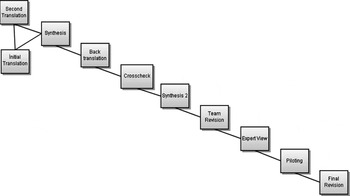
The adaptation process used in the study is summarized in Fig. 1. We conducted a ten-step adaptation model to achieve six dimensions of cultural equivalence that are described in the literature (Bravo et al. Reference Bravo, Canino, Rubio-Stipec and Woodbury-Farina1991; Bowden & Fox-Rushby, Reference Bowden and Fox-Rushby2003; Acquadro et al. Reference Acquadro, Conway, Hareendran and Aaronson2008). These dimensions are (1) semantic (the meaning of each item is to be similar in the language of each culture); (2) content (each item is to assess a content that is relevant to each culture under investigation); (3) technical (a similar effect is to be achieved by the measuring techniques in the different cultures); (4) criterion (the interpretation of the results of the measure is to be similar when evaluated in accordance with the established norms of each culture); (5) conceptual (the same theoretical construct is to be evaluated in the different cultures); and (6) item (all items are to be equally relevant and acceptable in both cultures). A translation committee, consisting of seven child and adolescent mental health professionals who were fluent in English, was formed first. In the first step, a member of this team translated the DAWBA into Turkish. In the second stage, another member reviewed the first translation and suggested improvements. In the third step, whole team came together and reviewed these two translations and combined their best features into a final Turkish version. The fourth step was back-translation into English by a professional translator. In the next step, the equivalence of the back translation and the original English version was checked by the creator of DAWBA (R.G.). In the following two steps, the concerns and recommendations of R.G. were discussed by the translators and, if the concerns could not be resolved, by the whole team. A linguist checked the suitability of the Turkish form before we carried out a pilot study with three administrators on 10 parents, 10 youths and three teachers. The feedback from the informants and administrators were collected and reviewed in the last step.
Summary of the translation and adaptation process.

The validity and reliability study of the Turkish version of the DAWBA
The validity and reliability of the Turkish form of DAWBA were examined in the clinical and community samples. In all instances, the online version of the DAWBA was used. All DAWBA diagnoses were made by the team at the clinic, trained and supervised by R.G.
The community sample consisted of 104 students aged 5–17 years. In Turkey, the official education programs start at an age of 6 years and the first 8 years of education is compulsory. Many of the primary schools also have a kindergarten accepting students of age 5. Three cases from all classes (including kindergarten classes) were randomly selected from two primary schools and one high school from the catchment area of Dokuz Eylül University Hospital. Owing to the differing levels of education and computer literacy, the parent interviews were administered at school by school counsellors who attended a 1-day course on the DAWBA; the interviewers’ role was to read the questions from the online interview and enter the answers. Youths aged 11 years and over completed the interviews individually, either at school or at home according to their preference. Teachers completed the brief DAWBA questionnaires online.
The clinical sample was recruited from the outpatient unit of the Child and Adolescent Psychiatry Department of Dokuz Eylul University Hospital. The first stage of the standard triage procedure in this unit involved two child and adolescent psychiatrists carrying out brief clinical evaluations to identify those children and adolescents with a possible DSM-IV Axis I disorder (subsequently referred to as the diagnosis from the brief clinical interview). Fifty families who had been through the triage procedure were invited to participate in a DAWBA assessment and all agreed. Participating families completed the DAWBA assessment 1–2 weeks later. The parent interview was administered by one of three lay interviewers who had been trained to administer the DAWBA. Youth aged over 11 years completed the interviews themselves in the clinic. The teachers were contacted by telephone and asked to fill in the teacher DAWBA online. DAWBA ratings were blind to the findings of the brief clinical interview.
Validity
The validity of the Turkish DAWBA was examined using two main strategies (Kaplan et al. Reference Kaplan, Bush and Berry1976).
1. Comparing rates of DAWBA diagnosed disorders in community and clinical samples: The underlying rationale is that if the Turkish DAWBA was a valid diagnostic tool, the rate of mental disorders diagnosed with DAWBA in the clinical sample would be much higher than in community sample.
2. Assessing the consistency of clinician diagnosis with DAWBA diagnosis in the clinical sample: The expectation is that the DAWBA assessment and the brief clinical interview should agree on DSM-IV diagnosis much more often than would occur by chance.
Reliability
We also examined the interrater reliability of the Turkish DAWBA. Twenty cases were randomly selected from the clinical and community samples. The chosen cases were scored by two experienced child and adolescent psychiatrists who had been trained as DAWBA raters by R.G. independently. Firstly, one of the raters made the diagnosis for these cases by using all the collected data from different informants on computer. After that, the scores of the first rater were recorded and the rating screens were cleared by a team member. Finally, the second rater, blind to the first raters diagnosis, was asked to score the interviews by the same way. The consistencies of diagnosis made by different raters were calculated to assess the reliability.
Statistical analyses
SPSS 15.0 was used for statistical analyses. To avoid unacceptably small cell sizes, both clinical and DAWBA diagnosis were grouped for statistical analyses in four diagnostic categories; ‘Emotional disorders (anxiety and mood)’, ‘Attention-deficit/hyperactivity disorder (ADHD)’, ‘Behaviour disorders (Oppositional Defiant Disorder and Conduct Disorder) and ‘Other disorders’. Odds ratio was used to compare the rates of mental disorders diagnosed with DAWBA in clinical and community samples. Cohen's κ coefficients were calculated for examining the correspondence of clinician and DAWBA diagnosis and the interrater reliability. The norms proposed by Landis and Koch were used to interpret the κ coefficients. Predictive values and the likelihood ratios of diagnosis were also calculated for clinical sample (Landis & Koch, Reference Landis and Koch1977). A p < 0.05 was considered significant.
Results
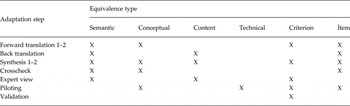
The translation and adaptation phase of the study lasted for 1 year. Semantic, conceptual, content, technical, item and criterion equivalence of the Turkish and original English forms were achieved. The contribution of adaptation steps to equivalence types are shown in Table 1.
Contribution of adaptation steps to equivalence dimensions

The clinical sample comprised 50 cases, 33 (66%) boys and 17 (34%) girls. The mean age was 11.1 ± 3.2 years. Twenty-eight (56%) of the sample were 11 years or older and all of these cases completed the youth interview. We successfully contacted 40 teachers (80%) and 26 completed the interview, representing 65% of those asked and 52% of the clinical sample. The community sample comprised 104 subjects, 47 boys (45.2%) and 57 (54.8%) girls, with a mean age of 11.7 ± 3.7 years. We obtained teacher information for all the cases. Sixty (57.6%) of the cases were 11 years and older and all of these cases completed the youth interview.
The agreement between brief clinician diagnosis and DAWBA diagnosis was found to be good to excellent (κ = 0.43–0.84) for different diagnostic categories (Table 2). The cases that were thought to have any psychiatric disorder by clinicians were also diagnosed by DAWBA with a sensitivity of 90%. The specificity of DAWBA for cases that did not receive any diagnoses in clinical interview was 83%. The positive likelihood ratios ranged between 5.4 and 14, while negative likelihood ratios were 0–0.6 (Table 2).
Comparison of DAWBA and clinician diagnoses

*Confidence interval.
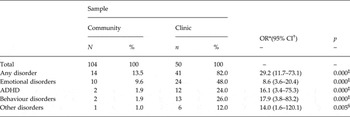
There was a marked difference between the rates of psychiatric disorders diagnosed by the DAWBA interview in the community (13.5%) and clinical (82%) samples; representing an odds ratio of 29.2. The rates and odds ratios for different diagnostic categories are shown in Table 3.
Rates of DAWBA diagnoses in clinical and community samples

*Odds ratio.
†Confidence interval.
‡Chi-square test result.
§Fisher's exact test result.
The degree of agreement between two raters who independently diagnosed randomly selected cases was excellent, with к values ranging 0.85–1 for the various diagnostic groupings.
Discussion
In keeping with previous studies in other languages in a wide range of countries, the results of this study support the validity and reliability of DAWBA (Goodman et al. Reference Goodman, Ford, Richards, Gatward and Meltzer2000; Mullick & Goodman, Reference Mullick and Goodman2005; Alyahri & Goodman, Reference Alyahri and Goodman2006). The validity of the Turkish DAWBA was supported by two main findings from this study. The first one was the substantial agreement between the DAWBA diagnosis and the independent brief clinical diagnosis (made by clinicians during initial triage). The second was the substantially higher rates of psychiatric disorders in clinical sample than in community. Our findings were similar to those from previous studies from other countries. For example, in Bangladesh, Mullick and colleagues reported substantial agreement between the DAWBA and clinic diagnosis with κ values ranging 0.63–0.94; values of 0.63–0.69 were reported in a validation study of the Arabic version (Mullick & Goodman, Reference Mullick and Goodman2005; Alyahri & Goodman, Reference Alyahri and Goodman2006). The interrater reliability was excellent, as for other DAWBA studies (Ford et al. Reference Ford, Goodman and Meltzer2003; Fleitlich-Bilyk & Goodman, Reference Fleitlich-Bilyk and Goodman2004; Heiervang et al. Reference Heiervang, Stormark, Lundervold, Heimann, Goodman, Posserud, Ullebo, Plessen, Bjelland, Lie and Gillberg2007).
Increase in the usage of quality of life measures and conflicting evidences derived from different countries using these instruments triggered the efforts for standardizing the translation and adaptation of health-related questionnaires and measures (Beaton et al. Reference Beaton, Bombardier, Guillemin and Ferraz2000; European Medicines Agency, 2005; United States Department of Health and Human Services Food and Drug Administration and Research, 2009). Translation of an assessment instrument into another language introduces the problem of differences in the conceptual meaning of the problems that need to be tapped. Therefore a careful translation and back translation, as well as possible adaptations of wording to a specific culture, is important (Weisz & Eastman, Reference Weisz, Eastman, Verhulst and Koot1995). Our multistep multidisciplinary adaptation model was mainly based on methods described by Guillemin and Beaton and Mapi Research Institute (Beaton et al. Reference Beaton, Bombardier, Guillemin and Ferraz2000; Acquadro et al. Reference Acquadro, Conway, Hareendran and Aaronson2008). In addition to the steps in these approaches, in our model, all texts that were back translated in English were checked by Robert Goodman, the creator of DAWBA, establishing the equivalence of the translated and original versions. This multistep adaptation format has some advantages and disadvantages. Although using such an approach convincingly establishes equivalence with the original form, it is labour and resource intensive when applied to a detailed interview.
The possible benefits of having generated and validated a Turkish DAWBA are not limited to Turkey. Turkish-speaking people make up the biggest immigrant group in Europe, comprising 2.4 million people, or 7.5% of all immigrants living in the European Union (Vasileva, Reference Vasileva2010). Working with immigrants poses transcultural challenges to clinicians and researchers in Europe, affecting daily practice and clinical trials (BengiArslan et al. Reference Bengiarslan, Verhulst, Vanderende and Erol1997; Koch & Turgut, Reference Koch and Turgut2004). Establishing valid diagnoses in immigrant groups can be complicated by cultural and linguistic issues, increasing the risk of diagnostic mistakes. Mental health assessments depend primarily on accurate enquiry about complex behaviours, emotions and relationships. A review of migration and mental health in Europe reported that most migrants thought that the language problems were underestimated by care providers, and that language difficulties contributed to aggression and paranoia directed towards care providers (Carta et al. Reference Carta, Bernal, Hardoy and Haro-Abad2005). A separate study of Turkish-speaking refugees and migrants with a history of psychosis living in London reported that these individuals were likely to reject contact with non-Turkish doctors. This may have been due to their wanting to avoid the need for someone to translate intimate thoughts and private experiences, or to their belief that cultural aspects of the illness could not be fully appreciated by non-Turkish doctors (Leavey et al. Reference Leavey, Guvenir, Haase-Casanovas and Dein2007). Although linguistic and cultural barriers are hard to overcome, there are advantages to well-translated, culturally adapted self-administrable standardized interviews (Cheng, Reference Cheng2001; Lewis & King, Reference Lewis, King and Lewis2002). With the online DAWBA, a clinician in any country who works with Turkish-speaking people is able to obtain comprehensive information from parents and children by self-administered Turkish forms, while also collecting information from teachers in their own language. The DAWBA computer program allows the clinician to see the data from closed questions in English and shows the likely diagnoses. Such an application will reduce the potential for misunderstanding due to linguistic and cultural differences. By providing clinicians with more accurate information, the likelihood of accurate diagnoses is increased. If respondents provide written open-ended comments in Turkish, these can be potentially be translated by a professional translator (which is likely to be substantially cheaper than hiring an interpreter for the entire interview). Free computer translation is also increasingly accurate.
One limitation of this study is that we did not measure test–retest reliability in order to reduce the burden on respondents. While it would have been ideal to compare DAWBA diagnoses with those from another standardized assessment, and not simply with a brief unstructured clinical interview, this was not possible for two reasons. Firstly, the administration of two lengthy interviews would over-burden families and children and change the reliability of answers in the second administration (Jensen et al. Reference Jensen, Roper, Fisher, Piacentini, Canino, Richters, Rubio-Stipec, Dulcan, Goodman, Davies, Rae, Shaffer, Bird, Lahey and Schwab-Stone1995). Secondly, there was no suitable ‘gold standard’ instrument available in Turkish. While the, K-SADS, is now available in Turkish, it does not cover adolescents and the authors of the Turkish reliability study state that the sample size was insufficient to demonstrate reliability for many disorders (Gökler et al. Reference Gökler, Ünal, Pehlivantürk, Kültür, Akdemir and Taner2004). We preferred to gather information from parents by interviewers rather than self-administrations. This choice may bring the concerns on validity of self-administrations. We had two main reasons for using such a method. Although the computer usage is wide among youth in Turkey, as a developing country, this ratio among adults is highly variable and moreover illiteracy rate of adult females is still 15% (World Bank, 2009). Thus, a method based on self-administrations would exclude a great proportion of the population and cause variations in applications which would be inappropriate for an epidemiologic tool. As DAWBA has a structured manner, the interviewers only read the written texts, types the comments of respondents to open-ended questions and do not give extra explanations on their own. For such a diagnostic tool, clarity seems more important than by whom the texts were read. One of the benefits of comprehensive adaptation and translation method used in this study is obtaining this ‘clarity’, which is a proof of validation of all application types including self-administrations, which would be used by more educated people.
On the basis of the available evidence from this study, the Turkish DAWBA appears to be a suitable assessment tool for both clinical and research purposes in Turkey. This assessment tool may also be useful for clinicians in other countries who study or care for Turkish-speaking populations. By its comprehensive methodology, this study would be an exemplar of validating a diagnostic interview from a foreign language and become a model that other researchers engaged in translating and validating similar instruments may take into account in their work.
Declaration of Interest
The author(s) declare that they have not received economic support and they have no conflict of interest related to the present paper.