

Introduction
Through the methods of Precision Farming in agriculture, a site-specific management of the crop stand becomes possible. Examples of practical technologies in the field of plant protection are the GPS-based automatic boom section control for a reduction of double treatments as well as the computer-controlled adaptation of the application rates. Through site-specific application of plant protection products (PPP), the consumption of PPP can be reduced in the case of heterogeneous distribution of harmful organisms, if the density has fallen below the economic threshold (Nordmeyer, Reference Nordmeyer2006). The economic viability of plant cultivation is increased by the saving of PPP and the pollution of the environment is reduced (Wartenberg, Reference Wartenberg2000). In order to apply different products in one run, tank mixtures with several PPPs have been used, which makes a site-specific application of individual plant protection products impossible. A solution to this problem is provided by field sprayers with direct injection of the PPP.
The idea of direct injection of plant protection products instead of the use of common tank mixtures is already over 30 years old. The advantage of a direct injection system is that there are no residual amounts of spraying liquid, since only clear water is present in the tank, which is mixed with PPP ahead of the nozzle (Walgenbach, Reference Walgenbach, Vondricka, Dörpmund, Xiang and Lammers2011). The field sprayer has actually two separate nozzle lines with one respectively two direct injection systems, to meter the different plant protection products. In order to avoid delay times, the nozzle lines are precharged. On the basis of site specific treatments, herbicides and thus also costs could be saved. An additional advantage is the direct injection making it possible to conduct a site-specific application of individual plant protection products with only one run (Vondricka et al., Reference Vondricka and Schulze-Lammers2009). This can also be achieved with multi-tank sprayers (each device is fitted in a separate tank) (Gerhards and Oebel, Reference Gerhards and Oebel2006), but the residual quantity problem remains unresolved. The use of direct injection systems developed so far has not been possible in practice because long delays occurred between dosing and spraying. When a plant protection product was injected straight into the water stream by direct injection, it took very long to reach the desired concentration at the nozzle. Other problems concerned the metering accuracy as a function of the rheological qualities (elasticity, viscosity, plasticity) of the plant protection product and the ambient temperature, as well as the cleaning of the system and the contamination of the system with rinse water.
In the previous project, a prototype with three independent spray systems was developed and built, regarding to the intensive practice test, the sprayer is reconstructed in the present project to two separate nozzle lines. Test bench measurements for metering accuracy and field tests were performed for the functionality of this prototype.
Materials und methods
A prototype sprayer with direct injection has been developed and built, which is currently trialled in an intensive field test. With this sprayer, test stand measurements for metering accuracy were performed using a fluorescent dye. In a field trial on self-greening, the functionality of the prototype under field conditions was audited in autumn 2014. In the spring of 2015, a field trial was carried out for the use of specific herbicide application in winter wheat (Triticum aestivum L.). At the beginning of the plant protection season 2016, the field sprayer with direct injection is used in intensive field tests, whereby the user friendliness is to be improved.
Description of the developed field sprayer with direct injection
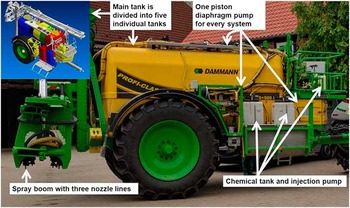
The developed field spraying unit with direct injection consists of three separate nozzle lines, each with an associated water pump, valve and electrically driven direct injection unit. In the following these are spoken of as system I system II and system III. This means that up to three different plant protection products can be applied independently of each other. Since the direct injection pumps, which were purchased from the company Raven Industuries, did not cover all PPP application rates at different working speeds even in partial widths, two different pump sizes were installed in the field sprayer. System I and system II each have a large direct injection pump with a working range of 0.15–5.9 l/min. System III works with a small pump having a range of 0.03–1.18 l/min. Furthermore, the tank of the prototype is divided into four chambers. One chamber is used for the carrier liquid, for system I with 4500 l and for system II with 2000 l volume. Another chamber is equipped with 500 l as flushing water tank (fresh water) and the fourth with a volume of 200 l as rinsing water collecting tank. The prototype is thus comparable to three plant protection devices on one chassis.
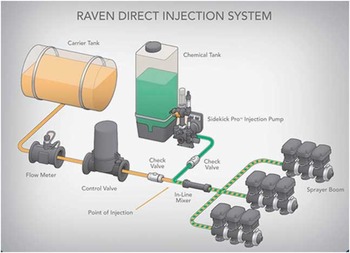
The reason for the division into separate chambers is the opportunity to mix active substances, which are not avaible in liquid formulation. During the development and test phase, the device was equipped with 5 separate tanks and three independent spraying systems in one unit, however now system I and system III are combined for practical use (Figure 1). The minimization of the delay times of the direct injection was achieved by precharging the nozzle lines. For this purpose, the nozzle lines are designed as circulation lines. The return flow is only activated for the precharging of the nozzle line. The water pump constantly supplies water which flows back into the tank via the pressure-relief valve. Before starting the application, the circulation line is opened for a defined time until the desired concentration is reached and the system is thus precharged. When opening the circulation line, water flows through the flowmeter and a signal is sent to the direct injection system which doses the plant protection product as a function of the flow rate of the water and the set dosage value. The rinse liquid generated during precharge up to the desired concentration is conducted into the rinsing water collecting tank and applied to the surface at the end of the application process.When the nozzles are switched on during application, the target concentration is available instantly (Figure 2).
Overview of the field sprayer prototype with direct injection system

Illustration of the field sprayer prototype with direct injection system

Results and discussion
Field test Application accuracy
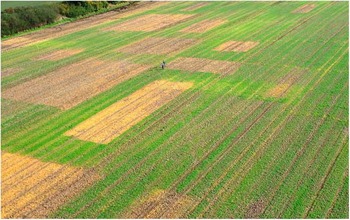
In order to check the application of the direct injection system, a field was divided into several plots and then the field plots were sprayed with different herbicides or remained untreated and application accuracy was estimated. The plots were defined with the aid of GPS, so that an application map could be generated. Based on this map, the prototype sprayer treated the selected plots with two different non selective herbicides. The experiment was designed in a way that different plot combinations with varying plot sizes were possible.
The field plots had a uniform width in the direction of travel, according to the predefined treatment width, which shows that preloading works well and there is no difference in concentration from the boom center towards the boom end. Figure 3 shows the treated plots. The partial overlaps over the plot boundary were very small. The resulting exceedances of the target limits are within the tolerable range, taking into account that a GPS signal without RTK accuracy was used.
Field test for the application accuracy of herbicides with direct injection - aerial image two weeks after application of herbicide treated plots

The effectiveness of the treatment confirmed the dosage accuracy of the direct injection systems. When switching on and off at the beginning or end of the plots, it was found that the field sprayer operated negligeble delay. Therefore it is possible to switch between three nozzle lines, each with its own direct injection system and different PPP without delays, or if required, two or three different PPPs can be applied simultaneously.
Test stand measurements
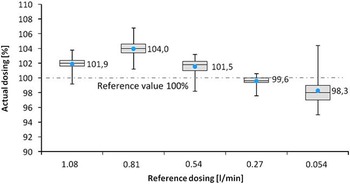
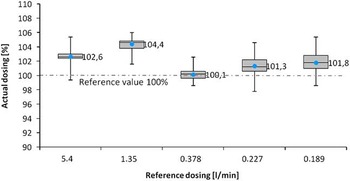
The dosing accuracy of the direct injection units was checked on a test bench. For this purpose, a tracer solution with a fluorescent dye (Brilliantsulfoflavin BSF) was used to detect even smallest quantities by fluorometry. Figures 4 and 5 show the results of the test bench measurement with a direct injection pump. In each case, measurements are made in five different adjustments within the operating range of the pump.
Dosing accuracy at different outputs (l/min) for the small pump with a range of 0.03–1.18 l/min (n=180)

Dosing accuracy at different outputs (l/min) for the large pump with a range of 0.15–5.9 l/min (n=180)

As the results for the small metering pump in Figure 4 show, the deviation of the metering accuracy from the setpoint is no more than 4% on average. The highest deviation (106.8%) of the actual dosing was measured for the pump with the small delivery volume. This is still within the previously defined tolerance range of +/−7% compared to the setpoint, which is indicated by optional sprayer tests. The lowest value (95%) is also within the specified tolerance range. Effectively the test bench measurements show that the tracer solution used is dosed into the water stream with the required accuracy.
The direct injection pumps provide an easy calibration procedure. If this is used for any plant protection product no major problems with the dosing accuracy should occur. This is important because a determination whether all plant protection product formulations can be metered without problems under different environmental conditions only after extensive practical applications.
Intensive practice
The practicability of these systems is expected in the near future. The goal of the current project is the intensive testing of the direct injection system in order to evaluate the functional safety of the system and the effects of a site-specific treatments. An important issue in this context is the optimization of the operability of the prototype sprayer as well as of the electronics. This is of fundamental importance for obtaining the market maturity of the direct injection and the associated introduction to agricultural practice.
The sprayer with direct injection is currently used on a large farm near the JKI location. This measure allows the sprayer, which is in intensive practice, to be further improved and redesigned. It turned out that the cleaning process after each application is an important measure to maintain the operability of the sprayer. The care of the operator plays a very important role. A greater automation of the cleaning process would provide further ease of operation. Furthermore important information from practise is available regarding the user-friendly operation of the complete system. Within the winter half year 2016/2017, the direct injection pumps will be converted to ISOBUS, which would enable direct integration into the control system.
In autumn 2016, post-emergence applications were carried out in four different winter wheat fields. For this purpose, weed occurrence was recorded manually and application maps were created, according to which the areas were treated with plant protection products site-specifically. After application, repeated assessments have to confirm the application success. The field effectiveness of the treatment was assessed by field observations, the results confirm the dosage accuracy. The suggestions for improvements made here will be implemented by Dammann company during the winter period 2016/2017, so that the device can be further tested.
The field tests for measuring application accuracy show that an herbicidal effect has occurred right at the start of a plot over the full working width. This shows that the precharging of the system is working.
Conclusions
The investigations show that the field sprayer prototype with direct injection is capable of applying liquid formulated plant protection products with high dosing precision within the working range of the dosing pumps. The plant protection products can be applied site-specifically and without delay times. The test results and experience so far with the field sprayer prototype show, that practically applicable systems for direct injection without delay times are now possible. Overall, the field trials with the direct injection system has proven to be field-suitable. This allows the weed control to be more appropriate to the situation, which means that herbicides are saved and environmental pollution can be reduced.
Acknowledgements
The project was funded by the Federal Ministry of Food and Agriculture (BMEL) on the basis of a decision of the German Bundestag. The project sponsored by the Federal Institute for Agriculture and Food (BLE) within the scope of the program for the promotion of innovation. We would like to thank the colleagues of the Institute for Application Techniques in Plant Protection and the Institute of Plant Protection in Field Crops and Grassland of the Julius Kühn-Institute in Braunschweig for the support of the experiment.