Introduction
In recent years, linguists have become interested in ‘interactional’ aspects of English: resources which are used as two or more interlocutors dynamically adapt their expression to an ongoing exchange (Biber et al., Reference Biber, Johansson, Leech, Conrad and Finegan1999: 1045). This process occurs mainly in conversation, but it is also an aspect of informal ‘dialogic’ writing. Features such as intensifiers (They sound reallythick), colloquial discourse markers (You know he's likeupset that nobody got killed), and quotative forms (He went, ‘Gran’, and Gran went, ‘Yeah’)Footnote 1 vary so widely and change so rapidly that they have attracted the attention of folk and professional linguists alike, and interesting work now regularly appears in the research literature (see, for example Dailey-O'Cain, Reference Dailey-O'Cain2000, Ito and Tagliamonte, Reference Ito and Tagliamonte2003, Anderson, Reference Anderson2006). My purpose in this article is to offer an initial account of geet/git, a vernacular feature used in North East England. Drawing on data from social websites, I explore the range of functions it performs in discourse. In doing so, I hope to contribute to a developing body of research which considers such features not only in terms of their function, but also as markers of geographical identity (see, for example, Macaulay's work on pure in the west of Scotland (Reference Macaulay2006) and Bucholtz et al. (Reference Bucholtz, Bermudez, Fung, Edwards and Rosalva2007) on hella in Northern California).
In the spring of 2010 – using Google's advanced search capabilities – I found all the publicly available web pages from MySpace and BeboFootnote 2 containing the terms geet or git together with the name of one or more of the main centres of population in North East England: Sunderland, Newcastle, Durham, and South Shields. This geographically-based search protocol helped eliminate such ‘false positives’ as British colloquial English ‘git’ (an unpleasant and annoying person) and ‘geet’ (a transliteration of गीत, the Hindi for ‘song’). The nature of social networking sites, in which participants discuss and make arrangements about their social lives, forge and maintain relationships, and convey aspects of their personality and beliefs, means that the language – though written – is often unguarded, highly informal and, in some respects, speech-like (Hewings & North, Reference Hewings, North, Maybin and Swann2010: 72–3). This combination of factors generates a high density of the kind of features I'm interested in.
I collected 150 examples of geet/git. In speech, the word is pronounced /giːʔ/ or /gɪʔ/ (note that the final consonant is almost always realized as a glottal stop). There is some evidence which points to the pronunciation /giːʔ/ being associated with Tyneside and the north of the region, and /gɪʔ/ with Wearside and the south (Burbano-Elizondo, Reference Burbano-Elizondo2008: 163–4). This variation in vowel length is reflected in the two spellings. Of these 150 occurrences, the spelling <geet> was used eighty-two times and <git> sixty-eight times. From now on I will use geet to represent both spellings of the form. In what follows I provide an overview of geet, based on my examination of this small but fascinating corpus, and conclude with some thoughts on its historical development.
Geet in use
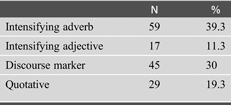
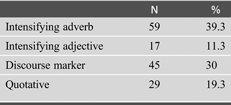
In the corpus, geet is used in four main ways: as an intensifying adverb, as an intensifying adjective, as a discourse marker and as a ‘quotative’. Table 1 gives the frequency of occurrence in each category.
Relative frequency of uses of geet
Geet as an intensifying adverb and adjective
An intensifier modifies the quantity, quality or intensity of the element it accompanies. Ito and Tagliamonte (Reference Ito and Tagliamonte2003: 258–9), drawing on observations from a range of scholars, suggest that intensifiers play a key role in ‘social and emotional expression’ due to the ways in which they allow a speaker to influence a listener's reception of the message by impressing, praising, persuading, insulting, and so on. This makes them a valuable resource in the context of social networking sites, where people routinely engage in dynamic forms of self-display.
Geet is frequently used adverbially to intensify the meaning conveyed in the following adjectival head. In these examples, geet performs an analogous function to items such as ‘really’, ‘very’, ‘completely’, and so on:
(1) aah he's git canny
(2) your songs on here are geet good
(3) its git shite like
(4) am geet bored
(5) am geet excited
(6) ur git hard as owt !!!
(7) im geet lazy
One third of the adjectival heads occurring with geet convey general evaluation, and most of these are positive (e.g. good, canny). A minority, however, are negative (e.g. shite).Footnote 3 Others relate to human cognitive states or characteristics (e.g. bored, lazy). In the corpus, adjectives from other semantic domains are also intensified by geet, including bright, cold, curly, dangerous, drunk, fast, funny, interesting, long, popular.
As with more widespread intensifiers such as ‘very’ and ‘really’, geet can also be used to modify adverbs, although there are only a few examples in the corpus:
(8) i know her bfFootnote 4geet well and that so its canny
More often, geet occurs with verbs which are capable of showing degrees of activity, usually to indicate a high intensity of that activity:
(9) am still recoverin off goin out on thursday nyt lyk am git achein all ova
(10) aye me and shawn git bitch about her in science lyk
(11) lauren [SURNAME]'s fone went ov a was geet creaseing man
(12) all the old ladies were git knocking on the door
(13) i thought id lost you and started geet panicking
Just over eleven per cent of occurrences of geet are as an adjective intensifier. Some signify large size or extent:
(14) had a geet egg on the side of me face
However, most adjectival occurrences have a general evaluative or emotive meaning denoting judgment or emphasis:
(15) i remember the days when u went with renton and i was a geet emo
(16) ill hav 2 ask the geet computer genious that is louise
As an adjective geet occurs only as a premodifier, so that geet life story is acceptable, whereas my life story is geet is not.
Geet as a discourse marker
In thirty per cent of occurrences, geet is functioning as a discourse marker. Its main use is as a highlighting device signalling non-contrastive focus. It can occur before a noun phrase:
(17) Havent seen you in geet ages
(18) i'll get more drunk and spend more than geet £15 on a night out
(19) wasnt drinkn was on geet coke n j2o :| lol
(20) a dunno if u know her she was geet my geet manager in teleclaims
It also occurs before an adverb or adverb phrase, and before a prepositional phrase functioning as subject complement:
(21) No but honestly, I wasnt meaning it git nastily
(22) we go back 2 school in 12 daiis am geet on count down
(23) ha walked past u tonight lol was geet in me shorts nd hat lol
(24) its git about the economy and interest rates and tax and spending and shit
Before a verb phrase:
(25) he git dropped me off at home this morning
(26) i git slept with yay last neet
And also in a verb phrase between the auxiliary and the verb, and between the infinitive marker to and the base form of the verb:
(27) she was git taking pictures nd the camera had the stupid flash on
(28) i was geet working it out in my head
(29) al be geet telling you everything tht he says if he says oot
(30) I'll have to geet send you a copy
Geet can also occur before a subordinate clause:
(31) i start git retreating slowly to where its less rough ahahah
(32) he made me git go out and take pictures of something which is like me
In just one instance it is used to ‘launch’ an utterance (geethave a good day n that like).
As a discourse marker, geet operates in a similar way to like. Indeed, in examples (17) – (32), geet could happily be replaced with like (see Underhill, Reference Underhill1988 for an overview of the syntax and pragmatics of like as a discourse marker). Furthermore, many of the ‘utterances’ in the corpus contain like:
(33) still like git close with grace and then sarah [SURNAME] but shes like year below
(34) they were like asking for a spliff and they were all geet freaks haha
(35) sorry i was git quiet last night like
(36) 17 again isnt geet good like, but its canny
(37) git boring sometimes like
(38) been geet ages like!
(39) I'm still geet poorly like
(40) aye me and shawn git bitch about her in science lyk
In these examples like occurs most often clause-finally: a position not occupied by geet in the corpus. In examples (35) – (40) replacing like with geet would seem to be inadmissible. This restriction is possibly due to the widespread use of like in the North East as an emphatic device in clause-final position (Beal, Reference Beal, Schneider, Burridge, Kortmann, Mesthrie and Upton2004: 136). It is so well-established that innovatory geet seems unable to displace it.
Geet as a quotative
Just as geet and like function in a broadly similar way as focusers, so quotative be geet has certain parallels with quotative be like. In English, reported speech or thought can be introduced in a variety of ways. In recent years, be like and be all have been widely remarked upon in the sociolinguistic literature (see for example Romaine and Lange, Reference Romaine and Lange1991, Tagliamonte and Hudson, Reference Tagliamonte and Hudson1999 and Buchstaller, Reference Buchstaller2006). Be geet seems to be a relatively recent (albeit highly localized) addition to the quotative resources of English, which perhaps developed by analogy with be like. Tagliamonte and Hudson (Reference Thorne1999: 152) outline the evolution of quotative like, which originated in the USA in the early 1980s. They suggest that it was ‘first used for dramatic effect in introducing non-lexicalized sounds as well as encoding the inner thoughts and emotion states of the speaker which may or may not have been actually spoken at the time of the event … and only subsequently spread to direct speech’. In the corpus, be geet performs all the functions identified by Tagliamonte and Hudson.
(41) i was geet ehhhhh
(42) i was git AHH
(43) i was git i have them towels
(44) i was git ohh Shit wer gunna all get fukin killed haahaa
(45) stacey was git ‘wheres me burger then’
(46) eee when we went to tha ballay lol a was git “LOOK AT HIS BULGE HAHA”
In (41) and (42) ehhhhh and AHH could be approximations of the sound made by the writers when the incidents being narrated took place, or attempts to communicate a sense of what they were feeling at the time (which somehow lies beyond words). In (43) and (44) the thoughts rather than the actual words of the writer are probably being reported, while in (45) and (46) it seems – particularly given the presence of speech marks – that actual utterances are being quoted.
Etymology
Where does this intriguing multifunctional feature come from? A connection with Scots gey has been proposed by Beal (Reference Beal, and Milroy1993: 210). The Dictionary of the Scots Language (DSL) records how gey as an adjective can be used to convey approval (‘fine’, ‘excellent’, ‘good’) and size and extent (‘considerable’, ‘good sized’), and as an intensifier it is roughly synonymous with ‘considerably’, ‘very’. There are certainly parallels with geet, as the citations from DSL, OED and Griffiths' A Dictionary of North East Dialect (Reference Griffiths2005) in Box 1 illustrate. In these examples, gey is functioning as an intensifier, and is being used in much the same way as geet in contemporary North East English. The geographical spread and date range suggest that gey arose in Scotland, later spreading to the north of Ireland and northern England. Scotland and North East England share a long history of population movement and other forms of economic and cultural interaction. For example, Mitcalfe (1937, in Griffiths, Reference Griffiths2005: xvii–xviii) points out that in the seventeenth and eighteenth centuries many of the keelmen (who worked transporting coal by boat along the rivers Tyne and Wear) were originally from Scotland and there was a further influx of Scottish immigrants during the exploitation of the Great Northern Coalfield in the nineteenth and twentieth centuries. Gey as an intensifier might have been among their linguistic imports (see Pearce, Reference Pearce2009 for an overview of the sociolinguistic contexts of English in North East England).
Box 1: Gey, gay, gaie, gaye, gie, gy as an intensifier (examples from DSL, OED and Griffiths, Reference Griffiths2005)
a. Your Enemies (of which..yo've had a gay convenient number) (Scotland, 1686)
b. I thought her ance a gay smart lass (Mearns, North East Scotland, 1799)
c. A Lowlander had an occasion to visit Loch Buy, at Moy. “Well, what think you of this spot?” said a gentleman, “Ah! Sir, it is a gaiebonnie place to be out of the world.” (Scotland, 1809)
d. I ken I'm gay thick in the head (Scotland, 1816)
e. We've come, doctor, to ask a gaye queer question (Scotland, 1835)
f. I had taen a gie erly brekfast that mornin' an' I dae think I niver felt as hungry in a' my life (Ulster, Ireland, 1879)
g. I've seen him colloguing with some gey queer acquaintances (Scotland, 1893)
h. Some said she would make ‘a gey good schoolmistress’ (Northern Ireland, 1913)
i. It's that Yard Seam that's troubling them, Paddy. That seam's worried them for a gay long time (County Durham, North East England, 1935)
j. She's gey hard up (County Durham, North East England, 1938)
k. Had he not been gie on edge already, he'd have been smoored among them (North East Scotland, 1952)
l. Fadder hed gay strang views aboot cooken ov a Sunda (Cumbria, North West England, 1978)
m. A lot of big black buildings and a gey smoky environment (Scotland, 1991)
n. So this man gets nearer. Jane goes, maybe he's got lost? I go, must be gy donnert as all the shops and that are down the hill (southern Scotland, 1999)
o. It was gey near the middle ae the day afore he feenished (central Scotland, 2001)
However, if geet is simply a North East ‘version’ of gey how can we account for the change of form? Beal suggests that ‘Scots /ei/ would correspond to Tyneside /iː/, and, since glottalization of final voiceless stops is common in Tyneside, an underlying /t/ may have been added by inference’ (Reference Beal, and Milroy1993:210). The first part of this explanation seems reasonable; the second part less so. An alternative, or perhaps additional, source for geet (which at least provides a more robust explanation for the presence of final /t/) might be a broadly northern form of great with an /ɪ/ or /i:/ vowel, a form reflected in vernacular spellings such as <grit > , <gritt> and <greet>. The Survey of English Dialects attests to this pronunciation in North East England (Orton and Halliday, Reference Orton and Halliday1963: 982), and Griffiths' entry for great includes the following citations from the eighteenth and nineteenth centuries: for a greetwhile; a gritbig bird; greetsurprise (2005: 74). But this still leaves the problem of the missing /r/ in geet. Its absence might be linked to the loss of the Northumbrian ‘burr’, which consists of a ‘uvular realization of /r/: usually a voiced uvular fricative [ʁ], occasionally a uvular tap or velar fricative’ (Wells, Reference Wells1982: 368). This has been receding in North East England, and was perhaps particularly vulnerable when following a velar such as /g/. The loss of /r/ from the initial consonant cluster could also be a consequence of metathesis: some modern dialects have metathetic forms of great which are captured in vernacular spellings such as <gert > , <girt> and <gurt>.
A further reason for linking geet with great is the fact that variants of great have been used as an intensifier across a thousand year time span in England and Scotland (see Box 2). Admittedly though, these examples are not as convincing as analogues of geet as are the examples of gey (for more on gey in Scots and Scottish English see Anderson, Reference Anderson2006).
Box 2: Great, grit, greate, greit, grete as an intensifier (examples from DSL and OED)
a. Quhen this thing was to his Hienes kend, Grit glaid he was (Scotland, 1075)
b. We ar not grit amervellit of this deid (Scotland, 1257)
c. Lodwick he thocht greit lang (Scotland, 1515)
d. Now Ioachim..was a greate rich man (England, 1535)
e. Thys yere was a grete dere yere (England, 1556)
f. Say that he thriue, as 'tis great like he will (England, 1593)
g. Horses that labour great, Are cast in ditches for the Dogges to eate (England, 1609)
h. Great, very; as ‘great much’, very much (Kent, 1736)
i. Great likly, very likely. ‘Ay, ay, great likly, great likly’ (Yorkshire, 1855)
Another question is provoked by the historical evidence. If gey was once an option for intensification in North East England, what happened to it? The Newcastle Electronic Corpus of Tyneside English (NECTE),Footnote 5 which archives sociolinguistic interviews recorded in the late 1960s and early 1990s, does not contain intensifier gey, but there are several instances of geet. So while geet has been used as an intensifier in North East England since at least the 1960s, the latest evidence I have so far uncovered for gey is 1938 (Box 1, example j). One very speculative explanation for the apparent decline of gey and the rise of geet relates to the main twentieth century sense of the adjective gay: ‘homosexual’. It first came into general use in the 1950s (Ayto, Reference Ayto2005: 240) and as this sense became more widespread it might have inhibited speakers from using gey as an intensifier, thus increasing the opportunities for the spread of geet. An additional inhibiting factor might be the widespread tendency for young people since the 1990s to use gay to mean ‘bad, in poor taste, socially inept or unsophisticated’ (Thorne, Reference Thorne2007: 180).
Discussion and conclusion
An outline of the development of geet can be tentatively sketched. At some point in the nineteenth century, probably as a consequence of immigration from Scotland, gey began to be used as an intensifier in North East England, later to be superseded by geet (which is perhaps related to an r-less form of northern great). Gey and geet as intensifiers, as we have seen, are not new phenomena in the North East. But what is new is the way in which people are now using geet as a discourse marker and quotative. Such usages were not uncovered in research undertaken by the Durham & Tyneside Dialect Group in 2001 which formed the basis of many of the most up to date citations in Griffiths' Dictionary of North East Dialect (2005). Therefore it might be reasonable to regard them as innovations of the last ten years or so. The trajectory of development from intensifier to discourse marker to quotative is not unique to geet. Macaulay (2006) records several instances of Glaswegian adolescents using pure not only as an intensifier (as in he's puregorgeous) but also as a focuser (is she purestanding at that windae; she puregies us rock solid hard work now) and as a quotative: I was pure“Naw”; and she's pure“You got it wrong” (275–8). Another vernacular item, which like geet and pure has extended its function from intensifier to pragmatic marker, is hella. Bucholtz et al. (Reference Bucholtz, Bermudez, Fung, Edwards and Rosalva2007: 342–3) in their study of the perceptual dialectology of California, claim that hella – an abbreviation of ‘hell of a’ – is a ‘crucial shibboleth separating the two major regions of the state’. Interestingly, they make no reference to hella as a discourse marker, describing it as ‘a quantifier (There were hella people there) and an intensifier (He runs hella fast)’. But an advanced Google search of MySpace and Bebo for ‘hella’ and ‘California’ reveals ‘utterances’ such as They hellaput off my courtdate too; You hellatook me outta your top 8; You're hellasitting right next to me (in these instances, hella is a focuser, not a quantifier or an intensifier). In May 2010 I could find no MySpace or Bebo evidence for be hella as a quotative, but a broader search did result in a few online examples (e.g. i was hella“oH sHiT!” when i saw it). The research on which Bucholtz et al.'s paper was based was carried out in 2003–2004, so it seems that in seven years hella has expanded its range of functions, and we might predict that be hella will enter into competition with be like as a quotative, at least in Northern California.
Geet, hella and pure differ from more widely used interaction features such as like, really, totally in that they are geographically restricted and therefore capable of acting as markers of regional identity. In the pages I visited in assembling my geet corpus it was striking to see the ways in which non-standard grammar and lexis, together with orthographic accent stylizations, are deployed. Box 3 gives examples of features found in the immediate vicinity of the 150 occurrences of geet in the corpus. One feature particularly worth noting in relation to geet is the use of canny as an intensifier. As an adjective, of course, canny has a long and well-attested history in the North East. It appears in the titles of traditional songs (‘Hi Canny Man, Hoy a Ha'Penny Oot’), it is an epithet for the region's major city (‘Canny Newcastle’), and is often used in the names of shops and businesses (‘Canny Carpet Clean’). According to the OED it is not found before the seventeenth century, having apparently developed from the verb can (‘to know how’, ‘be able’) and/or the derived Scots noun can (‘skill, knowledge’). In Scotland, it is often used to refer to qualities such as shrewdness, cautiousness and thrift; or skilfulness, cunning and wisdom. In the North East, canny is historically associated with approval or approbation (Griffiths, Reference Griffiths2005: 27). Griffiths, while noting adverbial uses of canny, including meanings relating to Standard English ‘agreeably’ and ‘carefully’, does not record any instances of it functioning as an intensifier. But this usage is certainly evident on MySpace and Bebo, with no apparent restrictions on the semantic domains of the adjectives it collocates with: the one you sent me was cannygood like; it was cannycold like; Durham is cannyshit. Canny, like geet, is a relatively recent addition to the resources for intensification in North East English and – as with geet – it will be interesting to track its progress over the next few years.
Box 3: Examples of North East dialect in the corpus

 MICHAEL PEARCE is Senior Lecturer in English Language at the University of Sunderland. Before moving to North East England he was a lecturer in the School of English at the University of Leeds. He has research interests in corpus linguistics, perceptual dialectology and discourse analysis and is the author of The Routledge Dictionary of English Language Studies (2007). Email: mike.pearce@sunderland.ac.uk