I. INTRODUCTION: CAUSATION IN LIABILITY CASES
In order to be justified in court, the imposition of an obligation to compensate must be the conclusion of legal reasoning that contains the following premises: 1) the legitimate interests of the victim were in some way set back; 2) the defendant performed an act or omission subject to liability by the law; and 3) there must be a causal relationship between the harm or loss suffered by the victim and the act or omission by the injurer. These three elements are usually considered to be prerequisites for liability. There is neither liability nor is there compensation for the victim if it cannot be verified that there was some loss, a factor of attribution, and a causal link between the two.
We shall assume, as we do in the previous paragraph, a very basic (and deliberately general) concept of harm; namely, that which is produced when the victim's legitimate interests are in some way set back.Footnote 1 For what follows there is no need to develop this issue any further.
I do not say too much either about the attribution factors. The only thing to bear in mind is that not all behavior is subject to liability. Of all the actions or omissions that can harm the interests of others, only some are set out as legally relevant in terms of the obligation to compensate. Usually, tort law systems include two types of factors of attribution: the so called “subjective factors” are negligenceFootnote 2 and malice. The objective factors can be diverse, but the risk created and the benefit obtained are the most common. The big difference between the subjective and objective factors is not in the blameworthiness of the behavior but rather in its incorrectness. A blameworthy or willful fault is always wrong, while risky behavior, even if it results in liability, is not necessarily a violation of any standard of behavior.
Finally, with regard to causation, leaving aside the conception of causal judgments one is willing to endorse, it should be emphasized that it is a requirement of great complexity. In legal doctrine, the requirement of causation has one purely factual aspect and another normative aspect. Both are clearly distinguishable. When we ask if the agent's action caused the loss suffered by the victim, our question aims at an empirical investigation into how the events occurred and if there is a factual link between them. In the simplest case, the question is whether the agent's action was, in the circumstances in which it occurred, a necessary condition in producing the damage. If this action had been omitted, would the injury have occurred anyway? Of course, answering this question does not only require a knowledge of the circumstances of the case (i.e., the specific historical narrative); we also need to be able to explain the connection between the events (the act or omission and the result) as a particular instance of a general causal law. Only then can we assert the existence of a causal relationship between the defendant's behavior and the harm done to the victim.
This factual aspect of the requirement of causation should not be confused with its normative aspect. When analyzing causation, the lawyers do not limit themselves to verifying the connection that I mention in the previous paragraph; they must also consider legal policy in order to decide whether the result factually linked to the defendant's action can be attributed to him. In general, causal remoteness, unpredictability, or the fact that the action merely anticipated an unavoidable result count as reasons for limiting or eliminating liability, depending on the case. This problem—which in civil law is addressed by the so-called adequate causation doctrine and in common law by the doctrine of proximate cause—has no connection to the causal investigation in the strict sense.Footnote 3
It is important to point out that the three elements set forth here are necessary and jointly sufficient for the obligation to compensate and, by correlation, for the right to compensation. Nevertheless, they are conceptually independent. In other words, the presence of one of the elements does not determine the concurrence of the others. Hence an individual can suffer a loss without anyone being liable for it, for example, because the defendant's action is not included under any existing attribution factors—that is, it is neither faulty nor risky—or, even if it is included, it is not causally linked with the harm. In these cases, at least one of the prerequisites for liability is absent.
These brief, theoretical considerations are an attempt to capture the basic core of the legal reasoning that culminates in a liability judgment. Agreement with this broad outline is essential in order to assess the explanatory capacity of the various different theories. A theory that seeks to explain the purpose of tort liability must specify how these elements relate to a more fundamental principle or set of principles. Hence some theorists argue that the requirements for the obligation to compensate are the legal embodiment of the principle of corrective justice, of a justice between individuals.Footnote 4 In contrast, others have tended toward a more reductionist explanation. Specifically, supporters of the economic analysis of law (EAL) state that all the concepts that are used in the practice can be understood in the light of a single notion contained in efficiency judgments. They believe this is so in the sense that tort liability consists of achieving the best allocation of resources in order to maximize the general welfare.Footnote 5
In the pages that follow, I argue that EAL has never been able to provide a coherent explanation of the causation requirement. The economic characterization of this requirement faces insurmountable difficulties, in my opinion, since discourse on tort liability cannot be reduced to a cost-benefit analysis without a loss of meaning. More seriously, I show that by describing causation in economic terms, EAL theorists offer an image of the practice in which the participants engage in logical contradictions and develop patterns of inference that are far from intuitive. The problem, I argue, is that EAL is committed to a probabilistic concept of causation, which operates ex ante and is forward-looking in character, whereas the concept of causation as it is applied in the law of torts is essentially factual and backward-looking. Since these patterns of reasoning are incompatible, efficiency cannot be the fundamental principle underlying tort law. Finally, I suggest that EAL can provide a genuine explanation of certain aspects of legal practice if it relinquishes its reductionist claims.
II. THE ECONOMIC CONCEPT OF CAUSATION
A. Against the Unidirectional View
From the EAL standpoint, retrospective causal investigation required by tort law makes little sense. If the overall goal of the system is to help increase social wealth by minimizing the number and severity of accidents, it should impose the obligation to compensate on those who are in a position to reduce risks in the future, not on the individual whose behavior is factually related to the occurrence of harm in the specific case. Past losses are unrecoverable losses. At most, liability can transfer the cost of these losses from the victim to the defendant, investing the administrative resources required to do so, but it cannot eliminate them. However, placing the burden of the costs of the accident onto the cheapest avoider will provide incentives to all those who are in similar situations in the future to take the optimal precautions.
Note that creating incentives for efficient behavior does not require us to look into what kind of behavior is factually connected to the harmful outcome. Moreover, the importance of causation can be insisted upon only if we ignore that the problem is reciprocal in nature. Ronald Coase in a classic paper emphasizes that in economic terms, the unidirectional view of causation—where one individual is the injurer who harms another individual who is the victim—is quite naïve.Footnote 6 In the case of two individuals performing incompatible activities, the law must choose between protecting one or the other. Choosing to protect the first is the same as allowing harm to the second, and vice versa.
To illustrate this, imagine that Axileas is a trombone teacher and teaches private lessons at his home early each morning. His neighbor, Xenophon, works the night shift in a museum and so spends much of the day sleeping. The activities of the neighbors are obviously incompatible, because the trombone lessons given by Axileas prevent Xenophon from getting adequate rest. The unidirectional view of causation would say that Axileas causes harm to Xenophon. At the same time, it would be difficult to claim that Xenophon harms Axileas by sleeping. However, according to Coase, it would be a mistake to infer from this that Axileas should be held liable in order to avoid harm to Xenophon. The state's decision in such circumstances will necessarily affect one of the two individuals. If Axileas is allowed to continue with his trombone lessons, Xenophon will suffer. In contrast, if Xenophon is protected by prohibiting Axileas from playing music in his house, it will be Axileas who suffers. Causation is irrelevant in these situations: in contrast to what the traditional approach suggests, we cannot identify, as such, an injurer and a victim via a causal direction. To put it another way, given that any decision regarding liability will always harm one of those involved, neither of them can strictly be considered as “causing” the loss. It is up to the state to decide whom to harm, and this decision cannot be taken without assessing what is gained and what is lost with each alternative.
Thus, according to EAL, when Xenophon sues Axileas for damages caused by the trombone lessons, the judge should not investigate whether Axileas produces an unreasonable noise which prevents Xenophon from sleeping. Instead, the judge should try to identify the benefits and costs arising from holding either Axileas or Xenophon liable. If it turns out that both Axileas's classes and Xenophon's sleep produce benefits to society, but the cost of soundproofing Axileas's home is $100 and the cost of earplugs for Xenophon is $20, wealth is maximized when Xenophon is denied the possibility of compensation. In this case, Xenophon will invest $20 in earplugs and this will maximize the aggregate wealth. The loss suffered by Xenophon is reduced to the lowest possible cost when he is given the incentive to take precautions rather than Axileas. The distributional issues, that is, the fact that it is Xenophon who must spend money on prevention rather than his neighbor, are independent of the efficiency issues. Tort liability covers only the latter. Perhaps some other branch of law, such as taxation law and public spending laws, may deal with the former.
In conclusion, causal direction need not play any role in decisions relating to liability. The decision should be made by taking into account the incentives generated for injurers to take efficient precautions in the future; and to this end, the law should consider that the lack of soundproofing (or the lack of earplugs in some other cases) is the cause of the harm. Only in this way will the expected value of the losses be minimized.
In a similar vein, the most important studies concerning the economic analysis of tort liability assume that the requirement of causation as it is traditionally understood is an obstacle to minimizing the cost of accidents. Almost at the same time that Coase published his work, there appeared an article by Guido Calabresi that adopts the same approach.Footnote 7 Subsequently, in The Costs of Accidents, Calabresi explicitly speaks out against what might be called the relational view of tort liability, where the obligation of the injurer and the right of the victim are invariably correlated by the causal relationship linking the action of the first with the harm suffered by the second. In Calabresi's view, it is simply a well-established myth that the costs of accidents should be assigned to either the injurers or the victims. In his view, there are no economic reasons to limit the allocation of losses to one of these two groups. As he says, “there are virtually no limits on how we can allocate or divide the costs of accidents.”Footnote 8
This implies a radicalization of the economic point of view: not only does Calabresi argue that the traditional concept of causation should be replaced by a paradigm of reciprocity in which we cannot make a distinction between the injurer and the victim according to how they intervene in the events in question; he goes much further and adopts an understanding of accidents as a social problem.Footnote 9 At this point, anyone who is in a position to avoid, in the cheapest way, the loss that Axileas causes Xenophon can be held responsible. This will give all agents the proper incentives that will ultimately minimize the social costs.
Obviously, a theory of tort liability that denies the importance of causation will not be very intuitive for lawyers. For this reason, in 1975 Calabresi published the article “Concerning Cause and the Law of Torts: An Essay for Harry Kalven, Jr.,”Footnote 10 which is specifically devoted to the analysis of causation and which to a certain extent moderates some of his previous ideas. In this article, he attempts to determine which economic functions can be satisfied by the requirement of causation as it is used in legal reasoning. It is well known that Calabresi believes tort law can meet several goals.Footnote 11 Although the requirement of factual causation does not fit perfectly into any of these goals, he concludes that the persistence of this requirement is explained by its malleability: causation is a flexible concept that can be used to pursue a number of purposes.Footnote 12 This allows tort law to adapt to new circumstances while retaining the language of the past, thus reducing the negative consequences of resistance to change.
For the purposes of my argument, rather than explaining why causation is not wholly functional for all objectives of tort law,Footnote 13 it might be better to examine why this requirement is not a necessary contribution to the goal of reducing the number and severity of accidents. Note that making the incentives of the injurer depend upon whether he factually caused the result is not the only way (nor, perhaps, the best way) to maximize wealth.
Calabresi distinguishes two ways of reducing what he calls primary costs, derived from the number and severity of the accidents that take place. One is specific deterrence and the other is the market method. Specific deterrence comprises a social or collective judgment about what activities are worth penalizing. When an activity is considered to be more risky than beneficial, it is simply prohibited or restricted in some way. The market method, however, includes the cost of the accident in the cost of the activity and delegates the decision on which activities should be performed onto the agents. Individuals make these decisions by themselves, taking into account the expected costs they may face in the form of compensation. This method is based on the idea that a price can be put on various activities. That said, if specific deterrence were the only objective of tort liability, then risky actions would be penalized regardless of whether any harm was actually caused in each particular case, and, therefore, the requirement of a factual connection to the harm would become superfluous.Footnote 14 On the other hand, from the market-method stance, the function of the factual causation requirement is to ensure that the agent is imputed with only the costs generated by his actions, so that a proper analysis can be carried out to determine what harms should be avoided. The legal disputes that arise help to build up a useful actuarial basis for this calculation.
This, as Calabresi recognizes, is not the only way to develop an actuarial basis of this type; therefore the requirement of causation is not essential in tort law. In his opinion, a far more economical way to achieve the same result is by a random sampling of the expected costs associated with certain activities. The question of which of these will be the most efficient alternative will depend on the administrative costs associated with them.Footnote 15
So far, EAL theorists seem unable to find a solid economic foundation for the doctrine of causation that provides an explanation of the practice recognizable by lawyers. This changed to some extent with the model developed by Steven Shavell, in which he argues that the requirement of causation plays an essential role in limiting the scope of the agents’ liability in order to prevent the disappearance of certain socially valuable activities.Footnote 16 I analyze this model in the following section.
B. Limitation of Liability
Shavell, like Calabresi, begins with an instrumentalist approach to causation. What is perhaps new in his approach is that he asks no questions about the direct impact of the requirement of a factual link on the incentives for an injurer to take action. Instead, Shavell notes that the requirement of causation produces the immediate effect of limiting the scope of liability. The agents have the obligation only to repair some of the losses resulting from their actions, and this can be positive for two reasons. First, limiting the scope of liability reduces the administrative costs associated with the use of judicial processes dealing with compensation. Second, the limitation of liability can have positive economic effects whenever a broader scope of liability would create incentives for people to abandon socially beneficial activities.
The first idea is that the principles of causation can be used to reduce the costs of administrating the tort liability system. However, it is clear that limiting the scope of liability will cause the injurer to lose some of his or her incentive to behave responsibly. In such circumstances, there would be less reason to avoid causing certain types of loses that might otherwise be avoided. In the end, the efficiency of reducing the scope of liability in this way will depend on the extent to which the cost of the losses caused by the measure does not exceed the savings in the cost of administration. An optimal system would try to find a balance between these two factors.Footnote 17
The second idea—preventing socially valuable activities from being abandoned—is, according to Shavell, easier to understand under rules of strict liability but is also relevant under fault-based rules. Let us consider a company that uses a carcinogenic substance in its production process that is essential for the production of the specific product. Suppose that the production and sale of the product are socially beneficial or efficient. However, with full liability rules, the company would be obliged to compensate every employee who developed cancer, which could, in turn, lead to the company terminating the production and sale of a product that was socially valuable and valued in the market. In this context, the principle of causation can be used to limit the scope of liability to those losses that are a consequence of the company's activity. If this principle is not applied, the company would be forced to overcompensate in excess of its actual contribution to causing cancer in its employees. Shavell's thesis is that the requirement of causation, used in this way, will maximize social wealth by preventing some activities from having to pay the costs generated by others.Footnote 18
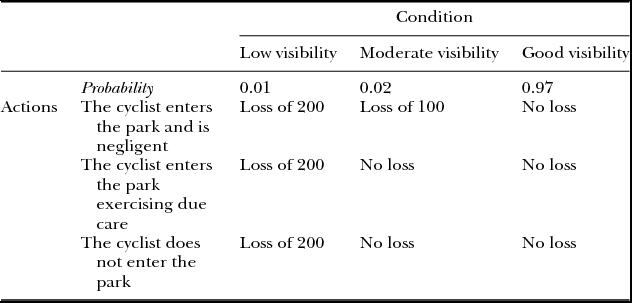
In order to analyze this idea in a little more detail, let us look at another of the many examples Shavell discusses. Suppose a cyclist, upon entering a park, collides with a jogger. Suppose also that the jogger would have suffered the same injury in any case by, for example, colliding with the branch of a tree rather than with the cyclist, and would have suffered an identical injury. This situation is illustrated in Table 1 below. In a low-visibility context, no matter what the cyclist does, there will always be a loss (valued at 200). In contrast, when visibility is moderate, the cyclist has some control over the damage caused. Finally, in conditions of good visibility, no loss will occur (assuming, of course, that the cyclist does not behave maliciously).

Note: the cost of precautions is 1 and the benefit the cyclist obtains by going into the park is 2.5.
In conditions of poor visibility, according to Shavell, we would not say that the cyclist factually caused the result when he entered the park (E) and injured the jogger, because the results (RE) of his entering the park are identical to the results of his not entering (R¬E).Footnote 19 The point is that if a result remains constant with respect to an action and its omission, neither the act nor the omission can be a contributory condition for that result. The absence of a factual link is therefore reason enough to reduce the scope of liability. Otherwise, if the agent is obliged to repair the damage produced in all three conditions, the end result will be inefficient. To test this, the expected values of all the actions are compared in order to determine whether the cyclist would opt for one that produces the highest social benefit in the context of a full-liability system.
With the data in Table 1, the expected value of each action is as follows.
a) The cyclist enters the park and is negligent: 2.5 − (0.01). (200) − (0.02). (100) = −1.5.
b) The cyclist enters the park exercising due care: 2.5 −1 − (0.01). (200) = −0.5.
c) The cyclist does not enter the park: − (0.01). (200) = − 2.
Obviously, the best result occurs when the cyclist enters the park exercising due care. This minimizes the expected value of the loss. The idea is very simple: in a scenario in which there will be a expected loss of 2 (i.e., 200 at a probability of 0.01), the activity of the cyclist adds a net profit of 1.5 (2.5 profit minus 1 for the precautionary measures), which decreases the expected harm of 2 to 0.5. Nevertheless, if the agent were to be held responsible in all scenarios, he would not enter the park, because if he does, he faces expected losses of 0.5 if he rides with due care or 1.5 if he is negligent. In any case, given that the cyclist must decide whether or not to enter the park before finding out what the conditions of visibility are, he would maximize his individual welfare by not cycling in the park at all.
But, as we have seen, the cyclist's activity is socially valuable. In what way can the cyclist be encouraged to enter the park with due care? Shavell points out that we will achieve exactly this result if—using the principle of factual causation—we exclude from the scope of liability those situations in which cycling with due care and not cycling cannot reduce the value of the loss. With this restriction, the expected value of each course of action to the cyclist is as follows:
a) The cyclist enters the park and is negligent: 2.5 − (0.02).(100) = 0.5
b) The cyclist enters the park exercising due care: 2.5 −1 = 1.5
c) The cyclist does not enter the park: 0
These new values would encourage the cyclist to enter the park exercising due care. Therefore, limiting the scope of liability via a requirement of (but-for) causation generates incentives in the agent to behave in a way that is more beneficial to society. The expected loss that society faces will be 2 in any case. The careful cyclist produces a benefit of 1.5, thus reducing the social losses to 0.5. Hence the importance of protecting the activity of cycling. The law should provide the necessary incentives to stop cyclists giving up their activity, and this can be easily accomplished, as mentioned above, by the principle of causation. Broadly speaking, this is Shavell's main argument.
This model has received strong and varied criticism.Footnote 20 I focus, however, on three issues (two of which are related) that, in my view, undermine the explanatory purpose of this economic interpretation of the requirement of causation.
The first problem is that the plausibility of Shavell's first example is not shared by his second. There is a clear structural difference between the case of the company that uses a carcinogenic substance in its production and the case of the cyclist and the jogger.Footnote 21 The company could argue that the substance to which workers were exposed made no difference in all cases of cancer that occurred, and this argument would be interpreted as a defense based on the lack of a causal link between the injury to the victim and the injurer's actions. The court, faced with an argument like this and regardless of who needs to prove the relevant facts, will attend to the plaintiff's case only if exposure to the substance was part of the instantiation on the particular occasion of a fully instantiated set of conditions that was minimally sufficient for the occurrence of the injury (in this case, cancer). If it can be proved that that the injury resulted from a cause other than exposure to the toxic substance, the victims would have no right to compensation because there would be no causal relationship: the toxic substance would not be part of a fully instantiated set of conditions that was minimally sufficient for the occurrence of the injury.
In contrast, the case of the cyclist provides us with an example of what we might call causal preemption.Footnote 22 In this case there is a factual link between the injury suffered by the jogger and the action of the cyclist. It can be argued that the cyclist preempts the injury the jogger would suffer anyway, but there is no plausible argument for saying that for this reason, the cyclist was causally irrelevant. It was the cyclist who injured the jogger. The branch that the jogger would have collided with would have caused the injury if the cyclist had not entered the park.
This case, unlike that of the carcinogenic substance, is analogous to those cases in which an individual shoots someone in the head who is already fatally wounded but not yet dead. No one would doubt that the last shot is the cause of death, even though all it really does is to hasten an inevitable result. This is not so with the carcinogenic substance, since it does not preempt a result that is necessarily going to happen. In those cases where the cancer is produced by the involvement of other factors, the toxic substance never comes into play. Thus, one of two things will have taken place: either 1) the exposure to the toxin did not contribute to the injury in any way, and therefore it is incorrect to say that it is a cause of the outcome, or 2) the exposure to the toxin contributed to the result (albeit in a duplicative or preemptive way), in which case the injurer's liability will depend on the tortious or nontortious nature of the other contributing conditions.
If we accept that the examples are structurally different, we must now accept that imposing an obligation on the company to compensate all cases of cancer—those the company caused and those it did not—would be an error, since causation is a necessary requirement for liability. That is why absolving the company of liability in some cases using the principle of causation simply rectifies what would have been an error of attribution. In contrast, absolving the cyclist of liability does not involve the correction of any error of causal attribution. The actions of the cyclist are a necessary element of the fully instantiated set of conditions that was minimally sufficient to produce the result. The branch of the tree that hypothetically would have harmed the jogger is not in the same category. It is not part of any fully instantiated set of conditions that was minimally sufficient to produce the injury; therefore it cannot be considered one of the causes.
In conclusion, Shavell's model is unable to reconstruct, in a satisfactory way, the requirement of causation. A more charitable reading would ignore the examples that are similar in structure to the case of the cyclist and concentrate on those comparable to that of the carcinogen substance. After all, the economic logic of causation decisions in such cases is quite solid. That is, one might object to Shavell having picked a bad example, but this does not imply that the theory is wrong. The problem with this is that in economic terms, the two cases discussed are identical even if, in the eyes of the lawyers, they differ substantially. This means that the principles of causation do not guarantee that the scope of liability will be restricted when efficiency so requires. What, then, explains the importance of factual causation in the typical inferences made by courts? EAL theorists appear once again to leave this question unanswered.
A second issue, related to the previous one, concerns the definition of loss implicitly assumed by Shavell. In his example, it is assumed that the cyclist or the branch will produce the same injury (thus each event is designated with the same probability of causing a loss valued at $200). Nevertheless, as noted by Mario Rizzo, we must distinguish between the resulting economic loss and the event that generated the loss. Suppose, says Rizzo, there is an operation that is undertaken with due care but nevertheless carries a probability of 0.01 that the patient will become blind in one eye. Suppose that this loss has a value of $50,000. Let us say that the same operation can be performed too quickly, that is, negligently, but that this in fact eliminates the risk of blindness, which depends on the length of time the patient is anesthetized. However, this haste brings new risks: 1) a risk of paralysis in one leg, with a probability of 0.01 and an estimated loss of $50,000; and 2) a risk of death during surgery, with a probability of 0.02.
If the doctor performs the operation negligently and the patient suffers paralysis, can it be argued that the negligence did not cause the injury because in any case the patient faced a 0.01 probability of an injury of $50,000? If the result of due care is the same as the result of negligence, that is, if RN = R¬N, how can it be said that negligence (N) is the cause of the injury?Footnote 23
Shavell's arguments gain whatever plausibility they may have only because of how he interprets what constitutes the result of an action. The cyclist's action of entering the park (with or without due care) produces the same result in terms of economic loss as his not entering the park at all. But in each of these events that generate the economic loss, the results are different. Shavell tries to avoid this objection by assuming that the cyclist and the branch would produce identical injuries. However, quite apart from the fact that such assumptions end up being too unrealistic to be used as a model in the practice of law,Footnote 24 it needs to be said that from the economic point of view, it is irrelevant whether the injury is the same. In order to limit liability efficiently in the example of the cyclist, the value of injuries must be the same. Shavell merely adds that both events produce similar injuries so that the analysis is acceptable to lawyers. Would different conclusions be drawn if we assumed that the cyclist causes a loss of $200 because the jogger tears his calf muscle, while the branch causes a loss of $200 by causing him a sprained ankle? And since the quantitatively measured loss is inevitable, would the principle of efficiency not require releasing the cyclist from liability anyway? If this is so, maximizing wealth requires the application of the same principles that limit liability even if the events that generate the loss are different. This shows, from another perspective, that Shavell's reconstruction is unable to account for the role of factual causation in the attribution of legal liability.
The last point I want make concerns the inconsistencies in the assumptions Shavell makes in his theory.Footnote 25 The example of the cyclist is an attempt to illustrate that restricting the scope of liability can be useful in preventing people from abandoning socially beneficial activities. This requires, among other things, that the following conditions are met: 1) that the courts have perfect information about the expected values for each possible state of the world; 2) that the agents also have perfect information, so that they find that taking efficient precautions is beneficial for them, and 3) that no mistakes are made by the courts in their assessment of the agents’ liability nor by the agents when deciding what to do.Footnote 26 If any of these conditions are not met, then limiting liability would not bring the desired beneficial effects.
Unfortunately, in Shavell's explanation, these assumptions—which are essential in his analysis of strict liability—become problematic when it comes to making intelligible the requirement of causation in fault-based liability. When the rules governing the activity of an injurer are fault-based, there is no need to restrict the scope of their liability in order to prevent people from abandoning socially valuable activities. This is because once the requisite of due care is satisfied, the agent is no longer responsible for any loss he causes. Therefore, no further incentives are necessary for him to carry on doing the activity. In the example above, if it were a fault-based system, the cyclist would have to choose from the following options:
a) The cyclist enters the park and is negligent: 2.5 − (0.01). (200) − (0.02). (100) = − 1.5
b) The cyclist enters the park exercising due care: 2.5 − 1 = 1.5
c) The cyclist does not enter the park: 0
Obviously, the cyclist will choose to enter the park exercising due care, and to achieve that result we do not need to exclude any possible state of the world from the scope of his liability. But that is not all. As Shavell himself acknowledges, restricting the scope of liability may even bring negative consequences, since it would increase the incentives for agents to engage in inefficient activities (in which the private benefit is less than the cost imposed on others) and, conversely, reduce the incentive to take the appropriate precautions.Footnote 27 So, what explains the limitation of liability under a fault-based system? For Shavell, the only explanation is to recognize that an element of strict liability is inherently present in fault-based liability—that even under fault-based rules, some injurers who act with due care will still be found at fault by the courts. Judges can make errors in the formulation of the standard of due care or in the reconstruction of the facts of the case. In turn, the injurers may be mistaken with regard to the level of care they take. Once these factors are introduced, Shavell argues, meeting the standard of due care is not enough to free oneself from responsibility, which is why both types of liability end up resembling each other considerably. Consequently, the analysis of strict liability becomes relevant to the study of fault-based liability.Footnote 28
This leap, of course, can be taken only by forsaking the assumptions mentioned above concerning perfect information and error-free courts and agents. Put differently, since we cannot simultaneously accept the assumptions that are required to analyze strict liability and those required to analyze fault-based liability, Shavell's explanation now requires that we accept that judges can make mistakes but that this does not affect the efficiency of decisions to restrict the scope of liability in strict liability regimes.Footnote 29 This methodological inconsistency undermines the theoretical value of his approach.
I believe that the three objections I set out here are enough to discard Shavell's model. Nonetheless, in the following section I develop a new argument for rejecting the economic interpretation of causation. This argument seeks definitively to lay to rest the reductionist aspirations of EAL in order to make room for a plausible economic explanation of tort liability.
III. FAULT, CAUSATION AND EFFICIENCY
A. Fault, Causation, and the Hand Formula
In the introduction, I state that a judgment of liability is based on certain assumptions, namely, causation, loss, and a factor of attribution, whether subjective or objective. These requirements are, logically, independent, so that one may occur without either of the others being verified. Furthermore, the analysis usually carried out by the courts or in legal doctrine is multilayered. The first thing to determine is whether the victim has suffered a setback of his legitimate interests. Then there must be a reason for imposing an obligation on the injurer to make reparation. Acting negligently or introducing a risk usually counts as a reason to this effect, provided that a causal link can be established between the defendant's conduct and the harm suffered by the victim. Of course, a liability lawsuit is much more complex than that. There are burdens of proof, exemptions from liability, and so on, which I do not deal with here. What I want to discuss in this section is whether the economic interpretation of two of these prerequisites, fault and causation, is consistent.
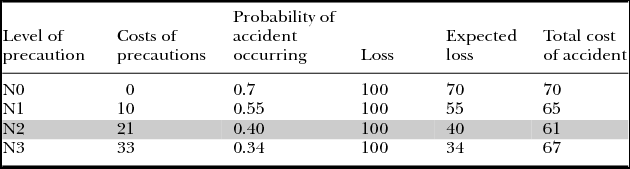
The economic notion of fault was encapsulated by Judge Learned Hand's famous opinion in United States v. Carroll Towing Co.,Footnote 30 which held that due care is a function of three variables: 1) the probability of occurrence of the accident (P); 2) the gravity of the loss if it occurs (L); and 3) the burden, or cost, of precautions (B) that can prevent it from happening. Accordingly, someone is at fault when he omits the measures that could have prevented the accident at a lower cost than the expected value of harm (B < P.L). Let us look at the example with values in Table 2 below.

A literal reading of the Hand formula would suggest that anyone who does not adopt a level of precaution N3 is negligent, since the cost (33) of reducing the loss from 70 to 34 is less than the benefit (36) obtained by the reduction. However, the total cost of the accident, that is, the expected value of loss added to the spending on prevention, is reduced to a minimum when the agent adopts the level of precaution N2. For this reason, the Hand formula should be read in marginal terms.Footnote 31 This means that not all measures that cost less than the expected loss are efficient. Note that when an agent adopts a precautionary level N1, the expected loss is reduced by 15, from 70 to 55. This can be achieved by an investment of 10 on precautions. A rational agent would adopt such precautions because they are justified by their costs. From this point on, stepping up from N1 to N2 has an additional cost of 11 and a further decrease of 15 in the expected loss from 55 to 40. Thus the marginal benefits of adopting N2 are slightly lower than those of N1, but it would still be beneficial to take these measures. However, this is not the case when stepping up to N3, because achieving this level of precaution incurs an additional cost of 12 and the expected loss is reduced by only 6. According to the Hand formula, in marginal terms, it would not be negligent to avoid taking precautions at a cost of 12 in order to prevent a loss of 6.
With this in mind, let us return for a moment to the example of the cyclist described by Shavell. According to Shavell, a judge deciding such a case would release the agent from liability when the loss occurred in circumstances of poor visibility. The judge would argue that there was no causation. Since he could not reduce the loss in any way, it could not be argued that the cyclist caused it. I criticize this argument above. However, if we focus on fault rather than causation, using the Hand formula it could not be argued that the cyclist was at fault. Since the loss would occur in any case, the optimal investment in precautions is zero. According to the economic reconstruction, even if the cyclist was blindfolded, he would not be negligent in conditions of poor visibility. Conversely, if the cyclist had been able to reduce the loss by taking precautions, omitting to do so would make him negligent and, necessarily, would show that he caused the accident because he could have influenced the result in an efficient way.
Note also that if the cyclist takes due care, then, by definition, there are no further optimal measures he can take. In Table 2, when the agent adopts the precautionary level N2, his behavior is efficient, and that means that no additional measures can reduce the expected loss at a reasonable cost, or, in other words, in marginal terms due care is zero. Once he has adopted N2, his legal duty of care is met and he is not required to take any further precautions. Hence, from this point on, the agent cannot be considered at fault, nor (under the economic interpretation) to be the cause of the loss, which occurs in any case, because according to the economic view, causation depends on the possibility of reducing the loss by taking optimal precautions. When the due care of the agent reaches level N2, the expected loss of 40 cannot be reduced efficiently with any further precautions, and therefore the agent cannot be considered as the economic cause of that damage.Footnote 32
More recent studies attest to the conceptual relationship between fault and causation that I am highlighting here. Some studies, in analyzing the rule of comparative causation (in which the loss is distributed between injurers and victims, neither of whom are at fault, by taking into account only their causal contribution to the outcome), assume that causation depends positively on the level of the agents’ activity and negatively on the level of care taken by the parties. For a particular occurrence of harm, the causal contribution of each party could be determined by observing the decisions they made regarding precautions and how often they engaged in their activities. Liability would be assigned on the basis of this contribution.Footnote 33 As far as negligence is concerned, the fewer the precautions taken, the greater is the agent's causal contribution to the outcome. As the level of care increases, the causal contribution decreases, until, we can assume, it reaches zero when the precautions taken are optimal. As for the level of the agent's activity, the opposite occurs; the more activity she carries out, the greater her causal contribution is. As the individual decreases the frequency of her activity, her contribution is reduced to zero. Hence, if an individual reduces her activity to zero and takes maximum care, causation corresponds entirely to the agent who carries out the harming activity, even though she takes due care.
There are two issues that come up at his point. The first is that the economic interpretation logically nullifies the possibility that negligent conduct has no causal link with the loss. Hence, if the agent is negligent, he contributes causally to the injury. One might think that the logical inverse relationship is not true, because if someone contributes causally, then he is either negligent or he carries out some level of activity. That is, the causal contribution does not imply negligence because the agent may also contribute to causing harm simply by carrying out the activity with due care. However, in order to achieve an efficient outcome, this distinction between the level of activity and due care is somewhat tenuous. Let us consider why.
As is argued above, there are two ways to influence the outcome: taking precautions or decreasing the level of activity. In economic terms, reducing the level of activity (or even abandoning it) is one more precaution that may be taken to prevent the loss. In fact, courts do not include the level of activity in the standard of due care simply because they lack the necessary information to do so, but an absolute standard would undoubtedly include the frequency with which individuals carry out the activity that produces the loss in question.Footnote 34 Thus it would not be anomalous to say that an individual who has a car in perfect condition, who drives at permitted speeds, and so on, is nevertheless negligent when, on a day of heavy snowfall in which the weather conditions are almost guaranteed to produce a accident, she goes off in her car for no justifiable reason (i.e., it is not an emergency). In such a case, would we say that the agent was negligent or that the level of her activity (i.e., driving) was excessive because the optimal level of activity in those circumstances was zero?Footnote 35 As far as efficiency is concerned, there is no reason to believe that regulating one's level of activity is anything other than taking precautions, and both should be part of the standard of due care in an ideal world with perfect information.
If this argument is economically plausible, the only factor that determines the causal contribution is the balance between costs and benefits, as summarized in the Hand formula. The conclusion I reach is not new for the more orthodox positions such as that of W. Landes and R.A. Posner. According to these authors, causal statements are the result rather than a premise of the economic analysis of tort law. Thus, an individual is considered to cause harm when he can avoid it in the most economical way and yet does not. This does not mean that lawyers can or should dispense with the central concepts that are the backbone of the practice of tort law, since they are often unable to communicate the economic ideas contained in traditional notions. But things are different for economists, who do not depend on causal notions in order to study tort law. Instead, economists can deal with cases in which the question of causation is raised by simply asking how such cases would be resolved by the Hand formula, because the formula is an algorithm for resolving liability issues in general, and not just those relating to negligence.Footnote 36
Landes and Posner explicitly state that “violating the standard is not negligent or, if one wants to use the word, is not a cause of the accident” when the expected accident costs do not decrease with a greater level of care.Footnote 37 The idea is that it makes sense to point out the individual who caused the accident insofar as, by making him liable, other agents have an incentive to minimize the cost of accidents in the future. From this perspective, it is pointless to argue that someone caused a loss but should not be liable for it. For the traditional theorist, however, causation is only a necessary element of liability but insufficient on its own.
In short, the Hand formula, which is usually taken as an economics-based definition of fault, is actually a conclusive judgment of responsibility whose content is projected over the central concepts of tort law. This can also be clearly seen in a number of later studies that attempt to formalize causation as a function of three variables: 1) the probability of the accident occurring; 2) the magnitude of the loss; and 3) the precautions that can be taken to prevent the accident.Footnote 38 Obviously, this formalization of causation incorporates exactly the same elements as the Hand formula.
I think the interesting point about this argument is that it shows how difficult it is for EAL to avoid the reductionism of more orthodox positions. Since EAL sees law as concerned with providing the proper incentives for efficient behavior, liability should be imposed on actions whenever their expected marginal costs exceed their expected benefits. Despite the efforts of some of its advocates, this commitment prevents economic views of escaping the conceptual reductionism mentioned above. This makes it impossible to distinguish certain notions that are essentially different in the practice. In particular, fault and causation (notions that are logically independent premises for any lawyer familiarized with tort law) fuse together onto the same cost-benefit analysis. This conceptual merge might not be terribly troubling for a legal economist, but its consequences for the soundness of economic theory clearly should be, as I show below.Footnote 39
B. Hand and No-Hand: The Inconsistency of the Economic Interpretation
In this section I propose to show that the inability to distinguish between concepts is an epistemological shortfall that fatally undermines the explanatory potential of economic theory. In particular, I try to show that the economist, by using the same cost-benefit analysis both to determine whether the agent is at fault and to identify the cause of the accident, paints a picture of the practice in which the participants (academic scholars, judges, and lawyers in general) are irrational, given that they incur blatant contradictions in their everyday reasoning. The proof of this hypothesis should be fairly obvious to those who accept the argument I make in the previous section; however, I would like to go deeper into this idea in order to express it as clearly as possible.
If we accept that the Hand formula is all we need to define negligence and causation, then the EAL thesis can be summarized as follows:
1. For any individual, she is at fault if, and only if, she satisfies the Hand formula.
2. For any individual, she caused the accident if, and only if, she satisfies the Hand formula.
Logically, these two propositions entail that whenever someone is at fault, his conduct will be the (economic) cause of the accident, and vice versa.Footnote 40 We must not forget that from an economic standpoint, fault and causation are instruments that—in different circumstances—are used to achieve the same goal: the optimal allocation of resources. Because this requires minimizing the cost of accidents, and because this is impossible without applying the Hand formula, then all doctrines must comply with it. If, in a particular case, the agent is released from liability for lack of fault, and this decision is efficient, it cannot mean anything other than that the defendant could not avoid the accident at a lower cost than the cost of the harm.
The same applies to causation. Despite its elegance, the simplicity of economic theory precludes a meaningful interpretation of the inferences that are made in arriving at a judgment of liability. By depriving the traditional concepts of their meaning or content and reducing the legal discourse to the implementation of the Hand formula, the economic theory ends up presenting an implausible explanation in which participants are assumed to be irrational. It must be remembered that private-law theorists hold that fault and causation are logically independent concepts, so it is perfectly possible for an individual to be at fault without being the cause, and vice versa. However, the economic translation of any of these propositions leads necessarily to a contradiction. When the theory claims that it is possible, for example, that someone caused the accident but was not at fault, if the terms are to be understood in the way proposed by the economic analysis, deductive logic tells us that the theory is inconsistent, because from its statements it follows that the agent does and does not satisfy the Hand formula at the same time. In other words, whoever says that someone was at fault but was not the cause, or that someone caused the harm but was not at fault, incurs a clear contradiction, and because these statements are more than usual in liability judgments, the economic interpretation of tort law offers a vision of the practice that is permeated with a profound irrationality.Footnote 41
It may happen that individuals in certain practices hold contradictory beliefs. This may be because they are irrational or because a profound error is shared by the participants and repeated over time. But the principle of charity in interpretation set out by Davidson and the humanistic conception of the person require us to assume the opposite, namely, that individuals are rational and their beliefs are true—unless there is clear evidence that the community in question has incurred some kind of error or does not know the basic rules of inference.Footnote 42
No evidence is presented by EAL theorists to demonstrate the latter, and indeed, they cannot do so, because one of the fundamental assumptions of all the models applied to tort law is the rationality of agents. Liability rules create incentives for rational agents to behave efficiently. If this requirement is abandoned, no aspect of tort liability could be interpreted in terms of efficiency. It is true that the models may incorporate defects in terms of information. In fact, many models assume that the agents do not have perfect information and that this explains certain features of the law.Footnote 43 But it is exactly this rationality of the agents that allows us to predict how they will behave in various contexts in which the information is sometimes incomplete, imperfect, or asymmetric. Hence EAL assumes that individuals are rational enough to make the right decisions with regard to minimizing private costs but not rational enough to realize that they assert two contradictory propositions (that the agent does and does not satisfy the Hand formula at the same time). For these reasons, I believe we should be doubtful of the economic interpretation of the traditional concepts, such as fault and causation.
This conclusion essentially depends on accepting the reconstruction of the EAL theses according to propositions 1 and 2. Both express a biconditional so that the negation of the antecedent implies the negation of the consequent. The reasoning I give shows that the denial of fault implies the denial of causation, and vice versa. But if the relationship that fault and causation have with the Hand formula were not represented by biconditionals, my argument would not hold with the same consequences. Therefore, something must be said about the correctness of my reconstruction.
Let us consider an economic notion of fault represented only by a material conditional such as the following: if the Hand formula is satisfied, the injurer is at fault. However, this definition admits the possibility that an individual is at fault even though his conduct does not satisfy the Hand formula. That is, the antieconomic behavior would be a sufficient but not necessary condition of fault. There may be other behaviors that despite being more beneficial than harmful, were found to be at fault in any case. But if this is the case, then EAL could not argue that the content of the concept of fault is determined by the Hand formula. The Hand formula only partially determines its content.
This does not fit quite well with the objectives of the EAL theorists, which is to understand fault through the exclusive use of a cost-benefit analysis. More important, it should not go unnoticed that a broader notion, which exceeds the limits of the Hand formula, would in no way serve to maximize wealth. It would often happen that the person found to be at fault would not even be the person capable of avoiding the accident most cheaply. To avoid this consequence, the relationship between fault and the Hand formula must be represented by a biconditional. And, as mentioned above, a similar argument applies to causation.
Another alternative would be to understand that the Hand formula is only a necessary but not a sufficient condition for the fault of the agent. This reconstruction has the advantage of being very intuitive because it is usually accepted that the possibility of preventing harm to third parties at a reasonable cost is an important element in determining any violation of the required standard of due care. Thus antieconomical behavior would be one of the various components of fault but not an exhaustive one. From this, it follows that not all inefficient behavior would be deemed legally culpable; and in the cases covered by subjective liability, what would happen is that some inefficient behavior would not be liable for the costs it imposes on others, and therefore those who behave in this way would not have incentives to avoid damage. The same can be said of causation. If the Hand formula was a necessary condition of it, a great deal of behavior that satisfies the formula would remain outside the scope of liability.
In short, if the Hand formula was a sufficient but not a necessary condition of fault (or causation), the outcome would be inefficient because the resulting liability would affect a great deal of socially valuable behavior, which would undoubtedly lead to a decrease in its frequency. If on the other side, the Hand formula was a necessary but not a sufficient condition of fault (or causation), the result would also be inefficient because a great deal of unreasonable behavior—more costly than beneficial—would fall outside the scope of liability, thus creating the wrong incentives for potential injurers. The only interpretations that make of fault and causation two instruments suitable for maximizing wealth are those that associate both notions with the Hand formula in terms of a biconditional, as explained in the beginning of this section. The alternative reconstructions have the typical problems of under- and overinclusion. However, at the same time, the interpretation that makes the most economic sense paints a distorted picture of the practice, in which the participants are irrational.
Thus it seems the only way to avoid the contradiction is to do without causal language, as suggested by Landes and Posner, and to explain tort law from the standpoint of a conclusive liability judgment contained in the Hand formula. In the next section, I show why this strategy is not viable either.
IV. PROBABILISTIC CAUSATION IN LIABILITY JUDGMENTS
The earliest formal economic models did not deal specifically with causation, although they did implicitly use a probabilistic notion. Already, in the work of Brown in 1973, it can be clearly seen that the link between the loss suffered by the victim and the precautions taken by the injurer is not factual but probabilistic in nature: it is based on the probabilities of the harmful event occurring. The model assumes that the expected losses are a function of the different levels of care taken by the agents. The effective production of the loss, which is an essential element of factual causation, is replaced by the weighted sum of the cost of any accidents that are expected to take place in the future. Shavell's model, discussed above, follows a similar line, despite the fact that it purports to deal directly with the problem of causation.Footnote 44
This being so, the idea of taking refuge in the Hand formula to explain all tort liability, far from avoiding the problems brought up by causation, commits EAL theorists to a rather particular notion of causation. Richard Wright points out that probabilistic causation is a strange concept of causation, since a negligent action may increase the probability of future losses that in the end do not actually occur. In this sense, if the cause is any condition that increases the probability that a particular outcome takes place, this negligent action would be the cause of an effect that never came to pass.Footnote 45 Wright's observation captures the central problem of EAL, but we do not discuss it in further detail for now. Taken superficially, this statement makes it incomprehensible how anyone could seriously sustain such a concept. Before reaching conclusions similar to those of Wright, I attempt to explain in a little more detail what probabilistic causation consists of, what exactly its relationship with the Hand formula is, and why this conception of causation is problematic for any theory of tort law that seeks to deploy it.
In what follows, the strategy is to show that probabilistic causal statements, which are essentially forward-looking, are a necessary (implicit) part of the Hand formula, and for this reason, cost-benefit analysis is unable to reconstruct the backward-looking structure of causal inquiry in tort law. Even in cases where probabilistic statements seem to be used or assumed (typically, cases decided on the ground of the res ipsa loquitur doctrine), the role that probabilistic causation plays is different from the function it performs within the Hand formula. Probabilistic statements that are part of the Hand formula work guiding action ex ante toward efficient behavior. In res ipsa loquitur cases, we are still concerned with what really did happen, and probabilistic statements can serve an epistemic function in the ex post inquiry.
A. Causation and ProbabilityFootnote 46
The perplexity felt by Wright is due to the fact that his approach begins by observing that certain facts may be causal conditions even though they do not change any results. It is therefore natural to ask: In what sense can they be causal conditions? The question changes, in my opinion, if we begin with the investigation into certain events that we are trying to explain.
Often, when we ask why a certain event occurred, we are looking for a causal explanation that presupposes certain covering laws. In the simplest case, a general statement that asserts a causal connection between two kinds of events, say A and B, is tantamount to a statement of a general law according to which whenever A happens, B happens.Footnote 47 Suppose we want to explain why Xenophon has recovered from a streptococcus infection. If everyone who is given penicillin recovers from a streptococcus infection, and Xenophon was treated with penicillin, then we would explain deductively that Xenophon recovered from the infection because he received the appropriate dose of penicillin, or that the cause of Xenophon's recovery was the treatment with penicillin. But what would we think if not everyone who received penicillin recovered from the infection? Could Xenophon's recovery be explained using a statistical generalization according to which most people who are treated with penicillin recover?Footnote 48 It is true that an explanation of Xenophon's recovery on the grounds that 90 percent of people on penicillin recover will be less satisfactory, but it is still persuasive. Hence, in what Papineau calls the standard view, one event explains another event if the first creates a high probability that the second will take place.Footnote 49
This way of linking high probabilities with causal explanation faces a serious difficulty. Imagine that in a subset of people, those over seventy years old, for example, the percentage of patients who recover is drastically lower. Suppose that only 10 percent of these older patients recover. If Xenophon is over seventy and was treated with penicillin, two things could occur: 1) he recovers; or 2) he does not recover. The problem is that both of these events could be explained by our statistical generalizations. If Xenophon recovers, then this is surely due to the fact that 90 percent of people who are treated with penicillin recover. But if Xenophon does not recover, this can also be explained, because being over seventy gives a 90 percent chance of not recovering. The trick is to use a different reference class for each case. This theoretically inadmissible consequence can be avoided by ensuring that statistical generalizations (the probabilities) used in the explanation correspond to homogeneous classes. In this example, the class of “persons” is not homogeneous because it can be subdivided into those older and those younger than seventy years, and each subclass or category has a different probability of recovery. In short, the explanation for Xenophon's recovery based on a generalization that 90 percent of those treated with penicillin recover is inadequate because it does not employ a homogeneous reference class.Footnote 50
The standard or traditional view is supported by the strong intuition that high probability appears to have explanatory power. The higher the probability contained in the statistical generalization, the stronger the explanation. However, if we are told that smoking increases the chance of getting lung cancer by 10 percent, it would be difficult for us to explain that Xenophon's cancer was due to his smoking, because in accordance with the traditional view, the statistical generalization is too low to explain the cancer. This throws doubt on whether high probabilities are the only way in which probabilities are related to a causal explanation.
An alternative is suggested by authors such as Patrick SuppesFootnote 51 and Wesley Salmon.Footnote 52 Setting aside matters of detail in each concept or how they have changed over time, the essence of this view, which we can call incremental, is that it defines the cause as all conditions that make the outcome we want to explain more probable. Causes, in other words, increase the probabilities that an outcome will occur. Hence no condition must be taken as the cause of an event if it does not increase its probability. This means that smoking (S) may be a cause of cancer (C) provided that Prob (C/S > Prob (C/¬S) or simply that Prob (C/S) > Prob (C).
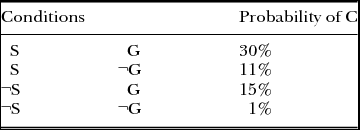
This model, unlike the traditional one, does not require that the probabilities that make up the statistical generalization correspond to homogeneous classes. It may be the case that the likelihood of cancer increases with tobacco consumption, but more severely among those with a particular genetic predisposition (G). Let us look at an example. In Table 3, it holds that Prob (C/S∧G) > Prob (C/¬S∧G) > Prob (C/S∧¬G) > Prob (C/¬S∧¬G). Note that it is still true that Prob (C/S) > Prob (C/¬S). Smoking makes a difference for both those with a genetic predisposition and those without it, but it affects the former to a greater degree. This means that genetic predisposition does not invalidate the correlation between S and C, although the division between smokers and nonsmokers is not homogeneous, given that there is a condition, G, that, in addition to S, also influences the probability of C.
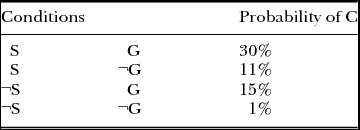
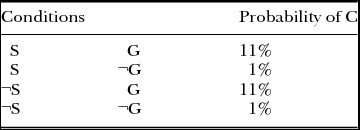
The issue would be very different if the initial correlation between smoking and cancer turned out to be spurious. This would occur if Prob (C/S∧G) = Prob (C/¬S∧G) and, furthermore, Prob (C/S∧¬G) = Prob (C/¬S∧¬G). The correlations are spurious when a condition (which in our example is the condition S) is absolutely irrelevant because it has no impact whatsoever on the probabilities of the outcome (C). In short, although the probabilities may be mixed in the sense of corresponding to nonhomogeneous classes, for the causal explanation to be plausible, there must not be any condition that invalidates the correlation between the supposed cause and effect we want to explain. The genetic predisposition invalidates the correlation between S and C if S does not increase the probabilities of C in any of the partitions resulting from combining the properties S and G. Consider Table 4 below.
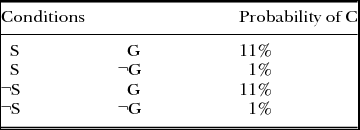
In this case, the correlation between S and C is spurious and is invalidated by G. This could happen, for example, if genetic predisposition were a common cause of cancer and also of tobacco addiction. The researcher must accept the statistical correlation between S and C as evidence that smoking is a cause of cancer provided that he cannot prove the association between these two factors to be spurious. In his observations, he may also note that the individuals in his statistical sample have a certain genetic predisposition. In order to check whether G invalidates the correlation between S and C, he must proceed as follows: the sample must be subdivided into those individuals with G and those without G. The next thing to check is whether in either of these two categories there is a difference in the frequency of C between smokers and nonsmokers. If none of the divisions is found to have more cases of C among smokers than among nonsmokers, then S is not a cause of C. The genetic predisposition, G, will have invalidated the causal correlation between smoking and cancer, which may be explained by the fact that genetic predisposition not only causes cancer but also causes a propensity to tobacco addiction.
The advantage of the incremental approach with respect to the traditional approach is that it does not require the cause to correlate with the outcome via high probabilities. Let us return to the case of the penicillin. Suppose that Xenophon is in fact over seventy years old, (E), so the chances of recovery from the streptococcus infection are only 10 percent. If he does not recover after treatment with penicillin (P), this outcome can be explained by the statistical generalization that says that penicillin is not effective against streptococcus infection in 90 percent of patients over seventy years old. The high probability of the outcome is sufficient to explain why Xenophon did not recover. But if Xenophon gets better, how can this be explained from the traditional standpoint? The fact is that the probabilities of recovery (R) were very low, which means there is no statistical generalization that can be referred to in order to explain the outcome.
The incremental approach, however, does not have this problem. Xenophon's recovery, despite his being over seventy, can be explained by penicillin. Provided that Prob (R/P) > Prob (R/¬P), cases such as Xenophon's can be explained, despite the divisions not being homogeneous. Thus it could be true that Prob (R/P∧¬E) > Prob (R/P∧E) > Prob (R/¬P∧¬E) > Prob (R/¬P∧E). Both old age and penicillin are relevant to the probabilities of recovery. But these relationships necessarily lead to the following: Prob (R/P) > Prob (R/¬P). In this way, the incremental approach can explain convincingly that Xenophon's recovery was caused by penicillin treatment.
B. Probabilistic Causation, Economic Causation and the Hand Formula
As already mentioned, the Hand formula assumes probabilistic causation. Consider again the numerical examples in Table 2.
The injurer is faced with different probabilities of causing a loss of 100, depending on his behavior. Imagine that the defendant took precautions of 10 to reduce the probability of an accident to 0.55, although the most efficient would be to take precautions of 21, thus reducing probability to only 0.4. In that case, the marginal cost analysis indicates that if he does not invest 21 in precautions, he is at fault according to the Hand formula (because 21 − 10 < 55 − 40). This is the basic analysis that underlies all liability rules. Let us now see how these judgments of efficiency assume judgments of probabilistic causation.
The Hand formula never indicates that an agent is negligent unless the difference between the burden, or cost, of the precautions adopted (BA) and the precautions omitted (BO) is less than the difference between the loss (L) resulting from BA (L.pA) and the loss resulting from BO (L.pO). That is to say, only if, BO − BA < L.pA − L.pO will the agent be considered to be negligent. From this it follows that whenever someone acts negligently, it will be true that:
1) BA < BO, which is to say: BO − BA > 0,
and, more important for the point I wish to stress here,
2) L.pO < L.pA, which is to say: L.pA − L.pO > 0.
Since the Hand formula always guarantees the latter, it will also necessarily be true that the probability of loss occurring during negligent conduct (N) is greater than the probability of loss during behavior with due care (¬N): Prob (L/N)> Prob (L/¬N).
According to the economic view, the claim that negligence is causally linked to the loss means that the probability of loss taking place is increased. A break in the causal chain could occur only if the correlation was spurious, that is, if some other factor, such as negligence on the part of the victim (V), for example, would entail that Prob (L/N∧V) = Prob (L/¬N∧V) and Prob (L/N∧¬V) = Prob (L/¬N∧¬V). But in this case, according to the Hand formula, the agent's conduct could never be considered as cause, or as negligent, since it would be false that L.pA − L.pO> 0.
This shows that there is a material implication relationship between probabilistic causation and the Hand formula. Satisfying the formula is a sufficient condition to verify a probabilistic link between the precautions omitted (i.e., negligent conduct) and the loss. But the verification of a probabilistic link is not sufficient for the Hand formula to be satisfied. To return to our example in Table 2, if the agent adopts precautions costing 33, he could reduce to 0.34 the probability of a loss of 100. However, although the due conduct implies a higher probability of loss than the one generated by the additional measures (X) that could be taken, these precautions become excessive, according to the Hand formula, because they are inefficient. Their marginal costs are higher than the marginal benefits they produce by reducing the expected loss. In notation, although Prob (L/X) < Prob (L/¬X), the omission of X is not negligent because BO – BA > L.pA − L.pO.
The temptation now is to think that EAL might give up trying to interpret causation in terms of the Hand formula in order to avoid the conceptual overlap and the inconsistencies that I criticize in Section III.B. As an alternative, one could adopt a probabilistic notion of causation and keep the formula for deciding upon the negligence of the agent. Unfortunately, this path also leads to implausible results. A theory that seeks to capture the pattern of inferences that is applied in practice should realize that agents may be negligent without being the cause, and vice versa. Accepting probabilistic causation can make only the second of these terms intelligible but never the first one. That is so because it is possible that the agent has increased the probability of the loss (i.e., that he is the cause in the probabilistic sense), but his behavior does not satisfy the Hand formula because the burden of the precautions would outweigh the benefits of reducing the probability of loss. However, it is not possible to claim that someone was at fault but not the cause, because if the Hand formula provides a judgment of negligence, then it also implies a judgment of probabilistic causation. Whoever asserts the latter would be asserting the contradiction mentioned previously: that the agent does and does not satisfy the Hand formula at the same time.
C. The Tension between Prospective and Retrospective Views of Tort Liability
Probabilistic causation, which is implicit in the Hand formula, means that the EAL interpretation of tort law is prospective in nature. The aim is to minimize the costs of accidents, and to that end, EAL theorists attempt to reduce, in the most efficient way, the probability of loss. The actions of agents are evaluated from an ex ante perspective. However, factual causation, a necessary element in every liability judgment, takes on an ex post perspective. Legally relevant causation has to do with what actually happened and what actually caused the loss, not with the risks created. It is therefore retrospective in nature.
If it is true that there is a clear disparity between the legal reasoning and economic reasoning, how can EAL theorists argue that their explanations are superior to traditional theories? How can they even argue that their explanation coherently accommodates the various parts of tort law? I first offer one answer to these questions here and a different one toward the end of this article.
The first answer is that EAL theorists often confuse ex ante probabilities with the ex post findings.Footnote 53 This can be seen clearly in Shavell's analysis of Summers v. Tice.Footnote 54 This is a case in which two hunters, Tice and his companion, Simonson, negligently fired their weapons in the direction of the victim, Summers, who was their guide, using the same type of shotgun. Summers was injured in one eye by a shotgun pellet, but it could not be determined whose shotgun pellet caused the harm. The court ruled that both defendants were responsible, a solution that Shavell considered to be economically correct because otherwise there would be no incentive for people to prevent losses in the future in those situations where the identity of the injurer cannot be established with certainty.Footnote 55
The interesting point, as noted by Wright, is that Shavell's mathematical proof, in order to simplify the calculation, assumes that the probability of both hunters hitting Summers at the same time is zero.Footnote 56 The probability of two independent events is the product of the probability of each one of them. So to calculate the probability that both hunters hit the victim at the same time, we multiply the probability that hunter 1 hits the victim (Prob C1) by the probability that hunter 2 hits the victim (Prob C2). If Prob C1 x Prob C2 = 0, then this must mean that either Prob C1 or Prob C2 equals zero.
But what reason is there to believe that, ex ante, the probability of injuring the victim is zero for one of the hunters? If the two men fired simultaneously in the direction of the victim, the probability—no matter how small—that both hit the same target must exist. Shavell's assumption seems to be motivated by his knowledge, obtained ex post, that only one of the shotgun pellets struck Summers in the eye. However, when one looks at the moment the shots are fired and before the victim is hit, it seems unreasonable to assume that there is zero probability of both shots hitting their (unintended) target simultaneously. Neither this assumption nor the fact that the mathematical proof is defective affects the correctness of Shavell's conclusions, but they do show that the model confuses the ex ante and ex post standpoints.
Much more serious is the mistake of Landes and Posner in their discussion of Weeks v. McNulty.Footnote 57 In this case, the defendant, Frank McNulty, a hotel owner, failed to install fire escapes in his hotel as required by regulations. This, however, was deemed irrelevant by the court, because the victim, Arthur Weeks, a guest in the hotel, apparently panicked and did not attempt to find and use a fire escape to flee the fire. The fact that the installation of the fire escape would not have prevented the death of Weeks implies, in the Landes and Posner model, the probability that his death was independent of the injurer's negligence. The violation of the standard of due care was not the cause of the loss because it did not alter the probability that the victim would die.Footnote 58
Landes and Posner's argument included a series of statements that are, to begin with, difficult to reconcile. Their initial premise is that the defendant was negligent but that his negligence did not cause the loss. At the same time, they assert that omitting to invest in the fire escape does not constitute a violation of the due-care requirement because from the economic point of view, the expected benefits of such an investment would have been zero. They appear to be stating an inconsistency here that is even worse than the one indicated in Section III.B, since it is expressly stated that the agent's negligence is not a violation of due care. Landes and Posner attempt to resolve this problem by proposing a particular interpretation of the liability judgments. In their view, the first legal issue is whether the behavior was prima facie negligent in the sense of it being the kind of behavior that generally produces more social costs than benefits. Then, having taken that into account, what needs to be determined is whether any additional precautions would have produced an efficient outcome. The economist, unlike the lawyer, applies a single algorithm in making his decision.Footnote 59 Thus the Hand formula may be considered a conclusive or final liability judgment.
Several issues here need to be analyzed. First, it is arguable that the reasoning of lawyers can be reconstructed in the two steps referred to by Landes and Posner. Any lawyer familiar with tort law would say that breaking a regulation that imposes a duty of care is negligence. The absence of a causal relationship, established a posteriori, does not annul the wrongful nature of the act carried out. It is precisely for this reason that certain actions, though negligent, do not generate civil liability for the agent who performs them. This reveals that there are essential differences, which I will not go into here, between wrongful behavior and inefficient behavior. Contrary to the intentions of EAL theorists, the former cannot be reduced to the latter.Footnote 60
Furthermore, as Wright argues, the expected benefit of installing the fire escape is not zero, but positive. At some point in time, the defendant had to decide whether or not to invest in precautions. This moment is, in the eyes of the law, the relevant moment regarding incentives for efficient behavior. The fact that he omitted to install a fire escape increased the risk that the victim and any other guests would suffer injury or loss. The only way we can argue that the defendant's omission was irrelevant in producing the damage is to assume an ex post perspective, with complete information about what really happened. In this particular case, the negligence made no difference. However, the omission, considered ex ante, was undoubtedly inefficient.Footnote 61
According to Hugo Acciarri, Landes and Posner's debate with Wright has nothing to do with the perspective from which the probabilities are calculated but rather with how they describe the consequent facts. His argument is that
if this event is described as “the death of an individual who would not have withstood the inhalation of smoke for more than five seconds” and if it is assumed that the distance that Weeks would have had to go, had there been emergency exits, in order to reach safety would have taken him longer than five seconds, then it is reasonable—as Landes and Posner have it—that the installation of the fire escapes would not have significantly changed the probability of the outcome.Footnote 62
However, a contrary conclusion can be obtained if we exclude the lack of resistance to smoke from the description. For this reason, Acciarri understands that what the debate is really about is the description of the facts. In this sense, no one is wrong, because unique and true descriptions of events do not exist, although there may be some descriptions more functional than others for meeting social objectives such as reducing the cost of accidents.Footnote 63
The argument is ingenious, but I do not think it adequately reconstructs the legal investigation into cases of tort. We can be sure that the judge in Weeks did not find himself trying to establish what actually caused the “death of an individual who would not have withstood the inhalation of smoke for more than five seconds.” This is not the description of the event that gave rise to the judicial investigation, since it includes part of what is supposed to be investigated. The story began with the death of a hotel guest in a fire. Also, the plaintiff (the victim's wife in this case) will have alleged that the defendant was negligent because he failed to install the fire escape required by city ordinances. Once the fact that the defendant failed to install the fire escape has been verified, the judge must assess whether the defendant's negligence (N) was causally linked to the harmful outcome. At this point, since it was found that the victim was in a position from which it would have been impossible to reach the fire escape before succumbing to the smoke, the defendant's omission in not building a fire escape can hardly be considered a necessary element of a set of conditions that were sufficient for the result. Having removed this omission from the equation, all the remaining conditions are still sufficient to produce the harm. Ergo, the defendant's negligence was not one of the causes of the victim's death. This, I believe, is the usual legal reasoning.
However, if the judge had proceeded to apply the Hand formula and had made the appropriate judgment of probabilistic causation included in it, he would have found that the failure to install the fire escape increased the probabilities of Weeks's demise (M). The judge, however, should not be content with the statistical generalization from which it follows that Prob (M/N) > Prob (M/¬N). He would also need to rule out other conditions that are capable of invalidating the correlation between N and M, such as asphyxia (A) occurring before the victim can reach the emergency exit. But in this case, A does not alter the correlation between N and M, since although it is true that Prob (M/N∧A) = Prob (M/¬N∧A), it is also true that Prob (M/N∧¬A) > Prob (M/¬N∧¬A). Therefore, it is false that N is irrelevant in all circumstances; it is only irrelevant in those circumstances in which the victim suffers asphyxia.
One may object to the fact that the judge applies the Hand formula in the way I describe on the basis of a very general description. Precisely because we are dealing with a conclusive judgment of liability, it should be made with all the pertinent information relating to the case. For this reason, Landes and Posner employ a more refined, more specific description of the consequent facts.Footnote 64 Once this has been noted, we are no longer dealing with the impact of negligence on the probability of the victim's death, but with the impact of negligence on the death of a victim who was unable to withstand inhaling smoke. Thus, the issue is to to determine whether Prob (MA/N) ≠ Prob (MA/¬N). This would be the way in which Landes and Posner could capitalize on Acciarri's arguments.
All this movement does, however, is to bring the analysis toward a homogeneous partition or class. Any probabilistic calculation can be limited by including certain conditions as part of the consequent facts. An inquiry into the probabilities of recovery (R) of patients who are treated with penicillin (P) could begin with a more refined and homogeneous subdivision if we ask about the probabilities of recovery for elderly patients, (E), aged seventy or over, who are treated with penicillin. Instead of inquiring about the probability of R, given conditions P and E, the question could be limited to establishing the probability of RE, given the condition P. In the case of Weeks, the refinement in the description assumes that the investigation focuses on the probability of the death of an individual who would not have survived smoke inhalation (MA), given the omission in that there was no fire escape (N). Since Prob (MA/N) = Prob (MA), negligence can be eliminated as a cause of the victim's death.
The problem with this operation is that the calculation of probabilities with homogeneous partitions and above all with the information about what really happened would have to lead Landes and Posner to impose an obligation to compensate (by virtue of the final judgment of liability contained in the Hand formula) on the defendant who carried out an allowable action that proved to be the cause of a serious loss. Imagine a driver who goes out for a Sunday drive with his family and, despite taking all the precautions he is legally required to take, runs over a pedestrian. The probability of the accident, considered ex post based on what we know happened, is 100 percent. This would indicate that perhaps the driver should take further precautions, such as not driving at all that day.Footnote 65 After all, the social benefits of a day trip cannot be compared with the loss suffered by the victim.
Stated more simply, the final judgment of liability would have to investigate the probabilities that a motorist, driving at 40 kilometers per hour at a certain time of day along a particular street in the old quarter of Girona, hits a pedestrian who was distracted as he left a shop while reading a magazine, and so on, in order to state the full story of events. Having considered all the conditions and events that actually occurred and were relevant to the production of the result, we would have to agree that the probability of loss is no longer a probability and is, in fact, a certainty. Homogeneous partitions that take all relevant data of the situation exactly as it happened always leave us with probabilities of either 0 or 1, and this makes it impossible to distinguish between probabilistic causation and factual causation.Footnote 66
It seems, then, that EAL cannot help but distort the concepts. In general, it distorts the legal concepts by trying to make them instrumental to the requirements of efficiency. On this occasion the opposite occurs: it is the efficiency that ends up being distorted in order to account for the legal concepts. How could it be efficient, in this case, to place no liability on the defendant? It is true that investment in a fire escape is useless when the loss is the result of the suffocation of a person who was not able to use it. But it is also true that it is impossible to create incentives for such measures to be adopted without substantially increasing the expected cost of the losses that all those who could have used the fire escape would have suffered. In other words, it is impossible to install a fire escape only for those who do not succumb to the smoke. Once installed, the fire escape provides a social benefit. An abstract judgment, and probably also a concrete one, upon assessing how many individual lives would be saved by the fire escape would provide ample justification for building it. No efficiency target is achieved when the person who omitted carrying out this basic precaution is not made liable.
Of course, if the hotel owner had known that the hotel would only ever suffer a single, devastating fire and that the only victim would be someone who would not attempt to use a fire escape, then he should be given incentives to refrain from investing in useless precautions. However, agents always make decisions with imperfect information. It is rarely known which partition or reference class they will find themselves in. It is therefore rational to make their decisions based on a mixture of probabilities that correspond to nonhomogeneous classes, provided that the correlation between the negligent conduct and the loss is not invalidated by some other factor. Only if the agent faces spurious probabilities do his actions become completely irrelevant.Footnote 67 At the same time, it is impossible for legislators to create incentives for those who are in a position of irrelevance, because given the lack of information, it is unlikely that agents would be able to recognize the context. Hence, from the standpoint of efficiency, the solution requires liability to fall on the person who omitted those precautions that, ex ante, would minimize the expected cost of accidents.
In conclusion, the plausibility of the economic explanations results from the fact that surreptitiously, the theorists are analyzing the cases from an ex post perspective. Hand's formula and the probabilistic causation at work within it cannot be the final test that participants use in their liability judgments, because the pattern of inferences that is projected onto the practice is retrospective rather than prospective.
D. Probabilities in the Proof of Causation
In the previous section, I reject the idea that probabilities and legal causation share the constitutive relationship that EAL theories require. This does not mean that they have no epistemic role to play in the acceptability of causal statements. By the very nature of all legal processes, causal statements, like any statement of fact, can only be confirmed with a degree of probability, not of certainty. This is because, as explained by M. Taruffo, truth in the legal process is “relative to the evidence.” In order to determine the facts, the judge and jury may use only the evidence that has been produced during the proceedings.Footnote 68 For this reason, the available information is often insufficient to make us certain of the truth of a causal statement. Hence standards in law never require absolute certainty but rather a sufficient or minimum degree of conviction.
For others authors, the problem is not only confined to the legal process, but is a general epistemic difficulty that includes all evidence-based inferences. Thus it has been said that any conclusion drawn from evidence is essentially probabilistic for five reasons. First, the evidence is always incomplete. Second, the evidence is normally inconclusive, in the sense that it is compatible with several hypotheses at the same time. Third, the evidence is often ambiguous. Here the difficulty lies in interpreting the information provided by the evidence in question. In other words, what does a certain fact actually prove? Fourth, evidence may be dissonant. While some evidence points to one hypothesis, other evidence favors a different one that is incompatible with the first. Finally, sources of information have varying degrees of reliability and are never perfectly reliable.Footnote 69
Added to this, because of informational problems and evaluative judgements, the historical narrative of the case is always limited, although to a degree that does not produce great practical problems. We form beliefs about facts and make rational decisions, but the truth of the propositions that describe the factual context in which we operate is, to some degree, indeterminate.
Given this scenario, probabilistic causation appears to be no more problematic in law than the proof of any other factual statement. It is true that defects in information mean we can never be sure what happened. Statistical generalizations, for their part, help to identify whatever most probably caused an event—or, in tort law, whatever most probably caused the loss. So how can probabilistic causation be inconsistent with a pattern of inferences that is essentially probabilistic? In other words, if all the events that are considered to be proven are described by statements that are probably true, what reason can there be to reject statements that describe cause with a certain degree of probability?
In a sense, it could be said, probabilistic causal judgments are indistinguishable from a probably true, causal statement. This is because from a proposition about what was likely to occur, we can derive a proposition about what probably occurred. If the only thing we know is that Axileas fired ninety-nine bullets at Xenophon and Telemachus fired only one bullet, the most probable finding would be that Xenophon was injured by Axileas and not by Telemachus (assuming that neither of them are sharpshooters, the weapons are identical, etc.) If this were our only information, and Xenophon is found injured, we can say that what probably happened is that Axileas injured Xenophon. Thus there is no reason to reject statements of probabilistic causation, since they have the same content as statements of probably true, factual causation.
Indeed, this kind of reasoning, it could be argued, is behind common-law doctrines such as res ipsa loquitur (the thing speaks for itself). In cases where there is an important epistemic gap and the defendant is unable to provide a plausible alternative explanation, judges have presumed that given the surrounding circumstances of the case, the accident was caused by the defendant's negligence.Footnote 70 So res ipsa cases are the more explicit expression of the probabilistic nature of all factual statements.
However, I think this argument is wrong. The propositional content of a probabilistic statement differs from the propositional content in a traditional causal statement that because of our lack of complete information, we can only accept as probably true. Note that in this latter type of statement, probability is not part of its content. What ends up being probably true is the content of the statement “Axileas caused the death of Xenophon,” and it is probably true for the reasons listed above and applicable to all factual statements. In contrast, the first kind of causal statement, referring to probabilistic causation, has the following form: “There is a high probability that Axileas has caused the death of Xenophon,” and this means only that the defendant increased the probability that the victim suffered the loss he suffered. The truth conditions of the statement are different. To hold as true a statement of probabilistic causation, statistical generalization is sufficient. But the truth of a traditional causal statement requires evidence relating to the particular case. Put another way, probabilistic causation does not explain an individual case but rather a tendency in a series of individual cases.
In the example just mentioned, the generalization according to which there is a 99 percent probability that Xenophon was killed by Axileas and only 1 percent probability that Telemachus killed Axileas, is enough to accept as certain that Axileas probably killed Xenophon. But this is not enough for a traditional causal statement that attempts to describe what actually happened. A ballistics test might indicate that the bullet was in fact fired by Telemachus, which would invalidate the probabilistic causal statement. Of course, if the ballistics test used had a margin of error, this would also determine, among other factors, that the conclusion that Telemachus killed Xenophon is probably true. But the important thing is that the probabilities are not part of the propositional content in this kind of causal judgment. The same can be explained in terms of external or internal probabilities. In traditional causal judgments, probability is external to the proposition; in probabilistic judgments, it is internal. Expressed symbolically, if we replace the statement “Axileas killed Xenophon” with p, the truth of a proposition by T,Footnote 71 and the probability by Prob, we can say that causal statements have the following logically form:
Probabilistic causation (internal probability): T “Prob p”
Traditional factual causation (external probability): Prob T “p”
Probabilistic causal statements based solely on statistical generalizations are rarely, if ever, sufficient to certify a causal link in court.Footnote 72 This makes perfect epistemic sense, given that the difference between a general probabilistic causal statement and a singular causal statement is that the former causally links abstract classes and describes the frequency of singular causation. To say that smoking is a (probabilistic) cause of cancer, for example, means only that smoking is sometimes, often, or very regularly, but not always, a singular cause of cancer.Footnote 73 Wright sheds some light on the matter by noting that statistical frequency or probabilities are extremely useful when placing bets on what happened, but they can never tell us who won the bet.Footnote 74 That is to say, the probabilities cannot tell us if the specific case in question is part of the percentage of cases in which B follows A or if it is one of those cases that does not. The relevant fact—whether B was caused by A, or whether Xenophon was killed by Axileas—remains a mystery, despite there being an ex ante probability of 99 percent that the hypothesis is true.
Obviously, in the absence of evidence other than the number of shots fired and the harmful result, the probabilities can help to form our belief that the causal statement is true. When we have only one probabilistic causal generalization, and the facts do not fit any other causal generalization, we may be inclined to believe that a certain event is the cause even though we have no direct evidence concerning the event we are investigating. But in any case, this only shows that in certain circumstances we are willing to bet on what happened. Therefore the appearance of evidence, however slight, that contradicts this hypothesis will generally lead us to abandon our belief, which was based on ex ante probabilities, in favor of the causal history based on our ex post findings.
In most cases, the epistemic situation of judges is one of moderate scarcity. There will be a modicum of relevant data with which to develop a singular causal statement whose truth will be measured with some degree of probability. Complete information, as said above, is hardly ever available. For this reason, judges evaluate the extent to which the evidence obtained is consistent with the story or the causal hypothesis under consideration. Obviously, it has to be confirmed that these tests do not also fit reasonably well with various other causal hypotheses that would be incompatible. The decision regarding the facts, including the causal links, is taken when the evidence most consistently fits one hypothesis more than all others considered. The greater the degree of coherence, the more we are inclined to believe that the hypothesis is true.Footnote 75 This is the pattern of inferences that legal reasoning follows in matters of civil liability, the result of which is the probable truth of a nonprobabilistic causal statement.
V. CONCLUSION: TOWARD A NONREDUCTIONIST ECONOMIC EXPLANATION
There are two fundamental reasons that EAL is unable to offer a good explanation of tort liability. First, due to its reductionist nature, it cannot form an adequate conceptual reconstruction of tort practice. The second reason, closely related to the first, is that the prospective component of the principle of efficiency results in an irreconcilable disparity between the normative structure of tort law and economic reasoning.
With greater or lesser reluctance, supporters of EAL accept that tort liability is structured around a series of concepts that are central to the participants. The causal link between the defendant's conduct and the damage done to the victim is the mainstay of the pattern of inferences that lead to a liability judgment. Other notions, such as the correlativity of rights and duties of the parties or the difference between fault and strict liability, are also essential, but I do not discuss them here. I instead focus my arguments on showing that the EAL interpretation of causation, being markedly reductionist, makes the prerequisites of the obligation to compensate unintelligible. From the economic point of view, all the considerations necessary to judge the defendant's liability are included in the Hand formula, which requires the weighing of the costs and benefits of avoiding harm to others. Leaving aside the way legal reasoning is expressed, any action that minimizes the costs of accidents, according to the formula, should be held liable, thus giving all agents the right incentives to achieve a more desirable social state in which the number and severity of accidents are kept to a reasonable level.
My objection to the EAL does not target the efficiency thesis. I do not intend to deny that one of the functions of tort liability as a whole is to reduce the incidence of harm. It is easy to see that systems of tort liability have beneficial effects on the cost of accidents. It could even be accepted that traditional legal reasoning actually implements conclusive judgments of efficiency. But in this case, the EAL needs to show how the language of the participants can be consistently reinterpreted in economic terms, and as I argue, here lies the biggest flaw in the theory. By blending all the concepts of legal practice into a single cost-benefit balance, EAL fails to distinguish between fault and causation. By judging whether the injurer is at fault, we determine whether his action fails to comply with a duty of care, that is, if it violates a current standard of behavior in the community. The causal investigation, on the other hand, is of a completely different nature. What is at issue is whether the defendant's conduct is factually linked to the loss suffered by the victim in such a way that the sequence of both events figures in a meaningful historical narrative that presupposes the existence of certain general causal laws.
In legal doctrine, it is an obvious truth that these assumptions are logically independent in the sense that one can be true without verification of the other. However, when translated into economic terms, the relationship between the two notions is not preserved, which is why anyone who says that, for example, the injurer was at fault without being the cause of the accident is contradicting himself. Consequently, as shown in Section III.B, EAL provides a picture of a practice in which the participants are irrational. So it is obvious that EAL does not understand law as participants do. In short, economic terms do not fit in the pattern of legal reasoning as it is structured by those individuals who take up what Herbert Hart called the internal point of view.Footnote 76
Similarly, I point out that judgments of efficiency have a prospective component. They take the minimization of expected costs as relevant, and for this reason they no longer require the typical investigations of the facts aimed at identifying the causal links in the particular case. All the Hand formula requires is probabilistic links to be established between classes of events in order to estimate correctly the precautions that are able to minimize the social costs. Factual causation is abandoned, then, and replaced by the probabilistic concept of causal judgments. It comes as no surprise that EAL explains very little, since probabilities are more important in the principle of efficiency than they are in actual liability judgments. Some EAL theorists have found a way to get around this obstacle, at least in appearance, by using the probabilistic analysis of the facts of the case that are determined ex post. However, this strategy makes it impossible to distinguish between probabilistic causal statements and factual ones, since the calculation of probabilities based on all facts of the particular case will always produce a probability of 1 or 0. In short, while EAL continues to explain tort liability by reducing all the central concepts to a judgment of efficiency, the value of these theoretical contributions will remain limited.
A more promising alternative, in my opinion, is to provide a nonreductionist explanation of the practice of compensation for the harm suffered. EAL should focus primarily on developing technical studies that describe the incentives produced by the various institutional systems. The concepts of tort liability should be understood in the same way as the participants understand them, since the economic translation of the legal discourse provides a poor explanation of the internal point of view. Once this is done, EAL can look more precisely into the question of which ex ante incentives can be created by the rules that assign liability via ex post findings. Such predictive studies would in some way measure the effects of liability rules on the incentives for all parties to take optimal precautions and to regulate their level of activity, where this is efficient.
The usefulness of such studies needs no justification from a practical point of view. Without doubt, this is an indisputably sound approach for making decisions on legal policy and the design of our institutions. But they can also have an interesting theoretical and explanatory impact. These studies are essential for developing a theory that explains the functions of tort liability. All institutions and social practices can be studied from many perspectives, of which I would like to stress two in particular. The first involves purposes: What is the point of those practices for those who carry them out? The second involves functions: What social needs do these practices satisfy?Footnote 77 It would not be too adventurous to suggest that the function of tort liability is to keep the cost of accidents at a reasonable level, irrespective of whether the institution of tort law is conceptually linked to this function. People may associate tort law with corrective justice. However, this does not stop institutions of corrective justice from being, even inadvertently, able to fulfill certain social functions at the same time, such as reducing the number and severity of accidents. It goes without saying that I do not have space here to develop this idea in depth.Footnote 78 I simply suggest that EAL is able to offer an interesting explanation of tort law in functional terms without having to reduce all the concepts to the cost-benefit analysis included in the Hand formula.