REPETITION
Repetition is a basic operation that speakers of any language do in and on talk. Studied for centuries as a central ingredient of many rhetorical figures in argumentative, narrative, and poetic discourse, repetition is now understood as a pervasive feature of any form of language usage, and in fact of social and cultural life more generally (Brown Reference Brown1999). Repetition plays a fundamental role in language usage from the early stages of development, supporting the transmission and acquisition of words, sounds, and syntactic structures (Keenan Reference Keenan, Ervin-Tripp and Mitchell-Kernan1977; Bennett-Kastor Reference Bennett-Kastor1994; Tarplee Reference Tarplee, Couper-Kuhlen and Selting1996; Brown Reference Brown1998). Among adults, repetition is a resource for building cohesion into the fabric of discourse (Halliday & Hasan Reference Halliday and Hasan1976), for creating interpersonal involvement and affiliation (Tannen Reference Tannen1989), and for accomplishing many other functions ranging from agreeing to contradicting, from sharing humour to mocking (Norrick Reference Norrick1987), making it a central building block in the architecture of intersubjectivity (Sidnell Reference Sidnell, Enfield, Kockelman and Sidnell2014).
Being such an important resource in language usage and social interaction and having been researched in various fields of linguistic and social science, the phenomenon of repetition can be approached in different ways. As such, we need to specify what kind of repetitions we are concerned with in what follows. First, our focus is on verbal repetition, that is, on the resaying of words, phrases, or clauses, to be distinguished from prosodic repetition that reproduces the suprasegmental features of previous speech (Couper-Kuhlen Reference Couper-Kuhlen, Couper-Kuhlen and Selting1996:367). Second, we intend repetition as lexical replication, that is, as the resaying of the ‘same’ word, phrase, or clause. This specification is necessary as repetition may be conceptualised on a cline extending from exact replication at one extreme to paraphrase at the other. A large strand of the literature adopts a broad definition of repetition that includes the resaying of something with substantial rewording; the interest of this research is typically in the wider phenomenon of parallelism, echoing, and resonance (Tannen Reference Tannen1989; Johnstone Reference Johnstone1994; Du Bois Reference Du Bois2014). In the present project, we adopt a strict definition, by which repetition is intended as a ‘near copy’ of the original saying (Couper-Kuhlen Reference Couper-Kuhlen, Couper-Kuhlen and Selting1996:368), involving the replication of its lexical material with only limited modification, such as deictic shifts (Schegloff Reference Schegloff1996, Reference Schegloff1997; Brown Reference Brown1998). Third, repetition can be divided into two classes depending on whether it is done by the same speaker of the first saying—self-repetition—or by someone other than the speaker of the first saying; our focus here is on the latter class: other-repetition. Lastly, our object of study needs to be delimited in terms of sequential action. As already laid out by Schegloff (Reference Schegloff1996:177), other-repetitions can occupy at least three different types of sequential position, or better, enact three different types of sequential functions: initiating, responding, and third-position functions. Other-repetition may be used to initiate a sequence, such as a repair sequence aimed at clarifying a reference to a person (e.g. A: my cousin studied classics B: your cousin? A: Mary).Footnote 1 Or it may be used responsively, for instance, to agree with an assessment (e.g. A: I remember she had a beautiful smile B: a beautiful smile [nodding]). Other-repetition may also enact a third-position action that serves to acknowledge receipt of a response, such as the answer to a question (e.g. A: were you classmates only in high school or? B: only in high school A: only in high school [nodding]). In the project reported on in this special issue, our focus is primarily on repetitions that initiate a sequence. This means, in the first place, other-initiations of repair and related actions. But we also consider repetitions embodying third-position actions as these, too, can occasion a response (see Schegloff Reference Schegloff1997:527).
In summary, our object of study in this project is verbal repetition, intended as exact or modified replication of lexical material, produced by someone other than the speaker of the first saying, so as to problematise or otherwise engage with what has been said making a response conditionally or optionally relevant (more details in later sections).
These other-repetitions have been the topic of much research, in some of which they have been referred to as ‘echo utterances’ or ‘echoes’, including ‘echo questions’ and ‘echo exclamations’ (Bolinger Reference Bolinger1957; Quirk, Greenbaum, Leech, & Svartvik Reference Quirk, Greenbaum, Leech and Svartvik1972:408–11). One of the reasons why such other-repetitions have fascinated generations of linguists and social scientists is that they can accomplish very different interactional work, ranging from seeking clarification to expressing surprise to questioning the acceptability of what is said, spanning many of the fundamental preoccupations of human interaction: mutual understanding, alignment, agreement, and affiliation. To distinguish among all of these functions, the lexical content of the repetition is generally of little help to the interlocutor, because it is after all what they have just said themselves. The replication of words per se does little more than tie back to the original saying. So, in other-repetition sequences, speakers and recipients need to resort to other cues, such as prosody and visible behaviour, in order to determine what the repetition is doing and how to respond to it.
But other-repetitions are not only a linguistic and interactional phenomenon in their own right; they also provide for a sequentially and formally delimited environment that is an especially good locus for cross-linguistic comparison. Repeating what another has just said is an operation that is available in any language, as it largely does not depend on language-specific forms. At the same time, other-repetition is never mere reduplication of what has been said: it always requires the speaker to modulate or frame the resaying in some fashion (Sidnell Reference Sidnell2009:5–7). As such, other-repetition involves the mobilisation of the local resources of a language, including different grammatical, prosodic, and gestural systems, which have consequences for how the actions accomplished by other-repetitions are marked and distinguished.
In the next two sections, I first elaborate on the topic of cross-linguistic comparison with a presentation of the field of pragmatic typology and then focus in on the study and comparison of prosody.
PRAGMATIC TYPOLOGY
The field of pragmatic typology combines two areas of linguistic science: pragmatics—the study of language in context and of the rules that govern its use—and typology—the comparative study of linguistic systems (phonological, morphological, syntactic, semantic) to determine how and to what extent their organisation is similar or different across languages. Pragmatic typology unites the goals and tools of pragmatics and typology to investigate patterns of language use and conversation across different communities, in order to establish similarities grounded in the common infrastructure of human interaction as well as differences driven by the local resources of particular linguistic and cultural settings (see also Sidnell Reference Sidnell2009; Dingemanse & Enfield Reference Dingemanse and Enfield2015, among others).
The roots of this growing field go a long way back and can be traced to early efforts of linguists, anthropologists, and sociologists (Dingemanse & Floyd Reference Dingemanse, Enfield, Floyd, Enfield, Kockelman and Sidnell2014). One of the most important landmarks in this field is the work done by Brown & Levinson (Reference Brown and Levinson1987) as part of their theory of politeness. The development of the theory was spurred by the observation of strong similarities in the design of speech acts in three unrelated languages and cultures (Tamil, Tzeltal, and English). This suggested the existence of common universal pressures affecting people's linguistic and social behaviour, which the theory of politeness was designed to explain. The theory partially influenced the development of a prolific area of research commonly known as ‘cross-cultural pragmatics’, the specific aim of which was to establish similarities and differences in the realisation of speech acts (e.g. requests, apologies) across languages and cultures, by following a common set of procedures based on written elicitation in the form of a ‘discourse completion task’ (Blum-Kulka, House, & Kasper Reference Blum-Kulka, House and Kasper1989).
The comparative study of language use has greatly developed since the inception of politeness theory and the booming days of cross-cultural pragmatics. In a nutshell, the latest research in this area can be characterised by two main elements. The first is a commitment to the empirical analysis of recordings of natural conversation—the central arena of language use—increasingly informed by the framework of conversation analysis. This creates a substantial overlap between pragmatic typology and what can be referred to as comparative conversation analysis (see Sidnell Reference Sidnell2009). The second element is a methodology for making comparison systematic. This normally requires us to identify a formally and sequentially delimited environment, establish clear parameters for linguistic and interactional variation, and it increasingly involves coding schemes that both aid in the formulation of comparative aims and enable quantitative analysis of linguistic and interactional features.
A prerequisite for research in any area of linguistic typology is the ability to compare like with like (Greenberg Reference Greenberg1966; Croft Reference Croft2003; Dingemanse & Enfield Reference Dingemanse and Enfield2015, among others). This means being able to draw the contours of the target phenomenon so that the categories under comparison and the environment in which they operate are commensurable. Just as in the study of the sound inventories that different languages have for constructing words (phonological typology) or in the study of the vocabularies they have for referring to parts of the body (semantic typology), in pragmatic typology as well, we must be able to properly define the environment in which a pragmatic phenomenon occurs and the categories of talk and other conduct that operate in it. To take the definition of the environment first, in the framework of conversation analysis this is achieved not by constraining the actions of speakers by means of experimental design, but by identifying a conversational structure, a formally and sequentially delimited exchange of actions that is recurrent and stable across topics, speakers, settings, languages, and cultures (see Stivers et al. Reference Stivers, Enfield, Brown, Englert, Hayashi, Heinemann, Hoymann, Rossano, de Ruiter, Yoon and Levinson2009; Dingemanse & Floyd Reference Dingemanse, Enfield, Floyd, Enfield, Kockelman and Sidnell2014). As discussed in the previous section, other-repetition sequences provide just such an environment. As for the categories under comparison, these will concern both the linguistic practices operating within the environment and the distinct interactional patterns they give rise to. The articulation of such categories, too, must be sensitive to cross-linguistic applicability. To achieve this, typologists make an essential distinction between language-particular descriptive categories, which are based on the internal organisation of a given language, and language-independent comparative categories, or better ‘comparative concepts’ (Haspelmath Reference Haspelmath2010), which are designed to capture generic patterns that cut across language-particular categories. This distinction allows us to juxtapose linguistic objects that are not equivalent when considered in their respective systems but that are sufficiently similar in a relevant respect. As a linguistic object, other-repetition is relatively straightforward to capture cross-linguistically as it is largely independent of language-particular morphosyntax and lexicon.Footnote 2 However, some of the formal parameters along which other-repetitions can be analysed do require us to use comparative concepts. For example, to analyse the grammatical function of a repeated word, we cannot use lexical categories such as adjective or adverb, because the criteria for assigning words to these categories are not the same across languages. However, we can use the concept of modification (as opposed to reference and predication) to capture words whose main function is to specify a property or quality of an entity or the manner of an action (see Croft Reference Croft2003:183–88). As another example, particles such as English oh, Finnish ai, and French ah are not equivalent in the range of meanings and uses they can have. When considered as prefaces to an other-repetition, however, these particles can all occupy the same turn-initial position to signal a ‘change of state’ of the speaker (Heritage Reference Heritage, Atkinson and Heritage1984). So, in this structural position, these particles are sufficiently similar for comparison. Finally, comparative concepts are necessary also in the domain of prosody. As is well known, the prosody of languages varies greatly, one area of particular variation being the intonation system (Hirst & Di Cristo Reference Hirst and Cristo1998). As an example, take a rise-fall contour, which is available in both French and Italian. Even if the contour is melodically similar in the two languages, its typical function in other-repetition sequences could not be more different: challenging in French, seeking confirmation in Italian (Persson, this issue; Rossi, this issue). As a descriptive category, therefore, the use of a rise-fall contour is not commensurable beyond its surface similarity (see also Dingemanse & Enfield Reference Dingemanse and Enfield2015:104). To compare intonation contours pragmatically, we must resort to comparative concepts that are grounded in the oppositional relations between them, formulated by reference to the functions that the contours are typically associated with. From this perspective, French and Italian draw very similar functional boundaries in the environment of other-repetition, with distinct contours associated with seeking confirmation, seeking completion, challenging, and registering (Persson, this issue; Rossi, this issue). So, above and beyond the surface form of individual intonation contours, we must look at the internal organisation of the repertoire.
This discussion shows that the articulation of categories for comparison in pragmatic typology requires us to combine formal, structural, and functional criteria. In the domain of grammar, such combination allows us to compare parts of speech by reference to cross-linguistic propositional acts such as reference, predication, and modification. In the domain of particles, we can juxtapose items that share a structural position in a turn (e.g. initial) and common functional properties (e.g. signalling the speaker's ‘change of state’). In the domain of prosody, we have seen that the comparison of intonation contours must be done by reference to the oppositional relations between them in their respective repertoires. That said, other prosodic features may be more amenable to direct comparison: as we see in the following section, these are features that are not strictly bound up in language-specific phonologies, and are therefore more free to vary according to language-independent principles (see Szczepek Reed & Persson Reference Szczepek Reed and Persson2016).
In sum, pragmatic typology is concerned with similarities and differences in situated language use and communicative behaviour across human groups. Starting from a common conversational structure, its aim is to uncover both invariants of conduct grounded in the generic organisation of interaction and distinct patterns driven by the particulars of different linguistic and cultural systems.
PROSODY
As the title of this article suggests, a key contribution of the present project is the bringing of prosody into pragmatic typology, using other-repetition as the terrain for this new development. Prosody is an established domain of linguistic analysis. However, its conceptualisation and boundaries can vary significantly between different traditions of research. So, just as with other-repetition, some specification of the domain, and of our approach to it, is in order.
Prosody can be generally understood as the nonlexical acoustic-auditory features of speech. This means sound patterns that do not concern the structure and meaning of words, but that belong to the organisation of a whole utterance, including its phrasing, information structure, pragmatic function, and other interactional properties.
Within prosody, the most well known subdomain of analysis is intonation. The simplest definition of intonation is as speech melody: the ‘ensemble of pitch variations in the course of an utterance’ (’t Hart, Collier, & Cohen Reference ’t Hart, Collier and Cohen1990:10).Footnote 3 Intonation has its own tradition of study, which has often involved a separation between aspects of the speech sound that are considered ‘linguistic’ and others that are considered ‘paralinguistic’, that is, not part of linguistic structure and meaning (Crystal Reference Crystal1969; Ladd Reference Ladd2008). This much debated distinction is, however, unnecessary when the speech sound is analysed in its full extent and relevance for social interaction (Local & Walker Reference Local and Walker2005). What is more useful to distinguish is between different ways in which the sound-meaning relation can be structured. One way is discrete, where changes in sound can be partitioned into contrastive units or categories (e.g. a rising vs. a rising-falling contour) and changes in meaning corresponding to these categories are mainly arbitrary-conventional. The other way is gradient, where changes in sound along a continuous variable (e.g. the height and depth of a rising-falling contour) correspond to gradual, analogic changes in meaning (e.g. the degree of the speaker's displayed surprise). These two kinds of sound-meaning relation, or modes of signification, often co-occur and interact in the speech signal, and both of them have been shown to give rise to orderly structures that have communicative and social import. This perspective encourages the treatment of intonation as one of several potentially relevant dimensions of the speech sound, with no a priori privileged status over other parameters (Kelly & Local Reference Kelly and Local1989; Walker Reference Walker, Sidnell and Stivers2013). So intonation—or perhaps more simply, pitch contour—is here considered on a par with parameters including pitch onset, that is, the level of pitch at the beginning of the utterance (higher or lower), and pitch span, the excursion of pitch in the course of the utterance (narrower or wider), as well as with nonpitch parameters like volume (louder or softer) and speech rate (faster or slower). This approach allows us to consider the same speech sound from different angles, either focussing on a particular prosodic feature, or identifying stable bundles of features that work together, on the condition that the categories of analysis be warranted on the basis of what is relevant to participants in producing and understanding talk. This is part of a more general approach that combines linguistics with conversation analysis (see Couper-Kuhlen & Selting Reference Couper-Kuhlen and Selting2018). While putting interaction at the centre stage of linguistic distinctions, this approach continues to draw on the knowledge accumulated in other areas of linguistics, provided that the previously identified structures and mechanisms can stand the test of what is observable in interaction. In this respect, it is worth saying a few more words about intonation to further situate our approach relative to the extensive literature on the topic.
Intonation has been often examined by looking primarily at terminal pitch (e.g. rising or falling), under the explicit or implicit assumption that this contributes to the meaning of an utterance. In fact, intonation comprises more than the end of an utterance and crucially involves the pattern created by prominent movements of pitch around one or more of the utterance's stressed syllables. These prominent movements are commonly referred to as pitch accents, but can also be more plainly seen as ‘landmarks’ (Nolan Reference Nolan, Aarts and McMahon2006:436). While agreeing on the existence of these landmarks, different traditions in intonational phonology diverge in how they analyse intonational structure and how they connect it to function and meaning. For instance, in the so-called British tradition (e.g. O'Connor & Arnold Reference O'Connor and Arnold1973), form-meaning mappings are established holistically by associating the global shape of the melody—the contour or tune (e.g. low rise, rise-fall)—to attitudes such as ‘tentative’, ‘deprecatory’, ‘impressed’, ‘pleading’. By contrast, in the autosegmental-metrical tradition (Pierrehumbert Reference Pierrehumbert1980; Beckman & Pierrehumbert Reference Beckman and Pierrehumbert1986), form and meaning are approached compositionally. The melody is decomposed into a string of localised tonal events, the atoms of which are H(igh) and L(ow) pitch targets as well as combinations of them into rising (L+H) or falling (H+L) pitch accents. These events, comprising pitch accents and edge tones, constitute distinct types of tonal ‘morphemes’, each of which makes an independent contribution to the total meaning of the melody (Pierrehumbert & Hirschberg Reference Pierrehumbert, Hirschberg, Cohen, Morgan and Pollack1990).
In our project, the formal analysis of intonation follows a somewhat hybrid approach that includes aspects from both the British and the autosegmental-metrical traditions. Our descriptions of speech melody emphasise the coherence of its global shape. At the same time, the labels we use to distinguish between alternative melodies typically focus on the section from the primary (or nuclear) pitch accent to the end of the utterance (e.g. rise from low, rise-fall-rise). We also pay special attention to the alignment of pitch components with relevant syllables, making reference to targets or levels of pitch (e.g. H[igh], L[ow]), and in some cases offer transcriptions following ToBI conventions (Silverman, Beckman, Pitrelli, Ostendorf, Wightman, Price, Pierrehumbert, & Hirschberg Reference Silverman, Beckman, Pitrelli, Ostendorf, Wightman, Price, Pierrehumbert and Hirschberg1992).
As far as the study of meaning is concerned, however, our project differs substantially from both traditions, as well as from most other frameworks. The reason is that most research on intonational meaning has been largely based either on introspection or on laboratory speech, or on speech elicited in constrained experimental settings. Such speech often sounds and works differently from conversational speech, and the contexts of use and functions of intonation in the laboratory are significantly impoverished compared to naturally occurring conversation. A few studies in the field of intonational phonology are based on more spontaneous speech produced in task-oriented dialogues (Carletta, Isard, Doherty-Sneddon, Isard, Kowtko, & Anderson Reference Carletta, Isard, Doherty-Sneddon, Isard, Kowtko and Anderson1997; e.g. Grice & Savino Reference Grice and Savino2003; Savino & Grice Reference Savino, Grice, Frota, Elordieta and Prieto2011). This approach adds a significant degree of ecological validity to the analysis, which is framed in terms of ‘conversational moves', including initiating and responding moves, and types of moves such as ‘queries', ‘checks', ‘objections', and ‘acknowledgements'. At the same time, the identification of these moves is based primarily on information status (given, new, accessible) and on the speaker's degree of confidence about it. This information-centred approach limits the reach of these studies into the range of meanings and functions that intonation serves in conversation.Footnote 4 In the present project, we analyse conversation as social action. Action distinctions are induced from sequential development and from the responsive behaviour of participants, and the attribution of meaning is grounded in details of talk and other conduct that exhibit the participants' own understanding of each other's actions. The phenomenon of other-repetition offers an environment featuring a diverse range of social actions, allowing us to connect intonational and prosodic form to meanings that go beyond the speaker’s degree of confidence, spanning issues of mutual understanding, alignment, agreement, and affiliation.
The breadth of social-interactional contingencies surrounding other-repetition along with the analytical precision afforded by a sequential, action-based approach to conversation gives us an advantage also over other lines of explanation of prosodic meaning based on the proposal of ‘biological codes’ (Ohala Reference Ohala1983; Gussenhoven Reference Gussenhoven2016). These codes include an iconic relation between prosodic meaning and the anatomical-physiological processes affecting vocal fold vibration: low pitch generally means ‘confidence’ because it is prototypically associated with the larynx of a large, dominant creature, whereas high pitch generally means ‘uncertainty’ by association with the larynx of a small, submissive creature. These associations, however, are rather abstract and hard to apply to language-specific systems.
Having situated the present project in relation to the study of prosodic form and function generally, we can now consider this domain more specifically with respect to cross-linguistic comparison. To pick up where we left off in the previous section, we have said that the analysis of intonation contours across languages requires the mediation of comparative concepts to formulate commensurable form-function distinctions. In what follows, we can expand the discussion to other prosodic features that are instead more amenable to direct comparison.
Among these features are the volume or loudness of an utterance and the ‘scaling’ of its pitch variations, including the height of its onset and the size of its span, as well as more complex features like register, which refers to the relative height of the whole pitch configuration. Crucially, such features can be measured on the basis of two different reference points. One is the speaker's own voice range, which gives us a measurement in terms of individual parameters; the other is previous talk by the same or another speaker, in which case the parameters are relational. Pitch and loudness relations with previous talk have been shown to be central to a wide range of interactional tasks in several languages, and to participate in the constitution of composite prosodic practices referred to as ‘upgrading’ and ‘downgrading’ (Curl Reference Curl2005; Ogden Reference Ogden2006). The former practice typically includes higher pitch onset or register, wider span, and louder volume, whereas the latter typically includes lower pitch onset or register, narrower span, and softer volume. This contrast between prosodic ‘upgrading’ and ‘downgrading’ has a counterpart in terms of individual parameters that can be referred to as ‘large’ and ‘small’ prosody (Pillet-Shore Reference Pillet-Shore2012). The use of these composite prosodic practices and more generally of the pitch and loudness features discussed above, along with features of tempo and articulation, is not strictly constrained by lexical and intonational phonology and is therefore more amenable to direct comparison across languages. For this to work, however, the use of these features has to be situated in conversational structure, including turns at talk and turn-constructional units (Sacks, Schegloff, & Jefferson Reference Sacks, Schegloff and Jefferson1974). These are the units that ‘enable us to establish structural “sameness”, and to compare “like with like” both phonetically and interactionally’ (Local Reference Local2007:1). Moreover, the conversational phenomenon of other-repetition has a further advantage for prosodic analysis, in that the varying lexical content of a repetition is, in a way, a constant across languages, and therefore provides an especially good locus for examining prosodic variation, as well as its combination with other linguistic and nonlinguistic resources.
Now that we have introduced the conversational phenomenon under analysis, situated its study in the field of pragmatic typology, and specified our approach to the analysis of prosody, we can recap the central questions of the project: what is the role of prosody in distinguishing the functions of other-repetition? How does prosody interact with other interactional resources? And how does this process differ across languages?
DATA AND METHODS
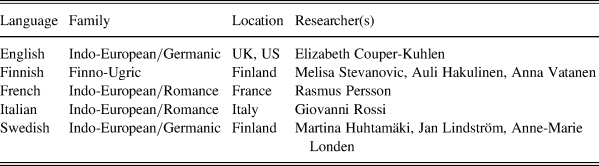
The project reported on in this special issue is based on data from naturally occurring conversation in five languages, collected and analysed by a team of researchers (see Table 1) that worked together between 2015 and 2018, with a primary base at the University of Helsinki.Footnote 5
Languages and researchers.

Detailed information on the languages, the particular variety or varieties examined, and on the corpora used is given in the language-specific articles. However, a few general notes on our corpora are in order here. All corpora include recordings of face-to-face conversation, with the English, Finnish, and French corpora also featuring telephone conversations. A large proportion of the conversations is informal, taking place in domestic settings among family, friends, and neighbours. Some French and Swedish recordings are from institutional settings, including service encounters at a ticket office, in a bakery, in a cheese shop, as well as workplace interactions and radio phone-in shows. Pooling data from these different settings is warranted by the fact that we did not observe any particular effects of setting on the resources that speakers use to design and understand other-repetitions. What we do observe is that certain kinds of institutional interactions, especially service encounters and radio phone-in shows, can increase the frequency of certain functions of other-repetition, especially registering (see extract (1) below). These imbalances in the frequency of certain functions, however, do not affect the main goal of the project, which is to account for how speakers and recipients distinguish among them.
All of the studies in this special issue draw on methods from linguistics and conversation analysis, including two particular intersections between these fields: the prosody and phonetics of talk-in-interaction, and pragmatic typology.Footnote 6 The main tenets and specifics of the methods used in these fields have already been extensively discussed in the previous two sections. With respect to pragmatic typology, however, it may be worth going over some of the practical steps of its mixed methodology to better situate the work reported in this special issue within the larger project of which it is part. As already discussed, the project as a whole joins a recent lineage of research involving the structured comparison of a formally and sequentially delimited phenomenon across languages. This begins with data sessions devoted to the qualitative analysis of audiovisual recordings in each language, with a thoroughgoing examination of each exchange in its own right, situated in the richness of its social context and enmeshed in a flux of other events. This allows analysts to get a firm grasp of the details of single cases before making generalisations across cases, and to identify deviations from a pattern that may reveal the violation of an underlying norm, thereby providing evidence for it. This qualitative analysis is also aimed at developing a principled definition of the phenomenon, which requires the discussion of borderline cases. Firming up the boundaries of the phenomenon is a prerequisite for the systematic collection of cases on a large scale; together with the qualitative analysis of linguistic and interactional patterns, this provides the foundation for the subsequent quantitative analysis. This phase begins with the design of a coding scheme to capture the core set of formal and functional categories, parameters, and variables that have emerged from the qualitative analysis and that are amenable to quantification. The coding scheme is piloted, revised, and then further refined after group coding exercises, which serve to increase the calibration among coders. When the coding scheme has been sufficiently tested and assimilated, the independent coding of each language's dataset can begin. The last step in the process is a test of intercoder reliability.
The coding scheme designed for the quantitative stage of the present project and the main quantitative cross-linguistic analysis are in preparation for publication at a later stage. The findings reported in the language-specific articles in this special issue are primarily the product of qualitative analysis.
DELIMITING THE PHENOMENON
We have already delimited our phenomenon as: verbal repetition, intended as exact or modified replication of lexical material, produced by someone other than the speaker of the first saying, so as to problematise or otherwise engage with what has been said making a response conditionally or optionally relevant. Here we draw the boundaries of the phenomenon in greater detail.
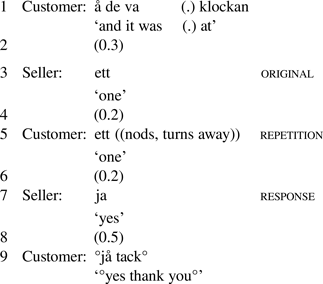
Let us begin by describing its basic sequential structure. Extract (1) reproduces the final moments of a service encounter at a ticket office (from Huhtamäki, Lindström, & Londen, this issue). Before the extract begins, the customer has sought and obtained information about an upcoming event from the ticket seller, and has begun moving away from the counter. The customer then stops and turns back to the ticket seller to double check on the time of the event (line 1).
(1) Swedish (HEL_LUC_RL_004_2 00:05)


This example makes very clear the three-part structure of an other-repetition sequence: in the original turn, Speaker A says something; in the repetition turn, Speaker B repeats all or part of what Speaker A has said; in the response turn, Speaker A responds to the repetition.Footnote 7 This pattern is in many respects analogous to that of an other-initiated repair sequence (Schegloff, Jefferson, & Sacks Reference Schegloff, Jefferson; and Sacks1977; Dingemanse & Enfield Reference Dingemanse and Enfield2015). However, the phenomenon of other-repetition is formally narrower and functionally wider than other-initiated repair, so it is important to further specify its boundaries in terms of linguistic construction, turn structure, sequential position, and response relevance.
Linguistic construction
Repetition is here intended as a lexical ‘near copy’ of the original saying (word, phrase, clause) with no or little modification. Modification is limited to deictic shifts between first and second person (e.g. extract (5)), changes in word order (e.g. extract (5)), the insertion of a particle, adjective, or adverbial (e.g. A: he wants a hug B: now he wants a hug?), and pronominalisation (e.g. A: Mary sold her car B: she sold her car?). We exclude repetition in the form of a pro-verb that stands for a verb in the original saying (e.g. A: they really love him B: do they?/they do?).
Turn structure
The repetition is the first unit in the turn or is preceded only by a turn-initial particle (e.g. oh). We exclude repetitions framed by a preface like the English what do you mean x, Italian come x, and French comment ça x, as well as repetitions with an in situ question word (e.g. she saw who?). We do include repetitions followed by further turn-constructional units.
Sequential position
The repetition is produced in next turn to the original saying or soon thereafter. While there can be intervening talk, this is generally restricted to cases of overlap and concurrent sequences, for example when the repetition speaker needs to finish off another line of talk before addressing the original turn. We exclude cases in which the repetition is produced after an earlier response to the original turn (e.g. A: I hate him B: why?! (0.3) you hate him?!).
Response relevance
As already discussed above, our focus in this project is on other-repetitions that make a response conditionally or optionally relevant by the original speaker. Optional response relevance applies especially to repetitions enacting a third-position action, typically registering (see extract (1)). Although they do not mandate a response, these repetitions create an opportunity for it, and recipients regularly volunteer it; this ‘displays an inclination to treat the repeat as response-worthy’ (Schegloff Reference Schegloff1997:527). With repetitions enacting a third-position action, responses are normally limited to confirmation. With initiating actions, the range extends beyond confirmation to include completion, clarification, justification, and backing down, among others. Laughter may be infused in these types of responses to add a particular emotive colouring.
Because the response relevance set up by an other-repetition plays an important role in delimiting the phenomenon in focus here, I now illustrate the most recurrent types of response with examples.
Confirmation is the most frequent type of response. We have already encountered an example in extract (1), where confirmation is accomplished by a positive polar interjection (‘yes’). Our definition of confirmation is functional and encompasses various practices ranging from polar interjections to (responding) repetitions to gestures such as head nodding. It also subsumes finer-grained distinctions within the domain, for example, between ‘confirming’ and ‘affirming’ (Sorjonen Reference Sorjonen2001), though we do keep track of these when relevant for the analysis (see extract (5)). The opposite of confirmation is of course disconfirmation, which is likewise defined functionally, encompassing polar interjections, head shaking, etc.
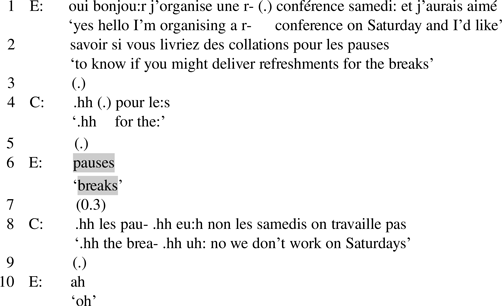
Completion refers to the reiteration of a segment of the original saying to fill a gap left by a partial repetition (Koshik Reference Koshik2002; Rossi Reference Rossi2015; Persson Reference Persson2017). This is typically a ‘missing bit’ that was not heard or understood, as illustrated in the following extract (from Persson, this issue).
(2) French (FTELPV19_0:05)

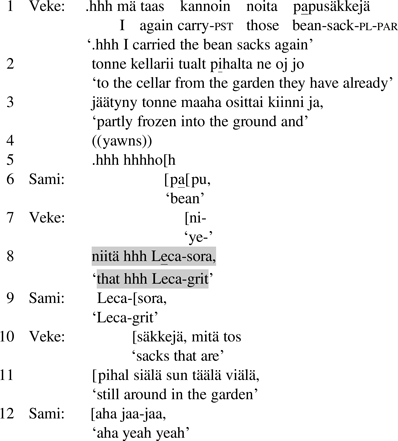
Clarification is intended as the explanation or specification of factual information or reference, aimed at making it more intelligible or plain. Extract (3) below gives us an example of clarification of a reference to an object. At line 1, Veke is talking about sacks of garden grit, referring to them as papusäkkejä ‘bean sacks’. After his interlocutor Sami repeats the problematic reference papu ‘bean’ (line 6), Veke clarifies it with Leca-sora, that is, ‘grit’ (sora) produced by the gardening brand ‘Leca’.
(3) Finnish (SG 096 B08_03.39)

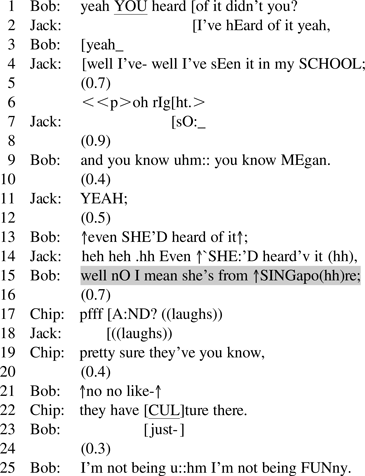
By justification we intend the action of defending or legitimising a behaviour, opinion, or expression. In the following extract (from Couper-Kuhlen, this issue), Bob is telling two friends about the amateur play he will soon be starring in at school. As evidence of the popularity of the play, Bob notes that even Megan, a mutual acquaintance from Singapore, has heard of it (lines 9–13). At this point, his friend Jack repeats what Bob has just said (‘even she'd heard of it’) to question its acceptability (line 14), conveying that it can be heard as demeaning or disrespectful of Megan. In response, Bob produces a justification (line 15) and subsequently continues to defend himself after Chip follows up on the challenge.
(4) English (Swimmers_01.23)

Whilst justification is aimed at holding one's ground, another way of responding to a challenge is by backing down, that is, by modifying the stance or expression in question (see Schegloff Reference Schegloff2007:151–55). Backdowns can range from a complete retraction to the gradual qualification of the previously held stance or expression, to a mitigated, weaker, or emended version.
Responses to other-repetition can of course contain more than one type of action, for example, confirmation followed by clarification or justification. Some combinations, however, such as justification and backing down, are unlikely. Also, completion is a very specific operation that tends to occur alone.
RECURRENT TYPES OF ACTION
One of the basic findings of the present project is that other-repetition is used to accomplish certain recurrent types of action that are common across languages. These types of action can be seen as generic functions that emerge out of the complex social-interactional contingencies and nuances that other-repetitions are enmeshed in—regular patterns that cut across the thick particulars of each case. Most types of action that we identify here have already been described, more or less extensively, in earlier research, including in studies of other-repetition. Some types have also already been found to be cross-linguistically recurrent in an earlier comparative project on other-initiated repair (Dingemanse & Enfield Reference Dingemanse and Enfield2015). In the present project, we build on this previous research to map out a larger space of action types ranging from actions that fall within repair initiation to actions that extend beyond repair initiation, to actions that are alternative to it. Our systematisation of this action space and of the distinctions within it goes hand in hand with our goal of explaining how people design and recognise the actions accomplished by other-repetition, and how this process is affected by cross-linguistic variation. Some of the action types discussed below are strongly associated with particular types of responses discussed in the previous section, including by relations of conditional relevance and type conformity (Schegloff & Sacks Reference Schegloff and Sacks1973; Raymond Reference Raymond2003); for other action types, the response space is wider and less constrained.
Initiating repair
Actions of initiating repair suspend the progress of conversation to deal with a ‘barrier’ that needs to be removed in order for intersubjectivity to be maintained and for progress to resume (Hayashi, Raymond, & Sidnell Reference Hayashi, Raymond, Sidnell, Hayashi, Raymond and Sidnell2013:13). Repetition can be deployed in different phases of the repair process, but here we are specifically interested in the initiation of repair by a person other than the speaker of the trouble-source. In this role, repetition is a practice for ‘restricted’ repair initiation (Dingemanse & Enfield Reference Dingemanse and Enfield2015) that narrows the problem down, instead of leaving it ‘open’ (Drew Reference Drew1997). This is because repetition displays greater access to the preceding talk—compared, for instance, to interjections (e.g. huh?) and question words (e.g. what? who?)—and is therefore stronger in locating and identifying where and what the trouble is (Schegloff et al. Reference Schegloff, Jefferson; and Sacks1977:369; Sidnell Reference Sidnell, Hornberger and McKay2010:117–18, among others). Within actions of initiating repair, we can distinguish different types accomplished by other-repetition. These types are best defined by reference to the kind of repair solution they seek. Here is where the pairing of initiating and responding action is characterised by conditional relevance and type conformity.
Seeking completion is a type of action that is associated with ‘hanging’ or ‘incomplete’ repetitions (Rossi Reference Rossi2015; Persson Reference Persson2017), where the speaker replicates the preceding talk up to and excluding the problematic part in order to ‘frame’ it (Jefferson Reference Jefferson and Sudnow1972). This prompts the previous speaker to fill in the rest, an example of which we have already encountered in extract (2).
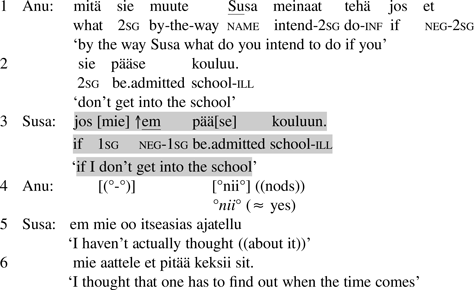
Seeking confirmation is a type of action that has been studied as part of the broader phenomenon of ‘understanding checks’ (Schegloff et al. Reference Schegloff, Jefferson; and Sacks1977) or ‘candidate understandings’ (Heritage Reference Heritage, Atkinson and Heritage1984:319), where the speaker presents a hypothesis as to what has been said or meant by the previous speaker. Here, we are interested in seeking confirmation only when done by repeating what has been said. An example can be found in the following extract (from Stevanovic et al., this issue). Anu and Susa have been talking about Susa's application to a vocational school. When the extract begins, Anu is asking Susa what her plans are in case she is not admitted (lines 1–2). Anu's question is produced very softly, almost in a whisper. Susa then repeats part of it to check that she has correctly understood the scenario invoked by Anu, that is, whether she is asking about the eventuality of Susa being not admitted to the school, as opposed to being admitted.
(5) Finnish (SG 151_21:45)

Anu's confirming response to Susa's repetition comes in the form of a positive polar interjection accompanied by a nod. Note that speakers of Finnish can select between two main verbal alternatives for confirming: nii(n) and joo, both translatable as ‘yes’. The fact that Anu uses nii here is evidence that she understands Susa's repetition as seeking confirmation (Sorjonen Reference Sorjonen, Ochs, Schegloff and Thompson1996).
Seeking clarification is a type of action by which the repetition speaker raises a problem of comprehension such as not recognising a reference or not being able to contextualise what has been said, which necessitates further specification or explanation (see e.g. Wu Reference Wu2006:76). We have already encountered an example of seeking clarification in extract (3). There the repetition does not ‘offer’ a candidate hearing or understanding to be confirmed or disconfirmed, but ‘requests’ a more complex repair operation with supplementary content to be provided by the previous speaker (Schegloff Reference Schegloff2004; Dingemanse & Enfield Reference Dingemanse and Enfield2015). While confirmation is still a possible response to a repetition seeking clarification, it is typically not treated as sufficient (see Persson, this issue).
Beyond initiating repair
In this section, we discuss actions that go beyond initiating repair simpliciter (Lerner, Bolden, Hepburn, & Mandelbaum Reference Lerner, Bolden, Hepburn and Mandelbaum2012:199), meaning that their import involves more than dealing with a problem of hearing or understanding. This ‘more’ often has to do with the unexpectedness of what the previous speaker has said (Selting Reference Selting, Couper-Kuhlen and Selting1996; Wilkinson & Kitzinger Reference Wilkinson and Kitzinger2006), for example, because it reports an extraordinary or remarkable fact, or because it presents an inappropriate or questionable view. In some cases, the work of dealing with unexpectedness is done in addition to initiating repair; in others, it is done instead of initiating repair, depending on whether or not there is a concurrent, genuine indication of a lack of understanding (Schegloff Reference Schegloff1997:505; Kendrick Reference Kendrick2015:181–82). This distinction, however, is not always clear, not only for analysts but also, arguably, for participants. For this reason, and for the purposes of systematisation and comparison of our project, we refer to these actions as going beyond initiating repair, to capture their potential to either subsume or transcend initiating repair.
Actions that go beyond initiating repair to deal with unexpectedness are less aptly defined by the kind of response they make relevant, in that the range of response options is wider and less constrained. Rather, they are better defined in terms of the interactional stance or position they express (see also Wu Reference Wu2006:78). Among the many nuances and colourings that actions in this domain can take, there are two recurrent types that stand out.
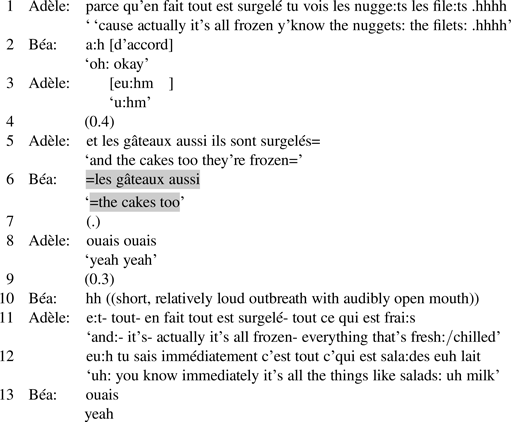
One is displaying surprise (Selting Reference Selting, Couper-Kuhlen and Selting1996; Wilkinson & Kitzinger Reference Wilkinson and Kitzinger2006). This action has been extensively studied especially with reference to expressions of ‘ritualised disbelief’ (Heritage Reference Heritage, Atkinson and Heritage1984:339) such as really, seriously, and you're kidding, which formally question the veracity of what has been said as a way of conveying the speaker's astonishment. Repetition is another practice for accomplishing this. Just like really and similar expressions, repetitions displaying surprise can be responded to with confirmation. These confirmations, however, often look different from those produced in response to a candidate hearing or understanding (cf. extract (5)) and do not usually conclude the sequence, which tends instead to be expanded with further expression of surprise, elaboration on the topic, and affiliation. In the following extract (from Persson, this issue), Adèle is talking about the procedures for keeping foodstuffs at the McDonald's she works in, which include the freezing of nuggets, filets, and ‘cakes too’ (line 5). In response to Béa's display of surprise at the revelation that ‘cakes too’ are frozen, Adèle confirms with ouais ouais ‘yeah yeah’ (line 8). The reduplicated ‘yeah’ conveys assurance of the reported fact and indicates the relevance of a stronger form of confirmation here. Béa then continues her display of surprise with a loud, open-mouthed outbreath (line 10), which is followed by Adèle's elaboration on the topic.
(6) French (Mac-cle-sd_20:30)

Another type of action in the domain of unexpectedness is questioning the acceptability of the preceding talk or, in other words, challenging. This has been the topic of a large body of research on the relation between repair initiation and incipient or manifest disagreement (Schegloff Reference Schegloff2007:151–55), part of which has focussed on other-repetition (Jefferson Reference Jefferson and Sudnow1972; Wu Reference Wu2006; Svennevig Reference Svennevig2008; Robinson & Kevoe-Feldman Reference Robinson and Kevoe-Feldman2010; Benjamin & Walker Reference Benjamin and Walker2013, among others). Issues of acceptability typically concern the truthfulness, accuracy, or appropriateness of what has been said. The difference from surprise is that here unexpectedness is morally and negatively charged. By questioning acceptability, the speaker claims that something is ‘wrong’ with the preceding talk, making the action negatively valenced. We have encountered an example of this in extract (4). In this and other cases, the speaker's stance might also be concurrently characterised as ‘surprised’, but crucially an issue of acceptability takes the stance further and gives the action a distinct import, changing the space of response options and the relations between them.Footnote 8 In extract (4), the previous speaker defends himself; in other cases, he may back down on what he has said. Yet another alternative is for the previous speaker to simply confirm—when this happens, however, confirmation amounts to resisting the challenge and often leads to more explicit disalignment and disaffiliation between participants (Jefferson Reference Jefferson and Sudnow1972:310–12).
Other than initiating repair
In this section, we discuss actions that are more clearly alternative to initiating repair, where repetition is deployed to a rather different effect and an analysis of it as involving the initiation of repair ‘would be incorrect’ (Schegloff Reference Schegloff1997:505). Perhaps the most recurrent and well established type of action in this domain is registering (Sorjonen Reference Sorjonen, Ochs, Schegloff and Thompson1996; Schegloff Reference Schegloff1997; Persson Reference Persson2015, among others). The action of registering is alternative to initiating repair in that, instead of signalling a trouble of hearing or understanding, the speaker acknowledges receipt of the preceding talk, which is ‘taken in’ rather than problematised. In a case like extract (1), this is visible in the fact that the speaker turns away while producing the repetition (line 5). At the same time, an action of registering often occasions a confirmation by the previous speaker. The social relevance of this is particularly clear in certain institutional settings where there are reasons for ratifying the correct transfer of information as part of a transaction or instruction, for example, concerning a type of service, the quantity of some good, or the time of an event (Goldberg Reference Goldberg1975). A registering repetition serves to put the information ‘on record’ (Lee Reference Lee2016). The fact that confirmation, when given, is ‘volunteered’ rather than mandated is reflected in the design of confirmation tokens (Sorjonen Reference Sorjonen, Ochs, Schegloff and Thompson1996; Persson Reference Persson2015).
The action of registering can also be coloured with additional social-interactional meanings that go beyond acknowledging receipt of information and involve, for example, displaying appreciation or affiliation (see Stevanovic et al., this issue). Other noninformational functions connect registering with other types of action that are alternative to initiating repair, including ‘mulling over’ a question (Kelly & Local Reference Kelly and Local1989:272ff) and ‘temporising’ before giving a response (Bolden Reference Bolden2009:136–38; see also Couper-Kuhlen Reference Couper-Kuhlen, Couper-Kuhlen and Selting1996:388–90). Further types of action that are alternative to initiating repair are documented elsewhere in this special issue (e.g. Persson, this issue).
To sum up this whole section, the types of action we have described reflect common social-interactional preoccupations that speakers of different languages have in conversation, surrounding mutual understanding, alignment, agreement, and affiliation. The finding that other-repetition is recurrently used to accomplish analogous actions across languages contributes to the body of evidence for a universal infrastructure of human interaction. At the same time, these commonalities in terms of sequential action provide us with yardsticks for comparing how actions are designed in different communities, and how the local resources of specific languages may introduce inflections and nuances of meaning.
CONCLUSION
The project reported on in this special issue contributes to the development of pragmatic typology as a growing field of research into the universal and culture-specific aspects of language usage and social interaction. The project focusses on a recurrent conversational phenomenon in which a speaker repeats all or part of what another speaker has just said, typically in the next turn. Other-repetition can accomplish very different interactional work, ranging from seeking clarification to expressing surprise to questioning the acceptability of what is said, spanning many of the fundamental preoccupations of human interaction: mutual understanding, alignment, agreement, and affiliation. The puzzle is: how do speakers of different languages distinguish these actions? And how do recipients know what to respond with? In addressing these questions, the project puts at centre stage the resources of prosody, generally understood as the nonlexical acoustic-auditory features of speech, along with other elements of language and context. In so doing, the project breaks new ground by bringing the systematic study of prosody into the field of pragmatic typology.
The payoffs of an approach that situates linguistic analysis and comparison in the realm of natural conversation are many. One is that it allows us to provide new, more grounded answers to questions that have been previously addressed without the support of ecologically valid data. To give an example, previous work in prosodic typology asserts that ‘echo questions’ (another term for certain other-repetitions) are ‘invariably rising in English, Swedish, French, Portuguese, Romanian and Finnish’ (Hirst & Di Cristo Reference Hirst and Cristo1998:27). Our analysis demonstrates that this is not the case, that other-repetitions are produced with a variety of intonation contours, and that the use of intonation must be studied together with other aspects of prosody. But the empirical strength of our approach goes beyond prosodic form-function mappings. Focussing on a robust conversational structure (original turn > repetition > response) gives us a controlled environment for studying the interface of prosody with a number of other interactional resources, and therefore to excavate the meanings of prosody from the complexity and richness of conversation. In this project, we adopt a framework ‘that is both interactionally sensitive and adequate for systematic comparative analyses’ (Enfield, Stivers, & Levinson Reference Enfield, Stivers; and Levinson2010:2618), allowing us to uncover basic features of human communication and sociality, in both their universal and language-specific aspects.