Introduction
Dying is not a new phenomenon, nor is caring for the dying as their physical and conscious state declines. As death approaches, there is a gradual failure of all the major organs. This progressive failure of the body's systems and organs, together with the resulting physiological and metabolic changes, are precipitating factors contributing to altered consciousness in people nearing the end of their life (Freeman, Reference Freeman2015; Matzo and Hill, Reference Matzo, Hill, Matzo and Sherman2019). This reduction in consciousness suggests that dying patients are less able, or completely unable, to communicate their own symptoms, needs, or levels of distress (Benedetti et al., Reference Benedetti, Ostgathe and Clark2013; Hui et al., Reference Hui, dos Santos and Chisholm2015b; Azhar and Bruera, Reference Azhar and Bruera2018; Campbell et al., Reference Campbell, Kiernan and Strandmark2018; Krooupa et al., Reference Krooupa, Vivat and McKeever2019). This review aims to explore the care needs of the dying as their conscious level changes. Understanding how these care needs are determined when the dying patient's conscious state changes as they progress closer to death will also be investigated.
For the purpose of this paper, and in line with the Diagnostic and Statistical Manual of Mental Disorders (DSM-5), consciousness is considered as a state of alertness (American Psychiatric Association, 2013). A more precise definition for consciousness remains elusive and has variably been described in terms of levels of awareness and intellectual function (Sarà and Pistoia, Reference Sarà and Pistoia2010; Naccache, Reference Naccache2017; Koch, Reference Koch2018; Brown et al., Reference Brown, Lau and LeDoux2019). The related term, cognition, is the ability to think, reason, and respond (American Psychiatric Association, 2013). The two terms — consciousness and cognition — are used largely interchangeably in the literature due to a lack of definitional precision (Van Gulick, Reference Van Gulick, Margolis, Samuels and Stich2012).
Improved end-of-life care and individualized care planning are fundamental to meet the specific needs of the dying individual and their family, and are recognized and championed internationally (The Institute of Medicine Committee on Approaching Death: Addressing Key End-of-Life Issues, 2014; NICE, 2017; Palliative Care Australia, 2018). Poor symptom control can be traumatic for patients and a significant source of emotional and psychological distress for their families (Donnelly et al., Reference Donnelly, Prizeman and Ó Coimín2018; Coelho et al., Reference Coelho, de Brito and Teixeira2020). How people die remains in the long-lasting memories of their families and loved ones (Saunders, Reference Saunders2006). Those who have witnessed inadequate symptom palliation in the context of their dying loved ones are often the people who are active advocates for legislative change to allow assisted dying (Feigin et al., Reference Feigin, Owens and Goodyear-Smith2019; Roest et al., Reference Roest, Trappenburg and Leget2019).
As the patient's conscious level deteriorates so too does their ability to reason, to process information and instructions, and articulate their needs or respond to stimuli (Hui et al., Reference Hui, dos Santos and Chisholm2015b). This deterioration may impact on care delivery, as the dying patient may encounter difficulties articulating their own care needs. The “gold standard” for assessing symptoms for example, is to ask the patient, because they are the ones experiencing the symptom (McColl, Reference McColl2004; Hui and Bruera, Reference Hui and Bruera2017; Wiegand et al., Reference Wiegand, Wilson and Pannullo2018). Identifying and diagnosing distressing symptoms can therefore be problematic once the dying patient is no longer able to verbalize or communicate their own care needs. Contemporary research indicates that existing assessment tools to assess dyspnea, levels of consciousness, and pain may not be appropriate for cognitively impaired dying patients (Campbell et al., Reference Campbell, Kiernan and Strandmark2018; Krooupa et al., Reference Krooupa, Vivat and McKeever2019; Tapp et al., Reference Tapp, Chenacher and Gérard2019). Further, existing reviews and studies do not provide insights into how healthcare professionals should assess the dying patients’ care needs (Plonk and Arnold, Reference Plonk and Arnold2005; Eychmüller et al., Reference Eychmüller, Benedetti and Latten2013; Kehl and Kowalkowski, Reference Kehl and Kowalkowski2013; Kennedy et al., Reference Kennedy, Brooks-Young and Brunton Gray2014; Hui et al., Reference Hui, dos Santos and Chisholm2015b; Campbell et al., Reference Campbell, Kiernan and Strandmark2018; Krooupa et al., Reference Krooupa, Vivat and McKeever2019; Tapp et al., Reference Tapp, Chenacher and Gérard2019). There is, therefore, a clinical need to appraise current evidence to understand the conscious state of the dying patient.
This integrative review, therefore, aimed to examine the existing evidence to better understand:
• the conscious state of the dying adult patient,
• whether the conscious state of the dying adult changes over time as patients progress closer to death,
• what the care needs of dying adults associated with altered levels of consciousness are; and
• how individual care needs are determined when the dying patient's conscious state changes.
Methods
An integrative review (Whittemore and Knafl, Reference Whittemore and Knafl2005) was conducted and has been reported according to the Preferred Reporting Items for Systematic Reviews and Meta-Analyses (PRIMSA) guidelines (Moher et al., Reference Moher, Liberati and Tetzlaff2009). An a priori review protocol was developed and registered with PROSPERO (registration no. CRD42020160475), available from: https://www.crd.york.ac.uk/prospero/display_record.php?ID=CRD42020160475.
Theoretical framework
Although palliative care has more recently been associated with care needs early in a progressive life-limiting illness (Waller et al., Reference Waller, Chan and Chan2020), it is traditionally associated with optimum care in the last days of life. The World Health Organization (WHO) definition for palliative care (World Health Organization, 2020) provided a conceptual framework to guide this review. Specifically, the following palliative care concepts were used to guide data extraction and analysis: quality of life, suffering, assessment and treatment, pain, physical, psychosocial, and spiritual problems, and the family (World Health Organization, 2020).
Eligibility criteria
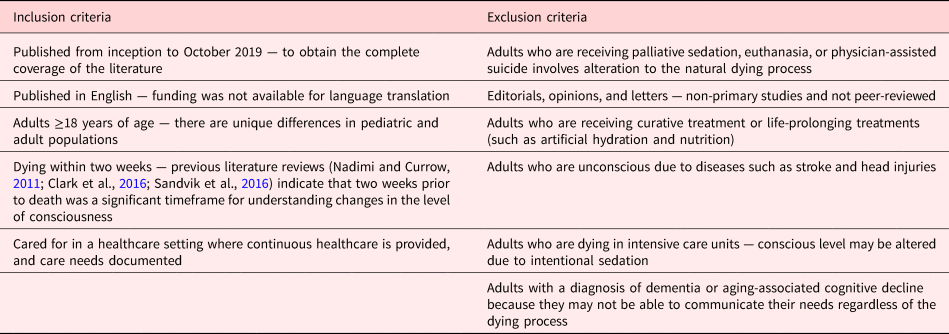
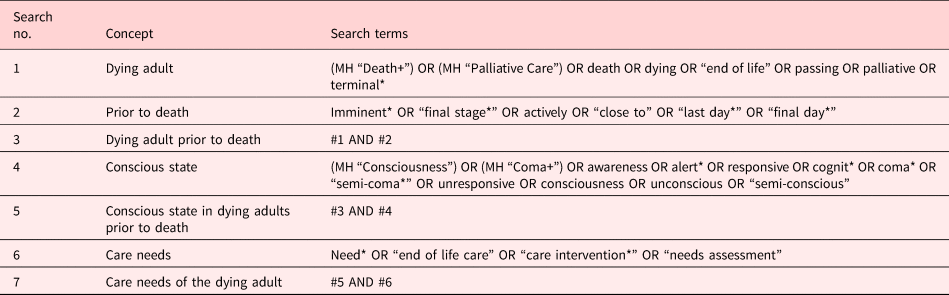
Inclusion and exclusion criteria were developed to identify studies of interest that addressed the review's aims (see Table 1 for inclusion and exclusion criteria with rationales). A systematic electronic literature search of CINAHL, MEDLINE (OVID), Scopus, PsycINFO, Cochrane Library, and PubMed was conducted in collaboration with a professional university research librarian. Subject headings and keywords were adapted according to the nuances of each database using MESH subject headings and other key search terms (see Table 2).
Inclusion and exclusion criteria

Example of database search strategy for CINAHL and MEDLINE

Search outcome
All references were uploaded to EndNote™ (X9.3) and then exported to Covidence™ (Covidence Systematic Review Software) where duplicates were removed. Covidence™ was used to complete the title and abstract screening based on the inclusion and exclusion criteria across the reviewers. Relevant titles and abstracts meeting the inclusion criteria were moved to full-text review screening. Full-text publications were reviewed by three researchers. Where required, consultation with a fourth reviewer resolved any disagreements. Authors of one study (Geijteman et al., Reference Geijteman, van der Graaf and Witkamp2018) were contacted seeking more complete data. It was later identified that this study did not meet the inclusion criteria (Geijteman et al., Reference Geijteman, van der Graaf and Witkamp2018). Citation tracking was used in the Scopus database, hand searches of reference lists, and review of existing systematic reviews. Searches of gray literature were conducted via Google Scholar to increase inclusiveness.
Quality appraisal
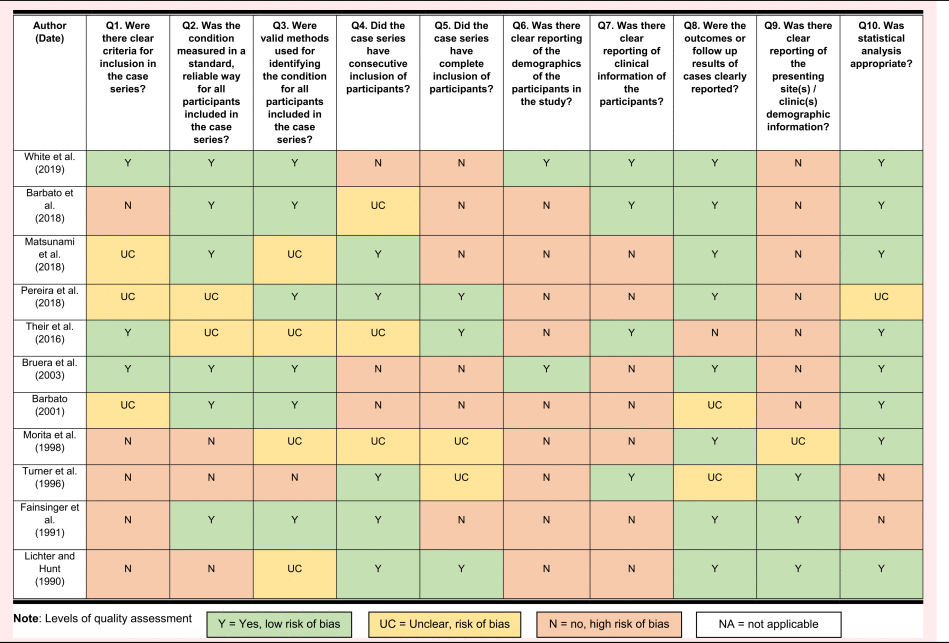
The included studies were assessed for methodological quality using the Joanna Briggs Institute's (JBI) Critical Appraisal Tool: the “Checklist for Case Series” (Moola et al., Reference Moola, Munn, Tufanaru, Aromataris and Munn2017). The Case Series appraisal tool is to be applied to studies where all participants have a specific disease or specific disease-related outcome (Moola et al., Reference Moola, Munn, Tufanaru, Aromataris and Munn2017, p. 4). This appraisal tool enabled the assessment of differing study designs and was considered appropriate as the disease-related outcome for all the studies was death. The JBI Critical Appraisal Tool allocates “yes”, “no”, “unclear”, or “not applicable” for 10 quality appraisal questions. Studies were not eliminated based on methodological quality; but rather, all studies were included with the evidence summarized and recorded noting concerns about quality or risk of bias.
Data abstraction
Data abstraction was informed by the WHO definition for palliative care (World Health Organization, 2020) and the aims of the review. The following information was extracted and tabulated in an MS Excel™ spreadsheet: primary author, publication year, country, purpose, sample size, design, assessment tools, data collection, and data analysis. Details describing any change in conscious state, care needs, quality of life, assessment, treatments or interventions, pain, and any other details of suffering (physical, psychosocial, or spiritual) were also extracted. Any references to family within the individual studies were also extracted. Data were extracted from all included studies and double-checked for accuracy and completeness. Any disagreement or uncertainty in data extraction was resolved by discussion among the four reviewers.
Data synthesis
Extracted data were synthesized using a narrative approach. A thematic analysis was undertaken following the process outlined by Braun and Clarke (Reference Braun and Clarke2006) (see Supplementary Material 1) and guided by the WHO definition for palliative care (World Health Organization, 2020).
Results
Search results
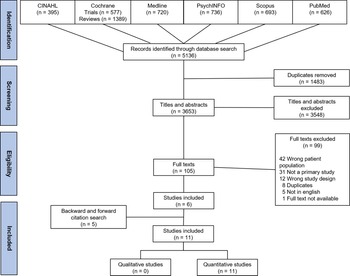
The search identified 5,136 studies, of which 105 studies were assessed in full text according to the inclusion and exclusion criteria. A further five articles were identified from backward and forward citation tracking, and hand search processes. A total of 11 studies fully met the inclusion criteria (see Figure 1).
PRISMA.

Quality appraisal results
Based on the JBI Level of Evidence (The Joanna Briggs Institute Levels of Evidence and Grades of Recommendation Working Party, 2014), all included studies were classified as level four, namely, observational descriptive studies. No studies were graded level 1 to 3, suggesting that robust, higher levels of evidence in this area are currently lacking. The quality appraisal identified several limitations among the included studies. All studies received low to moderate scores for methodological quality (see Table 3). The most common limitation across the studies was poor reporting of the independent variables [demographics (n = 9) and clinical information (n = 7)]. There is, therefore, a risk that confounding factors may have introduced bias in these studies and as such, the results should be viewed with caution. Secondly, 6 of the 11 studies were published more than 15 years ago. Thus, some of the data may not be representative of contemporary clinical practice. Thirdly, the included studies had small sample sizes, and many were retrospective case series studies. The lack of qualitative studies meant the voices of the patients, and the staff providing for their care needs were not fully reflected in the literature. The findings of this review should be viewed in this context.
JBI risk of bias results

Study characteristics
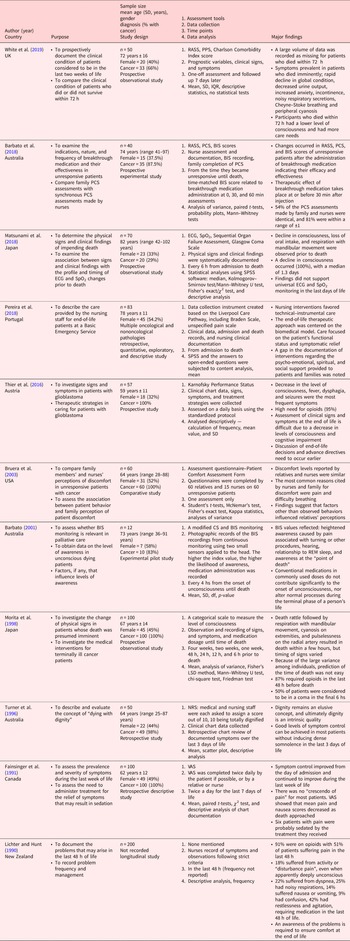
All 11 studies used quantitative designs (see Table 4). None of the studies reported a theoretical model or conceptual framework. Non-probability sampling methods were used across all the studies. The studies represented clinical settings in eight different countries: Australia (n = 3), Japan (n = 2), Austria (n = 1), Canada (n = 1), New Zealand (n = 1), Portugal (n = 1), the UK (n = 1), and the USA (n = 1). The studies were published between 1990 (Lichter and Hunt, Reference Lichter and Hunt1990) and 2019 (White et al., Reference White, Reid and Harries2019). There was a combined total of 822 participants, ranging from 12 to 200 participants (Lichter and Hunt, Reference Lichter and Hunt1990; Fainsinger et al., Reference Fainsinger, Miller and Bruera1991; Turner et al., Reference Turner, Chye and Aggarwal1996; Morita et al., Reference Morita, Ichiki and Tsunoda1998; Barbato, Reference Barbato2001; Bruera et al., Reference Bruera, Sweeney and Willey2003; Thier et al., Reference Thier, Calabek and Tinchon2016; Barbato et al., Reference Barbato, Barclay and Potter2018; Matsunami et al., Reference Matsunami, Tomita and Touge2018; Pereira et al., Reference Pereira, Barbosa and Dixe2018; White et al., Reference White, Reid and Harries2019). Generally, the studies had representation of both males and females, with slightly more male participants represented (56%). The average age was 64 years, with a range of 25–102 years. One study did not record age nor gender (Lichter and Hunt, Reference Lichter and Hunt1990). Studies either exclusively or predominantly focused on participants with a diagnosis of cancer. All studies discussed dying patients with an altered level of consciousness, however, not all participants died. Two studies compared nurses’ and families’ perceptions of patient comfort and did not indicate if any participants died during the studies (Bruera et al., Reference Bruera, Sweeney and Willey2003; Barbato et al., Reference Barbato, Barclay and Potter2018). A further study compared the clinical condition of those who died within 72 h [48% (n = 24)] with those who lived longer than 72 h [52% (n = 26)] (White et al., Reference White, Reid and Harries2019). The use of various assessment tools and scales were reported (see Table 4). One study did not specify any particular assessment tool or scale (Lichter and Hunt, Reference Lichter and Hunt1990).
Overview of the included studies

Abbreviations: BIS, Bispectral Index Score; CS, Consciousness Score; df, degrees of freedom; ECG, electrocardiogram; Fisher's LSD method, Fisher's least significant difference; IQR, interquartile range; NRS, Numerical Rating Scale; PCS, Patient Comfort Score; PPS, Palliative Performance Scale; REM, rapid eye movement; RASS, Richmond Agitation-Sedation Scale; SpO2, peripheral capillary oxygen saturation; SPSS software, Statistical Package for the Social Sciences; SD, standard deviation; VAS, Visual Analogue Scale.
Conscious state, awareness, and change over time
Two themes addressing the conscious state of the dying adult were identified in the thematic analysis, namely, the conscious state and change over time, and awareness.
Conscious state and change over time
Various terms were used across the studies to describe the conscious state of the dying patient prior to death: “conscious” or “unconscious” state [55% (n = 6)] (Lichter and Hunt, Reference Lichter and Hunt1990; Turner et al., Reference Turner, Chye and Aggarwal1996; Barbato, Reference Barbato2001; Thier et al., Reference Thier, Calabek and Tinchon2016; Matsunami et al., Reference Matsunami, Tomita and Touge2018; White et al., Reference White, Reid and Harries2019), “unresponsive” [27% (n = 3)] (Fainsinger et al., Reference Fainsinger, Miller and Bruera1991; Bruera et al., Reference Bruera, Sweeney and Willey2003; Barbato et al., Reference Barbato, Barclay and Potter2018), and “comatose” [18% (n = 2)] (Morita et al., Reference Morita, Ichiki and Tsunoda1998; Pereira et al., Reference Pereira, Barbosa and Dixe2018) (see Supplementary Material 2). In three studies, 100% of participants were reported as unconscious/unresponsive prior to death (Barbato, Reference Barbato2001; Bruera et al., Reference Bruera, Sweeney and Willey2003; Barbato et al., Reference Barbato, Barclay and Potter2018).
Only one study provided a definition for “unconscious”, stating that “patients responded lethargically or not at all to their name being spoken, and had infrequent or no spontaneous movements” (Barbato, Reference Barbato2001, p. 104). Three studies described or implied that “unconscious” was being unable to respond to questions regarding symptoms (Turner et al., Reference Turner, Chye and Aggarwal1996; Bruera et al., Reference Bruera, Sweeney and Willey2003; White et al., Reference White, Reid and Harries2019). Morita et al. (Reference Morita, Ichiki and Tsunoda1998) provided a categorical scale to measure the patients’ level of consciousness which described states between awake and coma, where coma was defined as “does not awaken to any stimuli” (Morita et al., Reference Morita, Ichiki and Tsunoda1998, p. 218).
Despite the lack of definitions used across the studies, five different tools were used to assess the conscious state of dying patients, namely, a modified Consciousness Scale (Barbato, Reference Barbato2001), Bispectral Index monitoring (Barbato, Reference Barbato2001; Barbato et al., Reference Barbato, Barclay and Potter2018), Richmond Agitation-Sedation Scale (Barbato et al., Reference Barbato, Barclay and Potter2018; White et al., Reference White, Reid and Harries2019), Glasgow Coma Scale (Matsunami et al., Reference Matsunami, Tomita and Touge2018), and a Categorical Scale designed to measure patients’ level of consciousness (Morita et al., Reference Morita, Ichiki and Tsunoda1998). An assessment of behavior and consciousness was completed in 96.4% (80) of patients in another study, but the assessment tool used was not reported (Pereira et al., Reference Pereira, Barbosa and Dixe2018).
A gradual decline in conscious levels over a period of 7 days to death was identified in three studies (Lichter and Hunt, Reference Lichter and Hunt1990; Fainsinger et al., Reference Fainsinger, Miller and Bruera1991; Morita et al., Reference Morita, Ichiki and Tsunoda1998). Morita et al. (Reference Morita, Ichiki and Tsunoda1998) found that none of the participants in their study were in a coma 7 days prior to death. An increase of 12% (n = 12) of the participants were in a coma 1 day prior to death, with 50% (n = 50) of the participants in a coma on the day of death (Morita et al., Reference Morita, Ichiki and Tsunoda1998) (see Supplementary Material 2). Similarly, Fainsinger et al. (Reference Fainsinger, Miller and Bruera1991) reported that 57% (n = 57) of participants were unresponsive on the day of death. In contrast, a lesser number of study participants (38%, n = 76) were described by Lichter and Hunt (Reference Lichter and Hunt1990) as unconscious on the day of death.
Four studies referred to delirium (Lichter and Hunt, Reference Lichter and Hunt1990; Fainsinger et al., Reference Fainsinger, Miller and Bruera1991; Turner et al., Reference Turner, Chye and Aggarwal1996; White et al., Reference White, Reid and Harries2019). In one study, delirium was included as a key prognostic feature in a table with no mention elsewhere (White et al., Reference White, Reid and Harries2019). Another reported that delirium did not frequently occur (Turner et al., Reference Turner, Chye and Aggarwal1996). The third study reported that 39% (39) of participants experienced delirium, and 26% (10) of those that developed a delirium required additional treatment to relieve their symptoms (Fainsinger et al., Reference Fainsinger, Miller and Bruera1991). Fainsinger et al. (Reference Fainsinger, Miller and Bruera1991) reported that delirium was the most difficult symptom to control without using sedation. A cause for delirium in the dying was difficult to find (Lichter and Hunt, Reference Lichter and Hunt1990). Four studies (Lichter and Hunt, Reference Lichter and Hunt1990; Bruera et al., Reference Bruera, Sweeney and Willey2003; Barbato et al., Reference Barbato, Barclay and Potter2018; Pereira et al., Reference Pereira, Barbosa and Dixe2018) used related terms such as restlessness, agitation, confusion, and disorientation without being definitive about whether they were referring to delirium or not.
Eighteen percent of participants (n = 15) were reported to suffer agitation and 19% (n = 16) disorientation or confusion in the chart review by Pereira et al. (Reference Pereira, Barbosa and Dixe2018). Together with delirium, the table presented in the study by White et al. (Reference White, Reid and Harries2019) revealed that 20% (n = 5) of participants who died within 72 h of assessment were agitated, while 70% (n = 18) of those who did not die within 72 h had mild agitation or were sedated. Lichter and Hunt (Reference Lichter and Hunt1990) found that 42% (n = 84) of the participants experienced restlessness and agitation in the last 48 h of life.
Awareness
Despite a decline in consciousness related to dying, and associated medication administration for symptom management, results from two studies found evidence of participants experiencing signs of awareness (Lichter and Hunt, Reference Lichter and Hunt1990; Barbato, Reference Barbato2001). These authors reported that apparently unconscious patients demonstrated an awareness of pain and discomfort during care activities, such as repositioning or during the provision of fundamental care interventions (Lichter and Hunt, Reference Lichter and Hunt1990; Barbato, Reference Barbato2001).
Awareness was recorded via bispectral index monitoring (Barbato, Reference Barbato2001) and staff observation (Lichter and Hunt, Reference Lichter and Hunt1990). Bispectral index monitoring is described by Barbato (Reference Barbato2001) as a noninvasive method of electroencephalography monitoring, where two small sensors are applied to the head. The higher the index value, the higher the likelihood of awareness (Barbato, Reference Barbato2001). Barbato (Reference Barbato2001) reported values fluctuating above basal levels in response to pain and nursing procedures. In the study by Lichter and Hunt (Reference Lichter and Hunt1990), staff recorded all symptoms and observations using strict criteria. The nature of the criteria was not reported.
Several studies noted that sedation secondary to medication was a cause for an altered conscious state in the dying patient (Lichter and Hunt, Reference Lichter and Hunt1990; Fainsinger et al., Reference Fainsinger, Miller and Bruera1991; Turner et al., Reference Turner, Chye and Aggarwal1996; Barbato et al., Reference Barbato, Barclay and Potter2018). This induced reduction in cognition and awareness was variously viewed as justifiable (Barbato et al., Reference Barbato, Barclay and Potter2018), defensible (Barbato et al., Reference Barbato, Barclay and Potter2018), unavoidable (Lichter and Hunt, Reference Lichter and Hunt1990), and preferable (Turner et al., Reference Turner, Chye and Aggarwal1996).
Care needs of the dying adult with an altered level of consciousness
Four themes were identified which described the care needs of the dying adult with an altered level of consciousness, namely, pain, absence of holistic care, the voiceless patient, and signs and symptoms of dying.
Pain
Pain was mentioned in 81.8% (n = 9) of studies (Lichter and Hunt, Reference Lichter and Hunt1990; Fainsinger et al., Reference Fainsinger, Miller and Bruera1991; Turner et al., Reference Turner, Chye and Aggarwal1996; Barbato, Reference Barbato2001; Bruera et al., Reference Bruera, Sweeney and Willey2003; Thier et al., Reference Thier, Calabek and Tinchon2016; Barbato et al., Reference Barbato, Barclay and Potter2018; Pereira et al., Reference Pereira, Barbosa and Dixe2018; White et al., Reference White, Reid and Harries2019). Physical and observable indications associated with pain were only described in 4 of the 11 studies (Lichter and Hunt, Reference Lichter and Hunt1990; Barbato, Reference Barbato2001; Bruera et al., Reference Bruera, Sweeney and Willey2003; Pereira et al., Reference Pereira, Barbosa and Dixe2018).
Only two pain assessment tools were referred to across the 11 studies: the Patient Comfort Score (PCS) (Barbato et al., Reference Barbato, Barclay and Potter2018) (described by the author as a numeric scale), Visual Analogue Scale (VAS) (Fainsinger et al., Reference Fainsinger, Miller and Bruera1991).
The terms narcotics, opioids, or morphine were specifically mentioned in 8 of the 11 studies (Lichter and Hunt, Reference Lichter and Hunt1990; Fainsinger et al., Reference Fainsinger, Miller and Bruera1991; Turner et al., Reference Turner, Chye and Aggarwal1996; Morita et al., Reference Morita, Ichiki and Tsunoda1998; Barbato, Reference Barbato2001; Thier et al., Reference Thier, Calabek and Tinchon2016; Barbato et al., Reference Barbato, Barclay and Potter2018; Pereira et al., Reference Pereira, Barbosa and Dixe2018). Between 86% (n = 480) and 100% (n = 558) of patients were recorded as receiving opioids before their death (Lichter and Hunt, Reference Lichter and Hunt1990; Fainsinger et al., Reference Fainsinger, Miller and Bruera1991; Turner et al., Reference Turner, Chye and Aggarwal1996; Morita et al., Reference Morita, Ichiki and Tsunoda1998; Barbato, Reference Barbato2001; Thier et al., Reference Thier, Calabek and Tinchon2016; Barbato et al., Reference Barbato, Barclay and Potter2018). Two studies indicated that 92% (n = 48) to 100% (n = 52) of dying patients were on a continuous infusion of opioids (Barbato, Reference Barbato2001; Barbato et al., Reference Barbato, Barclay and Potter2018).
Absence of holistic care
There was no reference made to the emotional, psychological, spiritual, or social issues in relation to the dying patient in 5 of the 11 studies (Morita et al., Reference Morita, Ichiki and Tsunoda1998; Barbato, Reference Barbato2001; Thier et al., Reference Thier, Calabek and Tinchon2016; Barbato et al., Reference Barbato, Barclay and Potter2018; Matsunami et al., Reference Matsunami, Tomita and Touge2018). In those studies that did comment, two noted the lack of documentation in patient records regarding emotional, psychological, spiritual, or social care needs (Pereira et al., Reference Pereira, Barbosa and Dixe2018; White et al., Reference White, Reid and Harries2019). Although emotional distress was one of the checklist reasons suggested for discomfort in Bruera et al. (Reference Bruera, Sweeney and Willey2003), there was no further mention of emotional care or distress in the study. Reported psychosocial and spiritual issues for the patient (Lichter and Hunt, Reference Lichter and Hunt1990) and the emotional distress of the family (Fainsinger et al., Reference Fainsinger, Miller and Bruera1991) were considered resolved once medical treatment was administered in two other studies. Turner et al. (Reference Turner, Chye and Aggarwal1996) also listed emotional distress as a symptom; however, actions to manage or treat this symptom were not discussed.
The voiceless patient
All the included studies were quantitative in design; consequently, the voice and experience of the patient with altered levels of consciousness is silent. Perspectives and information were sought from nurses, family members, and equipment being trialled (Barbato, Reference Barbato2001; Bruera et al., Reference Bruera, Sweeney and Willey2003; Barbato et al., Reference Barbato, Barclay and Potter2018). Data regarding pain on the day death for 90% (n = 90) of patients were completed by the nurse (Fainsinger et al., Reference Fainsinger, Miller and Bruera1991). The retrospective study designs adopted by some researchers also resulted in the voice of the patient not being reported (Fainsinger et al., Reference Fainsinger, Miller and Bruera1991; Turner et al., Reference Turner, Chye and Aggarwal1996; Pereira et al., Reference Pereira, Barbosa and Dixe2018).
Research consent is an important area of note across the 11 studies. Only 27% (n = 3) of studies documented obtaining consent from patients and/or next of kin (Barbato, Reference Barbato2001; Barbato et al., Reference Barbato, Barclay and Potter2018; White et al., Reference White, Reid and Harries2019). Four of the studies did not mention research consent (Lichter and Hunt, Reference Lichter and Hunt1990; Fainsinger et al., Reference Fainsinger, Miller and Bruera1991; Turner et al., Reference Turner, Chye and Aggarwal1996; Morita et al., Reference Morita, Ichiki and Tsunoda1998), and a further four studies stated that consent was waivered at their institution due to the study design for chart reviews and observational studies (Bruera et al., Reference Bruera, Sweeney and Willey2003; Thier et al., Reference Thier, Calabek and Tinchon2016; Matsunami et al., Reference Matsunami, Tomita and Touge2018; Pereira et al., Reference Pereira, Barbosa and Dixe2018). One study referred to legislation and mental capacity in the context of informed consent (White et al., Reference White, Reid and Harries2019).
Signs and symptoms of dying
The patients’ signs and symptoms varied and were widely discussed as predictors of dying. Respiratory changes were the most dominant sign and symptom reported by 91% (n = 10) of authors (Lichter and Hunt, Reference Lichter and Hunt1990; Fainsinger et al., Reference Fainsinger, Miller and Bruera1991; Turner et al., Reference Turner, Chye and Aggarwal1996; Morita et al., Reference Morita, Ichiki and Tsunoda1998; Bruera et al., Reference Bruera, Sweeney and Willey2003; Thier et al., Reference Thier, Calabek and Tinchon2016; Barbato et al., Reference Barbato, Barclay and Potter2018; Matsunami et al., Reference Matsunami, Tomita and Touge2018; Pereira et al., Reference Pereira, Barbosa and Dixe2018; White et al., Reference White, Reid and Harries2019). The prevalence of dyspnea was reported by Fainsinger et al. (Reference Fainsinger, Miller and Bruera1991) in 46% (n = 46) of participants, Lichter and Hunt (Reference Lichter and Hunt1990) 22% (n = 44), Pereira et al. (Reference Pereira, Barbosa and Dixe2018) 61% (n = 51), Turner et al. (Reference Turner, Chye and Aggarwal1996) 26% (n = 13), and White et al. (Reference White, Reid and Harries2019) as 8% (n = 2). Difficult and noisy respirations were also recorded as being problematic in between 31% (n = 26) (Pereira et al., Reference Pereira, Barbosa and Dixe2018) and 56% (n = 112) (Lichter and Hunt, Reference Lichter and Hunt1990) of participants. The main indication for breakthrough medication was respiratory in nature (Barbato et al., Reference Barbato, Barclay and Potter2018). Several studies (n = 4, 36.3%) indicated that respiratory issues in the dying patient were likely to cause suffering for the patient, family, and staff (Lichter and Hunt, Reference Lichter and Hunt1990; Turner et al., Reference Turner, Chye and Aggarwal1996; Bruera et al., Reference Bruera, Sweeney and Willey2003; Barbato et al., Reference Barbato, Barclay and Potter2018).
One of the physical signs that indicated imminent death on the last day of life is respiration with mandibular movement, according to Matsunami et al. (Reference Matsunami, Tomita and Touge2018) and White et al. (Reference White, Reid and Harries2019). Thier et al. (Reference Thier, Calabek and Tinchon2016) described a decreased level of consciousness, fever, dysphagia, and seizures as the most frequently reported symptoms in people dying with a glioblastoma. Elsewhere, Lichter and Hunt (Reference Lichter and Hunt1990) identified that symptoms such as twitching, jerking, restlessness, agitation, and “plucking” were observed in the period before death. White et al. (Reference White, Reid and Harries2019) documented a decrease in oral intake, a rapid decline in health, and a decreased level of consciousness as indications of dying. Although White et al. (Reference White, Reid and Harries2019) identified increased care needs, this was not the aim of their study. The study aimed to detect and document signs and symptoms of dying as prognostic markers with view to improving the skill level of staff in identifying patients whose death was imminent (White et al., Reference White, Reid and Harries2019).
Cognizant of the variation in findings, Morita et al. (Reference Morita, Ichiki and Tsunoda1998, p. 220) concluded that there was diversity among individual dying patients signs and symptoms which made it difficult to predict the time of death.
Discussion
This integrative review identified and confirmed changes over time in the conscious state of dying adults prior to death. Although the aims and purposes of the 11 selected studies were diverse, the timeframes, prognosis, and symptoms that predict dying in the selected studies were congruent with other reported results (Eychmüller et al., Reference Eychmüller, Benedetti and Latten2013; Kennedy et al., Reference Kennedy, Brooks-Young and Brunton Gray2014; Hui et al., Reference Hui, dos Santos and Chisholm2015a; Clark et al., Reference Clark, Connolly and Clapham2016; Sandvik et al., Reference Sandvik, Selbaek and Bergh2016). This review extends our current knowledge by tabulating the gradual but consistent deterioration in the cognitive state of dying patients in the last days of life. A lack of definitional clarity for terms such as consciousness was evident within the studies but consistent with other literature (Sarà and Pistoia, Reference Sarà and Pistoia2010; Naccache, Reference Naccache2017; Koch, Reference Koch2018; Brown et al., Reference Brown, Lau and LeDoux2019).
There is currently significant clinical uncertainty about what the dying person is experiencing. Due to the physiological process of dying, loss of both motor function and verbal response is common. However, the findings of this integrative review identified that patients may have periods of heightened awareness during, for example, repositioning or during the provision of hygiene care (Lichter and Hunt, Reference Lichter and Hunt1990; Barbato, Reference Barbato2001). Anecdotal evidence suggests that apparent unconscious patients may maintain the ability to hear until the last moments of life (Freeman, Reference Freeman2015; Matzo and Hill, Reference Matzo, Hill, Matzo and Sherman2019). Emerging scientific research confirms this, indicating that dying patients may in fact have a level of awareness, even when that awareness cannot be physically communicated during the last hours of life (Rady and Verheijde, Reference Rady and Verheijde2016; Blundon et al., Reference Blundon, Gallagher and Ward2020). Awareness indicates not only the ability to hear but also to maintain a perception of self and the environment (Rady and Verheijde, Reference Rady and Verheijde2016). The dying patient should therefore be considered “unresponsive” rather than “unconscious” (Rady and Verheijde, Reference Rady and Verheijde2013; Barbato et al., Reference Barbato, Barclay and Potter2015). Noxious stimuli, such as movement after several hours of inertia, may therefore cause pain and discomfort in the dying. The inability to self-express, combined with an absence of visible markers of pain and discomfort, could mean that pain and suffering are not being recognized or considered in the dying patient with an altered or diminished level of consciousness. These findings have significant implications for the care needs of dying patients.
This review also highlighted a further cohort of patients who may be unable to convey their own care needs: those who develop delirium or become terminally restless or agitated due to the dying process (Lichter and Hunt, Reference Lichter and Hunt1990; Fainsinger et al., Reference Fainsinger, Miller and Bruera1991; Turner et al., Reference Turner, Chye and Aggarwal1996; Bruera et al., Reference Bruera, Sweeney and Willey2003; Barbato et al., Reference Barbato, Barclay and Potter2018; Pereira et al., Reference Pereira, Barbosa and Dixe2018; White et al., Reference White, Reid and Harries2019). The incidence of delirium is reported elsewhere, varying from 58% to 88% in dying patients, with the prevalence increasing closer to death (Hosie et al., Reference Hosie, Davidson and Agar2013, Reference Hosie, Siddiqi and Featherstone2019; Lawlor et al., Reference Lawlor, Davis and Ansari2014; Maeda et al., Reference Maeda, Ogawa and Yoshiuchi2020; Watt et al., Reference Watt, Scott and Webber2021). Delirium affects perception, attention, and communication, leading to a reduced ability to express symptoms (Hosie et al., Reference Hosie, Siddiqi and Featherstone2019; Hui, Reference Hui2019). Despite delirium being an important area of concern at the end of life, only 3 of the 11 studies mentioned delirium (Fainsinger et al., Reference Fainsinger, Miller and Bruera1991; Turner et al., Reference Turner, Chye and Aggarwal1996; White et al., Reference White, Reid and Harries2019). This is consistent with other recent research, suggesting that delirium is often not recognized or not identified in palliative care patients (Watt et al., Reference Watt, Scott and Webber2021), despite the availability of both diagnostic criteria (American Psychiatric Association, 2013) and validated delirium screening tools (Watt et al., Reference Watt, Scott and Webber2021). Given that delirium is perceived as a very distressing condition by those who have experienced it and recovered (Kuusisto-Gussmann et al., Reference Kuusisto-Gussmann, Höckelmann and von der Lühe2021), it is possible that the dying patient with an altered level of consciousness is equally distressed. The findings of this integrative review agree with the previously reported findings regarding the lack of available guidance, and the difficulty in assessing the care needs of the voiceless and vulnerable dying patient with delirium (Gao et al., Reference Gao, Prigerson and Diamond2013; Lawlor et al., Reference Lawlor, Davis and Ansari2014; Blinderman and Billings, Reference Blinderman and Billings2015; Mah et al., Reference Mah, Rodin and Chan2017).
Various assessment tools and scales were reported across 10 of the 11 included studies. Only two studies reported the use of pain assessment tools: VAS and PCS (Fainsinger et al., Reference Fainsinger, Miller and Bruera1991; Barbato et al., Reference Barbato, Barclay and Potter2018). Other research comparing the VAS and Numeric Rating Scale found that both these subjective pain assessment tools require some level of cognitive ability to comprehend the questions and formulate an opinion (Hjermstad et al., Reference Hjermstad, Gibbins and Haugen2008, Reference Hjermstad, Fayers and Haugen2011). Importantly, this integrative review has provided evidence that across 8 of the 11 studies that more than half of the study participants had a decreased conscious state prior to death. Recorded pain assessment scores may therefore have been the subjective evaluation by the nurse, that is, the recorded pain assessment scores describe the nurse's perception of the patient's level of pain. High rates of pain prevalence were reported in most of the studies, yet only 4 of the 11 studies documented pain markers (Lichter and Hunt, Reference Lichter and Hunt1990; Barbato, Reference Barbato2001; Bruera et al., Reference Bruera, Sweeney and Willey2003; Pereira et al., Reference Pereira, Barbosa and Dixe2018). A correspondingly high prevalence of opioid use was recorded, indicating that healthcare professionals were prescribing and administering opioids for unresponsive patients. This would suggest that a level of patient awareness was observed and/or, that a degree of assessment, diagnosis, and decision-making had taken place, yet evidence of this decision-making remains unrecorded and unknown.
Respiratory changes were the most dominant sign and symptom reported across 10 of the 11 studies, yet there was no evidence of assessment of care needs nor documentation of assessment tools or scales. Equally, nausea, vomiting, and other gastrointestinal issues were reported as problematic with no reporting on assessment. This too is consistent with other studies which report a lack of appropriate tools suitable for assessing the needs of the dying patient, such as levels of consciousness (Krooupa et al., Reference Krooupa, Vivat and McKeever2019), dyspnea (Campbell et al., Reference Campbell, Kiernan and Strandmark2018), and pain (Tapp et al., Reference Tapp, Chenacher and Gérard2019).
Given the intrinsic value of dignity in dying and the inherent importance of a “good death”, being free from pain and suffering is imperative for all dying patients (Kastbom et al., Reference Kastbom, Milberg and Karlsson2016; Meier et al., Reference Meier, Gallegos and Thomas2016; Rodríguez-Prat et al., Reference Rodríguez-Prat, Monforte-Royo and Porta-Sales2016). For the dying patient, sources of pain can be numerous (Herr et al., Reference Herr, Coyne and Ely2019). Compounding the problem, pain markers may not be a sign of physical pain but of emotional or existential pain (Herr et al., Reference Herr, Coyne and McCaffery2011; McGuire et al., Reference McGuire, Kaiser and Haisfield-Wolfe2016), yet emotional, psychological, spiritual, or social issues in relation to the dying patient were not addressed across the studies. There was no mention or discussion of referral to other members of the multidisciplinary team.
An increased need for assistance with activities of daily living would be expected as the dying patient deteriorates both physically and cognitively as death approaches. Fundamental care activities, such as the patient's personal care and oral hygiene, were only mentioned in one study (Pereira et al., Reference Pereira, Barbosa and Dixe2018). In this study, nearly 98% of patients did not have oral hygiene care documented during their admission (Pereira et al., Reference Pereira, Barbosa and Dixe2018). Perhaps these caring activities had in fact been provided and were not documented, but ultimately this will remain unknown. Kitson et al. (Reference Kitson, Carr and Conroy2019) believe that nursing notes regarding patient care are commonly deemed as “fluffy notes” (p. 2). In this context, fundamental caring activities or basic nursing care has been devalued by nurses themselves and has become invisible (Zwakhalen et al., Reference Zwakhalen, Hamers and Metzelthin2018). Yet, nursing documentation provided the foundational data utilized by the authors across the studies included in this review. “Care” is at the core of what nursing is, with care for the dying being an integral component of nursing care (Robinson et al., Reference Robinson, Moeke-Maxell and Parr2019) and is embedded within the multidisciplinary team (Epstein, Reference Epstein2014; Hickman et al., Reference Hickman, Phillips and Newton2015). Nurses provide the most direct patient care to the dying across all healthcare professional groups (Sekse et al., Reference Sekse, Hunskår and Ellingsen2018), yet, across the 11 studies, there was only one nurse-led research study (Pereira et al., Reference Pereira, Barbosa and Dixe2018).
The findings reported here are dominated by cancer diagnoses, which is consistent with previous studies (Moens et al., Reference Moens, Higginson and Harding2014; Etkind et al., Reference Etkind, Bone and Gomes2017; Quinn et al., Reference Quinn, Shurrab and Gitau2020). Although cancer and non-cancer patients have different disease trajectories (Lunney et al., Reference Lunney, Lynn and Foley2003; Murray et al., Reference Murray, Kendall and Boyd2005), non-cancer patients have equally complex symptoms and care needs (Stiel et al., Reference Stiel, Heckel and Frauendorf2015). As life expectancy increases so too does the incidence and prevalence of chronic diseases, such as organ failure and neurological diseases (Moens et al., Reference Moens, Higginson and Harding2014; Etkind et al., Reference Etkind, Bone and Gomes2017). Although the lack of non-cancer-related studies and the increasing need for further research in this area have previously been reported (Moens et al., Reference Moens, Higginson and Harding2014; Etkind et al., Reference Etkind, Bone and Gomes2017; Quinn et al., Reference Quinn, Shurrab and Gitau2020), this integrative review reiterates this call for further research.
Although physical care needs such as pain and dyspnea have been highlighted, insights on how to best identify and assess these needs in the dying patient with an altered conscious state were missing. Equally, other obvious care needs such as quality of life, suffering, psychosocial and spiritual problems, and the family (World Health Organization, 2020) were absent. Minimal guidance was therefore detected in this integrative review on how best to care for the dying patient in the last hours to days of life when they have an altered conscious state due to the dying process.
Limitations
This review has several key limitations. Only studies published in English were examined; thus, the evidence may not capture different international cultures and experiences of care. A meta-analysis was precluded due to the broad range of outcome variables across the studies; therefore, the findings of this review are constrained by the current state of the evidence. Combining heterogeneous methodologies, with various study designs, sizes, setting, and characteristics of the population studied, was also a limitation. Despite these limitations, this review followed a rigorous, clear, and transparent process which has provided valuable directions for future research, education, and practice.
Conclusion
This integrative review focussed on the alteration and gradual deterioration of the conscious state of the dying adult patient, and their care needs as they progress toward death. As death approaches the conscious state of many patients declines and they become unresponsive. Although unable to respond, the findings of this integrative review identified that the dying patient may retain a level of awareness, including awareness of pain and other forms of discomfort. This review highlighted the prevalence of distressing physical symptoms such as pain and dyspnea as the patient nears death. A biomedical model of care was apparent, dominated by medications and in particular, by opioids. The lack of suitable assessment tools to determine and assess care needs when the dying patient's conscious state changes was also highlighted. The assessment of emotional, psychological, spiritual, or social care needs was largely absent from the literature. These issues raise significant uncertainty and challenges for the patient, healthcare professionals, and families in relation to the delivery of person-centered care; and raise significant questions about the delivery of holistic care for patients who are unable to communicate their own individual needs due to the dying process. This review adds to the call for urgent development of assessment tools to determine the care needs of dying adults with an altered level of consciousness to ensure holistic, patient-centric care.
Supplementary material
The supplementary material for this article can be found at https://doi.org/10.1017/S1478951521001541.
Acknowledgments
The authors wish to acknowledge and thank librarians, Murray Turner, who assisted in developing the search strategies, and Sonny Chandra, for technical advice.
Funding
This research received no specific grant from any funding agency, commercial, or not-for-profit sectors.
Conflict of interest
None declared.