The sites and modes of popular protest in China are rich in variation, from rural activists engaging in “rightful resistance,”Footnote 1 to the “not in my backyard” protests of urban house-owners,Footnote 2 to the transnational activism of the Free Tibet movement.Footnote 3 The variation and sheer pervasiveness of popular protest in China has led to an intensification of researchFootnote 4 on the organization, forms and sites of protest; exploration of the implications for civil society, state–society relations and political change; and meaningful discussion on bringing China into the study of contentious politics and vice versa.Footnote 5
One area of increasing interest is the potential role of the internet, as a communication tool and a public space, in facilitating and channelling dissent.Footnote 6 The dramatic growth of China's internet population and the emergence of an “internet culture” are well documented.Footnote 7 In some demographic sectors, such as urban youth, the level of internet usage is high. Official reports indicate that half of Beijing and Shanghai residents “frequently use the internet.”Footnote 8 Recent research also demonstrates that dissent is highly visible in Chinese cyberspace,Footnote 9 prompting speculation about the potential effects of information and communication technologies on the emergence of social movements and the pluralization of Chinese society.Footnote 10
Though there are obvious geographic and demographic disparities in levels of access to information and communication technologies in China, it appears that activists have embraced and learned to exploit the opportunities afforded by the internet to “organize and communicate with each other, to access banned information and draw support from a global network of activists and NGOs.”Footnote 11 Indeed, many activists have found expression in cyberspace easier to achieve than on the ground, where state policing of mobilization and other activities has proven more effective.Footnote 12 A virtual dimension to social organization amongst the activist population is increasingly visible and grows in importance as more activists develop a capacity for publicizing and co-ordinating their activities online, and more citizens are able to access the World Wide Web.
In the case of the environment, activism is clearly flourishing on the web. Indeed it has been argued that the contemporaneous rise of environmentalism and the internet in the mid-late 1990s was not coincidental.Footnote 13 The nascence of web-based environmental NGOs (ENGOs) and green virtual communities has stimulated interest as a case study in how the internet potentially “facilitates the creation of new institutions for social change.”Footnote 14 As yet however, little is known about the behaviour of activist groups online or how their activities in cyberspace reflect or interact with those offline.
In this article we speculate that linking patterns in the form of social networks, which often facilitate environmental activism on the ground, may also be visible in cyberspace in the form of an online network of activists. This conjecture raises several questions explored in the article. Is it possible to identify an “environmental network” in cyberspace? Which actors constitute the online network? Are they the same kind of actors observed on the ground? In addressing these questions the article aims to contribute to the growing debate on the implications of the internet for the potential emergence of social movements in China.
Environmental Activism and the Internet
Environmental activism in China encompasses many disparate causes and the state has not, in the main, conceived ENGOs as an explicit challenge to its authority. A state-corporatist model arguably best fits the evolution of ENGO activity in China, albeit one where “those groups working in the field of education and environment have been permitted or have negotiated relatively free space.”Footnote 15 This latitude is one reason for Economy's argument that “ENGOs in China are at the vanguard of non-governmental activity.”Footnote 16
Nevertheless, green activists are faced with multiple constraints and few opportunities to influence or even access the environmental policy making process. Whilst several environmental laws require the government to make information public, few allow for citizens to become involved in the policy making process. The Environmental Impact Assessment Act 2003 affirms the right of public participation, but in practice the law is seldom followed.Footnote 17 The legal framework is complemented by the Environmental Protection Administrative Licensing Hearings Provisional Measures 2004 and Provisional Measures for Public Participation in Environmental Impact Assessment 2006. Both legal documents define measures for citizen participation in environmental impact assessment, but implementation is weak and geographically uneven.Footnote 18
Would-be ENGOs are confronted with an array of legal restrictions and financial restraints. Co-ordinated actions that are not in line with state policy or enjoy tacit support from the government are difficult to execute and potentially risky. Consequently, Chinese ENGOs are seldom able to exploit the strategies, resources or organizational schemes available to Western NGOs.
Given these constraints, the internet represents an attractive new opening for activists. Cyberspace offers room for expression in a relatively uninhibited space with low financial and social costs. For many ENGOs, particularly small groups in their emergent phase, the web is a lifeline. As Yang observes, “for groups of volunteer environmentalists lacking both official status and office space, an online presence is a key sign of their existence.”Footnote 19
The internet is also a powerful communication tool, allowing activists to receive and disseminate information, much of it more contentious than that available through official sources, and to co-ordinate with like-minded domestic organizations and, potentially, actors in the international environmental movement. Internet communications are well suited to maintaining, amplifying and expanding such connections, and preliminary evidence suggests some interaction between activities online and on the ground. For instance, examining four prominent ENGOs, Yang demonstrates how these groups “move between the virtual and the real world to deal with environmental problems.”Footnote 20
In this context of constraints and opportunities, it is not surprising that ENGOs are frequently found to have at least a minimal level of internet proficiency and utilize the internet in a variety of ways.Footnote 21
Environmental Activism and Social Networks
China scholars are no strangers to the concept of social networks, particularly in the form of guanxi,Footnote 22 although a social network approachFootnote 23 to analysing patterns of connections among people and organizations in China is less well established.
Social networks amongst the activist population potentially act as a mechanism for coping with the absence of a formal and reliable system of laws and regulations.Footnote 24 Given the well-documented limits to transparency, association and resistance in China, pre-existing networks can reduce barriers to participation “by opening channels for censored materials to circulate, diffusing the risks of association and, most broadly, substituting for a public sphere.”Footnote 25 It is not coincidental that many ENGO founders have personal ties from previous episodes of activism, such as the pro-democracy movement of 1989. Individual activists are also frequently connected to ENGOs through personal networks.Footnote 26 The following illustration of the importance of such connections is typical.
In July 2003, the National Investigation Institute and the Kunming Investigation Institute issued a report entitled “Planning of electricity exploration in middle and lower stream of Nu River.” The report detailed a plan for the construction of 13 hydro-electric power stations on the Nu River (Nu jiang 怒江).Footnote 27 Ecological and social impact was predicted to be serious and by August 2003 several environmental organizations had initiated a campaign to stop the project.
Global Environmental Volunteers (GEV), a Beijing-based environmental organization, played a crucial role in mobilizing a network of activists and supporters. The founder and leader of the GEV, Wang Yongchen 汪永晨, plays a significant role in its operations. A well-known journalist and environmentalist, Wang has an extensive personal network, with personal and professional contacts in government bodies, the scientific community and influential ENGOs. She has repeatedly drawn on these contacts to gain openings and resources for GEV activities.Footnote 28
Wang's links to the State Environmental Protection Agency were crucial to the outcome of the campaign. Through Wang's connection to Mu Guangfeng 牟广丰, then vice-chancellor in the supervision department at this Agency, the campaign was able to access crucial information concerning environmental impact issues and the development of the political debate. These informational resources were fundamental to the positions and strategies adopted by GEV.
At the same time, GEV was similarly exploiting Wang's informal network of experts and scholars, seeking legitimizing arguments through access to specialist scientific, ecological and environmental information. Reports based on these materials were then widely disseminated via the media, again through Wang's contacts. Through its connections to other ENGOs, GEV co-ordinated publicity-generating and non-confrontational collective activities in Beijing. In sum, the GEV network played a crucial role in a campaign that generated sufficient public support that a major state infrastructure project was suspended pending further environmental impact assessment.
A similar picture emerges in other case studies, where collective claims making and collective action are facilitated by social networks linking organizations, activists and individual stakeholders.Footnote 29 Where institutional channels are not established for ENGOs to access policy information or exert influence on decision-making, social networks can have a strong influence on the mobilization of movement resources and the construction of collective identities.
Social Networks and the Internet
The application of social network analysis to the study of organized activism, such as social movements in Western and other contexts, has evolved through the concept of “social movements as complex social systems.”Footnote 30 This complexity is a product of the connection and interplay of all of the agencies and structures implicated in the movement.
A network is typically defined as a set of identified nodes linked by specific ties, in a context delimited by particular boundaries. Nodes can consist of individuals, organizations or any kind of social agency. The distinctive feature of network analysis is that it focuses on connections between nodes as the key units of analysis.
Empirical analyses of social movements have explored how collective action is affected by pre-existing social networks, how activists create and develop linkages between themselves to build and shape their network around a collective identity, and the relationships between social movements and broader political structures and processes. Network analysis has also been suggested as an appropriate method for uncovering social structures on the web,Footnote 31 with a strong interest in the question of how “hyperlink networks among websites reflect social relations among their producers.”Footnote 32
Hyperlink network analysisFootnote 33 is an extension of social network analysis, where the focus of analysis is on virtual networks in cyberspace. If we assume that webmasters possess agency in the decision to link to other websites, then the action of hyper-linking can be conceived as a socially purposeful expression of the willingness to be associated with others. Networked hyperlinks have thus been described as social bonds, albeit virtual, embodying “ties of affinity, paths of communication, tokens of mutual aid in achieving public recognition, and/or potential avenues of coordination.”Footnote 34 The practical advantage of hyper-link networks is that they allow websites, which are often treated as actors, to be “linked together, exchange information and maintain cooperative relationships … around a common background, interest or project.”Footnote 35 Revealing the structure of these linkages may therefore provide an additional perspective on the organization of particular social relationships.
We have argued that the internet and social networks have an important individual influence on environmental activism in China. There is also tentative evidence of an interactive effect of social networks and the internet on environmental activism,Footnote 36 although our understanding of such interaction is currently limited.Footnote 37 A first information gap concerns the extent to which, if at all, environmental actors are connected in cyberspace. A second concerns the identity of the actors involved.
A Virtual Environmental Network in China?
In order to address these gaps we used the IssueCrawler software package to generate data on hyperlink connections in cyberspace.Footnote 38 The software is free for academic use and is straightforward to use through an online interface. This computer assisted procedure is an appealing alternative to counting links manually.Footnote 39 Naturally it is much faster and less laborious and at the exploratory stage all that is required of the user is to enter a small number of urls from which the software initiates its web-crawl.Footnote 40 As it crawls the web, the software generates numerical data by counting and ordering links between websites. These data are more detailed and comprehensive than those derived from manual counts, generating information on the density and clustering of links. The resulting quantitative data matrices can be exported for statistical analysis with traditional network analysis software.Footnote 41 Alternatively the quantitative data can be represented graphically as we do in this article, to facilitate visualization of the contours of the network.
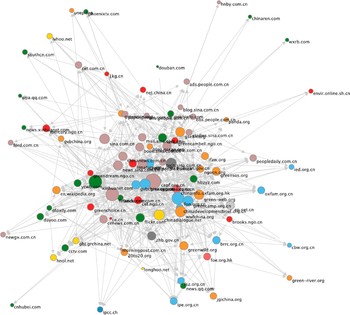
In hyperlink network “maps,” websites are depicted as circles with arrows indicating the direction(s) of linkages. The size of the circles is proportional to the number of in-links received from the population of crawled sites; more in-links generate a larger circle. Websites that are located closer together on the map are more strongly linked, that is, they are connected by a higher number of hyper-links. Groups of websites with strong connections are represented as clusters. The spatial location of websites on the map represents the degree of centrality in the network; nodes on the edge of the map are more peripheral actors in the network. The results of a recent analysis are represented graphically in Figure 1.Footnote 42
Online Environmental Network Cluster Map

The first observation to make is that it is possible to identify an online network of groups involved in environmental activism in China. Moreover the network appears to be comparatively large and dense, with 82 websites sharing 454 linkages within it. For the sake of comparison, a similar analysis of the falun gong online network, a group described as having “a massive and extremely sophisticated presence on the World Wide Web,”Footnote 43 identified 24 nodes sharing 125 linkages. Furthermore, an identical hyperlink analysis of online environmental actors conducted in June 2007 identified a much lower number of linkages (280) within the network, but not a substantially lower number of websites (68). In the absence of further analysis we should interpret these findings with caution, but they suggest that the level of connectivity within the environmental network is increasing rather than reflecting the expansion of the internet. One plausible explanation is that as ENGOs have grown in stature, the incentive for other groups to link to them has increased. This is consistent with Yang's finding that “the more influential organizations are more likely to be linked to.”Footnote 44
One striking feature of the network is the variation in websites or types of organization that are linked. We interpret this as evidence of the blurring of boundaries and amorphous nature of the environmental sphere in China. Apart from green activists and ENGOs, political conditions in China have also provided openings for other actors, such as the media and government-organized NGOs (GONGOs) to become involved in the environmental sphere. As the GEV campaign against the Nu River project shows, the links between these different actors are often crucial to the nascence and outcome of collective action.
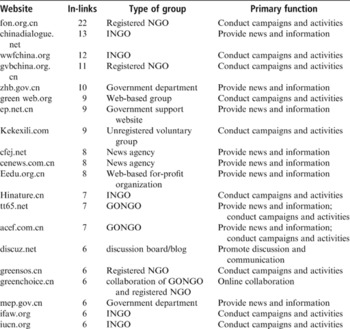
Extending Yang's typology of organizations active in the environmental sphere in China,Footnote 45 we identified ten types of organization/actor in the online network: GONGOs, International NGOs (INGOS), registered voluntary groups, registered and unregistered NGOs, web-based NGOs, government departments, news organizations and business corporations, in addition to online discussion boards and blogs. Table 1 lists the top 20 actors in the network ranked by the number of in-links they receive from other actors in the network.
Major Actors in the Online Network

Registered NGOs, including Wang's GEV,Footnote 46 INGOs, GONGOs and government departments occupy a central position in the network. It is also notable that organizations with their physical headquarters based far apart geographically are connected through the online network. Consistent with Yang's concept of “transboundary interactions,”Footnote 47 we find links between actors that cross territorial and institutional boundaries.
An assessment of the websites in the network reveals four primary functions. These are publicizing and mobilizing for campaigns and activities at the national or local level, providing news and environmental information, promoting discussion and communication, and online collaboration. The first of these functions in particular, publicizing and mobilizing for local and national campaigns on the ground, supports the view that many actors are crossing the boundary between the online and offline realms.
The objective of this preliminary analysis was to ascertain whether or not an online “environmental network” exists, and to determine the identity of the actors involved. A more detailed understanding of the online network requires further analysis of the density, growth and internal variation of the network. Further work can also build on this study in several ways: by exploring the content of linked websites, tracking user behaviour to see how online networks are actually navigated, uncovering the motives of activists and webmasters in their networking strategies, and determining user attitudes towards organizations/websites in or out of the network. We also need to recognize that cyberspace is a dynamic entity and online networks require investigation as they evolve over time. Finally, instead of focusing primarily on organizational actors as we have done here, it may be instructive to explore the online networks of more informal actors such as those implicated in blogs and discussion boards.
Conclusion
Having argued that the internet and social networks have both had a significant influence on the evolution of environmental activism in China, we have also demonstrated that networking patterns observed on the ground are similarly visible in cyberspace. Preliminary analysis of hyperlink patterns demonstrates that extensive linkages exist between actors online, to the extent that it is possible to identify a network of environmental actors connected in cyberspace. The constituent actors of this network are highly diverse, including state and non-state actors with a varied focus and various functions.
From a methodological perspective, these results suggest that the concept and method of identifying virtual networks has the potential to deliver additional insights on social activism in China that may be equally useful in other cases such as pro-democracy. From a substantive perspective we find evidence that environmental activism in China is situated in a grey area between state and society where multiple stakeholders interact and both offline and online activism involves “a network of informal interactions between a plurality of individuals, groups and/or organizations.”Footnote 48