





Introduction
Hand hygiene (HH) is the simplest and most effective way to prevent healthcare-associated infections (HAIs) and the spread of antimicrobial resistance (AMR), which lead to increased morbidity, mortality, and healthcare costs. 1–Reference Haley, Culver and White4 However, lack of compliance with HH in healthcare settings remains a major problem. Reference Erasmus, Daha and Brug5 Barriers to appropriate HH, including lack of knowledge and increased workload, contribute to low compliance among healthcare workers (HCWs). Reference Pittet, Hugonnet and Harbarth6 In addition, limited availability of resources necessary for HH, such as a functional sink with soap, single-use towels, and alcohol-based hand rub (ABHR), is an easily modifiable contributor to poor HH. Reference Owusu-Ofori, Jennings, Burgess, Prasad, Acheampong and Coffin7,Reference Amazian, Abdelmoumène and Sekkat8 Measuring HH compliance and sharing regular feedback of data are among the most effective measures to improve HH practice. Reference Pittet9,Reference Boyce and Pittet10
The issue of HH is particularly urgent in Greece, as European Centre for Disease Control (ECDC) assessments of infection prevention activities show that Greece has extremely high rates of HAIs and AMR. Data from the ECDC 2022–2023 point prevalence survey found that the prevalence of HAIs in Greece was 12.2%, one of the highest rates in the European Union, whereas the median country mean was 6.8%. 11 AMR among HAIs, fueled by antimicrobial use and poor compliance with infection prevention practices, was also significant. Carbapenem resistance was reported in 58% of Klebsiella spp. and 94% of A. baumannii isolates. Furthermore, the ongoing economic crisis has led to an increased financial burden on public hospitals in Greece, leading to understaffing, lack of supplies, increased admissions, and crowding, increasing the risk of HAIs, AMR, and healthcare costs.
There are very limited data regarding HH practices in Greek hospitals. The aim of our study was to assess current HH practices in Greece and improve compliance at the hospitals studied. We also aimed to provide local data to clinicians to guide future work to improve HH compliance.
Methods
Study design and setting
This was a prospective observational study, with a quasi-experimental (before-after) design, of HH compliance in 8 adult public tertiary hospitals across all 7 healthcare districts of Greece, to provide proportional geographic representation. The hospitals included the largest university and public hospitals as well as the largest cancer center in Greece. The study was conducted as part of the Stavros Niarchos Foundation (SNF)–funded Greek Infection Prevention Program (GRIPP). SNF-GRIPP is a 10-hospital collaborative (including 2 children’s hospitals not included in this study) that was implemented and mandated by legislation passed by the Greek Parliament. In this study, a total of 23 hospital units were included, composed of intensive care units (ICUs), oncology, internal medicine, and surgery units, where rates of HAIs and AMR are highest. Three time periods were defined: the baseline period (7 months, December 2021–June 2022), intervention period (7 months, July 2022–January 2023), and postintervention period (16 months, February 2023–May 2024).
Compliance was defined using World Health Organization (WHO) “5 Moments of Hand Hygiene,” which states that the 5 moments when HH should be performed are 1) before patient contact, 2) before aseptic procedures, 3) after exposure or risk of exposure to bodily fluid, 4) after patient contact, and 5) after contact with a patient’s surroundings. The Institute of Healthcare Improvement (IHI) had a coaching and advisory role throughout the process.
Data collection
Data was collected by direct observation, with proper precautions to ensure anonymity and discretion. Trained observers conducted observations using the data collection tool (see Appendix), which was based on the WHO HH standardized data collection form. Observers included infection control practitioners, nurses and physicians.
A minimum of 30 total observations per month per ward were required. Observations were conducted during all shifts (morning, afternoon, and night) for different roles such as physicians, nurses, and other hospital personnel, including auxiliary personnel, medical personnel from other units, physiotherapists, stretcher bearers, technicians, and students. The number of observations of one person per day could not exceed 3, to avoid bias. When an “opportunity” for HH was observed, it was recorded as an “action” if HH was performed and as a “lost opportunity” if HH was not performed. Data collected included the moment observed, per the WHO 5 Moments of Hand Hygiene; the profession of the individual observed; whether soap and water or ABHR was used; and whether gloves were used, indications for glove use, as defined by WHO guidelines, were not within the scope of this study. Duration of cleaning and whether the technique was appropriate were not assessed. The identities of the individuals being observed were not recorded. We also collected antibiotic use as defined by days of antibiotic therapy per 1,000 days (DOTs).
Intervention
A HH compliance improvement bundle was implemented which included continuous feedback of data, repeated staff education, and visual reminders placed throughout the study units, including floor stickers, posters above sinks, and posters displaying the WHO moments of HH. The IHI’s quality improvement methodology was implemented in all hospitals. 12 The improvement bundle of interventions (all elements) was maintained through the postintervention period until the end of the study. IHI created a learning action network in which all 8 hospitals participated. Three in person training sessions were held in Greece where all hospitals participated. These sessions were organized and moderated by IHI in person. Along with the in-person sessions, regular calls/meetings were held virtually with hospital leadership and separately with clinical and infection control teams. Each month, each unit received a graphical representation of its results, which were discussed with staff and stakeholders. Staff training on the bundle was carried out by infection control nurses.
Statistical analysis
HH compliance was calculated as the proportion of HH opportunities where HH was performed. The compliance proportion was calculated for both the baseline and postintervention periods for each participating ward, as well as aggregated by type of ward and for the entire network of wards. Differences in proportions between the baseline period and postintervention period were tested using the χ2 test of independence, with P-values < .05 considered statistically significant. Stratified analyses were performed across the WHO “5 Moments for Hand Hygiene,” HCW types, HCW shifts, and type of ward. An interrupted time series design with segmented linear regression and Newey-West standard errors was used to assess changes in HH compliance trends associated with the intervention. We included antibiotic use in the same study units as defined by days of antibiotic therapy per 1,000 days (DOTs) as a non-equivalent control group. The presence of autocorrelation was assessed using the Cumby-Huizinga test. Monthly HH compliance proportions were used as the dependent variable. Analysis was conducted using STATA MP v18.
Results
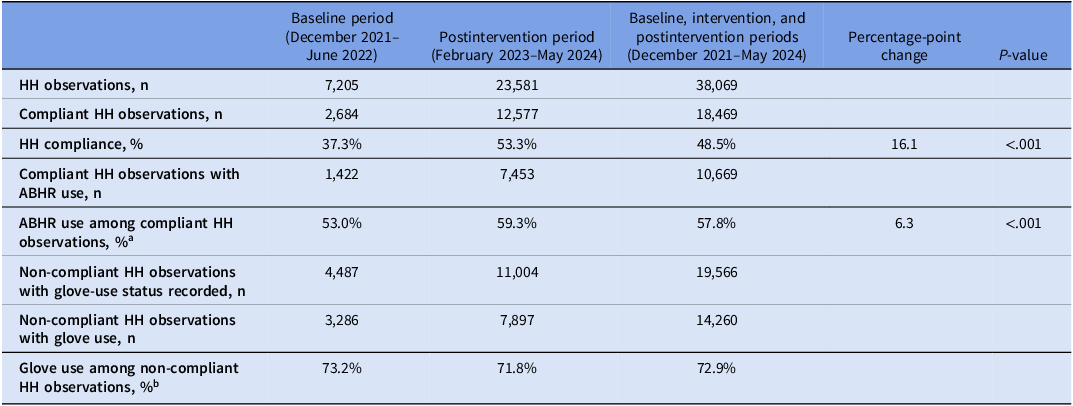
Table 1 shows summary data on observations, compliance, glove use, and ABHR use during the study period. Overall, 38,069 HH opportunities were observed, and overall compliance during the whole study period was 48.5%. Glove use without proper HH was observed in 72.9% of opportunities, whereas ABHR was used for HH by 57.8% of HCW who conducted HH. Compliance improved from 37.3% in the baseline period to 53.3% after the intervention (+16.1 percentage points, P < .001). Figure 1 shows the interrupted time series analysis comparing the baseline, intervention, and postintervention periods. Compliance in general ICUs and cardiac intensive care units (CICUs) pre- and postintervention are shown in Figure 2. Of the 13 participating ICUs and CICUs, improved HH compliance was observed in 9/13 (69%) of units, and percent improvement in compliance in these units ranged from 0.4% to 31.6% (Figure 2). In the 10 participating medical and surgical wards, improved HH compliance was observed in 9 (90%), and percent improvement in compliance in these units ranged from 7.2 to 28.3% (Figure 3).
Interrupted time-series analysis comparing the baseline period (December 2021–June 2022), intervention period (July 2022–January 2023), and postintervention period (February 2023–May 2024).

Hand hygiene compliance in general intensive care units (ICUs) and cardiac intensive care units (CICUs) pre- and postintervention.

Hand hygiene compliance in medical and surgical wards pre- and postintervention.

Observations of hand hygiene compliance

Table 1. Long description
The table presents data on hand hygiene (HH) observations, compliance, glove use, and alcohol-based hand rub (ABHR) use across different periods. It has 10 rows and 5 columns. The columns are labeled as Baseline period (December 2021–June 2022), Postintervention period (February 2023–May 2024), Baseline, intervention, and postintervention periods (December 2021–May 2024), Percentage-point change, and P-value. The rows include data on HH observations, compliant HH observations, HH compliance percentage, compliant HH observations with ABHR use, ABHR use among compliant HH observations percentage, non-compliant HH observations with glove-use status recorded, non-compliant HH observations with glove use, and glove use among non-compliant HH observations percentage. Each row provides specific values for each period and the overall change.
Note: HH, hand hygiene; ABHR, alcohol-based hand rub.
a ABHR use (%) was calculated among compliant HH observations.
b Glove-use information was unavailable for 34 non-compliant HH observations; Percentages were calculated among non-compliant HH observations with recorded glove-use status.
Percentage-point change was calculated as the postintervention percentage minus the baseline percentage.
Observations of the use of gloves without appropriate HH did not change significantly over the study period (73.2 to 71.8%), (−1.4 percentage points; P = .064). Compliance with the use of AHBR increased significantly, from 53% to 59.3% after the intervention, an increase of 6.3 percentage points (P < .001).
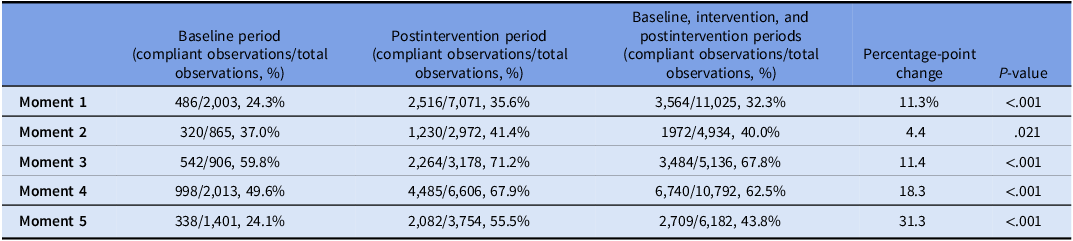
Table 2 displays HH compliance for each of the WHO 5 Moments of Hand Hygiene. Across the full study period, compliance was highest at moments 3 and 4 (67.8 and 62.5%, respectively). Compliance was the lowest at moment 1 (32.3%). Compliance increased significantly in the postintervention period for all 5 moments.
Compliance with the World Health Organization (WHO) 5 Moments of Hand Hygiene. The 5 Moments are before patient contact (Moment 1), before aseptic procedures (Moment 2), after exposure or risk of exposure to bodily fluid (Moment 3), after patient contact (Moment 4), and after contact with a patient’s surroundings (Moment 5)

Table 2. Long description
A table with five rows and five columns comparing hand hygiene compliance across different moments. The columns are labeled Baseline period (compliant observations/total observations, percent), Postintervention period (compliant observations/total observations, percent), Baseline, intervention, and postintervention periods (compliant observations/total observations, percent), Percentage-point change, and P-value. The rows are labeled Moment 1, Moment 2, Moment 3, Moment 4, and Moment 5. Each row provides specific compliance percentages and changes for each moment. Notable trends include the highest compliance at Moments 3 and 4, and the lowest at Moment 1. Compliance increased significantly in the postintervention period for all moments.
Percentage-point change was calculated as the postintervention percentage minus the baseline percentage.
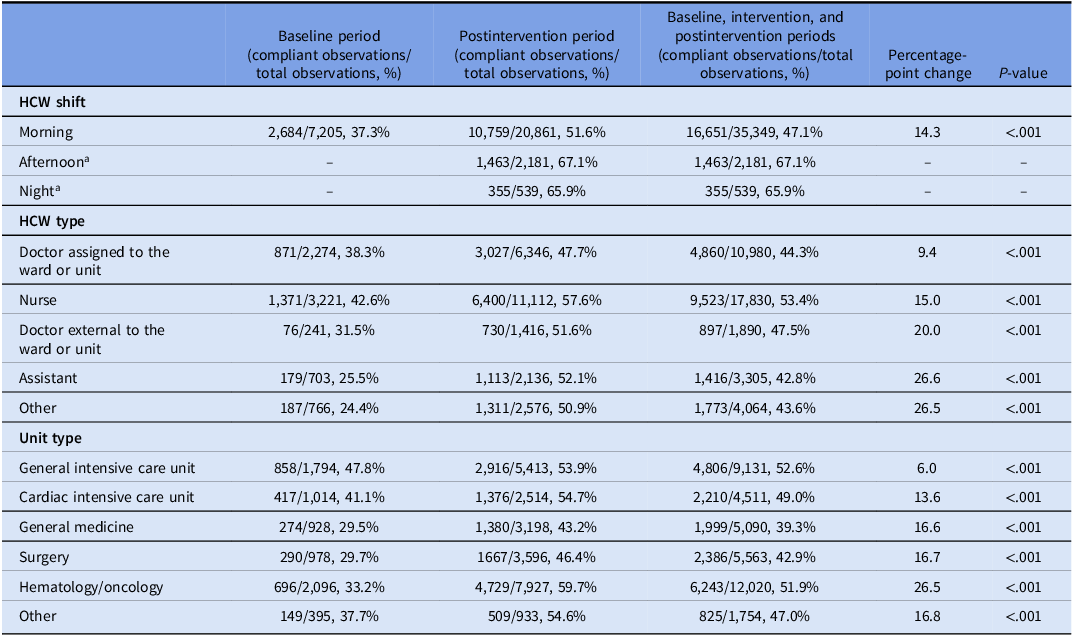
Table 3 displays HH compliance for different HCW shifts, HCW types, and unit types. HH compliance significantly improved postintervention.
Hand hygiene compliance by healthcare worker (HCW) shift, HCW type, and ward

Table 3. Long description
The table presents data on hand hygiene compliance by healthcare workers (HCWs) across various shifts, types, and unit types. It includes columns for baseline period, postintervention period, and combined periods, with compliance observations and total observations percentages. The table is divided into sections for HCW shift, HCW type, and unit type. Each section lists specific categories and their compliance percentages across the different periods. Notable trends include significant improvements in compliance postintervention across all categories.
a Observations for the afternoon and night shifts were not taken in the baseline period.
Percentage-point change was calculated as the postintervention percentage minus the baseline percentage.
There was no statistically significant difference in antibiotic use as defined by days of therapy during the study period.
Discussion
To our knowledge, this is the largest study of HH compliance in Greek hospitals to date. Overall, we found low HH compliance rates and gaps in HH practices in the 8 Greek hospitals involved in the study. A quality improvement intervention improved overall compliance across all types of HCWs and all types of hospital units.
Limited data are available on HH compliance in Greek hospitals. A 2018 study found that compliance rates ranged between 17% and 56%. Reference Kritsotakis, Astrinaki, Messaritaki and Gikas13 Although 17 hospitals were included, the study was a survey and did not include direct observation of HH practices. Still, the range of compliance rates is similar to those in our study. A 2016 study that included 13 medical wards and direct observation found an overall HH compliance rate of 33.4%. Reference Astrinaki, Messaritaki, Mourtou, Niakas and Messaritaki14 As in our study, the majority of HCWs used hand washing instead of ABHR, and in 70% of events where glove use was recorded, HCWs failed to perform HH. Compliance was highest after “touching a patient.” Similarly, we identified the highest compliance rates for moments 3 and 4. Compliance rates in studies from other Southern European countries range from 20% to 84% in Italy to approximately 40% in Spain and 66% in Portugal. Reference Canta, Bordino, Libero and Zotti15–Reference Fernandes, Aires, Rodrigues and Vasconcelos17 Compliance rates from reports in Finland and Sweden are approximately 80%. Reference Yanagizawa-Drott, Kurland and Schuur18,Reference janperä, Kanste and Syrjala19
We found low use of ABHR despite the evidence that ABHR is significantly more effective in reducing microbial counts on skin than plain soap-and-water hand-washing and despite recent data showing that ABHR is widely used in Greek hospitals. Reference Widmer20,Reference Boyce21 In the ECDC point prevalence survey of HAIs in European acute-care hospitals, ABHR was provided in 1,082 hospitals, including multiple Greek hospitals. 11 Greece had among the highest rates of consumption, at greater than 40L/1000 patient-days. Overall, there was a strong negative correlation between a composite index of AMR and ABHR consumption, except in Greece, where rates of both AMR and ABHR consumption were high. The ECDC had personal communications with infection control professionals in Greece who attributed a large proportion of ABHR consumption to private use by visitors of patients and staff outside the hospital and to use within the hospital for other purposes than HH (eg, disinfection of surfaces). Greek hospitals also scored below the median in the number of observed HH opportunities. Finally, the median percentage of beds with an ABHR dispenser at the point of care was less than 50%. Our findings that nurses have higher compliance rates than physicians is consistent with previous findings. Reference Bredin, ODoherty, Hannigan and Kingston22
Even following the intervention, overall compliance remained relatively low. We believe factors beyond our intervention are in large part responsible for the overall low HH compliance rate. Both healthcare system factors and knowledge gaps affect HH practices among Greek HCWs. System factors identified in one study included patient care needs in an overwhelmed healthcare system taking priority and low staff-to-patient ratio, especially with respect to nursing staff. Reference Malliarou, Adreanides, Sarafis and Kotrotsiou23 Several studies have reported gaps in education and knowledge about HH among medical and nursing students and HCWs. Reference Bounou, Katelani and Panagiotopoulou24,Reference Sinopidis, Tsekoura and Plotas25 There are also cultural and workplace barriers to HH compliance including rigid hierarchical traditions and a collective preference for manual soap-and-water over alcohol rubs that have become deep rooted norms.
Our multimodal intervention based on quality improvement principles, the first of its kind to be implemented in Greek hospitals, improved HH compliance rates significantly. Overall, compliance improved by 16% and we believe our results can be attributed to the intervention as the improvement was statistically significant and consistent among the majority of types of hospital units and HCWs, HCW shifts, and WHO Moments of HH. Studies have found that HAI rates are directly proportional to HH compliance and that a 10% increase in compliance is associated with a decrease in HAI rates. Reference Boyce and Pittet10,Reference Sickbert-Bennett, DiBiase, Willis, Wolak, Weber and Rutala26
One study had several strengths including the large number of observations and the standardization of observer training. Further, the hospitals included represented the different geographic regions of Greece and different governance structures, including university hospitals and a cancer center. Another strength of the study was the inclusion of non-equivalent control group. The selection of antibiotic prescribing as a control group has limitations as the majority of the participants in the study were not involved in both prescribing and hand hygiene (eg, nurses). However, 15% of a large sample size of participants were physicians who would be able to participate in prescribing in addition to be being observed for HH compliance. One possible limitation of our study is the Hawthorne effect, or the tendency of individuals to change their behavior when they know they are being observed. Although we do not know the direction of the bias that the Hawthorne effect, we believe the effect would not be different pre- and post-intervention.
In summary, we found HH compliance rates in Greek hospitals to be similar to rates in other Southern European countries. We assessed current HH practices in Greece, improved compliance at the hospitals studied, and provided urgently needed data on HH. We identified potential areas of improvement to target, including the inappropriate use of gloves and low utilization of ABHR and specific Moments of HH that can be the target of improvement efforts. The finding that a quality improvement initiative can improve HH compliance despite healthcare system factors and gaps in knowledge is encouraging and especially important for Greece, a country with high rates of HAIs and AMR. Expansion of this quality improvement initiative to all Greek hospitals should be considered.
Financial support
The study was supported by a grant from the Stavros Niarchos Foundation.
Competing interests
None.
Appendix A: GRIPP-SNF Consortium (Collaborative Author)
Agios Savvas Athens General Oncology Hospital: Georgiou, Serafeim; Drosopoulou, Lida-Paraskevi; Papadimitriou, Aristotelis; Kargaki, Ioanna; Koraka, Chrysanthi; Koukeli, Foteini
University General Hospital of Alexandroupolis: Panagopoulos, Periklhs; Panopoulou, Maria; Lazaridis, Georgios; Ouzounakis, Petros; Karaggeli, Nerantzia; Lemonakis, Nikolaos; Geitona, Euaggelia; Matskas, Andreas; Tziwra, Bagia; Katsantridou, Marina; Karavasili, Maria; Achyrkidou, Chrysoula; Gkogkotsi, Xristina; Konsoula, Eythumia; Papandroudi, Dapne; Tziakas, Dimitrios; Xalikias, Georgios, Papageorgi, Eirini; Kelesidhs, Eythymios; Kavanozi, Eleni; Mikroulis, Dimitrios; Partheniadou Matina; Xenitidou, Theodora; Matsia, Xristina; Daskalopoulou, Aikaterini; Ntolia, Ioanna; Georgati, Christina; Triantafyllidou, Xrysa
Attikon University General Hospital, Athens: Pournaras, Spiridon; Tsiodras, Sotirios; Kostoula, Maria; Kliani, Ismini; Poulianou, Eleni; Thomolari, Alexa; Cakaj, Emanuela
General Hospital of Athens Evangelismos: Papastamopoulos, Vasileios; Argyropoulou, Athina; Kostourou, Sofia; Kolokotroni, Chrysoula; Michopanou, Nektaria; Elthini, Rokeia; Giankoula, Dimitroula; Spyrakou, Efthimia
University General Hospital of Larissa: Petinaki, Efthimia; Gatselis, Nikolaos; Xatzivasiou, Asimina; Papatheodorou, Stella; Kiklou, Efthalia; Papachristou, Olga; Kαouna, Varvara; Mpairamoglou, Androniki; Malita, Aikaterini; Georgiou, Eleni; Brodis, Alexandros
University Hospital of Heraklion: Kofteridis, Diamantis; Hamilos, George; Astrinaki, Eirini; Vitsaxaki, Efsevia; Saplamidou, Stamatina; Skevakis, Panagiotis; Kokkini, Sofia; Samaritaki, Evangelia; Skouteli, Eirini; Zervaki, Kyriaki; Politis, Nikolaos
Papageorgiou General Hospital: Arvaniti, Kostoula; Trakatelli, Christina-Maria; Papadopoulou, Georgia; Christodoulou, Eugenia; Kalousiou, Athanasia; Portokalidis, Aristeidis; Psomiadis, Charalampos; Papadopoulou, Eugenia; Lazaridis, Georgios; Ntagioukla, Aikaterini; Vourtziadou, Anastasia; Koinoviarhou, Eugenia, Topalidou, Maria; Naoum, Vasiliki; Vataroglou, Ioannis; Papaemmanouil, Eleni; Sotiriadou, Chrysanthi
University Hospital of Patras: Marangos, Markos; Paliogianni, Fotini; Chondroleou, Anna; Skintzi, Aikaterini; Ntai, Eleni; Tsokana, Paraskevi-Olga; Delia, Theodora; Mantzana, Xanthoula; Malami, Dimitra; Verra, Anastasia



 Open access

