The reinforcement sensitivity theory (RST) is one of the most influential neuropsychological theories and it was developed by Jeffrey Gray (Reference Gray1982) in an attempt to provide a scientifically viable explanation for states of emotion, learning and motivation and related traits of personality (Corr, Reference Corr, Corr and Matthews2009). The most recent version of the theory (rRST; Gray & McNaughton, Reference Gray and McNaughton2000) postulates the existence of three systems that mediate the relationship between emotionally/motivationally salient inputs and behavioral responses under the control of specific neuroanatomical structures: The behavioral approach system (BAS), associated with the frontostriatal and limbic areas; and the fight-flight-freeze system (FFFS), and behavioral inhibition system (BIS) associated with the septohippocampal system and amygdala (Adrián-Ventura et al., Reference Adrián-Ventura, Costumero, Parcet and Ávila2019; Gray & McNaughton, Reference Gray and McNaughton2000). (For discussion of how the RST fits into the wider motivation literature, see Corr & Krupic, Reference Corr, Krupic and Elliot2017.)
The BAS mediates responses to all appetitive stimuli and is related to personality traits, such as optimism, reward-orientation, and impulsivity, which are clinically associated with addictive and high-risk behaviors (Corr, Reference Corr, Corr and Matthews2009). The FFFS is responsible for mediating reactions to all aversive stimuli and is in charge of generating defensive behaviors, such as avoidance, escape and freezing. This system is associated with the personality trait of fear-proneness, which is clinically related to phobia and panic (Corr, Reference Corr, Corr and Matthews2009). Finally, the BIS is responsible for the detection and resolution of goal conflicts (e.g., coactivation of FFFS and BAS). This system resolves this conflict by increasing the negative valence of stimuli (e.g., activating FFFS) until resolution occurs, either in favor of approach (BAS) or avoidance (FFFS). The associated personality traits associated with the BIS are worry-proneness and anxious rumination, which could lead to being constantly on the search for possible signs of danger. These factors can be related to certain clinical conditions, such as generalized anxiety and obsessional-compulsive disorder (OCD) (Corr, Reference Corr, Corr and Matthews2009).
Over the past few decades, several questionnaires have been developed to measure RST constructs, being the BIS/BAS scales (Carver & White, Reference Carver and White1994) and the Sensitivity to Punishment and Sensitivity to Reward Questionnaire (SPSRQ; Torrubia et al., Reference Torrubia, Ávila, Moltó and Caseras2001) the most widely used. Even though the RST has been substantially modified over the years, most research studies still use the scales based on the non-revised theory (Gray, Reference Gray1982). There have been some attempts to develop scales based on the revised RST, such as the Jackson–5 Questionnaire (Jackson, Reference Jackson2009), the Reinforcement Sensitivity Questionnaire (Smederevac et al., Reference Smederevac, Mitrović, Čolović and Nikolašević2014), and the Revised Reinforcement Sensitivity Theory Questionnaire (Reuter et al., Reference Reuter, Cooper, Smillie, Markett and Montag2015). However, the existing questionnaires have their limitations, especially relying on a single factor to measure the BAS, which is not consistent with the complexity of BAS processes (for a review of this literature, see Corr, Reference Corr2015). To address these limitations, the Reinforcement Sensitivity Theory–Personality Questionnaire (RST–PQ; Corr & Cooper, Reference Corr and Cooper2016) was developed.
The RST-PQ has a six-factor structure: Four behavioral approach system factors (Reward Interest, Goal-Drive Persistence, Reward Reactivity, and Impulsivity) and two defensive factors: The fight-flight-freeze system, related to fear, and the behavioral inhibition system factor, related to anxiety (Corr & Cooper, Reference Corr and Cooper2016).
The RST-PQ has good internal consistency with Cronbach’s alpha values for all the factors oscillating between .74 and .93 and other psychometric properties that are also adequate. This instrument has been validated using well-known personality measures and the factors have shown good convergent and discriminant validity. Furthermore, it has been validated in several languages including German, Croatian, Swedish and Polish (Corr & Cooper, Reference Corr and Cooper2016; Eriksson et al., Reference Eriksson, Jansson and Sundin2018; Krupić et al., Reference Krupić, Corr, Ručević, Križanić and Gračanin2016; Pugnaghi et al., Reference Pugnaghi, Cooper, Ettinger and Corr2018; Wytykowska et al., Reference Wytykowska, Fajkowska, Domaradzka and Jankowskic2017).
The only RST questionnaire that has been validated in the Spanish language is the Carver and White’s (Reference Carver and White1994) BIS/BAS scales (Martinez et al., Reference Martinez, Zalazar-Jaime, Pilatti and Cupani2012; Pulido Rull, Reference Pulido Rull, Rivera Fong, Fondón Mora and Vázquez Pérez2016). Considering the relevance of the revised RST and the aforementioned advantages of the RST-PQ, having a validated version of this instrument in Spanish seems critical. For this reason, this study aimed to adapt the original English version of the RST-PQ into Spanish and to validate the Spanish version. More specifically, the current study aimed to:
-
1. Translate the original instrument into Spanish, pilot-test the questionnaire, conduct an item analysis and refine the Spanish version of the RST-PQ (Study 1).
-
2. Analyze the internal structure of the questionnaire through exploratory and confirmatory factor analyses (Study 2).
-
3. Obtain evidence of predictive validity using the Criterion Set of Act Clusters that measures the frequency in which people perform relatively undesirable activities, desirable activities and relatively neutral activities (Study 2).
-
4. Obtain evidence of concurrent validity with the Five Personality Factors model, with other RST questionnaires and with specific questionnaires measuring anxiety and fear (Study 3).
Study 1: Item Translation and Pilot Study
Materials and Method
Participants
After getting authorization from the professor in charge of one of the admission courses to study Psychology, all the attendees were invited to participate. The prospective students that were interested in taking part in the study stayed after the class to complete the questionnaires. The sample consisted of 139 prospective university students attending one of the admission courses to study Psychology at Universidad Nacional de Córdoba (68.3 % women and 31.7% men, age range 16–36 years, M = 19.86; SD 3.54).
Instruments
Reinforcement Sensitivity Theory–Personality Questionnaire (RST-PQ) (Corr & Cooper, Reference Corr and Cooper 2016 ). It consists of 65 items that assess the three neuropsychological systems BIS, FFFS, and BAS in their four dimensions. Each item is written as a statement and describes people’s everyday behaviors and feelings. Participants were asked to assess the level of precision with which each sentence describes him/herself using a four-point scale (Nothing, Little, Moderately, Highly). The original version of this questionnaire reports reliability values from .74 (Impulsivity) to .93 (BIS). The 65 items were independently translated from English into Spanish by four specialists in the English language (direct translation). Half of the translators had prior knowledge of psychometry and the measure rationale. These translations were compared, and the necessary cultural and idiomatic adaptations were made to obtain a consensual version (e.g., use of words in English that are widely used in the Spanish language as well, such as hobbies).
Procedure
The translated version was administered in paper-and-pencil format to a pilot sample of prospective university students in the classroom. Participants were asked to complete the questionnaire selecting the options that better described them and were also encouraged to indicate which terms or expressions were not clear or were unusual/atypical in their daily language. Although this second instance aimed to identify and modify items that presented some degree of difficulty (either in terms of participants’ understanding or factor loadings), it was not mandatory and not all the participants provided this specific feedback. The data was collected by the first author and participants took approximately 15 minutes to complete the questionnaire.
Data Analysis
Items presenting some degree of difficulty were identified based on the participants’ written report. The missing data pattern was assessed to estimate whether it responded to a random distribution (Tabachnick & Fidell, Reference Tabachnick and Fidell2011). If they did not exceed 5% of the cases, data would be imputed by the central tendency (mode) measure of the complete responses of the same participant in the same scale. It has been chosen to impute through the mode because this method has proven to provide equilibrium, precision, and conceptual simplicity in the cases lost by the absence of response in some items (Shrive et al., Reference Shrive, Stuart, Quan and Ghali2006). After that, the mean, standard deviation, frequency distribution, skewness, and kurtosis for each of the items were examined. The skewness and kurtosis indices between ± 1.00 were considered excellent, and the ones between ± 2.00 were considered adequate (George & Mallery, Reference George and Mallery2011). The discrimination indices through item-total correlation were calculated. Items showing low or non-significant (lower to .30) item-total correlations were revised. Moreover, the internal consistency was assessed through Cronbach’s alpha. The SPSS 19 statistical package was used to perform the analyses.
Results
The missing cases due to lack of response to one item were analyzed but, because they did not exceed 5% of the cases, they were imputed by the mode of participants’ complete responses on the same scale.
Six items (8%) were considered difficult to understand so they were revised. The indices of skewness and kurtosis of the 65 items oscillated between –.86 and .54 and between –.62 and .99, respectively. In relation to the item-total correlations, the values for the different scales varied for Reward Interest, between .19 and .46; for Goal-Drive Persistence, between .28 and .57; for Reward Reactivity, between .22 and .53; for Impulsivity, between .06 and .43; for FFFS, between .20 and .50; for BIS, between .22 and .69. Out of the total of items, 14.4% present item-total correlations lower to .30.
Considering the data obtained from the analyses and the participants’ comments, items were revised on the following bases: (a) Discrimination indices lower to .30 and (b) hard-to-understood idiomatic expressions. The revised Spanish version was translated back into English by two language specialists. The new version in English was sent to one of the authors (P. J. Corr) of the English version of the RST-PQ questionnaire, and he performed a comparison between the original version and the one inversely translated. After due consideration of the author’s corrections and observations, minor edits were made to four items (e.g., changes in some words or prepositions).
Study 2: Evidence of Internal and External Validity
Materials and Method
Participants
A convenience sampling procedure was used. The link to access the virtual questionnaire was disseminated via e-mail and several social networks, mainly Facebook. An increased heterogeneity was sought through the link publication in groups of diverse university degrees from different faculties and universities across the country as well as in groups of Argentinian people joined by specific interests as regards the preference of certain recreational activities, music genres, and lifestyles. The sample consisted of 1,281 subjects (54.3 % women and 45.7% men, age range 17–72 years, M = 26.3; SD = 9.16). In relation to the participants’ educational level, 55.6% had incomplete university level, 19.1% had complete university level, 13.5% complete secondary level, 5.9% incomplete secondary level, 5.7% postgraduate level, and 0.2% complete primary level.
Instruments
Reinforcement Sensitivity Theory-Personality Questionnaire (RST-PQ) (Corr & Cooper, Reference Corr and Cooper 2016 ). The translated version from the previous study was used.
The Criterion Set of Act Clusters (Goldberg, Reference Goldberg, Mervielde, Deary, De Fruyt and Ostendorf 1999 ). This study used six scales of self-reported frequencies of various categories of specific activities. These six scales consisted of 54 items measuring six types of recreational activities distributed as follows: Relatively undesirable activities (drug use and undependability); desirable activities (creativity and friendship); and relatively neutral activities (communication and erudition). All participants were asked to mention how often they had engaged in certain activities in the previous year, following response options: (a) Never in my life; (b) not in the past year; (c) once or twice in the past year; (d) three or more times in the past year, but not more than 15 times (such as once or twice a month); and (e) more than 15 times in the past year. The reliability values of these scales ranged from .70 to .89 (Grucza & Goldberg, Reference Grucza and Goldberg2007). The Spanish version of the Criterion Set of Act Clusters (Contreras & Cupani, Reference Contreras and Cupani2015) was used in this study; the reliability indices ranged from Cronbach’s alpha = .67 (Communication) to Cronbach’s alpha = .87 (Drug use).
Procedure
The study was administered online and voluntarily completed using the LimeSurvey virtual platform. The time required to complete the questionnaire was approximately 20 minutes. The platform did not allow participants to leave unanswered questions on each questionnaire. Only the participants that completed both questionnaires were considered.
Data Analysis
To overcome some potential limitations of only conducting a confirmatory factor analysis (CFA) to assess the internal validity of the scale, the sample was divided at random into two parts and exploratory factor analysis (EFA) and CFA were performed. Through EFA (N = 663), the most adequate factor structure was examined. Horn’s parallel analysis was used to identify the number of factors to be extracted (Horn, Reference Horn1965); weighted least squares and Promin oblique rotation were also used. This analysis was performed with FACTOR 9.3 (Lorenzo-Seva & Ferrando, Reference Lorenzo-Seva and Ferrando2006). Then, the resulting model was validated through CFA with the Mplus 6.12 program (Muthén & Muthén, Reference Muthén and Muthén2010). To carry out CFA, the robust weighted least squares with mean and variance (WLSMV) was employed as a method of technical estimation; it is considered the most adequate to deal with categorical data, and it works properly when the sample size is ≥ 200 (Flora & Curran, Reference Flora and Curran2004). To assess the model fit, the statistical chi-squared test (χ2), Comparative Fit Index (CFI), Tucker-Lewis Index (TLI), Root Mean Square Error of Approximation (RMSEA), and Weighted Root Mean Square Residual (WRMR) were used. Values higher than .90 for CFI and TLI indicate a fit from acceptable to excellent; for RMSEA, values between .05 and .08 are expected; for WRMR, values lower than 1.00 (Yu, Reference Yu2002) are considered adequate. Each of the proposed psychometric analyses was performed separately for each RST-PQ factor. Finally, a multiple regression analysis was conducted to estimate the extent of the contribution of each RST-PQ personality trait to independently explain the different types of daily behaviors. Consistent with the development of the original RST-PQ, defensive and BAS factors were analyzed separately.
Results
Defensive System: BIS and FFFS
Exploratory factor analysis. The obtained Kaiser-Meyer-Olkin sampling adequacy measure (.90) and Bartlett’s sphericity test values of 6675.7 (df = 528; Sig. =.001) warned about the viability of performing the factor analysis of the data. Horn’s parallel analysis (Horn, Reference Horn1965) suggested the extraction of two factors. Therefore, a two-factor solution was obtained. The first factor consisted of 23 items with factor weights between .30 and .81 belonging to the BIS scale. The second factor consisted of 10 items with factor weights between .30 and .71 belonging to the FFFS scale. Two items had cross-loadings, but it was decided to keep the total of the items corresponding to this system because both belonged to the “Avoidance” dimension and we prioritized respecting the original structure.
Confirmatory factor analysis. The results indicated that the two-factor model did not fit the data adequately, CFI = .85, TLI = .83, RMSEA = .077, 95% CI [.073 .080], WRMR = 2.008). The standardized regression weights (p ≤ .05) in the BIS factor oscillated between .46 and .78, whereas in the FFFS factor oscillated between .21 and .80. The modification indices were inspected, and a possible overlapping between the BIS factor items was observed. Besides, one BIS factor item presented unsatisfactory factor weight. Based on this observation, a new model was assessed eliminating one BIS factor item and the correlation between the errors of the five pairs of BIS factor items. This model fit was acceptable (CFI = .91, TLI = .90, RMSEA = .16, 95% CI [.058 .065], WRMR 1.627). The standardized regression weights (p ≤ .05) in the BIS factor oscillated between .39 and .79, and in the FFFS factor oscillated between .39 and .86. The composite reliability was .76 and .93, for FFFS and BIS, respectively (see Supplementary Table 1 in Supplemental Materials).
BAS
Exploratory factor analysis. The obtained Kaiser-Meyer-Olkin sampling adequacy measure (.90) and Bartlett’s sphericity test values of 6378.6 (df = 528; Sig. = .001) warned about the possibility of applying the factor analysis. Horn’s parallel analysis (Horn, Reference Horn1965) suggested the extraction of three factors when the 95th percentile was considered, and four factors when the mean was considered. The four-factor structure was the simplest one and the most theoretically relevant. It explained 55.8% of the variance. The Goal-Drive Persistence factor (six items) presented weights ranging between .31 and .70, the Reward Reactivity factor (7 items) between .49 and .77, the Reward Interest (6 items) between .54 and .73; and the Impulsivity factor (5 items) between .28 and .78 (see Supplementary Table 2 in Supplemental Materials).
Confirmatory factor analysis. The four-factor original model did not fit adequately to data (CFI = .80, TLI = .78, RMSEA = .075, 95% CI [.072 .077], WRMR 2.585). The standardized regression weights (p ≤ .05) in the Reward Reactivity factor oscillated between .39 and .75; in the Goal-Drive Persistence factor oscillated between .37 and .76; in the Reward Interest factor oscillated between .45 and .75, and in Impulsivity oscillated between .10 and .81. The modification indices indicated an overlapping among factors and items corresponding to other factors. Besides, some items had a standardized regression weight not significant or lower to .30. Hence, a new model was tested eliminating two items and proposing a six-item residual correlation because it had similar content. This model fit was satisfactory (CFI = .91, TLI = .90, RMSEA = .054, 95% CI [.051 .057], WRMR = 1.886). The standardized regression weights (p ≤ .05) in the Reward Reactivity factor oscillated between .35 and .75; in the Goal-Drive Persistence factor oscillated between .37 and .77; in the Reward Interest factor oscillated between .46 and .75, and in Impulsivity oscillated between .30 and .86 (see Supplementary Table 2). The composite reliability coefficient for Reward Interest was p = .79; for Goal-Drive Persistence was p = .85; for Reward Reactivity was p = .83, and for Impulsivity was p = .68.
Supplementary Table 3 shows the correlations among the different factors of the RST-PQ (see Supplemental Materials).
Predictive Validity Study
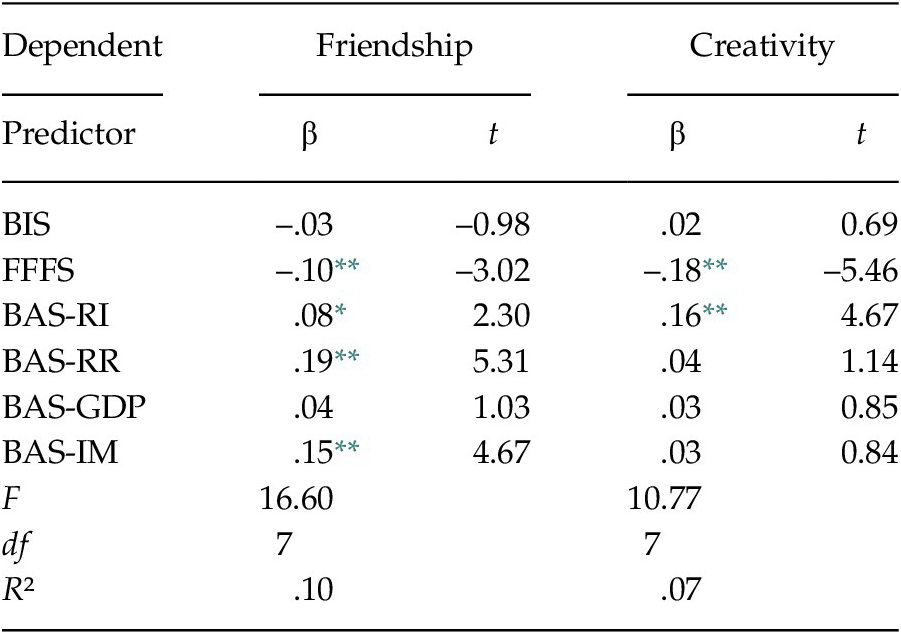
For the criterion validity study, the six recreational activities (Drug Use, Irresponsibility, Creativity, Friendship, Communication, and Erudition) were used as dependent variables and the RST-PQ sub-scales as independent variables. A multiple regression analysis was conducted to estimate the extent of the contribution of each RST-PQ factor to explain recreational activities. Prior to each regression analysis, the multivariate assumptions of independence among residues, homoscedasticity, linearity, normality, and multicollinearity were checked (Tabachnik & Fidell, Reference Tabachnick and Fidell2011). Drug use was positively correlated with Impulsivity and negatively with FFFS and Goal-Drive Persistence; Irresponsibility correlated positively with BIS; Communication and Friendship had a positive correlation with Reward Interest; Creativity was positively associated with Reward Interest and negatively with FFFS; and Erudition was positively correlated with Reward Interest and Goal-Drive Persistence. Tables 1, 2, and 3 summarize the main results of this analysis categorized by type of activity.
Multiple Regression Analysis among the RST-PQ Factors and the Relatively Undesirable Behaviors

Note. BIS = behavioral inhibition system; FFFS = fight–flight–freeze system; BAS = behavioral approach system; RI = Reward Interest; RR = reward reactivity; GDP = goal-drive persistence; IM = Impulsivity.
* p < .05.
** p < .01.
Multiple Regression Analysis among the RST-PQ Factors and the Relatively Neutral Behaviors

Note. BIS = behavioral inhibition system; FFFS = fight–flight–freeze system; BAS = behavioral approach system; RI = Reward Interest; RR = reward reactivity; GDP = goal-drive persistence; IM = Impulsivity.
* p < .05.
** p < .01.
Multiple Regression Analysis among the RST-PQ Factors and the Relatively Desirable Behaviors

Note. BIS = behavioral inhibition system; FFFS= fight–flight–freeze system; BAS = behavioral approach system; RI = Reward Interest; RR = reward reactivity; GDP = goal-drive persistence; IM = Impulsivity.
* p < .05.
** p < .01.
Study 3: Convergent Validity Evidence
Materials and Method
Participants
After getting authorization from the professors in charge of different courses of the faculties of Psychology, Architecture, Medicine and Engineering, students were invited to participate. Those students that were interested in taking part in the study stayed after the class was over to complete the questionnaires. The sample consisted of 190 participants (58.8 % women and 41.2% men, age range 18–48 years, M = 21.05; SD = 3.95) recruited in university degree courses from different public universities in the city of Córdoba. 45.7% of the participants studied Psychology; 16.6% studied Architecture; 6% studied Medicine at Universidad Nacional de Córdoba, and 31.7% studied different branches of Engineering at Universidad Tecnológica Nacional-Regional Córdoba.
Instruments
Reinforcement Sensitivity Theory-Personality Questionnaire. The adapted version consisting of 62 items was used. The RST-PQ in Spanish language is available in the Supplemental Materials.
IPIP-R Big-Five factor markers (Cupani & Lorenzo-Seva, Reference Cupani and Lorenzo-Seva 2016 ). Consists of 50 items that define five personality domains: Emotional Stability (ES), Extraversion (E), Intellect (I), Agreeableness (A), and Responsibility (R). Each domain is measured by a number of items written in phrase form describing people’s typical behaviors. Each participant is asked to assess the degree of precision to which each sentence describes himself/herself using a five-option response scale (from “I disagree a lot with this description of myself” to “I agree a lot with this description of myself”). The reported reliability indices range from .79 to .86.
BIS/BAS-IPIP-R scale (Martinez et al., Reference Martinez, Zalazar-Jaime, Pilatti and Cupani2012). Consists of 16 items that allow assessing the two BIS/BAS dimensions. Each item describes people’s typical behavior. Each participant is asked to assess the degree of precision to which each sentence describes himself/herself using a five-option response scale. The reliability indices of this scale ranged between .74 for BIS and .86 for BAS.
State-Trait Anxiety Inventory (STAI; Spielberger, Reference Spielberger, Gorsuch and Lushene1970). Consists of two scales that assess state-anxiety and trait-anxiety. In this study, only the trait-anxiety scale, consisting of 20 items was considered. Participants are provided with a list of expressions through which they usually describe themselves and each individual must respond using a scale from 1 (nothing) to 4 (a lot) about how he/she usually feels. The test-retest reliability of this scale in its adapted version to the Argentinian population is .73 (Leibovich de Figueroa, Reference Leibovich de Figueroa, Casullo, de Figueroa and Aszkenazi1991) and ranged between .80 and .82 in a recent validation study (Vaiman & Pereno, Reference Vaiman and Pereno2014).
Procedure
The questionnaires were administered in paper-and-pencil format to a sample of university students. The students that were interested in taking part in the study completed the questionnaires in the classroom. The data was collected by the first author and participants took approximately 30 minutes to complete the questionnaires.
Data Analysis
The SPSS software for Windows version 19.0 was used with the aim of preparing data for the proposed analyses. Firstly, the missing data pattern was assessed following the criteria detailed in Study 1. Then, the direct scores of each one of the instrument sub-scales were calculated, and they were correlated through the Pearson correlation coefficient r. To interpret the effect size, Cohen’s indications (1988) were followed, in which the effect sizes (r) .10, .30, and .50 are considered small, medium, and big, respectively.
Results
The missing cases due to lack of response to one item were analyzed but because they did not exceed 5% of the cases, they were imputed by the mode of participants’ complete responses on the same scale.
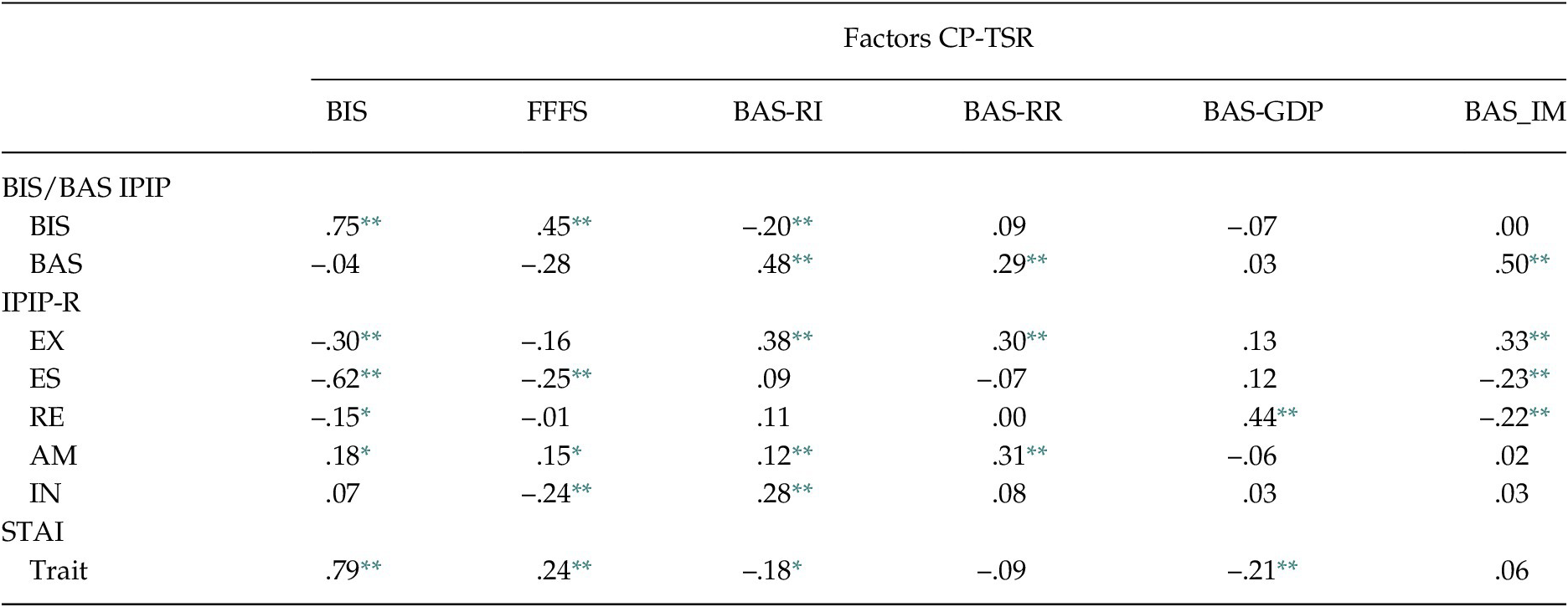
Table 4 shows the correlations between the different RST-PQ factors and some other personality measures. As an effect to the medium to large size, the BIS scale of RST-PQ correlated with the BIS scale of BIS/BAS IPIP questionnaire, with Anxiety of the Anxiety-Trait Inventory, and with Emotional Stability of the IPIP-R questionnaire; the FFFS factor correlated with the BIS scale; the BAS-RI scale correlated with the BAS scale and Extraversion; the BAS-RR scale correlated with BAS scale and Extraversion; the BAS-GDP scale correlated with Responsibility; and the BAS-IM scale correlated with BAS.
Correlations among the RST-PQ Factors and other Personality Measures

Note. EX = extraversion; ES = Emotional Stability; RE = Responsibility; AM = Agreeableness; IN = Intellect.
* p < .05.
** p < .01.
All three studies have been conducted in accordance with the principles stated in the 1964 Declaration of Helsinki and its later amendments. Informed consent was obtained from all individual participants involved in the three studies.
Discussion
This research aimed to adapt the RST-PQ to the Spanish speaking population. This instrument, in its original version, consists of 65 items written in the English language. Therefore, the first step was to achieve a meaningful and coherent translation, both at semantic and cultural levels. From the results obtained in Study 1, it was possible to conduct the first modifications considering the study pilot participants’ observations and feedback and to obtain a general panorama of the item functioning. Once the revised version in Spanish was obtained, two specialists in the English language performed a reverse translation, which was sent to the lead author of the questionnaire so that he could compare the two versions. The author’s corrections allowed modifying the items that presented difficulties to be adapted to the local context without losing the theoretical meaning they have in their original language. When the definite translated version was obtained, it was possible to develop reliability studies (internal consistency through Composite Reliability) and studies to establish evidence of internal validity, through EFA and CFA, as well as external (convergent and criterion) validity.
Reliability values for all the sub-scales were acceptable and satisfactory (between .76 and .93) and are similar to the results obtained by the authors of the original questionnaire. However, the reliability of the Impulsivity scale was lower than the recommended standards (≥ .70). In this sense, the Impulsivity construct has proven to be multidimensional (Cross et al., Reference Cross, Copping and Campbell2011), so it is possible that the seven items are not enough to measure its complexity and it would be necessary to revise this sub-scale or add a number of items.
In general, EFA and CFA showed that the RST-PQ performed adequately, and the results were satisfactory. The definition of the internal structure of the behavioral approach system was the most difficult one. In principle, EFA provided a structure different from the original one, in which some of the items loaded adequately onto more than one factor. In turn, CFA presented high collinearity levels among various items in the same factor and, sometimes, with another factor, which was expected because the four sub-scales measure the same general construct. There is no consensus regarding the dimensional nature of the BAS among the authors of the different rRST questionnaires, and therefore, the BAS is considered to have a complex structure (Corr, Reference Corr2015). However, it is worthwhile to clarify that both the theoretical conditions and the previously revised empirical results indicate that BAS must be multidimensional and with a clear distinction between Sensitivity to Reward (Reward Interest and Reward Reactivity) and Impulsivity (Corr, Reference Corr2015), which has been accomplished in the present adaptation. In fact, the items of the Goal-Drive Persistence factor were the ones presenting weights shared with other factor items that were clearly different among them. Two items of the Impulsivity factor and one item of the BIS factor presented drawbacks in both of the factor analyses conducted and did not have an adequate factor load. Thus we decided to eliminate them definitely from the scale increasing, in that way, the scale reliability and generating a more parsimonious structure.
Furthermore, when we assessed the correlations between the different RST-PQ factors, we found similar results to the ones obtained by the authors of the original questionnaire; they were consistent with the theory and other validated instruments (Corr, Reference Corr2015; Corr & Cooper, Reference Corr and Cooper2016). In this sense, an evident positive correlation could be observed among all the BAS dimensions and, at the same time, there was a clear differentiation between the BIS and FFFS scales.
Regarding the predictive validity studies about recreational our findings indicated that Drug Use was positively correlated with Impulsivity and negatively with FFFS and Goal-Drive Persistence. These results are consistent with previous studies suggesting that the problematic substance use, mainly alcohol, correlates positively with Impulsivity and Sensation Seeking (George et al., Reference George, Connor, Gullo and Young2010; McAdams & Donnellan, Reference McAdams and Donnellan2009; Pilatti et al., Reference Pilatti, Urrizaga, Chincolla and Cupani2014; Smith & Anderson, Reference Smith, Anderson, Monti, Colby and O´Leary2001), and negatively with the traits related with responsibility, such as Goal-Drive Persistence (Bogg & Roberts, Reference Bogg and Roberts2004; McAdams & Donnellan, Reference McAdams and Donnellan2009; Pilatti et al., Reference Pilatti, Urrizaga, Chincolla and Cupani2014; Walton & Roberts, Reference Walton and Roberts2004), and with FFFS (Ivory & Kambouropoulos, Reference Ivory and Kambouropoulos2012).
Irresponsibility correlated positively with BIS, which is consistent with other studies. if we consider the high positive correlation between BIS and Neuroticism (which is the same as having a high negative correlation with Emotional Instability), it is possible to assume that Irresponsibility is related to high levels of Avoidance (Corr et al., Reference Corr, DeYoung and McNaughton2013; Mount et al., Reference Mount, Barrick, Scullen and Rounds2005).
When considering Communication, we found strong positive correlations with Reward Interest, and the same was found for Friendship. These results are consistent with those from other investigations highlighting that BAS is inversely related to anxiety in social interaction; because of this, people with high BAS activation have a certain preference for social activities and the interaction with others (Kashdan & Roberts, Reference Kashdan and Roberts2006; Kimbrel et al., Reference Kimbrel, Cobb, Mitchell, Hundt and Nelson-Gray2008; Kimbrel et al., Reference Kimbrel, Mitchell and Nelson-Gray2010). Moreover, Creativity was positively associated with Reward Interest and negatively with FFFS, which was consistent with previous research (Walker & Jackson, Reference Walker and Jackson2014). In relation to Erudition, which was weakly correlated with Reward Interest and Goal-Drive Persistence we could not find prior studies to contrast the results obtained in the present investigation; because of this, they might become a great precedent for future research.
On the other hand, the convergent validity study replicated the correlations with other personality measures from prior research (Smillie et al., Reference Smillie, Cooper, Wilt and Revelle2012); moreover, our results were similar to the ones of the original questionnaire. In this sense, the most important correlations were the positive ones between BIS and the BIS scale of BIS/BAS IPIP and the STAI-R, and the negative ones between BIS and Emotional Stability; and the positive ones between FFFS and BIS from BIS/BAS IPIP, between Goal-Drive Persistence and Responsibility, and between Impulsivity and BAS from BIS/BAS IPIP; Reward Reactivity was the factor that presented the weakest correlations.
In general, the obtained results suggest that RST-PQ has adequate psychometric properties, although some limitations of the present work must be considered. Firstly, the participants’ socio-demographic variables were not considered in the studies, except for the maximum attained education level. Another constraint is that the adult samples were relatively small, especially the sample of men, which might explain why there were not significant correlations with some of the variables. Furthermore, in the present investigation, we did not consider clinical samples; it would be interesting to assess how the instrument works in that type of population. Moreover, the participants of this study were from Argentina, and although the literary Spanish language is governed by academic prescriptive rules and is recognized by the majority of Spanish speakers, there is considerable diversity at the morphological and syntactic levels (Garatea Grau, Reference Garatea Grau2006). Therefore, although efforts were made to use idiomatic expressions that can be generalized for the entire Spanish speaker population, in the future it would be appropriate to replicate these studies in different populations (Spain, Mexico, etc.) and to record those possible differences of in interpreting items. Finally, it is important to highlight that, although the presented model exhibits adequate fit values, three items were removed from the original version (one BIS-item and two BAS-items). Therefore the resulting questionnaire differs slightly from the original scale.
The results of the present study indicate that the RST-PQ is a valid instrument to assess personality and offers a non-invasive measure technique of the activation of the three neuropsychological systems proposed by Gray. The results suggest that the RST-PQ scales have adequate psychometric qualities and that the questionnaire can be used with relative reliability as an auxiliary tool in research and to work in different areas, such as clinical and work-related environments.
Having a Spanish language version of the RST-PQ is important, not only to advanced RST research but also to demonstrate that this theoretical approach contributes to the prediction and explanation of different behaviors whether they are healthy, as it was observed in the predictive validity study, or pathological ones, such as substance use, clinical disorders (Zinbarg & Lira Yoon, Reference Zinbarg, Lira Yoon and Corr2008), and psychopathology (Wallace & Newman, Reference Wallace, Newman and Corr2008).
Supplementary Materials
To view supplementary material for this article, please visit http://doi.org/10.1017/SJP.2022.5.