Introduction
The enduring presence of extreme right-wing populist parties in France, Austria, Switzerland, Flemish Belgium, and Denmark suggests their being firmly rooted in social structures, and thus that they represent more than outbreaks of popular disenchantment with representative democracy. What, then, explains the lack of success of these parties in other countries? Prior research, as well as the results presented in this article, suggest that voters with anti-universalistic and exclusionist worldviews exist throughout Western Europe, and demand-side factors are thus insufficient to explain the lack of success of the populist right in, for example, Germany and Britain (see van der Brug et al., Reference van der Brug, Fennema and Tillie2005; Kriesi et al., Reference Kriesi, Grande, Lachat, Dolezal, Bornschier and Frey2008). To explain differences in the entrenchment of the extreme populist right, I suggest that differing patterns of party competition account for the emergence and institutionalization of the Front National in France, and for the lack of success of similar parties in Germany.
I use two hypotheses to explain the differential success of the extreme populist right in these two cases. First, the capacity of a challenging party to redraw voter alignments is limited by the degree to which the electorate remains anchored in older conflicts. In other words, German voters may be more firmly rooted in class and religious cleavages than their French counterparts. A second explanation lies in the differing dynamics of competition between established political parties regarding the cultural issues the extreme populist right thrives upon.
In a first step, I review and systematize the various competing and sometimes contradictory explanations that have been advanced concerning the effect of mainstream party competition on the fortunes of right-wing populist challengers. I argue that the different expectations and even contradictory results of empirical research on this issue derive from neglecting the difference between strategies allowing mainstream parties to prevent the entry of the extreme right to the party system, and those factors that determine the ability of the extreme right to stabilize support or even grow after an initial breakthrough. In making this distinction, I build on recent theorizing by Ellinas (Reference Ellinas2010) and Mudde (Reference Mudde2007).
I then argue that the positions of established parties matter primarily for the entry phase, when the extreme right challenges the mainstream by seeking to polarize cultural conflicts. To the degree that the mainstream right retains ownership of issues such as immigration and the defense of traditionalist values, the mobilization space for right-wing populist challengers is restricted. Whether or not the center-right is successful in averting entry by an extreme right competitor, in turn, also depends on the behavior of the left. Thus, the analysis shows that the differing positions of the mainstream right and left explain why the Front National was able to establish itself in the French party system, while parties of this type have had limited support in Germany. The French case demonstrates that once such a party has become firmly entrenched in a party system, the position of the mainstream right may have little effect on its subsequent electoral success.
Finally, this article makes it clear that both the German and French party systems are responsive to voter preferences along the cultural and economic divides. More specifically, voters holding anti-universalistic and exclusionist worldviews exist in both countries, but they are integrated into mainstream party electorates in Germany, and mobilized by a party of the extreme right in France.
To measure party positions on the economic and cultural dimensions of political conflict, I use data from a larger project based on sentence-by-sentence coding of newspaper coverage of four election campaigns in each country, one in the 1970s and three since the late 1980s or early 1990s (see Kriesi et al., Reference Kriesi, Grande, Lachat, Dolezal, Bornschier and Frey2006, Reference Kriesi, Grande, Lachat, Dolezal, Bornschier and Frey2008). The strength of this data is that it allows me to measure reliably how the established parties have dealt with the issues the extreme populist right thrives upon, as well as with economic issues, both of which impinge on the mobilization space of the extreme right. Furthermore, in focusing on how the media have covered party appeals, these data are more situational than other sources based on party manifestos or expert assessments, and therefore are closer to what voters are likely to learn about party positions. As the available data do not cover all the relevant time periods for this study, I complement and validate the media data by drawing on secondary sources. I also assess the correspondence of party positions with the preferences of voters by measuring the positions of party electorates along the same dimensions of political conflict using post-election surveys.
The article is structured as follows. The first section provides the context for the emergence of the extreme populist right by discussing the transformation of party systems resulting from a new value opposition that has emerged throughout Western Europe. I then review the most common explanations for the absence of any important party of the extreme populist right at the national level in Germany. The third and fourth sections theorize, respectively, how older cleavages can be expected to condition the manifestation of new conflicts, and how the stances of mainstream parties impinge on the success of the extreme populist right. The analysis thus integrates a cleavage-theoretical and an actor-centered perspective. The fifth section explains the measurement of the variables in the analysis. The subsequent section tests the hypotheses by analyzing the transformation of the French and German party systems over three decades. I conclude by discussing what the results of this analysis imply for extreme populist right parties in Western Europe beyond the two cases at hand.
The transformation of party systems and the potential of the extreme populist right in Western Europe
Although many parties present in West European party systems are reminiscent of the historical class and religious cleavages, the dimensions underlying party interactions have changed. While the state-market cleavage remains one of the two dimensions structuring party interactions (e.g. Kriesi et al., 2006, 2008), the religious cleavage has been transformed into a new cultural dimension of conflict. A first restructuring of the political space occurred as a consequence of the mobilization of the New Social Movements of the left in the 1970s and 1980s (Kitschelt, Reference Kitschelt1994). Spurred by the educational revolution of the 1960s and 1970s, the diffusion of universalistic values led actors to call for individual autonomy and free choice over lifestyles (see Stubager, Reference Stubager2008, Reference Stubager2009). A conservative counter-movement to the libertarian left gained momentum only in the 1980s and 1990s, when immigration offered a possibility for right-wing parties to mobilize the diffuse anti-universalistic counter-potential against the libertarian left, which had already emerged in the 1970s at the attitudinal level (Sacchi, Reference Sacchi1998). In some countries, this potential gave rise to the emergence of powerful parties of the extreme right, while in others, it was absorbed by the established right.
Thus, although the extreme populist right introduced a novel ‘ethno-pluralistic’ or ‘differentialist nativist’ discourse (Betz, Reference Betz2004; Betz and Johnson, Reference Betz and Johnson2004), this second cultural dimension of political conflict emerged both in countries where an exponent of this new party family was present, as well as where parties of the established right averted their entry with more restrictive positions on immigration (evidence is provided by Kitschelt, Reference Kitschelt1994; Kitschelt and McGann, Reference Kitschelt and McGann1995; Warwick, Reference Warwick2002; Bornschier, Reference Bornschier2005; Kriesi et al., Reference Kriesi, Grande, Lachat, Dolezal, Bornschier and Frey2006, Reference Kriesi, Grande, Lachat, Dolezal, Bornschier and Frey2008). Consequently – and although it may prove more or less durable depending on whether or not an extreme right-wing populist party is present – a similar cultural dimension of conflict opposing libertarian-universalistic convictions and traditionalist-communitarian values emerged throughout Western Europe in the 1980s and the 1990s (Bornschier, Reference Bornschier2010b). One side holds universalistic conceptions of community and advocates individual autonomy, while the other emphasizes the right to preserve traditional communities in which common moral understandings have developed, and that are seen as threatened by a multicultural society. Whether or not this division acquires the long-term stability that most scholars conceive as a defining feature of cleavages (Lipset and Rokkan, Reference Lipset and Rokkan1967; Bartolini and Mair, Reference Bartolini and Mair1990; Tóka, Reference Tóka1998; Rokkan, Reference Rokkan1999) remains to be seen.
In this analysis, I begin with the existence of a two-dimensional space. Although there is some debate over whether one or two dimensions are necessary to accurately map party positions,Footnote 1 my aim is not to verify this finding here. Instead, I build on previous studies and use the same data, based on a coding of the policy statements of political parties in election campaigns, as two analyses that have presented evidence for both an economic and a cultural dimension to structure party positions in Germany and France (Bornschier, Reference Bornschier2008; Dolezal, Reference Dolezal2008a). Given the similarity of the structure of political space, this feature cannot account for the varying success of the extreme right in the two countries. Consequently, this article goes beyond previous studies in analyzing how the patterns of opposition within the same space created political potential for the Front National in France, while similar parties have remained largely without success in Germany.
Existing explanations for the weakness of the extreme right in Germany
The absence of a right-wing populist party is striking in light of the similarity of the basic dimensions underlying the party system in Germany and in countries where these parties have been successful (Kriesi et al., Reference Kriesi, Grande, Lachat, Dolezal, Bornschier and Frey2006; Dolezal, Reference Dolezal2008a). In this section, I briefly discuss three of the most important explanations advanced for the failure of the extreme right in Germany. The first points to institutional factors, and in particular to the 5% threshold that parties must reach in order to gain representation in the federal parliament. According to Givens (Reference Givens2005), this feature goes a long way in explaining the lack of success of the extreme right in Germany. Upon closer inspection, several points place doubt on this explanation. First, it is worth remembering that the first transformation of cultural conflicts in Germany, which took place in the 1970s and 1980s, resulted in the emergence of a strong Green party, despite the 5% threshold. Most importantly, electoral rules cannot explain the extreme right's failure to institutionalize itself in those German states where it has succeeded in passing the threshold. On various occasions, an extreme right party has succeeded in passing the 5% threshold for representation in regional legislatures. In almost all cases, however, the extreme right has been unable to consolidate its success (see Stöss, Reference Stöss2005: 124–133). If the votes for these parties were guided by strategic considerations, the parties’ potential voters should not have deserted them once represented in Parliament, having received a signal that their votes were unlikely to be wasted. Other institutional features, such as the rules for the state funding of parties, do not seem to create unfavorable conditions for the extreme right in Germany either (Norris, Reference Norris2005: 95–102). More generally, Carter (Reference Carter2005) shows that characteristics of the electoral system do not have a significant effect if the ideological and organizational features of right-wing extremist parties are taken into account.
A second explanation points to the features of the extreme right parties themselves to account for their limited appeal. Given the experience of National Socialism, extreme right parties will clearly have to moderate their discourse and distance themselves from fascism even more explicitly than elsewhere to attract more than a handful of extremists and protest voters in Germany (see Art, Reference Art2006). Against this background, it is obvious that neither the National Democratic Party of Germany (NPD) nor the German People's Union (DVU) is likely to make large electoral inroads. The Republican Party, however, is often regarded as representing the ‘new’ extreme right party type (Ignazi, Reference Ignazi2002: 28; Golder, Reference Golder2003; Cole, Reference Cole2005), and clearly had better chances of success. Indeed, Schönhuber, the party's leader, explicitly stated the desire to turn the Republican Party into a right-wing populist party inspired by the French Front National (Ignazi, Reference Ignazi2003: 71–72).
Yet, as I will seek to show, the joint efforts of the mainstream right and left prevented the Republicans from becoming a modern right-wing populist party. Despite Schönhuber's efforts, he failed to develop an elaborate ‘cultural differentialist’ discourse (Backes and Mudde, Reference Backes and Mudde2000: 459; Mudde, Reference Mudde2000: 171–172). Owing to the mainstream right's capacity to co-opt the extreme right's culturalist discourse by politicizing the immigration issue and by orchestrating Germany's reunification, all but the most extreme part of the traditionalist-communitarian terrain was occupied (Stöss, Reference Stöss2005: 38–40, 86; Art, Reference Art2006: 158, 163). In addition, because the Social Democrats denounced the extreme right's anti-democratic character, but refrained from taking a strong counter-position, the radicalization of mainstream right voters was averted. As a consequence of the joint strategies of the mainstream left and right therefore, even the Republicans lacked broad appeal. My account, which focuses precisely on the behavior of mainstream parties, therefore nuances and modifies a third common explanation for the lack of success of the German extreme right: it is not the Christian Democratic sister parties’ ability to restrict the political space to their right that explains the weakness of the German extreme right (e.g. Minkenberg, Reference Minkenberg1997: 155; Jaschke, Reference Jaschke1999: 141–142; Niedermayer, Reference Niedermayer2006: 119; Dolezal, Reference Dolezal2008a), but rather the interplay of the strategies of the mainstream left and right.
Historical cleavages and the mobilization space for new conflicts
One potential explanation is missing from the debate: from a cleavage perspective (Bartolini and Mair, Reference Bartolini and Mair1990; Kriesi and Duyvendak, Reference Kriesi and Duyvendak1995; Rokkan, Reference Rokkan1999; Bartolini, Reference Bartolini2000), established conflicts limit the space for the mobilization and political manifestation of new political groups. New divides will only materialize if the established cleavage structure no longer ‘organizes’ issues that cut across existing lines of division ‘out of politics’, to put it in Schattschneider's (Reference Schattschneider1975 [1960]: Ch. 4) words. Thus, the highly uneven success of parties of the extreme populist right may be explained by the varying strength of older state-market and religious cleavages.
In order to assess the impact of established cleavages in structuring alignments, we must assess the degree to which cleavages really matter in party competition. Put differently, we must incorporate the role of political agency in creating and reproducing the group identifications that underlie historical cleavages. Based on the insight that conflict has group-binding functions (Coser, Reference Coser1956), I postulate that the level of political conflict plays an important role for the long-term fate of an institutionalized cleavage. Only if the group identifications underlying the cleavage are maintained by ongoing conflicts over policy, will members of an objective social category remain loyal to the parties that historically represented their interests, as Sartori (Reference Sartori1968) pointed out long ago. Cleavages remain stable to the degree that the basic oppositions they represent continue to shape voters’ understandings and interpretations of everyday politics, thereby ‘organizing out’ new issues. New voters are socialized into the existing structure of cleavages (Bartolini and Mair, Reference Bartolini and Mair1990). In this process, they develop cognitive schemas that allow them to interpret new issues in terms of more basic ideological divisions. Acknowledging the role of political conflict helps make sense of the famous ‘freezing into place’ of European party systems that Lipset and Rokkan (Reference Lipset and Rokkan1967) observed. Thus, I hypothesize that where the state-market cleavage has remained vibrant, the space for the mobilization of new cultural divisions is restrained.
Mainstream party positions and the electoral fortunes of the extreme populist right
Political conflict around established cleavages impinges on the mobilization of new conflicts, but so too does the manner in which established parties handle the new value conflicts the extreme populist right thrives on. In this section, I systematize the various explanations regarding the impact of mainstream party positions on the emergence and electoral fortunes of the extreme populist right. I derive three hypotheses from the extant literature, and then present two of my own, which modify and partially contradict earlier assumptions.
First, the populist right presumably has difficulties in breaking into party systems in which established actors already absorb the traditionalist-communitarian potential. Several authors have suggested that the convergence of mainstream parties creates, while more divergent positions restrict, space for the extreme right (see also the more extended discussion in Mudde, Reference Mudde2007: Ch. 10). Focusing on overall left-right measures of political space, most studies measure the proximity of mainstream parties (Abedi, Reference Abedi2002; Luebbers et al., Reference Luebbers, Gijsberts and Scheepers2002; Arzheimer, Reference Arzheimer2009), while others focus solely on whether the centrist position of the established right provides political space for a polarizing party (van der Brug et al., Reference van der Brug, Fennema and Tillie2005), or test both propositions (Carter, Reference Carter2005). Although many studies tend to find some support for this proposition, the evidence is not conclusive. This is partially due to the scarcity of adequate data to measure party positions. Although most of these studies appear to suggest that the convergence thesis applies mainly to the cultural domain, or even exclusively to the immigration issue, they often employ overall left-right measures of political space.
Second, Kitschelt (Reference Kitschelt2007), building on Kitschelt and McGann (Reference Kitschelt and McGann1995), suggests a variant of the convergence hypothesis: mainstream party proximity along the economic dimension makes voters open to right-wing populist parties’ appeals along the cultural dimension. This hypothesis corresponds to the cleavage argument put forward in the preceding section: to the degree that the state-market cleavage has been pacified, political space is opened for the mobilization of conflicts rooted in social groups different from the class conflict. Measuring mainstream party positions separately along the economic and the cultural dimensions, this article provides the first joint empirical test of both variants of the convergence hypothesis.
Third, returning to the cultural divide, the opposite view to the first hypothesis, namely, that mainstream party polarization may actually help the extreme right, has also been voiced. Thus, Arzheimer and Carter (Reference Arzheimer and Carter2006) argue that by issuing tough stances with respect to immigration, the established right may legitimize the extreme right's claims and thereby foster its success. The apparent contradiction between this and the former hypotheses may be because the strategy to prevent the emergence of an extreme right party differs from the strategy best suited to contain the success of such a party already present. This roughly corresponds to the sequential hypothesis put forward by Ignazi (Reference Ignazi2003): it was the polarizing strategy of the conservative mainstream parties in the early 1980s, and their subsequent move back to the center, that opened space for the extreme right. In a similar vein, Ellinas (Reference Ellinas2010) shows that mainstream parties may politicize national identity issues, but are then often forced to moderate their positions because of internal divisions within the party or when they come to govern. Consequently, established parties first legitimize the extreme right's appeals, and then leave the nationalist political space unoccupied by moving back to the center.
A fourth hypothesis modifies Ignazi's account and specifies that it applies only to the entry of an extreme right challenger: it is not party system polarization as such, which much of the quantitative literature has focused on, but the position of the mainstream left that is crucial. Many parties of the established right, including the French Gaullists and the German Union parties, played with fire in the early 1980s by politicizing the immigration issue. My explanation as to why the German parties succeeded in averting the entry of an extreme right competitor, whereas the French mainstream parties failed, focuses on the reaction of the mainstream left. If the latter chooses an adversarial strategy against an extreme populist right challenger by denouncing its anti-immigrant stance and by promoting a universalistic defense of multiculturalism, this reinforces the extreme right's issue ownership of the traditionalist-communitarian position.
My account of the role of the mainstream left differs from Meguid's (Reference Meguid2005, Reference Meguid2008) in a crucial respect, which is consequential for the capacity of the mainstream parties to avert the entry of an extreme right competitor: competition in the cultural domain is not exclusively about immigration. Rather, as the prior discussion concerning the transformation of the cultural dimension has made clear, the New Left and the extreme populist right defend polar normative ideals along a dimension that encompasses a range of cultural issues. To the degree that the mainstream left adopts or retains a clear New Left profile in the light of the extreme right challenge, the subsequent polarization of the cultural dimension due to the joint efforts of the extreme right and the New Left results in the cultural dimension becoming the prime dimension of opposition.Footnote 2 In this situation, the extreme populist right can claim to represent a traditionalist-communitarian counter-position to the libertarian-universalistic conviction of the left much more credibly than the established right, which often meshes restrictive positions regarding immigration with rather tolerant attitudes with respect to cultural liberalism. It thus falls short of approximating the extreme right's ideology, which centers on an extreme position in both domains. If, however, the established parties jointly succeed in keeping polarization around the issues relating to immigration, multiculturalism, and cultural liberalism low, this dimension will prove less divisive, and the entry of a right-wing populist challenger will be unlikely.
Contrary to the latter, my fifth hypothesis focuses not on the entry, but on the subsequent success of extreme right parties. Whether mainstream parties are able to crowd out extreme right parties that are already established remains an open question. Drawing on Ellinas’ (Reference Ellinas2010), and Kitschelt's (Reference Kitschelt2007) emphasis on issue ownership, I argue that co-opting the extreme right's message is difficult once such a party has institutionalized: voters are likely to prefer the original, rather than the copy, as Jean-Marie Le Pen, the Front National's long-term leader, has frequently stated. Thus, it becomes a daring, if not impossible, task for the center-right to crowd out its extreme right challenger once it is firmly entrenched, because the latter constitutes a much more credible counter-pole to the universalistic New Left than the former. As Ellinas’ (Reference Ellinas2010) and Meguid's (Reference Meguid2008) detailed analyses show, and as the analysis presented in this article confirms, center-right parties often send mixed signals to voters with anti-universalistic and exclusionist worldviews. My analysis of the French case shows that, once an extreme right party has established its position at the traditionalist-communitarian pole of the cultural divide, the varying positions of the mainstream parties have little effect on its electoral success.
To summarize, the empirical part of this article will test the following hypotheses. First, that the saliency of the state-market cleavage hinders the mobilization of the extreme right in Germany; second, that the position of the established right makes the difference, either by legitimizing a position at the extreme of the traditionalist-communitarian divide (hypothesis 2), or, inversely, by its capacity to crowd out its extreme right competitor (hypothesis 3); fourth, that the viability of this strategy depends on the mainstream left adopting a moderate position along the cultural divide; and finally, that the position of the mainstream right is irrelevant to the electoral success of the extreme right after the first rounds of party competition, when the challenger has become firmly entrenched in the party system.
The extreme populist right in France and Germany: research design
To determine the positions of parties along the economic and the cultural divide, I rely on data based on the media coverage of election campaigns, derived from a coding of party positions as reported in newspapers during election campaigns (see Kriesi et al., Reference Kriesi, Grande, Lachat, Dolezal, Bornschier and Frey2006; Dolezal, Reference Dolezal2008b). In each country, all articles related to the electoral contest or politics in general were selected from a quality newspaper and a tabloid, covering the last 2 months before the election.Footnote 3 The articles were coded sentence-by-sentence using a method developed by Kleinnijenhuis and Pennings (Reference Kleinnijenhuis and Pennings2001). The data predominantly captures statements that party exponents make at press conferences and on other occasions, and the campaign data therefore closely reflects what voters actually know of the parties’ positions. The data is therefore more situational than expert surveys or party manifestos, which is necessary to test the argument developed in this article: on the one hand, I assume voters’ political identities are reinforced by conflict between parties, and this data has the advantage of tapping parties’ policy positions regarding those disputes that actually took place during election campaigns. On the other hand, the data offers more accurate information on the positions of parties concerning the new cultural divide, since the public debate has forced all parties to take positions regarding immigration and traditionalist-communitarian values. The data covers three electoral contests that took place between the late 1980s and the early 2000s, and one election from the 1970s. Because of the lack of data for the 1980s, the data is supplemented with information from secondary sources in order to assess how the mainstream parties dealt with the cultural issue in this period of time.
The political issues put forward by parties in these campaigns are regrouped into 12 broader categories that allow an operationalization of the political divides relevant for this analysis. Thus, party positions along the economic dimension are calculated as the mean of their stances with respect to support for the welfare state and economic liberalism throughout the time period under consideration. These two categories represent the poles of the state-market divide. Positions along the cultural dimension, however, are determined differently in the 1970s and later contests. In the 1970s, the cultural dimension was marked by cultural liberalism and budgetary rigor in both countries, and additionally by support for the army in Germany, as prior research has shown (Bornschier, Reference Bornschier2010a: 180–183), and I calculate parties’ positions as the weighted mean of these issue categories.Footnote 4 The antagonism between cultural liberalism and budgetary rigor, as well as support for the army, can be interpreted as a neo-conservative anti-state position, which is liberal in economic terms and traditionalist in cultural matters (see Habermas, Reference Habermas1985, Eatwell, Reference Eatwell1989). From the late 1980s on, party positions along the cultural dimension are expressed by their mean position with respect to cultural liberalism and immigration policy. I take these two categories to embody the libertarian-universalistic vs. traditionalist-communitarian line of conflict. Note that conceiving of extreme right-wing populist parties as mobilizing along this dimension differs from a view of these parties as single-issue anti-immigration movements (e.g. see also Mudde, Reference Mudde1999; Meguid, Reference Meguid2008; Ellinas, Reference Ellinas2010).
As an indicator of the degree of polarization a divide entails in a particular election, the standard deviations of parties’ positions is used. This allows me to test my first hypothesis, that is, whether differing intensities of conflict along the state-market cleavage leave varying room for the culturalist mobilization of the extreme populist right. Furthermore, measuring the standard deviation of party positions along the cultural divide can verify the second hypothesis, that is, the various propositions regarding the consequences of party system features for the entry of extreme right parties.
In a second step, I relate the positions of parties to those of their voters in order to assess how accurately parties represent the preferences of voters. Party system responsiveness is an essential feature of the analysis for two reasons. Concerning the established state-market cleavage, a mismatch between political supply and demand is likely to erode the link between parties and their social constituencies, opening up space for new divisions based on other group attachments. Taking responsiveness into account qualifies the above argument: if mainstream party convergence along the economic cleavage adequately mirrors diminishing differences in preferences between electorates, then it is less likely to lead to realignments along the cultural dimension than if parties fail to adequately represent their voters. With respect to the new divide between libertarian-universalistic and traditionalist-communitarian values, however, the responsiveness of the party system determines whether the established parties are able to absorb the traditionalist-communitarian potential: if parties fail to adequately represent voters along this new dimension, challenging parties will find fertile ground. Thus, measuring party system responsiveness along the new cultural divide is necessary in order to verify my claim that, despite the presence of an extreme right party in one case and its absence in the other, parties in France and Germany have remained responsive to their respective electorates.
To measure responsiveness, I determine voter positions along the dimensions structuring party competition using survey data from national election studies. Most of the issue categories forming the divides discussed above can be operationalized using national election studies, and I use principal component factor analysis to combine the various survey items that correspond to the categories into an index. The survey items used and their assignment to the categories employed in the analysis of party positions are available in the online Appendix. Voters’ positions along the dimensions are then derived from a second factor analysis combining the two relevant issue categories into an index. The mean positions of parties and their voters cannot be compared directly, because they have been measured on different scales. However, it is possible to assess the congruence of representation by calculating the correlations between positions. Because this only taps the covariance between positions, the differing scales are not a problem. Note that while the economic and cultural divides are both value dimensions, they are measured using statements for both parties and voters that tap positions with respect to concrete political issues and conflicts.
The structure of economic and cultural oppositions in France and Germany
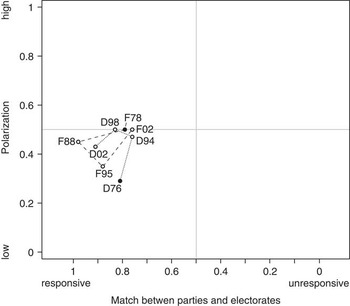
This section presents aggregated results concerning party system features in Germany and France. Figures 1 and 2 map the degree of polarization of the two countries’ party systems, as well as their responsiveness to voter preferences along the economic and cultural divisions, respectively, for each election. I start with the economic cleavage in order to test whether the German party system remains more polarized along this dimension than the French, thus opening more space for the mobilization of cultural conflicts in the latter. While there are elections that exhibit a somewhat lower match between the positions of parties and their voters, Figure 1 does not reveal marked differences between the two countries due to medium-to-low levels of polarization and rather responsive party systems in most elections in both countries. Since the 1970s, the economic divide has thus not been strongly reinforced by political conflict. Loyalties related to the state-market cleavage may have delayed, but not organized out completely the rising prominence of political identities related to the new cultural divide.
Polarization and party system responsiveness along the state-market cleavage in France and Germany.

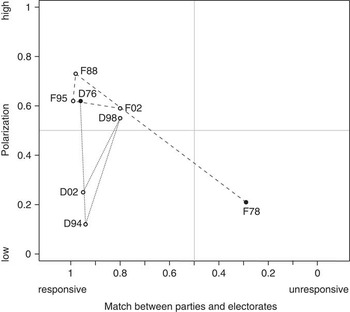
Polarization and party system responsiveness along the cultural divide in France and Germany.

While the nature of oppositions is thus quite similar along the economic dimension in the two countries, the nature of conflicts differs much more strongly with respect to the cultural dimension, as Figure 2 reveals. In France, the party system has clearly become more polarized along the new cultural line of conflict than along the economic divide. With the manifestation of the left-libertarian agenda in party competition in the 1970s, the party system first lost, but subsequently regained, responsiveness due to a reconfiguration of partisan alignments and parties’ political offers. By the late 1980s, under the impact of the mobilization of the populist right, a three-block structure emerged in which the poles are constituted by the left-libertarian and the traditionalist-communitarian blocks, with the center-right squeezed into the middle, as we shall see later. At the end of this process of party system transformation, parties closely mirror the positions of the electorate, that is, they are indeed responsive.
In Germany, however, the party system was relatively polarized in 1976 and then again in 1998, but not in 1994 and 2002. And while the level of polarization varies, the party system is responsive to voter preferences throughout the period studied. How could the emergence of a political space defined by the same two dimensions in France and in Germany have such different consequences with respect to the configuration and polarization of the party system? The next section shows that not only the mainstream right, but also the left pursued diverging strategies in dealing with the new cultural issues that have shaped political controversy since the 1970s.
Mainstream party positions and space for the populist right in France
France is a prime example that seems to corroborate Ignazi's (2003) influential claim that the established right pushed a radicalization of political discourse which right-wing populist parties later thrived on. In 1977, the right-wing government, confronted with rising levels of unemployment, announced plans to repatriate immigrants. However, the counter-mobilization of the unions and the non-communist left, as well as by parts of the right, led the government to abandon the plan (Martin, Reference Martin2000: 258–259). In the 1978 parliamentary election, immigration was no longer a prominent issue, and thus does not form part of the cultural dimension. In a campaign centering on cultural liberalism and budgetary rigor, the mainstream parties, with only the partial exception of the Gaullist Rally for the Republic (RPR), did not differ strongly with respect to their positions on the cultural dimension. The party system was clearly unresponsive in this campaign, as reflected in the low match between party positions and the preferences of their electorates. Nonetheless, the Front National, which competed in those elections, won a mere 0.3% of the vote.Footnote 5 Hence, the mainstream right's playing with the fire was not enough to create space for the extreme right.
The dynamics of competition changed 3 years later after the 1981 elections, won by the left. When the Socialist government under Mitterrand decided to regularize illicit immigrants and abandon the death penalty, the right radicalized its discourse to oppose these measures. The Socialists, having been forced to abandon their ambitious plan of Keynesian demand stimulation, continued to push polarization. In light of the early successes of the Front National, it promoted anti-racism as a central issue, defending a multiculturalist ‘recognition of difference’ (Perrineau, Reference Perrineau1997: 49–50). This position contributed to the rising salience of the cultural as opposed to the economic dimension of conflict. Furthermore, it reinforced the Front National's ownership of the immigration issue (Meguid Reference Meguid2005, Reference Meguid2008: 159–163). The mainstream right was uneasily caught in between: after oscillating for some time between playing down the immigration issue and taking a tough stance due to internal divisions (Meguid, Reference Meguid2008: 163–165), it seems to have begun sending clearer signals taking the Front National's policy position seriously from the mid-1980s on (Ellinas, Reference Ellinas2010: 181–184). Nonetheless, this strategy proved unable to stop the extreme right's entry into the system.
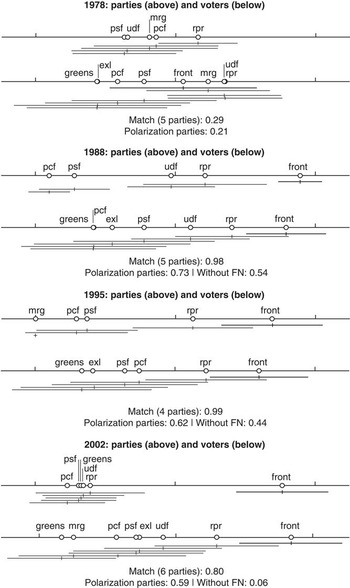
From the 1980s on, when the immigration issue had become a permanent feature of party competition in France, the new cultural divide was established. For each election shown in Figure 3, the first line indicates the positions of parties and the second line that of their voters. A position to the left indicates a libertarian-universalistic stance, while a position to the right denotes a traditionalist-communitarian resistance against these universalistic principles. The bars beneath the average positions of parties and voters show the standard deviation of party statements and voter orientations, respectively. The result of the clear ideological posture of the left in conjuncture with the rise of the Front National is mirrored in the evolution of the patterns of opposition between 1978 and 1988. The results presented in Figure 3 underline the polarizing strategy of the Socialists and Communists, which have moved towards the libertarian-universalistic pole of the divide. With the Front National catering for the opposing traditionalist-communitarian pole of the divide, polarization surges between 1978 and 1988. The Gaullist RPR has not changed its position very much. Although the Gaullists took restrictive positions with regard to immigration, they did not clearly oppose cultural liberalism, as the more detailed position measures provided in Table A.4 in the online Appendix show. As a result, the RPR is situated at a considerable distance from the Front National. This leaves ample room for the latter to mobilize an electorate that is similarly extreme to the party itself. Although there is some overlap between relatively traditionalist supporters of the RPR and the less traditionalist followers of the Front National, a large number of the latter's voters are located at the extreme of the dimension. The relatively large spread of the RPR's issue statements also underlines the party's difficulty in defining its position on the cultural dimension, and its voters are also more dispersed along the spectrum than those of the Front National.
Parties and voters on the cultural divide in France, 1978–2002. Notes: exl, extreme-left parties; front, Front National; greens, Greens, other ecologist parties; mrg, Movement of Left-Wing Radicals; pcf, French Communist Party; psf, French Socialist Party; rpr, Rally for the Republic (Gaullist; later, Union for a Presidential Majority, then Union for a Popular Movement); udf, Union for French Democracy, small centrist parties.

While the 1995 campaign mirrors the situation of the preceding one, the Gaullists’ shift in position in the most recent contest covered by the data underlines that the Front National's electoral support has become largely independent from the positions of the mainstream right. In 2002, the established right suddenly converged with the left in a libertarian-universalistic position.Footnote 6 In light of this quite dramatic change of strategy on the part of the mainstream right, the growth of Le Pen's support base from 15% in 1995 to 16.9% in the first round of the 2002 presidential elections appears rather meager. Indeed, Le Pen made it to the run-off in that election, yet the story of the Front National up until 2002 is one of a more or less linear rise in success.Footnote 7
No space for the populist right in Germany?
How did the strategies of the established parties in Germany differ from those of their counterparts in France? Since World War II, the two Christian Democrat sister parties have proven a remarkable capacity for integrating the entire right-wing spectrum. Smith (Reference Smith1976), discussing Germany's ‘restricted ideological space’, points out that ‘The early ability of the CDU to spread itself across the previously rigid lines of German society led to the assimilation of a large proportion of the electorate within a single umbrella-party’ (1976: 402). In the 1970s, Germany witnessed a ‘renaissance of conservatism’ as a reaction to the 1968 student movement and the formation of a social-liberal government after the 1972 election. Confronted with the decline of religiosity, the Union parties seized the opportunity and endorsed the Zeitgeist by stressing the importance of the family for moral guidance, and by propagating a new historical and national consciousness (Grande, Reference Grande1988). As Figure 4 shows, the positions of the major parties and their voters were much more polarized in the German elections of 1976 than was the case in the late 1970s in France. The Social Democratic Party (SPD) and Free Democratic Party (FDP), their Liberal coalition partner, strongly endorsed the universalistic norms of the New Social Movements, and the SPD thus has a clear New Left profile. The position of the Christian Democrat sister parties (CDU and CSU), however, reflects their neo-conservative profile. The party system represents voter preferences almost perfectly, and a two-block structure is clearly discernible at both levels.
Parties and voters on the cultural divide in Germany, 1976–2002. Notes: cdu, Christian Democratic Union; csu, Christian Social Union (only in Bavaria); fdp, Free Democratic Party, liberals; exr, extreme right parties (including the National Democratic Party, German People's Union, and Republican Party); pds, Party of Democratic Socialism; spd, Social Democratic Party.

The new conservative-liberal coalition that took office under Kohl's chancellorship in 1982 failed to bring the promised ‘turn’ in terms of concrete policies, however. This was one of the major reasons that provoked the breakaway of the extreme right Republikaner from their Bavarian Christian Democrat mother party (Grande, Reference Grande1988; Minkenberg, Reference Minkenberg1992: 70–72; Ignazi, Reference Ignazi2003: 74–75). The odds for absorbing the traditionalist political potential improved, however, with the rise of two new issues on the political agenda. For one thing, the Union orchestrated the reunification of the country under Helmut Kohl's leadership and thereby deprived the extreme right of one of its central themes of the post-war decades (Stöss, Reference Stöss2005: 38–40, 86). For another, the CSU and parts of the CDU had already taken up the immigration issue in the early 1980s. A few weeks before the fall of the social-liberal coalition, CDU leader Helmut Kohl demanded the reduction of the number of foreigners in Germany, and the CSU continued to campaign against refugees (Thränhardt, Reference Thränhardt1995; Schmidtke, Reference Schmidtke2004).
Obviously, then, the established right pursued a similar strategy to that of its counterpart in France in the early 1980s. Consequently, the hypothesis focusing on the availability of political space for the extreme right cannot explain why the Front National was successful in France, while the Republicans failed in Germany. The crucial difference, then, lies in the reaction of the left. Using Meguid's (Reference Meguid2005) terms, the Socialists in France pursued an ‘adversarial strategy’ regarding traditionalist-communitarian issues, making multiculturalism a central claim, while the SPD employed a ‘dismissive strategy’ by systematically downplaying the immigration question. In retrospect, Helmut Schmidt explained that the SPD in 1980 had decided not to ask for local voting rights for foreigners, which were discussed at the time, because this went ‘against the instincts of our core electorate’, namely, their blue-collar constituency (Thränhardt, Reference Thränhardt1995: 327; Schmidtke, Reference Schmidtke2004: 166–167). However, the Union parties reacted promptly when they were confronted with a wave of extreme right activism and violence in the early 1990s. They succeeded not only in modifying the constitution to allow for a far more restrictive immigration policy, but also in forcing the SPD into the so-called ‘asylum compromise’ (Schmidtke, Reference Schmidtke2004: 169). Hence, the SPD again avoided a stretching of the ideological space. Rather than legitimizing the immigration issue, the combined strategies of the major parties of the left and right ousted the issue from the political agenda. A similar scenario occurred in 1999, when the red–green coalition announced a reform of Germany's nationality law. The Union parties launched a large debate on national identity, demanding that immigrants must conform to Germany's ‘guiding culture’ (‘Leitkultur’). As a consequence, the new nationality law was drafted in close collaboration with the opposition, because the government wanted to keep the issue out of partisan politics.
In line with this narrative, the positions of parties and voters presented in Figure 4 show a clear break between the situation in the mid-1970s and the three more recent contests, where the old contrast is no longer present. The most striking feature of the new pattern is that the two major parties, the SPD and the CDU, do not take strongly opposing positions, and that the same holds true for their respective average voters. In the 1994 contest, a year after the new immigration law took effect, the SPD and CDU lie very close to one another, a finding confirmed in the later elections. Together, the major parties lie closer to the libertarian-universalistic pole in 1994, move to the center of the spectrum in 1998, and then move back to the left in 2002.
In 1994, we cannot place the smaller actors due to the media's narrow focus on the three traditional German parties, but the results for 1998 indicate that they occupy the universalistic space to the left of the SPD, which the latter has abandoned since the mid-1970s. While large parts of the electorate are thus bound into an alliance with the two major centrist parties, the Greens mobilize the forefront of the New Left electorate.Footnote 8 In turn, by leaving the libertarian-universalistic electorate to the Greens, the SPD has avoided a dealignment in the party system that could have provided a new constituency for the extreme right. Although the party system is responsive to voter preferences, then, the absence of a counter-pole to the Greens mobilizing voters at the traditionalist-communitarian extreme of the preference distribution implies an imbalance in the party system. A potential for differentiation exists on the right, since the center of the axis halves the distribution of respondents. In other words, many voters lie to the right of the average CDU/CSU voter. However, apart from the small group of extreme right followers, these voters do not seem inclined to support new or anti-establishment political parties.
In the two more recent elections, Republikaner, NPD, and DVU voters are subsumed under the extreme right label. This electorate is clearly situated at the extreme of the cultural dimension, but lacking a ‘modern’ right-wing populist discourse, and with the immigration issue off the agenda, the corresponding parties are unable to mobilize voters beyond their core constituency of hardline authoritarians. To a large degree, then, voters with traditionalist-communitarian worldviews vote for the Union parties. However, the Union parties do not permanently mobilize this potential. Rather, it remains latent most of the time and does not manifest itself politically. This is only possible because of the collusive strategy the major parties of the left and right generally pursue, combined with the Union's temporarily moving to the right whenever the immigration issue actually surfaces in the public debate.
Conclusion
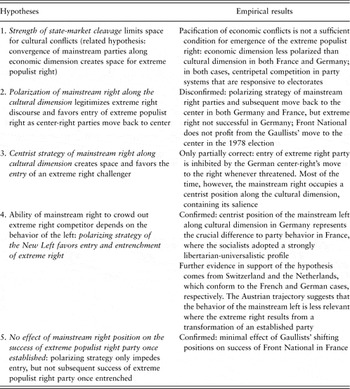
Table 1 summarizes the implications of the analysis for the various hypotheses concerning the impact of mainstream party positions on the ability of an extreme populist right party to gain entry to the party system and subsequently consolidate its success. Similarly to France, it is not the strength of the state-market cleavage that precludes a stronger mobilization of cultural conflicts in Germany (hypothesis 1). Hence, while the convergence of the mainstream parties may be a necessary condition for the emergence of an extreme right party, it is by no means a sufficient one. In both countries, the libertarian-authoritarian antagonism characteristic of the 1970s was transformed by the advent of the issue of community on the political agenda in the 1980s and 1990s. As I have shown in this article, the nature of the resulting conflict differs in the two countries. Despite both party systems remaining largely responsive to voters, oppositions have been polarized between parties in France since the 1980s, when the Front National established itself as a durable actor in French politics. Once established, an extreme right party contributes to perpetuating this polarized pattern of opposition, since it keeps disputes over the proper definition of binding norms, and over what constitutes the basis of the national community, on the political agenda. Despite the recent electoral losses of the Front National, there is little evidence that the mainstream parties are able to strategically crowd out an extreme right competitor that is already established, or to oust its key issues from the political agenda (hypothesis 5).
Hypotheses and empirical evidence of the analysis

Mainstream party behavior in the early stages of the extreme right challenge is therefore crucial. Contrary to what is suggested by other studies taking a snapshot of party positions at one point in time, the German Christian Democrats do not permanently close the space to their right (hypothesis 3). Rather, oppositions along the cultural divide in Germany have oscillated between more or less polarized patterns since the 1970s. The result is that issues relating to immigration and multiculturalism are not permanently on the political agenda, thereby containing the realigning potential of a polarization of cultural conflicts. However, by moving to the right, the Christian Democratic Union parties have the continuing ability to rally voters holding traditionalist-communitarian preferences whenever they are challenged by an extreme right competitor.
Hence, the simple polarization hypothesis, which states that the mainstream right's politicization of identity issues legitimizes the extreme right's discourse, cannot explain the difference between Germany and France (hypothesis 2). My modified account, however, does: contrary to earlier studies, the analysis reveals that the most important factor impinging on the fortune of the populist right in Germany lies in the interplay of the strategies of the mainstream left and right (hypothesis 4). Were it not for the moderate position of the Social Democrats, the centripetal competition in the cultural domain could not be maintained. Instead, collusion among the major parties prevents cultural or value oppositions from becoming salient and divisive. While this strategy has resulted in the emergence of one of the most successful Green parties in Europe, it has also precluded more far-reaching realignments along the cultural dimension comparable to those in France.
The question remains how consciously this joint strategy of the German mainstream left and right was chosen, and whether the account developed in this article can be generalized to other contexts. Indeed, there is evidence showing that the behavior of German parties was motivated by the memory of the Nazi regime and by the common conviction that the establishment of an extreme right party should be averted (Art, Reference Art2006). Nonetheless, the argument is not specific to Germany, in the sense that similar strategies pursued elsewhere are likely to inhibit the entry of a right-wing populist competitor as well. Since the German Social Democrats exhibited a clear-cut New Left profile in the 1970s, they have clearly undergone a programmatic shift that is difficult to account for if not by strategic reasons. Hence, I find it more plausible to assume that strategy matters in the German case, but not in the French case. Concerning France, Meguid (Reference Meguid2005, Reference Meguid2008) suggests that the Socialists adopted an adversarial strategy with respect to the Front National not so much because of their ideological convictions, but primarily in order to weaken their mainstream right competitor. However, if we conceive of the immigration issue as part of a cultural dimension that is also central for the left, then what needs explaining is why, in a case like Germany, a left-libertarian party did not take a strong counter-position to the extreme populist right.
Obviously, the Christian Democrats’ maneuvering also requires explanation, since the mainstream right may be tempted to continue invoking strongly traditionalist-communitarian messages. The Christian Democrats in Germany have resisted this temptation, in part perhaps because of the memory of National Socialism, but also due to their hegemony within the right, which gives them considerable leeway to shift their positions. In the latter respect, the situation has been rather different in party systems characterized by competition within the established right. This applies to Switzerland and Austria. Both the Swiss People's Party and the Austrian Freedom Party underwent a permanent transformation to extreme right-wing populist parties in their attempt to attract voters with traditionalist-communitarian worldviews from their center-right competitors.
In line with Ellinas’ (Reference Ellinas2010) argument, I have claimed that the behavior of the mainstream parties is crucial above all with respect to the initial breakthrough of extreme right parties. This has important implications for theories intended to explain the varying fortunes of the extreme right. It implies that we cannot expect the same factors to affect both the success of new parties of the extreme right, and those that have resulted from the transformation of a mainstream party, as in the case of the Swiss People's Party or the Austrian Freedom Party. Given the latters’ easier access to the media (see Ellinas, Reference Ellinas2010; Bornschier, Reference Bornschier2010a: 174–175), they might be able to establish themselves as the owners of the traditionalist-communitarian pole in the political space even in the absence of a mainstream left bolstering their support by taking a decisive counter-position. What is more, these parties already occupied a similarly extreme position along the then salient libertarian-authoritarian divide in the 1970s (Bornschier, Reference Bornschier2010b: 428). While the Swiss Social Democrats’ behavior corresponds to that of their French counterpart,Footnote 9 the early entrenchment of the Austrian Freedom Party might be the reason why this party began to flourish long before the Social Democrats started taking a strongly antagonistic position against it (Art, Reference Art2006: 132–139).
In the Netherlands, however, the mainstream left and right seem to have behaved in a manner roughly similar to Germany (see Kriesi and Frey, Reference Kriesi and Frey2008 for an analysis of the Dutch political space), although the liberal-conservative People’s Party for Freedom and Democracy adopted a harsh position with respect to the immigration issue throughout the 1990s. As a consequence, the issue remained on the political agenda, presumably aiding Pim Fortuyn's success in 2002. Yet, the movement of all parties away from the libertarian-universalistic pole (see, e.g. Bornschier, Reference Bornschier2010a: 44) resulted in the Pim Fortuyn movement's inability to consolidate its early success.
More broadly, then, this article shows that political actors may not be able to inhibit structural conflicts from manifesting themselves politically. How they manifest themselves, however, is largely the result of politics. Thus, mainstream party behavior impinges on how polarizing these conflicts become, and whether they provide an opportunity for extremist parties to durably entrench themselves in party systems.
Acknowledgements
I would like to thank Silja Häusermann for valuable comments on earlier versions of this article. I also thank the various anonymous reviewers for their criticisms. One reviewer made particularly valuable comments, which helped to sharpen the focus of the article. Needless to say, I carry the sole responsibility for any remaining errors and omissions.
Appendix 1
Online Appendix is available at www.journals.cambridge.org/epr