The persistent patency of the arterial duct occurs in about one in every 2000 births. As such, it is the second most common congenital cardiac malformation.Reference Mitchell, Korones and Berendes1 Although generally regarded as a sporadic abnormality, genetic risk factors may play a role, and recurrence is observed among 5% of siblings of affected subjects.Reference Lamy, De Grouchy and Schweisguth2, Reference Polani and Campbell3 Persistent patency is also part of rare syndromic defects, such as the Char syndrome,Reference Satoda, Zhao and Diaz4, Reference Mani, Radhakrishnan and Farhi5 and a new heart-hand syndrome comprising patency of the duct, an aortic valve with 2 leaflets, hypoplasia of the 5th metacarpal, and brachydactyly.Reference Gelb, Zhang, Sommer, Wasserman, Reitman and Willner6 A recessive form of non-syndromic smooth muscle myosin heavy chain has also been reported in the Iranian population.Reference Mani, Meraji and Houshyar7 Homozygosity mapping in 21 unrelated consanguineous kindreds led to the identification of a susceptibility locus on chromosome 12q24.
More recently, investigations have been made of American and French kindreds with familial aneurysm and dissection of the thoracic aorta, and persistent patency of the arterial duct.Reference Glancy, Wegmann and Dhurandhar8, Reference Khau Van Kien, Wolf and Mathieu9 In these families, genome-wide linkage analysis mapped the causal locus to 16p12.2-p13.13,Reference Khau Van Kien, Mathieu and Zhu10 and mutations in the MYH11 gene were eventually identified.Reference Zhu, Vranckx and Van Kien11 This gene encodes the smooth muscle myosin heavy chain, a major contractile protein of smooth muscle cells. It is known that differentiation of smooth muscle cells, constriction, migration, and apoptosis all play a major role in physiological closure of the arterial duct.Reference Imamura, Nishikawa, Hiratsuka, Takao and Matsuoka12–Reference Slomp, Gittenberger-de Groot and Glukhova14 Differences in levels of smooth muscle myosin heavy chain between the arterial duct and aorta have also been reported towards the end of fetal development.Reference Kim, Aikawa and Kimura13, Reference Slomp, Gittenberger-de Groot and Glukhova14 MYH11 is thus a legitimate candidate gene for variations potentially favouring persistent patency of the arterial duct.
Methods
Patients
We recruited patients from the Paediatric Cardiologic Department of Necker-Enfants Malades Hospital. In total, we had treated 84 patients with isolated persistent patency of the arterial duct in the three years preceding the study, and these were the patients available for our genetic analysis. We selected 60 of these children, based on them having isolated persistent patency of the arterial duct with no other abnormality, the duct continuing to be patent after one year of age in 3, or having required endovascular closure in 50, and surgical closure in the remaining 7. All were delivered after 36 weeks of gestation in the absence of maternal infection with rubella or any of the other known factors that might have favoured persistent patency. All patients were Caucasian, and written informed consent for genetic analysis was obtained from their parents. Our study was approved by the ethics committee of the Necker Hospital.
MYH11 sequencing
Direct bidirectional sequencing of the 42 exons of the human MYH11 gene, which encodes smooth muscle myosin heavy chain 11 isoform SM2 (MIM 160745), was carried out for all the 60 cases, using the Sanger method (BigDye Terminator cycle sequencing kit, Applied Biosystems, CA, USA). Sequencher® 4.0.5 (Gene Codes Corporation, Michigan, USA) was used for sequence analysis and alignment.
We also used this method to check for the presence of rare genetic variants or common polymorphisms in our control population. The primers used for direct sequencing of the MYH11 gene have been described elsewhere.Reference Zhu, Vranckx and Van Kien11 The control group consisted of 192 normal, healthy, Caucasian volunteers from the general population.
Coiled-coil region prediction
We used Coils softwareReference Lupas, Van Dyke and Stock15 to predict residue positions in the heptad repeat pattern and the probability of coiled coil formation. The wildtype smooth muscle myosin heavy chain sequence was entered under the following configurations: matrix MTK, window width 21, weighted.
Sequence alignment
We used ClustalW to align the amino-acid sequences of several type II myosin heavy chains.Reference Chenna, Sugawara and Koike16
Statistics
Quantitative values are expressed as means plus or minus standard deviations. We used non-parametric Chi-squared tests, as implemented in StatView 5.0 software (SAS Institute Inc, NC, USA), to compare groups. Linkage disequilibrium and haplotype analyses were carried out with THESIAS software (www.genecanvas.org), based on the SEM algorithm.Reference Tregouet, Escolano, Tiret, Mallet and Golmard17 Linkage disequilibrium was deduced from the estimated haplotype frequencies, and its extent was expressed in terms of D’, this being the ratio of the nonstandardized coefficient to its maximal and minimal values. Haplotype effects are expressed as odds ratios with 95% confidence intervals (ORs; 95% CI). Effects associated with rare haplotypes, considered as those having a frequency of less than 0.03, were not estimated, but instead were fixed at zero.
Results
Characteristics of the patients
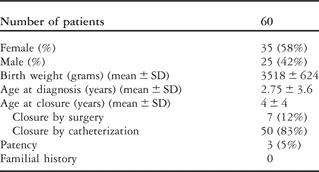
The characteristics of the 60 selected cases are summarized in Table 1. In line with the criterions for selection, none of the patients was born before term, with the mean gestational age at birth being 39.9 plus or minus 1 week, and this maturity at delivery was reflected in the mean birth weight, of 3518 plus or minus 624 grams. Diagnosis in our department occurred quite late, at a mean of 4 years, because most of the children were referred to us for the treatment of congenital cardiac malformations. Indeed, 50 of the patients required transcatheter, and 7 surgical, closure.
General characteristics of the patients.

Rare MYH11 genetic variants
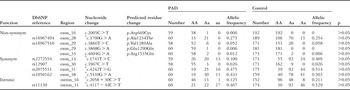
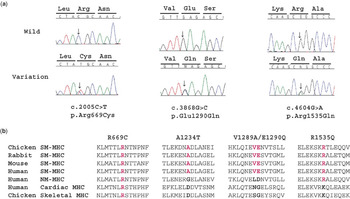
We detected 5 non-synonymous variants (Table 2) among these 60 cases. We also found 2 rare heterozygous missense mutations, absent from the control group, in 2 affected individuals (Fig. 1). The first, p.Arg669Cys, was located in a conserved motif of the smooth muscle myosin heavy chain also present in the human cardiac myosin heavy chain MYH7 and the chicken skeletal myosin heavy chain. The corresponding residue is located on the surface of the molecule in all structural states characterized to date, and could contribute to actin binding. The second mutation, p.Glu1290Gln, corresponded to an amino acid in the rod region of the smooth muscle myosin heavy chain. This mutation was present in the sequence of smooth muscle myosin heavy chains from different species, but not in other myosin heavy chains (Fig. 1). Its position “b” in the heptad repeat of the coiled-coil tail suggests a possible effect on the arrangement of the smooth muscle myosin heavy chain tail. This mutation did not significantly affect the probability of coiled coil formation, as predicted by Coils software (data not shown).
New MYH11 variants and polymorphisms found in the sporadic cases of persistent patency of the arterial duct (PAD).

*Single nucleotide polymorphism (SNP) used for haplotype frequency analysis. Abbreviations: AA: homozygous wild-type; Aa: heterozygous variant; aa: homozygous variant.
Description of the five non-synonymous variants found in the cases of persistent patency of the arterial duct. (a) Chromatography of the three new non synonymous variants. (b) Alignment of the human SM-MHC with other isoforms of type II MHC in the regions affected by the non synonymous variants. The residues concerned are shown in bold.

Another rare missense variant, namely p.Arg1535Gln, was observed in 2 children with persistently patent arterial ducts. This mutation was also located in a region conserved between humans, mice, rabbits and chickens. It was also found in two controls, providing evidence that this variant plays no substantial role in promoting persistent patency.
Common MYH11 polymorphisms
We identified 2 coding polymorphisms, p.Ala1234Thr and p.Val1289Ala, with similar allelic frequencies in cases and controls (0.27 versus 0.25 and 0.05 versus 0.06, both ns). We found 5 non-synonymous variants, and 23 synonymous polymorphisms in the coding region, 14 of which were already present in public databases (http://www.ncbi.nlm.nih.gov/SNP), and 9 of which had never before been described (see supplementary Table 1). We also identified 38 diallelic polymorphisms in the non-coding sequences explored during the analysis of intron-exon boundaries, 21 of which had not been described before. We also identified several new intronic variations in the vicinity of splicing sites (see supplementary Table 1). None of these variations affected the probability of splicing, as predicted with NetGene 2 softwareReference Hebsgaard, Korning, Tolstrup, Engelbrecht, Rouze and Brunak18, Reference Brunak, Engelbrecht and Knudsen19 (data not shown).
Association study: single polymorphism and haplotype analysis
We selected 6 polymorphisms, 1 non-synonymous, 3 synonymous, and 2 intronic, based on their allelic frequency being greater than 0.10, and on the absence of complete linkage disequilibrium among the 60 cases. The 192 individuals in the control group were genotyped for these polymorphisms, by the same direct sequencing method used in the affected group. In some cases, genotyping was difficult due to poor-quality samples. This resulted in only 300 chromosomes from 150 normal individuals being genotyped without ambiguity for all six polymorphisms.
Individual comparisons of genotypic frequencies showed no significant difference between cases and controls. Significant linkage disequilibrium was found between the various polymorphisms, with all D’ values significantly different from zero (Table 3). These six polymorphisms generated seven major haplotypes (Table 4). The global haplotype distribution differed significantly between cases and controls (χ2 = 14.32 with 6 d.f.; p = 0.026). This difference was mainly due to the lower frequency in cases than in controls (0.072 versus 0.220) of the only haplotype carrying the c2058 + 30T allele (TTGTGA). In logistic regression analysis, the odds ratio for patent arterial duct being associated with this haplotype was estimated at 0.231 [95% CI 0.079–0.675] (p = 0.007).
Pairwise analysis of linkage disequilibrium between the six polymorphisms of the MYH11 gene in the 150 pooled samples.

Main haplotype frequencies of the MYH11 gene, as a function of case as opposed to control state, in the whole sample and estimation of haplotypic odds ratios, amongst the 150 samples.

*Haplotype used as the reference haplotype.
Discussion
This is the first study to investigate the possible relationship between variations in the MYH11 gene and the sporadic occurrence of persistent patency of the arterial duct. Overall, our results show that the MYH11 gene does not play a substantial role in such apparently sporadic cases. We identified four subjects (6.7%) with three rare missense mutations, R669C, E1290Q, and R1535Q, that might affect the structure of the smooth muscle myosin heavy chain tail or interaction with actin, thereby potentially causing problems with closure of the arterial duct. Only two of these mutations were not also found in normal volunteers, reducing to two (3%) the number of cases with unique missense variants. The smooth muscle myosin molecule is composed of two heavy chains, two essential light chains and two regulatory light chains. It assembles in dimers with two N-terminal globular heads housing the ATP- and actin-binding sites, and one coiled-coil rod assembled from two α-helical C-terminal tails. In one of the two variants, R669C, the mutation affected the globular head of the smooth muscle myosin heavy chain, whereas in the other, E1290Q, the rod domain was affected.
The myosin head is a motor domain containing binding sites for ATP and actin. Hydrolysis of ATP brings the myosin head into contact with actin filaments, allowing the thin filament of actin and the thick filament of myosin to slide past each other, resulting in generation of force in the myocytes and/or contraction.Reference Huxley20, Reference Huxley21 The R669 residue is located in a highly conserved segment within a long α helix in the globular head, and directly toward the proposed actin binding region.Reference Rayment, Rypniewski and Schmidt-Base22, Reference Rayment, Holden and Whittaker23 The structural role of this residue has not been identified,Reference McLachlan and Karn24 but it could contribute to binding of actin, either in the state of rigour, or as a contributor to one of the weak binding interactions. The mutations affecting the corresponding residue in the human cardiac myosin heavy chain, R663 H and R663C, have been associated with familial hypertrophic cardiomyopathy.Reference Rayment, Holden, Sellers, Fananapazir and Epstein25, Reference Song, Zou and Wang26 Based on these evidences, the substitution of R669C could change the binding constant to actin or actin activation, and thus influence the contractile properties of the molecule.
The rod region of myosin consists of a series of heptad repeats (a, b, c, d, e, f, g), resulting in 28-residue periodicity, with alternate bands of positive and negative charges essential for rod assembly.Reference McLachlan and Karn24, Reference McLachlan and Karn27 The residues at position a and d are usually hydrophobic, and this property is critical for the association of two alpha-helical myosin heavy chain tail regions to form the coiled-coil rod. The other residues at positions e, b, f, c and g participate in the interaction with other myosin rods to form myosin thick filaments. They are usually hydrophilic, and contribute to the periodic alternation of charge. Four non-synonymous variants were found in this region. Of these, the p.Glu1290Gln variant was found in only one child with persistent patency. This glutamine residue is conserved among smooth muscle myosin heavy chain proteins from different species, but not in cardiac or skeletal muscle myosin heavy chain. Its position “b” in the heptad repeat of the coiled-coil tail indicates that it may affect the interaction of smooth muscle myosin heavy chain rods to assembly thick filaments, but not the coiled-coil formation as indicated by the Coils prediction. The negatively charged glutamine replaced by a non-charged glutamic acid may change the periodicity of the rod and interfere with thick filament formation,Reference McLachlan and Karn24 or influence the proper alignment or registration of dimers into filaments as showed for similar MYH9 mutations In this study by Franke et al.,Reference Franke, Dong, Rickoll, Kelley and Kiehart28 change of charged pattern in the myosin rod was showed to form paracrystals with normal periodicity, but the mixed wildtype and mutant paracrystals were narrower than the wildtype ones. Further structural data is needed to draw firm conclusions on the functional effects of our mutation.
The other three variants, p.Ala1234Thr, p.Val1289Ala, p.Arg1535Gln, all involved the smooth muscle myosin heavy chain rod region. Based on Coils prediction, the affected residues correspond to positions b, a, and b, respectively, and the mutations do not significantly affect the probability of coiled coil formation. All three variants were observed in controls with a similarly low, for p.Arg1535Gln and p.Val1289Ala, or high, for p.Ala1234Thr, frequency. They should therefore be considered not as mutations, but rather as genetic rare variants or polymorphisms.
Our analysis of the six informative polymorphisms in this series of cases and 150 Caucasian controls suggested, therefore, that the MYH11 gene does not have a major effect on producing persistent patency of the arterial duct. A significant, but mild overall effect was observed, but this effect resulted mostly from a difference in the frequency of one particular haplotype between cases and controls, at 0.072 versus 0.220. This haplotype carries the c2058 + 30T allele, corresponding to intron 16 of the MYH11 gene. As this C > T transition at position +30 after the splicing donor site is not predicted to affect the splicing of exon 16, we can only suggest that it is part of a haplotype containing another variant affecting expression of the MYH11 gene or production of protein. The protective effect of this variant against persistent patency is difficult to interpret because we were expecting to find a deleterious risk factor. The replication of these findings in an independent sample is required before we can conclude that MYH11 is a gene involved in producing the sporadic variant of persistent patency of the arterial duct.
Although genes might play a role in the occurrence of isolated persistent patency, our preliminary analysis does not demonstrate that the human MYH11 gene is a strong susceptibility factor for such condition. It remains possible that rare missense variants of MYH11 may account for a small percentage of cases.
Acknowledgments
We thank all the affected children and their parents for participating in this study. We thank I Decamps and I d’Argentré for secretarial assistance, and Julie Sappa for editing the manuscript. We also thank F Gary for help with the genotyping of cases and controls, and Drs A Houdusse, I Rayment and J Fagart for assistance with the bioinformatic prediction of the structural consequences of rare variants. This study was funded by INSERM, the Fondation pour la Recherche Médicale and by the Agence Nationale pour la Recherche (ANR 05PCOD01403-Project A05243). Dr Limin Zhu was supported by the Charcot Programme of the French Foreign Ministry.