1. Introduction
1.1. Background
My interest in using traditional instruments in electroacoustic performances is longstanding (Whalley Reference Whalley2005). This extends to real-time performance systems that incorporate regional acoustic instruments and environmental sounds (Whalley Reference Whalley2008). Prior work has also involved applying multi-agent technology to explore this and other aesthetic areas (Whalley Reference Whalley2004, Reference Whalley2010c).
A focus of my work with multi-agent software has been to implement Paine's (Reference Paine2002: 297) conversational model of interaction, to extend machine/human dialogue in electroacoustic music performance. An assessment of different multi-agent approaches against Paine's concept (Whalley Reference Whalley2009) illustrated that the best implementation was a machine/human generative improvisation model. This model allowed for real-time improvised human and machine input, and human and machine adaptation (autonomy and learning), to the input of both parties.
1.2. Recent work
As part of a series of Internet2 projects expanding aspects of these interests (Whalley Reference Whalley2010d, Reference Whalley2011), Mittsu no Yugo (Whalley Reference Whalley2010a) included input from three different countries. It was realised through the IPv6 format, and used multiple bi-directional audio streams and HD digital video connections. Performers at Waikato University, New Zealand, included Ian Whalley – Max/MSP patches, wind synthesiser/controller, effects; Lara Hall – violin gestures (non-tonal) and looper; Hannah Gilmour – spectral beds, rhythm and effects; and Richard Nunns – short traditional Maori instrument samples. At Calgary University in Canada, David Larsen played Buffalo drum, and at Beijing's Central Conservatory of Music, Bruce Gremo played Shakuhachi at the MUSICACOUTICA10 event.
1.3. Questions, approach, assumption
While the literature on Internet2 music increasingly considers the technical and social aspects of getting things done, coverage of sonic languages in tandem is often neglected because ‘netspace’ is usually considered to be a medium. From a philosophical perspective, Tanzi (Reference Tanzi1999: 106) provides a counterpoint to a largely production view when discussing electroacoustic music generally, noting that, for innovations to be validated, the grammar constituted by the phenomenological rules of musical communication needs to be respected.
Starting questions were then how to accommodate and balance experimental and traditional perspectives to make a cohesive sonic statement, and how to map choices available in an expanded and multi-dimensional decision arena to realise this.
In response, a framework is put forward covering three inter-related areas: production, relationships and language. This provides at least a useful way of navigating the territory for others who may want engage in the area. ‘Production’ briefly covers linear and non-linear approaches, and real/‘netspace’ combinations. ‘Relationships’ looks at some established and new dialogues, and changing roles in making music. ‘Language’ is an approach to melding established and more recent methods through juxtaposition, synthesis and assimilation.
The assumption is that it is worthwhile to make sonically layered works that combine different aesthetic approaches. This is because the outcome may engage wider audiences for electroacoustic music practitioners through broader participation as input, and Internet broadcast as output.
1.4. Significance
Through the application of digital media, there has been a shift from a command and control approach that is typical of industrial and hierarchical societies in stable environments, to a coordinate and cooperate paradigm where multiple entities self-assemble (Friedman Reference Friedman2007). Moreover, machines have become increasingly independent and participatory through the application of automation and new artificial intelligence software – allowing teams (machines and humans) to operate in dynamic industrial situations where there can be many participants and outcomes.
Reflecting this, the experimental use of Internet2 for electroacoustic musics, considered broadly here as any sound-based art form that is electronically mediated, allows for synchronous approaches to composition/improvisation by co-located musicians and machines. People/‘intelligent’ machines must also come to terms with an extended set of relationships in different time zones, the desire to combine real and virtual spaces, and perhaps the desire to express geographic identity through unique instrumental timbres and gestures. Coupled with agent-based software and data transfer through OSCgroups, the decision space covering what, how and why to implement works then becomes complex.
The significance of coming to terms with these issues for electroacoustic practitioners is in increasing broadband speed and connectivity, more powerful grid computing, increasingly distributed intelligent machine participation, and more mobility and diversity of net access/interfaces. This is likely to increase demand for works that are more participation driven with open and flexible structures and content.
1.5. Concepts of space
Accepting that concepts of space are historically and culturally embedded (Wertheim Reference Wertheim1999), real space is understood here as the physical place where people are located, each with its own acoustic characteristics. This is usually considered in three dimensions.
Electroacoustic space concerns the manufacture of space within works (internal space) as well as a work's diffusion (diffusion space) through different speaker arrays. Smalley (Reference Smalley1997) gives a conceptual overview of this. Apart from electroacoustic space, electroacoustic music can be manipulated beyond three dimensions, for example to control timbre on a single machine, making a multi-dimensional parameter space possible.
Finally, it is useful to differentiate between cyberspace (Mitra and Schwartz Reference Mitra and Schwartz2001) and cyberplace. Cyberspace is understood as a web of connections between people at nodes in an electronic network – an extension of the physical Cartesian model of space. Cyberplace is understood here as the meeting points between parties in cyberspace, at best characterised by a sense of resonance between participants, simultaneous activity, and non-linear action. In crude terms, production values are generally associated with cyberspace, and relationship values associated with cyberplace.
2. Starting Decision-Space Map Choices
2.1. Frame
While using Internet2 affords new possibilities for electroacoustic music practitioners through using audio exchange, the practice builds on earlier attempts at network music performance (NMP) based on exchanging data that are well documented (Joy and Sinclair Reference Joy and Sinclair2009). The framework put forward here partly draws on aspects of this early work, as well as more recent experiences and experiments.
Similarly, machine/human interactivity is well covered in the literature. Making Mittsu no Yugo (Whalley Reference Whalley2010a) then began from a prior decision map covering production approaches, language and machine role/relationships (Whalley Reference Whalley2009). This map provided a basis to partly judge what new offerings NMP/Internet2 provided, and so it is first reiterated here.
2.2. Prior decision space
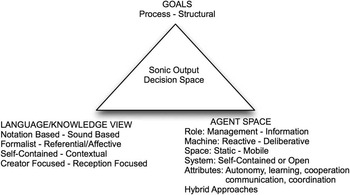
Gimenes, Miranda and Johnson (Reference Gimenes, Miranda and Johnson2006) note that artworks reflect a cultural inheritance, composer choices and the history of influences on a work. Composers consciously or unconsciously draw on their view of music/sound art and are influenced by the purposes for which the output is intended. They are also influenced by the knowledge, techniques and conventions developed through artistic and technical training. A multi-dimensional decision space that integrates some of these concerns with software-based multi-agent technology is given in figure 1 (Whalley Reference Whalley2009).
Decision space.

3. Production Decisions – Goals And Space
3.1. Goals
The choice of creative goals (figure 1) influences the type of system used or built for a work. Weinberg (Reference Weinberg2005: 31–2) characterises the extremes of the two approaches as being structure/composer controlled or processes based. Technically, a structure-centred approach allows participants (agents and/or humans) to fill prescribed musical or performance outcomes. A process-centred approach concentrates on exploring possibilities or fulfilling goals through collaboration or competition, and the experience may differ with each session. This continuum is often described as being linear or non-linear in making form and/or content.
3.2. Production/technical choices: networks approaches and latency
Using networks to exchange data rather than sound between nodes precedes Internet2. Barbosa (Reference Barbosa2003: 57) classifies NMP according to a co-located to remote action approach, and a synchronous to asynchronous approach. He concludes that local interconnected music networks and aspects of shared sonic environment methods best suit co-located/synchronous performance. This analysis also identifies the subsequent domain of Internet2 music-making through audio exchange.
As data transfer using OSC as part of sound-based works in Internet2 music-making continues, and assuming the desire for works with a collective output created through synchronisation, aspects of Weinberg's (Reference Weinberg2005) concept of defining connectivity based on the relationship between players and the network continues to be useful. The two relevant choices are a bridge approach, which directly connects geographically dispersed users to perform/improvise together, and a shaper approach, where users modify musical material that is generated algorithmically by a central system, and where players respond to the collated input of all participants.
For the real-time exchange of audio data, Alexandraki and Akoumianakis (Reference Alexandraki and Akoumianakis2010: 69) put forward three possible models. A peer-to-peer approach has no central sound server. Each peer streams to close peers making a cluster network, and each peer transmits many and receives many streams with no central mixing. A star approach provides a central server that collects individual outputs and sends out individual streams. Peers then transmit one stream and receive many, and they can alter input streams – a method that has flexible routing options. Finally, a mixed peer-to-peer and star approach is one in which each peer sends one output and receives the combined mix from the server. This allows server intervention in the artistic mix, and peers can respond to a collective output.
Even with the greater bandwidth that Internet2 affords, however, latency cannot be avoided. Renaud, Carôt and Rebelo (Reference Renaud, Carôt and Rebelo2007) put forward three choices to cope with this: accept it, ignore it or play with it. Again assuming the need to play synchronously, the two choices they offer are a realistic jam approach (RJA) and a latency accepting approach (LAA). RJA attempts to imitate a live situation as best possible, and is a primary concern of making Internet2 works for music driven by a pitch/duration matrix. Carôt and Werner (Reference Carôt and Werner2007), for example, suggest several methods to accommodate the delay for this. LAA is more suited to electroacoustic music productions, where one learns to compose/improvise in ways for which timing is not critical, and/or use strategies to compensate for it in aesthetic terms.
Latency/delay is also a creative opportunity. Among others, Caceres and Renaud (Reference Caceres and Renaud2008), for example, suggest methods such as using network delays as multiple musical delays, using synchronisation limitations to make performances slightly different at each location, and mapping latencies into spatial algorithms in connected physical spaces. Further, Caceres and Renaud (Reference Caceres and Renaud2008) also suggest combining the acoustics of the network with the acoustics of physical spaces at nodes that join in. This makes the sharing of space a multi-dimensional possibility, such as using the reverberation space at one point to change to quality of sound from a node sent to it.
3.3 Production integration
Follmer (Reference Follmer2005: 189), in contrast to Barbosa (Reference Barbosa2003), sets out a three-dimensional matrix to assess approaches to the NMP idiom that can include Internet2 practice. The matrix maps:
• interplay with network characteristics – how the structural characteristics of the network shape the music, including the relationship between real and virtual space;
• interactivity and openness, or the extent to which users/audiences can join in with and influence outcomes – considering the role of people, interfaces/instruments, trivial machines (reactive) and non-trivial (intelligent) machines; and
• complexity and flexibility, or how musically/sonically flexible the outcome can be, including the role of listeners/participants/instruments, machines, and the network in any combination in creating complex and flexible outputs.
Based on this analysis, Follmer suggests that the production approaches best suited to the medium are hypermusic (new hybrid instruments), real-virtual/space sound installations, and algorithmic/generative installations.
3.4. Linear/non-linear shift and composition or communication
In general, linear/edited electroacoustic music has often sacrificed spontaneity and interactivity for the sake of deterministic control of increasing parameter space, where time is secondary to innovation and reflection in working toward a perfect product (Helmuth Reference Helmuth2005: 2002). Interactive and generative systems apart from NMP often sacrifice aspects of real-time parameter space in favour of spontaneous outcomes that can be multiple and varied.
A consequence of the shift from linear to non-linear and distributed approaches, extended in the Internet2 music-making domain, is a choice between two paradigms, best thought of as a continuum (Follmer Reference Follmer2005). Practitioners may primarily be concerned with a composition approach, which concentrates on the structuring of new works in relationship to network structures, communications and sound aesthetics. The preference of practitioners for this is often because telepresence works can be broadcast to audiences at each real node as well as streamed to a worldwide audience through the Internet. A communication approach treats sound as a means to understand the network and its affect on social relationships, explores real space/cyberspace combinations, and experiments with new structures.
4. Identity, Relationships And Roles
4.1. Frame
Barbosa and Follmer identify by proxy the importance of relationships in Internet2 music-making, and significant changes to the traditional roles of composer/musician or composer/editor that began with interactive music and are extended in the new domain. The following discussion, in addition to a map of choices, extends to some issues that might be taken into account in the decision space.
4.2. Telepresence, identity and negotiation in sound
Given that Internet2 audio/data/video can be largely synchronous and always on, telepresence and identity become significant. Follmer (Reference Follmer2005) notes that telepresence reflects the attention given to parties or entities that take the most action – or at least combine the actions of others in a way that is meaningful to participants. In cyberplace, this partly defines ones identity.
But perhaps more significant is the exploration of timbre and gesture in music/sound art to reflect and explore identity. Historically this has been a central concern of musicians/composers (Whalley Reference Whalley1999). How can this be accounted for?
Theoretically, Hall (Reference Hall1996: 115) notes that individual and group identity is ‘formed at the unstable point where the unspeakable stories of subjectivity meet the narratives of history and culture’, and that it is maintained and updated once established. While identity can be fixed, allowing discussion of it, identity is also a narrative used for experimentation or reaffirmation, rather than an attribute of character. Further, Hall and Back (Hall Reference Hall1991: 55; Back Reference Back1996), in discussing identity generally, also argue that new ethnicities can evolve at a local level because of the productive tension between global and local influences.
A theoretical link to music is made by Shepherd and Wicke (Reference Shepherd and Wicke1997), who point out that music is a medium that expresses a dialectic of sounds and people: that music is a process rather than an object. This people/sound dialectic is both structured and structuring in interaction with the human body. Music may then both restrict and facilitate simultaneously the range of meanings that can be constructed by recipients.
As narrative, music as a medium then allows for the creation and construction of experiences. Frith (Reference Frith1996: 109) points out that ‘music produces people since talking about identity is talking about experience’. Frith (Reference Frith1996: 111) expands the link between music and identity when he notes that groups do not agree on values and then express these in their cultural activities, but that they only get to know themselves as groups, through cultural activity, through aesthetic judgement. Making music is then not just a way of representing ideas, but a way of living them.
It is therefore of little surprise that geographically dispersed musicians would want to mark their identity in Internet2 music-making by retaining unique timbres, spaces, samples and gestures; providing a starting point for negotiation in cyberplace/cyberspace. Without this, one's node/contribution and distance on the network becomes difficult to value beyond simple telepresence. Further, if no video input supports Internet2 performances, sound identity and meaning is vital as a basis for mediating ‘dialogical music interactions’ (Beilharz and Mills Reference Beilharz and Mills2010).
4.3. Motivation, net access and payoff: taking part
A consideration of what motivates people to invest in and take part in telemusic events in a cost/benefit sense is then vital, because in contrast to on-site music-making methods such events are often complicated, expensive to assemble and more time consuming. It may, for example, be cheaper to fly people to one place or gather local experts to perform works, than put in the video, sound and network links to make a Internet2 events work. Further, the technology can sometimes become the focus and fascination of projects and detract from the sonic product.
Access to Internet2 globally is also limited to a few, and its infrastructure still favours partners in closest physical proximity to each other because of time delays increasing over distances. Beattie (Reference Beattie2009: 69) notes that, historically, for any trade to be worthwhile, all transport costs have to be outweighed by the profit gained by taking goods from a place of plenty to a place of scarcity; and, in discussing trade routes and supply chains, he notes that success is afforded to those who establish low-risk, reliable, predictable, standardised and low-cost infrastructures.
Ongoing questions are then likely to revolve around how the culture of the dominators of infrastructure determines the content that is produced. Further, Wertheim (Reference Wertheim1999) also notes that the idealised democratic view of cyberspace as a new global democracy is significantly flawed.
From a compositional perspective, experience suggests that the main benefit of Internet2 is that it allows the forging of new relationships that can be artistically rewarding beyond what might be produced by other means, but that these relationships take time to build through rehearsal processes (Ayromlou, Deal, Humbert, King, Mercer, Miklavcic, Miklavcic, Nichols, Rogers and Wachtel Reference Ayromlou, Deal, Humbert, King, Mercer, Miklavcic, Miklavcic, Nichols, Rogers and Wachtel2005). In tandem, the sense of playing simultaneously in both real and virtual environments, regardless of the compromises made to personal aesthetics, can be rewarding by extending musical proximity through co-located action. And there are aesthetic rewards in exploring artistic possibilities that could not be experienced without co-location or net infrastructure.
To facilitate the sense of participatory reward, however, Bryan-Kinns and Fencott (Reference Bryan-Kinns and Fencott2010), for example, suggest that people need time to develop and reflect on individual contributions as part of the rehearsal process, that they value identifying individual contributions as part of the whole, and that the resulting work is likely to be strengthened when there is sufficient time to combine the public-space interactive process of group work with personal reflection time. From a compositional perspective, it is then valuable to decide at the outset of projects which party might take on what role toward making a collective sonic structure.
4.4. Focus, structures and dramaturgy models in Internet2
Assuming that one has people and machines involved, understanding the motivations of parties at the outset or during the process is then inevitable. Again, Weinberg's (Reference Weinberg2005: 32) classification is helpful here. Process-centred approaches can be for social experience, creative experience or learning experience; the aim being exploratory interaction or goal-oriented interaction through collaboration or competition. Structure-centred approaches can focus on music or performance. In addition, Weinberg (Reference Weinberg2005: 33) describes centralised networks as being conducted with equality (democratically) or inequality (monarchy), and decentralised networks as being conducted with equality (through decentralised organisation) or inequality (anarchy).
One way to frame this discussion from an artistic/production perspective beyond Rowe's (Reference Rowe1993) classification of interactive systems into the conductor model, chamber music model and improvisation model is the three dramaturgy models of Rebelo (Reference Rebelo2009), which are based in traditional performance practice as a way of getting things done through Internet2. These provide a continuum of choices in combining technical and social resources, and also allow for the reconsideration of the traditional roles of composer and performer.
In brief, Rebelo's (Reference Rebelo2009) projected dramaturgy allows one node to act as the author and other nodes to contribute or project to it, allowing individual contributions but defined by one author node. In directed dramaturgy, authorship remains with a group/individual who takes on a director's role, like in film or theatre. Each node then makes a contribution based on expertise in support of the director, who prescribes a presentation model addressing the environment and presence apart from contributing nodes, and by one aesthetic. A distributed dramaturgy model is one where authorship is retained by each node while contributing expertise and content to a shared production. Relationships between nodes define outputs as there is no control of each node's content, and material may not be predetermined. Nodes may, however, filter or combine incoming data and so each node controls its presence and environment.
4.5. Relationship: machine role considerations
Conceptually, relationships between people and machines when combining acoustic and electroacoustic music in performance in real space is well covered by Emmerson (Reference Emmerson2009). This can be drawn on in Internet2 practice at individual nodes. His classification of choices suggests two paradigms of machine role: as an extension of the human body, or another performer either as a clone or something in its own right. Emmerson (Reference Emmerson2009) also outlines the main themes of combination or mixed works including antithesis, integration and co-existence; transformation, such as through spatialisation, time-shifting or frequency and timbral alteration; and control, covering fixed, flexible and open scores, and interaction between performer and equipment – including algorithms and rules.
But given the increasing ubiquity of non-trivial machines, and that data can be exchanged between individuals/machines and between nodes using OSCgroups, a broader view of the role of intelligent machines implemented through multi-agent technology is included in figure 1 (Whalley Reference Whalley2009). In this agent-view space, technical decisions must be made as to the level and approach of the deployment of the technology. Subdivisions of the decision space in Figure 1 should be read as a continuum rather than binary oppositions, and a system might also contain a hybrid of approaches given in the diagram.
This leaves Internet2 electroacoustic music practitioners with two significant choices at or between nodes in the Internet. They can select a multi-agent system that is self-contained (generative model), or one that can include external input (machine or human) to make a generative improvisational model. As previously noted (Whalley Reference Whalley2009), multi-agents’ adaptive learning ability and the level of autonomy largely characterise the level of agent ‘intelligence’, and a good fit to implementing a machine/human conversation model (Paine Reference Paine2002) is found in a machine/human generative improvisational model of interaction (Whalley Reference Whalley2009). While this allows machines to become active participants in the improvisational process in real space, the technology can also be extended in Internet2 music-making through OSC message transfer, allowing a distributed generative improvisational model.
4.6. ‘Instrument’ choices and communication
To perform electroacoustic music in real time, choices need to be made about ‘instruments’ beyond just adding effects to acoustic instruments as new hybrids. Braasch (Reference Braasch2009) notes that, historically, instruments were optimised for the environment and cultural situation in which they developed, and that many telemusic events are conducted through using replicas of traditional models. His proposition is that telemusic has its own aesthetics, and that the field should draw on instrument-building traditions suited to this environment and optimise performance for it – and that this may require leaving some of the advantages of traditional instruments aside. Questions to confront, then, include what the new environment provides that onsite venues do not, and what can be communicated in the medium that cannot be in other methods of transmission.
Extending Braasch's (Reference Braasch2009) notions, Kim-Boyle (Reference Kim-Boyle2009) also puts forward the notion of networked capable instruments, citing a variety of examples such as Tanaka's installation Global String (1999) as an instrument matched to the possibilities of the environment. In tandem, Tanaka (Reference Tanaka2009) notes how instruments evolve in the context of a language, and outlines a range of possible media that could be used for sound triggering.
Laptop orchestras extended over Internet2 as hyperinstruments are an increasing response to new instrument demands in the medium. The danger here is that increasing processing power and connectivity, and ease of exchanging data and/or data in an extended matrix, might again simply replicate existing aesthetics rather than explore new areas that Internet2 provides. In contrast, for example, Rebelo and Renaud (Reference Rebelo and Renaud2006) implement an interactive system through combining OSC control messaging, networked audio and interactive behaviours.
The addition of real-time digital video as part of Internet2 events to allow communication between performers and to audiences provides something a challenge to the laptop orchestra paradigm. Digital video addresses some of the communication problems inherent in the medium between co-located performers, but it also adds the need for greater consideration of the relationship between sound and gesture to communicate with audiences.
Finally, a way of exploring instrumental options to extend interactive music is provided by Bown, Eldridge, McCormack (Reference Bown, Eldridge and McCormack2009) – an approach well suited to Internet2 music-making. They suggest that interactivity requires new languages that acknowledge the attributes of the compositional medium because it redefines composition, performance and instrument. Their solution is to implement software based behavioural objects, or software that can act as both as music and social focus in interactive systems. Rather than seeing software instruments as replicas of the acoustic paradigm of instruments, performers or improvisers, they see behavioural objects as creative entities that can collapse the traditional composer/performer roles. Apart from being a means of communication, these behavioural objects can have and use independent minds. Their proposition then arrives at a similar perspective to the use of multi-agent systems as generative improvisation tools to Whalley (Reference Whalley2009).
4.7. Chains and channels
Extending the instruments discussion, the assumption thus far has been based in a compositional/performer model of communication: the need for expression, clean lines of communication and transparent interfaces. However, Gurevich and Trevino (Reference Gurevich and Trevino2007) note that, if the need for expression is removed, listeners will make what they wish of works. Further, they argue that contemporary aesthetics presents different demands beyond simply confirming the transparency of medium, making glitch/unwanted sound a valid part of process.
In tandem, they see works as being beyond the product of a single creator. They then propose an ecological view of music creation that is distributed: audience, composers and performers being part of a system that encompasses performance scenario, historical reception, social context and genre.
In a similar vein, Kane (Reference Kane2007) argues that rather than using net interfaces designed to understand an artist's intention, and experience being a product of users reaching the requisite level of control, interaction needs to extend to subversion of familiar purposes, alteration of interfaces, and dysfunction – and this needs to be valued as valid experience. Kane's justification here is that digital interfaces and experiences are largely surface effects, and so the body has to do more when engaging in net experience; and that using Internet2 as a bridge approach does not engage with net characteristics.
Accordingly, Kane suggests ‘multiple realization’ as a way of producing works. His proposed implementation of this is extensive, centring on issues such as undermining individual control, disrupting and misapplying data flows, subverting interfaces, using multiple starting points for works, and the continuous realisation of works.
4.8. Changing roles: makers/machines/audiences
Internet2 music-making then anticipates a decision space that extends current interactive music paradigms, changing the traditional roles of composer, musician and producer. But it also anticipates the creative role programmers are likely to play in Internet2 works, the further deployment of intelligent machines, and more participatory roles for audiences who may use infrastructures and interfaces in ways unintended by makers. Given multiple outcomes of works, the process of exchange is then sometimes as significant as the product that is created, making the structure of relationships a significant concern for Internet2 music-making in the recent literature.
Kim-Boyle (Reference Kim-Boyle2009), for example, outlines three central concerns arising as: the influence of democratised approaches on performance and how democracy is promoted through technical architecture; how the temporal and spatial aesthetics of networks mediate relationships; and how the roles of performer and composer have transformed to designer and player. His argument is that the new technology has not changed older collaborative arts forms’ defining characteristics, but it has allowed distinctive mediations of them.
5. Conception And Language
5.1. Frame
In figure 1, language/knowledge decision space (Whalley Reference Whalley2009) includes choices within established computer music idioms from a composition/production perspective. Creators decide if a work is to be notation-based or include non-notated pitch/duration traditions; or if they will take Smalley's (Reference Smalley1997) spectomorphology approach to creating sound works based on audio gestures apart from instrumental music paradigms. Creators can take a formalist view of language (sound or notation based), or one that has affective/emotional elements (Juslin and Sloboda Reference Juslin and Sloboda2001). Choices can also be made as to whether musical/sound language is self-contained, or includes some other communicative elements, such as dance (see Bryant and Hagen Reference Bryant and Hagen2003; Thaut Reference Thaut2005; Brown and Parsons Reference Brown and Parsons2008), or narrative storytelling.
Finally, choices are made as to whether works are creator focused, or based in reception studies and/or human physiology and phenomenology: see Landy (Reference Landy1999) or Weale (Reference Weale2006) on electroacoustic music reception, for example; and Mithen (Reference Mithen2005) and Brown, Merker and Wallin (Reference Brown, Merker and Wallin2001) on evolutionary approaches to human musical abilities and responsiveness.
Toward realising the proposition put forward at the outset, the question remains how to integrate within works some conventional methods of sound-based music-making with more experimental approaches that interactivity and Internet2 provides. The suggestion is to take a language-layering, juxtaposition and amalgamation perspective: where multiple audio and or/data streams from co-located traditions are combined, and where multiple aesthetics can be explored through collective conversation and negotiation as part of an evolving global identity.
In addition, layering is a way of acknowledging that while people are sometimes poor serial processors of information in comparision to computers, they are very efficient and extensive multi-parallel processors.
5.2. Melding linear approaches
Historically, the exploration of global music aesthetics through applying new technology of course predates Internet2 music-making. In popular music, for example, a survey (Whalley Reference Whalley2003) argued that when new music technology is being used to replicate existing musical styles and techniques the problems are mainly technological – aesthetic problems being largely explored within the rubric of existing practices. As composers move on a continuum from the stylistically known to the unknown through using new technology, problems increasingly concern fusing new production techniques with new art. The conclusion reached (Whalley Reference Whalley2003) was that, at least in popular music at the experimental extreme, innovation in language and technique needed balancing with language redundancy and traditional musicianship to ensure continuity of discourse with audiences.
Similarly, when discussing how experimental academic music might bridge with wider communities (Whalley Reference Whalley1999), solutions included alternative live performance venues and working with performers in other mediums. Internet2 broadcast and live performance provides one means of realising aspects of these ideas. Further proposed (Whalley Reference Whalley1999) was the need to find in language meeting points with broader audiences by using some musical codes that were shared and generally understood by them – and that the language, syntax and grammar of electroacoustic music needed to be integrated with aspects of traditional-musical language idioms so that the codes used to transmit meaning are retained but also extended. Of course, this assumes the need to take on a compositional perspective, and the desire for expression.
5.3. Matrix and compromise
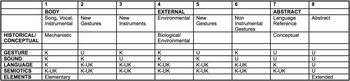
To aid diverse sound-artists navigate the decision space, the matrix in figure 2 (Whalley Reference Whalley2010b) includes a range of considerations, written largely from a traditional musician's perspective as a starting point by way of example, and incorporating non-western practices. The framework is based on the educational premise of working from the known to the unknown (K–UK). It begins from a very broad definition of what electroacoustic music or sound art can be in a stylistic sense. It includes historical/cultural, stylistic and production perspectives, and integrates a reception dimension.
Creator's matrix.

In eight segments, the framework partly draws on Smalley's (Reference Smalley1997) theory of spectromorpholgy and Wishart's notion of sonic art/dynamic morphology, but it is expanded to consider gesture as having a semiotic dimension. The primary focus in the first instance is then on concept, gesture, sound, language and semiotics in a chosen cultural context.
Each participant can then map his or her skills and experience to the matrix as a starting point for discussion about works. A summary of the framework is given below:

Steps one to eight (see figure 2) subdivide into three broad blocks of music/sound-making, including traditional instruments and experimental music approaches.
BODY: Approaches associated with the human body and instrumental gestures and sounds or extended instruments and gestures through electronics, and with mechanical concepts. This is predominately pitch/duration driven (scales and alternate tunings) and uses instrumental/vocal music algorithms, but extends to sound-based approaches. It includes improvisation and both linear and non-linear forms. Semiotics here relate to speech, words, dance, contexts, mimicking, programmatic stories, and established dramatic forms. Simple to extended sound effects are included.
1. Song, instrumental, and ensemble works. New scales. Performance values.
2. New gestures with known instruments, and extending known instruments through electronics. New tunings.
3. Using known gestures with new instruments (invented/found) or new electronic instruments and extended sounds. Extending gestures with new instruments
EXTERNAL (NON-INSTRUMENTAL): Approaches associated with non-body gestures and sounds that are non-instrumental, but with sounds that are still largely known, and with biological/environmental and process concepts. Environmental (natural/industrial/radiophonic) sound-driven approaches/soundscapes. Shift to new algorithms in language. Generative Systems. A semiotic stretch to include new perspectives and external references. Process based forms extended. Environmental/industrial/some human gestures.
4. Known sounds and known gestures. Soundscape approaches, and some effects extensions.
5. Unfamiliar gestures but familiar sounds, such as using invented gestures mapped to environmental samples. Extended elements.
6. Known gestures, such as flocking algorithms, mapped to new sounds that may have been programmed. Extended elements.
ABSTRACT: Works/approaches associated with abstract gestures and sounds that often do not have reference points, and draw on abstract concepts. From Smalley's notion of unknown gestures and unknown sounds. Language increasingly conceptual and involving semiotic stretching, fragmentation and disorientation. Extended elements.
7. Unknown gestures and unknown sounds; but the language (forms, phrasing, juxtapositions etc) may be familiar, or even some aspects of the sound (e.g. spectral synthesis).
8. Gestures, sound and language are unfamiliar, such as aspects of experimental contemporary electroacoustic music.
Rather than hard divisions between the eight blocks, there is a continuum within each step, and overlaps between them. It is common in established electroacoustic music to mix different aspects of these divisions, for example. The matrix simply provides a starting point for discussion for a range of possible participants in Internet2 projects.
More usefully, rather than beginning works from production perspectives framed by technology or methods of getting things done common in much Internet2 literature, the matrix allows potential practitioners to also begin from a discussion of sound aesthetics/practices – balancing production and phenomenological approaches to sound-making. Further, it provides a counterpoint to the notion that increased technical complexity relates to more profound artistic output in a phenomenological sense. Meaningfulness of gesture, physicality of sound, and sonic complexity through whatever means are then given more significance in any ongoing dialogue.
Once a sense of practitioner placement is understood on the matrix, Internet2 practice provides an extended opportunity to layer different methods within new works. Negotiation of language, aesthetics and methods of doing things then becomes part of the process of making works. What might go where may depend on the dramaturgical model selected: for example, the outcome of the process of rehearsals and the adjustments between participants in real-time.
The compromises that need to be made by parties to make new works might then result in unique hybrids that satisfy a diversity of demands that practitioners seek from the outcome of investing time and resources in projects.
6. Synthesis And Conclusion
6.1. Mittsu no Yugo
The twelve-minute work Mittsu no Yugo (Whalley Reference Whalley2010a) was one of a series of ongoing Internet2 works with international partners including Syneme Summer Soundscape (Whalley Reference Whalley2010d), and Hikishio (Whalley Reference Whalley2011) that also incorporated OSCgroup control (Sound example 1).
Demonstrating the starting proposition, Mittsu no Yugo required compromises to meld aspects of the expanded decision space in terms of production, relationships and languages, but also compromises to balance the phenomenology of player music-making with aspects of contemporary interactivity and Internet2.
Aesthetically, the idea explored different locations reflected in distinct instrument timbres and gestures, but also explored melding aspects of sonic inputs from three different country nodes through real-time conversation and negotiation. Making sonic streams where some parts were familiar and others unfamiliar to participants and audience achieved this. In addition, combining ‘body’, ‘environmental’ and ‘abstract’ sonic streams gave the work textural diversity, and allowed for the work to evolve interactively in real-time.
As a result, while one can sometimes identify individual parts in the work, at others it is difficult to discern who contributed what to the texture. This is partly because many of the real instruments acted as both pitch/duration and textural/spectral sound makers. But it is also because some of the instruments could be digitally manipulated directly to get variation, or manipulated through adding real-time effects.
The technical process involved linking multiple bi-directional audio channels between the three countries (a mixed peer-to-peer and star approach), using fourteen audio streams. Independent of this, we linked HD digital video conferencing units so performers could see and hear each other, making performance gestures vital to communication between both players and audience. In addition, multiple Skype channels allowed technicians at each station to type/chat ‘off-stage’, to address any technical problems during the performance.
An LAA approach was taken to compensate for small delays with audio latency, and a graphic score was used as a performance guide that allowed the entry of different parts to be rhythmically imprecise.
A mixed structure-based and process-based approach to composition was taken because the work had to be played as part of a concert, dictating its length. Relationships were managed using a directed dramaturgy model. Accordingly, the graphic score prescribed macro structure, gestures within sections, and broad motives for the work. In addition, sectional tunings and parts of the spectra that each larger section might adhere to were prescribed, toward getting sonic coherence.
However, the general structure of the work was flexible, as was the order of material within each section of the graphic score. Participants could then make decisions interactively within each section as to what to play. They could also expand or compress sections, and edit larger shapes in real-time. This allowed for different outcomes from each performance, and for new performers/'instruments’ to negotiate new outcomes with each rendition.
Reflecting Follmer's (Reference Follmer2005) ideas for NMP, the work was then partly realised through variation in the hyperinstruments (new hybrid instruments), and improvisation resulted in collective decisions as to aspects of form and/or content through dialogue between players. Developing the work through rehearsals was therefore a significant part of the process, and negotiation and relationship-building resulted in better sonic outputs as the rehearsals progressed.
Machine participation, in line with prior work (Whalley Reference Whalley2005), was first implemented through the real-time manipulation of some of the pre-prepared sampled traditional instruments – allowing for the development of motives using electroacoustic manipulation techniques.
In addition and extending Follmer's (Reference Follmer2005) notion of generative improvisation in NMP, a generative improvisation model (Whalley Reference Whalley2009) was enabled at the Waikato node. Intelligent machine participation involved a MAX/MSP agent-based system build by the composer. This could generate data and respond to human input, allowing human/machine dialogue to create content based on the dynamic interplay of parts in a gestural manner. The output was sonically realised through a combination of resyntheisis and additive synthesis.
The work then adopted aspects of Paine's (Reference Paine2002) concept of a conversational model of interaction between human and machine, beyond reactive machines that some players might use to extend/manipulate sounds in real-time or add effects to after the fact. But the best implementation of the notion of a conversational model was perhaps in the real-time dialogue between performers as they made the work.
While Internet2 music-making then expands parameter space made available to composers by single computers, its complexity here was made subservient to extending organic musical practice through improvisation. Electroacoustic music practices then added to and extended older organic music traditions, but electroacoustic techniques were also used as points of juxtaposition in the work.
The model here then explores one way that electroacoustic music practitioners might engage with this new medium, and engage with different communities.
6.2. Conclusion
Internet2 allows composers/musicians/programmers to rethink older sonic art forms, but, as more countries begin to explore this new medium, we are likely to partly preserve and value the distinct sonic nature of different nations’ nodes – the sounds and gestures that identify us. In tandem, as one's sense of identity is confronted in this new digital space, we are also likely to use our unique regional sound arts/references as a means to take part in global conversations – extending older organic music practices. Moreover, decisions will increasingly need to be made as to how to accommodate intelligent agent technology, and how to link this technology to unique sonic identities.
Some interesting research questions then arise. Are we likely to develop broader regionalised aesthetics and undermine national ones? Should machines be subservient to regional aesthetics? What sort of unique identity might be developed by just machine/machine conversations, or machine/human conversations? And are new net-based identities likely to evolve?