Multidrug-resistant microorganisms (MDROs) are a major concern in infection control. 1 The 2 most prevalent MDRO in hospital settings are third-generation cephalosporin-resistant Enterobacteriaceae (3GCR-E), typically represented by extended spectrum β-lactamase–producing Enterobacteriaceae (ESBL-E) and methicillin-resistant Staphylococcus aureus (MRSA).Reference de Kraker, Jarlier, Monen, Heuer, van de Sande and Grundmann 2 These bacteria induce substantial morbidity and mortality in hospital settings. MRSA bacteremia has been associated with 2-fold increased mortality compared to sensitive strains,Reference Boucher and Corey 3 whereas ESBL-E bacteremia has been linked by meta-analysis to 1.85-fold augmented relative risk of death.Reference Schwaber and Carmeli 4 MRSA incidence has decreased in many European countries in recent years,Reference Köck, Becker and Cookson 5 , Reference Olearo, Albrich, Harbarth and Kronenberg 6 and 3GCR-E incidence has increased during the same period.Reference Leistner, Schröder, Geffers, Breier, Gastmeier and Behnke 7 , Reference Coque, Baquero and Canton 8 Similar trends have been observed in the United StatesReference Thaden, Fowler, Sexton and Anderson 9 , Reference Baker, Cohen, Liu and Larson 10 and Asia.Reference Molton, Tambyah, Ang, Ling and Fisher 11
Contact precautions against MDRO are a major component of most infection control strategies. 12 They are effective in controlling MDRO transmission during hospital outbreaks,Reference Jernigan, Titus, Gröschel, Getchell-White and Farr 13 despite repeated discussion of efficacy, compared to consistent implementation of standard precautions or other measures.Reference Morgan, Kaye and Diekema 14 , Reference Dhar, Marchaim and Tansek 15 While it has been described in some settings, compliance with isolation precautions (IPs) has been assessed in a nonoutbreak context less frequently. Factors associated with lack of IP implementation could guide future strategies to improve compliance with IPs and limit MDRO spread. Barriers to IP implementation may be related to patient characteristics, type of infection (ie, urinary tract vs other infections) or organizational factors (ie, specialty or medical prescription for IPs). To the best of our knowledge, these factors have rarely been reported, and the relationships between them have been poorly investigated in a nonoutbreak context.Reference Reuland, Al Naiemi and Kaiser 16 , Reference Clock, Cohen, Behta, Ross and Larson 17
In view of the changing epidemiology of MDRO in hospitals and the dearth of knowledge of IPs against MDRO infections, we conducted a multicenter, hospital-based, observational study and an audit of practices at our university center in France. Our primary study objective was to identify factors associated with lack of IP implementation in patients infected or colonized with MRSA and 3GCR-E. The secondary objectives were to estimate the incidence of infections and/or colonizations with MRSA and 3GCR-E and to report IP compliance in 2015 compared to 2013.
METHODS
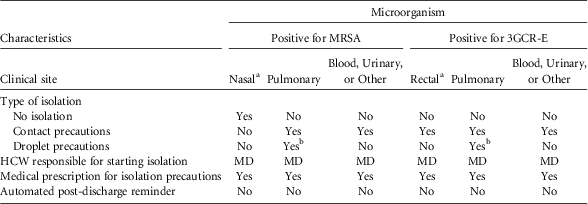
Standardized monitoring of IPs and epidemiological surveillance were undertaken for all patients hospitalized between April 1, 2013, and June 30, 2013, and between April 1, 2015, and June 30, 2015, in 4 Lyon University hospitals in France: Hôpital de la Croix-Rousse, Hôpital Edouard Herriot, Hôpital Gériatrique, and Hôpital Lyon-Sud. Surveillance of a local section of the MDRO Surveillance Network in southeastern France was based on standardized definitions.Reference Carbonne, Arnaud and Maugat 18 Implementation of IPs was based on a local protocol (Table 1); patients with MRSA nasal carriage without any site of infection or respiratory sign do not necessitate isolation precautions. Information on new positive culture results for MRSA and 3GC-E are normally reported in the electronic medical record, and microbiological staff orally inform practitioners. In addition, an automatic daily e-mail was sent to infection control practitioners. Overall, 3,713 and 3,454 hospital beds were monitored in 2013 and 2015, respectively.
Recommended Measures in Cases of Methicilin-Resistant Staphylococcus aureus (MRSA) or Cultures Positive for Third-Generation Cephalosporin-Resistant Enterobacteriaceae (3GCR-E) in University of Lyon Hospitals

NOTE. HCW, healthcare worker; MD, medical doctor.
a Site not included in the present study.
b If respiratory signs are present.
Each MDRO case patient had at least 1 positive clinical sample of MRSA or 3GCR-E after culture. The exclusion criterion was MRSA or 3GCR-E detection by rectal, nasal, or cutaneous screening. A standardized data collection form was completed for each case, with information on demographic characteristics, microbiological results, infections or colonizations, and acquisition type (hospital-acquired or imported). Colonization was defined as identification of MRSA or a 3GCR-E from a clinical sample, without clinical and therapeutic consequences for the patient, at a level below microbiological threshold. Infection was clinically defined as identification of MRSA or a 3GCR-E above the microbiological threshold, with clinical and/or radiological signs. This information was validated by an infection control practitioner, and uncertain cases were discussed with the physician in charge of the patient. For each patient, a new MDRO event was counted if (1) another clinical sample was positive from the same patient during study period but with different species or (2) another clinical sample from the same patient identified the same species with different antibiogram. An additional questionnaire concerning IPs was completed for type of isolation measures recommended and observed, prescription, and personal protective equipment available (Table 1). This form was filled out either by observation (30.0%) or by telephone contact (70.0%) with a healthcare worker from the unit.
Bacteria were identified using biochemical strips (Vitek 2 or Vitek Compact System, bioMérieux, Marcy l’Étoile, France) or matrix-assisted laser desorption/ionization time of flight (MALDI-TOF) mass spectrometry (Vitek MS System, bioMérieux). For Enterobacteriaceae, 3GCR-E was analyzed by broth dilution (Vitek 2 System, bioMérieux) or diffusion with antibiotic (ceftazidim, ceftriaxone, and cefotaxim) discs (SIRScan System, i2a, Perols Cedex, France). MRSA was recognized by cefoxitin testing with broth dilution (Vitek 2 System, bioMérieux), diffusion with cefoxitin disc (SIRScan System, i2a), mecA gene detection with “homemade” polymerase chain reaction, or PLP2a (PBP2a Culture Colony Test, Alere, Waltham, MA).
A descriptive analysis was conducted. Incidence was calculated per 10,000 patient days of hospitalization. Incidences were compared with a mid-P exact test, and crude incidence ratios were calculated according to the type of unit. Categorical variables were reported as numbers and percentages and were compared using the χ2 test. Continuous variables were described as mean (±standard deviation) and were compared using the Student t test. The following factors were potentially associated with lack of IP implementation: gender, age (<50 years, 50–59 years, 60–69 years, 70–79 years, ≥80 years), study year (2015 vs 2013), specialty (acute care, intensive care, rehabilitation, extended stay facility, nursing home, or psychiatric facility), hospital center (A, B, C, and D), microorganism, infection versus colonization, hospital-acquired versus imported infection, anatomical site (blood, deep wound, pulmonary protected or nonprotected samples, urine, other), time between admission and onset of infection (day 0, days 1–2, days 3–9, days 10–29, ≥day 30), type of isolation indicated (contact only, contact and droplets, or other), and medical prescription for IPs. After univariate logistic regression analysis of factors associated with lack of IP implementation, variables with P values <.10 were entered in the initial multivariate model. Variables then underwent backward stepwise deletion with the Wald test until all P values were <.05. Major relevant interactions were also tested; no interaction was finally retained in the multivariate model. All tests were 2-tailed, and P<.05 was considered significant. Analyses were conducted with Stata 13.0 software (StataCorp LP, College Station, TX). The study did not require ethics committee approval because it drew from an observational surveillance database approved under French national regulations (Comité National Informatique et Liberté). The data were analyzed anonymously, and patient care was not affected.
RESULTS
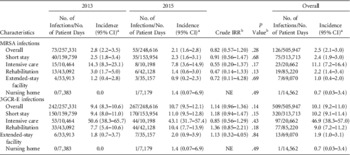
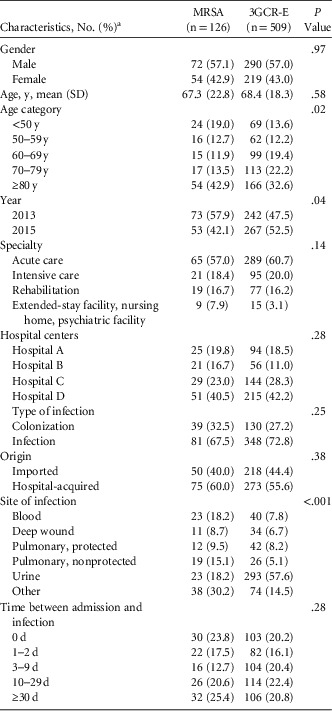
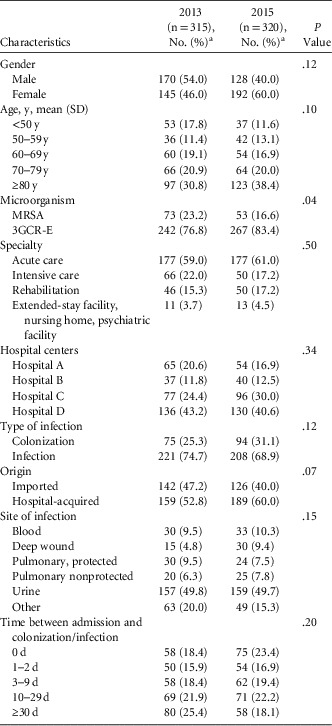
Overall, 57,222 patients were included in the study (29,136 in 2013 and 28,386 in 2015), accounting for 505,947 patient days of hospitalization (257,351 patient days in 2013 and 248,616 patient days in 2015). A total of 635 MDRO cases occurred overall, for a global attack rate of 1.3 (95% confidence interval [95% CI], 1.0–1.2) per 100 patients and an incidence of 12.5 (95% CI, 11.6–13.6) MDRO infections per 10,000 patient days. Crude incidence rates were somewhat stable in 2013 and 2015 for MRSA (P=.28) and 3GCR-E (P=.14; Table 2). The highest incidence of MDRO was found in intensive care units (ICUs) compared with extended-stay facilities and nursing homes. Among MDRO case patients, the male:female ratio was 1.3, and the mean age was 68.2 years (±19.3). Moreover, 268 infections (42.2%) were acquired in a hospital, and 348 infections (54.8%) were imported. Overall, 126 MRSA cases (19.8%) and 509 3GCR-E cases (80.2%) comprised the MDRO burden. The main 3GCR-E species were Escherichia coli (n=223; 43.8%), Klebsiella pneumoniae (n=158; 31.0%), Enterobacter cloacae (n=60; 11.8%), Citrobacter freundii (n=20; 3.9%), and Enterobacter aerogenes (n=16; 3.1%). Urinary tract infections accounted for almost half of MDRO cases (n=316; 49.8%). The other most prevalent infection sites were blood culture (9.9%) and pulmonary (protected) samples (8.5%) and pulmonary (nonprotected) samples (7.1%). Among 3GCR-E, 20 of 509 (2.8%) were also resistant to carbapenems. Table 3 reports the 3GCR-E and MRSA cases encountered. MRSA differed from 3GCR-E cases by age (P=.02), year (P=.04), and site of infection (P<.001). The proportion of 3GCR-E acquired in hospital decreased from 50.4% in 2013 to 39.2% in 2015 (P=.01), whereas MRSA proportion was stable. MDRO cases did not differ regarding main characteristics between 2013 and 2015 (Table 4).
Incidence of Methicilin-Resistant Staphylococcus aureus (MRSA) and Third-Generation Cephalosporin-Resistant Enterobacteriaceae (3GCR-E) Infections by Specialty and Year in University of Lyon Hospitals, 2013 and 2015 (n=57,222)

NOTE. CI, confidence interval; IRR, incident rate ratio.
a Per 10,000 patient days.
b 2015 compared with 2013 (reference).
Characteristics of Methicilin-Resistant Staphylococcus aureus (MRSA) and Third-Generation Cephalosporin-Resistant Enterobacteriaceae (3GCR-E) Infections in Lyon University Hospitals, 2013 and 2015 (n=635)

NOTE. IQR, interquartile range; SD, standard deviation.
a Unless otherwise specified.
Characteristics of Methicillin-Resistant Staphylococcus aureus (MRSA) and Third-Generation Cephalosporin-Resistant Enterobacteriaceae (3GCR-E) Infections in Lyon University Hospitals, 2013 and 2015 (n=635)

NOTE. SD, standard deviation.
a Unless otherwise specified.
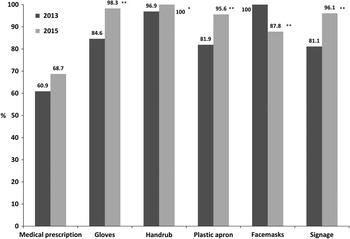
Overall, 461 (72.6%) MDRO case patients had an evaluation of IP implementation; the other patients were either discharged or deceased at time of IP evaluation. Among them, IPs were implemented in 76.0% of cases in 2013 and 81.4% in 2015 (P=.16), with no differences in temporal trends by hospital. However, IP implementation improved from 74.2% in 2013 to 87.1% in 2015 (P=.01) for patients with imported MDRO infection and/or colonization. Isolation precautions were implemented for 73% of patients on the day the test results were obtained, and for 91% on the day of medical prescription for IPs. Between 2013 and 2015, global improvement occurred in the presence of protective equipment, signage, and hand-rub solutions in patients with IPs (Figure 1).
Measures implemented in patients infected and/or colonized by multidrug-resistant organisms under isolation precautions, Lyon University Hospitals, 2013 and 2015, (n=477). *P<.05; *P<.001.

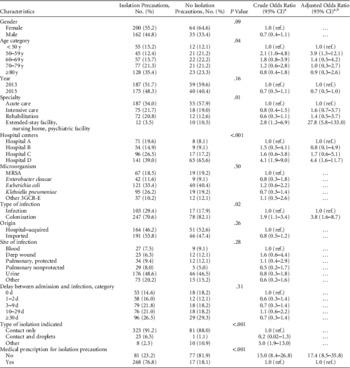
Table 5 shows the factors associated with lack of implementation of isolation precautions after univariate and multivariate analysis. The strength of the association between lack of medical prescription and absence of IPs was heterogeneous by specialty: crude odds ratios were respectively 15.4 (95% CI, 6.2–38.1; P<.001) in acute care, 9.7 (95% CI, 3.1–31.1; P<.001) in intensive care, and 24.8 (95% CI, 5.3–115.4; P<.001) in rehabilitation. On multivariate analysis, patient age, year, specialty, hospital, colonization versus infection, and lack of medical prescription for IPs were independent predictors of lack of IP implementation (Table 5). Lack of medical prescription for IPs was strongly associated with the absence of IPs (adjusted odds ratio, 17.4; 95% CI, 8.5–35.8; P<.001).
Factors Associated With Lack of Implementation of Isolation Precautions in Lyon University Hospitals, 2013 and 2015 (N=461)

NOTE. MRSA, methicillin-resistant Staphylococcus aureus; 3GCR-E, third-generation cephalosporin-resistant Enterobacteriaceae; ref., reference.
a By logistic regression.
b Adjusted to the other covariates.
DISCUSSION
The main objective of the study was to assess the determinants of lack of IP implementation in MDRO cases. We found that incidence was stable during this period, but the proportion of nosocomial-acquired MDRO infection and/or colonization decreased. Several factors were associated with the lack of IP implementation, but medical prescription for IPs was the main modifiable, contributing component. Significant differences in MDRO incidence were observed between specialties with higher frequency in ICUs. Our estimates agree with those of earlier French national surveillance, which reported MRSA and ESBL-E incidence rates of 0.40 and 0.39 per 1,000 patient days, with the highest incidence in ICUs.Reference Carbonne, Arnaud and Maugat 18 More recently, in Germany, MRSA incidence decreased between 2010 and 2014 (relative risk, 0.88; 95% CI, 0.84–0.91).Reference Köck, Becker and Cookson 5 The increased proportion of imported 3GCR-E infections and/or colonizations underlines the growing importance of community acquisition in the hospital burden of 3GCR-E, caused mainly by international travel and inappropriate antibiotic use but also by community acquisition.Reference Schwaber, Lev and Israeli 19 We observed similar trends in our study population.
Isolation precautions were applied frequently, sometimes despite a lack of medical prescription for IPs. After adjusting to confounding factors, 30% improvement of IP implementation was seen between the 2 study periods, while no major transversal campaign was instituted during this time. Improvement may be partially due to frequent on-site visits by infection control professionals in recent years in our hospitals, particularly in geriatric units. Continuous, prospective surveillance of MDRO cases is ongoing in all short- and extended-stay geriatric units. Each time a case is identified, an infection control professional calls the unit to establish whether IPs have been applied and whether they are appropriate. Protective equipment is most often present and is the consequence of an institutional campaign for the standardization of supports for patients who need complementary precautions.
According to our local protocols, IP implementation warrants medical prescription. Despite recent improvements, lack of medical prescription is the main limiting factor in IP implementation, indicating that it is often not recognized as a core component of patient care by some physicians. Contact precautions are, however, widely recommended by international societies.Reference Clock, Cohen, Behta, Ross and Larson 17
In addition, other policies call for implementation of IPs by infection control personnel, without a physician order, or mandatory implementation of IPs, which presumably would not require a physician prescription or order when patients are colonized or infected with highly drug-resistant pathogens.Reference Schwaber, Lev and Israeli 19 , Reference Palmore and Henderson 20 European guidelines recommend their application in hospitalized patients with detected or suspected MDRO infection or carriage, to limit nosocomial spread.Reference Tacconelli, Cataldo and Dancer 21 Moreover, errors or omission of medical prescription are frequent at hospital admissionReference Cornish, Knowles and Marchesano 22 or during hospital stay,Reference Lisby, Nielsen and Mainz 23 , Reference Kopp, Erstad, Allen, Theodorou and Priestley 24 and these may be associated with increased risk of various adverse events, such as pressure ulcers.Reference Bergstrom, Braden, Kemp, Champagne and Ruby 25
Other independent factors of IP absence are the medium age category of patients with better practices in younger and older populations. In acute or intensive care, the incidence of MRDO infections is high, but IP practices are good. However, units with lower risk of MDRO infections, namely, extended-stay facilities, nursing homes, and psychiatric facilities may have poorer practices. Particular attention must be given to specialties that are less aware of MDRO but are at risk of outbreaks.Reference Ikram, Psutka, Carter and Priest 26 , Reference Wybo, Blommaert and De Beer 27 Moreover, significant heterogeneity was observed between hospitals, even when all settings followed the same protocols and recommendations for IPs. This heterogeneity might be related more to local screening practices and IPs than to the type of study population. In addition, the probability of being isolated was greater in infected than in colonized patients, and their risk of transmission might be also higher.
This study had some limitations. First, screened patients with only positive nasal or rectal tests were excluded, while some of them might have needed contact precautions. However, patients with MRSA nasal carriage did not necessitate contact precautions according to our protocol. Second, although the study was prospective, there was a time lag between the identification of MDRO cases and investigation. Thus, some patients were already discharged at inclusion, and information was less reliable than direct observation. Third, although multivariate models were used to control for main cofounding variables, residual confounding (eg, change in staff who are eligible to write prescriptions for isolation or in training on isolation prescriptions between 2013 and 2015) might persist because such data were not prospectively collected. The study’s main strengths were its multicenter design, which increased external validity, and the standardization of data collection.
In conclusion, MRSA and 3GCR-E infections and/or colonizations are frequent in French healthcare settings. Isolation precautions are implemented in most cases. When they are lacking, the main causative factor is the absence of medical prescription for IPs. Despite recurring discussions on the importance of IPs to control the spread of MRDO infections, their utility is demonstrated in both outbreak and nonoutbreak situations. Continuous monitoring with real-time advice from the infection control team and the microbiological laboratory should be promoted and evaluated.
ACKNOWLEDGMENTS
The authors thank all infection control nurses and practitioners who participated in the study as well as the nursing staff from University of Lyon hospitals. We also thank Ovid Da Silva for her assistance in editing the manuscript.
Financial support. No financial support was provided relevant to this article.
Potential conflicts of interest. All authors report no conflicts of interest relevant to this article.