





1. Introduction
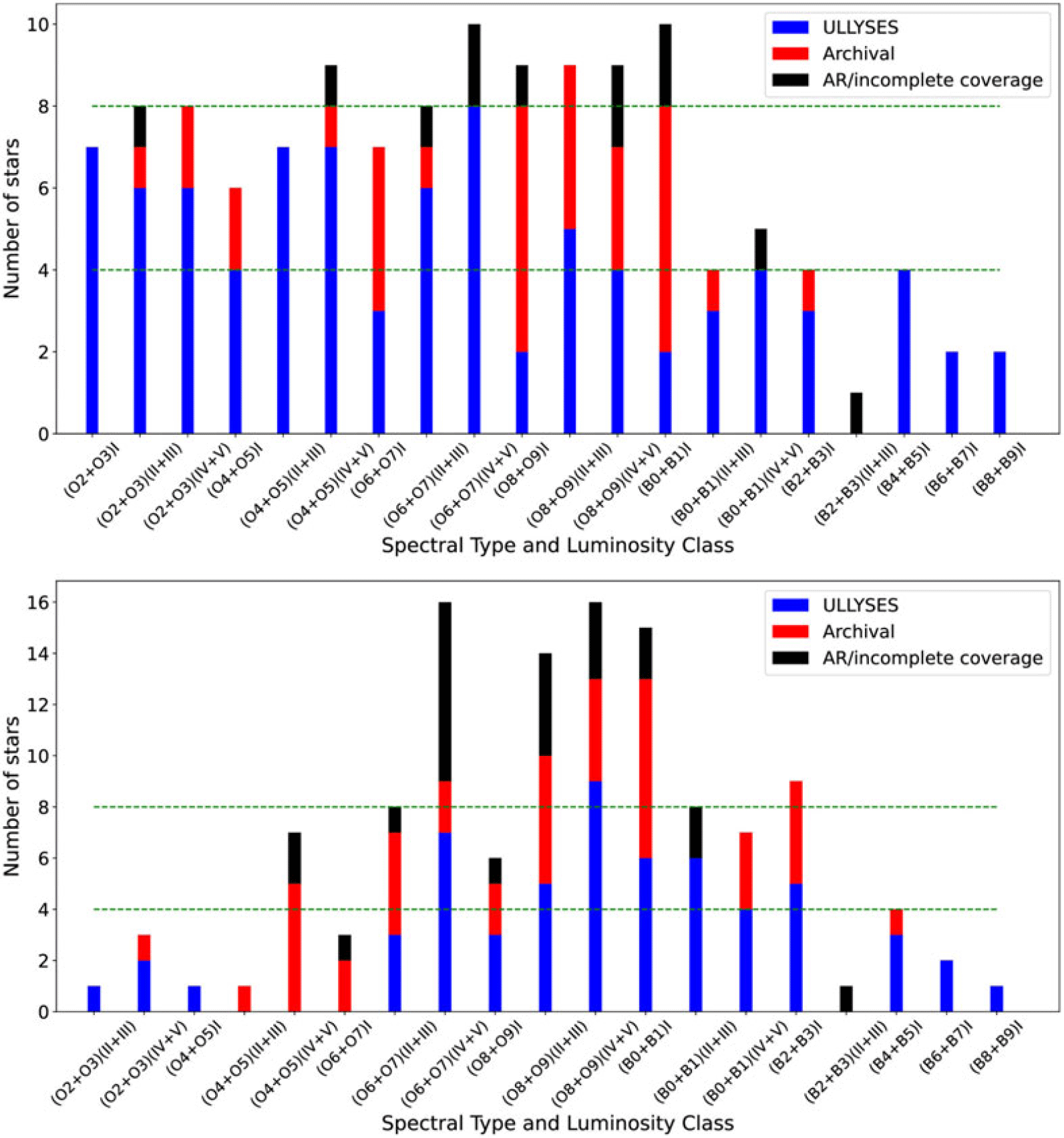
With approximately 1000 orbits, the Hubble Space Telescope (HST) Director’s Discretionary Time (DDT) program ULLYSESFootnote 1 is the largest DDT program ever performed. About 50% of the orbits were allocated to observe massive OB-type stars in the Magellanic Clouds and low-metallicity galaxies. The aim of ULLYSES is to provide a legacy UV spectral atlas spanning all spectral subtypes and luminosity classes (see Figure 1). The program was executed between 2020 and 2023, and complemented with archival data with similar instrumental setup and data quality (Table 1).
Top: Distribution of the targets in the ULLYSES sample in the LMC (top) and SMC (bottom). Figure from Roman-Duval et al. (Reference Roman-Duval, Fischer and Fullerton2025).

Distribution of ULLYSES stars.

Table 1 Long description
A table showing the distribution of ULLYSES stars across different samples and categories. The table has three columns labeled LMC, SMC, and Low-Z, and three rows labeled Core Sample, Archival, and Total. Row 1: Core Sample, LMC 129, SMC 105, Low-Z 6 to Sextans A & NGC 3109. Row 2: Archival, LMC 53, SMC 28, Low-Z 34 to Sextans A, IC 1613, WLM, Leo A, Leo P, Magellanic Bridge. Row 3: Total, LMC 182, SMC 133, Low-Z 40.
The UV spectral range provides excellent diagnostics to determine, for instance, stellar wind parameters and iron abundance. However, the optical regime remains critical for the determination of key stellar parameters such as effective temperature, surface gravity, and rotation rate. Information on wind clumping and mass-loss rate only become reliable when combining the UV diagnostics with those from the optical. Furthermore, with the advent of the James Webb Space Telescope and the upcoming extremely large telescopes such as the ELT, the focus shifts to longer wavelengths, and knowledge of the near-IR is desirable.
For these reasons, XShootUFootnote 2 (Vink et al. Reference Vink, Mehner and Crowther2023) was initiated by the IAU Commision G2 for massive stars. XShootU is an open, world-wide collaboration that aims to:
• Provide high-quality, optical to near-IR spectra for all massive stars in ULLYSES;
• Collaborate on the analysis of the combined datasets to address key science questions concerning massive stars at low metallicity.
Examples of the scienctific aims are: provide stellar and wind parameters from the combined datasets, benchmark atmoshpere models and fitting methods, test and improve evolution models at low metallicity, investigate the mass-loss behavior at cooler temperatures (e.g., bi-stability jump), population synthesis, and stellar libraries.
To reach these goals, the data need to meet several requirements: a large wavelength coverage, ideally spanning the full optical to near-IR wavelength range; a medium resolving power of  $R=\lambda/\Delta\lambda \gt 5\,000$ (needed to disentangle the several broadening mechanisms); a signal-to-noise ratio
 $S/N\gt100$ (needed for quantitative analysis); and a good absolute flux calibration (essential for use in population synthesis and stellar libraries).
To meet these requirements, X-Shooter (Vernet et al. Reference Vernet, Dekker and D’Odorico2011) on ESO’s Very Large Telescope was selected as the instrument of choice. X-Shooter provides a wavelength coverage from 300nm to 2.5 $\mu$m at medium to high resolving power, has a high throughput making it efficient, and has a good relative flux calibration. The latter, however, is affected by slit losses, telluric absorption, and variable sky transparency.
The next Section describes the data obtained by the XShootU collaboration, and presents the available and upcoming data releases. Section 3 gives an overview of the current status of the science goals, followed by a summary in Section 4.
2. Data overview
This section describes the X-Shooter data that has been obtained by the XShootU consortium, as well as the public data releases available and planned. The core ULLYSES sample has been observed by a Large Program, followed by three normal programs targeting the extended sample. Table 2 gives an overview of the observing programs. None of the programs have a proprietary time, so that the standard data products are available to the public as soon as they appear on the ESO archive.
Overview of XShootU observing programs.

Table 2 Long description
A table comparing XShootU observing programs with details on ID, hours, stars, dates, and status. The table has five rows and six columns. Column headers are Program, ID, Hours, Stars, Dates, and Status. Row 1: Program, XShootU LP; ID, 106.211Z; Hours, 126; Stars, 232+3; Dates, Oct 2020 - Jan 2022; Status, UVB & VIS data products for the Magellanic Clouds released. Row 2: Program, XShootU+; ID, 112.25D1; Hours, 33; Stars, 39; Dates, Oct 2023 - Mar 2024; Status, Observations completed. Row 3: Program, XShootU++; ID, 116.28LN; Hours, 9; Stars, 10; Dates, Sep 2025 - Mar 2026; Status, Observations ongoing. Row 4: Program, XShootU+++; ID, 117.29KZ; Hours, 22; Stars, 11; Dates, Apr 2026 - Mar 2027; Status, Submitted.
Notes: [1] Status as of Sep 2025. Estimated future dates in parenthesis.[2] Three stars were observed that were removed from the ULLYSES sample.
All observations were done in stare mode, using slit widths of 0.8" ( $R=6\,700$), 0.7" (
 $R=11\,400$), and 0.6" (
 $R=8\,000$) in the UVB, VIS, and NIR arms, respectively. Below, a description of the available and upcoming data releases is given.
2.1. DR1: UVB and VIS data products of the core ULLYSES sample
The first public data release (DR1) contains advanced UVB and VIS data products for the core sample of ULLYSES stars, excluding those for which archival X-Shooter data is available. The data have been reduced using the standard X-Shooter pipeline, with an improved flatfielding strategy and new flux models.
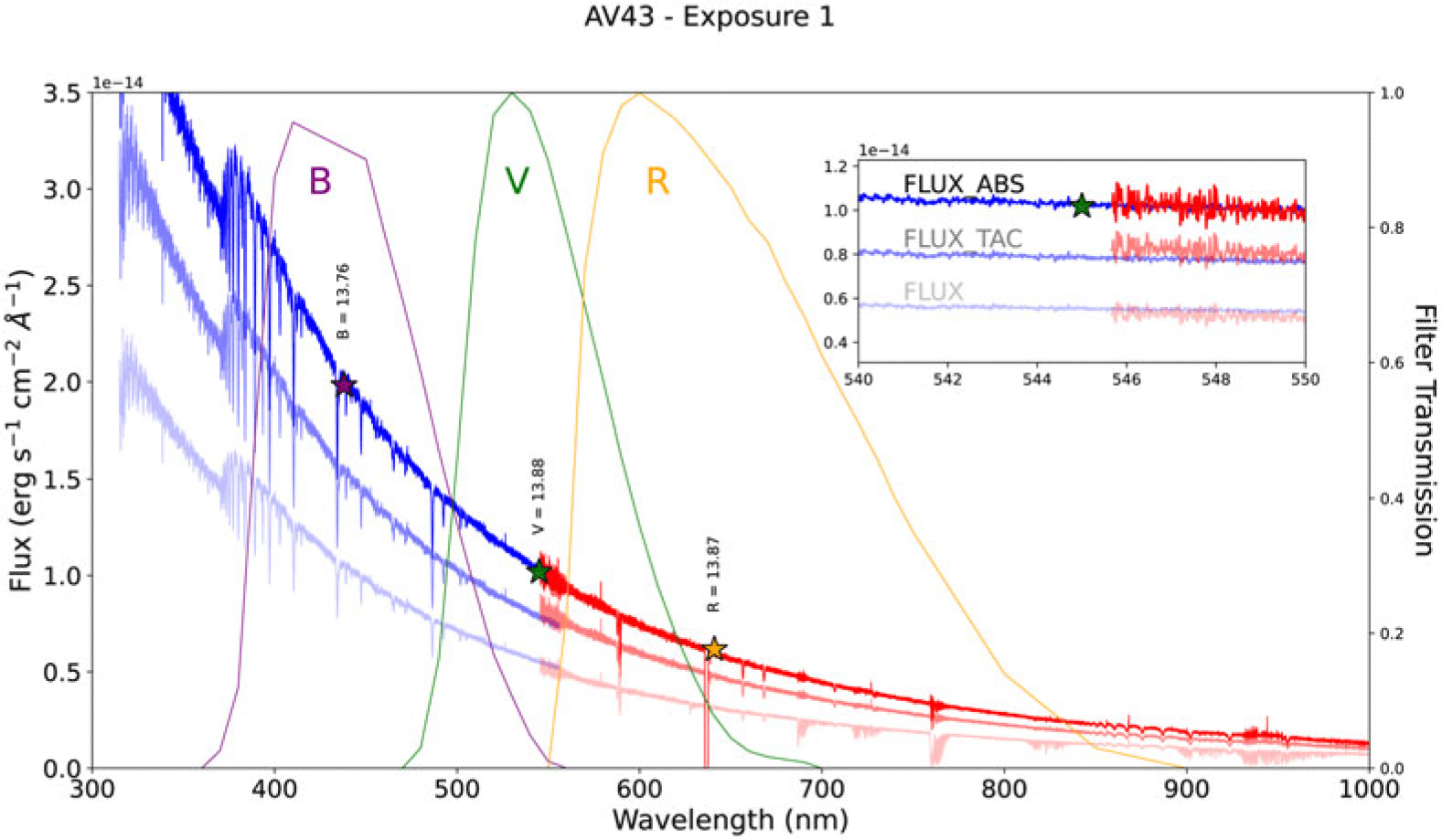
To obtain an absolute flux-calibrated spectrum, the following steps are taken:
• Slit-loss correction (SLC), taking into account the wavelength and airmass dependence of the seeing;
• Telluric absorption correction (TAC), using Molecfit (Smette et al. Reference Smette, Sana and Noll2015; Kausch et al. Reference Kausch, Noll and Smette2015) – Only performed for the VIS data;
• Absolute flux calibration by scaling the UVB data to the B-band magnitude and lining up the VIS to the UVB.
Figure 2 shows an example spectrum for each of these steps. Finally, a version of the absolute flux calibrated spectrum normalized to the continuum is provided.
Example of the spectrum of AV-43 after the pipeline reduction (bottom), slit-loss and telluric absorption correction (middle), and absolute flux calibration (top). Figure from Sana et al. (Reference Sana, Tramper and Abdul-Masih2024).

DR1 is publicly available on the ESO archiveFootnote 3 and ZenodoFootnote 4 . The data reduction and data products are described in detail in XShootU Paper II (Sana et al. Reference Sana, Tramper and Abdul-Masih2024).
2.2. DR2: NIR data products of the core ULLYSES sample (in prep.)
As all XShootU observations were done in stare mode and have relatively long exposure times, the sky subtraction and TAC in the NIR is more challenging. Furthermore, the current X-Shooter pipeline produces an incorrect wavelength scale in the NIR, causing further issues with the TAC. Hence, the NIR data will be made available in a separate data release.
The NIR data reduction involves an improved sky subtraction strategy, using small sky windows close to the stellar trace. An (currently not public) improved version of the pipeline will be used to correct the wavelength calibration based on the location of telluric lines in telluric standard star observations. Finally, the telluric absorption correction will be performed by splitting up the NIR data in several ( $\sim 10$) wavelength regions for which the telluric model is fitted independantly.
DR2 will contain advanced NIR data products for the core ULLYSES sample, and is scheduled for public release by the end of 2025/early 2026.
2.3. DR3: Data products of extended ULLYSES sample and low-Z galaxies (planned)
The last data release will contain advanced UVB/VIS/NIR data products for the extended ULLYSES sample for the Magellanic Clouds, including the data obtained by the XShootU programs as well as archival data. Furthermore, UVB and VIS data products for all low-metallicity targets will be included. This data release is planned for mid to late 2026.
3. Science overview
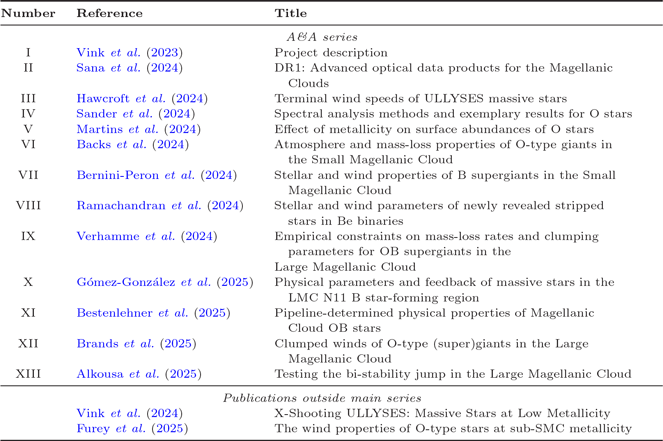
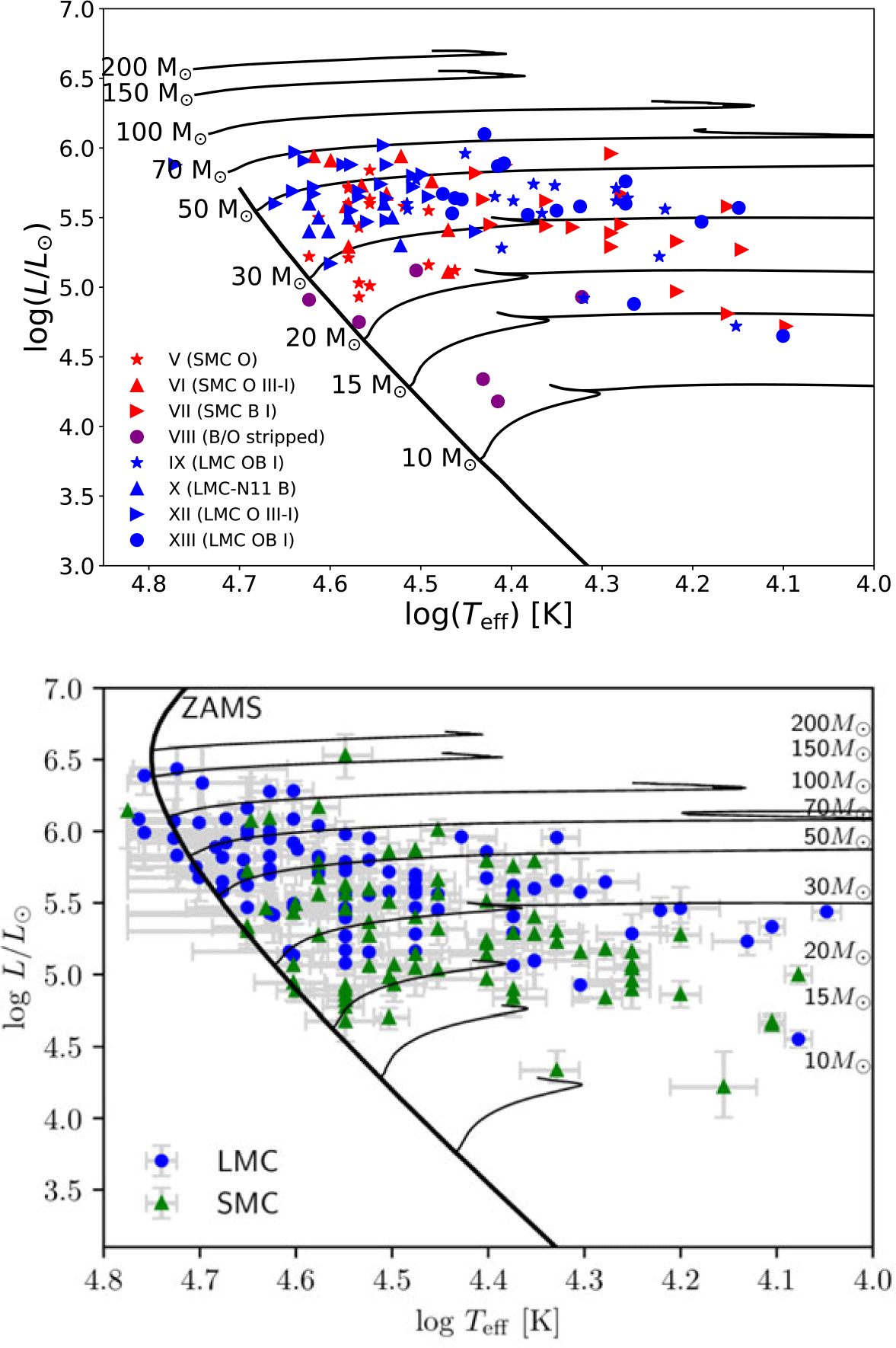
Significant progress has been made in the analysis of the shared ULLYSES and XShootU datasets. Table 3 gives an overview of all XShootU papers to date. Various papers are dedicated to the quantitative spectroscopic analysis of sub-samples of stars, an overview of which is given in the Hertzsprung-Russel diagram (HRD) presented in Figure 3. These studies make use of several codes (fastwind, Puls et al. (Reference Puls, Urbaneja and Venero2005); CMFGEN, Hillier & Miller (Reference Hillier and Miller1998); PoWR, (e.g., Gräfener et al. Reference Gräfener, Koesterke and Hamann2002)), as well as methods (by eye; genetic algorithm, Brands et al. (Reference Brands, de Koter and Bestenlehner2022); grid-based (e.g., Simón-D az et al. 2011)). A benchmarking study comparing these codes and methods was published in Paper IV (Sander et al. Reference Sander, Bouret and Bernini-Peron2024). Paper XI (Bestenlehner et al. Reference Bestenlehner, Crowther and Hawcroft2025) provides optical-only analysis of the full sample of ‘regular’Footnote 5 OB stars using a pipeline method.
Overview of XShootU publications.

Table 3 Long description
A table listing publications related to XShootU with references, titles, and numbers. The table has 13 rows and 3 columns. The columns are labeled Number, Reference, and Title. The rows are as follows: Row 1: Number, I; Reference, Vink et al. (2023); Title, A&A series. Row 2: Number, II; Reference, Sana et al. (2024); Title, DR1: Advanced optical data products for the Magellanic Clouds. Row 3: Number, III; Reference, Hawcroft et al. (2024); Title, Terminal wind speeds of ULLYSES massive stars. Row 4: Number, IV; Reference, Sander et al. (2024); Title, Spectral analysis methods and exemplary results for O stars. Row 5: Number, V; Reference, Martins et al. (2024); Title, Effect of metallicity on surface abundances of O stars. Row 6: Number, VI; Reference, Backs et al. (2024); Title, Atmosphere and mass-loss properties of O-type giants in the Small Magellanic Cloud. Row 7: Number, VII; Reference, Bernini-Peron et al. (2024); Title, Stellar and wind properties of B supergiants in the Small Magellanic Cloud. Row 8: Number, VIII; Reference, Ramachandran et al. (2024); Title, Stellar and wind parameters of newly revealed stripped stars in Be binaries. Row 9: Number, IX; Reference, Verhamme et al. (2024); Title, Empirical constraints on mass-loss rates and clumping parameters for OB supergiants in the Large Magellanic Cloud. Row 10: Number, X; Reference, Gómez-González et al. (2025); Title, Physical parameters and feedback of massive stars in the LMC N11 B star-forming region. Row 11: Number, XI; Reference, Bestenlehner et al. (2025); Title, Pipeline-determined physical properties of Magellanic Cloud OB stars. Row 12: Number, XII; Reference, Brands et al. (2025); Title, Clumped winds of O-type (super)giants in the Large Magellanic Cloud. Row 13: Number, XIII; Reference, Alkousa et al. (2025); Title, Testing the bi-stability jump in the Large Magellanic Cloud. The table also includes a section for publications outside the main series with two additional references.
Top: HRD with results of detailed analyses (Martins et al. Reference Martins, Bouret and Hillier2024; Backs et al. Reference Backs, Brands and de Koter2024; Bernini-Peron et al. Reference Bernini-Peron, Sander and Ramachandran2024; Verhamme et al. Reference Verhamme, Sundqvist and de Koter2024; Gómez-González et al. Reference Gómez-González, Oskinova and Hamann2025; Brands et al. Reference Brands, Backs and de Koter2025; Alkousa et al. Reference Alkousa, Crowther and Bestenlehner2025). Bottom: HRD with results of pipeline analysis (Bestenlehner et al. Reference Bestenlehner, Crowther and Hawcroft2025).

4. Summary
XShootU provides high-quality X-Shooter spectra for all stars in ULLYSES. Advanced UVB and VIS data products for the core ULLYSES sample have been publicly released, and two more public data releases are scheduled. The scientific exploitation of the combined datasets is well underway, with 13 papers published and many more in preparation.
Acknowledgements
FT acknowledges support by grant PID2022-137779OB-C41, funded by the Spanish Ministry of Science, Innovation and Universities/State Agency of Research MICIU/AEI/10.13039/501100011033.



 Open access

