Introduction
Reitlinger (Reference Reitlinger1965) described Dagmarita (type species Dagmarita chanakchiensis Reitlinger, Reference Reitlinger1965) from the middle–late Permian of Transcaucasia, as a new genus characterized by a biserial test with lateral spines, simple aperture, and thin calcareous wall. Subsequently, Bozorgnia (Reference Bozorgnia1973) specified in the description of Dagmarita chanakchiensis, from Central Alborz (Iran), that the wall is double-layered (inner layer microgranular and outer hyaline layer radiate and thin). From the late 1970s to early 1990s, the introduction of several new species, such as Dagmarita elegans Sosnina and Nikitina, Reference Sosnina and Nikitina1977 and Dagmarita simplex Wang in Zhao et al., Reference Zhao, Sheng, Yao, Liang, Chen, Lin and Liao1981, led to the increase in species diversity of the genus (Sosnina in Sosnina and Nikitina, Reference Sosnina and Nikitina1977; Wang in Zhao et al., Reference Zhao, Sheng, Yao, Liang, Chen, Lin and Liao1981; Hao and Lin, Reference Hao and Lin1982; Vuks in Kotlyar et al., Reference Kotlyar, Zakharov, Kochirkevich, Kropacheva, Rostovtscev, Chediya, Vuks and Guseva1984; Lin, Reference Lin1984; Lin et al., Reference Lin, Li and Sun1990). In the meantime, Altıner (Reference Altıner1981) and Loeblich and Tappan (Reference Loeblich and Tappan1987) described Dagmarita as having a possible short enrolled biserial earliest stage. Mohtat-Aghai and Vachard (Reference Mohtat-Aghai and Vachard2003) erected Dagmarita shahrezaensis from the Hambast Formation of the Shahreza area (Central Iran), introducing it as a biserial taxon, without thornlike projections and with a unilayered microgranular wall. Finally, Gaillot and Vachard (Reference Gaillot and Vachard2007) and Ebrahim Nejad et al. (Reference Ebrahim Nejad, Vachard, Siabeghodsy and Abbasi2015) further modified the description of Dagmarita, defining this genus as doubtfully characterized by three initial pairs of chambers, more or less globivalvulinid in coiling, and by a mono-, double- or trilayered wall.
Concerning its suprageneric position, Dagmarita was initially placed among the Biseriamminidae Chernysheva, Reference Chernysheva1941 (Reitlinger, Reference Reitlinger1965). Bozorgnia (Reference Bozorgnia1973) later introduced the monogeneric family Dagmaritidae. Successively, Zaninetti and Altıner (Reference Zaninetti and Altıner1981) synonymized the Dagmaritidae with the family Biseriamminidae and divided the latter into subfamilies Biseriammininae Chernysheva, Reference Chernysheva1941 and Dagmaritinae Bozorgnia, Reference Bozorgnia1973. Several later authors continued to retain the subfamily Dagmaritinae as valid, even if they revised its systematic status (Loeblich and Tappan, Reference Loeblich and Tappan1987; Mohtat-Aghai and Vachard, Reference Mohtat-Aghai and Vachard2003; Gaillot and Vachard, Reference Gaillot and Vachard2007; Gaillot et al., Reference Gaillot, Vachard, Galfetti and Martini2009; Altıner and Özkan-Altıner, Reference Altıner and Özkan-Altıner2010; Hance et al., Reference Hance L., and Vachard, Devuyst, Kalvoda, Poty and Wu2011; Vachard, Reference Vachard2016). The latest taxonomical rearrangement has been proposed by Gennari et al. (Reference Gennari, Cherin and Rettori2018a).
Based on material from Zal (NW Iran) and Abadeh (Central Iran) stratigraphic sections, the present study aims to introduce two new species of the genus Dagmarita. We redescribe the genus and discuss its taxonomic composition and phylogeny. In addition, the 3D reconstructions of the new species Dagmarita ghorbanii n. sp. and Dagmarita zalensis n. sp. are presented in order to better understand their complex shapes and transects in different orientations in thin sections. This paper also represents a methodological contribution, which could serve as a starting point for similar studies on other groups of fossil Foraminifera.
Geological setting
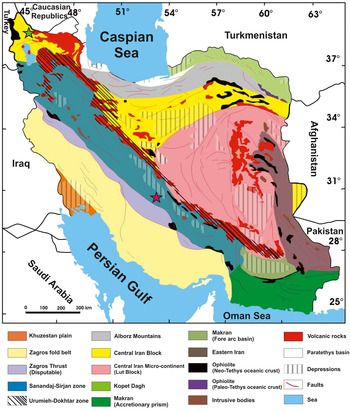
The analyzed stratigraphic sections (Zal and Abadeh C-D) are well known in the literature and extensively studied as containing the Permian-Triassic boundary (Iranian-Japanese Research Group, 1981; Heydari et al., Reference Heydari, Hassanzadeh, Wade and Ghazi2003; Korte et al., Reference Korte, Kozur, Joachimski, Strauss, Veizer and Schwark2004; Kozur, Reference Kozur2007; Shen and Mei, Reference Shen and Mei2010; Angiolini et al., Reference Angiolini, Shen, Bahrammanesh, Abbasi, Birjandi, Crippa, Yuan and Garbelli2013; Leda et al., Reference Leda, Korn, Ghaderi, Hairapetian, Struck and Reimold2013; Liu et al., Reference Liu, Wang, Shen, Gorgij, Ye, Zhang, Furuyama, Kano and Chen2013; Gennari et al., Reference Gennari, Rettori, Cirilli, Spina, Sorci, Ghorbani, Ovissi and Ghorbani2018b). The Zal section is located 26.5 km SSW of Julfa and 1.6 km WNW of the Zal village, NW Iran (38°43′9.1″N, 45°34′37.5″E), whereas the Abadeh C-D section is situated in the Hambast Valley, ~60 km SE of Abadeh, Central Iran (30°53′56.1″N, 53°12′29.8″E) (Fig. 1). This latter stratigraphic section corresponds to the entire Section C and part of Section D studied by Iranian-Japanese Research Group (1981).
Map of Iran showing the locations of studied sections.

Iran has been structurally subdivided into ten structural provinces, some of which are separated by suture zones (Stöcklin, Reference Stöcklin1968; Alavi, Reference Alavi1991; Nezafati, Reference Nezafati2006). These provinces are: (1) Khuzestan plain, (2) Zagros fold and thrust belt, (3) Sanandaj-Sirjan zone, (4) Makran, (5) Eastern Iran, (6) Lut Block, (7) Central Iran Block, (8) Kopet Dagh, (9) Urumieh-Dokhtar zone, and (10) Alborz Mountains (Fig. 2). The final structural setting of Iran is the result of tectonic processes that affected all the provinces during the Alpine-Himalayan orogeny in the Oligo-Miocene (Stöcklin, Reference Stöcklin1968, Reference Stöcklin1977; Alavi, Reference Alavi1991; Gaetani et al., Reference Gaetani, Angiolini, Ueno, Nicora, Stephenson, Sciunnach, Rettori, Price, Sabouri, Brunet, Wilmsen and Granath2009; Zanchi et al., Reference Zanchi, Zanchetta, Berra, Mattei, Garzanti, Molyneux, Nawab, Sabouri, Brunet, Wilmsen and Granath2009; Spina et al., Reference Spina, Stephenson, Cirilli, Aria-Nasab and Rettori2018). The studied sections are located in two different structural provinces: the Abadeh C-D section belongs to the Sanandaj-Sirjan thrust belt; the Zal section is located within the Central Iran Block (Fig. 2).
General geological map of Iran showing its structural provinces. The position of the Zal section is indicated by a green star, and the Abadeh C-D section by a pink star. Modified from Nezafati (Reference Nezafati2006).

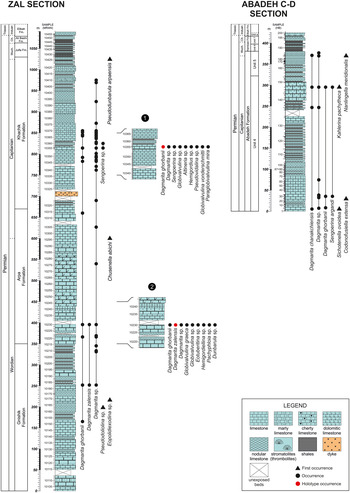
The Permian–Triassic Abadeh C-D section is composed from bottom to top by the Abadeh (380.5 m), Hambast (36 m), and Elikah (8 m) formations (Fig. 3). The Capitanian–early Wuchiapingian Abadeh Formation (Liu et al., Reference Liu, Wang, Shen, Gorgij, Ye, Zhang, Furuyama, Kano and Chen2013, with references therein) consists of two units (Unit 4 and Unit 5). The Unit 4 is mainly composed of thick-bedded bioclastic limestones and thin- to medium-bedded limestones alternating with black shales. The upper part of Unit 4 consists of thick-bedded limestones with abundant stratified and nodular chert. Unit 5 is dominated by dark thick-bedded bioclastic limestones. The overlying Lopingian Hambast Formation (Unit 6 and Unit 7) (Liu et al., Reference Liu, Wang, Shen, Gorgij, Ye, Zhang, Furuyama, Kano and Chen2013, with references therein) is characterized by thick black shales interbedded with dark-gray thin-bedded limestones, which become reddish and nodular in the upper part (Paratirolites Bed, Unit 7). The only investigated basal part of the latest Changhsingian–Induan Elikah Formation (Unit a) is marked by stromatolitic limestones (thrombolites) (Iranian-Japanese Research Group, 1981; Richoz et al., Reference Richoz, Krystyn, Baud, Brandner, Horacek and Mohtat-Aghai2010; Liu et al., Reference Liu, Wang, Shen, Gorgij, Ye, Zhang, Furuyama, Kano and Chen2013).
Stratigraphic logs of the Zal and Abadeh C-D sections, with the stratigraphic ranges of the genus Dagmarita Reitlinger, Reference Reitlinger1965, including Dagmarita ghorbanii n. sp. and Dagmarita zalensis n. sp., and of the genus Sengoerina Altıner, Reference Altıner1999. (1, 2) Details of the type levels of the new species with the accompanying foraminiferal assemblages. Abbreviations: Ch.: Changhsingian; Wuch.: Wuchiapingian.

The Permian–Triassic Zal section is characterized from bottom to top by the Gnishik (350 m), Arpa (320 m), Khachik (360 m), Julfa (33 m), Ali Bashi (16 m), and Elikah (10.5 m) formations (Fig. 3). The Wordian Gnishik Formation (Leven, Reference Leven1998) consists of dark-gray thin-bedded limestones and massive limestones alternating with marly limestones and black shales. The upper part of the formation shows an increase of marly limestones and black shales. The Wordian–Capitanian Arpa Formation (Leven, Reference Leven1998) is mostly represented by light-gray thin-bedded and massive bioclastic limestones. The occurrence of nodular chert in the lower part of the Formation is characteristic. The overlying Capitanian–early Wuchiapingian Khachik Formation (Ghaderi et al., Reference Ghaderi, Abad, Ashouri and Korn2016) consists of thin- and thick-bedded limestones passing upward into marly limestones and limestones with chert nodules interbedded with shales. The topmost unit of the Khachik Formation is characterized by dark-gray limestones, forming a unit named the Codonofusiella Limestone. The Lopingian Julfa Formation (Julfa Beds sensu Stepanov et al., Reference Stepanov, Golshani and Stöcklin1969) (Schobben et al., Reference Schobben, Stebbins, Ghaderi, Strauss, Korn and Korte2015; Ghaderi et al., Reference Ghaderi, Abad, Ashouri and Korn2016) is composed of nodular limestones and marly limestones with intercalations of gray to red shales. The Lopingian Ali Bashi Formation (Teichert et al., Reference Teichert, Kummel and Sweet1973; Schobben et al., Reference Schobben, Stebbins, Ghaderi, Strauss, Korn and Korte2015; Korn et al., Reference Korn, Ghaderi, Leda, Shobben and Ashouri2016) comprises the unnamed shaly unit (Ghaderi et al., Reference Ghaderi, Garbelli, Angiolini, Ashouri, Korn and Rettori2014) mostly characterized by red shales and the Paratirolites Limestone represented by red, nodular, marly limestones that are rich in ammonoids. The Ali Bashi Formation is successively overlain by the the latest Changhsingian–Induan Elikah Formation (Schobben et al., Reference Schobben, Stebbins, Ghaderi, Strauss, Korn and Korte2015; Zhang et al., Reference Zhang, Romaniello, Algeo, Lau, Clapham, Richoz, Herrmann, Smith, Horacek and Anbar2018) in the studied part, which is composed of red and gray shales (‘Boundary Clay’) and yellow-gray, marly thin-bedded limestones.
Material and methods
We studied a total of 553 limestone samples from the Zal and the Abadeh C-D sections, analyzing two thin sections per sample. Dagmarita ghorbanii n. sp. was recorded in 12 samples from the Zal section (Gnishik, Arpa, and Khachik formations) and in four samples from the Abadeh C-D section (Abadeh Formation), whereas Dagmarita zalensis n. sp. was recorded in two samples from the Zal section (Gnishik and Arpa formations). The images of the specimens were produced with different magnifications using Leica DM4500 P LED transmitted light microscope equipped with a Leica MC170 HD digital camera.
3D modeling
In our study, the new species Dagmarita ghorbanii n. sp. and Dagmarita zalensis n. sp. were investigated in detail with the purpose to obtain, for each of them, a three-dimensional visualization. The resulting 3D models have been reconstructed taking into account some parameters and measurements acquired from available specimens of the new taxa. The measurement data subsequently were used to obtain an average value for each of the parameters on which the 3D reconstructions are based. For this purpose, the open-source software ImageJ (https://imagej.nih.gov/ij/) was used to measure 2D images. The 3D renderings of the new species were computed using the software Maxwell Studio 4.1 for Mac, whereas the virtual reconstructions were performed using Rhinoceros 5.3.2 for Mac.
Repositories and institutional abbreviations
The studied material is stored at the paleontological laboratories of the National Iranian Oil Company (NIOC), Tehran, Iran, under the numbers MRAN 10103 to MRAN 10456 (Zal section) and in the micropaleontological collection of the Department of Physics and Geology of University of Perugia, Italy, under the numbers 1–200, corresponding to certain samples and thin sections in the collection of Abadeh (HB).
Systematic paleontology
Phylum Foraminifera d’Orbigny, Reference d'Orbigny1826
Class Fusulinata Maslakova, Reference Maslakova and Menner1990 emend. Gaillot and Vachard, Reference Gaillot and Vachard2007
Subclass Fusulinana Maslakova, Reference Maslakova and Menner1990 nom. correct. Vachard et al., Reference Vachard, Pille and Gaillot2010
Order Endothyrida Fursenko, Reference Fursenko1958
Remarks
Currently, the subclass assignment of the superfamily Biseriamminoidea Chernysheva, Reference Chernysheva1941 is doubtful. Herein, we have followed the macrotaxonomic classification suggested by Hance et al. (Reference Hance L., and Vachard, Devuyst, Kalvoda, Poty and Wu2011), Vachard (Reference Vachard2016), Gennari et al. (Reference Gennari, Cherin and Rettori2018a), and Gennari and Rettori (Reference Gennari and Rettori2019), who placed it in the subclass Fusulinana. However, the superfamily Biseriamminoidea could fall into the subclass Nodosariana Mikhalevich, Reference Mikhalevich1992 due to the test morphology and the wall structure of the included genera (Mikhalevich, Reference Mikhalevich2014). According to V.I. Mikhalevich (personal communication, 2019) fusulines rarely have a biserial test and never have a hyaline test wall. The continuity and evolution of the Paleozoic and Mesozoic nodosariats are marked by a gradual disappearance of the microgranular layer of the wall (Reitlinger, Reference Reitlinger1965; Kuznetzova and Basov, Reference Kuznetzova and Basov1974; Grigyalis, Reference Grigyalis1978; Mikhalevich, Reference Mikhalevich and Alimov2000; Karavaeva and Nestell, Reference Karavaeva and Nestell2007), so that Nodosariata Mikhalevich, Reference Mikhalevich1992 becomes the unique group with a hyaline wall in the Paleozoic (Vachard et al., Reference Vachard, Pille and Gaillot2010). Furthermore, Hohenegger (Reference Hohenegger, Ross, Ross and Brenckle1997) and Groves et al. (Reference Groves, Altıner and Rettori2003, Reference Groves, Rettori and Altıner2004, Reference Groves, Altıner and Rettori2005) considered Paleozoic and Mesozoic Lagenida as a monophyletic group. The macrotaxonomic position of the Biseriamminoidea will be the subject of a future research.
Superfamily Biseriamminoidea Chernysheva, Reference Chernysheva1941 emend. Gennari et al., Reference Gennari, Cherin and Rettori2018a
Family Globivalvulinidae Reitlinger, Reference Reitlinger1950 emend. Gennari et al., Reference Gennari, Cherin and Rettori2018a
Subfamily Dagmaritinae Bozorgnia, Reference Bozorgnia1973 emend. Gennari et al., Reference Gennari, Cherin and Rettori2018a
Diagnosis
Test free, elongated in shape, biserial, uncoiled with rounded peripheral outline. Subspheric chambers, semi-circular to semi-ellipsoidal in axial section. Presence of outer thornlike projections of the test wall. Endoskeletal septal partitions (peripheral chamberlets) are present in Louisettita. Test wall plurilayered, composed of dark microgranular and white median or outer hyaline layer. The microgranular layer described with perforations (in Danielita). Aperture depressed at the base of the final chamber and protected by a single or double valvular projection.
Occurrence
Roadian (Guadalupian, Permian) (Zheng, Reference Zheng1986) to latest Changhsingian (Lopingian, Permian) of the Paleotethys, the Neotethys, and the Panthalassa (Japan and North America) (Gennari et al., Reference Gennari, Cherin and Rettori2018a).
Remarks
Diagnosis emended from Gennari et al. (Reference Gennari, Cherin and Rettori2018a) due to the double valvular projection observed in the material from Abadeh C-D section (Central Iran). The subfamily Dagmaritinae is composed of the following genera: Dagmarita Reitlinger, Reference Reitlinger1965; Louisettita Altıner and Brönnimann, Reference Altıner and Brönnimann1980; Danielita Altıner and Özkan-Altıner, Reference Altıner and Özkan-Altıner2010.
Genus Dagmarita Reitlinger, Reference Reitlinger1965
Type species
Dagmarita chanakchiensis Reitlinger, Reference Reitlinger1965.
Other species
Dagmarita altilis Wang in Zhao et al., Reference Zhao, Sheng, Yao, Liang, Chen, Lin and Liao1981; Dagmarita ghorbanii n. sp.; Dagmarita zalensis n. sp. The species Dagmarita elegans Sosnina in Sosnina and Nikitina, Reference Sosnina and Nikitina1977, Dagmarita cuneata Sosnina in Sosnina and Nikitina, Reference Sosnina and Nikitina1977, Dagmarita exilis Sosnina in Sosnina and Nikitina, Reference Sosnina and Nikitina1977, Dagmarita oblonga Sosnina in Sosnina and Nikitina, Reference Sosnina and Nikitina1977, Dagmarita simplex Wang in Zhao et al., Reference Zhao, Sheng, Yao, Liang, Chen, Lin and Liao1981, Dagmarita minuscula Wang in Zhao et al., Reference Zhao, Sheng, Yao, Liang, Chen, Lin and Liao1981, Dagmarita liantanensis Hao and Lin, Reference Hao and Lin1982, and Dagmarita elongata Lin et al., Reference Lin, Li and Sun1990 are herein considered as synonyms of Dagmarita chanakchiensis Reitlinger, Reference Reitlinger1965.
Diagnosis
Test free, biserial, uncoiled, rectilinear. Subspheric chambers with a rounded periphery of the roof. Thornlike projections of the test wall are present at the peripheral edge of the chambers producing an external angular profile. Aperture depressed at the base of the final chamber. The apertural connection between one chamber and the other is marked by a thickened end of the slightly curved septa with a hooklike shape, which becomes a valvular projection in the last chamber. A secondary valvular projection is present, but not always preserved. The test wall is calcareous, two-layered, with an inner microgranular dark layer and an outer hyaline, clear, translucent layer.
Occurrence
Roadian (Guadalupian, Permian) to latest Changhsingian (Lopingian, Permian) of Paleotethys and Neotethys (Zheng, Reference Zheng1986; Gaillot et al., Reference Gaillot, Vachard, Galfetti and Martini2009; Ebrahim Nejad et al., Reference Ebrahim Nejad, Vachard, Siabeghodsy and Abbasi2015; Gennari et al., Reference Gennari, Cherin and Rettori2018a) (Fig. 4).
Stratigraphic range (thick line) of the genus Dagmarita and its species, including Dagmarita ghorbanii n. sp. and Dagmarita zalensis n. sp. The chronostratigraphic scale used is the last version published by International Commission on Stratigraphy (International Chronostratigraphic Chart 2019/05; http://www.stratigraphy.org/index.php/ics-chart-timescale).

Remarks
Diagnosis emended from Reitlinger (Reference Reitlinger1965). Reitlinger (Reference Reitlinger1965) described the transverse section of Dagmarita as flat, angular as figured (Reitlinger, Reference Reitlinger1965, pl. 1, fig. 11) for the type species Dagmarita chanakchiensis. In our opinion, the cross section figured by Reitlinger (Reference Reitlinger1965) is not perpendicular to the growth axes, but it is an oblique transverse section, passing through a corner of the chamber and showing a degree of compression, which is greater than the uncompressed specimens. On the basis of a huge number of observed specimens from our samples and from the literature, we consider the genus Dagmarita as uncoiled and biserial from the beginning (Fig. 5), as originally described by Reitlinger (Reference Reitlinger1965, p. 62), even if some authors report a probable biserial coiled earliest stage (Altıner, Reference Altıner1981; Zaninetti and Altıner, Reference Zaninetti and Altıner1981; Loeblich and Tappan, Reference Loeblich and Tappan1987; Gaillot and Vachard, Reference Gaillot and Vachard2007; Ebrahim Nejad et al., Reference Ebrahim Nejad, Vachard, Siabeghodsy and Abbasi2015). The specimen assigned to Dagmarita aff. D. chanakchiensis by Lys et al. (Reference Lys, Colchen, Bassoullet, Marcoux and Mascle1980, p. 99, pl. 3, fig. 13) shows an enrolled juvenile stage. On the basis of this character, Ciarapica et al. (Reference Ciarapica, Cirilli, Martini and Zaninetti1986, p. 208) considered the specimen figured by Lys et al. (Reference Lys, Colchen, Bassoullet, Marcoux and Mascle1980) as belonging to Crescentia vertebralis Ciarapica, et al., Reference Ciarapica, Cirilli, Martini and Zaninetti1986. Thornlike projections are always present in the genus Dagmarita, but their development and protrusion are herein considered to have taxonomic value at the species level. Observation of species populations highlights that the more the suture intersections are perpendicular, the less the thornlike projections are developed and protruding. Moreover, the depth of the septal depression increases when the angle of the intersection of the septum with the previous chamber is equal to or less than 90° and is further marked if the chambers have a hemispherical to semi-ellipsoidal shape as in Dagmarita chanakchiensis. The wall of Dagmarita is two-layered, as defined by Altıner and Özkan-Altıner (Reference Altıner and Özkan-Altıner2010), and there is no evidence of three-layered, as cited by Gaillot et al. (Reference Gaillot, Vachard, Galfetti and Martini2009) and Ebrahim Nejad et al. (Reference Ebrahim Nejad, Vachard, Siabeghodsy and Abbasi2015).
Cartoon showing the biserial test, completely uncoiled (1) and the secondary valvular projection (2). (1) Dagmarita sp. (modified from Gennari et al., Reference Gennari, Cherin and Rettori2018a, fig. 1). (2) Dagmarita chanakchiensis Reitlinger, Reference Reitlinger1965 (sample HB 148; Abadeh C-D section). Scale bar = 100 µm.

Dagmarita differs from the genera Paradagmarita Lys in Lys and Marcoux, Reference Lys and Marcoux1978, Paradagmacrusta Gaillot and Vachard, Reference Gaillot and Vachard2007, Sengoerina Altıner, Reference Altıner1999, and Crescentia Ciarapica et al., Reference Ciarapica, Cirilli, Martini and Zaninetti1986 by having completely uncoiled biserial test (Fig. 5), thornlike projections of the test wall, and a secondary valvular projection (Fig. 5). It also differs from the biserial, uncoiled genera Danielita and Louisettita because the former is characterized by a perforated inner, microgranular layer of the wall, whereas the latter has endoskeletal septal partitions. Based on the absence of thornlike projections, and in agreement with Gaillot et al. (Reference Gaillot, Vachard, Galfetti and Martini2009), we assert that Dagmarita shahrezaensis Mohtat-Aghai and Vachard, Reference Mohtat-Aghai and Vachard2003 might belong to another genus yet to be described and should be classified, according to Altıner and Özkan-Altıner (Reference Altıner and Özkan-Altıner2010), in a suprageneric taxon possibly related to Palaeotextulariidae. Furthermore, the morphological features of the population of Dagmarita shahrezaensis, illustrated by Mohtat-Aghai and Vachard (Reference Mohtat-Aghai and Vachard2003), do not seem to be congeneric with the genus Dagmarita. Gaillot et al. (Reference Gaillot, Vachard, Galfetti and Martini2009) doubtfully referred the species Dagmarita caucasica Vuks in Kotlyar et al., Reference Kotlyar, Zakharov, Kochirkevich, Kropacheva, Rostovtscev, Chediya, Vuks and Guseva1984 to the genus Bidagmarita Gaillot and Vachard in Gaillot et al., Reference Gaillot, Vachard, Galfetti and Martini2009, which has been recently kept outside the subfamily Dagmaritinae by Gennari et al. (Reference Gennari, Cherin and Rettori2018a).
Dagmarita chanakchiensis Reitlinger, Reference Reitlinger1965
- Reference Reitlinger1965
Dagmarita chanakchiensis Reitlinger, p. 63, pl. 1, figs. 10–12.
- Reference Sosnina and Nikitina1977
Dagmarita elegans Sosnina in Sosnina and Nikitina, p. 50, pl. 2, fig. 8.
- Reference Sosnina and Nikitina1977
Dagmarita cuneata Sosnina in Sosnina and Nikitina, p. 50, pl. 2, figs. 5, 6.
- Reference Sosnina and Nikitina1977
Dagmarita exilis Sosnina in Sosnina and Nikitina, p. 51, pl. 2, fig. 7.
- Reference Sosnina and Nikitina1977
Dagmarita oblonga Sosnina in Sosnina and Nikitina, p. 52, pl. 2, fig. 4.
- Reference Zhao, Sheng, Yao, Liang, Chen, Lin and Liao1981
Dagmarita simplex Wang in Zhao et al., p. 74, pl. 1, fig. 24.
- Reference Zhao, Sheng, Yao, Liang, Chen, Lin and Liao1981
Dagmarita minuscula Wang in Zhao et al., p. 74, pl. 1, fig. 26.
- Reference Hao and Lin1982
Dagmarita liantanensis Hao and Lin, p. 27, pl. 3, figs. 1, 13.
- Reference Lin, Li and Sun1990
Dagmarita elongata Lin et al., p. 122, pl. 2, figs. 23–26.
Holotype
Longitudinal frontal section (No. 3470/10) from the Khachik Formation of Chanakhchi area, Transcaucasia (Reitlinger, Reference Reitlinger1965, p. 63, pl. 1, fig. 10).
Occurrence
Roadian (Guadalupian, Permian) to latest Changhsingian (Lopingian, Permian) of Paleotethys and Neotethys (Lin et al., Reference Lin, Li and Sun1990; Kobayashi, Reference Kobayashi2004; Gaillot and Vachard, Reference Gaillot and Vachard2007; Song et al., Reference Song, Tong, Chen, Yang and Wang2009) (Fig. 4).
Description
Test free, rectilinear, elongated in shape, biserially arranged. The test is made up by seven to nine pairs of chambers rapidly increasing in the last two/three pairs of chambers. The chambers are hemispherical to semi-ellipsoidal in outline, with a rounded periphery of the roof. Sutures deeply depressed with an intersection angle never greater than 90° as observable in longitudinal frontal section. Nipple-shaped projections of the test wall are present at the peripheral edge of the chambers. The two growth axes in the final stage are close, coplanar, and parallel. The aperture is as described for the genus, even if the secondary valvular projection is not clearly visible. The apertural connection between one chamber and the other is placed at half of the height of the following chamber. The test wall is calcareous, two-layered, with an inner microgranular dark layer and an outer hyaline, clear, translucent layer.
Remarks
Dagmarita chanakchiensis differs from D. altilis by a greater height of the test, the shape of the test, the higher number of pairs of chambers, and the shape of the chambers (Table 1). We agree with Altıner (Reference Altıner1981), Jenny-Deshusses (Reference Jenny-Deshusses1983), and Mohtat-Aghai and Vachard (Reference Mohtat-Aghai and Vachard2003) that all the species from Middle–Late Permian of Russia described by Sosnina in Sosnina and Nikitina (Reference Sosnina and Nikitina1977) (D. elegans, D. cuneata, D. exilis, and D. oblonga) are synonyms of Dagmarita chanakchiensis. We also assert that D. simplex Wang in Zhao et al., Reference Zhao, Sheng, Yao, Liang, Chen, Lin and Liao1981, D. minuscula Wang in Zhao et al., Reference Zhao, Sheng, Yao, Liang, Chen, Lin and Liao1981, D. liantanensis Hao and Lin, Reference Hao and Lin1982, and D. elongata Lin et al., Reference Lin, Li and Sun1990, from Maokouan (~Guadalupian) to Changhsingian of southern China, are synonyms of the type species of the genus Dagmarita. The only distinctive features are the dimensional parameters, which however are gradual and change from specimen to specimen as well as with the orientation of thin sections. In addition, the type material is often poorly illustrated and sometimes (as for D. simplex, pl. 1, fig. 24) represented only by the holotype. This lack of information makes it difficult to achieve a clear understanding of the diagnostic criteria.
Comparative table of measurements of all the species of the genus Dagmarita.

Dagmarita altilis Wang in Zhao et al., Reference Zhao, Sheng, Yao, Liang, Chen, Lin and Liao1981
- Reference Zhao, Sheng, Yao, Liang, Chen, Lin and Liao1981
Dagmarita altilis Wang in Zhao et al., p. 74, pl. 1, fig. 21.
- Reference Lin1984
Dagmarita minima Lin, p. 112, pl. 1, figs. 18, 19.
Holotype
Longitudinal frontal section (ACT 29) from the upper part of Changhsing Formation of Changxing, Zhejiang, South China (Wang in Zhao et al., Reference Zhao, Sheng, Yao, Liang, Chen, Lin and Liao1981, pl. 1, fig. 21).
Occurrence
Roadian (Guadalupian, Permian) to latest Changhsingian (Lopingian, Permian) of southern China (Wang in Zhao et al., Reference Zhao, Sheng, Yao, Liang, Chen, Lin and Liao1981; Lin et al., Reference Lin, Li and Sun1990; Gaillot et al., Reference Gaillot, Vachard, Galfetti and Martini2009), Changhsingian of Transcaucasia (Pronina, Reference Pronina1988, Reference Pronina1989; Pronina-Nestell and Nestell, Reference Pronina-Nestell and Nestell2001), Lopingian of Zagros and Fars (Iran) and Hazro (Turkey) (Gaillot et al., Reference Gaillot, Vachard, Galfetti and Martini2009) (Fig. 4).
Description
Test free, rectilinear, conic shaped, biserially arranged. The test is made up by six to seven pairs of chambers, increasing in width rather than in height, making the test assume the typical low flared cone shape. The chambers are hemispherical elongated in outline, with a rounded periphery of the roof. Sutures slightly depressed, with an intersection angle greater than 90°. Pronounced and protruding thornlike projections of the test wall are present at the peripheral edge of the chambers. The two growth axes are coplanar and strongly divergent. The aperture is as described for the genus, even if the secondary valvular projection is not clearly visible. The apertural connection between one chamber and the other is close to the base of the following chamber. The test wall is calcareous, two-layered, with an inner microgranular dark layer and an outer hyaline, clear, translucent layer.
Remarks
The species Dagmarita minima Lin, Reference Lin1984 from early Maokouan of southern China, is herein considered as synonymous with D. altilis, as already proposed by Lin et al. (Reference Lin, Li and Sun1990), Gaillot and Vachard (Reference Gaillot and Vachard2007), and Gaillot et al. (Reference Gaillot, Vachard, Galfetti and Martini2009).
Dagmarita ghorbanii new species
Figures 6, 7
- Reference Okimura and Ishii1981
Dagmarita sp.; Okimura and Ishii, p. 20, pl. 1, fig. 10.
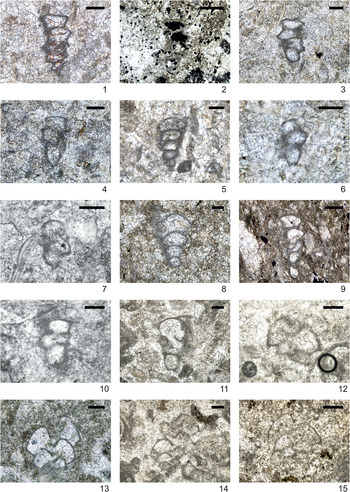
Dagmarita ghorbanii n. sp. from Zal (NW Iran) and Abadeh (Central Iran) stratigraphic sections: (1) holotype, oblique longitudinal lateral section, sample MRAN 10355; (2) oblique longitudinal lateral section, sample MRAN 10319; (3) oblique transversal section, sample MRAN 10230; (4) oblique longitudinal lateral section, sample MRAN 10367; (5) longitudinal lateral section, sample MRAN 10183; (6) oblique longitudinal lateral section, sample MRAN 10230; (7) oblique longitudinal lateral section, sample MRAN 10230; (8) longitudinal lateral section, sample MRAN 10355; (9) oblique longitudinal lateral section, sample MRAN 10349; (10) oblique longitudinal section, sample MRAN 10230; (11) oblique longitudinal section, sample HB 148; (12) oblique longitudinal frontal section, sample MRAN 10367; (13) oblique longitudinal frontal section, sample HB 30; (14) oblique longitudinal frontal section, sample HB 148; (15) oblique longitudinal frontal section, sample HB 148. Scale bars = 100 µm.

Three-dimensional reconstruction of Dagmarita ghorbanii n. sp.: (1) oblique longitudinal frontal section; (2) oblique transversal section; (3) oblique longitudinal frontal section; (4) oblique longitudinal lateral section.

Holotype
The specimen in oblique longitudinal lateral section in Figure 6.1, from sample MRAN 10355; Capitanian (Guadalupian, Permian); Khachik Formation; Zal section (NW Iran) (Fig. 3). The type material is stored at the National Iranian Oil Company, Department of Paleontology, Geochemistry and Researches (Tehran, Iran).
Diagnosis
Species of the genus Dagmarita characterized by two non-coplanar and divergent growth axes. The biserial test is made up by three to five pairs of trapezoidal chambers. Small thornlike projections of the test wall are present.
Occurrence
Middle Permian (=Guadalupian), Wordian to Capitanian, Iran (Fig. 4).
Description
Test free, rectilinear, cuneiform in shape, biserially arranged. The test is made up by three to five pairs of chambers increasing in width rather than in height. The chambers are trapezoidal in outline with a rounded periphery of the roof. Sutures depressed with perpendicular intersection. Small thornlike projections of the test wall are present at the peripheral edge of the chambers. The two growth axes of the adult stage are close, non-coplanar, and slightly divergent in the last two pairs of chambers. The aperture is as described for the genus, even if the secondary valvular projection is not clearly visible. The apertural connection between one chamber and the other is close to the base of the following chamber. The test wall is calcareous, two-layered, with an inner microgranular dark layer and an outer hyaline, clear, translucent layer.
Etymology
The new species is dedicated to Prof. Mansour Ghorbani (Department of Geology, Faculty of Geoscience, Shahid Beheshti University and Arian Zamin Co., Tehran, Iran) for his great contribution to the knowledge of geology of Iran.
Dimensions
Height of the test 280–500 µm; width of the test 270–410 µm; number of pairs of chambers 3–5; thickness of the wall 6–12 µm.
Remarks
Dagmarita ghorbanii n. sp. can be distinguished from Dagmarita chanakchiensis by the number of pairs of chambers (6–9 in D. chanakchiensis) and the smaller height of the test (up to 710 µm in D. chanakchiensis) (Table 1). The axes of D. ghorbanii n. sp. are non-coplanar and slightly divergent in the final part of the test, whereas in D. chanakchiensis the axes are coplanar and not divergent. In Dagmarita altilis, the axes are coplanar and highly divergent in the final part. The width/height ratio of the chambers in D. ghorbanii n. sp. is less than in D. altilis. The latter also has more pairs of chambers (6–7). Dagmarita ghorbanii n. sp. can be distinguished from Dagmarita zalensis n. sp. by its reduced number of pairs of chambers, smaller height of the test, and by the different shape of chambers (Table 1). The axes in D. zalensis n. sp. are coplanar and parallel. The development and protrusion of thornlike projections of Dagmarita ghorbanii n. sp. are less pronounced than in all the other species of Dagmarita.
Dagmarita zalensis new species
Figures 8, 9
- Reference Şahin, Altıner and Bülent Ercengiz2012
Dagmarita chanakchiensis Reitlinger; Şahin et al., p. 295, pl. 1, fig. 15.
- Reference Ebrahim Nejad, Vachard, Siabeghodsy and Abbasi2015
Dagmarita aff. elegans Sosnina; Ebrahim Nejad et al., fig. 12.1–12.5. [online publication]
- Reference Zhang, Shen, Zhang, Zhu and An2016
Dagmarita chanakchiensis; Zhang et al., p. 102, fig. 4.9–4.11.
Dagmarita zalensis n. sp. from Zal (NW Iran) stratigraphic section: (1) holotype, oblique longitudinal frontal section, sample MRAN 10230; (2) longitudinal frontal section, sample MRAN 10183; (3) longitudinal frontal section, sample MRAN 10230; (4) oblique longitudinal frontal section, sample MRAN 10230; (5) oblique longitudinal frontal section, sample MRAN 10183; (6) longitudinal lateral section, sample MRAN 10183; (7) longitudinal lateral section, sample MRAN 10230; (8) oblique longitudinal lateral section, sample MRAN 10183; (9) longitudinal lateral section, sample MRAN 10183. Scale bars = 100 µm.

Three-dimensional reconstruction of Dagmarita zalensis n. sp.: (1) longitudinal frontal section; (2) transversal section; (3) longitudinal lateral section; (4) oblique longitudinal frontal section.

Holotype
The specimen in oblique longitudinal frontal section in Figure 8.1, from sample MRAN 10230; Wordian (Guadalupian, Permian); Arpa Formation; Zal section (NW Iran) (Fig. 3). The type material is deposited at the National Iranian Oil Company, Department of Paleontology, Geochemistry and Researches (Tehran, Iran).
Diagnosis
Species of the genus Dagmarita characterized by two close, coplanar, and parallel growth axes. The biserial test is made up by eight to eleven pairs of subquadrate chambers. Pronounced thornlike projections of the test wall are present.
Occurrence
Middle Permian (=Guadalupian), Wordian to Capitanian, Iran, Turkey, and Tibet (Fig. 4).
Description
Test free, rectilinear, elongated in shape, biserially arranged. The test is made up by 8–11 pairs of chambers slowly increasing, so that the width/height ratio is approximately one, both in the juvenile and in the adult stages. The chambers are subquadrate in outline with a rounded periphery of the roof. Sutures markedly depressed with non-perpendicular intersection. Pronounced thornlike projections of the test wall are present at the peripheral edge of the chambers. The two growth axes of the adult stage are close, coplanar, and parallel, giving a skyscraper silhouette. The aperture is as described for the genus, even if the secondary valvular projection is not clearly visible. The apertural connection between one chamber and the other is placed at half of the height of the following chamber. The test wall is calcareous, two-layered, with an inner microgranular dark layer and an outer hyaline, clear, translucent layer.
Etymology
After the name of the Zal section (NW Iran), where the new species has been recorded.
Dimensions
Height of the test 450–800 µm; width of the test 180–280 µm; number of pairs of chambers 8–11; thickness of the wall 7–12 µm.
Remarks
Although the height range of the test of Dagmarita zalensis n. sp. and Dagmarita chanakchiensis partly overlaps, the former has the maximum height (Table 1). Dagmarita zalensis n. sp. can be more reliably distinguished from D. chanakchiensis by the higher number of chambers (maximum 22). Furthermore, the width of the final part of the test moderately increases in D. zalensis n. sp. and strongly in D. chanakchiensis, so that the maximum width of the latter is almost double that of the former. This is the reason why D. zalensis n. sp. shows the typical skyscraper silhouette. The thornlike projections in D. zalensis n. sp. are smaller and less protruding than in D. chanakchiensis. Dagmarita zalensis n. sp. also can be distinguished from Dagmarita altilis by the height (390 µm in D. altilis) and width (400 µm in D. altilis) of the test and the number of pairs of chambers (6–7 in D. altilis). Moreover, in D. zalensis n. sp., the axes are close and less divergent in the final part and the thornlike projections are less protruding.
Phylogenetic remarks of the genus Dagmarita
In the original description, Reitlinger (Reference Reitlinger1965) stated the uncertain status of the phylogenetic origin of the genus Dagmarita. Based on stratigraphic and morphological reasons, Zaninetti and Altıner (Reference Zaninetti and Altıner1981) reconstructed the possible phylogeny of Dagmarita, showing that it evolved from a biserially coiled ancestor belonging to the Globivalvulina stock. In particular, they supported this lineage asserting that some specimens of Dagmarita chanakchiens show a coiled initial stage. According to this evolutionary trend, Altıner (Reference Altıner, Ross, Ross and Brenckle1997, Reference Altıner1999) identified Globivalvulina cyprica Reichel, Reference Reichel1946 as a possible ancestor within the Globivalvulina stock. Moreover, Altıner (Reference Altıner1999) established the genus Sengoerina (‘genus A’ in Altıner, Reference Altıner, Ross, Ross and Brenckle1997) as having morphological features both of globivalvulinin and dagmaritin stages. According to Altıner, this genus represents the ancestor of biseriamminids having angular chambers (Dagmaritinae). Mohtat-Aghai and Vachard (Reference Mohtat-Aghai and Vachard2003) objected to this phylogenetic interpretation, claiming that the genus Sengoerina is younger (Midian = Capitanian) than Dagmarita (early Murgabian = late Roadian), so that Sengoerina cannot represent the ancestor of Dagmarita. Subsequently, for chronostratigraphic reasons Gaillot and Vachard (Reference Gaillot and Vachard2007), Altıner and Özkan-Altıner (Reference Altıner and Özkan-Altıner2010), and Vachard (Reference Vachard2016) considered the appereance of Dagmarita to be later than that of Sengoerina, acknowledging the lineage Globivalvulina cyprica-Sengoerina-Dagmarita.
In this study, we follow the most recent phylogenetic reconstruction of the family Globivalvulinidae and its subfamilies (Globivalvulininae, Paraglobivalvulininae, Dagmaritinae, and Paradagmaritinae) (Gennari et al., Reference Gennari, Cherin and Rettori2018a), in which Dagmaritinae is sister taxon to Paradagmaritinae. In the phylogenetic reconstruction proposed by Gennari et al. (Reference Gennari, Cherin and Rettori2018a), the Globivalvulininae would represent the most primitive clade within the family Globivalvuninidae, whereas the pair formed by Dagmaritinae and Paradagmaritinae occupy the most derived position in the phylogenetic tree. Gennari et al. (Reference Gennari, Cherin and Rettori2018a) included Sengoerina within the subfamily Paradagmaritinae due to its biserially enrolled early stage and chambers that become angular in the uncoiled stage. Therefore, we cannot retain as valid the relationship between Sengoerina and Dagmarita. Our stratigraphic data (Fig. 3) support this hypothesis, indicating that the appearance of Dagmarita is earlier (Wordian) (Gennari et al., Reference Gennari, Cherin and Rettori2018a) than that of Sengoerina (Capitanian) (Fig. 10). Conversely to what has been previously suggested by Zaninetti and Altıner (Reference Zaninetti and Altıner1981), Altıner (Reference Altıner, Ross, Ross and Brenckle1997, Reference Altıner1999), Gaillot and Vachard (Reference Gaillot and Vachard2007), Altıner and Özkan-Altıner (Reference Altıner and Özkan-Altıner2010), and Vachard (Reference Vachard2016), and in agreement with Gennari et al. (Reference Gennari, Cherin and Rettori2018a), the only possible evidence for a phylogenetic relationship between Globivalvulininae, Paradagmaritinae, and Dagmaritinae would be a still unknown Carboniferous (?Mississippian) common ancestor.
(1–3) Sengoerina argandi Altıner, Reference Altıner1999: (1) oblique lateral section, sample HB 30; (2, 3) oblique lateral section, sample HB 148. (4) Sengoerina sp., tangential section, sample MRAN 10360. Scale bars = 100 µm.

Conclusions
There are five main conclusions from this study summarized as follows: (1) the genus Dagmarita has been re-described on the basis of the type of chamber arrangement, apertural structures, and type of the test wall; (2) a secondary valvular projection has been defined for the first time, as a peculiar morphological feature of the genus Dagmarita; (3) two new species belonging to the genus Dagmarita (Dagmarita ghorbanii n. sp. and Dagmarita zalensis n. sp.) have been herein described from the Permian–Triassic successions of Zal (NW Iran) and Abadeh (Central Iran) (3D reconstructions allowed identification of the possible sections of the two new taxa, confirming those chosen to represent the populations); (4) on the basis of our taxonomic revision, the genus Dagmarita comprises Dagmarita chanakchiensis Reitlinger, Reference Reitlinger1965, Dagmarita altilis Wang in Zhao et al., Reference Zhao, Sheng, Yao, Liang, Chen, Lin and Liao1981, Dagmarita ghorbanii n. sp., and Dagmarita zalensis n. sp.; and (5) finally, in our phylogenetic interpretation, the initially coiled genus Sengoerina should not be considered as the ancestor of Dagmarita and the ancestor of the subfamily Dagmaritinae would still be an unknown Carboniferous (?Mississippian) taxon.
Acknowledgments
We are sincerely grateful to L. Sammartino and E. Cecchetti for 3D reconstructions and renderings. We also thank M. Cherin for his useful suggestions. Reviewers V.I. Mikhalevich, D. Altıner, L. Gale, H. Song, and an anonymous reviewer are thanked for their very careful and helpful reviews that improved the manuscript.
This study was supported by the project “Paleontology and Biozonation of Paleozoic Sediments of Zagros and Central Iran Basins” (coordinators M. Ghorbani and R. Rettori). Thanks are due to the National Iranian Oil Company (NIOC), Tehran. The authors gratefully thank Arianzamin Pars Geological Center for logistical support and assistance in the field.