1. INTRODUCTION
Early research in artificial intelligence (AI) in design was “AI in the large.” Artificial intelligence promised a revolutionary approach to assisting or automating design processes, separate from other computational systems. As the field matures, “AI in the small” has the most potential. Rather than seeing large AI programs, we see the results of research in AI in design providing the glue that holds larger systems together using reasoning systems that represent or manage processes, information, and interaction devices that use conventional procedural programming; effectively blurring the boundaries between AI and non-AI. Alternatively, we see research in AI in design as playing a role in blurring the boundaries between the physical and the virtual.
1.1. AI and non-AI
The boundary between AI and non-AI is hard to find. Broadly speaking, information technology is playing an increasing role in extending the capability of human problem solving. Design, as a reflective process, develops new products in the context of a perceived need or problem, and this context is now to a large extent in digital form. In design, problem finding becomes as important as problem solving. Designers often redefine the problem to be solved as they explore design solutions within a specific context. This means that the context needs to be changed as easily as the design model itself. Research in artificial intelligence in design is moving forward with advances in information technology in two ways:
- development of new models of design processes and
- development of new environments.
1.1.1. New models
Research in new models leads to new cognitive and computational models of design processes and design knowledge. New models are influenced by studies of human cognition while designing, and in reverse, new models of human design cognition are influenced by the developments in artificial intelligence. Although this area started as stand-alone AI models, the developments are increasingly influenced by and interact with new information technology. For example, advances in display technology have focussed AI research in the development of swarm models and machine-learning approaches to information clustering and visualization. AI is also used in organizing visualization of complex models on multiple screens, large CAVE environments, and interactive display technologies. Advances in network reliability, speed, and bandwidth has focused AI research on distributed design teams using intelligent agents. The research toward new models builds on AI research but is driven by advances in technology. Many of the new models are implemented and demonstrated without using traditional AI programming methods and languages, changing the focus from AI in the large to AI as an inspiration or component of a larger system.
1.1.2. New environments
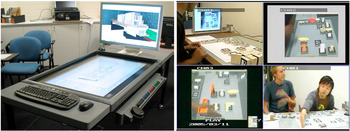
Research in this area focuses on the development of design environments as tools for a human designer. A broad spectrum of techniques are evolving in response to a perceived need to interact more naturally with digital content, such as multimodal interaction techniques, mobile computing, and tangible user interfaces. Tangible user interfaces enable you to interact with digital information by physically touching, grasping, pointing, and dragging physical objects on a digital workbench. Figure 1 shows a digital workbench integrated with table-size touch screen and augmented reality technologies, for design and collaboration in architectural design offices (Dong et al., 2006; Maher & Kim, 2006). The role that AI research plays in the development of these environments is in reasoning models for supporting and being proactive in the way in which designers interact with technology and knowledge. Data mining, linguistic analysis, and image content analysis are examples of how information can be manipulated to facilitate the understanding and use of large amounts of data in the context of a design problem. Models such as evolution, situatedness, and swarm algorithms provide new ways of interpreting and rerepresenting design knowledge.

A digital workbench for design and collaboration. [A color version of this figure can be viewed online at www.journals.cambridge.org]
1.2. Physical or virtual
In addition to blurring the boundary between AI and non-AI, the boundary between the physical environment and the virtual environment is becoming hard to find. The workplace can be anywhere that we have access to information technology. We can participate in a design session using advanced information technology from any place that is network enabled. The design and development of new ways of understanding and interacting with media and place is another manifestation of AI in the small. Research in AI in design is playing a role in supporting the following:
- collaboration spaces for people in different physical places,
- integration of digital media and place-making objects, and
- development of curious responsive places.
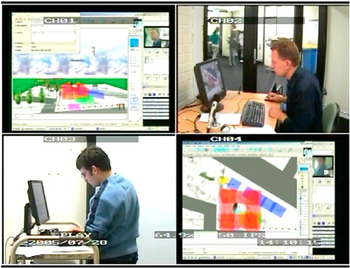
Although a person is always located in a physical place, he or she is no longer limited to interacting with others within that physical place. As we move from physical to virtual places we are afforded activities that can be supported by AI models of our activities. An example of this is DesignWorld (Rosenman et al., 2005), in which designers are located within a virtual world in which the objects that comprise the three-dimensional (3-D) model of the design have agency to support collaborative design activities. Figure 2 shows collaborating designers in a physical place and a virtual place.

Remote team collaboration using DesignWorld. [A color version of this figure can be viewed online at www.journals.cambridge.org]
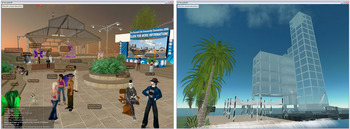
Virtual worlds such as SecondLife (http://www.secondlife.com, see Fig. 3) have attracted millions of members, each with the ability to create their own intelligent objects. Virtual worlds can develop into 3-D electronic institutions by combining a 3-D virtual world with an underlying agent framework that ensures secure business transactions and reinforces organizational structures. The 3-D virtual world is automatically designed and redesigned as needed using a design grammar (Gu & Maher, 2005), providing an adaptable virtual world for e-business.

Community members gather for a SecondLife convention (left) and a newly built virtual office building for rent (right). [A color version of this figure can be viewed online at www.journals.cambridge.org]
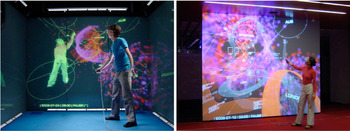
We think of media, including digital media, as information about some aspect of the world. In the past we understood that media is about something else and is separate from the thing it describes. Media merges with place as we integrate place making elements and physical objects with digital information visualization and sonification. Research in AI in design plays a role in how the object and the information are integrated. Figure 4 shows how information can be integrated with place making elements (Vande Moere, 2004; Vande Moere et al., 2004). Examples of smart objects, such as the Ambient Orb (http://www.ambientdevices.com/cat/products.html) and Nabaztag Smart Rabbit (http://new.nabaztag.com/en/index.html), bring ambient information into the workplace. Researchers at the MIT Media Lab developed a device that can turn any physical object into interfaces to digital information, as shown in Figure 5 (Carvey et al., 2006).

Users are immersed in commercial data sets. Images excerpted with permission from Vande Moere et al. (2004). [A color version of this figure can be viewed online at www.journals.cambridge.org]

Everyday objects become interfaces to digital information. Images excerpted with permission from Carvey et al. (2006). [A color version of this figure can be viewed online at www.journals.cambridge.org]
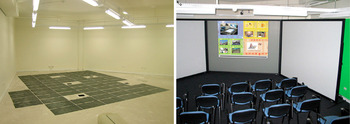
Research in AI in design is leading to the integration of places with intelligence. With the integration of intelligent agent technologies and learning algorithms, the workplace can become curious by taking interest in its inhabitants, learning about their behavioral patterns, and trying to provide better services. The “Curious Place” is a motivated learning agent, with sensors that provide data about the physical place that is motivated by an intrinsic reward based on a model of curiosity (Macindoe & Maher, 2005). The agent is capable of operating in the Sentient, a sensate room incorporated with sensors such as pressure-sensitive pads for tracking the presence and locations of people in the room, as shown in Figure 6. Currently, the agent is able to learn about the moving patterns of people in the room and actively composes and shows visual displays according to its learning outcomes.
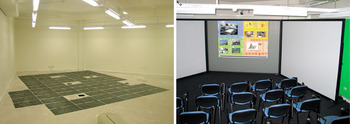
The pressure sensitive pads placed underneath the carpet (left) and the Sentient with completed flooring (right). [A color version of this figure can be viewed online at www.journals.cambridge.org]
In summary, the role of AI is changing as technology and expectation change. Research in AI in design applies and extends reasoning models for complex, ill-defined design domains. The future of AI in design is challenged and directed by advances in information technology. Research in AI in design no longer develops isolated models, and in the future will contribute as an enabler and integrator.
ACKNOWLEDGMENTS
This article was written while the author was employed by the National Science Foundation. The views herein do not necessarily represent the views of the National Science Foundation in the United States. Thanks to Ning Gu who helped source some of the images.