Introduction
Advances in cancer diagnosis and treatment have led to a growing population of childhood, adolescent, and young adult cancer survivors worldwide. While survival rates have improved substantially, exposure to potentially cardiotoxic therapies, including anthracyclines, chest radiotherapy, targeted agents, and immunotherapies, has resulted in an increased lifetime burden of cardiovascular disease. Reference Ryan, Bates and Kinahan1 Cardiovascular complications may emerge during treatment or years to decades later, making early detection, prevention, and long-term surveillance essential components of comprehensive cancer care. Reference Guerra, Mergiotti and Ardehali2
Over the past decade, cardio-oncology has evolved into a rapidly expanding multidisciplinary field, driven by increasing recognition of both acute and long-term cardiovascular complications associated with cancer therapies. Large cohort studies and international collaborations have demonstrated that survivors of childhood and adolescent cancer face a significantly increased lifetime risk of cardiomyopathy, heart failure, arrhythmias, and vascular disease. Reference Dixon, Liu and Chow3–Reference Toro, Felmingham and Jessop5
Paediatric and adolescent cardio-oncology has emerged as a specialised field aimed at mitigating cardiovascular risk across the cancer continuum, from diagnosis through survivorship. Reference Ryan, Bates and Kinahan1,Reference Toro, Felmingham and Jessop5 In high-income settings, this has been accompanied by the development of multidisciplinary cardio-oncology programmes, standardised surveillance protocols, and dedicated training pathways. These efforts have demonstrated improved detection of subclinical cardiotoxicity, more timely interventions, and more coordinated survivorship care. Reference Bloom, Vo and Rodgers6,Reference Pons-Riverola, Morillas and Berdejo7
In response, several international societies have developed comprehensive guidelines and quality frameworks to standardise cardiovascular surveillance and management, including the 2022 European Society of Cardiology cardio-oncology guidelines and recently proposed quality indicators for cardio-oncology care from both European and international initiatives. Reference Lyon, López-Fernández and Couch8–Reference Rao, Deswal and Lenihan11 These frameworks emphasise early detection of subclinical cardiotoxicity and risk-adapted monitoring strategies and highlight the importance of structured, multidisciplinary cardio-oncology programmes integrating cardiologists, oncologists, imaging specialists, and other healthcare professionals to optimise cardiovascular outcomes. Reference Lyon, López-Fernández and Couch8–Reference Rao, Deswal and Lenihan11
In contrast, the implementation of paediatric and adolescent cardio-oncology care in low-and middle-income regions remains uneven. Latin America faces unique challenges, including limited access to specialised training, heterogeneous healthcare systems, constrained diagnostic resources, and fragmented survivorship care. Despite the growing number of childhood and adolescent cancer survivors in the region, contemporary data describing the availability, structure, and scope of cardio-oncology services are scarce. Reference Villanueva, Sampor and Palma12
Despite the availability of international recommendations, there is limited evidence regarding how these strategies are implemented in real-world clinical practice across Latin America, where healthcare resources and system organisation vary widely.
Understanding the current landscape of paediatric and adolescent cardio-oncology care in Latin America is critical to identifying system-level gaps and informing strategies for regional capacity building. Such data are essential not only to guide clinical practice but also to support the development of collaborative networks, training initiatives, and implementation frameworks tailored to resource-limited settings.
Therefore, the objective of this study was to describe the current state of paediatric and adolescent cardio-oncology care in Latin America through a regional survey of healthcare professionals. Specifically, we aimed to assess workforce training, institutional infrastructure, availability of diagnostic resources, cardioprotective practices, survivorship follow-up strategies, and research capacity across the region.
Methods
Study design
This was an observational, descriptive, cross-sectional study conducted using a structured survey.
Study population and setting
The survey targeted healthcare professionals involved in the care of paediatric, adolescent, and young adult oncology patients across Latin America, including paediatric cardiologists and paediatric oncologists. Responses were obtained from multiple countries in the region, predominantly from tertiary-level public institutions providing cancer care to children and adolescents.
Participants were recruited through professional networks, including the SIAC Paediatric Cardiology and Cardio-Oncology Working Group, via email and messaging platforms. The survey was distributed using an open, network-based approach to maximise regional participation. Due to this distribution strategy, the total number of institutions approached could not be precisely determined, and therefore, a response rate was not calculated. Participation was voluntary and may be subject to selection bias.
Ethical considerations
The study was conducted in accordance with the principles of the Declaration of Helsinki. Given the voluntary nature of the survey, the absence of patient-level or identifiable data, and the lack of any intervention, formal institutional review board approval was waived according to local regulations. Completion of the survey was considered to imply informed consent.
Survey instrument (supplementary appendix S1. survey questionnaire)
A structured questionnaire was developed to evaluate:
-
• Availability of healthcare professionals with training in paediatric and adolescent cardio-oncology.
-
• Existence of formal interdisciplinary cardio-oncology teams and protocols.
-
• Cardiovascular evaluation and monitoring practices.
-
• Access to diagnostic modalities, including advanced echocardiography, biomarkers, and cardiac magnetic resonance.
-
• Use of cardioprotective strategies and management of cardiotoxicity.
-
• Long-term follow-up, survivorship care, and transition to adult cardiology.
-
• Participation in research activities and availability of training programmes.
-
• Perceived institutional needs to improve cardio-oncology care.
The survey instrument was developed by members of the SIAC Paediatric Cardio-Oncology Working Group based on clinical expertise and informed by existing literature, including international cardio-oncology guidelines and quality-of-care frameworks. In particular, the questionnaire domains were conceptually aligned with key components described in the 2022 European Society of Cardiology cardio-oncology guidelines, as well as recently proposed quality indicators for cardio-oncology care from both European and North American initiatives. Reference Lyon, López-Fernández and Couch8–Reference Rao, Deswal and Lenihan11
Although a formal checklist was not used, survey domains were designed to capture essential aspects of cardio-oncology care, including infrastructure, clinical processes, and long-term outcomes. The questionnaire was reviewed internally by experts within the working group for clarity and relevance prior to distribution; however, formal external validation or pilot testing was not performed.
The survey included both open and closed-ended questions and was distributed electronically using a Google Forms platform. Open-ended responses were reviewed and grouped into thematic categories for descriptive reporting. This process was performed to summarise common themes without applying formal qualitative analysis methods.
For conceptual analysis, survey domains were mapped to the Donabedian model, categorising findings into structure, process, and outcomes. Reference Lancellotti, Suter and López-Fernández9–Reference Rao, Deswal and Lenihan11
Statistical analyses
All analyses were descriptive. Categorical variables were summarised as absolute frequencies and percentages. No inferential statistical testing was performed, given the exploratory nature of the study. Data completeness was assessed for each variable, and missing responses were reported where applicable. Statistical analyses were performed using standard spreadsheet-based software.
Results
Respondent characteristics
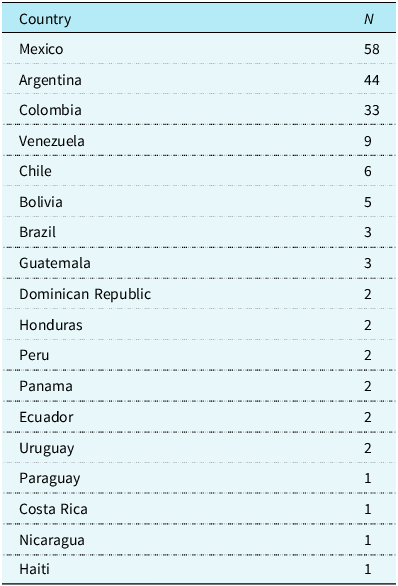
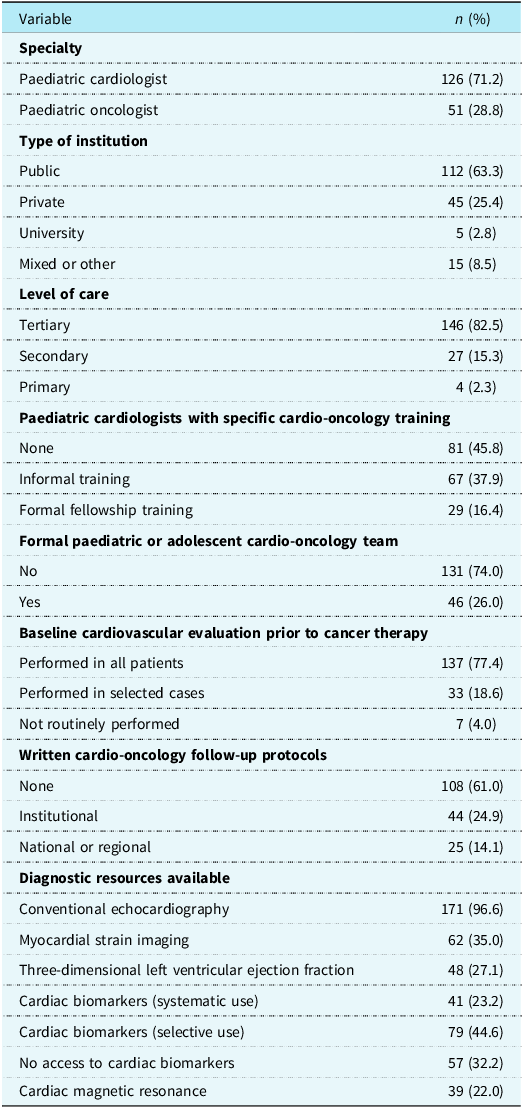
A total of 177 completed surveys from healthcare professionals across Latin America were analysed. Respondents represented multiple countries in the region, with the largest contributions from Mexico, Argentina, and Colombia, followed by Venezuela, Bolivia, Chile, and other Latin American countries (Table 1). Most participants were paediatric cardiologists (71.2%), with paediatric oncologists accounting for 28.8%. The majority of respondents practised in public institutions (63.3%), primarily at the tertiary care level (82.5%). All participating institutions reported providing care to paediatric oncology patients.
Participating countries and number of respondents

Table 1. Long description
The table presents the number of respondents from different Latin American countries who participated in a healthcare survey. It includes 17 countries listed in descending order of the number of respondents. Mexico has the highest number of respondents with 58, followed by Argentina with 44, and Colombia with 33. Other countries such as Venezuela, Chile, Bolivia, Brazil, Guatemala, Dominican Republic, Honduras, Peru, Panama, Ecuador, Uruguay, Paraguay, Costa Rica, Nicaragua, and Haiti also contributed with varying numbers of respondents. The table provides a clear comparison of the participation levels across these countries.
Workforce training and cardio-oncology structure
Nearly half of the respondents (45.8%) reported no access to paediatric cardiologists with specific training in cardio-oncology at their institutions. Informal training through courses or rotations was reported by 37.9%, whereas only 16.4% had access to cardiologists with formal cardio-oncology fellowship training (Table 2). A structured paediatric or adolescent cardio-oncology team was present in only 26.0% of institutions, while 74.0% reported no formal interdisciplinary programme (Table 2).
Workforce training, institutional structure, and diagnostic resources

Table 2. Long description
The table presents data on workforce training, institutional structure, and diagnostic resources in cardio-oncology. It includes variables such as specialty, type of institution, level of care, and specific training for pediatric cardiologists. The table has 10 rows and 2 columns, with column headers labeled ‘Variable’ and ‘n (%)’. Key trends include the majority of respondents being pediatric cardiologists, most institutions being public, and a significant portion lacking formal cardio-oncology training or structured teams. Diagnostic resources available vary widely, with conventional echocardiography being the most common.
Cardiovascular assessment and institutional protocols
Baseline cardiovascular evaluation before initiation of cancer therapy was routinely performed in 77.4% of institutions, selectively performed in 18.6%, and not systematically performed in 4.0%. Written institutional or regional cardio-oncology follow-up protocols were absent in 61.0% of centres; 24.9% reported institutional protocols, and 14.1% reported national or regional protocols. Education of patients and families regarding cardiovascular risk related to cancer therapy was delivered in a non-structured manner in 55.4% of institutions, through formal programmes in 24.3%, and was not routinely provided in 20.3% (Supplementary Table S2).
Availability of diagnostic resources
Conventional echocardiography was available in 96.6% of institutions. However, access to advanced echocardiographic techniques was limited, with myocardial strain imaging available in 35.0% and 3-dimensional left ventricular ejection fraction in 27.1%. Cardiac biomarkers were used selectively in 44.6% of institutions, systematically in 23.2%, and were not available in 32.2%. Cardiac MRI was accessible in only 22.0% of centres (Table 2).
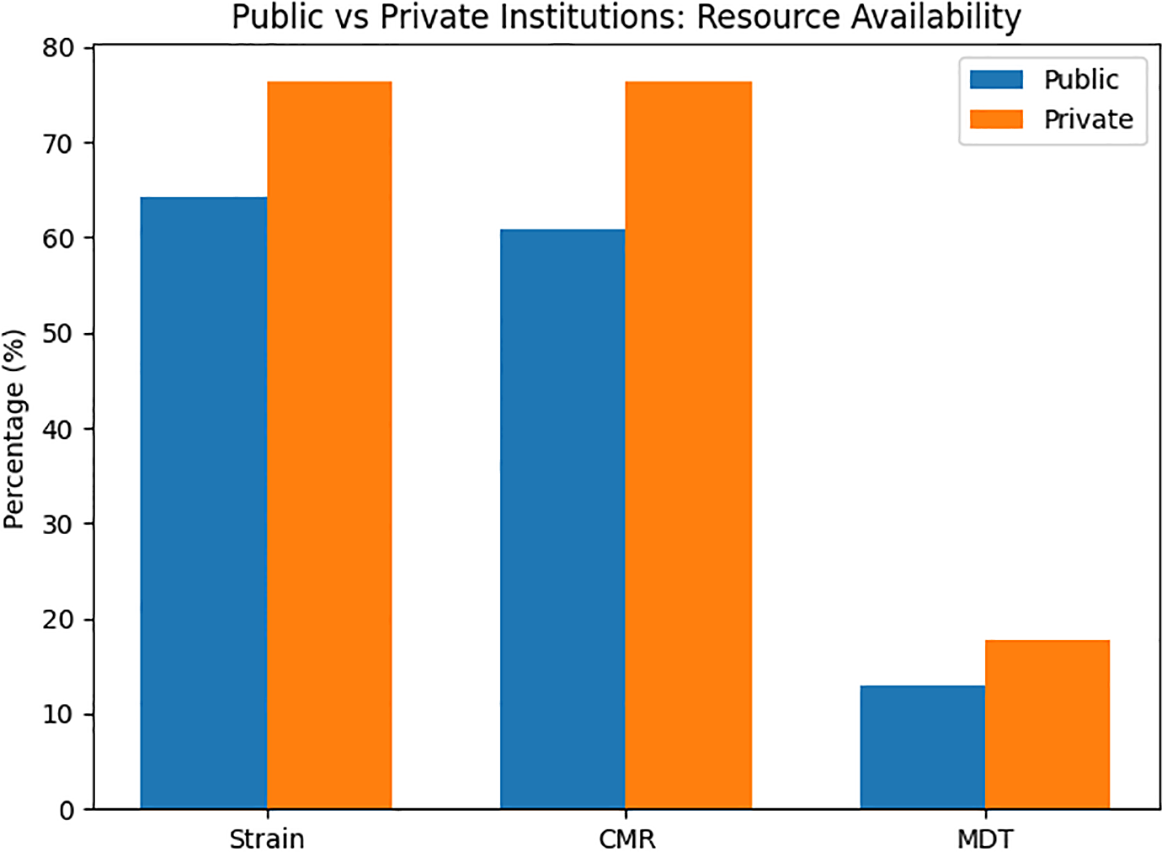
Exploratory comparisons between public and private institutions suggested differences in access to advanced diagnostic tools and structured cardio-oncology programmes, with private institutions more frequently reporting availability of myocardial strain imaging, cardiac magnetic resonance, formal multidisciplinary teams, and written protocols, whereas structured transition to adult care was reported more frequently by public institutions. These differences are visually summarised in Figure 1 and Supplementary Table S3.
Comparison of resource availability between public and private institutions. A grouped bar chart showing differences in access to advanced imaging modalities (strain and cardiac magnetic resonance [CMR]) and the presence of multidisciplinary teams (MDT) between public and private healthcare institutions.

Figure 1. Long description
The grouped bar chart compares resource availability between public and private institutions. The x-axis lists three categories: Strain, CMR, and MDT. The y-axis represents the percentage, ranging from 0 to 80 percent. Each category has two vertical bars, one for public institutions in blue and one for private institutions in orange. For Strain, public institutions have approximately 65 percent availability, while private institutions have around 75 percent. For CMR, public institutions show about 60 percent availability, and private institutions show around 75 percent. For MDT, public institutions have approximately 15 percent availability, and private institutions have around 20 percent. The chart highlights that private institutions generally have higher resource availability compared to public institutions. All values are approximated.
Prevention, survivorship, and transition of care
Primary cardioprotective strategies were not routinely used in 46.9% of institutions, were applied selectively in 40.1%, and were systematically implemented in 13.0%. Protocols for the management of treatment-related heart failure were available in 41.2% of institutions. Formal long-term cardiovascular follow-up programmes for childhood, adolescent, and young adult cancer survivors were present in only 13.6%, whereas 57.6% reported no structured survivorship programme. Structured transition to adult cardiology care was implemented in 22.0% of centres, while 41.8% reported informal transition and 36.2% reported no transition process. Participation in multicentre cardio-oncology research was reported by 15.8% of institutions, and formal training programmes were available in 21.5% (Supplementary Table S4).
Discussion
Principal findings
In this regional survey of healthcare professionals across Latin America, we identified substantial gaps in the delivery of paediatric and adolescent cardio-oncology care. Although baseline cardiovascular assessment before cancer therapy was commonly performed, formal cardio-oncology infrastructure, including trained personnel, interdisciplinary teams, standardised protocols, and survivorship programmes, was limited and highly heterogeneous.
Using the Donabedian framework, our findings highlight significant gaps in structure (limited trained workforce and infrastructure), process (lack of standardised protocols), and outcomes (limited survivorship programmes). Reference Lancellotti, Suter and López-Fernández9
Comparison with existing literature
In high-income settings, the expansion of paediatric and adolescent cardio-oncology programmes has been supported by structured training pathways, multidisciplinary clinics, and guideline-driven surveillance strategies. Reference Ryan, Bates and Kinahan1,Reference Campia, Moslehi and Amiri-Kordestani13 Our findings contrast sharply with these models, as fewer than one in five institutions reported access to formally trained cardio-oncology specialists, and fewer than one-third had established interdisciplinary teams. Limited access to advanced imaging modalities and cardiac magnetic resonance further underscores disparities in early detection of subclinical cardiotoxicity, a cornerstone of contemporary cardio-oncology practice. Reference Ryan, Bates and Kinahan1,Reference Addison, Neilan and Barac14
Clinical and systems implications
The low prevalence of structured long-term follow-up and transition programmes is particularly concerning, given the well-documented delayed cardiovascular morbidity among childhood and adolescent cancer survivors. Reference Dixon, Liu and Chow3,Reference Siegel, Kratzer and Giaquinto15,Reference Suh, Stratton and Leisenring16 Without coordinated survivorship care models, opportunities for early intervention, risk modification, and prevention of late cardiovascular complications may be missed. Reference Hammoud, Liu and Dixon4,Reference Strongman, Gadd and Matthews17,Reference Mulrooney18 These findings highlight the need for system-level implementation strategies tailored to resource-constrained environments, including scalable surveillance protocols, targeted training initiatives, and regional collaboration networks.
Exploratory analyses revealed differences between public and private institutions, particularly in access to advanced diagnostic resources and structured cardio-oncology programmes. Private institutions more frequently reported availability of cardiac magnetic resonance, myocardial strain imaging, and formal multidisciplinary teams, suggesting disparities in infrastructure and specialised care delivery.
These findings likely reflect broader structural inequities in healthcare systems across the region, where resource availability, funding models, and access to advanced technologies vary substantially. Interestingly, structured transition to adult cardiology care was reported more frequently in public institutions, which may reflect differences in long-term care organisation within public health systems.
Although these comparisons are exploratory and should be interpreted with caution, they highlight important system-level differences that may impact the early detection and management of cardiotoxicity, as well as long-term survivorship care. Addressing these disparities will be critical for the development of equitable and scalable cardio-oncology programmes across Latin America.
Our findings should also be interpreted in the context of existing international literature and quality frameworks in cardio-oncology. In high-income settings, the development of structured cardio-oncology programmes has been closely aligned with guideline-based recommendations and quality indicator initiatives, which emphasise standardised surveillance protocols, multidisciplinary care, and early detection of subclinical cardiotoxicity. Reference Lyon, López-Fernández and Couch8,Reference Addison, Neilan and Barac14
Recent efforts from international societies, including the European Society of Cardiology and collaborative cardio-oncology groups, have proposed quality indicators to support the implementation and evaluation of care delivery across the cancer continuum. Reference Lee, Lyon and López-Fernández10,Reference Rao, Deswal and Lenihan11 These quality indicator frameworks provide a structured approach to evaluate care delivery across domains of structure, process, and outcomes, aligning closely with the Donabedian model applied in this study.
In contrast, our results highlight a substantial gap between these recommended standards and real-world practice in Latin America. While baseline cardiac assessment is relatively well established, critical components of high-quality cardio-oncology care, such as access to advanced imaging modalities, formal interdisciplinary teams, and structured survivorship programmes, remain limited.
This “implementation gap” has been described in other areas of global cardiovascular care and is particularly relevant in cardio-oncology, where rapid advances in knowledge have outpaced the development of scalable models adapted to resource-limited settings.
Importantly, quality indicator frameworks may serve as a useful tool to guide these efforts, allowing institutions to prioritise key components of care and monitor progress over time. Adapting such frameworks to the Latin American context could facilitate more equitable and standardised delivery of cardio-oncology services across the region.
Future directions
Regional efforts should prioritise the development of standardised paediatric and adolescent cardio-oncology pathways adapted to local resource availability. Establishing collaborative registries, expanding educational opportunities, and leveraging telemedicine and international partnerships may represent feasible strategies to advance care delivery and research capacity in Latin America.
Paediatric and adolescent cardio-oncology care in Latin America remains fragmented, with limited formal infrastructure and uneven access to specialised resources. These findings underscore an urgent need for coordinated regional strategies to improve cardiovascular care across the cancer survivorship continuum.
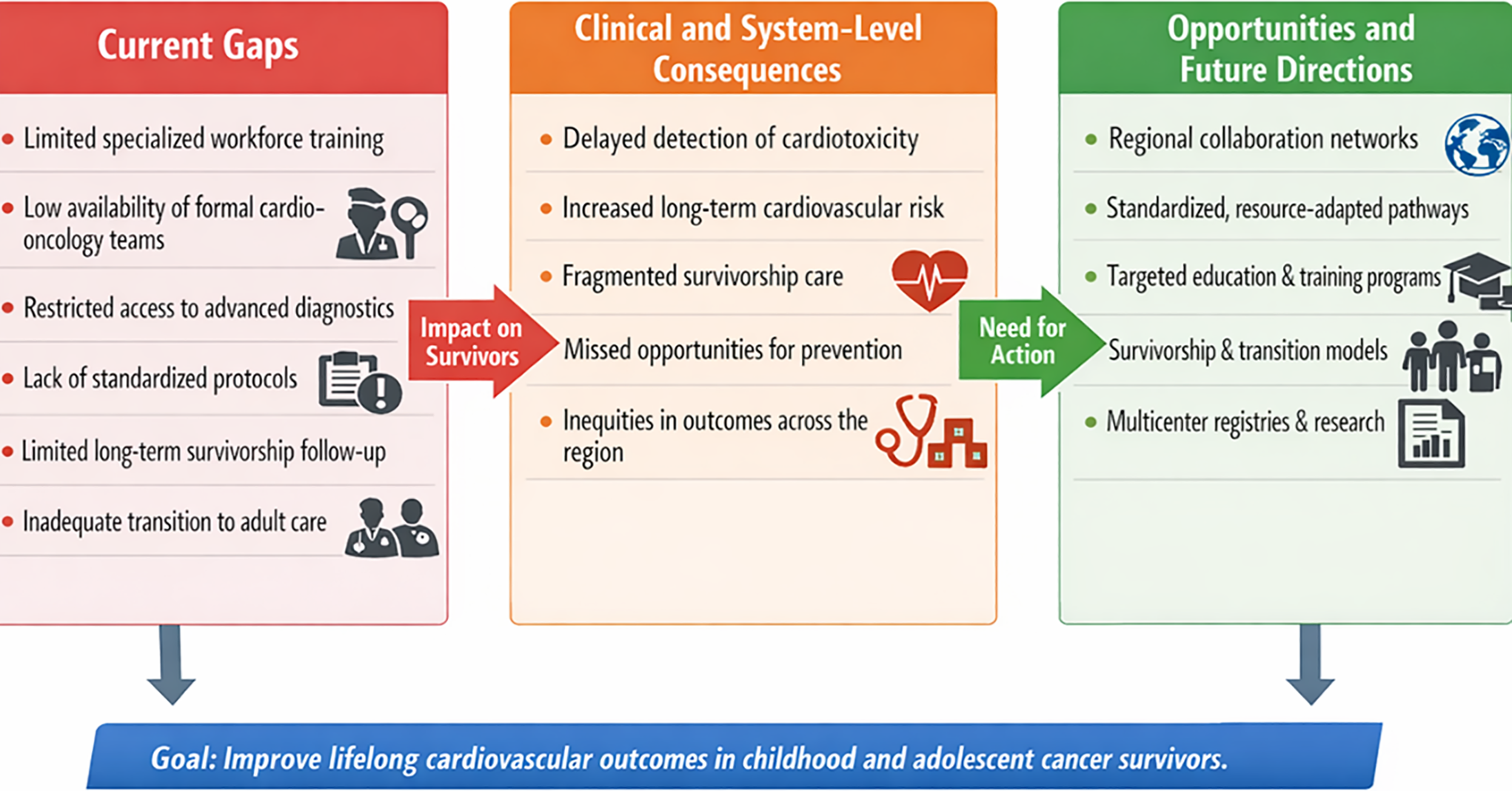
A conceptual overview of the principal gaps identified and potential strategic opportunities is presented in Figure 2.
Gaps and opportunities in paediatric and adolescent cardio-oncology care in Latin America. This illustration summarises the current landscape of paediatric and adolescent cardio-oncology care in Latin America, highlighting key gaps in workforce training, interdisciplinary team structure, diagnostic resources, survivorship follow-up, and transition to adult care. Limited access to formally trained specialists, advanced imaging, and structured long-term surveillance contrasts with the growing population of childhood and adolescent cancer survivors at lifelong cardiovascular risk. The figure also outlines potential strategies to advance care delivery, including regional collaboration, standardised surveillance pathways, and targeted education initiatives adapted to resource-limited settings.

Figure 2. Long description
The diagram is divided into three sections: Current Gaps, Clinical and System-Level Consequences, and Opportunities and Future Directions. The Current Gaps section lists limited specialized workforce training, low availability of formal cardio-oncology teams, restricted access to advanced diagnostics, lack of standardized protocols, limited long-term survivorship follow-up, and inadequate transition to adult care. The Clinical and System-Level Consequences section highlights delayed detection of cardiotoxicity, increased long-term cardiovascular risk, fragmented survivorship care, missed opportunities for prevention, and inequities in outcomes across the region. The Opportunities and Future Directions section suggests regional collaboration networks, standardized resource-adapted pathways, targeted education and training programs, survivorship and transition models, and multicenter registries and research. The diagram emphasizes the need for action to improve lifelong cardiovascular outcomes in childhood and adolescent cancer survivors.
Study limitations
This study was cross-sectional and descriptive and relied on self-reported data, which may introduce reporting bias. Interpretation of survey items may have varied across institutions and countries. Nevertheless, the broad regional participation provides valuable insight into current practice patterns and unmet needs.
The over-representation of certain countries, such as Mexico and Argentina, may reflect differences in survey dissemination and engagement rather than actual regional distribution of resources.
Additionally, the use of a network-based recruitment strategy precluded calculation of a response rate and may introduce selection bias.
In conclusion, paediatric and adolescent cardio-oncology care in Latin America remains heterogeneous and incompletely developed, with significant gaps in workforce training, infrastructure, and long-term survivorship care. Addressing these disparities through coordinated regional strategies will be essential to improve cardiovascular outcomes across the cancer continuum.
Supplementary material
The supplementary material for this article can be found at https://doi.org/10.1017/S1047951126113614.
Acknowledgements
None.
Financial support
This research received no specific grant from any funding agency, commercial or not-for-profit sectors.
Competing interests
The authors declare none.
Ethical standard
The authors assert that all procedures contributing to this work comply with the ethical standards of the relevant national guidelines on human experimentation and with the Helsinki Declaration of 1975, as revised in 2008. Given the voluntary nature of the survey and the absence of patient-level or identifiable data, formal institutional review board approval was waived according to local regulations.