The coronavirus disease 2019 (COVID-19) pandemic has highlighted the critical importance of rigorous infection control practices in preventing viral transmission in healthcare settings. Reference Rhee, Baker and Klompas1 Recommendations from the Centers for Disease Control and Prevention (CDC) have continued to evolve in response to real-world experiences on the effectiveness of infection control strategies, new data on the science of severe acute respiratory coronavirus virus 2 (SARS-CoV-2) transmission, and the rise of more transmissible variants. 2 However, the CDC guidance is not prescriptive and allows institutions considerable discretion for many key practices, including the specific type of face covering used for universal source control, how to prioritize airborne infection isolation rooms (AIIRs), the role of portable high-efficiency particulate air (HEPA) filters in mitigating transmission risk, and testing strategies for patients and healthcare workers.
Some hospitals considering potential modifications to their infection control programs in response to the evolving pandemic and new data on transmission may wish to compare practices at peer institutions. We surveyed hospital epidemiologists from leading US medical centers to understand COVID-19 infection control practices immediately following the COVID-19 wave caused by the SARS-CoV-2 omicron variant.
Methods
We distributed an electronic survey in REDCap Reference Harris, Taylor, Thielke, Payne, Gonzalez and Conde3 to hospital epidemiologists at 20 hospitals included in the 2021–2022 US News World & Report rankings and 10 nonoverlapping hospitals in the CDC Prevention Epicenters program (hospitals listed in the Supplementary Table online). The survey assessed hospital policies on masking and personal protective equipment (PPE), cohorting COVID-19 patients, use of AIIRs and HEPA filters, patient testing, and employee testing. Survey questions are provided in the Appendix (online). Hospital epidemiologists were contacted directly by the study investigators using an e-mail template. Reminders were sent twice if no response was received. Participation was voluntary, and the survey invitation clearly stated that individual hospital practices would not be identifiable. The survey was open from February 15 to March 3, 2022, corresponding to the period when all regions of the United States were experiencing decreasing COVID-19 case counts following the initial pandemic surge caused by the SARS-CoV-2 omicron variant. Simple descriptive analyses were used to summarize survey results. The study was approved by the Mass General Brigham Institutional Review Board.
Results
Survey response rate and hospital geographic distribution
We received responses from 23 of the 30 surveyed hospitals (77% response rate); all respondents identified themselves as hospital epidemiologists. All 23 hospitals were large academic hospitals representing all US Census regions of the United States (8 Midwest, 6 South, 5 Northeast, and 4 West).
Universal masking and personal protective equipment
Among responding hospitals, 18 (78%) used medical masks for universal masking (ie, non–COVID-19 care), 5 (22%) used N95 respirators, and none used KN95s (Table 1). Of the 18 hospitals that used medical masks, 11 explicitly allowed healthcare workers discretion for using N95s. In 1 hospital, N95s were used for high-risk encounters, but the criteria for these were not specified. Of the 5 hospitals with a universal N95 strategy, 2 respondents explicitly noted that it was tied to current high community rates of COVID-19. In 16 hospitals (70%), universal eye protection for non–COVID-19 care was required. When caring for patients with suspected or confirmed COVID-19, 22 hospitals (96%) used N95s for all aspects of care, and 1 hospital (4%) used medical masks as the default and reserved N95s for aerosol-generating procedures.
Summary of Survey Responses on Masking and Personal Protective Equipment

Note. PPE, personal protection equipment; AGP, aerosol-generating procedure.
COVID-19 care models, AIIRs, and portable HEPA filters
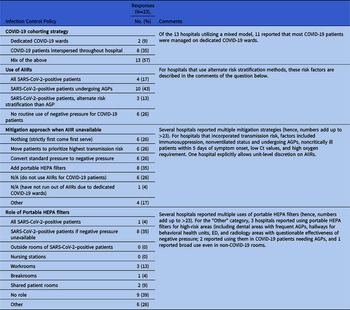
Among the responding hospitals, 2 (9%) cared for COVID-19 patients on dedicated COVID-19 units, 8 (35%) interspersed COVID-19 patients with non–COVID-19 patients on their wards (albeit in separate rooms), and 13 (57%) used both dedicated COVID-19 units and mixed units (11 of these 13 reported that most COVID-19 patients were managed on dedicated COVID-19 units) (Table 2).
Summary of Survey Responses on COVID-19 Cohorting, AIIRs, and Portable HEPA Filters

Note. AIIR, airborne infection isolation room; HEPA, high-efficiency particulate air, aerosol-generating procedure; N/A, not applicable; ED, emergency department.
4 hospitals (17%) used AIIRs for all COVID-19 patients, 10 (43%) prioritized AIIRs for aerosol-generating procedures, 3 (13%) used alternate risk-stratification criteria (eg, low PCR cycle threshold [Ct] values along with high oxygen requirement or nebulizer use), and 6 (26%) did not routinely use AIIRs. Hospitals used various mitigation strategies when hospital criteria for AIIR use were met but AIIRs were unavailable: 6 reported doing nothing (strictly first come–first serve); 6 moved patients to prioritize those at higher transmission risk; 6 worked with the engineering department to convert standard-pressure rooms to negative pressure; 8 added portable HEPA filters; 1 hospital had never run out of AIIRs because patients were cared for entirely on dedicated COVID-19 wards with abundant AIIRs; and 1 reported allowing unit-level discretion on allocating AIIRs. For hospitals that moved patients around based on transmission risk, factors considered included immunosuppression, nonventilated status and undergoing aerosol-generating procedures (AGPs), and non–critically ill patients within 5 days of symptom onset.
The use of portable HEPA filters varied greatly. 9 hospitals (39%) reported no use of portable HEPA filters at all. Of the 8 hospitals (35%) that used portable HEPA filters for COVID-19 patients when AIIRs were unavailable, 3 also reported using them in breakrooms, workrooms, shared patient rooms, and/or a specific high-risk area (eg, hallways occupied by behavioral health patients where masking was infrequent). Of the remaining 6 hospitals (26%), uses included portable HEPA filters in all COVID-19 rooms (n = 1), in COVID-19 rooms for patients undergoing AGPs or other high risk-procedures (n = 2), for broad use even in non–COVID-19 rooms (n = 1), in a dental procedural area (n = 1), and in emergency department and radiology areas where the effectiveness of built-in negative pressure was uncertain (n = 1).
Patient and employee testing
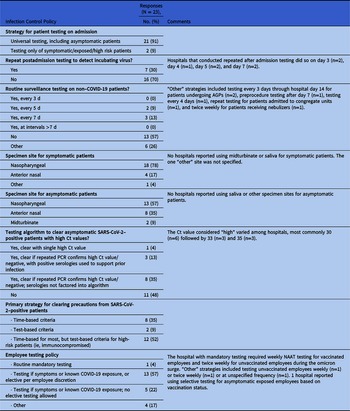
Overall, 21 hospitals (91%) used universal testing of patients (ie, both symptomatic and asymptomatic) on admission, whereas the other 2 hospitals tested only symptomatic, exposed, or other high-risk patients (Table 3). 7 hospitals (30%) had at least 1 postadmission test to detect virus that might have been incubating on admission and thus missed by the admission test. Testing occurred on day 3 (n = 2), day 4 (n = 1), day 5 (n = 2), or day 7 (n = 2). 6 hospitals additionally reported conducting repeated surveillance testing on non–COVID-19 patients every 4 days (n = 1), every 5 days (n = 2), or every 7 days (n = 3). In addition, 5 hospitals reported other tailored strategies: testing every 3 days through hospital day 14 for patients undergoing AGPs (n = 2), preprocedure testing after day 7 (n = 1); repeated testing for patients admitted to congregate units (n = 1); and twice weekly testing for patients receiving nebulizers (n = 1).
Summary of Survey Responses on Patient and Employee Testing Policies

Note. Ct, cycle threshold; NAAT, nucleic acid amplification test; PCR, polymerase chain reaction.
Among the respondents, 18 hospitals (78%) used nasopharyngeal swabs for symptomatic inpatients, 4 (17%) used anterior nasal swabs, and 1 used another site (not specified). For asymptomatic patients, 13 (57%) used nasopharyngeal swabs, 8 (35%) used anterior nasal swabs, and 2 (9%) used midturbinate swabs. No hospitals reported using saliva tests for symptomatic or asymptomatic patients.
Among all respondents, 12 hospitals (52%) used an algorithm to clear COVID-19 precautions for asymptomatic patients who tested positive for SARS-CoV-2 with high Ct values. Only 1 hospital used a single high Ct value; 3 hospitals required stably high Ct values on repeated PCR testing and factored in positive serologies to support evidence of prior infection (ie, residual viral RNA). 8 hospitals required stably high Ct values on PCR testing but did not factor serologies into their algorithm. The Ct value considered “high” for these purposes varied among hospitals, most commonly 30 (n = 6) followed by 33 (n = 3) and 35 (n = 3). When clearing precautions from patients with confirmed COVID-19, 8 hospitals (35%) primarily used time-based criteria, 2 (9%) used test-based criteria, and 12 used time-based criteria for most patients but used test-based criteria for high-risk patients such as those with immunocompromising conditions.
5 hospitals (22%) required regular testing of unvaccinated employees; 1 hospital (4%) reported mandatory weekly testing, even for vaccinated employees, during the COVID-19 surge related to the omicron variant. The other 18 hospitals did not have mandatory surveillance testing for employees but instead required testing for new symptoms or known COVID-19 exposures; 13 of these also allowed elective testing at the employee’s discretion.
Discussion
We surveyed hospital epidemiologists from 23 leading US hospitals to understand COVID-19 infection control policies in the context of the initial wave of COVID-19 caused by the SARS-CoV-2 omicron variant in the United States. The 2 policies that were nearly uniform were the type of respiratory protection for COVID-19 patients (96% of survey hospitals used N95s for routine care) and universal testing of patients on admission (91% of survey hospitals). Consensus was moderately high regarding universal eye protection for non–COVID-19 patients (70% of survey hospitals), preference for nasopharyngeal swabs for symptomatic patients (78% of survey hospitals), and targeted rather than mandated surveillance testing of employees (78% of survey hospitals). Beyond this, however, we observed substantial variation in care models (dedicated COVID-19 units vs mixed units vs a combination of both), use of airborne infection isolation rooms, use of portable HEPA filters, postadmission testing strategies, specimen source sites for asymptomatic patients, use of algorithms to clear precautions from asymptomatic patients with high Ct values on their initial positive SARS-CoV-2 tests, what Ct values were considered to be high, and use of time versus test-based strategies to clear precautions from patients with confirmed COVID-19.
The routine use of N95s for all COVID-19 care rather than only for AGPs corresponds with shifts in the CDC and WHO guidance that reflect the growing evidence of aerosol-based transmission, even in the absence of AGPs. 4–Reference Greenhalgh, Jimenez, Prather, Tufekci, Fisman and Schooley6 Although most hospitals used medical masks for universal respiratory protection and source control when caring for patients without suspected or confirmed COVID-19, 5 hospitals reported using N95s for this purpose, and several explicitly tied this to high community rates. This finding may reflect the growing recognition that patients with early unsuspected infection can be highly contagious, even in the absence of symptoms, and that most clusters tend to occur in non–COVID-19 wards where transmissions can be rapidly sparked by patients or healthcare workers with unsuspected acute infections. Reference Braun, Moreno and Buys7,Reference Jinadatha, Jones and Choi8 N95 respirators provide better respiratory protection for healthcare workers than medical masks and also provide better source control to reduce the risk of transmission to patients. Reference Klompas, Rhee and Baker9–Reference Baker, Rhee and Tucker11 The advantages of universal N95s over medical masks, however, must be balanced against higher costs, less comfort, and logistical challenges related to fit testing.
The variability in cohorting strategies and use of AIIRs may reflect variability in the physical infrastructure and engineering capabilities of hospitals. Some hospitals, for example, can convert standard pressure rooms, wards, or even entire buildings to negative pressure, whereas others may only have a small, fixed number of AIIRs. Hospitals also varied in the criteria they used to place COVID-19 patients into AIIRs, ranging from all COVID-19 patients to just those requiring AGPs to not using AIIRs at all. Some hospitals used non-AGP risk-stratification schemes that incorporated low Ct values, severity of symptoms, duration from symptom onset, and immunocompromised status. These criteria may reflect emerging data that AGPs do not generate aerosols, though they can sometimes be proxies for factors that do increase transmission risk (eg, heavy breathing, coughing, and high viral loads). Reference Brown, Gregson and Shrimpton13–Reference Thuresson, Fraenkel and Sasinovich17 Notably, few data are available on the clinical impact of AIIRs on preventing nosocomial spread of SARS-CoV-2 to other patients or healthcare workers. Reference Klompas, Ye and Vaidya19
Interestingly, 9 hospitals reported not using portable HEPA filters at all as part of their infection control strategy; on the other end of the spectrum, 1 hospital used them for all patient rooms, even those without COVID-19. Many hospitals had a more targeted strategy, including using them when COVID-19 patients met their criteria for negative pressure but AIIRs were unavailable. Some hospitals also deployed portable HEPA filters outside the rooms of COVID-19 patients in selected high-risk areas, or in shared patient rooms. The latter indication makes sense insofar as transmission risk between roommates is very high when one has an occult infection, Reference Trannel, Kobayashi and Dains20,Reference Karan, Klompas and Tucker21 and portable HEPA filters have been shown to help rapidly clear infectious aerosols and airborne virus from the rooms of COVID-19 patients. Reference Conway Morris, Sharrocks and Bousfield22–Reference Thuresson, Fraenkel and Sasinovich26
Almost all hospitals reported universal testing of patients on admission. This is an important infection control measure, given that a large fraction of infectious individuals are asymptomatic, presymptomatic, or paucisymptomatic. Reference Johansson, Quandelacy and Kada27 The strategies for repeated testing after admission, however, varied greatly, with some hospitals conducting repeated surveillance testing as frequently as every 4 days, while others only did so for new symptoms or known exposures. Prior studies have suggested that surveillance testing can identify occult nosocomial infections, but the overall yield may be low depending on community transmission rates. Reference Smith, Pau and Fallon28
Most hospitals used nasopharyngeal swabs for testing symptomatic patients, but many used anterior nasal swabs for asymptomatic screening. Although anterior nasal swabs may have slightly lower sensitivity than nasopharyngeal swabs, they have the advantage of greater patient comfort. Reference Tsang, So, Ng, Cowling, Leung and Ip29 Interestingly, no hospitals used saliva testing, although this also appears to perform well and is noninvasive. Reference Bastos, Perlman-Arrow, Menzies and Campbell30
More than half of the hospitals used algorithms to clear precautions from patients who incidentally tested positive with high Ct values. Some of these algorithms have been shown to safely facilitate rapid discontinuation of isolation in a large fraction of SARS-CoV-2–positive patients. Reference Rhee, Baker and Kanjilal31,Reference Kobayashi, Trannel and Holley32 However, the precise algorithm and Ct value varied between hospitals (with 30 being the lowest threshold used). Some hospitals may be reluctant to consider Ct values for infection control decisions, however, given potential variability between assays and sample quality, given the lack of a uniform standard for inferring absence of infectiousness, and because some hospitals’ assays or laboratories may not generate or report Ct values. Reference Rhoads, Peaper and She33
Only 22% of hospitals in this survey required regular surveillance testing of employees. Conducting routine surveillance testing for large numbers of healthcare workers poses logistical challenges and is costly. False-positive results can exacerbate staff shortages, and the benefit on top of universal masking is unclear. Reference Shenoy and Weber34 Nonetheless, pre-emptive testing when community incidence rates are high (as was the case with the initial pandemic surge due to the SARS-CoV-2 omicron variant) may be a reasonable additional strategy to minimize infections in the workplace. Reference Klompas, Baker and Rhee35–Reference Klompas, Baker and Griesbach37
Our study had several limitations. First, the survey sample was drawn from 30 large academic hospitals, many with considerable resources relative to other hospitals, and with an incomplete response rate. Hence, these results cannot be considered generalizable to all US hospitals. However, our goal was to identify practices at leading institutions that many hospitals strive to emulate. Second, our study was conducted at a specific point in time, but COVID-19 infection control policies continue to evolve rapidly in response to new data and changes in local incidence rates. Third, our survey was designed only to describe the infection control policies being used across these hospitals and did not attempt to assess their effectiveness. Lastly, we attempted to focus on the most pressing questions regarding COVID-19 policies, but numerous other nuanced infection control issues likely vary across hospitals, such as the quarantine period and testing strategy for COVID-exposed inpatients, repeated testing practices prior to discharge to facilities, whether and how employee or patient vaccine and booster status affect testing strategies, and policies for visitations and visitor masking.
In conclusion, in this survey of 23 leading US hospitals, we documented some infection control policies that were common across institutions, but many more that were highly variable. This variability underscores the need for ongoing research into the effectiveness of different infection control policies. Clearer public health guidance and transparency around hospitals’ policies may also facilitate more consistent national standards.
Supplementary material
To view supplementary material for this article, please visit https://doi.org/10.1017/ice.2022.155
Acknowledgments
Financial support
There was no specific funding associated with this study. Drs Rhee, Klompas, and Baker acknowledge funding from the CDC Prevention Epicenters program, which has supported research related to COVID-19 infection prevention and control.
Conflicts of interest
Dr Rhee reports royalties from UpToDate, Inc, for authoring chapters related to procalcitonin use in respiratory infections, as well as consulting fees from Pfizer and Cytovale on unrelated topics. Dr Klompas reports royalties from UpToDate, Inc, for authoring chapters related to hospital-acquired pneumonia prevention.