Introduction
Tympanoplasty grafting can be undertaken either with fresh, undried tissue or with graft material prepared to make it more rigid. Proponents of undried grafts argue that greater cellular survival facilitates the reparative process, with fibroblasts synthesising collagen.Reference Loock and Naude1 However, many surgeons use the more rigid, dried graft as they find it easier to manipulate; they argue that the graft simply forms a framework for epithelial migration.Reference Loock and Naude1 Two randomised, controlled trials comparing fresh versus dried grafts found that, while desiccation resulted in degeneration of cellular elements, there was no significant difference in tympanoplasty success rates.Reference Loock and Naude1, Reference Alkan, Baylancicek, Sozen, Basak and Dadas2 The recommendation was therefore that clinicians should opt for ease of manipulation.Reference Loock and Naude1
Tympanoplasty graft preparation methods vary. Some involve graft compression, such as between a vein press or tongue depressors clamped using towel clips.Reference Kong and Walker3 Other methods involve drying the graft with prolonged exposure to air, under a heater, under theatre lights or by using a hair dryer.Reference Kong and Walker3 Whilst these methods have been used successfully, they may put the graft at risk. The use of compression can risk tearing the graft if insufficient care is taken. Direct heat or prolonged air exposure poses a risk of excessive desiccation, and may increase exposure to airborne pathogens.
Technique
We report a novel technique for tympanoplasty graft preparation. After the graft is harvested, it is immersed in ear drops containing polyethylene glycol, flumetasone pivalate (0.02 per cent) and clioquinol (1 per cent) (Locorten-Vioform; Amdipharm, Basildon, UK). The graft stiffens and is typically removed after several minutes (Figure 1). The lead author utilises an underlay technique with a composite graft consisting of perichondrium, with an island of cartilage. Perichondrial and temporalis fascia grafts can also be prepared using this technique.
Photographs of perichondrial graft with cartilage island (a) before and (b) after preparation with Locorten-Vioform ear drops.

The use of Locorten-Vioform is contraindicated in the presence of iodine sensitivity. We also do not recommend this technique if inner ear integrity is compromised.
Audit of technique
Methods
We prospectively audited 39 consecutive tympanoplasty cases performed by the senior author (HLT) during 2008. In all cases, a composite graft consisting of perichondrium with a cartilage island was prepared in Locorten-Vioform ear drops and sited using an underlay technique. Cases were subdivided by tympanoplasty type: type one was used in patients with an intact ossicular chain (n = 14); type two (n = 14) in those with a defective ossicular chain but intact stapedial arch; type three (n = 8) in ossiculoplasty cases with an absent or severely defective stapedial arch; and type four (n = 3) in cases with absent ossicles, absent stapedial arch and no ossiculoplasty.
Results
In these 39 cases, 92 per cent of grafts stayed intact over the first 12 months' follow up. No patients had an adverse reaction to the prepared graft. During the first post-operative year, it was found that: two patients (5 per cent) had no documented pre-operative bone conduction thresholds, four patients (10 per cent) had no documented post-operative bone conduction thresholds, and one patient (3 per cent) had no documented post-operative audiogram. Patient data are displayed in Figures 2 and 3 and Table I.
Pre- and post-operative air–bone gaps for each individual patient (The air bone gaps are calculated for all patients that had both pre and post operative audiograms). ABG = mean air–bone gap at 0.5, 1, 2 and 4 kHz

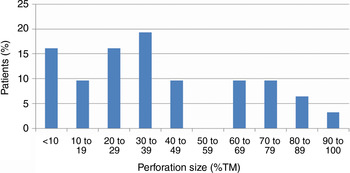
Distribution of pre-operative tympanic membrane perforation sizes. %TM = percentage of total tympanic membrane area

Patients' audiometric parameters for tympanoplasty types 1–4, and overall

Data are expressed in dBHL. Negative hearing threshold changes indicate improvement in hearing. *At 0.5, 1, 2 and 4 kHz. CI = confidence interval; pre-op = pre-operative; ABG = air–bone gap; post-op = post-operative; with post-op BC = air bone gap calculated using the bone conduction threshold obtained at the post-operative audiogram; with pre-op BC = air bone gap calculated using the bone conduction threshold obtained at the pre-operative audiogram; BC = bone conduction; AC = air conduction
In the three patients with grafts that were not intact after 12 months' follow up, pre-operative perforations had been anterior, posterior and subtotal, variously, and had ranged in size from 40 to 80 per cent of the total tympanic membrane area. At operation, all three cases had demonstrated active mucosal disease. Two of these cases had undergone type one tympanoplasty and one had undergone type three tympanoplasty with total ossicular replacement prosthesis. Two cases had small post-operative perforations (<5 per cent), while the third had a perforation involving 10 per cent of the total tympanic membrane area (this patient underwent type one tympanoplasty). At the time of surgery, the latter patient's middle ear and tympanic membrane was very oedematous, and follow up identified persistent mucosal disease.
Discussion
Our audit demonstrated successful use of the above technique across a range of tympanoplasty cases.
Locorten-Vioform ear drops contain polyethylene glycol, a polymer used to produce osmotic pressures in experimental biochemistry. We hypothesise that polyethylene glycol dehydrates the tympanoplasty graft in a controlled fashion by creating an osmotic gradient, thereby stiffening the graft.
Post-operative perforation occurred in three patients. These patients' pre-operative perforations involved 40 to 80 per cent of the tympanic membrane area, in subtotal and anterior locations. These factors may be associated with lower graft success rates.Reference Kotecha, Fowler and Topham4, Reference Lee, Kelly and Mills5 Overall, our tympanoplasty success rate was comparable to or better than other reported results.Reference Kotecha, Fowler and Topham4–Reference Yung6
Our technique has several advantages. It avoids risking mechanical damage during compression. Clioquinol may reduce post-operative infection and flumetasone may reduce the inflammatory response. The graft can remain immersed in the drops if placement is delayed, reducing the risk of extreme desiccation and airborne infection. The need to sterilise a vein press or tongue depressors is avoided. Locorten-Vioform ear drops are readily available and relatively cheap, at £1.76 per 7.5 ml.
We believe that this technique is a viable alternative to established methods of tympanoplasty graft preparation.