


Introduction
In the past few years, the sugarcane industry in Colombia moved toward the production of more efficient alternatives for industrial waste treatment and environmentally friendly. Within this trend, the country has promoted the need to reduce the exploitation of natural resources, promoting changes in the production systems, currently linked to environmental issues and a better use of industrial residues. Adoption of several technologies has raised yields in sugarcane crops; also, soil quality and its function have been maintained and even improved across the years.
Several technological developments applied to the soil and directly to the crops contribute to sustainability, such as soil recovery and continued fertility. Besides, several other factors are included, such as, precision farming, soil conservation techniques, mechanization of agricultural operations, the development of superior varieties, nutrient recycling, new fertilizer sources that are more efficient and cause less impact on the environment, and irrigation techniques.
Sugarcane is a high-yielding crop that requires a significant amount of nutrients since nutrients comprise about 3–5% of its dry matter (25–40 mg ha−1 of dry matter) of which about 60–70% are removed from fields as stalks. Adequate sugarcane fertilization aims to increase crop yields and replenish the nutrients exported by the harvested parts, as well as, to maintain and even raise the nutrient stock across the years and increase the longevity of sugarcane crops (Cortez, Reference Cortez2010; Tarazona, Reference Tarazona2011).
Nutrient recycling, common in the sugarcane industry, is important for rational fertilizer use. Part of the fertilizers used for sugarcane may be replaced with several residues generated in the sugar and alcohol industry such as the filter cake, boiler ash, bagasse and especially vinasse due to its large amounts produced. The solid and liquid waste recycling additional to agricultural practices that avoid burning of sugarcane crops may improve the efficiency in systems for managing nutrients, with economic and environmental benefits. Sugarcane products, especially sucrose and ethanol, consist of carbon, hydrogen and oxygen, so that the mineral nutrients for producing sugarcane can be at least partially recovered and recycled in agriculture (Cortez, Reference Cortez2010).
The composting practice has advanced in the past years as an alternative to the industrial waste treatment in Colombia (Libreros-Salamanca, Reference Libreros-Salamanca2012). The use of compost is mainly due to the rich organic amendment obtained and the highest amounts of beneficial organisms that prevent and help control soil-borne diseases (Pizano, Reference Pizano2001). Consequently, in the Llanos Orientales (eastern) region, composting is an alternative considered by the palm producers or the companies that produce it to solve the problem of using byproducts and returning nutrients to the agroecosystem of the oil palm (Castañeda and Romero, Reference Castañeda and Romero2012). The center of the country (the savannah of Bogotá) uses composting as a solution to large amounts of vegetable waste generated in the flower farms.
The annexed distilleries from the main region of sugarcane production in Colombia, the Cauca River Valley (south-west), are used to process the industrial waste generated from sugar and ethanol production. This region has counted with 24.2 million mg of sugarcane produced in a planted area of 232.070 ha in the year 2015, positioning Colombia as the second largest sugarcane producer in South America after Brazil. The soils of this sugarcane production area are associated with the geomorphology of the region, which is subject to floods, and the dark brown color of the soil reveals a high content of decomposed organic matter. The predominant soils are Mollisols (which have been catalogued among the best in the world) and Vertisols is reported in the region with an average productivity of 120 mg ha−1 of sugarcane (Consorcio CUE, 2012; Quiroz and Perez, Reference Quiroz and Perez2013). In 2016, the ethanol production was of 456 million litters, reaching an average of more than 1.25 million litters of ethanol per day (ASOCAÑA, 2016).
Colombian sugarcane industry expands its production in the Llanos Orientales region due to the favorable climate conditions, a good agricultural practice developed and a significant amount of arable land available for agriculture. This region counts with nearly 2 million ha suitable for sugarcane crops without irrigation, reporting a sugarcane yield between 70 and 100 mg ha−1. In this region, the predominant soil in areas suitable for sugarcane production is the Oxisols, characterized by a thick subsurface layer that contains kaolin-group clay minerals and metal oxides in a finely textured matrix with very few or no easily weathered silicates (Tarazona, Reference Tarazona2011; UPRA, 2017b, 2017a; Rueda Ordoñez et al., Reference Rueda Ordoñez2018).
The current anhydrous ethanol production in the annexed distilleries of Cauca River Valley uses as raw material the final molasses (impure solution of sugars that remains after sucrose crystallization, 60–70%), and a fraction of B molasses (30–40%). In some cases, molasses are not enough and ethanol is produced from a mixture of molasses and a proportion of sugarcane juice (syrup, 2–5%) (Consorcio CUE, 2012; Castañeda-Ayarza and Cortez, Reference Castañeda-Ayarza and Cortez2017). Furthermore, the autonomous distillery of Bioenergy Company (El Alcaraván), Colombia's largest and newest autonomous distillery located in the department of Meta in the region of the Llanos Orientales, produces ethanol from 100% sugarcane juice (BIOENERGY, 2017).
The amount of solid and liquid residues generated from sugar and ethanol production may constitute a serious environmental problem depending on the manner in which it is disposed of. Currently, the industrial composting plants transform the solid and liquid waste into a stable and sanitized product applicable in agriculture as organic fertilizer (compost), improving the medium- and long-term physical, chemical and biological properties of the soil, and also, increases the concentration of nutrients and the biological activity of the soil (Quiroz and Perez, Reference Quiroz and Perez2013). Usually, sugarcane yield responses to the compost go beyond its nutrient value, especially in low fertilized soils, and include greater tolerance of the crop to increased sugarcane longevity and soil pests such as nematodes and termites (Rossetto et al., Reference Rossetto, Dias, Vitti and Cantarella2014).
Vinasse is a liquid residue generated in the distillation of wine, resulting from the fermentation process of the sugarcane juice, molasses or a mix of both, to obtain alcohol. The Ethanol distilleries from the Cauca River Valley produce lower volumes of vinasse, about 1–3 L L−1 of ethanol with 20–50° Brix after the concentration process, in comparison to the Brazilian sugarcane industry (9–14 L L−1 of ethanol with 4–8° Brix without concentration process) (BNDES and CGEE, 2008; Cortez, Reference Cortez2010; ASOCAÑA, 2011; Consorcio CUE, 2012; Moraes et al., Reference Moraes, Junqueira, Pavanello, Cavalett, Mantelatto, Bonomi and Zaiat2014).
The vinasse production and concentration processes are relevant stages of the compost production in the distilleries of Cauca River Valley due to its use in the potassium enrichment of the compost caused by its content of organic matter and nutrients, mainly potassium, nitrogen, phosphorous, calcium, magnesium and micronutrients (Freire and Cortez, Reference Freire and Cortez2000; Quiroz and Perez, Reference Quiroz and Perez2013). Vinasse is a relatively diluted effluent but has basically all the chemical elements present in the sugarcane juice (and in the fermentation additives), plus organic matter. K is the most concentrated nutrient in vinasse (0.6–3 kg m−3 K2O), the content of N is about 0.57–1.2 kg m−3, and 0.1–0.34 kg m−3 of P2O5 (Mutton et al., Reference Mutton, Rossetto, Mutton and Cortez2010; CGEE, 2011).
In Brazil, vinasse is commonly used to fertigate sugarcane (BNDES and CGEE, 2008; Cortez, Reference Cortez2010; CGEE, 2011; Oliveira et al., Reference Oliveira, Dias, Maciel, Eduardo, Cavalett, Eduardo, Rossell and Bonomi2015). Fertigation complies with current Brazilian legislation that bans the discharge of such wastes to rivers, lakes and other water resources (Decree-Law n.303, of February 28, 1967). Moving large volumes of vinasse from ethanol distilleries to the field, however, incurs high transportation costs and contributes a significant increase in greenhouse gas (GHG) emissions due to diesel consumption (Cavalett et al., Reference Cavalett, Chagas, Seabra and Bonomi2013; Moraes et al., Reference Moraes, Junqueira, Pavanello, Cavalett, Mantelatto, Bonomi and Zaiat2014; CETESB, 2015).
The solid waste used in the compost production as the filter cake contributes to the composting process with nutrients and the degradable cellulose material, necessary for the growth of microorganisms. The filter cake is the solid residue from the clarification and filtration process of the sugarcane juice to separate the different materials from the sucrose found in the juice and represents 2.8–4.5% of the total mass of processed sugarcane (Basanta et al., Reference Basanta, Delgado, Martínez, Vázquez and Vázquez2007; Larrahondo, Reference Larrahondo2009). On average, crushed and processed sugarcane per mg produce 30 kg of filter cake (70% moisture). Filter cake presents high amounts of compostable organic matter (>50%), and variable amounts of nutrients, including those from the lime and phosphates, added to help in the clarification process. Usually, phosphorus (0.1–0.2 kg kg−1 P2O5 of dry filter cake) is the nutrient of interest when filter cake is applied to the planting furrow. It also carries other nutrients as well, and its easiness in mineralizing the organic matter decomposition is highly beneficial as a soil conditioner. The application is in dosages ranging from 15 to 35 mg ha−1 (Cortez et al., Reference Cortez, Magalhaes and Happi1992; CGEE, 2011; Rossetto et al., Reference Rossetto, Dias, Vitti and Cantarella2014).
The boiler ash is the solid waste generated during the combustion of bagasse in boilers of the sugarcane mills and added into the compost production. Its nature is vegetable and mineral and is useful as a source of micronutrients, and as a soil pH corrector. The boiler ash contains oxides of most of the cations present in bagasse, plus portions of the N, S and other elements that are partially lost as gases during combustion. The production of ash in the burning of bagasse represents about 2% of the total dry bagasse (Cortez and Gómez, Reference Cortez and Gómez1998; CGEE, 2011; Consorcio CUE, 2012; Cacuro and Waldman, Reference Cacuro and Waldman2015). Moreover, among the solid waste used in the composting process, a fraction (1–5%) of produced bagasse is used to obtain an adequate balance of the C:N ratio, helping to accelerate the decomposition process.
The bagasse is the fibrous matter that remains after sugarcane is stalked and crushed to extract their juice, representing an average of 250 kg mg−1 of sugarcane (50% residual dry matter), and is mainly used as fuel in boilers during the industrial process. The bagasse physically constitutes 45% fibers, 2–3% of non-soluble solids and 48–50% of water (Basanta et al., Reference Basanta, Delgado, Martínez, Vázquez and Vázquez2007; Milanez et al., Reference Milanez, Bonomi, Dayan, Nyko, Valente, Chagas, Rezende, Cavalett, Junqueira and Gouvêia2015). In the Cauca River Valley, from the sugarcane bagasse produced annually, 80–90% is usually mixed with coal and used in the cogeneration (CHP) systems, whereas 10–20% is used as raw material (fiber) to produce paper and agglomerate in the furniture industry (Paredes and Bermúdez, Reference Paredes and Bermúdez2009). The co-firing process of the coal–bagasse mixture is an opportunity to increase the electricity generation in the CHP systems of the sugarcane mills. Also, it has become very important as a measure to solve the problem of shortage of electric power. Between the years of 2015 and 2016, in the El Niño Southern Oscillation (ENSO) and in the dry season, the co-firing of coal–bagasse in the sugarcane mills contributed with 51 MW to the energy grid (Rincón et al., Reference Rincón, Vera, Guevara and Duarte2017).
In Brazilian sugarcane mills, the solid waste generated from the sugar and ethanol production usually returns directly to the field without being composted. The effect of vinasse (applied in the ratoon cultivation areas), and compost (applied in sugarcane planting furrows) in the soil, when applied in non-proper doses, could cause salinization or ion lixiviation problems that may compromise the environment. The average vinasse doses normally used by mills, around 100–200 m3 ha−1 and 5–15 m3 ha−1 of concentrated vinasse, and for the compost doses of 5–20 mg ha−1, have not shown negative saline effects on the soil (Cortez, Reference Cortez2010; Korndorfer et al., Reference Korndorfer, Nolla and Ailton2010; Consorcio CUE, 2012; Páez-Ortegón, Reference Páez-Ortegón2012).
The impacts due to the use of vinasse and compost in the soil were not considered in this study, and the sugarcane yield was assumed accordingly to the average productivity of each selected production region in Colombia. It is important to highlight that there is no specific legislation for the vinasse treatment and its use in the country. However, the Regional Autonomous Corporation of Cauca Valley (CVC) in the Resolution 6 300 081 of the year 2012 regulates the use, handling, application and storage of the vinasse, and its derived products as compost.
Taken into consideration the relevant differences between the Colombian and the Brazilian industrial waste treatment in the sugarcane production sector, the present study assessed six alternatives of sugarcane mills for ethanol production in two different productive regions. Two scenarios were considered to represent the annexed distillery of the current agricultural and industrial processes in the Cauca River Valley. Moreover, two sugarcane mills corresponding to the models of annexed distilleries in the Cauca River Valley were selected, but considering the agricultural practices from the Llanos Orientales region. Finally, two autonomous distilleries were proposed for the expansion region of the Llanos Orientales. As part of the comparison process, the scenarios were proposed accordingly to the current technology used in the ethanol production in Colombia, and the vinasse treatment and the compost production and application in the agricultural practice of sugarcane production.
This study aims to evaluate and compare the economic benefits and the GHG emissions related to the sugarcane production system in the Cauca River Valley and the Llanos Orientales region, which has been simulated in this study to evaluate the effects of beneficial reuse of industrial waste from ethanol production, taking into account the calculation of NPK fertilizer value of waste, vinasse treatment, compost production and application, and agricultural practices adopted in the selected scenarios. The improvement of nutrient recycling in the sugar and ethanol industry is a growing area of interest and relevant to the understanding of how fertilizer management practices influence sustainable sugarcane production in the Colombian biorefineries.
This study highlights the importance of research, development and updating of industrial waste treatment technologies in the sugar and ethanol industry. The agronomic management of industrial sugarcane byproducts (i.e., vinasse, filter cake, ashes and bagasse) has a major impact on the overall economic and environmental effects of sugarcane products (i.e., sugar, ethanol and electricity). Improving on-farm production practices is important to develop sustainable agricultural and industrial systems. Finally, the results of this research would be helpful to the entrepreneurs and policymakers by evaluating the importance of the industrial waste as a source of raw material for the recycling and production of organic fertilizer for the agricultural use, becoming an important contribution to the value chain.
Methodology
The ethanol industry in Colombia has an integrated production chain from the sugarcane cultivation to the industrial waste treatment resulting in an improvement in the economic benefits of the sugarcane production (Consorcio CUE, 2012). This study was performed using the Virtual Sugarcane Biorefinery (VSB) developed by the Brazilian Bioethanol Science and Technology Laboratory (CTBE) (Oliveira et al., Reference Oliveira, Dias, Maciel, Eduardo, Cavalett, Eduardo, Rossell and Bonomi2015; Bonomi et al., Reference Bonomi, Cavalett, Da Cunha and Lima2016). The VSB is a structure that comprises computer simulation platforms with computational tools for economic, social and environmental evaluation. The VSB can represent different sugarcane biorefinery routes and alternatives comprising all the stages of the sugarcane chain: agricultural, transport, industrial process and management of products disposal. An important feature of the VSB is its flexibility since it is possible to adjust several parameters depending on the type of bioenergy chain scenario.
The agricultural and industrial simulations of this study were based on Brazilian sugarcane mills, where the necessary adaptations were carried on to better represent the current conditions of the sugarcane and ethanol production and the usual industrial waste treatment in Colombia. Also, the considered technical, economic and environmental parameters were adjusted to the VSB. Within this context, appropriate analyzing tools and design methods of simulation cases can be used to properly assess the sustainable line, which assembles economic, social and environmental performance metrics. VSB is a reliable tool to assess the sustainability's triple bottom line as shown in numerous study cases along the past few years (Bohórquez et al., Reference Bohórquez, Puentes and Menjivar2014; Chagas et al., Reference Chagas2015; Pereira et al., Reference Pereira, Dias, MacLean and Bonomi2015; Rueda Ordoñez et al., Reference Rueda Ordoñez2018; among others). Data used in the elaboration of the life cycle inventory (LCI) referring to the production of sugarcane, compost, sugar, ethanol and electricity cogeneration were obtained through direct communications with professionals from the sugarcane industry (the Manager of Factory Process Program in CENICAÑA, Nicolas Javier Gil Zapata; the Agronomist from BIOENERGY, Robinse Eduardo Acevedo Arias; and the Professional in the Research Centre La Libertad-CORPOICA, Julio Jairo Becerra Campiño). Moreover, the literature information reported by the Colombian Association of Sugarcane Technicians (TECNICAÑA), the Colombian Sugarcane Research Center (CENICAÑA), the Colombian Association of Sugarcane Growers (ASOCAÑA), the Colombian Agricultural Institute (ICA) and other institutions linked to the sugar and ethanol industry in Colombia was considered.
The current ethanol industry in the Cauca River Valley and the Llanos Orientales region was the foundation to represent the evaluated scenarios. The selected scenarios were based on two first-generation sugarcane facilities, including both autonomous and annexed distilleries. Table 1 presents the selected scenarios and the basic agricultural parameters considered in this study to represent the sugarcane production in Colombia, and Table 2 presents the industrial parameters considered in this study to represent the industrial process and the main products obtained in the simulated biorefineries.
Main agricultural parameters considered to represent the sugarcane mills in Colombia

The fraction value (%) corresponds to the area where operations are used.
Main industrial parameters considered to represent the sugarcane mills in Colombia

The first selected scenario (S1) corresponds to an annexed distillery based on the current agricultural and industrial process in the Cauca River Valley. In the agricultural stage for S1, the production and harvesting operation was considered to run all year round (330 days). The irrigation process was assumed through the open channel irrigation system and water consumption of approximately 1500 m3 ha−1 that was carried out five times per year. The irrigation area represents 95% of the total area, and the water used was 50% surface water, and 50% groundwater. Moreover, the manual harvesting index of 49% was considered with the previous burning of sugarcane straw, and a mechanical harvesting of 51%. The ethanol production was simulated using molasses as raw material, and also the vinasse concentration process was considered, with vinasse reaching a 45° Brix according to Consorcio CUE (2012).
Two distilleries in the Llanos Orientales region were considered, the scenario 2 (S2) corresponds to an annexed distillery based on the current industrial process in the Cauca River Valley (ethanol production from molasses, and concentration of vinasse reaching 45° Brix) but taking into consideration the agricultural practices of the Llanos Orientales region (without irrigation process and straw burning before the harvest process, and others), allowing the direct comparison between the sugar and ethanol production in each region using the same technology. Furthermore, scenario 3 (S3) corresponds to an autonomous distillery representing current sugarcane and ethanol production in the Llanos Orientales region (http://www.bioenergy.com.co/SitePages/Home.aspx). For the simulated scenarios in the Llanos Orientales region, the operation period of the mill of 240 days per year was estimated, with fully mechanized harvesting operation without previous burning of sugarcane straw, and the non-use of an irrigation system. The ethanol production was simulated using sugarcane juice as raw material, and the vinasse concentration process was considered, with vinasse reaching a 30° Brix (BIOENERGY, 2015).
As part of the comparison process, the same scenarios without the vinasse treatment and the compost production (S1A, S2A and S3A) were assessed. In these scenarios were assumed a return of the industrial waste (filter cake, ash and vinasse) directly to the sugarcane field without being composted. Data in Table 3 show the main agricultural operations such as fertilizer application, planting process, harvesting process and others.
Mechanized agricultural operations in the sugarcane production system

Regarding the vinasse treatment and the compost produced in the sugarcane mills in Colombia, those were simulated assuming the process of the Ingenio Providencia S.A (http://www.ingprovidencia.com/es/), located in the Cauca River Valley region (Libreros-Salamanca, Reference Libreros-Salamanca2012; Ingenio Providencia, 2016).
The agricultural stage simulation
The feedstock production system, considering the sugarcane management in different scenarios, was modeled using CanaSoft model, included in the VSB. This model is based on interconnected spreadsheets and integrates several calculation modules and databases. It is based on the definition of the main parameters that characterize a sugarcane production system (e.g., yield, operational efficiencies, pre-planting operations, harvesting systems, fertilizer doses, mechanical operations and transport distances, among other factors). These parameters are considered for the LCI calculation and for the economic assessment. Both economic and inventory calculations are linked to an agricultural database which involves the information about all agricultural operations used in sugarcane production such as agricultural performance parameters, types of harvesters, tractor and implements, as well as their weight, costs, diesel consumption, annual use, lifespan and depreciation, among other parameters. The composition of the different types of sugarcane that were used in this study was accordingly to the information given for each region. For the Cauca River Valley was considered a composition of: water (70.3%), sucrose (14%), reducing sugars (0.6%), fibers of 13.2% (corresponding to a cellulose content of 6.2%, hemicellulose 3.7% and lignin 3.3%) and other compounds such as organic acids and minerals (2.1%) (CENICAÑA, 2014, 2015). Moreover, for the Llanos Orientales region, the sugarcane composition was: water (72%), sucrose (14.8%), reducing sugars (0.6%), fibers of 11.5% (corresponding to a cellulose content of 5.4%, hemicellulose 3.2% and lignin 2.9%) and others as organic acids and minerals (1.1%).
The composition of the bagasse used in the compost production model corresponds to a water content of 47.9%, sucrose (1.1%), reducing sugars (0.1%), fibers (a total of 49.1%, corresponding to a cellulose content of 26.4%, hemicellulose 13.9% and lignin 12.5%) and other compounds such as organic acids and minerals (1.2%) (Milanez et al., Reference Milanez, Bonomi, Dayan, Nyko, Valente, Chagas, Rezende, Cavalett, Junqueira and Gouvêia2015).
The industrial stage simulation
Regarding the industrial conversion phase, mass and energy balances, the industrial configurations were obtained through computer simulations of the industrial scenarios using the Aspen Plus® software included in the VSB (Oliveira et al., Reference Oliveira, Dias, Maciel, Eduardo, Cavalett, Eduardo, Rossell and Bonomi2015; Bonomi et al., Reference Bonomi, Cavalett, Da Cunha and Lima2016).
In the industrial simulation process, the updated operational and process parameters of the annexed plants and autonomous distilleries in Colombia were considered. The calculated mass and energy balances helped in modeling the industrial LCI, including the identification of the main products (sugar, ethanol and electricity), as well as the most significant industrial byproducts (bagasse, filter cake, vinasse and boiler ash) and the GHG emissions. The selected scenarios in this study are based on the industrial process described in Figure 1, which presents the process flowsheet related to the current ethanol production in the sugarcane mills of Cauca River Valley (S1, S1A, S2 and S2A). Furthermore, Figure 2 shows the process flowsheet used in the industrial simulation of the autonomous distillery, related to the current process in the Llanos Orientales region (S3 and S3A).

Process flowchart for the current autonomous distillery in the Llanos Orientales region: ethanol (blue), cogeneration system (black) and waste treatment unit (red) (BIOENERGY, 2015).

In the industrial simulation process of S1, S1A, S2 and S2A (Fig. 1), the vinasse reached a solid concentration of about 8–20° Brix, and 60% of the total produced is re-circulated to the fermentation process to help dilute the raw material and save water. The remaining 40% of the produced vinasse is concentrated by evaporation in Flubex concentration units connected in series, which are systems, composed of vertical shell-and-tube heat exchangers, where the vinasse reaches the concentration of 45° Brix (Larrahondo, Reference Larrahondo2009; Korndorfer et al., Reference Korndorfer, Nolla and Ailton2010; Páez-Ortegón, Reference Páez-Ortegón2012).
The co-firing of a coal–bagasse mixture in the co-generation system was assumed since it is a characteristic process used to increase the electricity production in the dry season of the Cauca River Valley region. The inclusion of the co-firing of coal and bagasse mixture in the CHP system in this study accurately represents the current industrial process of the sugarcane mills in the Cauca River Valley (S1 and S1A). In the simulated mills in the Llanos Orientales region (S2, S2A, S3 and S3A), the use of coal was not included in the model due to the absence of the paper industry in the region that may represent a possibility to sale bagasse or coal exchange, as is usual in the mills of the Cauca River Valley.
The compost production system and the evaluated scenarios
The data shown in Table 4 correspond to the average concentration estimates for primary macronutrients (NPK) content in the vinasse used in the agricultural model, validated by comparison with values from García and Rojas (Reference García and Rojas2005); Peña (Reference Peña2009); Zúñiga Cerón and Gandini Ayerbe (Reference Zúñiga Cerón and Gandini Ayerbe2013); and Moore et al. (Reference Moore, Nogueira and Kulay2017). The compost production model was adapted to the amount of filter cake, vinasse, bagasse and the boiler ash according to the industrial outputs of the evaluated scenarios as is presented in Table 5. Moreover, it shows the amount of industrial waste that returns to the field without being composted in each scenario.
Nutrient (NPK) contents in vinasse produced by the selected scenario

S1 (45° Brix); S1A (12° Brix); S2 (45° Brix); S2A (12° Brix); S3 (30° Brix); S3A (5° Brix).
R1 (5° Brix) (Moore et al., Reference Moore, Nogueira and Kulay2017); R2 (10° Brix); R3 (50° Brix) (García and Rojas, Reference García and Rojas2005).
Industrial waste production (wet basis) and the inputs used in the compost production model for each evaluated scenario

The results obtained through the simulated scenarios present values of industrial waste produced similarly to the average production of sugarcane mills in the Cauca River Valley, validated with reference data from Consorcio CUE (2012) (compost production of 30–60 kg mg−1 of sugarcane, filter cake production of 30–35 kg mg−1 of sugarcane, concentrated vinasse production of 18–70 kg mg−1 of sugarcane).
The composition of the compost model used in the evaluated scenarios (S1, S2 and S3) was of 30% of moisture, total N of 1%, P2O5 of 1.3%, K2O of 2.2%, CaO of 3.5%, C/N (carbon/nitrogen ratio) of 15%, O.M. (organic matter) of 26% (Libreros-Salamanca, Reference Libreros-Salamanca2012; Molina et al., Reference Molina, Victoria and Saa2012). Figure 3 shows the vinasse treatment and the compost production that occurs in the S1 representing the industrial waste treatment in the sugarcane mill of the Cauca River Valley.
Flowsheet representing the industrial waste used in the compost production modeled for the mills in the Cauca River Valley (outputs from S1).

Economic benefits related to the compost production and use in the Colombian sugarcane industry
Production of anhydrous ethanol, sugar, electricity, byproducts and GHG emissions was obtained for each scenario based on the results of computer simulations of the industrial process using the Aspen Plus® software included in the VSB. Sugarcane total production cost for the several evaluated scenarios was calculated using the economic module of CanaSoft model in the VSB framework.
The economic assessment was based on a cash-flow analysis for each scenario, taking into account the investment and all expenses and revenues that came from technical parameters obtained through the simulation of the industrial process (mass and energy balances), and from historical data observed over recent decades for sugar, ethanol and electricity production cost, and market prices. To compare the economic viability of the scenarios, the internal rate of return (IRR) and net present value (NPV) were calculated to analyze their economic performance. The VSB usually allocates the total cost and its elements among the biorefinery products according to their share in the total revenues. This approach is necessary to determine the cost breakdown of ethanol, sugar and electricity production.
Results of economic assessment in the compost production and use were defined in terms of the fertilizer costs, transport of vinasse and benefits of compost use. Concerning the biomass costs, this study considered the concept of a vertically integrated model. In the VSB, this definition means that the biomass cost, which is an output of CanaSoft model, is considered as an input to the industrial cash flow analysis. It is worth to mention that, in this case, the agricultural system is fully integrated to the industrial scenarios, i.e., biomass production costs are directly affected by the industrial scenarios since they consider parameters such as the average distance between farm and industry, or even the influence of industrial residues (vinasse, filter cake, boiler ash and compost) that are recycled to the sugarcane field, thus decreasing the expenses with fertilizer, i.e., on the biomass production cost. For the economic assessment, the agricultural and the industrial dataset of the evaluated scenarios was calculated using 1 mg of processed sugarcane as the functional unit. Furthermore, the lifetime of the industrial plant includes 2 yr of construction and start-up in addition to 25 yr of full production capacity (project lifetime). This was considered, and the value of the plant at the end of the project was assumed to be zero. The sugar, ethanol and electricity market prices were assumed to be US$0.44 kg−1 of sugar (Moncada et al., Reference Moncada, El-Halwagi and Cardona2013), US$0.85 L−1 of ethanol (FEDEBIOCOMBUCTIBLES, 2017) and US$50.9 MWh−1 of electricity (XM 2015). The land cost considered was accordingly to the average land cost in Colombia of US$450 ha−1 taking an average historical data from 2006 to 2014. The minimum attractive rate of return (MARR) was 15.3% calculated through the Capital Asset Pricing Model (CAPM) (Sánchez, Reference Sánchez2010; Damodaran, Reference Damodaran2012). The exchange rate was calculated as COP/US$ = 2049.3; R$/US$ = 2.65. The period of historical data to calculate the product prices was considered from 2006 to 2014. The total production costs are obtained by summing operating and capital expenses. In the case of ethanol production, the cost per liter would be the yearly total cost divided by the number of liters of ethanol produced over the year.
Environmental impacts related to the compost production and use in the Colombian sugarcane industry
Life Cycle Assessment (LCA) methodology has been widely applied to evaluate the environmental aspects of sugarcane biorefineries, and used in this study in the evaluation of GHG emissions associated with sugarcane industry in Colombia. The LCA is a well-known method for determining the environmental impact of a product, process or activity, by the identification and quantification of energy and materials that have been used and the waste released during its entire life cycle (ISO, 1998). According to LCA methodology, the allocation is required for multi-output processes. In this study, the criteria used for the different outputs of the industrial process were the economic allocation among the biorefinery products according to their share in the total revenues. The development of this study is a ‘cradle to gate’ analysis with the functional unit being a liter of anhydrous ethanol, covering a broad range of environmental aspects from GHG emissions. It evaluates all resources used and emissions (to the air, soil and water) from the extraction of raw materials to manufacturing, logistics and final products.
The parameters used in the simulations and the calculated mass and energy balances helped in modeling the LCI of the agricultural and industrial stage. The LCI of feedstock production system was modeled with CanaSoft model, and the industrial conversion phase was obtained using the Aspen Plus®. Background process data (e.g., fertilizers, diesel and agrochemicals, production processes) were based on Ecoinvent version 2.2 database and its modifications at the VSB life cycle inventories databank, adjusted to better represent the Colombian conditions (Chagas et al., Reference Chagas2015; Rueda Ordoñez et al., Reference Rueda Ordoñez2018). The use of resources and the emissions was translated into environmental impacts using the ReCiPe Midpoint Impact Assessment method (Goedkoop et al., Reference Goedkoop, Heijungs, Huijbregts, Schryver, Struijs and Zelm2009) in the VSB framework to assess the impacts in terms of GHG emissions measured in kg of CO2eq.
The environmental analysis considered the gaseous emissions generated in the compost production process, calculated according to Pipatti et al. (Reference Pipatti, Silva, Joao, Gao, López, Mareckova, Oonk, Scheehle, Sharma, Smith, Svardal and Yamada2006) methodology. Where M is the compost mass, and FE is the emission factor [4 g CH4 biogenic per kg of compost (wet basis) and 0.24 N2O kg−1 of compost (wet basis)], according to Equations 1 and 2:
 $${\rm Emission}\;{\rm of}\;{\rm C}{\rm H}_4 = M \times {\rm FE} \times 10^{-3} [{{\rm kg}\,{\rm of}\,{\rm C}{\rm H}_4}] $$
 $${\rm Emission}\,{\rm of}\,{\rm N}_2{\rm O} = M \times {\rm FE} \times 10^{-3} [{{\rm kg}\;{\rm of}\;{\rm N}_{\rm 2}{\rm O}}] $$
It is worthwhile to mention that important differences in the agricultural process for the different sugarcane biorefinery alternatives were considered in this study because of the different amounts of residues (vinasse, boiler ash, filter cake and compost) returned to the field in each scenario and, consequently, different rates of fertilizer application, agricultural operations and soil emissions were observed.
Results and discussions
The approach considered for the economic analysis of the compost production model was based on the cost assessment for the use of NPK fertilizer in the selected scenarios. The economic assessment takes into account the comparison of fertilizer doses, mechanical operations and transport distances, among other factors. The assessment was between the scenarios with compost application (S1, S2, S3) and the scenarios without compost process of the industrial waste and therefore disposed directly in the field (S1A, S2A and S3A). It is important to highlight that the compost production was not considered in the scenarios without the vinasse concentration process, becoming important the analysis of agricultural cost and benefits related to the compost application in the sugarcane field. Table 6 details the main economic outputs among the evaluated scenarios in the Cauca River Valley and the Llanos Orientales region, beginning with the technical and economic assessment of the agricultural stage of sugarcane production and transport to the mill, followed by the economic evaluation of the industrial production (sugar, ethanol and electricity). Finally, the results, referring to the IRR and the NPV of the selected scenarios, are presented.
Summary of the economic result from selected scenarios in the Cauca River Valley and the Llanos Orientales region

The simulated sugarcane cost of S1, representing current production of an annexed distillery in the Cauca River Valley, is similar to the sugarcane cost per hectare reported in the literature of US$2248 (COLOMBIA.MINAGRICULTURA, 2014).
The economic assessment related to the sugarcane production revealed that the higher sugarcane production cost is related to the scenarios without the use of compost, corresponding to US$18.9 mg−1 of sugarcane calculated in S1A, S2A (US$22.3 mg−1 of sugarcane) and S3A (US$23.0 mg−1 of sugarcane), and are associated with a higher cost of the NPK fertilizers. S1, S2 and S3 present a lower use of mineral NPK fertilizers in the planting and the ratoon areas, and lower fertilizer cost, due to the amount of compost and concentrated vinasse that returns to the field compared with S1A, S2A and S3A. Not using the compost may have a significant effect on the NPK fertilizer cost with an increase of as much as 38.3% for SA1, 8.9% for S2A and 10.4% for S3A. The benefits for the compost application could be for S1 of US$0.6 million per year, for S2 of US$0.4 million per year and for S3 of US$0.3 million per year. Furthermore, the vinasse concentration process contributes to a decrease in the transport cost of returning the vinasse to the sugarcane field. With the results obtained from the simulated scenarios, it is possible to show that the application of concentrated vinasse and compost in the sugarcane field can contribute to decreasing the sugarcane production cost in about 2.0% in S1 compared with S1A, 1.5% in S2 compared with S2A and 5.0% in S3 compared with S3A.
S1 presents the lower result of fertilizer cost of US$37.6 ha−1 followed by S1A (US$60.9 ha−1). These scenarios (simulated in the Cauca River Valley) present a total crop area of 33% less (25 424 ha) than in the evaluated scenarios in the Llanos Orientales region (S2, S2A, S3, S3A). The difference in the areas is due to the sugarcane productivity in the Cauca River Valley assumed as 120 mg ha−1 in comparison with 80 mg ha−1 considered for the proposed scenarios of the Llanos Orientales. The scenario S3A presents the highest sugarcane cost (US$23.0 mg−1 of sugarcane) mainly due to a higher cost of the transport operations, as is the case of the vinasse transport (US$31.0 ha−1 yr−1). In the S3A (Autonomous distillery), the vinasse concentration process was not considered, producing 722.2 kg mg−1 of sugarcane of vinasse. The concentration process decreases the amount of vinasse to be harnessed in comparison with the production of vinasse. The S3 produces the same amount of vinasse than S3A, and after the concentration process, the amount of vinasse decreases to 50.4 kg mg−1 of sugarcane. The steam from the concentration unit is recycled (195.1 kg mg−1 of sugarcane), and the condensates are sent to the wastewater treatment (476.6 kg mg−1 of sugarcane).
For the evaluated distilleries in the Cauca River Valley and the Llanos Orientales region, the agricultural operations (machinery, maintenance and diesel cost) and the land cost correspond to more than 60% of sugarcane production cost for the evaluated scenarios. For the S1 and S1A, the irrigation process corresponds to 15% of the sugarcane cost.
In the output analysis of the evaluated annexed distilleries (S1, S1A, S2 and S2A), it is possible to observe that the sugar production of 26.6 (S1 and S1A) and 24.2 kg mg−1 of sugarcane (S2 and S2A) corresponds to the industrial average sugar production in the region of 70–93 kg mg−1 of sugarcane (Consorcio CUE, 2012). The ethanol production of 26.6 L mg−1 of sugarcane in S1 and S1A, and 24.2 L mg−1 of sugarcane in S2 and S2A corresponds to the average production in the region, of 15–22 L mg−1 of sugarcane. The electricity production per mg of sugarcane obtained for S1, S1A, S2 and S2A (51.0, 54.1, 41.4 and 44.0 kWh mg−1 of sugarcane) corresponds to the industrial average production in this region (24–70 kWh mg−1 of sugarcane). The differences in electricity production are mainly due to the steam used in the vinasse concentration process that decreases the amount of energy sold to the grid. The industrial production in the autonomous distillery, represented by S3 and S3A, presents values that correspond to the average values for the production in this region, of 87.5 L mg−1 of sugarcane and 40–80 kWh mg−1 of sugarcane, respectively (BIOENERGY, 2015). Furthermore, the results of the industrial production obtained from the evaluated scenarios correspond to the values reported for the sugarcane production in Brazil (PECEGE, 2016).
The economic assessment carried out for the annexed distilleries (S1, S1A, S2 and S2A) shows that the scenarios with compost and concentrated vinasse returning to the field are related to the higher IRR of 24.3% and NPV of US$181.5 million per year calculated for S1, and for S2 an IRR of 20.7% and NPV US$121.7 million per year compared with its counterpart, the scenarios without the compost and concentrated vinasse application (S1A and S2A). The IRR calculated was lower than the reported by Quintero et al. (Reference Quintero, Montoya, Sánchez, Giraldo and Cardona2008) of 28% for the sugarcane mill in the Cauca River Valley.
S1 and S2 have the highest IRR and NPV mainly due to the lower sugarcane production cost and the lower capital expenditures. It is important to point out that the calculated capital expenditures in S1A, S2A and S3A do not assume the investment in the vinasse concentration system (S1 of US$0.8 million, S2 of US$1.4 million and S3 of US$9.2 million) and the composting plant (assumed as US$2.7 million for S1, S2 and S3). S1 and S1A are related to lower sugar production cost (US$0.32 kg−1) and ethanol production cost (US$0.62 L−1) mainly due to the lower production cost of raw material, and the high sugarcane yield considered in the scenario configuration.
The results of the economic assessment for the autonomous distilleries (S3 and S3A) show that S3 is related to the highest IRR of 22.5% per year and a positive NPV of approximately US$120.2 million, mainly due to the lower capital expenditures and the lower sugarcane production cost compared with S3A.
Regarding the environmental impact assessment related to the GHG emissions of the sugarcane production, industrial production (sugar, ethanol and electricity) and byproducts treatment in evaluated annexed plants (S1, S1A, S2 and S2A) and autonomous distilleries (S3 and S3A) were assessed using a cradle to gate LCA. Sugarcane production impacts are mainly related to fertilizer use, diesel consumption in agricultural operations, sugarcane transport, industrial waste treatment and transport to the field, and pre-harvesting sugarcane burning (considered only in the S1 and S1A).
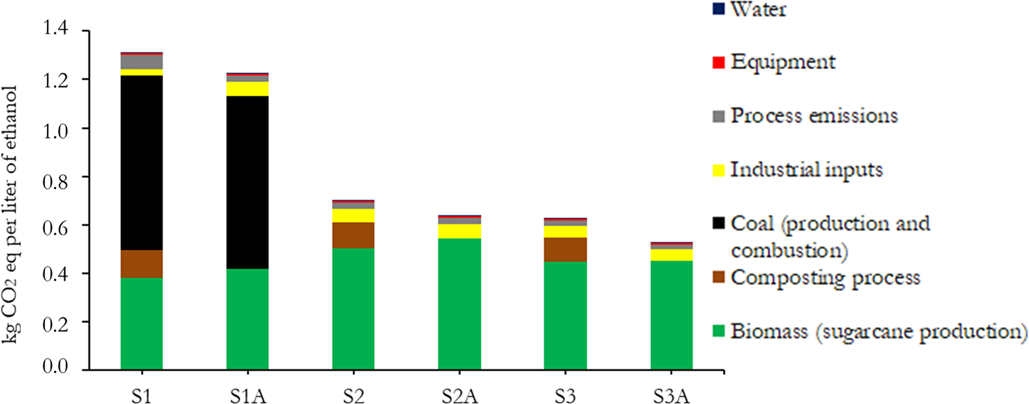
The results of GHG emissions from the sugarcane production and processing, use of vinasse and production and application of compost simulated in the evaluated scenarios correspond to the average GHG emission reported for the sugarcane industry in Colombia. For the scenarios with compost application (S1, S2 and S3), the GHG emissions related to the sugarcane production shows about 5% higher emissions than its counterpart (the scenarios without compost application: S1A, S2A and S3A), for most of the GHG emissions considered in Table 7 (measured in kgCO2eq kg−1 sugarcane) and presented in Figure 4 (measured in kgCO2eq L−1 ethanol) for the evaluated scenarios in the Cauca River Valley and the Llanos Orientales. The GHG emission by the use of mineral and organic fertilizers simulated in the evaluated scenarios of 0.012–0.03 kgCO2eq kg−1 sugarcane corresponding to the average GHG emission reported for the sugarcane production in Colombia of 0.008–0.025 kgCO2eq kg−1 sugarcane (Buitrago and Belalcázar, Reference Buitrago and Belalcázar2013). The coal combustion in the boiler, in S1 and S1A, generates about 0.6 kgCO2eq L−1 ethanol, more than 55% in S1 and 58% in S1A of the total GHG emissions for the production and consumption of coal (16.1 kg mg−1 of sugarcane), whereas the burning of bagasse corresponds to only 5% of S1 and 2% of S1A. The generated emissions from the compost production model in S1, S2 and S3 were about 0.1 kgCO2eq and were due to the CH4 biogenic and the calculated N2O, representing 9% of the total GHG emissions calculated for S1, 15% for S2 and 16% for S3. The same scenarios without the compost production have the possibility of decreasing the emissions to 10, 16 and 19%, for S1A, S2A and S3A.
Selected life cycle inventory parameters for the sugarcane production (values in kg−1 sugarcane), and sugarcane processing (values in L−1 ethanol) simulated in the evaluated scenarios

Comparison of GHG emissions from the sugarcane production, industrial process and waste treatment, in the evaluated scenarios.

Conclusions
The economic assessment of the evaluated scenarios shows that all of them (S1, S1A, S2, S2A, S3 and S3A) are profitable and attractive project alternatives. The economic output of the evaluated scenarios shows the IRR results between 20 and 24%, higher values than the calculated MARR of 15.30%. Besides, the NPV values for the evaluated scenarios were higher than zero. The results could encourage the entrepreneurs of the sugarcane sector to increase the investment in the sustainable sugarcane expansion in new agricultural areas and contribute to the expansion of ethanol production.
The economic assessment related to the sugarcane production revealed that the higher sugarcane production cost is related to the scenarios without the use of compost (S1A, S2A and S3A) and are associated with the higher cost of the NPK fertilizers. S1, S2 and S3 present the lower use of mineral NPK fertilizers in the planting and the ratoon areas, and lower (NPK) fertilizer cost, due to the amount of compost and concentrated vinasse returned to the field. Not using the compost may have a significant effect on the NPK fertilizer cost with an increase of as much as 8.9–38.3%. The benefits for the compost application could be of US$0.3 million to US$0.6 million per year. Furthermore, the vinasse concentration process contributes to decreasing the transport cost of returning the vinasse to the sugarcane field. With the obtained results of the simulated scenarios, it is possible to show that the application of concentrated vinasse and compost in the sugarcane field contributes to decreasing the sugarcane production cost to about 2.0–5.0%.
The economic result of S1 and S1A shows positive economic advantages, such as the lower capital investment when compared with the models considered for the Llanos Orientales region. The lower sugarcane production cost calculated for the S1 corresponds to the higher sugarcane yield assumed for the region in this study, and the lower application of NPK fertilizers due to the compost and concentrated vinasse application. S2 and S2A show the worst economic outputs, mainly due to the lower sugarcane yield considered for the region, and the highest capital investment among the scenarios. Between the evaluated autonomous distilleries, S3 shows a positive economic advantage due to the lower sugarcane production cost compared with S3A.
Regarding compost and vinasse use as fertilizer and soil conditioner, GHG emissions from the biogenic origin are not included as a reported item in the matrix of GHG emissions of the sugarcane sector. The generated emissions from the compost production model were calculated in about 0.1 kgCO2eq, mainly due to the emissions of CH4 and the N2O, and represents 9–16% of the total GHG emissions calculated for S1, S2 and S3. The scenarios without the compost production have the possibility of decreasing the emissions from 10 to 20%. The reduction of GHG should be addressed as a relevant priority and hence ways should be found to address alternative forms of industrial waste processing.
The concentrated vinasse used in the compost production does not exceed 30% of the total amount produced; the other 70% (disposed in the field without treatment) could better contribute to the value chain. Instead it is important to evaluate other alternatives of vinasse treatment besides vinasse recirculation and concentration, as is the case of assessing the economic and environmental impacts of new alternatives, such as the vinasse methanation that can be followed up and discussed for better exploitation of concentrated vinasse.
Author ORCIDs
Diego Andrés Rueda-Ordoñez, 0000-0002-4279-3868.
Acknowledgements
We thank the financial support from CAPES (Coordenação de Aperfeiçoamento de Pessoal de Nível Superior) and the Brazilian Center for Research in Energy and Materials (CNPEM). Also, we are very grateful to FAPESP/BIOEN (project contract grant number 2012/00282-3—Bioenergy contribution of Latin America, Caribbean and Africa to the GSB project—LACAf-Cane I).