1. INTRODUCTION
High-order harmonic generation from relativistically intense laser pulses interacting with solid targets has been identified as a promising way to generate bright ultra-short burst of X-rays: (Nakamura et al., Reference Nakamura, Koga, Esirkepov, Kando, Korn and Bulanov2012; Ledingham & Galster, Reference Ledingham and Galster2010; Bulanov et al., Reference Bulanov, Bychenkov, Krushelnick, Maksimchuk, Popov and Rozmus2010; Esirkepov et al., Reference Esirkepov, Bulanov, Kando, Pirozhkov and Zhidkov2009; Galy et al., Reference Galy, Maucec, Hamilton, Edwards and Magill2007). In the “overdense” region where the electron density n e greatly exceeds the critical or cut-off density n c the linear refractive index of the plasma 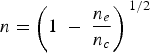 $n = \left({1\; - \; \displaystyle{{n_e } \over {n_c }}} \right)^{\; {1 / 2}}$ has imaginary values and the laser pulse cannot propagate. All the laser-plasma interactions occur either in the “underdense” region where n e < n c or near the critical surface at which n e ≅ n c. Relativistic effects make the refractive index non-linear
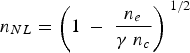 $n_{NL} = \left({1\; - \; \displaystyle{{n_e } \over {{\rm \gamma} \; n_c }}} \right)^{\; {1 / 2}}$, where the relativistic factor γ is given by
 ${\rm \gamma} \; = \; \sqrt {1\; + \; \; \left\langle {a^2 } \right\rangle } \quad = \; \; \sqrt {\; 1\; + \; a_0^2 \; /\; 2}\comma$a = eA/m ec 2 is the normalized vector potential, and the angular bracket denotes an average over the oscillation period. The parameter a 0 is the commonly used dimensionless amplitude related to the laser intensity I by
 $$a_0 \; = \; \; 0.85\; \left({\displaystyle{{I\; {\rm \lambda} _{{\rm \mu} \; m}^2 } \over {10^{18} \; W\; cm^{ - 2} }}} \right)^{1/2}.$$
Extreme laser pressure at high intensities is given by the expression P L = 2I = 6 G bar at 1019 W cm− 2. When a high-power relativistically intense laser pulse interacts with a very thin slab of dense plasma, it leads to a variety of non-linear phenomena such as the relativistic self-focusing (Litvak, Reference Litvak1970; Max et al., Reference Max, Arons and Langdon1974; Monot et al., Reference Monot, Auguste, Gibbon, Jakober and Mainfray1995); relativistic transparency (Kaw & Dawson, Reference Kaw and Dawson1970); non-linear Thomson scattering (Chen et al., Reference Chen, Maksimchuk and Umstadter1998), generation of ultra-short pulses during the reflection from “Flying Mirror ” (Bulanov et al., Reference Bulanov, Esirkepov and Tajima2003), production of ion beams (Pegoraro et al., Reference Pegoraro, Bulanov, Califano, Esirkepov, Lisekina, Naumova, Rhul and Vshivkov2000; Reference Pegoraro, Atzeni, Borghest, Bulanov, Esirkepov, Honrubia, Kato, Khoroshkov, Nishihara, Tajima, Temporal and Willi2004), relativistic harmonic generation (Bulanov et al., Reference Bulanov, Naumova and Pegoraro1994; Linde et al., Reference Von der Linde, Engers, Jenke, Agostini, Grillon, Nibbering, Mysyrowicz and Antonetti1995; Baeva et al., Reference Baeva, Gordienko and Pukhov2006; Zepf et al., Reference Zepf, Dromey, Kar, Bellei, Carroll, Clarke, Green, Kneip and McKenna2007), Relativistic plasma control for single attosecond pulse generation (Baeva et al., Reference Baeva, Gordienko and Pukhov2007), so on.
The interaction of laser pulse with an overdense plasma, ω ≪ ωp, depends on the laser pulse amplitude, the plasma density, and the scale length of the plasma non-uniformity and can be explained with (1) the oscillating mirror model (Bulanov et al., Reference Bulanov, Naumova and Pegoraro1994; Linde et al., Reference Von der Linde, Engers, Jenke, Agostini, Grillon, Nibbering, Mysyrowicz and Antonetti1995; Zepf et al., Reference Zepf, Dromey, Kar, Bellei, Carroll, Clarke, Green, Kneip and McKenna2007; Baeva et al., Reference Baeva, Gordienko and Pukhov2006), (2) coherent wake emission (Kando et al., Reference Kando, Fukuda, Pirozhkov, Ma, Daito, Chen, Esirkepov, Ogura, Homma, Hayashi, Kotaki, Sagisaka, Mori, Koga, Daido, Bulanov, Kimura, Kato and Tajima2007), (3) sliding mirror mechanism (Pirozhkov et al., Reference Pirozhkov, Bulanov, Esirkepov, Mori, Sagisaka and Daido2006).
The oscillating mirror model describes the case when the laser pulse of central frequency ω0 interacts with the electron layer oscillating with the amplitude comparable to the light wavelength. As a result, the reflected wave frequency spectrum is enriched with high-order harmonic: ω0/4γe2 < ω< 4γe2ω0 (Pegoraro et al., Reference Pegoraro, Bulanov, Califano, Esirkepov, Migliozzi, Tajima and Terranova2005). In the scheme of the accelerating double-sided mirror, which can efficiently reflect the counter-propagating relativistically strong electromagnetic radiation, the role of the mirror is played by a high-density plasma slab accelerated by an ultra-intense laser pulse (the driver) in the Radiation Pressure Dominant regime (Esirkepov et al., Reference Esirkepov, Borghesi, Bulanov, Mourou and Tajima2004). There occurs an energy transfer from the driver pulse to the co-propagating plasma slab, which acquires the fraction ≈1 − (2γ)−2 of the driver pulse energy. The plasma slab also acts as a mirror for a counter-propagating relativistically strong electromagnetic radiation (the source- pulse). As such it exhibits the properties of the sliding and oscillating mirrors, producing relativistic harmonics. In less dense foil, the electrons can perform collective motion in the direction perpendicular to the foil, thus forming a mirror oscillating with relativistic velocity. A portion of an incident relativistically strong electromagnetic wave, driving the oscillating mirror, is reflected in the form of strongly distorted wave carrying high harmonics. If the density of the thin foil mirror is high enough such that the electrons are confined within the boundaries of the ion layer, capable of performing non-linear motion along the foil, then the thin foil is said to constitute the so-called sliding mirror (Pirozhkov et al., Reference Pirozhkov, Bulanov, Esirkepov, Mori, Sagisaka and Daido2006). A foil accelerated to relativistic energies by a laser pulse can act as a relativistic flying mirror for frequency upshift and intensification of a reflected counter-propagating light beam. In the flying mirror concept, the role of the mirror is played by the electron density modulations in a strongly non-linear Langmuir wave excited by an intense laser pulse (driver) in its wake in underdense plasma (Kando et al., Reference Kando, Fukuda, Pirozhkov, Ma, Daito, Chen, Esirkepov, Ogura, Homma, Hayashi, Kotaki, Sagisaka, Mori, Koga, Daido, Bulanov, Kimura, Kato and Tajima2007). A relatively weak counter-propagating EM wave (source) is (partially) reflected at these modulations moving with the velocity equal to the group velocity of the driving laser pulse.
Our main concern in this work is to investigate numerically the reflection of the counter-propagating relativistically strong laser pulse from a uniformly moving, accelerating, and oscillating double-sided mirror. In doing this, we follow the analytic description of reference (Esirkepov et al., Reference Esirkepov, Bulanov, Kando, Pirozhkov and Zhidkov2009) and simplify the derivation of basic equations representing the reflection and transmission of intense laser pulse from an overdense thin plasma foil representing a mirror moving along the x-axis. We assume that the incident laser pulse is short, so that we can neglect the slow ion dynamics and consider the electron motion only. The electrons are driven by the laser light pressure, a restoring electrostatic force coming from the ions. Section 2 elaborates the basic equations representing the reflection and transmission of intense electromagnetic wave from a thin plasma foil. Expressions for the amplitude of the reflected electromagnetic wave from a uniformly moving mirror, an accelerated plasma mirror, and an oscillating mirror are given in Section 3. In Section 4, we present numerical results along with discussion. The numerical results depict the Fourier spectrum of the reflected intensity, variation of amplitude and frequency of the reflected electric fields from uniformly moving, accelerated, and oscillating mirrors. Conclusions are drawn in Section 5.
2. BASIC EQUATIONS REPRESENTING THE REFLECTION AND TRANSMISSION OF INTENSE EM WAVE FROM A THIN PLASMA FOIL
For infinitely thin foil, representing a mirror moving along the x-axis with coordinate χm(t), the equation for the vector potential A(x,t) is
 $$\displaystyle{{\partial ^2 A} \over {\partial \, t^2 }} - c^2 \displaystyle{{\partial ^2 A} \over {\partial \, x^2 }} + \, \displaystyle{{4\, {\rm \pi} \, e^2 \, n_e \, l\, {\rm \delta} \, \left({x - \, {\rm \chi} _M \, \left(t \right)} \right)} \over {m_e \, {\rm \gamma} _M }}\, A\, \, = \, 0.$$
In terms of the dimensionless variables  $\bar x = \, k\, x$,
 $\bar t = \; c\, k\, t$ and new variables
 ${\rm \xi} = \; \displaystyle{{\bar x - \, \bar t} \over 2}$, and
 ${\rm \eta} = \, \, \displaystyle{{\bar x + \bar t} \over 2}$, χM(t) = k −1X M(η − ξ),
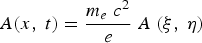 $A\lpar x\comma \; t\rpar =\displaystyle{{m_e \; c^2 } \over e}\; A\; \lpar {\rm \xi}\comma \; {\rm \eta}\rpar $, the relativistic factor of the mirror (the moving plasma slab)
 ${\rm \gamma} _M=\, \left[{\; 1 - \, \dot X_M^2 \, c^{ - 2} \, } \right]^{ - {1 / 2}}\comma$ Eq. (1) can be expressed
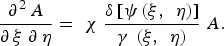 $$\displaystyle{{\partial ^2 \, A} \over {\partial \, {\rm \xi} \; \partial \, {\rm \eta} }} = \, \, {\rm \chi} \; \displaystyle{{{\rm \delta} \left[{{\rm \psi} \left({{\rm \xi} \comma \; \, {\rm \eta} } \right)} \right]} \over {{\rm \gamma} \, \left({{\rm \xi} \comma \; \, {\rm \eta} } \right)}}\; A.$$
where
 $${\rm \psi} \left({{\rm \xi} \comma \; \, {\rm \eta} } \right)= {\rm \xi} \, + \, {\rm \eta} \, - \, X_M \, \left({{\rm \eta} \, - {\rm \xi} } \right).$$
and χ = 2n elr eλ,  $r_e = \, \displaystyle{{e^2 } \over {m_e \, c^2 }}$ is the classical radius of the electron,
 ${\rm \lambda} \; = \, \displaystyle{{2\, {\rm \pi} } \over k}$.
The solution to Eq. (2) in the form of incident wave a 0, reflected wave a 1, and transmitted wave a 2 can be written as:
 $$A\lpar {{\rm \xi} \comma \,{\rm \eta} }\rpar \; = \; a_1 \lpar {\rm \xi} \rpar \; + \; a_0 \; e^{2\, i\, \;{\rm \eta} }\comma \; \quad {\rm \psi} \lpar {{\rm \xi} \comma \;{\rm \eta} }\rpar \; \gt \; 0$$
 $$= \; a_2 \lpar {\rm \eta}\rpar \comma \; \quad \quad \quad\quad\quad\quad\qquad\quad {\rm \psi} \lpar {{\rm \xi} \comma \;{\rm \eta} } \rpar \; \le \; 0.$$
The solution should satisfy the boundary conditions at the position of the mirror, ψ(ξ, η) = 0.
Introduction of the new functions ξ0(η) and η0(ξ), which satisfy the following expressions:
 $${\rm \psi} \lpar {{\rm \xi} _0 \, \lpar {\rm \eta} \rpar \comma \;{\rm \eta} } \rpar \; = \; 0 \quad \quad \hbox{for all values of}\,{\rm \eta}$$
 $${\rm and}\,{\rm \psi} \lpar {{\rm \xi} \comma \;{\rm \eta} _0 \; \lpar {\rm \xi}\rpar }\rpar =0 \quad \quad \hbox{for all values of}\,{\rm \xi}.$$
The requirement that the solution is continuous at the boundary of the mirror, A(ξ, η0(ξ) − 0) = A(ξ, η0(ξ) + 0), leads to the following condition:
 $$a_1 \lpar {\rm \xi}\rpar \; + \; a_0 \; e^{2\, i\, \, {\rm \eta} _0 \lpar {\rm \xi} \rpar } \; = \; a_2 \lpar {{\rm \eta} _0 \lpar {\rm \xi} \rpar } \rpar \;.$$
Integrating Eq. (2) over η in the vicinity of η0(ξ) for fixed ξ and small ε > 0, one obtains the following:
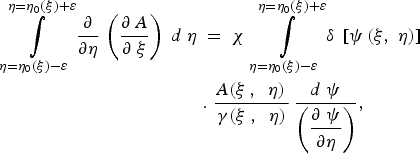 $$\eqalign{\vint \limits_{{\rm \eta} = {\rm \eta} _0 \lpar {\rm \xi}\rpar - {\rm \varepsilon} }^{{\rm \eta} = {\rm \eta} _0 \lpar {\rm \xi}\rpar + {\rm \varepsilon}} \displaystyle{\partial \over {\partial {\rm \eta} }}\, \left(\displaystyle{{\partial \, A} \over {\partial \; {\rm \xi} }} \right)\; d\; {\rm \eta} \; & = \; {\rm \chi} \; \vint \limits_{{\rm \eta} = {\rm \eta} _0 \lpar {\rm \xi}\rpar - {\rm \varepsilon} }^{{\rm \eta} = {\rm \eta} _0 \lpar {\rm \xi}\rpar + {\rm \varepsilon} } {\rm \delta} \; \left[{{\rm \psi} \left({{\rm \xi} \comma \;{\rm \eta} } \right)} \right]\, \cr & .\; \displaystyle{{A\lpar {{\rm \xi} \, \comma \; \; {\rm \eta} } \rpar \, } \over {{\rm \gamma} \lpar {{\rm \xi} \, \comma \; \; {\rm \eta} } \rpar }} \, \displaystyle{{d\; {\rm \psi} } \over {\left({\displaystyle{{\partial \; {\rm \psi} } \over {\partial {\rm \eta} }}} \right)}}\comma \; }$$
or
 $$\eqalign{& \left. {\displaystyle{{\partial \, A} \over {\partial \; {\rm \xi} }}} \right \vert _{{\rm \eta} = {\rm \eta} _0 \; \left({\rm \xi} \right)- \, \, {\rm \varepsilon}}^{{\rm \eta} = {\rm \eta} _0 \; \left({\rm \xi} \right)+ \, \, {\rm \varepsilon}} \; = {\rm \chi} \displaystyle{{\,f\; \left({{\rm \xi} \comma \;{\rm \eta} _0 } \right)} \over {\left({\displaystyle{{\partial \; {\rm \psi} } \over {\partial {\rm \eta} }}} \right)_{{\rm \eta} _0 \, \left({\rm \xi} \right)} }}\comma \; \cr & \quad {\rm here} \quad f\lpar {{\rm \xi} \comma {\rm \eta} } \rpar \; = \; \displaystyle{{A\lpar {{\rm \xi} \comma \;{\rm \eta} } \rpar \, } \over {{\rm \gamma} \lpar {{\rm \xi} \comma \;{\rm \eta} }\rpar }}.}$$
In the limit ε → 0, Eq. (9) gives the magnitude of the jump discontinuity of the derivative  $A_{\rm \xi} \; = \; \displaystyle{{\partial \, A} \over {\partial \; {\rm \xi} }}$ at η = η0 (ξ) for fixed ξ:
 $$\left. {\displaystyle{{\partial \, A} \over {\partial \; {\rm \xi} }}} \right \vert _{{\rm \eta} = {\rm \eta} _0 \; \left({\rm \xi} \right)- \, \, 0}^{{\rm \eta} = {\rm \eta} _0 \lpar {\rm \xi}\rpar + \, \, 0} = {\rm \chi} F\lpar {\rm \xi}\comma \; {\rm \eta} _0 \lpar {\rm \xi}\rpar \rpar \; \; A\lpar {\rm \xi} \comma \; {\rm \eta} _0 \lpar {\rm \xi}\rpar \rpar \comma \;$$
where
 $$F\lpar {\rm \xi} \comma \; {\rm \eta} \rpar = \displaystyle{1 \over {{\rm \gamma} \lpar {\rm \xi}\comma \; {\rm \eta}\rpar }} \times \displaystyle{1 \over {\displaystyle{{\partial \; {\rm \psi} } \over {\partial \; {\rm \eta} }}}}\;\; = \quad \left[{\displaystyle{{1\; + \; X^{\prime}_M \lpar {\rm \eta} - {\rm \xi} \rpar } \over {1\; - \; X^{\prime}_M \lpar {\rm \eta} - {\rm \xi} \rpar }}} \right]^{1/2}.$$
Substituting A(ξ, η0(ξ)) from Eq. (4) in Eq. (10), the following ordinary differential equation (ODE) is obtained:
 $$a^{\prime}_1 \lpar {\rm \xi} \rpar = {\rm \chi} \lpar {a_1 \lpar {\rm \xi}\rpar + a_0 \, e^{2\, i\, {\rm \eta} _0 \lpar {\rm \xi}\rpar } } \rpar \; F\lpar {{\rm \xi}\comma \; {\rm \eta} _0 \lpar {\rm \xi} \rpar }\rpar.$$
In the following similar expression is obtained for the magnitude of the jump discontinuity of the derivative  $A_{\rm \eta} = \; \displaystyle{{\partial \, A} \over {\partial \, {\rm \eta} }}$ at ξ = ξ0(η) for fixed η:
 $$2\, i\, a_0 \; e^{2\, i\, {\rm \eta} } \; - \; a^{\prime}_2 \, \left({\rm \eta} \right)\; = \; \displaystyle{{\rm \chi} \over {F\left({{\rm \xi} _0 \; \left({\rm \eta} \right)\, \comma \; \; \, {\rm \eta} } \right)}}\; a_2 \, \left({\rm \eta} \right).$$
3. REFLECTION AND TRANSMISSION OF EM PULSE FROM A UNIFORMLY MOVING/ACCELERATED /OSCILLATING THIN PLASMA MIRROR
We first consider the simplest case of uniform motion of the plasma mirror, i.e.,
 $$X^{\prime}_M \lpar {\bar t} \rpar = {\rm \beta} = {\rm constant}.$$
Using  $2 {\rm \eta} = \bar x + \bar t = {\rm \beta} \bar t + \bar t = \bar t\lpar {1\; + \; {\rm \beta} } \rpar = \lpar {1 + {\rm \beta} } \rpar \lpar {{\rm \eta} \; - \; {\rm \xi} } \rpar $, gives
 $${\rm \eta} _0 \; \left({\rm \xi} \right)= \; - \; \left({\displaystyle{{1\; + \; {\rm \beta} } \over {1\; - \; {\rm \beta} }}} \right)\; {\rm \xi} \; = \; - 4\; {\rm \gamma} ^2 \; {\rm \xi} = - F_0^2 \; {\rm \xi}.$$
where 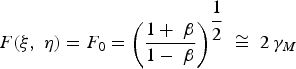 $F\lpar {{\rm \xi} \comma \; {\rm \eta} }\rpar = F_0 = \left({\displaystyle{{1 + \; {\rm \beta} } \over {1 - \; {\rm \beta} }}} \right)^{\displaystyle{1 \over 2}} \; \cong \; 2\, {\rm \gamma} _M$.
The solution to the differential equation (Eq. (12)) is
 $$a_1 \, \left({\rm \xi} \right)\; = \; C\; e^{ + \, \vint {{\rm \chi} \; F_0 \; d{\rm \xi} } } \; - \; \; \displaystyle{{a_0 \; {\rm \chi} } \over {{\rm \chi} \; + \; 2\; i\; F_0 }}\; e^{ - \, 2\, i\, F_0^2 \, {\rm \xi} }.$$
Similarly, after integrating Eq. (13) for obtaining the transmitted wave, we have
 $$a_2 \; \left({\rm \eta} \right)= \; C\; e^{ - \, \, \displaystyle{{\rm \chi} \over {F_0 }}\; {\rm \eta} \; } \; + \; a_0 \; \displaystyle{{2\; i\; F_0 } \over {{\rm \chi} \; + \; 2\; i\; F_0 }}\; e^{2\; i\; {\rm \eta} }.$$
The reflection coefficient for a uniformly moving mirror is
 $$R\; = \; \; \left\vert {\displaystyle{{a_1 } \over {a_0 }}} \right\vert ^2 \; \approx \displaystyle{{\left({n_e \; l\; r_e \; {\rm \lambda} } \right)^2 } \over {\left({n_e \; l\; r_e \; {\rm \lambda} } \right)^2 \; + \; 4\; {\rm \gamma} _M^2 }}.$$
For a uniformly accelerated mirror, let the acceleration be denoted by w:
 $$\displaystyle{d \over {d\, t}}\; \left({\displaystyle{v \over {\sqrt {1\; - \; \displaystyle{{v^2 } \over {c^2 }}} }}} \right)\; = \; w.$$
Integrating and setting,
 $$t = 0\; \comma \; \; v = 0\comma \;$$
the trajectory of the mirror is
 $$k\; x = \; g^{ - 1} \; \left[{\; \left({\; 1\; + \; g^2 \; \bar t^2 } \right)^{\; \displaystyle{1 \over 2}} } \right].$$
or
 $$X_M \; \left({\bar t} \right)= \; g^{ - 1} \; \left[{\left({1 + g^2 \bar t^2 } \right)^{\displaystyle{1 \over 2}} } \right].$$
The mirror velocity is
 $$X^{\prime}_M = g\lpar {{\rm \eta} - {\rm \xi} }\rpar \; \lsqb {\lpar {1 + g^2 \lpar {{\rm \eta} - {\rm \xi} } \rpar ^2 } \rpar }\rsqb ^{ - \textstyle{1 \over 2}}.$$
Now applying the boundary condition ψ(ξ, η0(ξ)) = 0 at the position of the mirror one finds
 $${\rm \eta} _0 \lpar {\rm \xi} \rpar = \lpar {4\, g^2 \; {\rm \xi} } \rpar ^{ - 1}.$$
In a similar way, using the condition ψ(ξ0 (η),η) = 0 one finds
 $${\rm \xi} _0 \; \left({\rm \eta} \right)\; = \; \left({4\, {\rm \eta} \; g^2 } \right)^{ - 1}.$$
For the trajectory of the mirror, Eq. (20),
 $$F\lpar {{\rm \xi} \comma \; {\rm \eta} } \rpar = \left[{\displaystyle{{1\; + \; X^{\prime}_M \; \left({{\rm \eta} \, - \; {\rm \xi} } \right)} \over {1\; - \; X^{\prime}_M \; \left({{\rm \eta} \, - \; {\rm \xi} } \right)}}} \right]^{\displaystyle{1 \over 2}}$$
reduces to
 $$F\lpar {{\rm \xi} \comma \; {\rm \eta} _0 \lpar {\rm \xi}\rpar }\rpar = \displaystyle{1 \over {2\; g\; {\rm \xi} }}\comma \;$$
and
 $$F\lpar {{\rm \xi} _0 \lpar {\rm \eta}\rpar \comma \; {\rm \eta} }\rpar = 2\; g\; {\rm \eta}.$$
For the value 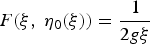 $F\lpar {{\rm \xi} \comma \; {\rm \eta} _0 \lpar {\rm \xi} \rpar } \rpar = \displaystyle{1 \over {2g {\rm \xi} }}$, the resulting ordinary differential equation Eq. (12) becomes
 $$a^{\prime}_1 \lpar {\rm \xi} \rpar - {\rm \chi} F_0 \lpar {{\rm \xi} \comma \; {\rm \eta} _0 \lpar {\rm \xi} \rpar } \rpar a_1 \; = \; {\rm \chi} \; a_{0\; } \displaystyle{1 \over {2 {\rm \xi} }}\; e^{\displaystyle{{2\; i} \over {4\; g^2 \; {\rm \xi} }}}.$$
The solution to the Eq. (25) is
 $$a_1 \; \left({\rm \xi} \right)\; = \; \, \; \; \displaystyle{{{\rm \chi} \; a_0 } \over {2\; g}}\lpar {2\; i\; g^2 {\rm \xi} } \rpar ^{{{{ \rm \chi} \over {2\; g}}}} \; \Gamma \; \left[{\; \displaystyle{{{\rm \chi} \; } \over {2\; g}}\; \comma \; \; \lpar {2\; i\; g^2 {\rm \xi} }\rpar ^{ - 1} \; \comma \; \; \; 0\; } \right].$$
where 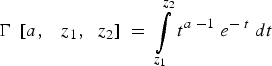 $\Gamma \; \left[{a\comma \; \; \; z_1 \comma \; \; z_2 } \right]\; = \; \vint\limits_{z_1 }^{z_2 } {t^{a\; - 1} } \; e^{ - \; t} \; dt$ is the generalized incomplete gamma function.
Noting the property of the gamma function viz. Γ(a, z 0, z 1) = Γ(a, z 0) − Γ(a,z 1), we can write
 $$\eqalign{\Gamma \; \left({\displaystyle{{\rm \chi} \over {2\; g}}\comma \; \; \left({2\; i\; g^2 \; {\rm \xi} } \right)^{ - \; 1} \; \comma \; \; 0} \right)\; & = \; \Gamma \; \left({\displaystyle{{\rm \chi} \over {2\; g}}\comma \; \; \left({2\; i\; g^2 \; {\rm \xi} } \right)^{ - \; 1} \; } \right)\; \cr & \quad - \; \Gamma \; \left({\displaystyle{{\rm \chi} \over {2\; g}}\comma \; \; 0} \right).}$$
In the limit ξ → 0
 $$\eqalign{\Gamma \; \left({\displaystyle{{\rm \chi} \over {2\; g}}\comma \; \; \left({2\; i\; g^2 \; {\rm \xi} } \right)^{ - \; 1} \; \comma \; \; 0} \right)\; & = \; \Gamma \; \left({\displaystyle{{\rm \chi} \over {2\; g}}\comma \; \; \infty \; } \right)\; \cr & \quad - \; \Gamma \; \left({\displaystyle{{\rm \chi} \over {2\; g}}\comma \; \; 0} \right).}$$
Therefore Eq. (26) becomes
 $$\eqalign{a_1 \; \left({\rm \xi} \right)\; & = \; \, - \; \; \displaystyle{{{\rm \chi} \; a_0 } \over {2\; g}}\; \left({2\; i\; g^2 {\rm \xi} } \right)^{{{\rm \chi} \over {2\; g}}} \; \Gamma \; \left({\displaystyle{{\rm \chi} \over {2\; g}}} \right)\; \cr & + \; \displaystyle{{{\rm \chi} \; a_0 } \over {2\; g}}\; \left({2\; i\; g^2 {\rm \xi} } \right)^{{{\rm \chi} \over {2\; g}}} \; \Gamma \; \left({\displaystyle{{\rm \chi} \over {2\; g}}\comma \; \; \infty \; } \right)\comma \; }$$
where we have replaced 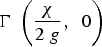 $\Gamma \; \left({\displaystyle{{\rm \chi} \over {2\; g}}\comma \; \; 0} \right)$ by the Euler gamma function
 $\Gamma \; \left({\displaystyle{{\rm \chi} \over {2\; g}}} \right)$.
Now using the property
 $\Gamma \lpar s\comma \; z\rpar \sim z^{s - 1} e^{ - z} \sum\limits_{k = 0} {\displaystyle{{\Gamma \lpar s\rpar } \over {\Gamma \lpar s - k\rpar }}z^{ - k} }$ as an asymptotic series where |z| → ∞, one gets
 $$\eqalign{\Gamma \; \left({\displaystyle{{\rm \chi} \over {2\; g}}\comma \; \; \; \left({2\; i\; g^2 {\rm \xi} } \right)^{ - 1} } \right)\; & = \; \left\{{\; \left({2\; i\; g^2 {\rm \xi} } \right)^{ - 1} } \right\}^{s\; - 1} \; e^{ - \; \left({2\; i\; g^2 {\rm \xi} } \right)^{ - \, \; 1} } \; \cr & \sum\limits_{k\; = \; 0} {\displaystyle{{\Gamma \; \left({\displaystyle{{\rm \chi} \over {2\; g}}} \right)} \over {\Gamma \; \left({\displaystyle{{\rm \chi} \over {2\; g}}\; - \; k} \right)}}\; \; \left({2\; i\; g^2 {\rm \xi} } \right)^{\; k} }}$$
 $$\eqalign{& = \; \; {e^{{i \over {2\; \; {g^2}{\rm \xi} }}}}\; \left({2\; i\; {g^2}{\rm \xi} } \right)\; {\left({2\; i\; {g^2}{\rm \xi} } \right)^{ - \; \displaystyle{{\rm \chi} \over {2\; g}}}} \cr & \quad \left\{{\displaystyle{{\Gamma \; \left({\displaystyle{{\rm \chi} \over {2\; g}}} \right)} \over {\Gamma \; \left({\displaystyle{{\rm \chi} \over {2\; g}}} \right)}}\; .\; 1\; + \; \displaystyle{{\Gamma \; \left({\displaystyle{{\rm \chi} \over {2\; g}}} \right)} \over {\Gamma \; \left({\displaystyle{{\rm \chi} \over {2\; g}}\; - \; 1} \right)}}\; \left({2\; i\; {g^2}{\rm \xi} } \right)} \right. \cr & \quad \left. { + \; \displaystyle{{\Gamma \; \left({\displaystyle{{\rm \chi} \over {2\; g}}} \right)} \over {\Gamma \; \left({\displaystyle{{\rm \chi} \over {2\; g}}\; - \; 2} \right)}}\; {{\left({2\; i\; {g^2}{\rm \xi} } \right)}^2}\; + \; ....} \right\}}$$
 $$\eqalign{& = \; \; e^{{i \over {2\; \; g^2 {\rm \xi} }}} \; \; \left({2\; i\; g^2 {\rm \xi} } \right)^{1\; - \; {{\rm \chi} \over 2g}} \; \left\{1 + \left(\displaystyle{{\rm \chi} \over 2g} - 1 \right)\; \; \left(2\;i\;g^2 {\rm \xi} \right)\; \; \right. \cr & \left. \quad + \; \; \left(\displaystyle{{\rm \chi} \over 2\;g} - 1 \right)\left(\displaystyle{{\rm \chi} \over 2\;g} - 2 \right)\; \left(2\;i\;g^2 {\rm \xi} \right)^2 \; + \; .....\; \right\}}.$$
Substituting this in the expression for a 1(ξ), one finds
 $$\eqalign{{a_1}\; \left({\rm \xi} \right)& = - \; \; \displaystyle{{{\rm \chi} \; {a_0}} \over {2\; g}}\; {\left({2\; i\; {g^2}{\rm \xi} } \right)^{{{\rm \chi} \over {2\; g}}}}\; \Gamma \; \left({\displaystyle{{\rm \chi} \over {2\; g}}} \right)\; \cr & \quad + \; \displaystyle{{{\rm \chi} \; {a_0}} \over {2\; g}}\; {\left({2\; i\; {g^2}{\rm \xi} } \right)^{{{\rm \chi} \over {2\; g}}}}\; .\; \; {e^{\displaystyle{i \over {2\; \; {g^2}{\rm \xi} }}}}\; \; {\left({2\; i\; {g^2}{\rm \xi} } \right)^{1\; - \; {{\rm \chi} \over {2\; g}}}} \cr & \quad \left\{{1\; + \; \left({\displaystyle{{\rm \chi} \over {2\; g}}\; - \; 1} \right)\; \; \left({2\; i\; {g^2}{\rm \xi} } \right)\; } \right. \cr & \quad \left. {+ \; \; \left({\displaystyle{{\rm \chi} \over {2\; g}}\; - \; 1} \right)\; \; \; \left({\displaystyle{{\rm \chi} \over {2\; g}}\; - \; 2} \right)\; {{\left({2\; i\; {g^2}{\rm \xi} } \right)}^2}\; + \; ...} \right\}}$$
or,
 $$\eqalign{a_1 \; \left({\rm \xi} \right)\; & = \; \; - \; \; \displaystyle{{{\rm \chi} \; a_0 } \over {2\; g}}\; \left({2\; i\; g^2 {\rm \xi} } \right)^{{{\rm \chi} \over {2\; g}}} \; \Gamma \; \left({\displaystyle{{\rm \chi} \over {2\; g}}} \right)\; \cr & \quad + \; \displaystyle{{{\rm \chi} \; a_0 } \over {2\; g}}\; \left({2\; i\; g^2 } \right)\; e^{\displaystyle{i \over {2\; \; g^2 {\rm \xi} }}} \; \; \; \left({{\rm \xi} \; + \; O\; \left({{\rm \xi} ^2 } \right)\; + \; ....} \right).}$$
For F(ξ0, η) = 2gη, the solution to the Eq. (13) is
 $$\eqalign{a_2 \; \left({\rm \eta} \right)\; & = \; \; \displaystyle{{{\rm \chi} \; a_0 } \over {2\; g}}\; \left({ - \; 2\; i\; {\rm \eta} } \right)^{ - \; {{\rm \chi} \over {2\; g}}} \; \Gamma \; \left({\displaystyle{{\rm \chi} \over {2\; g}}\comma \; \; - \; 2\; i\; {\rm \eta} \comma \; \; 0} \right)\; \cr & \quad + \; a_0 \; e^{2\; i\; {\rm \eta} }}$$
The frequency of the reflected radiation increases as ξ−1. The spectrum of the reflected intensity is given by the following expression:
 $$I_{\rm \upsilon} \; = \left\vert {\; \displaystyle{1 \over {\sqrt {\; 2{\rm \pi} } }}\; \vint\limits_{ - \, \infty }^{ + \; \infty } {e^{i\; {\rm \upsilon} \; {\rm \xi} } } \; a_1 \; \left({\rm \xi} \right)\; d\; {\rm \xi} \; } \right\vert ^{\; 2}.$$
For the case of a mirror oscillating with frequency Ω (normalized on the incident wave frequency) as defined below:
 $$\displaystyle{d \over {d\; \mathop t\limits^ - }}\; \left({\displaystyle{{{\rm \beta} \; \left({\mathop t\limits^ - } \right)} \over {\sqrt {1\; - \; {\rm \beta} ^2 \; \left({\mathop t\limits^ - } \right)\; } }}} \right)\; \; \; = \; \; g\; \cos \; \left({\Omega \; \mathop t\limits^ - } \right).$$
The corresponding trajectory of the mirror is
 $$X_M \; \left({\mathop t\limits^ - } \right)= \; \; \displaystyle{1 \over \Omega }\; \tan ^{ - \; 1} \; \left({ - \; \displaystyle{{\cos \; \left({\Omega \; \mathop t\limits^ - } \right)} \over {\sqrt {h^2 \; - \; \cos ^2 \; \left({\Omega \; \mathop t\limits^ - } \right)} }}} \right)\comma \;$$
where 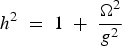 $h^2 \; = \; 1\; + \; \displaystyle{{\Omega ^2 } \over {g^2 }}$.
The boundary condition ψ(ξ, η0 (ξ)) = 0 at the position of the mirror gives
 $$0\; \; = \; \; {\rm \xi} \; + \; {\rm \eta} _0 \; - \; \displaystyle{1 \over \Omega }\; \tan ^{ - 1} \; \left({ - \; \displaystyle{{\cos \; \Omega \; \mathop t\limits^ - \; } \over {\sqrt {h^2 \; - \; \cos ^2 \; \left({\Omega \; \mathop t\limits^ - } \right)} }}} \right)\comma \; {\rm yielding}$$
 $${\rm \eta} _0 \; \left({\rm \xi} \right)\; = \; \; - \; \; \displaystyle{1 \over \Omega }\; \tan ^{ - \; 1} \; \left({\displaystyle{{h\; \; \tan \; \Omega \; {\rm \xi} \; + \; 1} \over {\tan \; \Omega \; {\rm \xi} \; + \; h}}} \right)\quad - \; \; \displaystyle{{k\; {\rm \pi} } \over \Omega }\comma \;$$
where k is an integer. The digamma factor for η0(ξ) becomes
 $$F\; \left({{\rm \xi} \; \comma \; \; {\rm \eta} _0 \; \left({\rm \xi} \right)} \right)\; = \; \left[{\displaystyle{{h^2 \; - \; 1} \over {h^2 \; + \; \; 1\; + \; 2\; h\; \sin \; \left({2\; \Omega \; {\rm \xi} } \right)}}} \right]^{\displaystyle{1 \over 2}}.$$
In this case the solution to the Eq. (12) is
 $$\eqalign{a_1 \; \left({\rm \xi} \right)\; &= \; \; C\; e^{ + \; \vint {{\rm \chi} \; F\; d\, {\rm \xi} } } \quad + \; \; e^{ + \; \vint {{\rm \chi} \; F\; d\, {\rm \xi} } } \cr & \; \left\{{e^{ - \; \vint {{\rm \chi} \; F\; d\, {\rm \xi} } } \; .\; \displaystyle{{{\rm \chi} \; a_0 \; e^{2\; i\; {\rm \eta} _0 \; \left({\rm \xi} \right)} \; \left({h^2 \; - \; 1} \right)^{\displaystyle{1 \over 2}} } \over {\left({h^2 \; + \; 1\; + \; 2\; h\; \sin \; \left({2\; \Omega \; {\rm \xi} } \right)} \right)\; ^{\displaystyle{1 \over 2}} }}} \right\}\comma \; }$$
which we solve numerically.
4. NUMERICAL RESULTS AND DISCUSSION
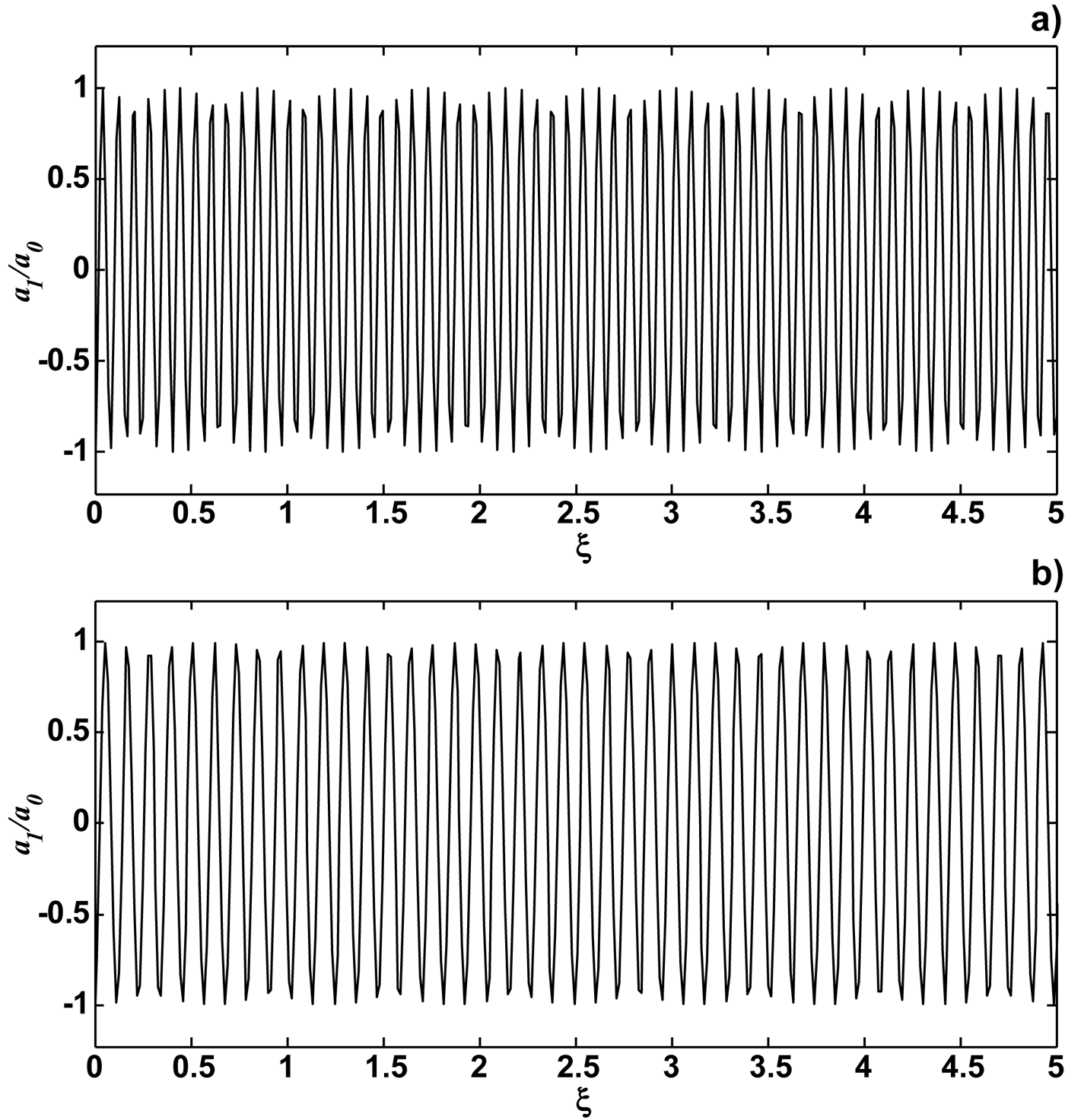
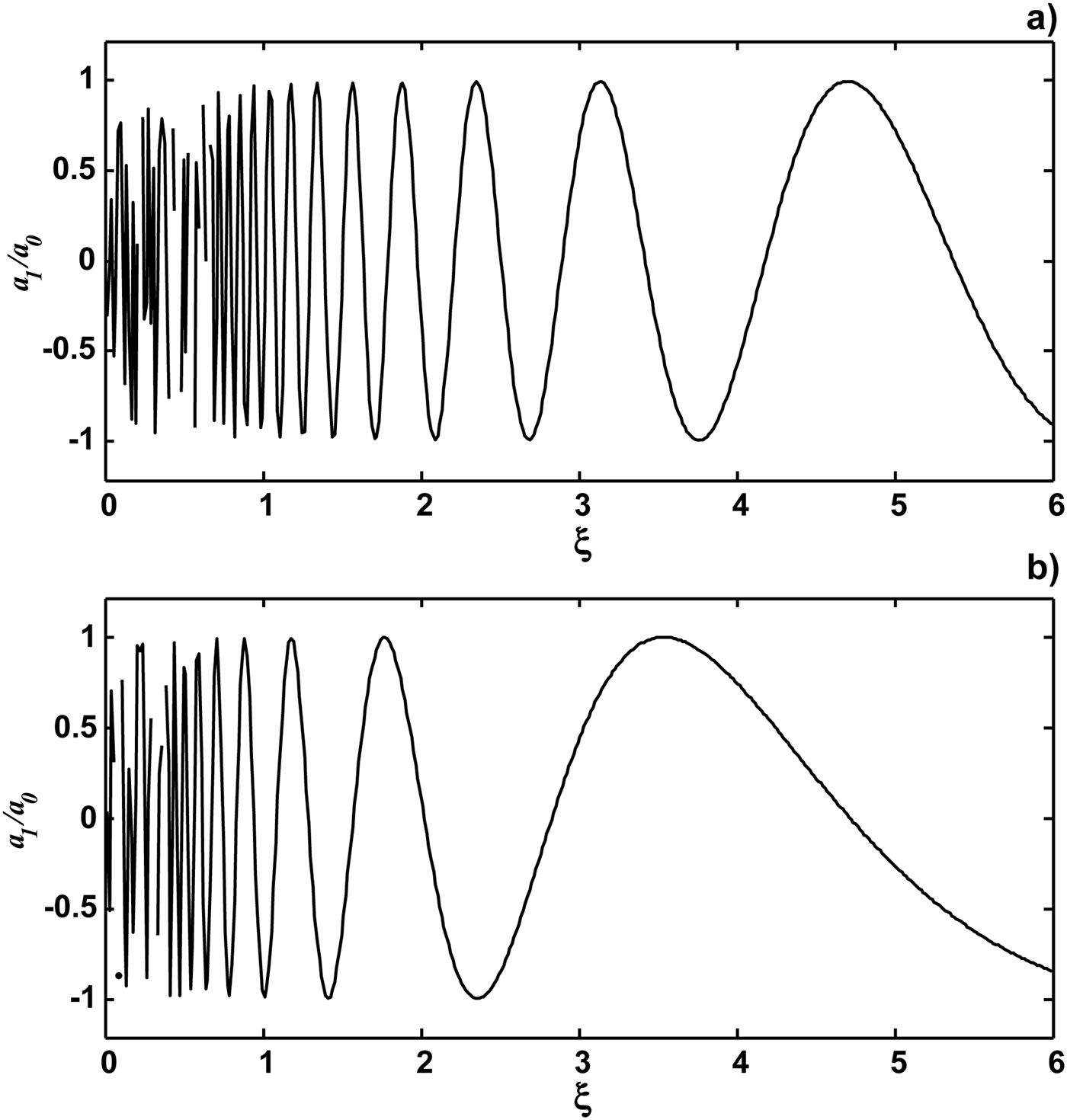
We performed calculations for the intensity of the driver laser pulse I d = 1023 W/cm2, λ = 800 nm, electron density n o = 1023 cm−3. In Figure 1 we present our numerical results showing the variation of the amplitude of the reflected radiation  $\displaystyle{{a_1 \; \left({\rm \xi} \right)} \over {a_0 }}$ from the uniformly moving mirror for β = 0.95, 0.99 at identical thin foil plasma density parameter χ = n olr eλ = 756. The results of the amplitude of the transmitted radiation
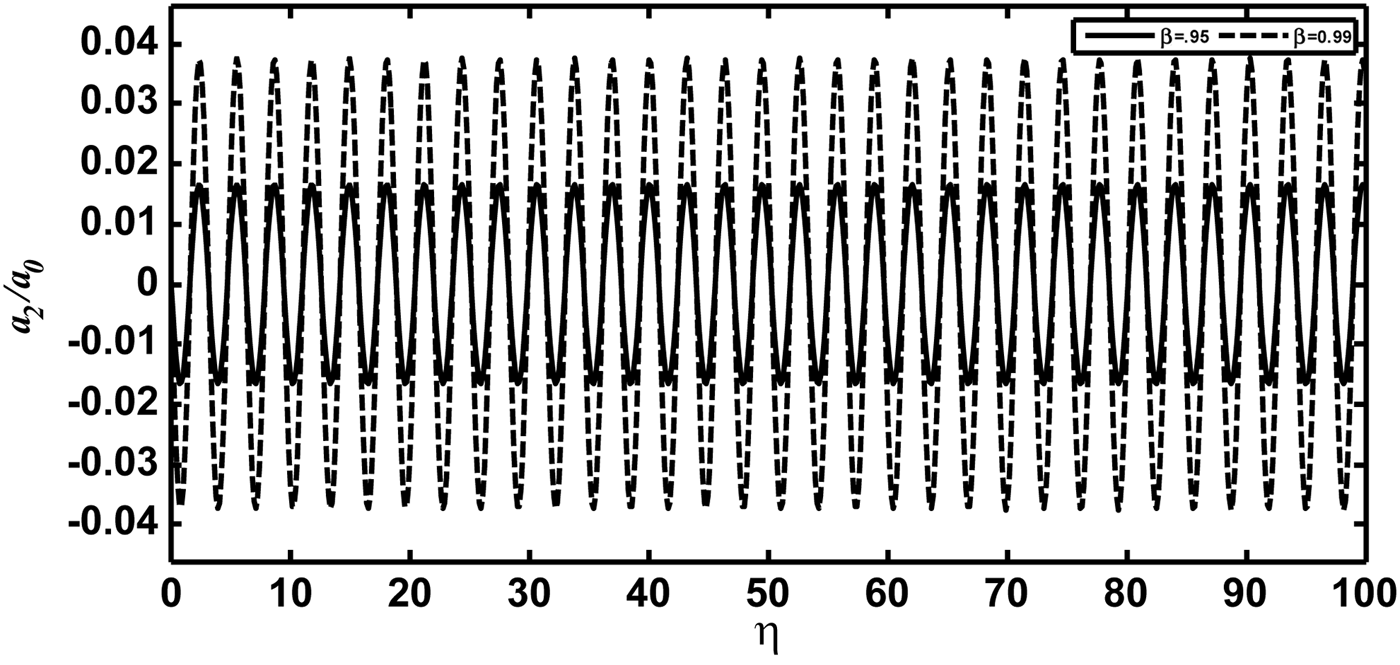
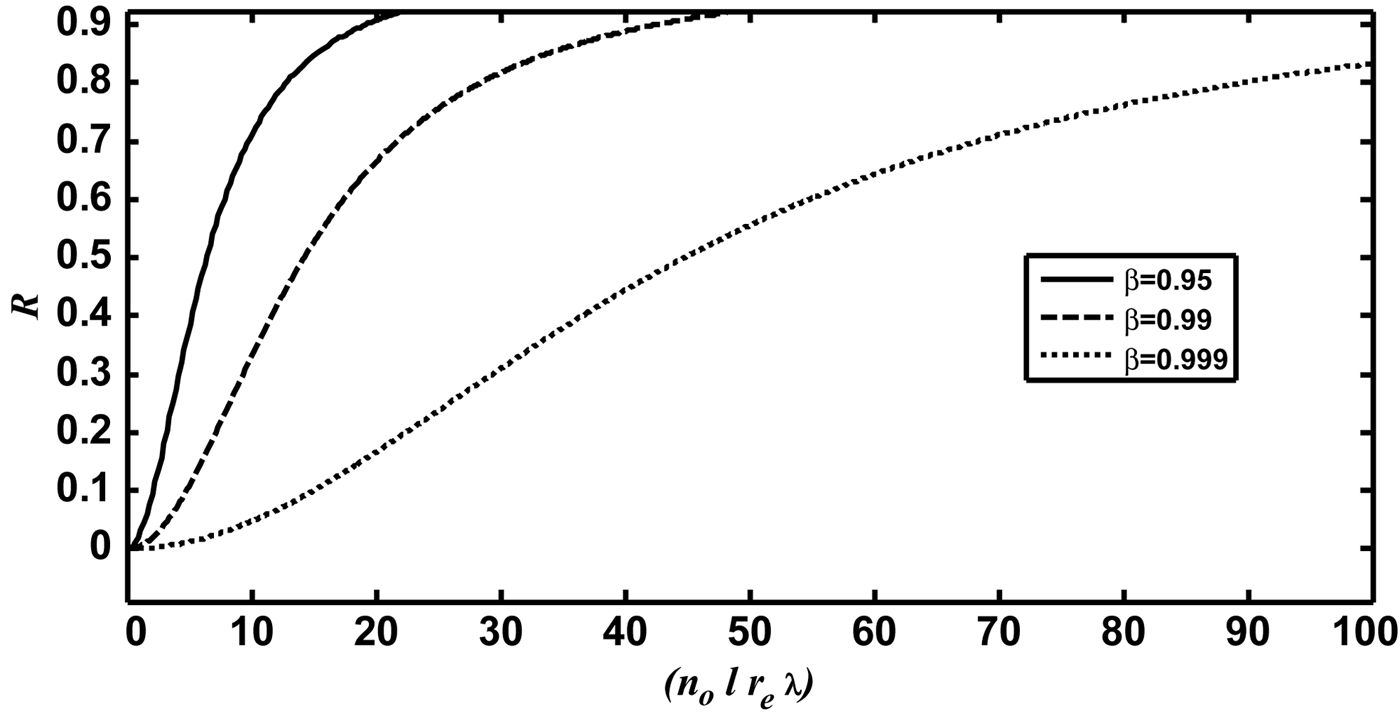
 $\displaystyle{{a_2 \; \left({\rm \eta} \right)} \over {a_0 }}$ from the uniformly moving mirror for β = 0.95, 0.99 and thin foil parameter n olr eλ = χ= 756 are displayed by the Figure 2. The variation of the reflection coefficient R of a laser pulse as a function of χ from a uniformly moving mirror for different values of β = 0.95, 0.99, 0.999 is presented in Figure 3. For values of n 0lr eλ ≪ 4γ2, the reflection coefficient approaches
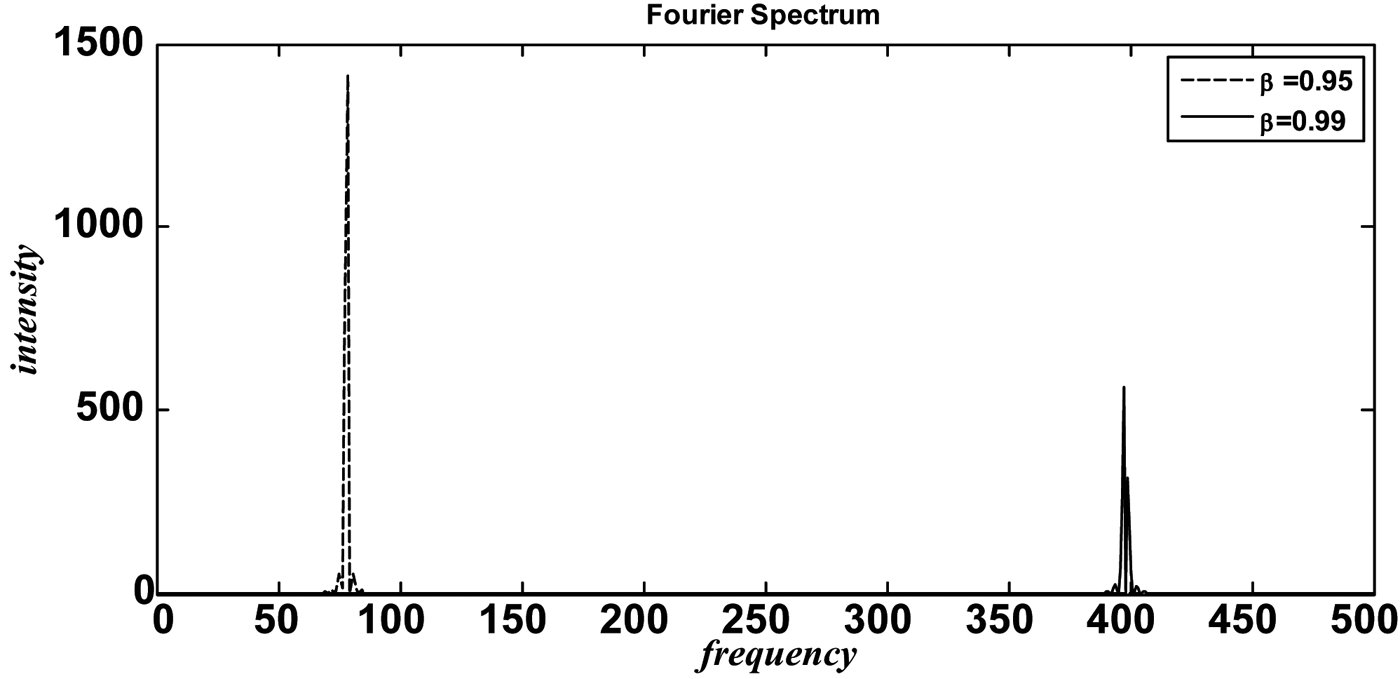
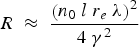 $R\; \approx \; \displaystyle{{\left({n_0 \; l\; r_e \; {\rm \lambda} } \right)^2 } \over {4\; {\rm \gamma} ^2 }}$ and for (n 0lr eλ)2 ≥ 4γ2, R is close to 1. Figure 4 shows the square of the modulus of the Fourier transform of the function a 1(ξ),
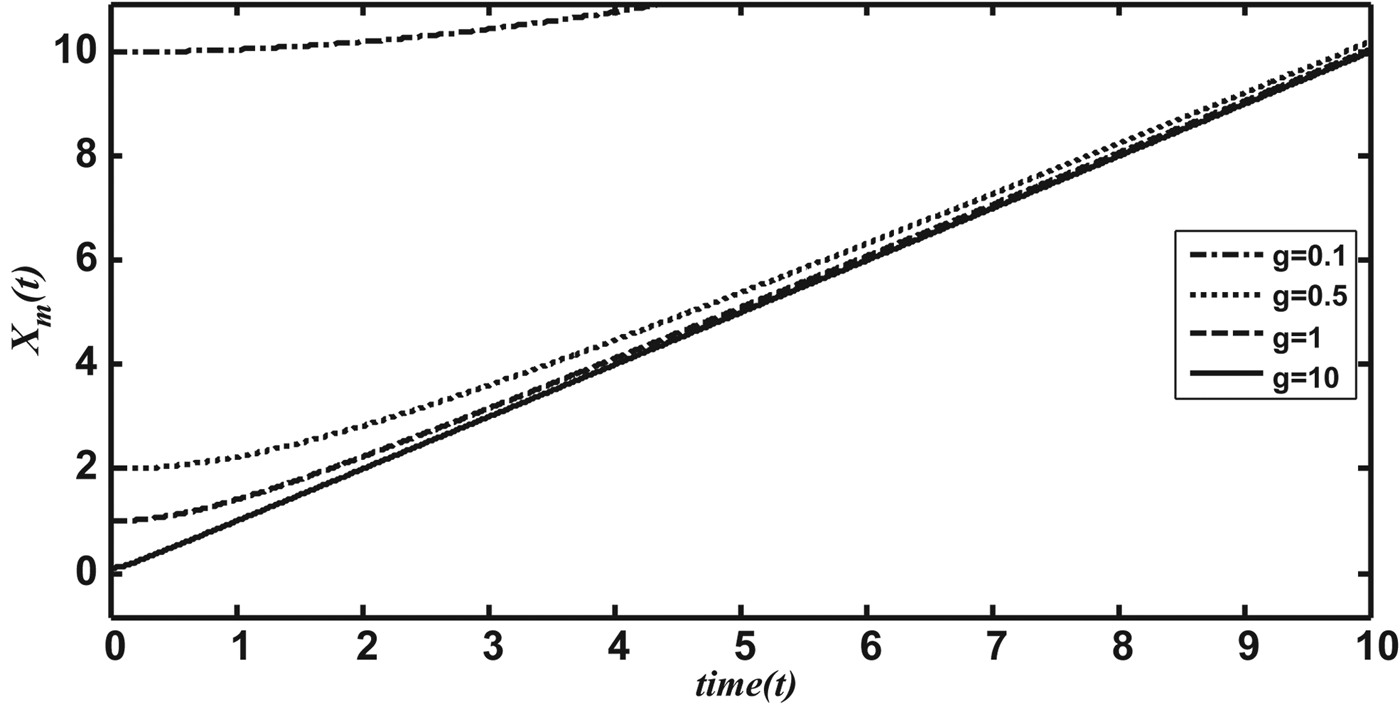
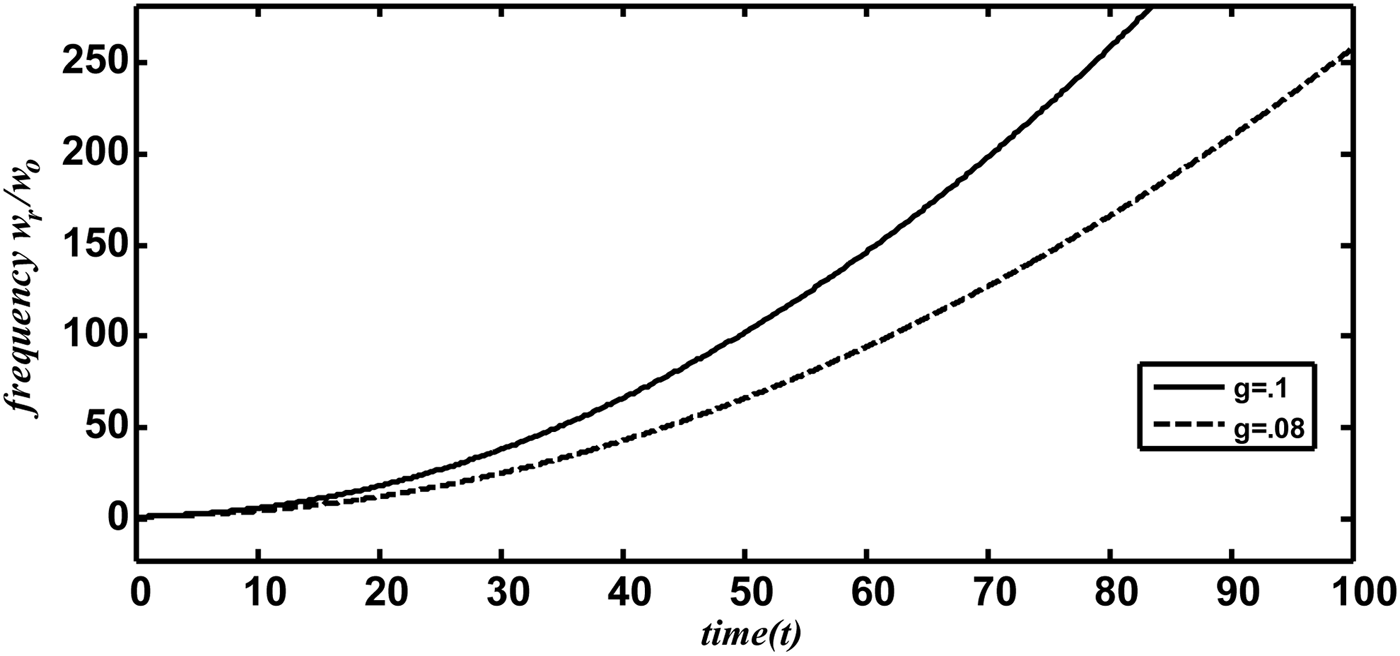
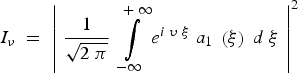 $I_{\rm \nu} \; = \; \left\vert {\; \displaystyle{1 \over {\sqrt {2\; {\rm \pi} } }}\; \vint\limits_{ - \infty }^{ + \; \infty } {e^{i\; {\rm \upsilon} \; {\rm \xi} } } \; a_1 \; \left({\rm \xi} \right)\; d\; {\rm \xi} \; } \right\vert ^2 \; $ where a 1(ξ) is the amplitude of the reflected laser pulse from a uniformly moving mirror having χ = 756 and β = 0.95, 0.99. The frequency spectrum shows that the spectral intensity decreases with increase in frequency (υ). In the scheme of the accelerating double-sided mirror, the role of the mirror is played by a high-density plasma slab accelerated by an ultra-intense laser pulse (the driver) in the Radiation Pressure Dominant regime (Esirkepov et al., Reference Esirkepov, Borghesi, Bulanov, Mourou and Tajima2004). The plasma slab also acts as a mirror for a counter-propagating relativistically strong electromagnetic radiation (the source-pulse). A foil accelerated to relativistic energies by a laser pulse can act as a relativistic flying mirror for frequency upshift and intensification of a reflected counter-propagating light beam. Figure 5 depicts the trajectory of the accelerated mirror for different parameters of g = 0.1, 0.5, 1, 10 as a function of
 $\bar t$. Figure 6 presents the variation of the amplitude of the reflected laser pulse
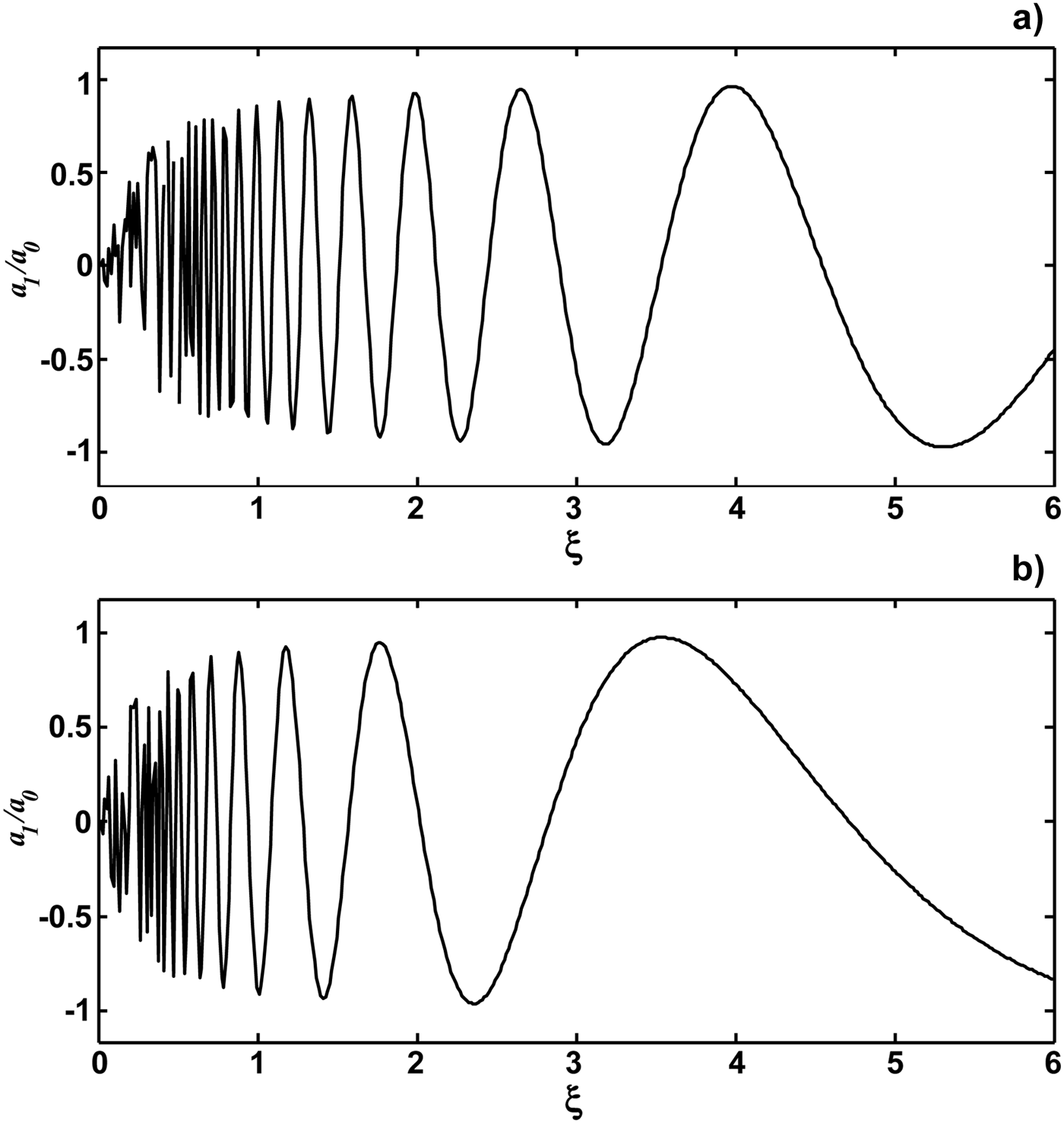
 $\displaystyle{{a_1 \lpar {\rm \xi}\rpar } \over {a_0 }}$ from an accelerating mirror for g = 0.08, 0.15, n 0 = 1023 cm−3, and χ = 756. Figure 7 displays the variation of the amplitude of the reflected laser pulse
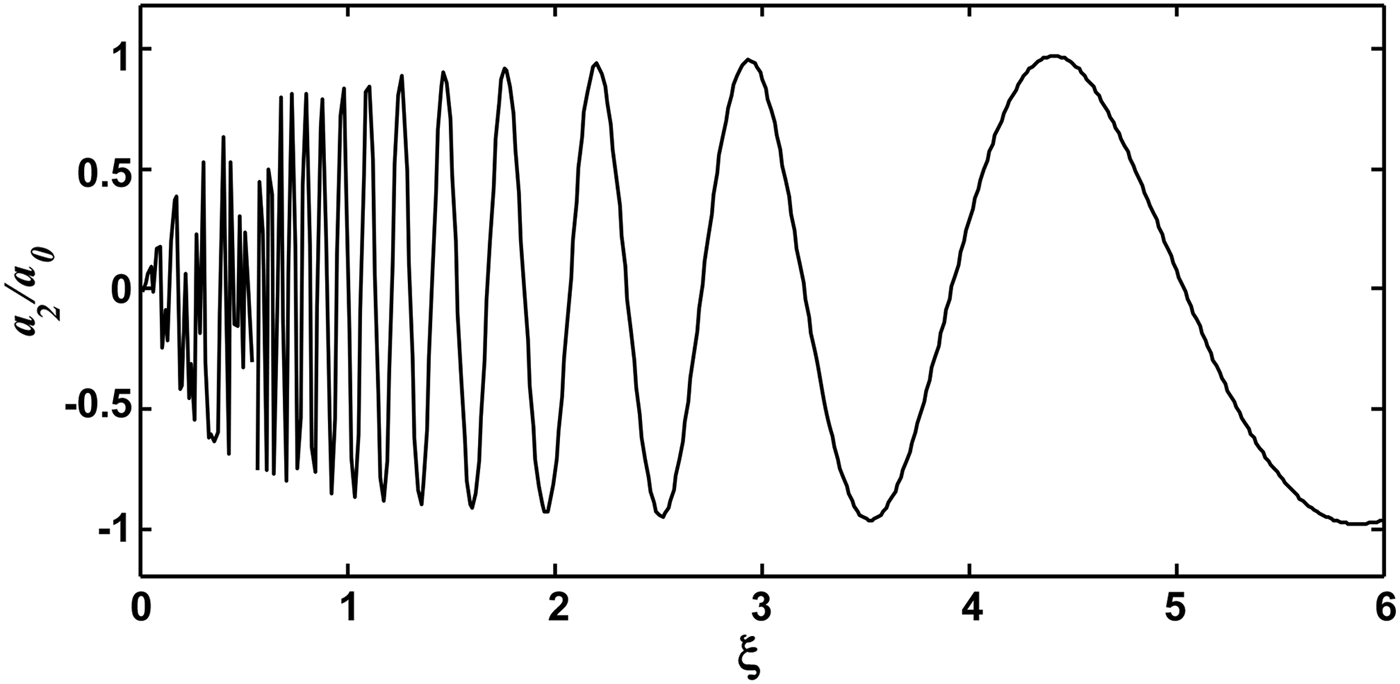
 $\displaystyle{{a_1 \lpar {\rm \xi}\rpar } \over {a_0 }}$ from an accelerating mirror for g = 0.10, 0.15, n 0 = 1022 cm−3, and a reduced value of thin foil plasma-density parameter χ = 75.6. Figure 8 gives the variation of the transmitted laser pulse through an accelerating mirror for g = 0.9, n 0 = 1022 cm−3, and χ = 75.6. Figure 9 represents the variation of the normalized frequency
 $\displaystyle{{\rm \omega} \over {{\rm \omega} _0 }}$ of the reflected radiation as a function of
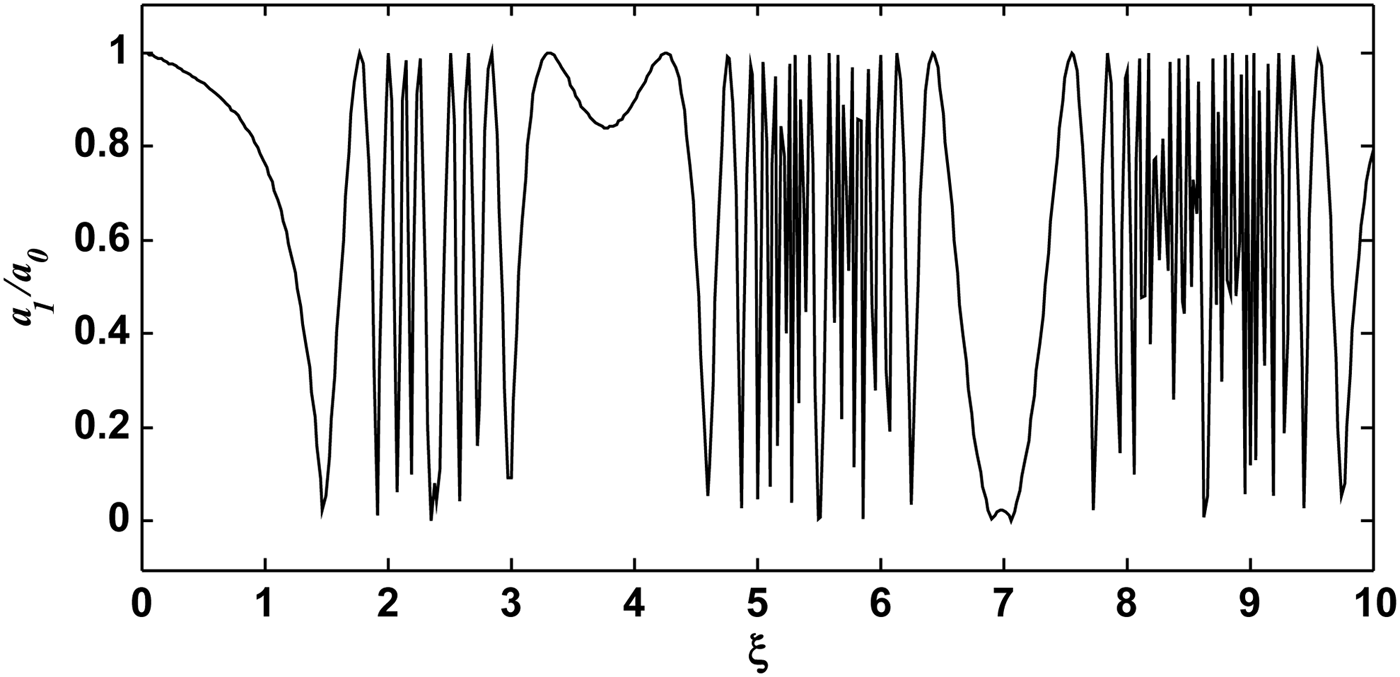
 $\bar t$ from an accelerated mirror for g = 0.08, 0.1. In general, the reflected radiation is chirped due to mirror acceleration. With appropriate values of the accelerating mirror parameter g, it is possible to obtain an intense ultra-short pulse of X-rays. If the mirror velocities are large enough so that the Doppler shifted wavelength of the incident radiation becomes smaller than the inter-particle distance in the proper frame of reference of the moving mirror, then the coherence of reflected radiation from the moving mirror is destroyed. In this case, however, the intensity of the reflected radiation is reduced and it is now proportional to the number density of the electrons. The variation of the reflected laser pulse from an oscillating mirror as a function of ξ for g = 1, and Ω = 1, n 0 = 1023 cm−3, and χ = 756 is presented in Figure 10.
(a) Variation of the amplitude of the reflected radiation  $\displaystyle{{a_1 \; \left({\rm \xi} \right)} \over {a_0 }}$ from the uniformly moving mirror as a function of χ for β = 0.95 and electron density n 0 = 1023 cm−3 at identical thin foil parameter χ = 756. (b) Variation of the amplitude of the reflected radiation
 $\displaystyle{{a_1 \; \left({\rm \xi} \right)} \over {a_0 }}$ from the uniformly moving mirror as a function of χ for β = 0.99 and electron density n 0 = 1023 cm−3 at identical thin foil parameter χ = n 0lr eλ = 756.

Variation of the amplitude of the transmitted radiation  $\displaystyle{{a_2 \; \left({\rm \eta} \right)} \over {a_0 }}$ from the uniformly moving mirror as a function of χ for β = 0.95, 0.99 and electron density n 0 = 1023 cm−3 at identical thin foil parameter χ = n 0lr eλ = 756.
Variation of the reflection coefficient (R) of a laser pulse from the uniformly moving mirror as a function of χ for different values of β = 0.95, 0.99, 0.999.
Variation of the frequency spectrum of the intensity of the reflected laser pulse from the uniformly moving mirror for different values of β = 0.95 and 0.99, n 0 = 1023 cm−3, and χ = 756.
Variation of the trajectory of the accelerated mirror for g = 0.1, 0.5, 1, 10 as a function of  $\bar t$.
(a) Variation of the amplitude of the reflected laser pulse  $\displaystyle{{a_1 \; \left({\rm \xi} \right)} \over {a_0 }}$ from an accelerating mirror for g = 0.08, n 0 = 1023 cm−3, and χ = 756. (b) Variation of the amplitude of the reflected laser pulse
 $\displaystyle{{a_1 \; \left({\rm \xi} \right)} \over {a_0 }}$ from an accelerating mirror for g = 0.15, n 0 = 1023 cm−3, and χ = 756.
(a) Variation of the amplitude of the reflected laser pulse  $\displaystyle{{a_1 \; \left({\rm \xi} \right)} \over {a_0 }}$ from an accelerating mirror for g = 0.10, n 0= 1022 cm−3, and χ = 75.6. (b) Variation of the amplitude of the reflected laser pulse
 $\displaystyle{{a_1 \; \left({\rm \xi} \right)} \over {a_0 }}$ from an accelerating mirror values of g = 0.15, n 0= 1022 cm−3, χ = 75.6.
Variation of the transmitted laser pulse through an accelerating mirror for g = 0.9, n 0= 1022 cm−3, and χ = 75.6.
Variation of the normalized frequency  $\displaystyle{{\rm \omega} \over {{\rm \omega} _0 }}$ of the reflected radiation as a function of
 $\bar t$ from an accelerated mirror for g = 0.08, 0.1.
Variation of the reflected laser pulse from an oscillating mirror for g = 1, and Ω = 1, n 0= 1023 cm−3, and χ = 756.
5. CONCLUSION
Non-linear interaction of ultra-intense laser pulses with an accelerated thin slab of overdense plasma is numerically studied. The reflection of a counter-propagating relativistically strong EM pulse from the relativistic mirror gives rise to the generation of ultra-bright high intensity X-rays and γ -rays. The reflected pulses have an up-shifted frequency and increased intensity. In general, the reflected radiation is chirped due to mirror acceleration. It is seen that the first few cycles of the reflected radiation exhibit presence of high harmonics, while the later cycles are short pulses of higher harmonics. The Relativistic Doppler effect, applicable to the concepts of the moving mirror, flying mirror and oscillating mirror, gives rise to the production of ultrashort pulses of X-rays and γ -rays. The conditions for relativistic transparency are presented.
ACKNOWLEDGEMENT
Thanks are due to the Department of Science & Technology, New Delhi, Government of India, for financial assistance to the project.