Introduction
Common lambsquarters is a summer annual broadleaf weed in the goosefoot family (Chenopodiaceae). Plants emerge very early in the spring (Mulugeta and Stoltenberg Reference Mulugeta and Stoltenberg1998) and also exhibit rapid, early-season growth in cool weather (Werle et al. Reference Werle, Sandell, Buhler, Hartzler and Lindquist2014). Common lambsquarters plants are primarily a self-pollinated species but can undergo some wind-mediated cross-pollination, producing an average of 72,500 seeds plant-1 (Colquhoun et al. Reference Colquhoun, Stoltenberg, Binning and Boerboom2001). Biological seed characteristics of common lambsquarters, including prolonged emergence patterns (Myers et al. Reference Myers, Curran, VanGessel, Calvin, Mortensen, Majek, Karsten and Roth2004; Werle et al. Reference Werle, Sandell, Buhler, Hartzler and Lindquist2014), seed dormancy (Curran et al. Reference Curran, Sprague, Stachler and Loux2007; Yao et al. Reference Yao, Lan and Zhang2010), and prolific seed production (Harrison Reference Harrison1990; Tharp and Kells Reference Tharp and Kells2001), all contribute to weediness of the species. Common lambsquarters is a troublesome broadleaf weed in many cropping systems, and infestations contribute significantly to yield losses in soybean [Glycine max (L.) Merr.], corn (Zea mays L.), and sugar beet (Beta vulgaris L.) (Beckett et al. Reference Beckett, Stoller and Wax1988; Crook and Renner Reference Crook and Renner1990; Harrison Reference Harrison1990; Schweizer Reference Schweizer1983; Shurtleff and Coble Reference Shurtleff and Coble1985; Tharp and Kells Reference Tharp and Kells2001).
Glyphosate, an herbicide widely used in agriculture, was first introduced for broad-spectrum weed control (Roisch and Lingens Reference Roisch and Lingens1974). Glyphosate inhibits 5-enolpyruvylshikimate-3-phosphate synthase (EPSPS), thereby disrupting the shikimate pathway, resulting in the depletion of aromatic amino acid production and eventual plant death (Jaworski Reference Jaworski1972; Steinrucken and Amrhein Reference Steinrucken and Amrhein1980). The heavy usage of glyphosate in glyphosate-resistant crops has resulted in glyphosate resistance in several weed species. Of the 37 weed species worldwide that have been documented to have evolved resistance to glyphosate, 16 of those are in the United States (Heap Reference Heap2017). Although there are no confirmed reports of evolution of glyphosate resistance in common lambsquarters, some accessions have variable or inconsistent response to glyphosate (Hite et al. Reference Hite, King, Hagood and Holtzman2008; Kniss et al. Reference Kniss, Miller, Westra and Wilson2007; Sivesind et al. Reference Sivesind, Gaska, Jeschke, Boerboom and Stoltenberg2011; Westhoven et al. Reference Westhoven, Kruger, Gerber, Stachler, Loux and Johnson2008; Yerka et al. Reference Yerka, Wiersma, Lindenmayer, Westra, Johnson, de Leon and Stoltenberg2013).
Size of common lambsquarters at time of glyphosate application, combined with environmental conditions before, during, or after application, may influence plant response to glyphosate (Kniss et al. Reference Kniss, Miller, Westra and Wilson2007; Sivesind et al. Reference Sivesind, Gaska, Jeschke, Boerboom and Stoltenberg2011). In field studies in Wyoming, common lambsquarters biotypes were larger but had greater mortality upon glyphosate application, because environmental conditions at one location were more humid and warmer than another at the time of application (Kniss et al. Reference Kniss, Miller, Westra and Wilson2007). Conversely, Sivesind et al. (Reference Sivesind, Gaska, Jeschke, Boerboom and Stoltenberg2011) in Wisconsin suggested that control of common lambsquarters by glyphosate was consistently high regardless of variation in environmental conditions. Taller common lambsquarters plants (15 cm) exhibited a 2.4- to 5.5-fold reduced sensitivity to glyphosate compared to shorter plants (2.5 cm) to elicit the same response (Schuster et al. Reference Schuster, Shoup and Al-Khatib2007). As a result of selection by glyphosate treatment, common lambsquarters biotypes from Indiana and Ohio that were identified as requiring greater glyphosate rates to elicit the same response also grew taller with more leaf area and biomass than susceptible plants during the early portion of the growing season (Westhoven et al. Reference Westhoven, Kruger, Gerber, Stachler, Loux and Johnson2008). The variability in phenotypes potentially would further influence the expected level of glyphosate efficacy. Reduced efficacy of glyphosate has been reported in several weed species under cool and dry conditions (Dall’Armellina and Zimdahl Reference Dall’Armellina and Zimdahl1989; Jordan Reference Jordan1977; Masiunas and Weller Reference Masiunas and Weller1988; Reddy Reference Reddy2000).
Individual plants in a common lambsquarters population in a soybean field from Dickinson County, KS (DK) were not controlled by glyphosate in 2012. In the study presented here the response of two different common lambsquarters biotypes to glyphosate was characterized, as well as the influence of plant growth stage at time of application and the influence of growing temperature on glyphosate efficacy.
Materials and Methods
The DK biotype of common lambsquarters consisted of seeds from a single plant harvested from a soybean field in 2012, whereas the second biotype was a known susceptible population from Riley County, KS (RL). The response to glyphosate of DK and RL biotypes was evaluated in a greenhouse dose–response study and with a shikimate accumulation assay. Seeds of DK and RL biotypes were sown in separate 20- by 28-cm flats filled with commercial growing medium (MiracleGro®, Scotts Miracle-Gro Products Inc., Marysville, OH; same media used for all greenhouse experiments) in a greenhouse maintained at 25/20 C day/night and 15-h photoperiod supplemented with 200 µmol m–2 s–1 photon flux provided with sodium vapor lamps. Individual plants were transplanted when they were 2 to 3 cm tall into 6- by 6-cm pots filled with commercial growing medium for each of the experiments described below.
Glyphosate Dose–Response
When the transplanted plants reached 8 to 10 cm in height, they were treated with a commercial formulation of glyphosate (Roundup Weathermax; Monsanto, St. Louis, MO; this formulation was used in all experiments) at doses of 105, 210, 420, 840, and 1,680 g ae ha–1 plus 2% vol/vol ammonium sulfate (AMS; Liquid N-PAK, Agriliance LLC, Inner Grove Heights, MN) using a chamber bench-type sprayer calibrated to deliver 187 L ha–1 at 138 kPa. A nontreated control was included. The experimental design was completely randomized with six replications and three runs. Aboveground biomass of each plant from each treatment was harvested 3 wk after treatment (WAT), then oven-dried at 60 C for 72 h, and dry biomass determined. Main effects and interactions of experimental run, biotype, and dose were tested using PROC MIXED in SAS Studio v.9.4 (University Edition, SAS Institute, Cary, NC). A three-parameter log-logistic regression model (Seefeldt et al. Reference Seefeldt, Jensen and Fuerst1995) was fit to the dry biomass data:
 $$Y\,{\equals}\, d\,/\,\left\{ {1{\plus}{\rm exp}\left( {b\left( {\log \left( x \right){\minus}\log \left( e \right)} \right)} \right)} \right\} $$
where Y is aboveground dry biomass (g plant–1), e (also known as GR50) denotes the herbicide dose that caused 50% response, d is the response upper limit, b denotes the relative slope around e, and x represents herbicide dose (g ae ha–1). The response lower limit was constrained to 0. Equation 1 was fit to the data using the drc package in R (v.3.2.1, R Foundation for Statistical Computing, Vienna, Austria).
Shikimate Accumulation Assay
The shikimic acid assay was performed as described by Shaner et al. (Reference Shaner, Nadler-Hassar, Henry and Koger2005) to determine the shikimate accumulation in the DK and RL plants following glyphosate application. Fifteen and six 10- to 15-cm tall plants of DK and RL biotypes, respectively, were selected for the assay. Six 4-mm leaf disks were collected from each plant and placed in a 96-well plate with one leaf disk well–1 containing 100 µM glyphosate solutions. Leaf disks were incubated for 16 h under continuous light (µmol 250 m–2 s–1). A shikimate standard curve was generated to calculate the shikimate accumulation in ng shikimate µL–1. The assay was conducted in triplicate and repeated.
Growth Stage and Glyphosate Efficacy
Individual plants of DK and RL biotypes were initially grown in 10- by 10- by 12-cm pots containing commercial growing medium in a greenhouse maintained at 25/20 C day/night and 15-h photoperiod supplemented with 200 µmol m–2 s–1 photon flux provided with sodium vapor lamps. Once a series of eight individual plants reached the appropriate growth stage (5 to 7, 10 to 12, 15 to 17, or 19 to 21 cm tall), four plants were treated with glyphosate at 840 g ae ha–1 with 2% vol/vol AMS using a chamber bench-type sprayer calibrated to deliver 187 L ha–1 at 138 kPa. Four plants of the same growth stage were maintained as a nontreated control. Each experiment was arranged as a completely randomized design with four replications (one plant per replication) and repeated in time for each biotype. Visual estimates of plant injury were recorded 2 WAT using a 0 to 100% scale where 0 was no injury and 100% was no survival relative to the nontreated plants. Aboveground biomass for each plant, treated and nontreated, were harvested at 3 WAT, oven-dried at 60 C for 72 h, and recorded. Main effects and interactions of experimental run, growth stage, and treatment on visual plant injury (%) and dry biomass (g plant–1) data for each biotype were tested using PROC MIXED in SAS Studio v.9.4 (University Edition, SAS Institute, Cary, NC). The two experimental runs composing the study and replications within each experimental run were considered as random effects, and means were separated with Tukey’s test (α = 0.05).
Growth Temperature Effect on Glyphosate Efficacy
Individual plants of DK and RL biotypes were initially grown in 10- by 10- by 12-cm pots containing a commercial growing medium in a greenhouse maintained at 25/20 C day/night and 15-h photoperiod supplemented with 200 µmol m–2 s–1 photon flux provided with sodium vapor lamps. The biotypes were grown and evaluated at separate times. When plants were 4 to 5 cm tall, pots were moved to one of three growth chambers that were maintained at low (25/15 C), medium (32.5/22.5 C), or high (40/30 C) day/night temperatures with 60% relative humidity and 15-h photoperiod provided by incandescent and fluorescent bulbs delivering 550 μmol m–2 s–1 photon flux. When plants reached 8 to 10 cm tall within a respective growth chamber, approximately 7 to 10 d after being placed in growth chambers, they were treated with glyphosate doses of 105, 210, 420, 630, 840, and 1680 g ae ha–1 with 2% vol/vol AMS using a chamber bench-type sprayer calibrated to deliver 187 L ha–1 at 138 kPa. The plants were returned to their respective growth chambers after glyphosate treatment. A nontreated control was included in each chamber. For each biotype and within a temperature environment, the experimental design was completely randomized with four replications and repeated in time. Aboveground biomass was harvested 3 WAT, oven-dried at 60 C for 72 h, and recorded. Main effects of experimental run, temperature, and dose within each temperature of dry biomass (g plant–1), and dry biomass reduction (% of nontreated) data were tested using PROC MIXED in SAS Studio v.9.4 with replications within each run considered as random effects. Dry-biomass (% of nontreated) data were described using a two-parameter log-logistic regression model:
 $$Y\,{\equals}\, 1\,/\,\{ 1{\plus}{\rm exp}\left( {b\left( {\log \left( x \right){\minus}\log \left( e \right)} \right)} \right)\} $$
where Y is aboveground dry biomass (% of nontreated), e (also known as ED50) denotes the herbicide dose that caused 50% biomass reduction, b denotes the relative slope around e, and x represents glyphosate dose (g ae ha–1). The response lower and upper limits were set to 0 and 100%, respectively.
Results and Discussion
Glyphosate Dose–Response
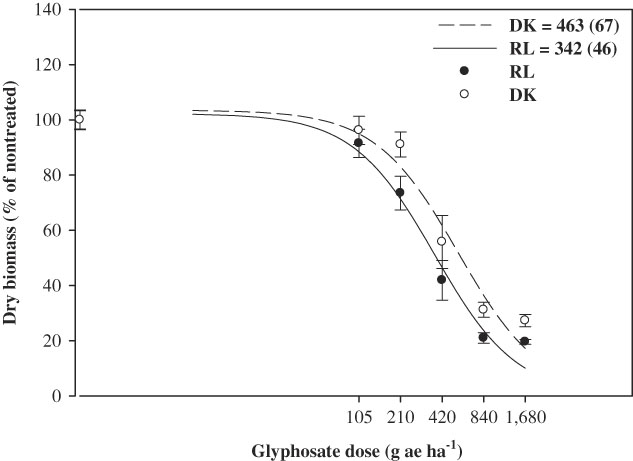
Results indicated that nearly 20% of the DK biotype of common lambsquarters survived treatment with 1,680 g ae ha–1 of glyphosate when assessed 3 WAT (Figure 1). The DK biotype of common lambsquarters required more glyphosate to reduce growth by 50%, as DK biotype had a GR50 of 463 (±67) g ae ha–1 compared to the RL biotype with a GR50 of 341 (±46) g ae ha–1 (Figure 1). There was no difference in value of GR50 estimates (P value = 0.1476). The majority of DK common lambsquarters was controlled with a field rate (840 g ae ha–1) of glyphosate, implying the biotype has not developed resistance to glyphosate. Previously, tolerance of lambsquarters (from Indiana and Ohio) to glyphosate with increase in overall plant growth and biomass relative to susceptible plants was reported (Westhoven et al. Reference Westhoven, Kruger, Gerber, Stachler, Loux and Johnson2008).
Aboveground dry biomass (% of nontreated) analysis of whole-plant glyphosate dose–response of RL (susceptible biotype from Riley County, KS) and DK (glyphosate-resistant biotype from Dickinson County, KS) common lambsquarters. The lines represent dose–response curves and were generated using three-parameter log-logistic model (Equation 1).

Shikimate Accumulation Assay
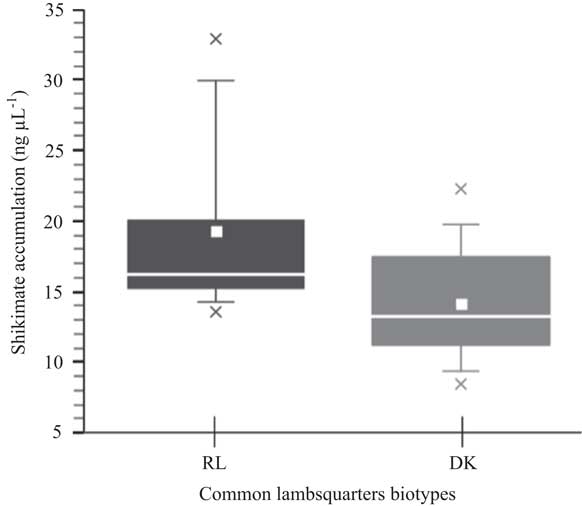
The shikimic acid assay can be used to measure EPSPS inhibition by glyphosate. Glyphosate inhibits production of the aromatic amino acids in the shikimic acid pathway, causing a buildup of shikimate-3-phosphate, a substrate of EPSPS and its dephosphorylated state, shikimate (Shaner et al. Reference Shaner, Nadler-Hassar, Henry and Koger2005). The DK and RL plants accumulated 14.9 and 19.2 ng µL–1 of shikimate, respectively (Figure 2), suggesting that the DK biotype was slightly more tolerant to glyphosate. Approximately one-half of the plants from the DK biotype of common lambsquarters accumulated as much shikimate (ng µL–1) as the RL plants (Figure 2). Individual plants from the DK biotype expressed variation in shikimate accumulation in response to glyphosate application, suggesting that the plants of DK biotype exhibit variation for sensitivity to glyphosate.
Shikimate accumulation in RL (susceptible biotype from Riley County, KS) and DK (glyphosate-resistant biotype from Dickinson County, KS) common lambsquarters upon glyphosate treatment (100 µM). The tails represent minimum and maximum values. The boxes represent the 50th percentile of those values. The solid line represents the median (most frequent) observation.

Growth Stage and Glyphosate Efficacy
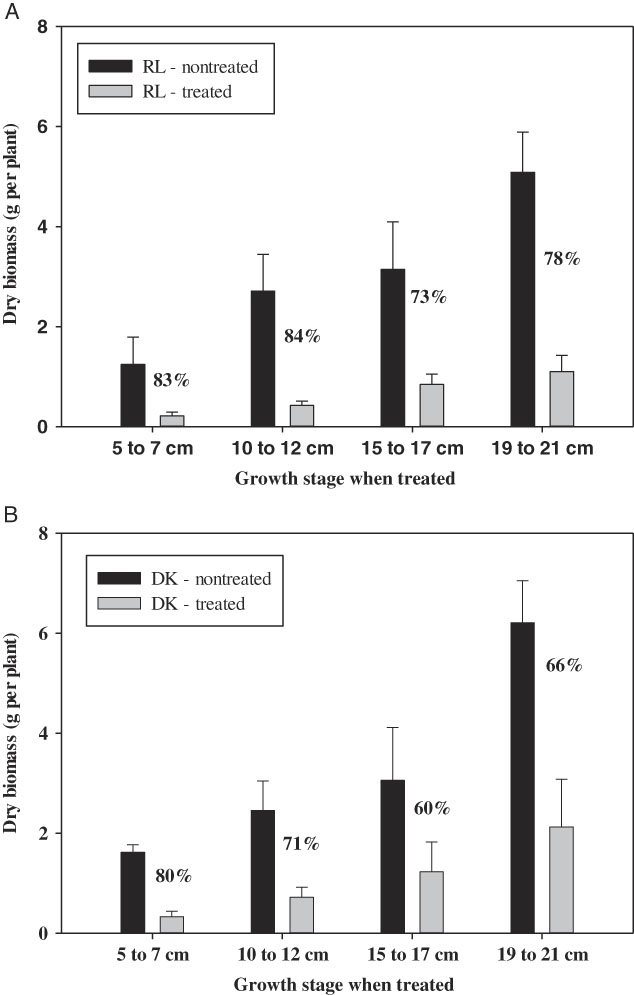
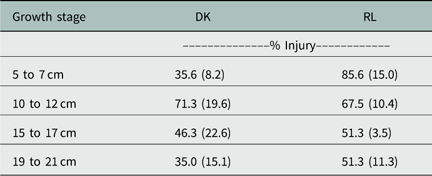
Glyphosate was more effective on common lambsquarters when the plants were treated at early stages (5 to 7 cm and 10 to 12 cm tall) compared to later stages (15 to 17 cm and 19 to 21 cm tall) (Table 1). In general, 65% to 85% injury was recorded 2 WAT when 840 g ae ha–1 of glyphosate was applied to 5- to 7-cm-tall plants of RL or DK biotypes, but injury was less than 50% when glyphosate was applied to 19- to 21-cm-tall plants. At least half of the 15- to 17-cm and 19- to 21-cm tall plants of both RL and DK biotypes survived the field rate of glyphosate. The surviving plants were stunted with some visible chlorosis and slow growth. By 2 WAT, the surviving plants began to regrow from near the lower branches, indicating a recovery from the glyphosate treatment (data not shown). Reductions in common lambsquarters biomass were recorded at 3 WAT (Figure 3). In response to glyphosate treatment, the reduction in biomass was less in 19- to 21-cm tall plants when compared to 5- to 7-cm tall plants (Figure 3). Irrespective of the biotype, control of smaller common lambsquarters plants (5 to 7 cm) with glyphosate was greater compared to larger plants (19 to 21 cm) (Figure 3). Results of the growth stage and glyphosate efficacy study were similar to findings of Schuster et al. (Reference Schuster, Shoup and Al-Khatib2007), where increased glyphosate injury was observed on 2.5- and 7.5-cm-tall common lambsquarters plants compared to 15-cm-tall plants. Schuster et al. (Reference Schuster, Shoup and Al-Khatib2007) also reported new growth on lateral and basal branches of 15-cm-tall plants surviving glyphosate at 1,100 g ae ha–1 application.
Dry biomass (g plant-1±SE) of RL (A) and DK (B) biotypes of common lambsquarters that were nontreated and treated with glyphosate (840 g ae ha–1) at different growth stages by 3 WAT. Percent values represent reduction in dry biomass between nontreated and treated within each growth stage. RL, susceptible biotype from Riley County, KS; DK, glyphosate-resistant biotype from Dickinson County, KS.

Visual estimates of plant injury (%) at 2 WAT of Dickinson County (DK) and Riley County (RL) biotypes of common lambsquarters when treated with glyphosate (840 g ae ha–1) at different growth stages.Footnote a

a The numbers in parentheses represent the standard error of the mean.
Growth Temperature Effect on Glyphosate Efficacy
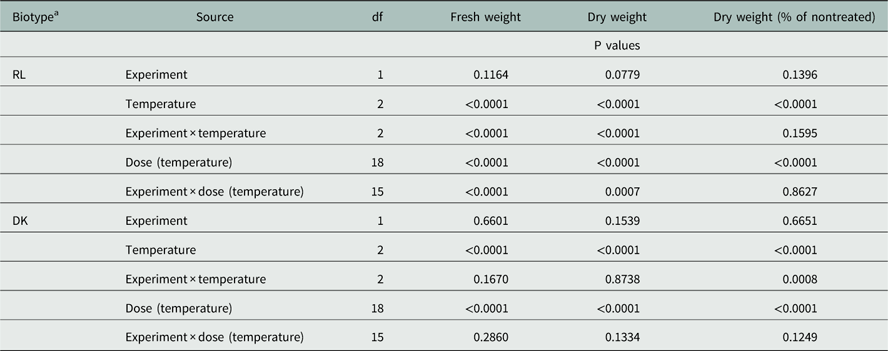
The analysis of combined experiments indicated that there were significant interactions for experiment with temperature and with dose within temperature for both fresh and dry biomass for RL biotype (Table 2). There were no significant interactions for experiment with temperature or with dose within temperature for fresh or dry biomass for DK biotype. The standardization of dry biomass as percentage reduction of nontreated controls resulted in no significant interactions of experiment with dose within temperature for either biotype. There was a significant interaction of experiment with temperature for DK biotype (Table 2).
Summary of P values for the ANOVA describing the effect of glyphosate dose nested within growth temperature across multiple experiments on fresh weight, dry weight, and percentage reduction of dry weight relative to nontreated of RL and DK biotypes of common lambsquarters.

Abbreviations: DK, glyphosate-resistant biotype from Dickinson County, KS; RL, susceptible biotype from Riley County, KS.
For the RL biotype, differences between experiments for each temperature condition resulted in very different dry biomass amounts per common lambsquarters plant. In experiment 1, dry biomass of nontreated common lambsquarters plants was 0.29±0.05 g (mean±SE) when grown at low temperature (25/15 C), compared to 1.07±0.08 g at medium temperature (32.5/22.5 C), and 0.24±0.03 g at high temperatures (40/30 C) (data not shown). In experiment 2, dry biomass of nontreated plants was 0.87±0.19 g when grown at low temperature, compared to 0.79±0.13 g at medium temperature, and 0.23±0.06 g at high temperatures (data not shown). For the DK biotype, dry biomass of the nontreated common lambsquarters plants was 2.7±1.0 g when grown at low (25/15 C), compared to 1.1±0.3 g at medium (32.5/22.5C), and 0.5±0.2 g at high (40/30 C) temperatures (data not shown).
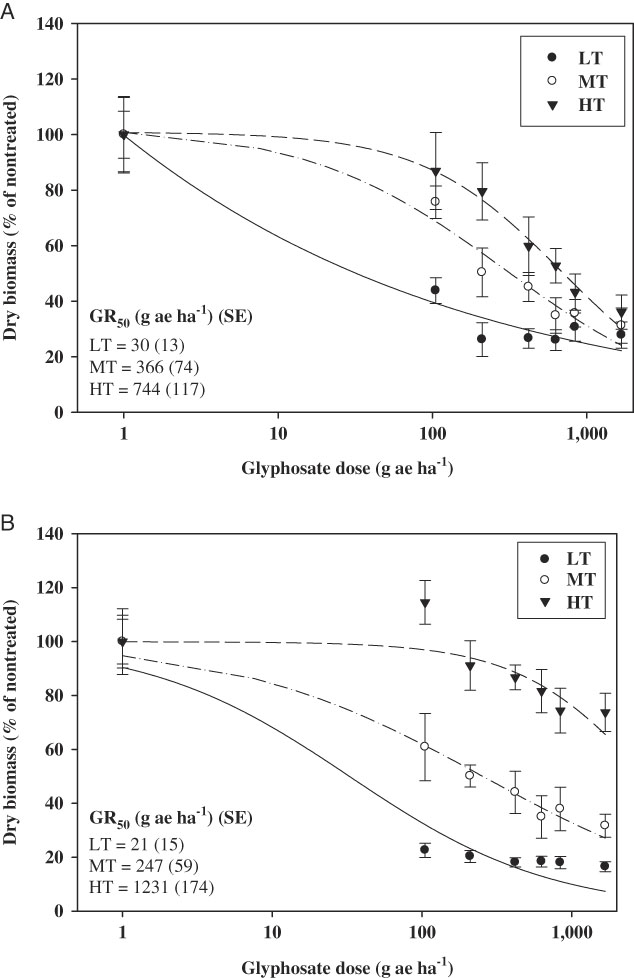
Glyphosate was more effective on common lambsquarters when grown under low (25/15 C) compared to medium (32.5/22.5 C) or high (40/30 C) temperatures (Figure 4). By 2 WAT, glyphosate rates required to reduce dry biomass of RL and DK biotypes were less for common lambsquarters plants grown at low temperature than at high temperature (Figure 4). The results suggest greater efficacy of glyphosate at lower temperatures on common lambsquarters. Results of previous studies examining the effect of air temperature and relative humidity on glyphosate efficacy were inconsistent. Increased absorption of glyphosate under high air temperature and relative humidity has been reported (Adkins et al. Reference Adkins, Tanpipat, Swarbrick and Boersma1998; McWhorter and Azlin Reference McWhorter and Azlin1978), whereas an opposite effect (Waltz et al. Reference Waltz, Martin, Roeth and Lindquist2004) or no relationship were also documented (Sivesind et al. Reference Sivesind, Gaska, Jeschke, Boerboom and Stoltenberg2011). Results of the growth temperature effects on glyphosate efficacy study suggest that efficacy was reduced when common lambsquarters were grown at higher temperatures. Similar results were reported by Tanpipat et al. (Reference Tanpipat, Adkins, Swarbrick and Boersma1997) in barnyardgrass [Echinochloa colona (L.) Link], where greater temperatures (35/30 C day/night) reduced glyphosate efficacy under severe water stress (29% of field capacity). Tanpipat et al. (Reference Tanpipat, Adkins, Swarbrick and Boersma1997) suggested that higher temperatures stressed the plants as a result of greater evapotranspiration, which reduced glyphosate translocation and efficacy. High temperatures tend to interfere with the delivery of the lethal dose of glyphosate required to inhibit the function of the target site and eventual death of the plant (Sammons and Gaines Reference Sammons and Gaines2014).Temperatures at which the common lambsquarters were grown in this study also had a significant effect on plant growth and development and thereby, possibly glyphosate efficacy. Plants produced more biomass when grown at lower temperatures compared to the slower growth and reduced biomass observed at higher temperature (Figure 4). Although plants at lower temperatures were larger, such as 0.87±0.19 g for RL in experiment 2 and 2.7±1.0 g for DK, glyphosate efficacy was still greater at lower rates than when applied to plants that were smaller, such as for 0.23±0.06 g for RL and 0.45±0.1 g for DK biotypes, at higher temperatures. Plant metabolism (photosynthesis, phloem and xylem transport) probably was greater in faster growing plants. Because glyphosate is a systemic herbicide, it can translocate rapidly in a faster growing plant, resulting in greater efficacy (Whitwell et al. Reference Whitwell, Banks, Basler and Santelmann1980).
Whole-plant glyphosate dose–response of RL (A) and DK (B) common lambsquarters 2 WAT based on percent dry biomass reduction at low (LT, 25/15 C), medium (MT, 32.5/22.5 C), and high (HT, 40/30 C) day/night temperatures. The lines represent response curves and were generated using two-parameter log-logistic model (Equation 2). RL, susceptible biotype from Riley County, KS; DK, glyphosate-resistant biotype from Dickinson County, KS.

Glyphosate efficacy was reduced at high temperatures regardless of the biotype, as evident from the percentage biomass reduction (Figure 4A, B). The DK and RL biotypes had GR50 values of 1,231 and 744 g ae ha–1, respectively, at high temperatures. The DK biotype requires a greater dose of glyphosate––above the field recommended dose (840 g ae ha–1)––to elicit the same response when grown at high temperatures. Nguyen et al. (Reference Nguyen, Malone, Boutsalis, Shirley and Preston2016) also observed a significant reduction in glyphosate efficacy on resistant populations of junglerice [Echinochloa colona (L.) Link] grown at 30 C compared with 20 C. Reduced glyphosate efficacy in these populations was attributed to reduced glyphosate translocation, which further limits the internal glyphosate concentration that is needed to enter the chloroplast. Thus, the DK biotype possibly require a much higher glyphosate concentration outside the cell so as to exert a similar lethal effect observed in susceptible populations.
Overall, the results of this research suggest that the DK biotype of common lambsquarters exhibited reduced sensitivity to glyphosate compared to the RL biotype. Although the response of the DK biotype to glyphosate treatment was not different from the RL, the efficacy of glyphosate was reduced at all the growth stages and across the three temperatures for DK biotype. The reduced sensitivity might have contributed to the failure of control with glyphosate applications observed under field conditions.
Although resistance to glyphosate in common lambsquarters has not been confirmed, varying response among plants and biotypes brings practical problems to weed control. The expansive adoption of glyphosate-resistant crops has led to development of weed species becoming more tolerant or resistant to glyphosate. Crop producers should be more proactive in utilizing diverse weed management strategies rather than relying on a single herbicide option for weed control. Use of various mixtures and herbicide modes of action will help slow the evolution of herbicide resistance. The results of this research suggest that it is possible to increase the efficacy of glyphosate on common lambsquarters by applying to smaller plants or at cooler temperatures, and confirms that there is significant variation in common lambsquarters response to glyphosate in Kansas.
Acknowledgments
This research received no specific grant from any funding agency, commercial, or not-for-profit sectors. This manuscript is approved for publication as Kansas Agricultural Experiment Station contribution no. 17-317-J. No conflicts of interest have been declared.