Implications
The present study elucidates how extrusion of faba bean seeds influence performance, digesta and endogenous losses in broiler chickens. The study demonstrates a positive effect of extrusion on the determined parameters as confirmed by changes in the chemical composition of materials after extrusion. The obtained results showed that extruded faba bean seeds can be used as a good source of protein and starch in broiler chicken nutrition.
Introduction
Soybean meal is the main protein source used in poultry diets all over the world. This component is very popular because it is characterized by a high CP content and good amino acid (AA) profiles. Although soybean meal is the main protein component in poultry nutrition, the increasing price of this raw material reduces the profitability of poultry production. As a result, it has become necessary to look for alternative protein components which can fully or partially replace soybean meal in poultry nutrition. One of the alternative protein sources for broiler chickens is faba bean (Vicia faba L.). Seeds of this legume are characterized by moderately high protein levels and their AA profiles are similar to soybean meal with the exception of sulfur AAs (Hejdysz et al., Reference Hejdysz, Kaczmarek and Rutkowski2016a). However, utilization of faba bean seeds in poultry diets must be limited, due to their high concentration of resistant starch (RS) and the presence of anti-nutritional factors (e.g. tannins, phytic phosphorus (phytic P), raffinose family oligosaccharides (RFO) and non-starch polysaccharides) (Diaz et al., Reference Diaz, Morlacchini, Masoero, Moschini, Fusconi and Piva2006; Hejdysz et al., Reference Hejdysz, Kaczmarek and Rutkowski2016a). According to some researchers, RS is the sum of starch as well as starch degradation products not absorbed in the small intestine (Englyst et al., Reference Englyst, Kingman and Cummings1992). Faba bean starch, in view of its structure (high amylose level), is a type C RS (Gunawardena et al., Reference Gunawardena, Zijlstra and Beltranena2010), which is characterized by its slow digestibility in the bird gastrointestinal tract (Weurding et al., Reference Weurding, Veldman, Veen, van der Aar and Verstegen2001). Modern faba bean varieties contain a small amount of tannins. However, they still contain other anti-nutritional factors and RS, which can affect both the digestibility of nutrients and the AMEN value. Extrusion is one of technological processes, which can increase the use of faba beans in poultry nutrition. During this process, seeds are subjected to high temperature and pressure for a relatively short period of time (Bjork and Asp, Reference Bjork and Asp1983). The main advantage of the extrusion process is disruption of the grain structure, starch gelatinization and protein denaturation, as well as inactivation of heat-labile anti-nutritional factors, such as protease inhibitors and phytic P (Nalle et al., Reference Nalle, Ravindran and Ravindran2011; Hejdysz et al., Reference Hejdysz, Kaczmarek and Rutkowski2016a and 2016Reference Hejdysz, Kaczmarek and Rutkowskib; Hejdysz et al., Reference Hejdysz, Kaczmarek, Adamski and Rutkowski2017), which increase starch and protein digestion. One of the parameters which can prove the usefulness of extruded faba bean seeds in poultry nutrition is the content of sialic acid in excreta. Studies published so far have shown that the concentration of dietary fiber as well as anti-nutritional factors in feed components (Nyachoti et al., Reference Nyachoti, deLange, McBride and Schulze1997; Kaczmarek et al., Reference Kaczmarek, Hejdysz, Kubiś and Rutkowski2016) can influence mucin production and increase endogenous losses. Sialic acid, referred to as one of the components of the intestinal mucin, may be an indicator of endogenous losses (Cowieson et al., Reference Cowieson, Acamovic and Bedford2004). The analysis of this parameter will answer the question whether or not the extrusion of faba beans can reduce endogenous losses. Very little information can be found in the literature on the effect for broiler diets of the extrusion of new, low tannin faba bean cultivars on broiler chicken performance, nutrient digestibility and meat quality. Diaz et al. (Reference Diaz, Morlacchini, Masoero, Moschini, Fusconi and Piva2006) showed that a high level of extruded faba bean seeds does not influence broiler chicken performance, whereas in our earlier study, extrusion of pea seeds reduced feed intake (FI) and positively affected feed conversion ratios (FCRs) (Hejdysz et al., Reference Hejdysz, Kaczmarek, Adamski and Rutkowski2017). The analysis of raw and extruded seeds of peas and faba beans showed a similar effect of extrusion on the content of RS and anti-nutritional factors (Hejdysz et al., 2016Reference Hejdysz, Kaczmarek and Rutkowskia and 2016Reference Hejdysz, Kaczmarek and Rutkowskib); therefore, we can speculate that the effect of faba bean extrusion on broiler performance will be similar to that shown in our earlier study on extruded pea seeds (Hejdysz et al., Reference Hejdysz, Kaczmarek, Adamski and Rutkowski2017). Extrusion is a process which can change the structure of seeds (Nalle et al., Reference Nalle, Ravindran and Ravindran2011), but its effect on meat quality is not known. In the current literature, there is no information on the impact of legume seed extrusion on broiler meat quality. In publications about pig nutrition, only one research paper can be found presenting the effect of legume extrusion on meat quality (Chrenková et al., Reference Chrenková, Formelová, Chrastinová, ľak, Čerešňáková, Lahučký, Poláčiková and Bahelka2011), whereas the effect of extrusion on broiler meat quality has not been studied.
The aim of the present study was to investigate the effect of faba bean seed extrusion on broiler chicken performance, nitrogen-corrected apparent metabolizable energy values (AMEN), nutrient utilization and chicken meat quality, as well as excretion of total and free sialic acids. The tested hypothesis is: high temperature accompanying the extrusion process can decrease the content of RS and phytic P. This, in turn, improves nutrient digestibility, AMEN value and decreases endogenous losses exerting a positive effect on broiler chicken performance.
Material and methods
Faba bean seeds
The experiment used faba bean seeds (Vicia faba, Amulet cv.) characterized by a low tannin content and harvested in 2016. Seeds were obtained from the Plant Breeding Stations in Strzelce, Łódż Voivodeship, Poland. Part of faba bean seeds were extruded using a Single-Screw KMZ 2 extruder (Russia) (500 kg/h). The conditions for the extrusion process were as follows: moisture about 16%, exposition time 10 s, temperature 135±10°C and pressure of 30 kg/cm2. The extruded seeds were allowed to cool down to room temperature and ground in a laboratory grinder with 3.18 mm sieve (Retsch, Haan, Germany), and stored at 4°C.
Bird management and sample collection
In this 35-day study, 160 1-day-old male Ross 308 broiler chicks were bought from a commercial hatchery (Hama Plus S.A., Wolsztyn, Poland). The experimental birds (initial individual weight: 37±2 g) were divided into two groups with 10 replications (floor pens), each replication included eight birds. The first group was fed 300 g/kg diets of raw faba bean seeds, whereas the second – 300 g/kg diets of extruded faba bean seeds. The temperature was maintained at 32°C during the first seven days and then it was gradually reduced to about 23°C at the end of day 21 of the experiment. Fresh water and feed (mash form) were provided ad libitum throughout the whole experiment. Body weight and FI were controlled after days 14 and 35 (the end of the experiment), with the pen as the experimental unit. Before the planned weighing, the experimental birds were fasted for 4 h. Body weight gain (BWG), FI and FCR were used to establish broiler chicken performance.
Collection trays were placed in each floor pen on days 33 and 34 in order to enable excreta collection; 10 excreta samples (one repetition equals eight birds) were collected per group. The experiment was terminated on day 35 and, on that day, 18 chickens from each treatment were slaughtered using CO2 gas according to Close et al. (Reference Close, Banister, Baumans, Bernoth, Bromage, Bunyan, Erhardt, Flecknell, Gregory, Hackbarth, Morton and Warwick1997). Next the ileum was removed and digesta were flushed from the end of the ileum (15 cm, adjacent to the ileo-cecal junction) and pooled by pen (three birds per sample) to secure material for chemical analyses (n=6). Before further treatments, the obtained digesta samples were frozen, freeze-dried and ground. In order to determine meat quality, 10 birds per group (at 35 days of age) were selected for slaughter. The birds were starved for 12 h before slaughter. In a commercial slaughterhouse, the birds were electrically stunned and killed, and after blood removal, were processed and eviscerated. The quality of meat was examined on the right breast (skinless and boneless) and on the right side of the thigh (with skin and bone (g/kg of BW)).
Experimental diets
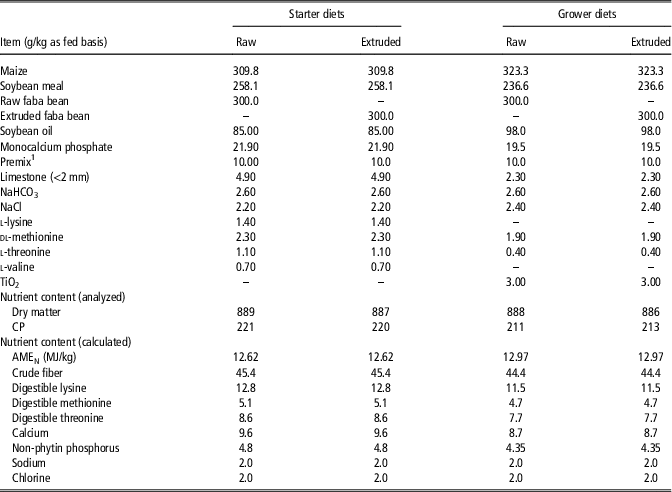
Experimental diets (starter and grower) are presented in Table 1. The nutrient content of the starter and the grower was balanced based on the chemical composition of faba bean seeds (Hejdysz et al., Reference Hejdysz, Kaczmarek and Rutkowski2016a). Experimental diets were corn–faba bean–soybean meal and these were formulated to meet or exceed Aviagen recommendations for broiler chickens (AVIAGEN, 2014). The diets were prepared at the experimental station of the Department of Animal Nutrition (Gorzyń, Poland). All necessary ingredients were ground with an RG11 hammer mill (Zuptor, Gostyń, Poland) with a screen size of 2.0 mm. Titanium dioxide (3.0 g/kg) was supplemented in grower diets, and this was used as an internal marker to calculate the following parameters: dry matter retention (DMR) and nitrogen retention (NR); apparent ileal digestibility (AID) and dietary AMEN values.
Ingredient composition and nutrient content of broiler chicken diets containing faba bean seed meal in raw or extruded form

AMEN = nitrogen-corrected apparent metabolizable energy values.
1 Provides per kilogram diet: IU: retinol 11 250, cholecalciferol 2500; mg: α-Tocopherol 80, menadione 2.50, cyanocobalamin 0.02, folic acid 1.17, choline 379, d-pantothenic acid 12.5, riboflavin 7.0, niacin 41.67, thiamin 2.17, d-biotin 0.18, pyridoxine 4.0, ethoxyquin 0.09, Mn 73, Zn 55, Fe 45, Cu 20, I 0.62, Se 0.3, salinomycin 60.
Chemical analyses
Before chemical analyses, samples of faba bean seeds (raw and extruded) as well as grower diets were ground to pass through a 0.5 mm sieve. Crude protein and ether extract (EE) were analyzed using Association of Official Analytical Chemists (AOAC) methods (2007) 976.05 and 920.39, respectively, in faba bean seeds, grower diets, ileum digesta as well as excreta. Furthermore, ADF and NDF were examined in faba bean seeds and grower diets according to AOAC (2007) (942.05 and 973.18, respectively). Amino acid content and starch was analyzed in the same samples as ADF and NDF. Amino acid was analyzed on an AAA-400 Automatic Amino Acid Analyzer, using ninhydrin for post-column derivatization. Before analyses, samples were hydrolyzed with 6 NHCl for 24 h at a temperature of 110°C (procedure 994.12; AOAC (2007)). Starch content was investigated using an agricultural diagnostic assay kit (Megazyme International) utilizing thermostable α-amylase and amyloglucosidase according to AOAC (2005) (method 996.11). Gross energy was analyzed in experimental diets as well as excreta using an adiabatic bomb calorimeter (KL 12Mn; Precyzja-Bit PPHU, Poland) standardized with benzoic acid. Total and free sialic acids were analyzed according to Jourdian et al. (Reference Jourdian, Dean and Roseman1971), while crude mucin was extracted from excreta according to the methods described by Lien et al. (Reference Lien, McBurney, Beyde, Thomson and Sauer1996). Titanium dioxide was determined according to Short et al. (Reference Short, Gorton, Wiseman and Boorman1996), while experimental samples were prepared according to the procedure described by Myers et al. (Reference Myers, Ludden, Nayigihugu and Hess2004). Resistant starch was analyzed in faba bean seeds and experimental grower diets, using the methods presented by Englyst et al. (Reference Englyst, Kingman, Hudson and Cummings1996) and Weurding et al. (Reference Weurding, Veldman, Veen, van der Aar and Verstegen2001). Raffinose family oligosaccharides were extracted from raw and extruded faba bean samples as well as experimental grower diets and analyzed by high-resolution gas chromatography, according to Zalewski et al. (Reference Zalewski, Lahuta and Horbowicz2001). Phytate was also analyzed in the experimental raw and extruded faba bean seeds and grower diets according to the method described by Haug and Lantzsch (Reference Haug and Lantzsch1983).
In order to determine the physicochemical properties of the meat, the acidification of muscle tissue in the right breast and right thigh was measured twice: pH – 15 min after slaughter and pH – 24 h after slaughter using a CX-701 pH meter (Elmetron, Poland). The water-holding capacity of meat was determined using the modified method of Reference Grau and HammGrau and Hamma (1952). For the analysis, a 300 mg meat sample was placed on Whatman 1 paper (GE Healthcare, Chicago, IL, USA), and the samples were subjected to a uniform load of 2 kg for 5 min. The water-holding capacity of meat was calculated based on the difference.
Calculations
The following parameters were calculated in relation to the ratio of titanium dioxide to the concentration of the nutrient in question in the feed, digesta or excreta: AID, DMR, NR and AMEN values. Equations used to calculate these parameters were presented in Hejdysz et al. (Reference Hejdysz, Kaczmarek, Adamski and Rutkowski2017).
Statistical analysis
All obtained data had been explored earlier in order to reject any possible outliers. Analyses were executed using SAS Software (distribution analyses; outliers were defined as observations whose distance to the location estimate exceeded three times standard deviation) (SAS, 2012). All the obtained results for experimental groups were compared using the Student’s t-test on the basis of the following formula:
 $$t{\equals}{{\overline{{X_{1} }} {\minus}\overline{{X_{2} }} } \over {\sqrt {{{s_{1}^{2} } \over {n_{1} }}{\plus}} {{s_{2}^{2} } \over {n_{2} }}}}$$
where, t is the Student’s t-test value,
 $$\overline{{X_{1} }} {\minus}\overline{{X_{2} }} $$
the difference in the means between the two groups being compared;
 $$s_{1}^{2} ,s_{2}^{2} $$
are variance estimates from each independent group, n
1, n
2 the respective sample sizes for each independent group. In this study, the standard error of the mean was established as a measure of error.
Results
Chemical composition of faba bean samples and grower diets
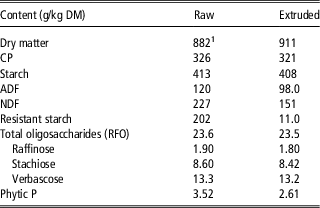
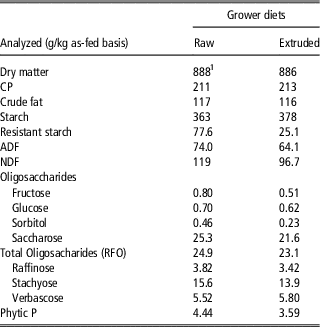
The analyzed composition of faba bean samples is presented in Table 2, whereas grower diets are presented in Table 3. There was no significant difference between raw and extruded faba bean seed samples in terms of the concentrations of CP and starch. Similar results were found in grower diets. The level of RS in faba bean samples and grower diets was reduced after extrusion, on average by 95% for faba bean samples and by 67% for grower diets. Faba bean seeds in extruded form and extruded diets were characterized by lower concentrations of NDF and ADF, which were reduced by approximately 33% and 18% for faba bean samples as well as 19% and 13% for grower diets. The concentration of RFO was similar in raw and extruded faba bean seeds, whereas the content of raffinose and stachyose was a little lower in extruded grower diets. Similar lower concentrations of the remaining oligosaccharides (e.g. sorbitol) were found for grower diets with extruded faba seeds. Extruded faba bean samples and grower diet were found to contain, respectively, 35% and 24% lower concentration of phytic acids in comparison with raw faba bean samples and grower diets.
Chemical composition of raw and extruded faba bean seeds used in broiler chicken diets

RFO = raffinose family oligosaccharides; Phytic P=phytic phosphorus.
1 Mean value of quadruplicate analyses.
Analyzed nutrient content of broiler chicken grower diets containing faba bean seed meal in raw or extruded form

RFO = raffinose family oligosaccharides; Phytic P=phytic phosphorus.
1 Each value represents mean of two replicates.
Performance
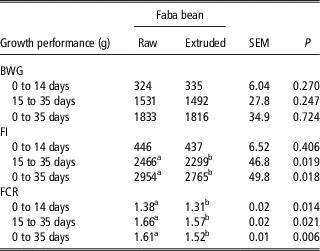
Birds remained healthy throughout the 35-day experimental period. The death rate did not exceed 1%. Table 4 shows the impact of faba bean seed extrusion on broiler chicken performance. The process failed to affect broiler chicken BWG in any of the studied periods. During to first experimental period (0 to 14 days), both experimental groups were characterized by a similar FI. However, extrusion decreased the amount of FI in the second (15 to 35 days) and entire experimental period (0 to 35 days). Faba bean extrusion was found to have a positive impact on FCR in all experimental periods (P>0.05).
Growth performance (g) in broiler chickens fed diets containing faba bean seeds in raw or extruded form 1

BWG = BW gains; FI = feed intake; FCR = feed conversion ratio.
1 Each value represents mean of ten replicates.
a,bValues within a row with different superscripts differ significantly at P<0.05.
Dietary utilization and excretion of total and free sialic acid
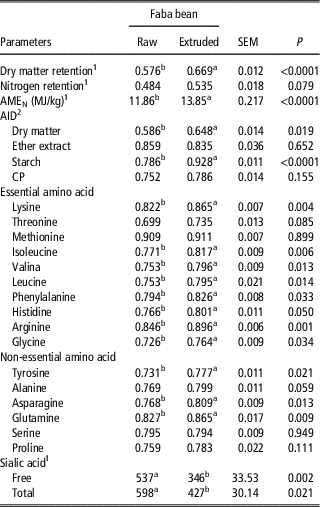
The effect of faba bean extrusion on nitrogen and DM retention, AMEN values, nutrient AID and the content of total and free sialic acid in digesta is presented in Table 5. Extrusion of faba bean seeds significantly improved DMR, whereas for NR – only a positive tendency was confirmed (P=0.079). A beneficial effect of extrusion was also found in terms of AMEN values. Metabolizable energy in groups with extruded faba bean was about 2 MJ/kg higher than in control groups. There was no significant effect of extrusion on EE or CP AID. The extrusion process improved by, respectively, 11% and 18% (P<0.05) AID of DM and starch in comparison with raw faba bean seeds. In addition, AID of most analyzed essential and non-essential AAs (P<0.05) was found significantly improved as a results of the applied extrusion. A lack of any statistically significant effect of extrusion was found only for Met, Ser and Pro (P>0.05), whereas for Thr and Ala, a positive tendency was found (P<0.10). The greatest enhancement was observed for Ile, Val, Leu, Arg and Tyr (about 6%), whereas the lowest was estimated for Phe (about 4%). Broiler chickens fed diets with extruded faba bean seeds were characterized by significantly lower exogenous losses and by lower excretion of total and free sialic acid in comparison with the control group. These differences amounted to ~30%.
The effect of faba bean extrusion on dry matter and nitrogen retention, AMEN value (MJ/kg), apparent ileal digestibility of nutrients and the excretion of total and free sialic acid (μmol/g of TiO2) from broiler chickens at 5 weeks of age

AMEN = nitrogen-corrected apparent metabolizable energy values; AID = apparent ileal digestibility.
1 Each value represents mean of ten replicates.
2 Each value represents mean of six replicates.
a,bValues within a row with different superscripts differ significantly at P<0.05.
Breast and thigh muscle quality
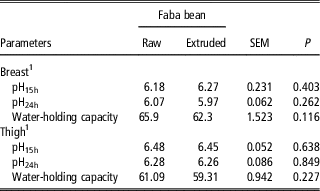
Physical properties of breast and thigh muscles are presented in Table 6. Extrusion of faba bean seeds did not significantly affect the acidification of muscle tissue in the breast or thigh (P>0.05). Similar results were confirmed for water-holding capacity in broiler breast or thigh muscles.
Physical properties of breast and thigh muscles of broiler chickens

1 Each value represents mean of ten replicates.
Discussion
Analyses of their chemical composition showed that faba bean seeds were a good source of protein and starch for broilers. Polish faba bean varieties were characterized by a slightly higher CP content than in previous studies (Moschini et al., Reference Moschini, Masoero, Fusconi, Morlacchini, Prandini and Piva2005), but the results were similar to those presented by Hejdysz et al. (Reference Hejdysz, Kaczmarek and Rutkowski2016a). In the studies presented by Mikulski et al. (Reference Mikulski, Juskiewicz, Przybylska-Gornowicz, Sosnowska, Slominski, Jankowski and Zdunczyk2017), the starch content was similar to our research. However, the level demonstrated in these studies was higher than that published in Moschini et al. (Reference Moschini, Masoero, Fusconi, Morlacchini, Prandini and Piva2005) –327 g/kg. The NDF, ADF, RS, RFO and phytic P concentrations were very similar to those of the same cultivar presented in our earlier study (Hejdysz et al., Reference Hejdysz, Kaczmarek and Rutkowski2016a). The applied extrusion process had no impact on CP, starch content in faba bean seeds as well as on experimental diets. These results are in keeping with earlier experiments on faba bean seeds (Diaz et al., Reference Diaz, Morlacchini, Masoero, Moschini, Fusconi and Piva2006; Hejdysz et al., Reference Hejdysz, Kaczmarek and Rutkowski2016a) and peas (Hejdysz et al., Reference Hejdysz, Kaczmarek, Adamski and Rutkowski2017). However, they differ from studies on peas carried out by Alonso et al. (Reference Alonso, Aguirre and Marzo2000), who found that CP and starch content decreased following extrusion, which can be attributed to differences in the methodology, among others, the type of the used extruder. Levels of RS in faba bean samples and grower diets changed following extrusion. Some researchers claim that RS is frequently analyzed as the sum of starch and starch degradation products not absorbed in the small intestine (Englyst et al., Reference Englyst, Kingman and Cummings1992). Due to its high amylose level, faba bean starch is a type C-RS (Gunawardena et al., Reference Gunawardena, Zijlstra and Beltranena2010), characterized by slow digestibility in the birds’ gastrointestinal tract (Weurding et al., Reference Weurding, Veldman, Veen, van der Aar and Verstegen2001). That is why part of the starch from legume seeds cannot be digested and finds its way to RS. One of the advantages of the extrusion process is a high level of starch gelatinization and disruption of grain structure (Nalle, Reference Nalle2009). According to Nalle (Reference Nalle2009), starch crystallinity after extrusion is disrupted and the substrate availability to enzymes is higher, which was also confirmed in our study (Table 5). The extrusion process changed levels of NDF and ADF in faba bean samples and grower diets. Our earlier studies confirmed the lower content of these components in extruded seeds and formulated diets (Hejdysz et al., Reference Hejdysz, Kaczmarek and Rutkowski2016a and 2016Reference Hejdysz, Kaczmarek and Rutkowskib; Hejdysz et al., Reference Hejdysz, Kaczmarek, Adamski and Rutkowski2017). Similar results were also reported in other publications (Diaz et al., Reference Diaz, Morlacchini, Masoero, Moschini, Fusconi and Piva2006; Sobota et al., Reference Sobota, Sykut-Domańska and Rzedzicki2010). The above-mentioned changes are difficult to explain, but as already discussed by Hejdysz et al. (Reference Hejdysz, Kaczmarek, Adamski and Rutkowski2017), in comparison with the control, the concentration of oligosaccharides (especially, raffinose, stachiose and verbascose) in extruded faba bean seeds and extruded grower diets was lower. These results contradict the result of our earlier publications (Hejdysz et al., Reference Hejdysz, Kaczmarek and Rutkowski2016a; Hejdysz et al., Reference Hejdysz, Kaczmarek, Adamski and Rutkowski2017). In the described experiment, extrusion decreased phytic P level in faba bean samples and grower diets. These results agree with our earlier studies (Hejdysz et al., Reference Hejdysz, Kaczmarek and Rutkowski2016a and 2016Reference Hejdysz, Kaczmarek and Rutkowskib) as well as other publications (Alonso et al., Reference Alonso, Aguirre and Marzo2000). According to Alonso et al. (Reference Alonso, Aguirre and Marzo2000), in the course of extrusion, some molecules of inositol hexaphosphate were hydrolyzed to penta-, tetra- and triphosphates affecting phytic P content in extruded seeds.
Extrusion of the studied legume did not significantly affect BWGs of broilers in any of the studied periods. Similar data were presented by Diaz et al. (Reference Diaz, Morlacchini, Masoero, Moschini, Fusconi and Piva2006) after 48% inclusion of extruded faba bean seeds in broiler diets. In our experiment, broiler chicken FI and FCRs were affected positively by the applied extrusion process contradicting the results of Diaz et al. (Reference Diaz, Morlacchini, Masoero, Moschini, Fusconi and Piva2006) in which they reported no impact of the extrusion process on broiler chicken performance. This difference can be attributed to the type of the employed extruder: for example, different pressure, temperature, exposure time. Decreased broiler FI and, consequently, FCRs in our study can be attributed to increased nutrient digestibility and AMEN values of faba bean seeds after extrusion. Higher diet nutrient digestibility containing extruded faba bean was probably caused by the destruction of NDF, ADF, RS and phytic P. Our current results are in agreement with data from our earlier studies (Hejdysz et al., Reference Hejdysz, Kaczmarek and Rutkowski2016a and 2016Reference Hejdysz, Kaczmarek and Rutkowskib; Hejdysz et al., Reference Hejdysz, Kaczmarek, Adamski and Rutkowski2017) and other publications (Alonso et al., Reference Alonso, Aguirre and Marzo2000). Moreover, Jang et al. (Reference Jang, Fadel, Klasing, Mireles, Ernst, Young, Cook and Raboy2003) reported a positive effect of a decrease in phytic acid from 0.9 to 0.5 g in broiler diets on broiler performance. In our study, diets with extruded faba bean contained ~0.8 g less phytic P than the control diet. According to Cowieson et al. (Reference Cowieson, Acamovic and Bedford2006), phytic P has a negative effect on CP and AA digestibility. In this study, there was no confirmed effect of extrusion on CP AID, whereas for most AAs such effects were confirmed. According to some researchers, the phytate mechanism action on AA can be explained by the presence of protein–phytic complexes in feed. Selle et al. (Reference Selle, Ravindran, Bryden and Scott2006) maintain that the de novo formation of two-component and ternary protein–phytate complexes in the gastrointestinal tract inhibits the action of proteolytic enzymes and exacerbates losses of endogenous AAs. Furthermore, a negative interaction between phytic P content in faba bean seeds and AAs AID was found in our earlier study (Hejdysz et al., Reference Hejdysz, Kaczmarek and Rutkowski2016a). Therefore, we can speculate that the lower phytic P content in extruded faba beans was the main factor that influenced better AA AID and partially affected a decrease in FI and FCR.
Improved starch digestibility and AMEN value were other factors which influenced lower FI and higher dietary conversion ratio of extruded faba bean diets (Table 5). Our earlier publication (Hejdysz et al., Reference Hejdysz, Kaczmarek and Rutkowski2016b) as well as other studies (Nalle et al., Reference Nalle, Ravindran and Ravindran2011) corroborate positive effects of extrusion on starch digestibility. Starch structure changes, for example, fusion, gelatinization, fragmentation, dextrination and increases in starch digestibility, could result in RS content decrease and, by doing so, influence high AMEN diets with extruded faba beans (Pérez-Navarrete et al., Reference Pérez-Navarrete, González, Chel-Guerrero and Betancur-Ancona2006). According to some researchers, lower contents of phytic P can also affect better starch digestibility and AMEN values (Cowieson et al., Reference Cowieson, Acamovic and Bedford2004). Phytic acid may interfere with starch digestion in two ways: by complexing of Ca, which is necessary for the action of α-amylase; or by complexation of starch (triple ion bridges). Therefore, the lower phytic P content in extruded faba bean diets probably also affected increased starch AID and AMEN values.
Our experiments showed that faba bean extrusion exerted a positive impact on total and free sialic acid excretion. Some researchers (Cowieson et al., Reference Cowieson, Acamovic and Bedford2004) maintain that sialic acid constitutes part of intestinal mucin, which can be determined as mucoprotein production and the loss of intestinal endogenous secretion. Increased endogenous loss of AAs and saccharides, reduced retention of nutrients and AMEN values are associated with increased mucin production (Cowieson et al., Reference Cowieson, Acamovic and Bedford2003). As presented by some scientists, mucin production depends on many factors, for example, dietary fiber and anti-nutritional factors (Nyachoti et al., Reference Nyachoti, deLange, McBride and Schulze1997). Lower mucin production in birds with extruded faba bean through destruction of some anti-nutritional factors and RS was probably one of the main factors that also impacted better AMEN values in our study.
The results of this study prove that application of extruded faba beans in feed has no negative influence on meat quality or its parameters. Similar results have been confirmed for extruded peas in pig trials (Chrenková et al., Reference Chrenková, Formelová, Chrastinová, ľak, Čerešňáková, Lahučký, Poláčiková and Bahelka2011).
Conclusion
The results obtained in this study suggest that extrusion is a process which can increase the use of faba bean seeds in broiler chicken nutrition. The extrusion process affected the chemical composition of faba bean seeds and diets by decreasing the contents of phytic P, ADF, NDF and RS. Broilers fed extruded faba beans were characterized by decreased FI, as well as FCR, without any effect on BWG. The applied extrusion process positively influenced the digestibility of the ileum, starch and most AAs, as well as the content of AMEN. These studies did not confirm any effect of the extrusion process on the quality of meat.
Acknowledgements
The experiment was supported by funds from the programme ‘Improvement of native plant protein feeds, their production, trade turnover and utilization in animal feed’ of the Ministry of Agriculture and Rural Development of Poland.
Declaration of interest
The authors declare that there are no conflicts of interests.
Ethics statement
All research methods and procedures were conducted according to EU directives, and the protocol for this study was approved by the Local Ethics and Animal Experimentation Committee at Poznan University of Life Science, the study adhered to all the requirements in relation to animal welfare.
Software and data repository resources
The data/models regarding the published article are not deposited in any official repository.