



Introduction
During perestroika and after having gained independence, Ukraine publicly disclosed crimes that occurred during the Soviet time and attempted to create a memory about the victims of Soviet repressions. Since then, a victimhood narrative has dominated in Ukraine’s portrayal of the Soviet past that greatly influences the establishment of memorials and museums. Ukrainian mnemonic strategies are not exclusive or unique but rather serve as an additional example of a universal Eastern European tendency in dealing with the communist past. Almost every post-communist country established a narrative of national suffering under communist rule. By elaborating this narrative, memorials and museums of post-communist countries create a symbolic “community of memory,” producing a knowledge about inhuman communist regimes responsible for millions of victims and developing a large-scape map of communist victimhood in Eastern Europe.
The topic of political repressions is primarily exploited in memorials and exhibitions located in formidable locations: in former KGB buildings, prisons, camps, cemeteries, or burial grounds, i.e., memory sites with a terrifying history that impressively testifies to the massive terror under communist rule. Burial grounds are the most important and indicative places in this regard, as they specify how each country makes a tribute to their own dead and deals with the tangible aspects of commemoration such as exhumation, identification, reburial, and developing the landscape. Discovered at the end of the 1980s and the beginning of the 1990s, such places as the Butovo Shooting Range near Moscow, Kuropaty near Minsk, Tuskulėnai park in Vilnius, and Bykivnia near Kyiv, became the most recognizable sites to visibly and symbolically testify to the mass scale of Stalinist repressions infamously known as Stalin’s Purges or the “Great Terror” (1937–1938), one of the bloodiest periods of Soviet history.
Yet, they have been exploited differently in each state’s memory politics, marking national peculiarities in commemoration of victims of Stalin’s Purges and specifying the involvement of a symbolic capital of victimhood in strengthening national identity. In 2001, the Butovo Shooting Range was recognized at the state level as a site of historical heritage of regional importance but is privately operated and memorialized by Russian Orthodox Church (Comer Reference Comer, Frihammar and Silverman2017). Similar to its Russian counterpart, Kuropaty became state-recognized in 2004, but was practically neglected by state authorities, eventually being supported and cared for by activists, relatives of the victims, and non-government organizations (Marples and Laputska Reference Marples and Laputska2020). In 2011, the Tuskulėnai Peace Park Memorial Complex was launched as a separate unit of the state-run Museum of the Occupations and Freedom Fights. Consisting of a museum building and columbarium with remnants of the Soviet victims, it greatly contributed to the state-approved victimhood narrative (Klumbytė Reference Klumbytė and Norris2020).
This article is a case study of the National Historical and Cultural Reserve “Bykivnians’ky Graves,” popularly known as Bykivnia, with a focus on the history of its recognition and martyrological imagology in memorializing victims of Soviet repression. I will discuss Bykivnia in the context of Ukrainian politics of memory, which is considered by many observers as being ambivalent. Oxana Shevel calls it “fractured and contentious” when political elite act as “mnemonic warriors” and create competing accounts for events in the Soviet era (Reference Shevel, Bernhard and Kubik2014, 152). Georgiy Kasianov distinguishes national (nationalistic) and Soviet nostalgic narratives as the two main tendencies in Ukrainian memory politics (Reference Kasianov2022, 390), while Barbara Törquist-Plewa and Iulia Iurchuk recognize anticolonial and national models of remembering, on one hand, and an expression of new subjectivity, transculturality, and hybridity, on the other (Reference Törquist-Plewa and Yurchyk2017, 1–2). In this article, I am going to prove that remembrance of Bykivnia serves as an example of a national (nationalistic) anticolonial narrative, although fractured and contentious in its attempt to introduce new subjectivity and transculturality. Anticolonial is used as a synonym to anti-Soviet and anti-Russian narratives, which have been created by emphasizing that the USSR and now the Russian Federation, in its current iteration, are responsible for the political persecution of Ukrainian people during Soviet regime. As it is, this article contributes both to the knowledge of Bykivnia which is not well researched in Ukrainian and foreign historiographies, as well as to the understanding of peculiarities of Ukrainian memory politics, which singles out Ukraine from other Eastern and Central European countries in how they remember the Soviet past and construct their national identities.
As a starting point of my research, I will use a quote from the article of Iuri Shapoval, a leading Ukrainian historian who specializes on Soviet political repressions and its remembrance in contemporary Ukraine. He stated that Bykivnia – the largest burial ground for the victims of Stalin’s Purge in Ukraine – is “extremely important in the search for our identity” (Shapoval Reference Shapoval2007) highlighting the symbolic meaning of this place in constructing a national identity. Hence, the main aim of this research is to illuminate how the martyrological landscape of Bykivnia reflects the complexity and ambiguity of the Ukrainian victimhood narrative and how remembering this place contributes to the issue of national identity.
At the beginning, I will provide a conceptual framework for my research discussing the memorialization of traumatic events and mourning as an approach in commemoration, the martyrdom paradigm of remembrance, the phenomenon of cemeteries as memory places and specifically of burial grounds. I will then examine the development of memory about Soviet repression and terror in contemporary Ukraine, which will provide an appropriate context for understanding the peculiarities of the Bykivnia memorialization. I will divide the analysis of Bykivnia into five sections: in the first, I will explore the history of recognizing the location as a burial site for victims of Stalinist repression, then I will proceed with the study of how the memorialization of Bykivnia occurred with its political usage, then I will turn to the creation of Bykivnia as a martyrological landscape with in-depth analysis of the establishment of “Polish military cemetery” within Ukrainian National Reserve and the ever increasing domestic and international contradictions regarding the memorialization of Bykivnia, and I will finalize with a discussion of the National Reserve’s recent activities to provide an understanding of its role in promoting knowledge about political repressions.
I am arguing that Bykivnia exemplifies and mirrors Ukrainian memory in transition, as a post-Soviet state using the victimhood narrative as a building tool for (re)establishing national identity. Yet, although involved in identity construction, Bykivnia is still overshadowed by the Ukrainian memory of the Holodomor as well as the Polish memory of Katyń, highlighting contradictions of the victimhood narrative at the domestic and international levels.
Mourning for Martyrs in a Landscape of the Unburied Past (Some Theoretical Remarks)
While theorizing atrocities, man-made catastrophes, and state violence, researchers exploit the term “trauma” in narrations about a “traumatic past” or “historical trauma.” Alexander Etkind proposes use of a generational principle while working with the trauma theoretical paradigm. He classifies a generational attitude to the traumatic events: “mass graves for the generation of terror, trauma for the first post-catastrophic generation, and mourning for the second” (Etkind Reference Etkind2013, 3). Etkind explains the “trauma” concept as “a response to a condition that had been experienced by the self”; and in his research, he prefers to use the concept of “mourning” as “response to condition of the others,” indicating that the “mourning is all about representation” (Reference Etkind2013, 14). The researcher introduces the term “mimetic mourning”: “a recurrent response to loss that entails a symbolic reenactment of the loss” (2013, 1).
In the context of post-communist mnemonic representations predetermined by the search for justice, the importance of political reasoning started to play an important role: a symbolic reenactment of the loss intertwined with a transformation of the political agenda. Katherine Verdery, studying the reburial of ex-high-ranked political leaders during post-socialist changes, calls this phenomenon “the political lives of dead bodies” (Vendery Reference Verdery1999). This description can be applied to the “ordinary” victims: the materiality of their remnants and symbolical meaning of their deaths can serve political purposes in state-building. For instance, activists initiated an exhumation in Demianiv Laz near Ivano-Frankivs’k, Ukraine, to find evidence of crimes made by the Soviet regime in order to condemn it. It is how “Ukrainians serve their Motherland after their death” (Dobosh Reference Dobosh2009) – this metaphoric statement clearly shows the political undertones for the representation of the “dead bodies.”
Remembering deaths by violence invokes the shift from victimhood to a martyrdom theoretical framework. Paradoxically, the standard definition of “martyr” is hardly applicable for Soviet victims since it foresees the drama of an individual who voluntarily makes a choice to die. The mass-scale of the state terror campaign and the anonymization of victims as well as involuntary nature of their deaths problematizes the usage of the martyrdom paradigm in this case. Uilleam Blacker and Julie Fedor propose that a refashioning of the martyrdom paradigm occurs in Europe, and it is caused by “the protracted and tortuous process of remembering and mourning the unacknowledged victims of successive waves of violence experienced in this part of the world in the twentieth century” (Blacker and Fedor Reference Blacker and Fedor2015, 200). An attempt to reframe the loss, to make a sense of mass violent deaths, to restore the dignity of the victims, as well as to construct new identities for societies in post-catastrophic period determines the “martyr” concept as usable for implementing these tasks. As the researchers point out, “The archetypical figure of the martyr offers a powerful vehicle for the remembering the dead, and a potential tool for making and remaking identity, and especially for cultivating national myths” (Blacker and Fedor Reference Blacker and Fedor2015, 197). As for the Ukrainian context, Blacker identifies a tradition of martyrological thinking in Ukrainian culture and commemorative practices. He distinguishes the literary-intellectual roots of involuntary martyrdom of the 19th century and the radical, voluntary, and violent paradigm of the 20th century (Blacker Reference Blacker2015), stating that they both work for the creation of an image of Ukraine as a crucified nation-martyr.
Cemeteries as mortuary landscapes would be the most evident sites for performing the ritual of mourning. Exemplifying “the intention to remember,” cemeteries can be recognized as iconic places of memory. Pierre Nora stated that lieux de mémoire have a double nature as “a site of excess closed upon itself, concentrated in its own name, but also forever open to the full range of its possible signification” (Nora Reference Nora1989, 24). He classifies three characteristics of the lieux de mémoire as being material, symbolic, and functional. Cemeteries are “natural, concretely experienced lieux de mémoire,” “topographical ones, which owe everything to the specificity of their location and to being rooted in the ground” (Nora Reference Nora1989, 22). As for functionality, the mnemonical power of cemeteries can serve pedagogical purposes as edification for the living. Symbolically, cemeteries can perform the dominant and dominated role of lieux de mémoire. The first is primarily imposed by the national authority serving as a site for official ceremonies while the second can be a place of refuge and spontaneous devotion, “where one finds the living heart of memory” (Nora Reference Nora1989, 23). W. Lloyd Warner analyses a cemetery as “a collective representation,” a sacred, symbolic replica of the living community that expressed many of the community’s basic beliefs and values (Warner Reference Warner1959). It is a socially bounded space, marking the relationship between the spiritual dead and secular world of the living, as well as persisting the historical continuity.
Discussing Soviet burial places in the context of theoretical framework for cemeteries, there is a need to point out the crucial differences. Unlike cemeteries as examples of a well-organized mortuary landscape, Soviet burial places were kept secret and hidden so as not to be identified or recognized. It is not about recycling the meaning but creating a sense of the place: to overcome forgetting, to establish a state of being, to immortalize the death, and to deal with the cult of dead.
Canonizing Suffering: Memory about Victims of Soviet Political Repression in Ukraine
Although the topic “Soviet political repression” covers the entire Soviet era, it usually focuses on Stalinism as the most repressive period in Soviet history. Having been previously taboo, historical knowledge about Stalinist repressions started to be released from Moscow, the capital of the USSR, in 1987. Disseminated during perestroika as a result of glasnost policy, information about purges was a “memory project” with a goal to condemn Stalinist crimes in order to reconsider the darkest pages of Soviet history and revive Soviet state-building. Archival documents and research on Stalinist crimes were publicized as the result of public pressure and requests coming from the relatives of victims of political repression who called for their rehabilitation, a restoring of their reputations, as well as from activists and social organizations who wanted to discover previously unknown crimes in the Soviet history. Resurrecting this information about the repressions mobilized the nationalistic movements in many of the Soviet republics and their eventual calls for independence. And after the dissolution of the Soviet Union in 1991, these truths about Stalinist terror were actively used in strengthening anti-Soviet sentiments and promoting nation building in the newly (re)established post-Soviet countries. Ukraine was a pioneering country in this regard, as the revelations of the Soviet repression were used as a cornerstone at the initial stage of Ukrainian independence, and they have remained the core topic of Ukrainian memory politics for more than 30 years.
On July 15, 1988, victims of political repressions in Kyiv were for the first time honored with interfaith memorial services at Bykivnia, highlighting the symbolic value of the site. One year later in 1989, two social organizations, which became leading influential memory stakeholders, were established: the All-Ukrainian Society of Political Prisoners and Repressed and the All-Ukrainian Memorial Society (the Ukrainian branch of Moscow-based “Memorial”).Footnote 1 The main goals of each organization were pretty much the same: to force a restoration of the historical truth and to honor the memory of victims of political repressions; to develop a civil society and a democratic legal state, to prevent a return to totalitarianism; to create society’s values based on democracy and law, to overcome totalitarian stereotypes, and to assert individual rights in political practice and public life.
Soon, popular initiatives were supported and “used” by the newly established state as a “mnemonical security” action: Ukraine was creating its biographical narrative by having declared itself as a victim of the totalitarian regime, providing a strong anti-Soviet discourse, and thus enriched a discourse of independence. On April 17, 1991, just few months before Ukrainian independence, the decree “About rehabilitation of victims of political repression in Ukraine” was issued. It was a one-page long document that does not mention the Soviet state as being responsible for terror and does not provide any guidance as to how to implement the rehabilitation. Yet, as a symbolic act it was still extremely important for introducing the main goal of transitional justice into Ukrainian legislative system: to recognize the suffering of the victims, to restore their dignity, and to ensure that the human rights of the Ukrainian people would be preserved. Since then, at least formally, rehabilitation and remembering victims of the totalitarian regime has been a major priority for the state in its memory projects.
In the following year, by April 1992, Verkhovna Rada (Ukraine’s parliament) issued a special decree “About preparation multi-volume publications of research and documents about victims of political repression,” which foresaw the “Rehabilitated by History” project, as well as an annual journal specifically dedicated to the research of Stalinist repressions. The Academy of Sciences of Ukraine accepted the state-sponsored “Rehabilitated by History” project as a priority activity in researching national history.Footnote 2 The project was conducted in all regions of Ukraine, exemplifying the regional peculiarities of Stalin’s Purges and their remembrance.Footnote 3 From this project, 140 volumes had been planned to be published during 1994–2000s. As the project’s website informs, even with a considerable delay, 120 volumes have already been published listing the details of approximately 700,000 repressed people. This state project also promoted research of the Soviet totalitarian system as a new trend in Ukrainian historiography and currently consists of about 9,000 bibliographical items. Scholars proved the centralized character of Stalinist repressions, which were intended to eliminate opposition and cleanse the state apparatus in order to empower Stalin’s authority; they studied the technology of terror, indicated the general image of the perpetrator, as well as revealed names of victims and circumstances of their arrests and executions. Investigating political repressions, scholars paid special attention to Bykivnia, which was closely associated with this topic. Needless to say, those researchers made a substantial contribution to the recognition of the forested area as a memorial site (Bazhan Reference Bazhan2000; Biliashivs’ky and Sheptyts’ka Reference Kasianov2017; Bykivnia 2014; Lysenko Reference Lysenko1996; Rozhenko and Bohats’ka Reference Rozhenko and Bohats’ka1999; Shapoval Reference Shapoval2007).
To understand the peculiarities of the Ukrainian victimhood narrative, we need to trace the coexistence and then separation of two main topics: political repression and the Holodomor (man-made famine in 1932–1933, which caused approximately four million deaths). Initially, during the first decade of Ukraine’s independence, those topics elaborated anti-Soviet sentiment and were seen together as testimony of Stalinist terror against the Ukrainian people. On December 6, 2002, President Leonid Kuchma signed a Decree “On additional measures in connection with the 70th anniversary of the Holodomor in Ukraine” stating construction of the memorial of victims of the Holodomor and political repression in Kyiv. After the Orange Revolution (2004–2005) when Viktor Yushchenko became the president, he specifically cherished the anti-Soviet and anti-Russian narratives and focused state memory politics on the Holodomor. He and his allies had the Holodomor recognized as a genocide by Verkhovna Rada in 2006, which made a substantial contribution in defining Ukraine as the main target of Stalinist terror. In 2007, Yushchenko then issued a law “About the 70th anniversary of Great Terror – massive political repression 1937–1938,” which introduced a Day of Remembrance for the victims of political repression. This law foresaw a change to a previously issued law, “On the establishment of the Day of Remembrance of the victims of famines and political repressions” (2004), simply by redacting the latter group. Thus, two events, as well as two groups of victims, were separated with the issuance of two different dates and places for their commemoration: (1) victims of the Holodomor being commemorated annually on the third Saturday of November at the National Museum of Holodomor-Genocide, and (2) victims of political repression, on the third Saturday of May at Bykivnia. Lastly, Yushchenko personally took part in creating the memorial, which would finally be launched in 2008, and devoted exclusively to the victims of famines, without denoting victims of political repression in its title.Footnote 4 To summarize, both topics – the Holodomor and the political repression – do not oppose each other; rather, they make the Ukrainian victimhood narrative heterogeneous and specify this nature. The topic of political repression unites Ukraine with other post-communist states, while the topic of Holodomor highlights the exclusive position Ukraine holds on the European map of victimhood.
A new wave of interest in political repressions occurred after Euromaidan and with the passing of the so-called “de-communization” laws in 2015, which included the law “On condemnation of the communist and national socialist (Nazi) regimes and prohibition of their symbols,” declaring communism as a criminal regime. As a result, a fifth amendment was added to the 1991 Decree “About rehabilitation of victims of political repression in Ukraine.” The most notable change is the perception of the Soviet time: while the initial document does not indicate any evaluation of the communist regime, the newest version clearly condemns the regime as being totalitarian and repressive, as well as extends the focus of the repression from Stalinism to the entire Soviet period. The title of the document convincingly indicates that shift: “On the rehabilitation of victims of repressions of the communist totalitarian regime of 1917–1991.”
Besides legislation and research, transitional justice foresees memorialization of political repression, i.e., (re)organizing martyrological sites, developing appropriate martyrological language, and creating a victimhood narrative in memorials and museums. Opening archives, conducting archeological expeditions, and performing exhumations have helped to uncover many (but not all) places of terror and burial sites of victims of political repressions, and they have in turn ultimately become sites for commemoration. There are at least 180 monuments and memorial plaques devoted to the victims of repression in Ukraine (Denysenko Reference Denysenko2012, 102). Construction of the martyrological landscape of burial places reveals the main tendencies to be a visual memorialization of the victims. Many are marked by crosses; thus, the martyrological imagology is mainly religious and in many cases is influenced by Orthodox traditions of mourning and commemoration, despite the fact that among victims were representatives of different nationalities and religions. This martyrological imagery resembles that of the Holodomor (Kudela-Świątek Reference Kudela-Świątek2021), creating the unified templates for the commemoration of victims of Soviet regime.
Bykivnia: The History of Recognition
Bykivnia is located on the northeast outskirts of Kyiv where the NKVD put a green fence around the 19th and 20th quarters of forest and secretly buried the corpses of people killed in Kyiv prisons during 1937–1941. The history of Bykivnia as a burial site is as depressing as the history of its recognition, which was in a way influenced by grave robbers, activists, and foreigners (Berkhoff Reference Berkhoff, Anstett and Dreyfus2015). The location was first discovered by the Nazis when they occupied Kyiv in autumn of 1941 and was then used in their anti-communist propaganda. Similarly, the post-war Soviet authority used the site in its anti-fascist propaganda, claiming it as a burial site for victims of the Nazi occupation. In order to hide the truth, three official commissions tasked to investigate Bykivnia in 1944, 1971, and 1987 made similar statements regarding Nazi victims, and failed to officially recognize that any Soviet crimes had occurred there. It is telling that even the 1987 commission, which was organized in response to a request from citizens searching to unfold the real history of the site, still hid the truth, stating that it was the burial site for prisoners of war killed by the Nazis at the Darnytsa camp, which had been located several kilometers away. In 1988, as a result of that commission’s findings, Soviet authorities constructed a monument with the inscription “Internal memory. Here are buried 6329 Soviet warriors, partisans, underground activists, peaceful citizens tortured to death by the fascist occupiers in 1941–1945.”
The fate of Bykivnia was decided not in Kyiv but in Moscow after requests from the Ukrainian “Memorial” society, local activists, and journalists. Sergei Kiselev, Kyiv journalist of Literaturnaia zageta (Literary newspaper) based in Moscow, published his report about Bykivnia on November 30, 1988, and it had a bombshell effect (Berkhoff Reference Berkhoff, Anstett and Dreyfus2015, 69). The Ukrainian “Memorial” society in its meeting on December 6, 1988, demanded that the Soviet authority open the KGB archives and reconsider the Bykivnia burial site as from the Stalin-era (Bazhan Reference Bazhan2000, 72). As a result of this societal pressure, the Soviet authority organized yet another commission, which in 1989 finally recognized Bykivnia as a burial place for victims of the Soviet regime.
Official recognition of Bykivnia was a necessary step in creating a knowledge about the site. After adopting a law about rehabilitation of victims of political repression in 1991 as well as using anti-Soviet sentiments in proclaiming Ukrainian independence, it would have been expected that Bykivnia should have immediately attracted the attention of Ukrainian politicians and received a priority in memorialization. Yet, to the contrary, for more than a decade the site was practically abandoned by Ukrainian politicians. When the Kyiv City mayor Leonid Kosakivs’ky opened the Memorial complex “Bykivnians’ky Grave” on April 30, 1994, he did so without any publicity (Berkhoff Reference Berkhoff, Anstett and Dreyfus2015, 71). This lack of attention toward Bykivnia in the 1990s might be explained in a few ways. Ukrainian authorities were busy resolving tremendous political and economic problems and just marginalized the politics of memory. Or possibly, many high-ranking politicians had strong connections with their Soviet past and did not wish to deal with the dark side of their past.
Although Ukrainian politicians practically abandoned Bykivnia during the 1990s and the beginning of the 2000s, foreign dignitaries were paying their tribute to the site and to the victims of the totalitarian regime. A visit by Pope John Paul II to Bykivnia in 2001 contributed the most to the current recognition of the site, domestically and internationally. Interestingly enough, the Pope’s visit to Bykivnia had not been previously scheduled, and the Pope extended his stay in Ukraine for one additional day in order to visit the site. The visit itself, as well as the urgency with which the Pope changed his event schedule, lifted the importance of Bykivnia as a site for pilgrimages and to mourn the victims of the Soviet regime.
In the 2000s Ukrainian politicians began to pay more attention to Bykivnia and this contributed to the development of a martyrological landscape and establishing rituals of commemoration. Subsequently, it changed the status of Bykivnia – from a site of political obscurity to a political stage for Ukrainian presidents and their domestic and international policies.
Bykivnia: The History of Political Usage
Bykivnia and its memorialization is reflected with each president’s agenda toward the topic of political repression and its symbolic value in nation-building. On August 11, 1994, pushed by national-oriented politicians, President Kuchma signed an order “On measures to honor the memory of victims of political repression in the village of Bykivnia,” yet he never visited the site. In contrast to that, Viktor Yushchenko, who was at the time Prime Minister of Ukraine, visited Bykivnia, and in 2001 signed an order establishing a reserve to commemorate victims of Soviet totalitarianism of 1937–1941. When Yushchenko later became president in 2005, memorialization of Bykivnia became a strategic task for his anti-Soviet memory politics. Bykivnia’s infamous status as a largest burial site of victims of Soviet totalitarianism predetermined its status as a symbol of political repression on an all-Ukrainian scale. Bykivnia’s location within Kyiv City made this site easily accessible and potentially very appropriate for establishing a large memorial complex. In 2006, Yushchenko updated the status of the reserve to that of a “national reserve,” highlighting the importance of the site for creating mnemonical securitization as a strategic plan of Ukrainian memory politics. In his view, Bykivnia was very important for the self-determination of the nation: “the truth about political repressions and the dignified commemoration of their victims is not just a symbol. This is the main sign that our soul is alive, that our life is indestructible, that our people have defeated both evil and death.” He insisted that “it is the duty of the nation to remember everyone.”Footnote 5
In 2008, the national reserve was opened for visitors, and only a few years letter, in 2011, a plan was announced for its future development. When Yushchenko lost the presidential election in 2010, he still continued to manage the reserve. As examples of his activities, he encouraged his rival and successor Viktor Yanukovych to visit Bykivnia, made requests for the construction of a memorial complex, and promoted the exhibition “The truth saves from death,” which was on view November 25–27, 2011, and was attended by Ukrainian and Polish dignitaries such as Polish president Bronisław Komorowski. Yushchenko continues to participate in annual commemorations at Bykivnia and posts on social media about the importance of the site, clearly showing that Bykivnia is important to him, not only for political purposes, but as a call of his own moral duty.
Before Yanukovych became president of Ukraine, he had never visited Bykivnia and had never showed any interest in the site. His attitude toward Bykivnia remained very formal, essentially because he considered the site as a bargaining chip in negotiations with Poland (to be expounded upon in next section). This situation was radically changed when Petro Poroshenko became president of Ukraine in the aftermath of Euromaidan and with the beginning the Russian-Ukrainian war (2014). As with Yushchenko, Bykivnia became a centerpiece of Poroshenko’s memory politics highlighting an anti-Soviet agenda, namely decommunization, the most notable event occurring during Poroshenko’s presidency, which foresaw the demolition of Soviet-era monuments and the renaming of Soviet toponyms. Additionally, Bykivnia provided Poroshenko with an appropriate context to accentuate the anti-Russian narrative. By comparing Soviet and Russian aggressions, Poroshenko highlighted the inhumane stance of both the Stalin and Putin regimes as well as insured a Ukrainian victory.
Similar to Yushchenko, Poroshenko continued to visit Bykivnia even after he was defeated in the 2019 presidential election by Volodymyr Zelensky. However, unlike Yushchenko who practically abandoned politics after his presidency, Poroshenko continued his political career as an opposition leader to the current president. Poroshenko’s interest in Bykivnia became one of the main undertakings in his opposition to Zelensky, who does not appear to show interest in memory politics, particularly with Bykivnia.
Initially, Zelensky’s inauguration ceremony had been planned for May 19, 2019, the Day of Remembrance of Victims of Political Repression, but it was rescheduled one day later after the realization of the conflict. On his last day as president, Poroshenko visited Bykivnia on that day of remembrance; however, Zelensky, the president-elect, did not. Only after some criticism from Volodymyr Viatrovych, then director of Ukrainian Institute of National Remembrance, did Zelensky make a post on his Facebook page, stating that the day was very important for Ukrainian people (Skorokhod Reference Skorokhod2019). Zelensky visited Bykivnia in 2020 but did not show up the following year, sending only a basket of flowers in lieu. Zelensky’s neglect and very formalistic attitude toward Bykivnia enhances Poroshenko’s devotion to the site: he has visited Bykivnia annually and even produced a video in May 2022 about remembering Bykivnia in order to emphasize that Bykivnia should not be forgotten even in the midst of large-scale war.
Messages delivered by Zelensky and Poroshenko radically differ from each other. In a speech delivered in 2020, Zelensky noted, “The colossal scale of the crimes and their inhumane nature are shocking. It is completely alien to both the laws of normal human existence and the social order of the civilized world. The totalitarian machine without hesitation destroyed human lives and destinies on its way” (President.gov.ua, May 15, 2020). One year later, he simply said that “today we honor the memory of every dead person and bow our heads to those who survived the hell of political repressions” (President.gov.ua, May 16, 2021). It seems evident that Zelensky foresees Bykivnia as an event of the past to be remembered and that the victims should be mourned. He does not see the political potential of the site as a source of identity-building and promotion of anti-Russian tendency in the current war with Russia. On the other hand, Poroshenko benefited greatly from using the symbolic value of Bykivnia for identity and statehood building. In a speech given on May16, 2021, he specified the role of Bykivnia: “This is where our statehood begins.” He differentiated language, the Ukrainian army, and Christian religion as nation-building anchors and the main targets for Stalinist terror (YouTube 2021). In a video from May 2022, Poroshenko stated that Bykivnia gives a historical context for understanding Russian atrocities in 2022, such as stealing Ukrainian grain, mass killings, and genocide. He stated that it will be Ukraine’s final and victorious attempt to overcome an empire, because Ukraine has an army, a language, and faith (YouTube 2022). It was as a reference to his famous motto for the presidential election in 2019, which he lost. In making this reference, Poroshenko simply reaffirmed his policy for strengthening Ukrainian statehood and memory politics as well as contributed to his image as a wise statesman for any future political ambitions. It should be noted that Poroshenko and Zelensky are not “mnemonic warriors” in their recognition of Bykivnia. However, their attitude to the site demonstrates how the symbolic value of Bykivnia is narrowed for a political agenda and partially explains the lack of support and financing of the National Reserve development.
Bykivnia: The History of Memorialization
The total number of victims buried at Bykivnia is unknown; moreover, it might never be correctly estimated. Archeological integrity of the site has been destroyed by decades of looting and impropriate Soviet exhumations, and many of the secret NKVD documents that could have potentially helped with victim data for Bykivnia were eradicated during Soviet times. In 2009, the Security Service of Ukraine announced 14,191 names of Bykivnia victims that were found in the few remaining Soviet documents. Researchers of the National Reserve made it a priority to complete the list of victims as their primary duty and, after additional investigation, were able to increase the list to 18,500 names. Iuri Shapoval, the historian of Bykivnia, estimates the actual number of victims could be as high as 35,000 (Radio Svoboda. March 25, 2015). Estimates from others propose that the number of victims might even be higher, ranging from 50,000 to 100,000; these latest estimates are circulating in many media reports and in informational portals (Bykivnians’ky mohyly; Bykivnia: pamiat’ zarady zhyttia).
Although the existing data provides that Bykivnia victims consisted of many nationalities and religions, the martyrological landscape is anchored through its Ukrainianness and Christian (in many cases Orthodox) traditions in the creating a theme for the site and its stylistic representation. This choice was predetermined by the pro-Ukrainian political views of the original activists who discovered and made substantial contributions for recognition of the site. The choice was also influenced by perestroika and early days of independence which were characterized by strong pro-Ukrainian sentiments and revival of the Ukrainian Orthodox church. In a certain sense, Bykivnia mirrors the main beliefs and expectations of the Ukrainian society from the transition of Soviet to post-Soviet times. Bykivnia was determined to be an appropriate site to embody Ukraine as a crucified nation-martyr – an image which plays a crucial role in Ukrainian state-building as a post-Soviet country.
“Ukrainianness” in context of the site was determined in that Bykivnia is a resting place for representatives of the “Executed Renaissance,” such as Mykhailo Semenko, who was a leading Ukrainian avantgarde writer, and Mykhailo Boichuk, who was an iconic Ukrainian artist. “Executed Renaissance” is a metaphor used by Ukrainian emigre critic Iuri Lavrinenko, and later became a term to describe the generation of Ukrainian intelligentsia, primarily writers and artists, who developed Ukrainian culture in the 1920s and were subsequently executed in 1930s by the Stalin regime. The totality of the Stalin execution policy resulted in removing approximately 90% of the Ukrainian elite. During perestroika and Ukrainian independence, “Executed Renaissance” has been used as an iconic martyrologic symbol of destroyed Ukrainian culture; and this symbolism highly influenced the commemoration of the victims of Stalin regime. Images of the “Executed Renaissance” and “the flower of the nation” were used in both Yushchenko’s and Poroshenko’s speeches to highlight the “Ukrainianness” of Bykivnia.
The Christian (primarily Orthodox) tradition predetermined the main landscape’s symbols and rituals in commemorative events at Bykivnia. In 1988, before the official recognition of Bykivnia as the resting place for victims of the Stalinist repression, activists had been organizing orthodox religious services at the site. Many crosses and other Christian visual signs were used to create an appropriate landscape of mourning and remembrance. In this context, the statement made by Viktor Yushchenko’s is very telling: “But, above all, speaking about the events in Bykivna, I am not proceeding from any political expediency, I am first of all proceeding from our Christian morality” (Ukrains’ka Pravda, May 20, 2007).
The history of creating a martyrological landscape at Bykivnia unfolds in three stages. The first stage was a grassroots effort and occurred when the site was originally publicized, i.e., at the end of 1980s and beginning of 1990s. In July 1989, the stone inscription was destroyed which informed visitors that victims of a Nazi terror were buried at the site. From that destruction, only the two words “Internal memory” remained on the inscribed stone. It was a very telling gesture of how society was victorious over the state which had been trying to cover up the truth about who the buried victims were to the very last moment. On May 10, 1990, people erected a large oak cross and on the nearby road shoulder they placed a marker informing travelers that the graves of repressed people could be found one kilometer ahead (Shapoval Reference Shapoval, Dziuba, Zhukovsky and Zhelezniak ta in2003). Relatives of those buried at Bykivnia, as well as activists, placed crosses, small-sized memorials and plaques at the site creating a symbolic graveyard – a practice widely used at other burial places for victims in Ukraine and other post-Soviet countries, though most are found primarily in Russia and Belarus (see Figure 1).Footnote 6
A Symbolic Graveyard.
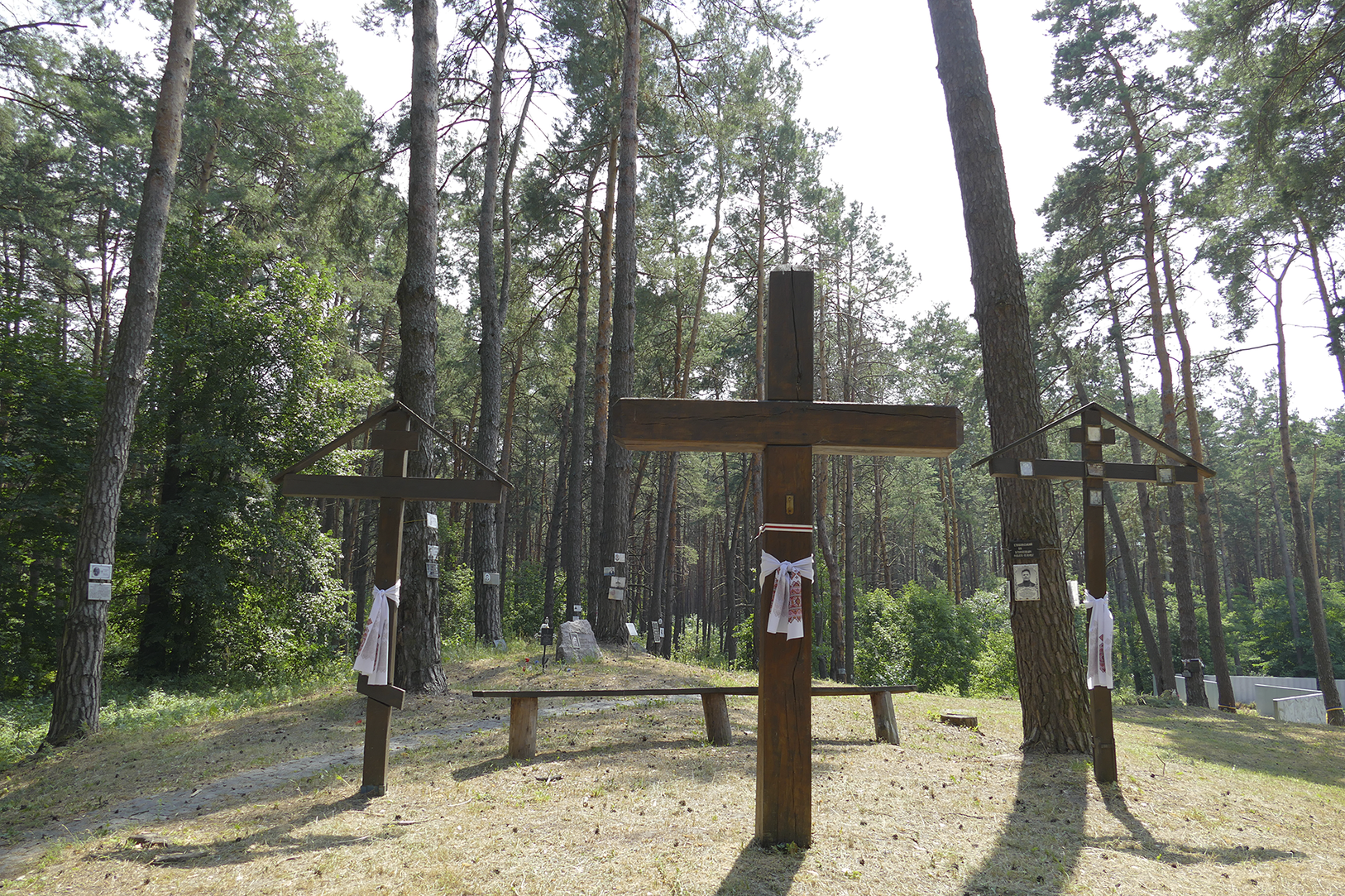
Individualization, emphasis on the personal histories, chaotic localization and eclectic stylistic representation made the first stage in creating Bykivnia’s martyrological landscape powerful and very emotionally appealing; it suggested the necessity to mourn and pay tribute to the innocent victims. This first stage of memorialization was preserved during the next state-approved actions of creating the martyrological landscape. Even though this stage does not complement the unity of later architectural design, it still acts as a powerful reminder of a popular commemoration of victims, and the role Ukrainian society had in the recognition of Bykivnia.
The second stage in organizing the memorial complex occurred in 1995, when a project consisting of seven memorial objects, was completed by sculptor Volodymyr Chepelyk and architect Georgy Kysly. A bronze sculpture of a prisoner was erected near the entrance of the national reserve, visibly marking the site as a lieu de memoire (see Figure 2).
A Bronze Sculpture of a Prisoner near the Entrance of the National Reserve.
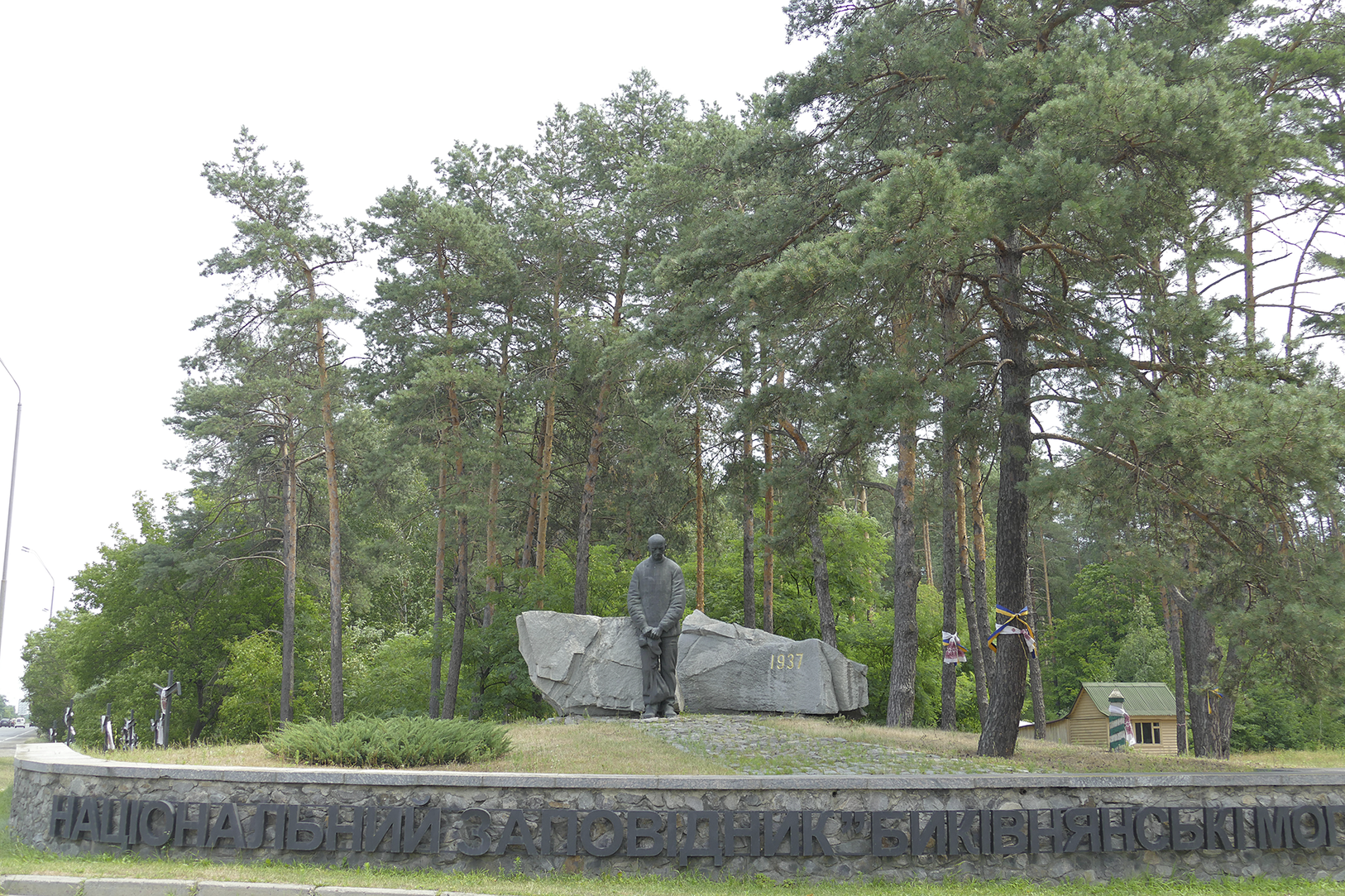
The Ukrainian encyclopedia provides a large description about the sculpture highlighting its role in the symbolism of the entire memorial complex:
The sculptor created a psychologically concentrated monument as a reflection of a certain mental condition. The man is dressed in boots, a quilted jacket, with a duffel bag in his hands folded in a lock. The documentary truthfulness of the image, which is as close as possible to the reality, is a capacious symbol of countless repressed people, whose features were artificially unified, depersonalized, often morally broken, turned into an amorphous crowd. Glasses are the only detail that hints at the past social status of the prisoner as a representative of intelligentsia. The tolerant psychologism of the portrait testifies to the deep inner tragedy of a person (in a broad sense – the entire Soviet people), repressed for his own ideological beliefs and ideals, and then physically executed (Zvid 2003, 843).
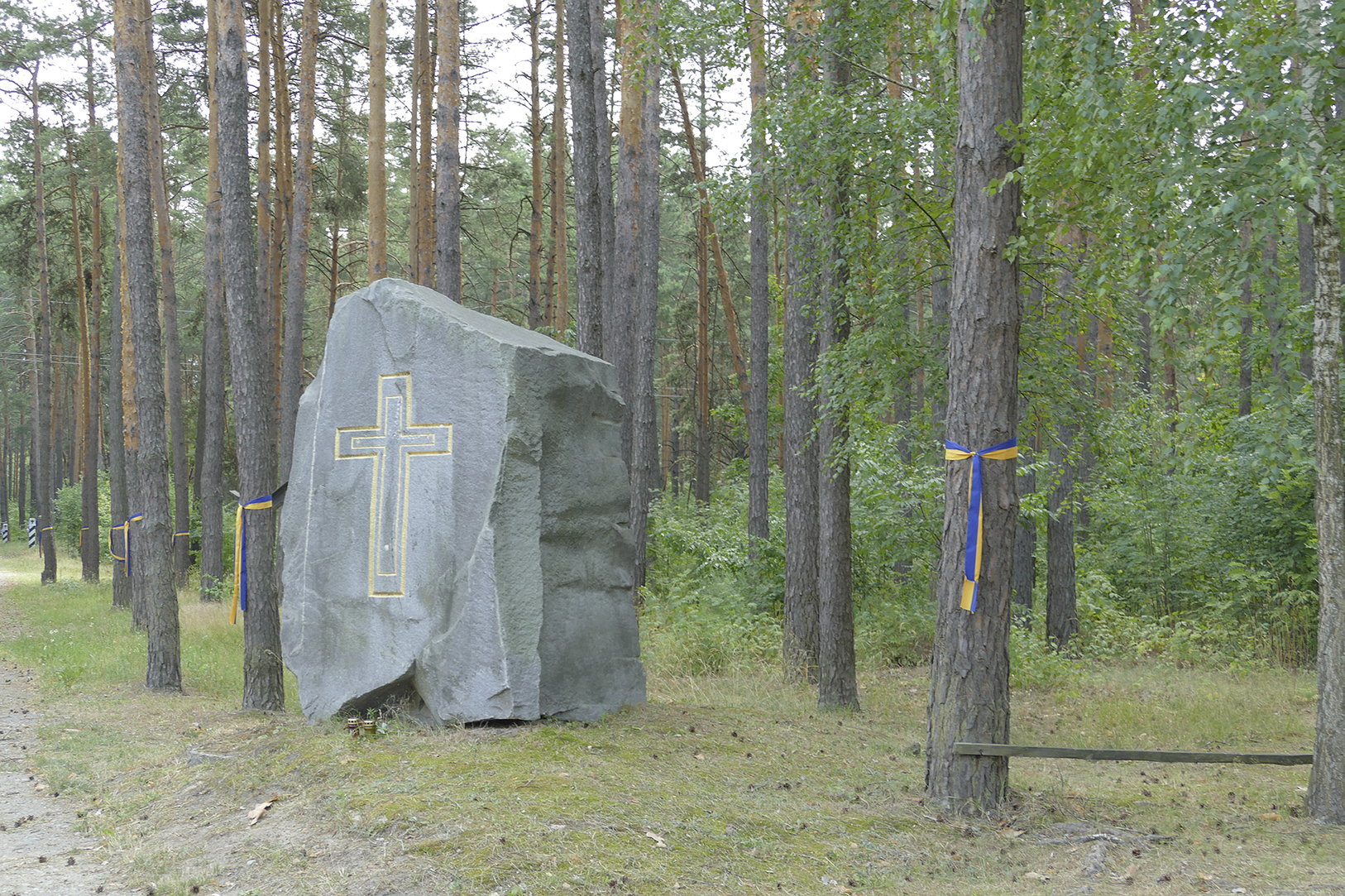
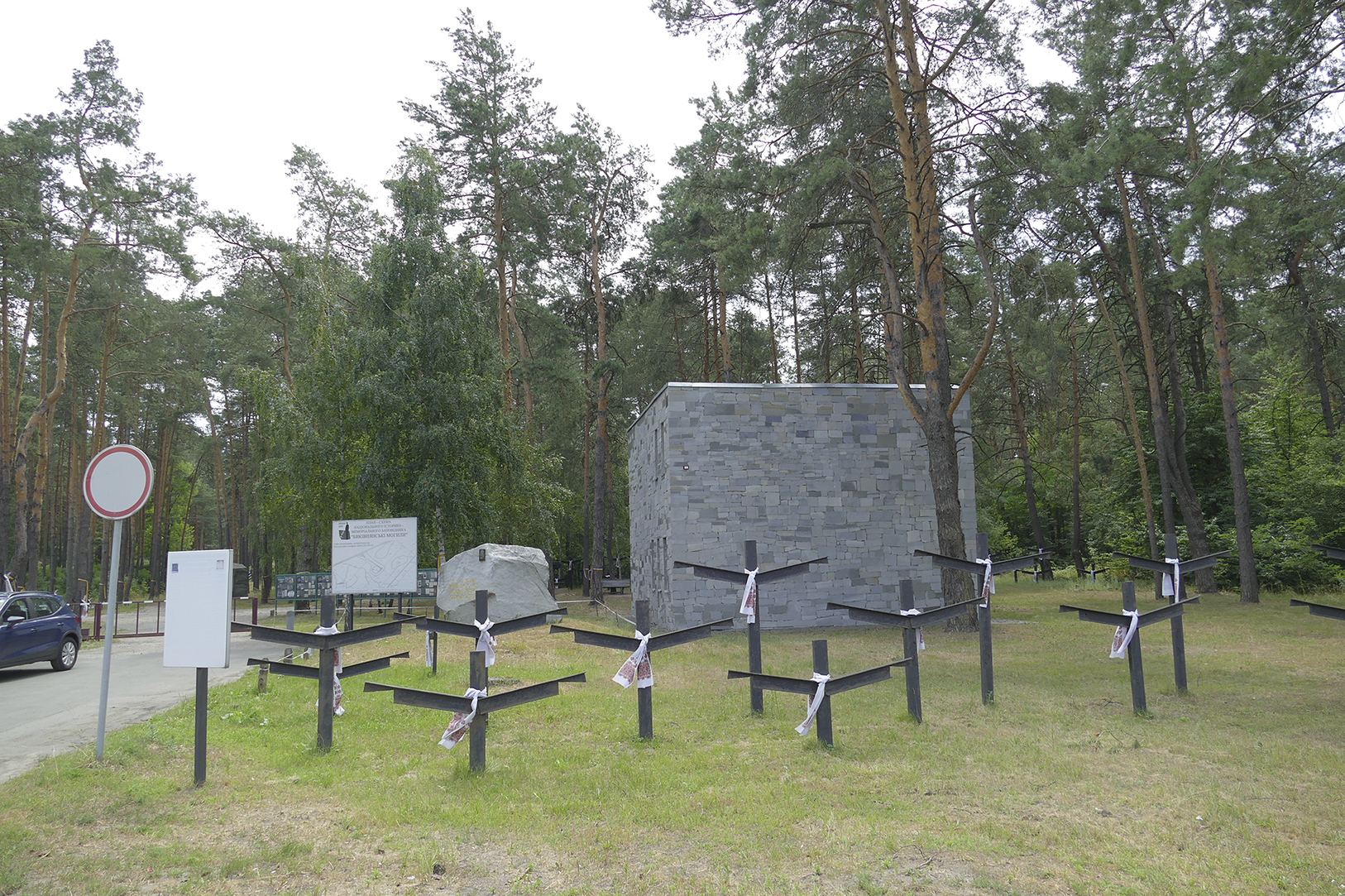
A mass grave with cross on the top was the next major construction in the memorial complex. This gravesite was located in the former 19th and 20th quarters of the Bykivnia forest and served as the main area for mourning and performing the rituals of commemoration. The sculpture of the prisoner and the mass grave is united by a path with five stones located on both sides (see Figure 3). Each stone delivers a different message ranging from simple information to beckoning the visitor for emotional involvement. One stone is located close to the entrance of the site and informs the guest about the mission of the national reserve as a burial site. A cross is depicted on two other stones, and the last two stones provide emotional statements: “Freedom is the most important for you and we paid for that with our lives,” “These pines are witnesses of a terrible crime. Thousands of innocent people were killed here. Worship the ashes.” There are 87 metal cross-like elements wrapped with Ukrainian rushnyks located throughout the memorial site (see Figure 4). As Tetiana Sheptyts’ka explained, they are stylized as a human figure with arms opened upwards and at the same time may be seen as the wings of a bird. The end result is symbolism with multiple meanings: in a folk tradition the soul can fly from the grave to heaven in the form of a bird, the cross portrays a symbol of martyrdom, and the person as a memory.Footnote 7
One of Five Stones Located along the Path.
Metal Cross-like Elements near the Entrance.
The second stage of organizing Bykivnia’s martyrological landscape reaffirms that it is state-recognized and portrayed as a graveyard and national necropolis. Unlike with the first stage where individualization approach predominates, the second stage was intended to create a generalized and unified picture of the victim by creating an image of a prisoner who should embody “countless repressed people.” Creating this image as the most realistic and psychologically detailed, architects are trying to actively engage the visitor to mourn and respect the dead. The messages written on the stones are tended to take this engagement even deeper: that they should be thankful for their freedom, and pay tribute and honor the innocent victims. Despite the generalized picture of a prisoner as the main anchor in the memorial imagery, it does not contribute to the understanding that the reserve is a burial site for people of different nationalities and religions overpowered by Christian and folk symbolism.
The second stage was initially regarded as just being the beginning of construction of the National Reserve. The detailed plan laid out for its landscaping and functioning was completed by the requested date at the end of the 2008 and finally presented to the public in 2011. The multi-paged plan includes chapters which analyzed the then current state of the memorial site. It addressed the planners’ concerns that more archeological work was still needed to discover the places where exhumations occurred, that some reburials had not been completed, and that they only knew a little about the number of victims and their personal details. Even with such limited knowledge about the site, the planners provided a very ambitious plan for developing Bykivnia into a large memorial complex. They began with an idea that since the site is a cemetery located in different zones, that there should be a tram to take visitors around the large area and to provide an immersive experience through the use of a period vehicle. They wanted the tram journey to offer a visit to the mass grave and the memorial part to consist of a large museum (approximately 5, 000 square meters), memorial park, small church and a research center devoted to the study of political repressions. The authors also proposed to install a historical recreation of a Soviet camp, restoring the infamously known “green fence” indicating 19th and 20th quarters, and an NKVD security building which would be used as an additional exhibition space. They also proposed four memorial trails, as well as other ideas to make the site more interesting and accessible to different groups of visitors (“Natsional’ny istoryko-memorial’ny” 2011, 175).
The authors provided a detailed schedule of implementation with a completion date in 2020. As evidence shows, none of the plans have yet been implemented. As National Reserve representatives testified, they were sending requests annually to the Minister of Culture asking to implement the state-approved plan for developing Bykivnia, but have thus far received only rejections to those requests. There might be a few reasons why this valuable project has never been implemented. One of these reasons may be domestic victimhood competition. As discussed previously, Viktor Yushchenko has been one of the main political figures helping to gain recognition for Bykivnia, yet during his presidency the state’s attention was focused on the Holodomor as the main victimhood narrative. Since 2008, the Holodomor memorial in Kyiv, the main site for commemorating Holodomor victims, is still in the process of development, and the museum remains under construction even during Russo-Ukrainian war which symbolizes its importance for Ukrainian memory. It seems obvious that the Holodomor as a symbol of victimhood has a higher standing in state projects and as a result currently overshadows Bykivnia.
With this in mind, the reserve would have likely remained in its 1995 state, if the Polish authorities had not made an inquiry about further development of the site in order to commemorate Polish citizens as victims of Soviet terror. Polish-Ukrainian negotiations, tensions and clashes for more than ten years finally ended up creating the third stage of the Bykivnia martyrological landscape.
Bykivnia and/or Katyń 4: Domestic and International Scale of Victimhood
The third stage of memorialization at Bykivnia signaled a major turn in remembering this site: from nationalizing to internationalizing victimhood. On September 12, 2012, the presidents of Ukraine and Poland jointly opened an international memorial for the victims of the totalitarian regime of 1937–1941, consisting of a Ukrainian memorial and a Polish military cemetery. This event publicly proclaimed the radical change in the status of Bykivnia, as now it was not only being used as a memorial site for Ukrainian victims of Stalinist terror, but also as a site to commemorate Polish victims, unofficially known as “Katyń 4.”
Katyń is one of the most tragic pages of Polish history in the 20th century with its own very long and dramatic process towards official recognition. A reference to the “Katyń Massacres” is used to codify a series of executions of Polish POWs and political prisoners carried out by the NKVD over the course of April and May 1940. The Katyń Forest site (located in present-day Russia) is where in 1943 the German army discovered mass graves containing a total of 4,123 corpses provided the name for this massacre. For several decades Soviet Union concealed the truth claiming that the Polish were executed by the Nazis, with a policy known as the Katyń Lie, one of the longest and most extensive cover-ups of a mass murder in history (Etkind et al. Reference Etkind, Finnin, Blacker, Fedor, Lewis, Mälksoo and Mroz2012, 5). Eventually in 1990, the Soviet Union admitted that its own officials had been responsible for the massacre of approximately 10,000 Polish POWs. The truth unfolds further when in 1992, Boris Yeltsin, then-president of Russia, provided additional documents which confirmed the executions of 21,857 Polish POWs and civilians and that they were buried at different sites. Many of those places were discovered and subsequently memorialized during the 2000s, such as Katyń and Mednoie (Russia) and Piatykhatky near Kharkhiv, Ukraine. The cemetery complex in Piatykhatky opened on June 17, 2000, weeks before its counterpart in Katyń, the first site discovered and the primary site commemorating the massacre. The construction process and architectural decisions exemplify the idea of a common victimhood and cultivation of Polish-Ukrainian solidarity in the remembrance their dead. At both ends of the cemetery, are two walls inscribed with Soviet and Polish names – the structures mirror each other in size and both display state flags that fly in tandem bringing Polish and Ukrainian victims into “a sphere of similarity” (Etkind et al. Reference Etkind, Finnin, Blacker, Fedor, Lewis, Mälksoo and Mroz2012, 73).
Based upon the Polish request for a search of additional burial places of Katyń victims, in 1994, the Ukrainian Security Service provided Poland with a list of 3,435 Poles killed in a “Katyń” operation within Ukraine but buried elsewhere beyond Piatykhatky. Polish officials called this document the “Ukrainian Katyń List” and Bykivnia was considered by the Poles as a possible place for the burials. Unlike Piatykhatky, Bykivnia became a heated topic of political debate and tensions between Ukraine and Poland. Poland was eager to find evidence of Polish burials in Bykivnia, increase the knowledge about Katyń massacre, and complete the main iconic image of Polish victimhood. In 2001, 2006, 2007, 2011, and 2012, without appropriate documents issued by Ukrainian officials, Polish experts accompanied by Ukrainian counterparts began conducting exhumations at the Reserve “Bykivnians’ky Graves.”
It was a decade of search without any proper outcome. Polish professor Sławomir Kalbarczyk admitted that the exhumations never proved that Bykivnia was the final resting place for 3,435 Polish victims (Kalbarczyk Reference Kalbarczyk2011).Footnote 8 While 2,000 remains were attributed as being Polish, only 7 remains were fully identified. However, since Polish exhumation groups found a few objects that allegedly belonged to victims from the “Ukrainian Katyń list,” they assumed that it was enough to recognize Bykivnia as a symbolic resting place for all executed Poles. Following the established commemorative tradition in Katyń, Mednoie, and Piatykhatky, Polish representatives began referring to the Bykivnia burial site as a “Polish military cemetery” or “fourth Katyń cemetery.” The Ukrainians opposed this approach, accusing the Polish approach of being historically inaccurate. Responding to Kalbarczyk, Ukrainian scholars Volodymyr Kryvosheia and Lesia Onyshko argued that the exhumations did not provide any reliable confirmations for a mass burial of citizens of pre-war Poland in Bykivnia. Moreover, the researchers stated that an analysis of the so-called “Ukrainian Katyń List” indicated that it included not only Polish military but also civilians of many nationalities and ethnic groups other than Poles, such as Ukrainians and Jews. They called the proposed label of a “Polish military cemetery” causeless and the “Ukrainian Katyń List” unrighteous (Kryvosheia and Onyshko Reference Kryvosheia and Onyshko2011).
Interestingly enough, the scholars mentioned above were representatives of both country’s institutes of national remembrance – the main government bodies in Poland and Ukraine responsible for the creating state-ruled national memories. It became obvious that the Polish-Ukrainian debate on the Bykivnia case has to do not only with historical accuracy but also with political credibility, as this case was so differently motivated for each side. “The political lives of dead bodies” was used to highlight national victimhood and to strengthen contemporary national identities. The Polish side applied a strategy that can be called “postmortem murder,” a form of violence consisting of depriving the dead of their own identity (Rozenblant Reference Rosenblatt2010, 949). Polish victims at Bykivnia are used to symbolize the tragedy of Katyń, which is focused on the loss of Polish military. Undoubtedly, the appearance of Katyń 4 at Bykivnia strengthened the memory of this tragedy, which resembles the martyr myth of innocent victims.
While Poland was accused of politicizing the memory of Katyń and sowing this memory on Ukrainian ground, the Ukrainian side used a similar strategy for the dead with an ideological pretense: regarding Bykivnia as a major site for creating an image of Ukrainians as being the only martyrs of the Stalin regime. Representatives of the “Memorial” were among activists who strongly opposed the construction of the Polish military cemetery and claimed that Bykivnia was a symbol of Ukrainian genocide and was a sacred place for contemporary Ukrainians. In their opinion, illegal “internationalization” of memory about Bykivnia could be a threat for Ukrainian national memory and for decoding the real memorial value of the site for Ukrainians. They even perceived a Polish attempt to occupy Bykivnia as a sign of Russian footprints in an attempt to debunk crimes of the Stalin regime (Kyrylenko Reference Kyrylenko2007; Krytsyk Reference Krutsyk2011). As the Polish presence at Bykivnia was not welcomed by nationalist-oriented Ukrainian activists, it was not possible to implement the project during the presidency of Viktor Yushchenko who had intended to build upon nationalistic memory politics (Istorychna Pravda, September 25, 2012). As stated by then-president of Poland, Bronisław Komorovsky, Poles did not succeed in negotiating with Yushchenko, and resumed their call for a Polish cemetery at Bykivnia after Viktor Yanukovych, who thought less about building a national-oriented memory and was well known for his pro-Russian intentions, became the Ukrainian president in 2010.
The presence of two symbols of victimhood in one memorial place inevitably raises questions about the specificity of their coexisting and equality of their symbolic meanings. Basically, the major questions are as follows: Should we consider Katyń as a component of Bykivnia or should there be a separate memorial site located at Bykivnia? Do both remembrances complement each other or become more confusing when placed together? The answers will be based on the viewer’s prospective: Bykivnia is more recognized domestically, while Katyń is more recognized internationally, being included in the lexicon of catastrophic cultural crypts such as the Holocaust and Gulag. While Bykivnia, as a burial place of Ukrainians, is a site of Ukrainian memory, Katyń is a part of memory of seven states: Poland, Russia, Ukraine, Belarus, and Baltic countries. Moreover, Katyń is considered as a symbol that covers all Soviet crimes against humanity, and as a sign of savagery. Thus, Katyń goes far beyond the pre-war period, being used to codify recent crimes – for example, a massacre in Srebrenica has been called a “new Katyń” (Etkind et al. Reference Etkind, Finnin, Blacker, Fedor, Lewis, Mälksoo and Mroz2012, 2). It seems obvious that Katyń is potentially a more powerful symbol overshadowing Bykivnia. Possibly the threat of re-focusing on Katyń became the main motivation for the defenders of Bykivnia to consider it as an exclusively Ukrainian site of martyrology.
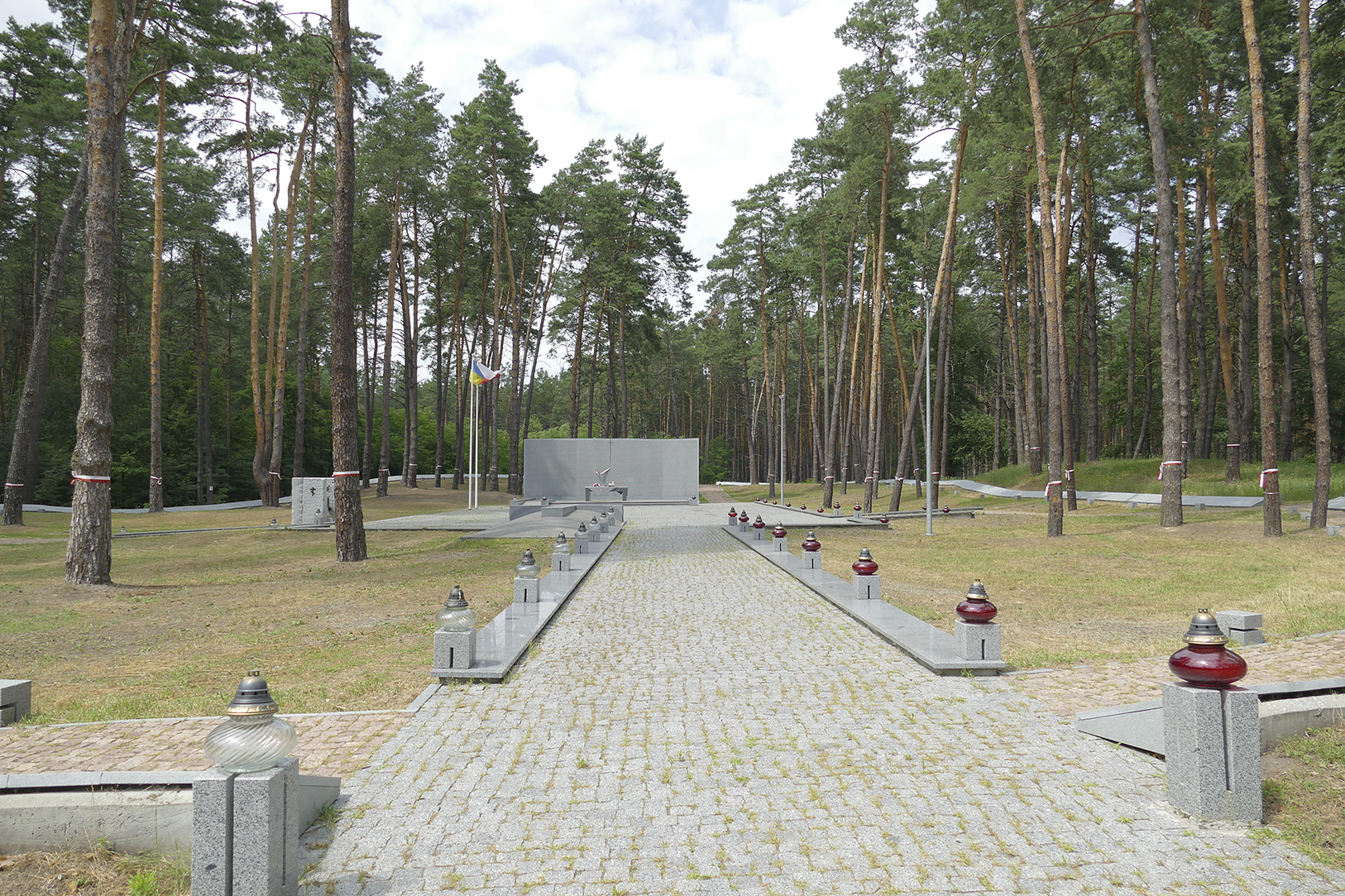
After many unresolved debates about historical accuracy and styles of memorialization, the international memorial for the victims of totalitarian regime of 1937–1941 was launched as one site that would consist of two parts. Interestingly enough, the Polish part received its own name “Polish military cemetery,” while the Ukrainian part remains unnamed even today. Unlike in Piatykhatky where these parts are similar, at Bykivnia they do not mirror each other. The mass grave with remnants of 2,000 Polish citizens is the main spot of the Polish military cemetery. Included is a remembrance bell with religious symbols of Latin and Orthodox crosses, a star of David, and a Crescent located close to the gravesite. There is also a large wall with the names of victims accompanied by a number of the small plaques commemorating deceased Poles (see Figure 5).Footnote 9
“Polish Military Cemetery”.
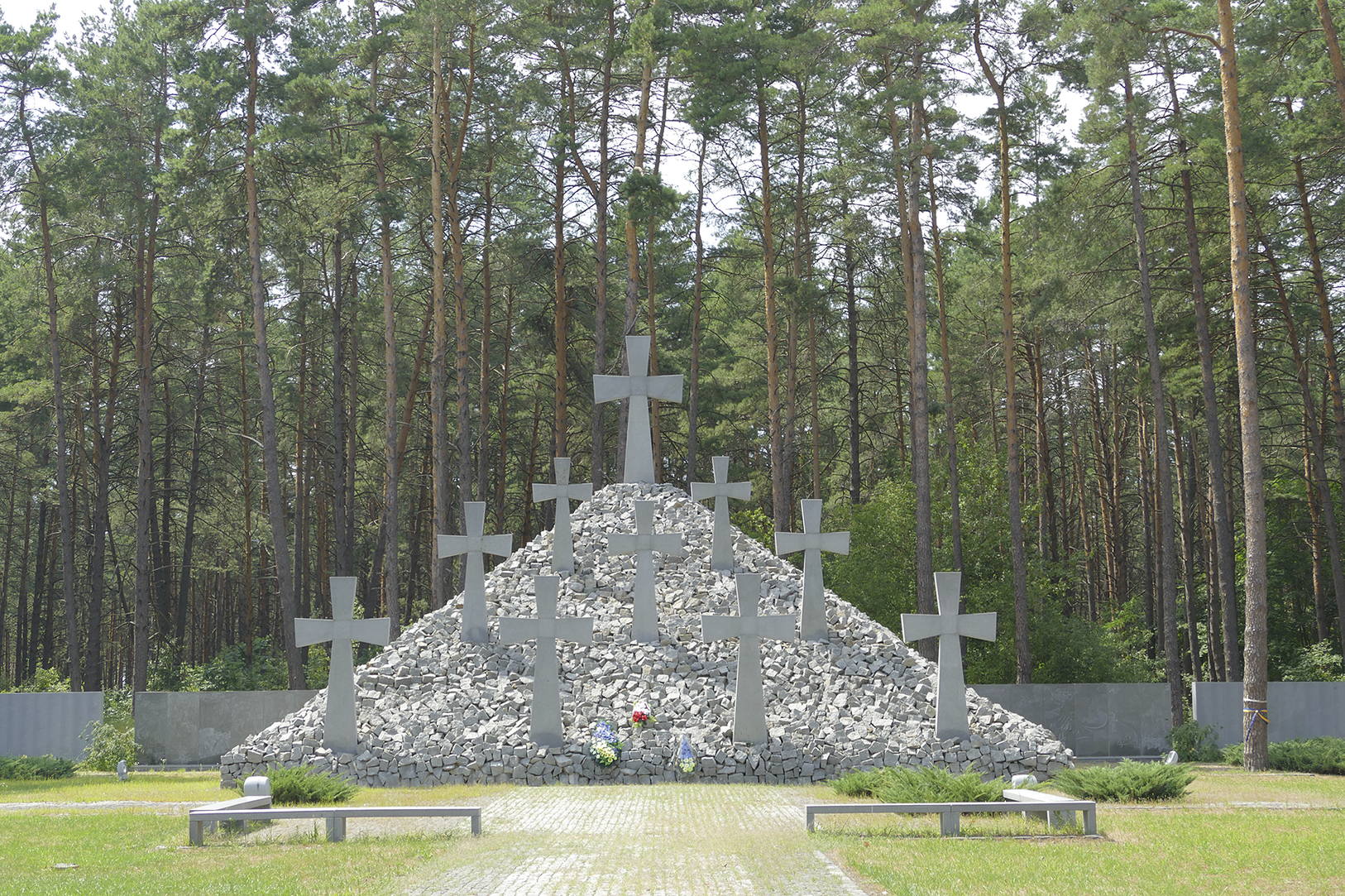
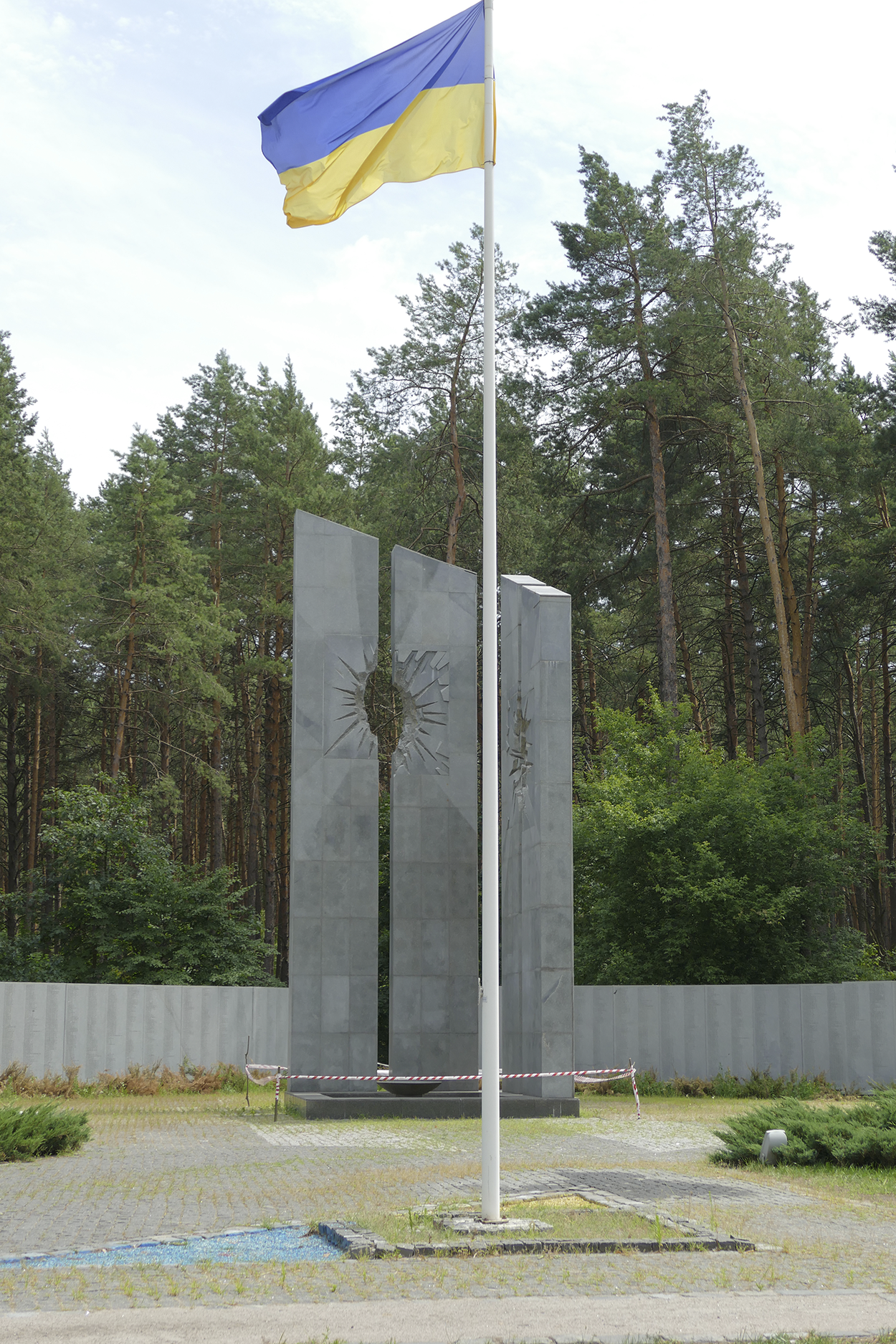
The Ukrainian section of the memorial consists of a mound with white stones and ten crosses surrounded by numerous walls with names of Ukrainian victims who are buried at Bykivnia. There is also a two-wall monument with bullet impaction marks symbolizing the execution of Bykivnia victims as having been shot in the head (see Figures 6 and 7). Larysa Skoryk, the architect of the Ukrainian section of the memorial, commented that her plan for site construction was not completed due to the lack of financial support and bureaucracy (Gazeta. Ua, September 20, 2012). Skoryk describes the process of planning, financing, and completing the project as a testimony to the absence of a general vision of how the site should have been memorialized and inertia to implement the project. The main driving force for the creating the memorial site was from a demand by Poland to establish the Polish cemetery. It appears that Ukraine only joined with its counterpart to create a common memorial space when Ukrainian participation was really needed to keep the site as a place of Ukrainian memory. Politically, the appearance of a common memorial space aimed to contribute toward the healing of Ukrainian-Polish ties, which became damaged during Yushchenko’s presidency (Sheptyts’ka Reference Sheptyts’ka2020, 212). For Yushchenko, Bykivnia was a site that would contribute to the development of an anti-Soviet national memory with the image of Ukrainians as the main victims of the Soviet totalitarianism, but for Yanukovych it was simply a place to make diplomatic negotiations. And whereas Yanukovych did not show up for the annual commemoration of the victims at Bykivnia in May 2012, a few months later he grandiosely opened the joint memorial (Krutsyk Reference Krutsyk2012).
A Mound with White Stones and Ten Crosses Surrounded by Numerous Walls with Names of Ukrainian Victims.
A Two-Wall Monument with Bullet iImpaction.
As was expected, the opening of the international memorial created an outcry from both sides not being satisfied by the way it had been implemented. They claimed a lack of historical accuracy, politization of the memory, and destruction of the archeological ground. Ukrainian activists were specifically upset by the irreversible damage to the 19th and 20th quarters of the site, which were the originally located NKVD burial grounds and historically the most important areas of the Reserve. They also accused the Ukrainian authorities of intentionally failing to accomplish the martyrological landscape of the Reserve, such as building the church and other memorial sites (Lysenko Reference Lysenko2013).
The next turn indicating that Bykivnia was becoming an international memorial occurred in 2015. It was predetermined by two events: the beginning of Russian aggression against Ukraine in 2014 and the 75th anniversary of the Katyń massacre. On April 6, 2015, the Ukrainian media reported that the Polish president had rejected going to the Katyń memorial located in Russia, the main site associated with the massacre, which would have been the most desirable site for the commemoration, and instead chose Kyiv and Bykivnia for the commemorative event devoted to Katyń (Taraniuk Reference Taraniuk2015). After all of the previous Polish-Ukrainian confrontations in establishing the international memorial, the site was then used to coordinate Polish-Ukrainian attempts to articulate not only an anti-Soviet but also an anti-Russian discourse. Both nation’s presidents mentioned in their speeches the resemblance of how the recent days were connected with the Soviet past, bearing in mind aggression, occupation, and terror.
Despite the common anti-Soviet and anti-Russian statements, which might have contributed toward unifying the image of Bykivnia, this commemoration event once again highlighted a different meaning of Bykivnia for Ukrainians. Ukrainian media covering Polish president Komorowski’s visit described the event at Bykivnia as a commemoration of the victims of the totalitarian regime; Katyń was mentioned, but not with emphasis that it was the only topic at the commemoration. In President Poroshenko’s speech, he spoke generally about the Ukrainian victims of totalitarianism, and Katyń was mentioned as a tragedy of the Polish people, as well as the fact that both events proved the criminal nature of the Stalin regime. One month later, on May 17, 2015, during the annual commemoration of victims of totalitarianism at Bykivnia, President Poroshenko made a post on Twitter that can be recognized as an iconic Ukraine-centered identification for the memorial site: “‘The Executed Renaissance’ of Ukraine is buried at Bykivnia – more than 100,000 innocent victims. Ukraine remembers!” The two events, which occurred in April and May 2015, demonstrate that the memory about victims of totalitarianism is a common memory for Ukraine and Poland and that rituals for mourning the dead can promote mutual understanding, solidarity, and friendship. Yet, this universalized image of “victims of totalitarianism” has a different national meaning, which predetermines the understanding of the memorial place. For Ukraine, Bykivnia is a burial ground of Ukrainian people and the symbol of a national tragedy, while Katyń is the tragedy of “others,” which only accompanies Ukrainian victimhood to complete a more striking picture of those Stalinist crimes. For Poland, Bykivnia is exclusively a burial ground of Polish POWs, which in combination with the other similar memorial sites contributes to the development of powerful narratives about Polish martyrs. Thus, the two symbols of national victimhood coexist and complement the understanding of the inhumane nature of the Stalin regime and create a strong anti-Soviet sentiment; however, their symbolic meanings and values for identity-creation defer to each country.
During the Polish president’s visit to Ukraine, which was supposed to have strengthened the political relationship, both countries faced a huge political scandal that caused a deepening crisis. After President Komorovsky’s speech in Verkhovna Rada on April 9, 2015, which was warmly received by the Ukrainian deputies, Verkhovna Rada on the same day adopted a law that recognized the UPA (Ukrainian Insurgent Army) soldiers as fighters for an independent Ukraine. This legislative action caused an outcry in Poland, where these same soldiers were suspected to have killed Poles in the Volhynia Massacre of 1943. The crisis deepened even more a few months later when the “Law and Justice” Party took power in Poland (Pachos Reference Pachos and Buslenko2017). As a response to what they considered provocative Ukrainian legislation for UPA recognition in Ukraine, the Polish Senate followed by adopted a law that recognized the Volhynia event as a genocide against the Polish people. The two confrontational laws together turned the Polish-Ukrainian friendship, which both presidents spoke of at Bykivna in 2015, into a memorial war.
Bykivnia was destined to play a crucial role in resolving this conflict: emphasizing the common grief and common struggle was used to accomplish a Polish-Ukrainian reconciliation. In May 2016, Poroshenko declared that “Bykivnia became a common necropolis for Ukrainians and Poles, an important element of common memory and our common struggle against Soviet totalitarianism and the empire for your and our freedom” (Ukrinform, May 15, 2016). In May 2017, during a commemoration event devoted to the 80th anniversary of the Great Terror, Poroshenko further stated that “Bykivnia Forest is a place of our common pain with Polish people” (Vbeloz.gov.ua 2017). He made this statement at the end of his long speech describing the suffering of the Ukrainian people under Soviet rule; however, Ukrainian journalists used it as a tag line for the media covering the president’s visit to Bykivnia. In 2018, Poroshenko talked mostly about religion and priests as also being victims at a Bykivnia event to justify his support of Ukrainian Orthodox Church in its quest for a Tomos, yet the Polish media extracted only Poroshenko’s non-church reference to Polish victims: “Bykivnia Forest is a place of common memory of Ukrainian, Polish and other peoples. […] We Ukrainians stand in solidarity with all peoples who suffered from the crimes of totalitarian regimes. We are determined to cooperate in overcoming the consequences of totalitarianism” (Polskie Radio, May 20, 2018). This politically correct and much needed messages signaled that Ukraine was taking steps toward reconciliation with Poland. Poroshenko was also laying down wreaths and, most importantly, kneeling in front of both parts of international memorial. It was indicative that the Polish media, Polish radio in particular, covered all Poroshenko’s visits to Bykivnia, emphasizing how he was paying tribute to Polish dead.Footnote 10
Rituals sharing mutual respect to the victims of both countries was mirrored by numerous Polish official delegations for whom Bykivnia now acts as the main site for commemoration of the Katyń massacre victims. The frequency of official Polish visits to Bykivnia provokes additional attention to the site in both countries and ritualistically contributes to the recognition Bykivnia as a place of common memory. In one of his more recent visits to Bykivnia, Poland’s president highlighted the importance of preserving a memory about the victims of Stalinism for the sake of independence and sovereignty of Poland and Ukraine (Ua.bykivnya.org, October 10, 2020).
In the last 21 years (2001–2022), Ukraine and Poland have been trying to contribute to the development of the site based on having a common memory toward implementing an international project. Yet “national” still means much more for both sides than “international.” Bykivnia and Katyń are deeply rooted in the national victimhood narratives of both countries, and their missions are predetermined by their symbolic values in creating ethnic-centered identities with a clear separation of victims as “ours” and “theirs.”
Bykivnia: Recent Rituals and Exhibitions
After official recognition of Bykivnia in 1988, it has functioned as a site for mourning rituals. In 2007, the Day for Victims of Totalitarian Regimes was established, and the remembrance now occurs annually on the third Saturday of May. The composition of these rituals remains unchangeable: it includes patriotic speeches, religious services, and singing patriotic songs. The mourning community has also hardly changed, as it consists of relatives of those buried in Bykivnia, organizations that played a crucial role in recognizing the site such as “Memorial,” and activists and politicians who intend to promote an anti-Soviet and anti-Russian agenda. As Vakhtang Kipiani noted with regret, for two decades this mourning community did not involve new people (Kipiani Reference Kipiani2012).
Since the project that foresaw the construction of museum was never completed, researchers of the National Reserve are very limited as to their exhibiting and related activities. Since 2016, they have offered several small exhibitions covering a large variety of topics, such as places of terror and victims of repression (writers, teachers, and peasants) and have emphasized different ethnic groups (Poles, Germans, and Greeks). Usually, these limited exhibitions consist of six to eight posters located near the entrance of the Reserve or even displayed in other locations such as history museums, libraries, or state offices. Researchers have also delivered lectures on the topics associated with Bykivnia targeted to Ukrainian youth and other museum audiences. Unfortunately, these occasional lectures and few, small-scale exhibitions can neither make up for the needed full-scale exhibition and missing information about Bykivnia and political repression in Ukraine nor contribute to the recognition of Bykivnia among a larger pan-Ukrainian and international audience. The lack of a permanent museum facility minimalizes the number of visitors – and further narrows the scope of Bykivnia as being used only as ritual site to commemorate victims of Soviet terror once a year.
In 2007, Iuri Shapoval testified with regret that Bykivnia was still hardly known among all Ukrainians (Shapoval Reference Shapoval2007). Five year later, Vakhtang Kiniani made a similar statement: “Kyivans prefer not to notice this place. The story of the tragedy did not become part of their life experience, nor did not affect their worldview in any way. Visiting the place did not turn into a ritualistic cultural practice. Bykivna’s legacy is not reflected, which significantly distinguishes it from the Jewish, Polish and Belarusian tragedies of the 20th century” (Kipiani Reference Kipiani2012). As this research shows, Kipiani’s observation made a decade ago still holds today for the description of Bykivnia’s role for Ukrainians, and for Ukrainian memory politics in general.
Summary
This analysis proves that remembering the victims of Soviet repression and terror has been a prime task for state and local levels engaging different memory entrepreneurs and has resulted in criminalizing communism and implementing transitional justice: legislative rehabilitation of victims and the creation of memory about them. Erecting memorials and plaques at the sites of Soviet atrocities testifies to the development of a martyrological landscape, which predominantly utilizes Christian imagology in visualizing Soviet victimhood. Mapping the martyrological landscape works toward the creditability of Ukraine’s biographical narrative as a victim of the Soviet totalitarian regime, yet exhibiting victimhood or explaining the history of Soviet atrocities complicates the biographical narrative.
The physical landscape of martyrology in Bykivnia reveals complications with state commemorative practices framed by mnemonical security intentions and their implementations. Despite recognition of the Stalinist crimes and willingness to commemorate victims of Soviet repression, Ukrainian authorities are much more successful in issuing laws, providing one-time rituals and using memorial places purely for political purposes, rather than implementing long-term projects such as a full-fledged memorial complex. At Bykivnia, there is no permanent narrated exhibition; it functions primarily as a ritual place for commemoration of Ukrainian and Polish victims of Stalinist crimes. Various attempts to create an appropriate martyrological landscape applied by different memory actors testify to the fractured and contentious nature of Ukrainian memory politics. The commemorative practices at Bykivnia highlight the need for the development of an inclusive, solidarity-based victimhood narrative, which should appropriately honor the memory of the victims as well as promote democratic values in Ukrainian society. In practice, the construction of the Polish section of the international memorial indicates how memory about victims can be instrumentalized and manipulated in order to serve political interests, which emphasize victimhood in state-building. Polish-Ukrainian tensions in memorializing Bykivnia problematize the issues of subjectivity and transculturality as crucial points to be dealt with in future memory politics.
The constructed martyrological landscape and undeveloped verbal narrative indicate that Bykivnia has now been undraped, yet remains a silent place of memory, functioning simply as a national and international symbol of political repression. The limitations placed on communicative practices, such as exhibiting, makes questionable the Reserve’s role in keeping the memory about victims of Soviet repression alive among the Ukrainian population. And when considering Shapoval’s quote – “Bykivnia is extremely important in the search for our identity” – must we conclude that Ukrainians are still in the process of finding and expressing their identity?
On May 2, Reference Osadcha2023, the Verhkovna Rada voted for the law that seeks to locate the National Memorial Military Cemetery in the immediate vicinity of the National Historical and Cultural Reserve “Bykivnians’ky Graves” (Osadcha). The facility plans include a military cemetery with 50,000 graves, a columbarium, and a museum complex. When the project is completed, it should create a different context for remembering and commemorating the Stalinist victims in Bykivnia.
Acknowledgements
I send my thanks to the three peer reviewers for making valuable comments and suggestions that let me substantially improve my arguments. I also express my gratitude to Tetiana Sheptyts’ka, Deputy Director of the National Historical and Cultural Reserve “Bykivnians’ky Graves,” for sharing valuable inside information.
Disclosure
None.
Financial support
This work was supported by the Canadian Institute of Ukrainian Studies under the Anna and Nikander Bukowsky Endowment Fund and the Stuart Ramsay Tompkins Professorship of the University of Alberta.



