Introduction
Heat stroke is a medical emergency characterised by a triad of hyperthermia (core body temperature≥40°C), hot and dry skin, and central nervous system dysfunction (Reference Bouchama and Knochel1). It could lead to multiple organ damage, and has a mortality rate of 10–50% (Reference Duthie2).
Heat stroke may be divided into exertional and non-exertional (classical) heat stroke (Reference Bouchama and Knochel1,Reference Shahid, Hatle, Mansour and Mimish3). Exertional heat stroke occurs in previously healthy young individuals during exercise sessions, usually in hot and humid weather. Classical heat stroke occurs in the elderly and vulnerable populations during extreme heat waves.
Psychiatric patients, particularly those with schizophrenia, are susceptible to classical heat stroke (Reference Reilly and Kirk4,Reference Hermesh, Shiloh, Epstein, Manaim, Weizman and Munitz5). The impaired thermoregulation and heat intolerance may be intrinsic to schizophrenia (Reference Hermesh, Shiloh, Epstein, Manaim, Weizman and Munitz5–Reference Shiloh, Weizman, Stryjer, Kahan and Waitman7). Antipsychotic and anticholinergic medications, which are commonly prescribed for patients with schizophrenia, may impair both peripheral and central mechanisms of thermoregulation, and therefore increase the risk of heat stroke (Reference Chong and Castle6,Reference Bark8). First-generation antipsychotics are well-documented risk factors of heat stroke (Reference Reilly and Kirk4,Reference Bark8). Among second-generation antipsychotics, risperidone (Reference Ramos, Valverde, Álvarez, Katnich and Quirante9), quetiapine (Reference Kao and Kelly10), and clozapine (Reference Kerwin, Osborne and Sainz-Fuertes11,Reference Thara12) may contribute to the development of heat stroke in patients with schizophrenia.
The hypothalamus plays a central role in the human thermoregulatory system (Reference Clapham13). It integrates the information of environmental and core temperatures from the thermoregulatory system, and sends appropriate signals to generate and conserve heat (or dissipate it). Although the anatomical physiology of thermoregulation is well-understood, the mechanism by neurotransmitters is unclear (Reference Hayes, Martinez and Barrueto14). Numerous neurotransmitters such as serotonin, acetylcholine, norepinephrine, dopamine, histamines, prostaglandins, and adrenocorticotropic hormones, may play roles in thermoregulation (Reference Clapham13).
Anticholinergics cause hyperthermia primarily through impaired heat dissipation (Reference Hayes, Martinez and Barrueto14). Peripheral blockade of muscarinic receptors in exocrine sweat glands produces anhidrosis. Furthermore, central blockade of muscarinic receptors leads to restlessness, agitation, and seizure, all of which increase heat production (Reference Hayes, Martinez and Barrueto14).
Dopamine in the pre-optic area and anterior hypothalamus plays a key role in thermoregulation (Reference Boulant15). Increased availability of dopamine in the brain may be associated with improvements in the tolerance to heat storage and increases in the metabolic rate induced by graded exercise (Reference Balthazar, Leite, Ribeiro, Soares and Coimbra16,Reference Balthazar, Leite, Rodrigues and Coimbra17). Dopamine also influences several mechanisms that can modify response to heat, such as cognition, arousal, reward, motivation, sympathetic nervous system activities, as well as stress response and motor control (Reference Balthazar, Leite, Rodrigues and Coimbra17).
Antipsychotics can cause neuroleptic malignant syndrome (NMS)(Reference Bhanushali and Tuite18), which is characterised by hyperthermia, motor symptoms, and autonomic instability. Central dopamine blockade in the hypothalamus and nigrostriatal pathways impair thermoregulation. Antipsychotics-induced Parkinsonism, which is characterised by muscle rigidity and akinaesia, also impairs heat dissipation (Reference Bhanushali and Tuite18). The cognitive impairment by central dopamine blockade can lead to inappropriate behavioural response to heat stress.
To our knowledge, olanzapine has not been reported to be associated with heat stroke in the literature thus far. In this study, we report a male patient with schizophrenia who suffered from classical heat stroke in a heat wave. Before the occurrence of heat stroke, he had received the maintenance treatment of olanzapine, trihexyphenidyl, and trazodone for 2 years.
Case presentation
Mr. A, a 49-year-old Taiwanese man, has suffered from schizophrenia since 29 years of age. He did not have a history of illicit substance abuse. During his first psychotic episode, he had auditory hallucination, delusion of persecution, depressed mood, insomnia, and poor attention. Subsequently, he was admitted to our hospital as he attempted suicide by ingesting sulphuric acid, which resulted in acute respiratory failure. He underwent tracheostomy, and stayed at our hospital for 1 month. After he was discharged, he was regularly followed-up in our psychiatric outpatient clinic, and was prescribed chlorpromazine 150 mg before bedtime, trifluoperazine 5 mg twice daily, trihexyphenidyl 2 mg twice daily (for antipsychotics-induced Parkinsonism), alprazolam 0.25 mg twice daily, and estazolam 2 mg before bedtime. His treatment adherence was excellent as his family would remind him. Despite the remission of his psychotic symptoms, he still suffered from insomnia, anxiety, and dysphoria. He was jobless, socially isolated, and never married. At home, he spent most of his time sitting in a chair [Positive and Negative Syndrome Scale (PANSS) negative subscale=30]. During his 30s, he developed lingual tardive dyskinaesia [Abnormal Involuntary Movement Scale (AIMS) overall severity=3 (moderate)].
At the age of 45, he had a relapse, which was similar to his first psychotic episode. He was admitted to our acute psychiatric ward due to his several suicidal attempts by swallowing thumbtacks and needles. His psychotic symptoms remitted under olanzapine 20 mg/day. He still had depressed mood, anxiety, and insomnia. His sleep disturbance improved after the addition of trazodone 50 mg before bedtime. We also included trihexyphenidyl 2 mg twice daily for his tardive dyskinaesia. One month later, he was transferred to our chronic psychiatric ward. After receiving psychiatric rehabilitation for 8 months, his mental condition was stable and he was discharged home. However, he had another relapse of psychosis 2 months after discharge. Although his psychotic symptoms improved under the combination of olanzapine 20 mg/day and sulpiride 400 mg/day, he was again admitted to our chronic psychiatric ward. During the years of his hospital stay, he had several episodes of aspiration pneumonia. The ward staff noted that he would easily choke over a meal. Besides his lingual tardive dyskinaesia, his affect was flat, but he did not show other Parkinsonian features such as muscle rigidity and tremors. We discontinued his 4-month treatment of sulpiride due to his tardive dyskinaesia and repetitive choking.
Inpatients in our chronic ward are allowed up to 7 days of home leave per month if their mental and physical conditions are stable. In the case of Mr. A, he would regularly take home leaves every 2 weeks when his condition was stable. On 9 July 2012, he took his home leave, which lasted 2 days. On that night, his mother mistakenly gave him an additional dose of trihexyphenidyl 2 mg. The next morning – that is, 10 July – he appeared normal. His family left him alone at home, and went to work. However, a heat wave hit Taiwan on that day, and the temperature in Taipei reached 38.3°C, which was the second highest record of the all-time record (19). At 1 p.m., his family came back home, and found him lying exhausted on the sofa. They just had him rest on the bed, and did not turn on fans or air conditioners. They left him alone and went out again. When his family returned home at 2 p.m., he was drowsy, weak, and slurring. He was immediately brought back to our chronic psychiatric ward at 6 p.m., when he had an ear temperature of 40.9°C, blood pressure (BP) of 116/70 mmHg, heart rate of (HR) 145 beats/min, and respiratory rate (RR) of 32 breaths/min. He was confused and agitated. His Glasgow Coma Scale (GCS) was E4V4M6. He was immediately transferred to our emergency department. His condition deteriorated: his ear temperature was 43.0°C, BP 98/32 mmHg, HR 142 beats/min, RR 32 beats/min, and GCS E3V2M4. Under the impression of acute respiratory failure, he underwent endotracheal intubation and received mechanical ventilation. After that, he was admitted to the neurological intensive care unit. The physical examination was unremarkable, except that he had general weakness. The neurological examination by the consultant neurologist showed that he had coarse hand tremors and oral dyskinaesia. He had no deep tendon reflexes and lateralising signs.
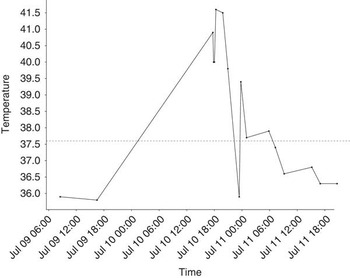
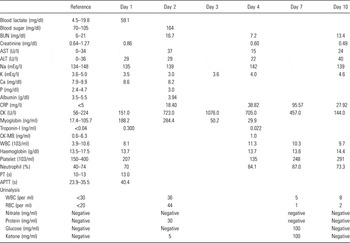
After being admitted to the intensive care unit, all of his psychotropic medications were discontinued. Table 1 shows the laboratory workup during the hospital stay. Fig. 1 shows the fluctuations in his body temperature from 9 July to 11 July (Day 2 of the medical hospitalisation). The ECG showed sinus tachycardia (164 beats/min), non-specific ST-T changes, and QTc prolongation (QTc=495 ms). His chest X-ray showed hazy infiltration in both the lungs, normal heart size and configuration, clear costophrenic angles of both the sides, midline position of the trachea, and no evidence of pneumothorax. Brain computed tomography showed infarcts in the left caudate lobe and cerebellum, which fit chronic insult. The urinalysis showed an increase in leucocytes (Table 1). His urine culture was unavailable because the staff failed to complete urinary catheterisation.
Temperature change by timing during admission.

Selected laboratory data obtained during the medical hospitalisation for heat stroke

ALT, alanine transaminase; APTT, activated partial thromboplastin time; AST, aspartate aminotransferase; BUN, blood urea nitrogen; CK, creatine kinase; CK-MB, CK-muscle/brain isoform; CRP, C-reactive protein; PT, prothrombin time; RBC, red blood cell; WBC, white blood cell.
With supportive care, his conscious disturbance, hyperthermia, acute kidney injury, and hypokalaemia improved. The electroencephalography was within normal limits. On Day 3 of his hospital stay, he was weaned-off from the mechanical ventilator and was extubated. However, 15 h after extubation, he presented with tachycardia, dyspnoea, stridor, and desaturation down to 90% under 70% of inspiration oxygen. He was again intubated, and received mechanical ventilation, intravenous dexamethasone, and inhalation therapy of epinephrine. The muscle enzymes peaked on Day 3 and then gradually returned to normal. He was smoothly weaned-off the ventilator, and was extubated on Day 7. Afterwards, he was transferred to the neurology ward on Day 7. As his amount of sputum increased, Gram stain and culture of the sputum were obtained. He received empiric antibiotic treatment (levofloxacin 500 mg/day) for suspected aspiration pneumonia. As his physical condition stabilised, the neurologist requested our consultant psychiatrist to visit him and give recommendation. The psychiatrist reported relapse of auditory hallucination, dysphoria, anxiety, and insomnia. He had no motor symptoms except for his lingual tardive dyskinaesia. Under the recommendation of the consultant psychiatrist, he has received amisulpride 400 mg/day since Day 9. His physical condition remained stable, except for having intermittent tachycardia up to 150 beats/min. The follow-up ECG showed sinus rhythm with occasional premature ventricular complexes. On Day 11, the follow-up electroencephalography was within normal limits. The antibiotic treatment was complete on Day 14. His blood and sputum cultures had no growth. On Day 15, he was discharged and re-admitted to our chronic psychiatric ward. A final diagnosis of HS was made.
Thereafter, he has received amisulpride 400 mg/day until now. He has had neither psychotic symptoms, mood disturbances, nor insomnia. However, he still has negative symptoms such as blunted affect, alogia, asociality, and avolition. At our chronic ward, he would spend most of his time sitting in a chair. Compared with the period of olanzapine treatment, he no more has aspiration pneumonia with amisulpride treatment.
Discussion
Before the introduction of psychotropic medication, it was known that patients with schizophrenia were susceptible to heat-related illnesses (Reference Bark8). In addition to the altered thermoregulation in patients with schizophrenia, several factors may be contributory to the risk of heat-related illnesses. First, patients with schizophrenia are usually socially disadvantaged. Therefore, they may be unavailable to adequate protective measures such as air conditioners during heat waves. Second, they may have insufficient knowledge about the risk and danger of heat waves. Third, they may be uninterested in weather forecasts due to their mental illness. Accordingly, they may fail to take preventive measures such as staying in air-conditioned places and taking adequate water. As heat waves are predicted to increase in frequency, intensity, and duration with climate change (20), it is important for mental health professionals to help psychiatric patients take effective measures to prevent heat-related illnesses. Staying in air-conditioned or cool environments, increasing social contact, and drinking extra amounts of liquids are effective strategies to reduce the risk of heat stroke (Reference Kilbourne, Choi, Jones and Thacker21,Reference Bouchama, Dehbi, Mohamed, Matthies, Shoukri and Menne22). Mental health professionals should educate psychiatric patients and their families about the dangers of extreme heat as well as alerting signs of heat stroke. Early recognition and appropriate treatment of heat stroke may greatly reduce the mortality associated with heat stroke (Reference Bouchama and Knochel1,Reference Bark8). Inpatient psychiatrists should suspend or discourage patients’ home leave during a heat wave. In addition, the psychiatric ward should be adequately air-conditioned, and the cooling measures should be readily available to the ward staff.
In our case, the psychotropic regimen might have further increased the susceptibility to heat stroke during the heat wave. The adverse drug reaction was determined as probable (Naranjo Probability Scale=7)(Reference Naranjo, Busto and Sellers23). At the dose of 20 mg/day, olanzapine exhibits strong antagonism towards several receptors such as dopaminergic D2, serotonergic 5-HT2A and 5-HT2C, adrenergic α1, muscarinic M1, and histaminergic H1 receptors (Reference Stahl24). Central dopamine blockade may impair thermoregulation and decrease heat tolerance (Reference Balthazar, Leite, Rodrigues and Coimbra17,Reference Bhanushali and Tuite18). Anticholinergic effects from olanzapine and trihexyphenidyl treatment may further impair heat dissipation (Reference Bhanushali and Tuite18,Reference Stahl24). Both olanzapine and trazodone have 5-HT2A and α1 antagonism (Reference Stahl24), 5-HT2A antagonism has been implicated in abnormal thermoregulation and hypothermia (Reference Kreuzer, Landgrebe and Wittmann25). α1-adrenergic antagonism can impair heat dissipation by producing vasoconstriction and by reducing sweating (Reference Hayes, Martinez and Barrueto14,Reference Longmore, Banjar, Szabadi and Bradshaw26). Finally, drug interaction between olanzapine and trazodone could be contributory to the occurrence of heat stroke in our case. Olanzapine is mainly metabolised via the enzymes CYP1A2 and CYP2D6, but also via CYP3A4 of the cytochrome P450 systems and through transformation of N-glucuronides (Reference Kassahun, Mattiuz and Nyhart27). Despite the fact that trazodone is metabolised via the enzyme CYP3A4, it did not affect the concentration of olanzapine (Reference Bergemann, Frick, Parzer and Kopitz28). However, both trazodone and olanzapine can cause sedation, which in turn might influence the prompt response of the patient to heat stress.
Several differential diagnoses of hyperthermia can be considered. First, infectious diseases such as urinary tract infection, pneumonia, and septicaemia might have caused hyperthermia in our case. He had a history of recurrent aspiration pneumonia, and the hyperthermia and leucocytosis might be explained by having another episode of aspiration pneumonia. However, the initial physical examination was unremarkable, and the chest X-ray that showed hazy infiltration in both his lungs was inconsistent with aspiration pneumonia. Although the urinalysis showed increased leucocytes, he was devoid of other symptoms and signs of urinary tract infection. If the infection was the cause of hyperthermia, his body temperature would not have returned to normal on Day 2, as the antibiotic treatment commenced on Day 7. Furthermore, all the cultures had no growth.
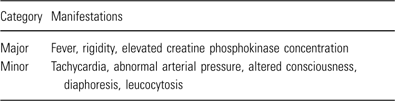
Second, his hyperthermia and autonomic instability might be explained by olanzapine-associated NMS, which may present hyperthermia, autonomic instability, leucocytosis, and elevated serum creatinine kinase levels (Reference Reilly and Kirk4,Reference Jafferany and Lowry29,Reference Kontaxakis, Havaki-Kontaxaki, Christodoulou and Paplos30). According to the Levenson’s criteria of NMS (Reference Levenson31) (Table 2), a probable diagnosis of NMS could be made in our case. Although our patient presented general weakness rather than muscular rigidity, which is typically seen in NMS, olanzapine-associated NMS has been reported as atypical NMS (Reference Kontaxakis, Havaki-Kontaxaki, Christodoulou and Paplos30). Furthermore, trihexyphenidyl could have altered the muscle tone, and, in theory, affected the motor symptoms of NMS in our case. In addition, NMS can occur any time during antipsychotic treatment (Reference Reilly and Kirk4,Reference Bhanushali and Tuite18). Nevertheless, the key to the differential diagnosis of heat stroke and NMS is the temporal relationship between the onset of hyperthermia and heat exposure. Therefore, the diagnosis of heat stroke should be made in our case rather than NMS.
Levenson’s clinical criteria for diagnosis of NMS

NMS, neuroleptic malignant syndrome.
All three major, or two major and four minor, criteria suggest a high probability of NMS, if supported by clinical history.
Finally, as serotonin syndrome shares several clinical features (such as hyperthermia and autonomic instability) with heat stroke (Reference Reilly and Kirk4), and as trazodone is a serotonergic antidepressant (Reference Stahl24), serotonin syndrome might have as well caused such a presentation in our case. However, our patient did not have cardinal features of serotonin syndrome such as diarrhoea, clonus, and hyperreflexia. Furthermore, trazodone does not significantly inhibit serotonin re-uptake at a dose of 50 mg/day (Reference Stahl24). Therefore, serotonin syndrome was unlikely the diagnosis for our patient.
Another observation was that the occurrence of aspiration pneumonia in our patient diminished since the switch from olanzapine to amisulpride. Kuo et al. (Reference Kuo, Yang and Liao32) showed that patients receiving amisulpride had a lower risk of pneumonia than those receiving olanzapine. Blockade of muscarinic M1 receptors could contribute to aspiration pneumonia due to dryness of mouth and oesophageal dilatation and hypomotility (Reference Maddalena, Fox, Hofmann and Hock33). Sedation via blockade of histaminergic H1 facilitates aspiration pneumonia. Therefore, the regimen of olanzapine, trihexyphenidyl, and trazodone could increase the risk of pneumonia in patients with schizophrenia. Amisulpride has a unique mechanism of action among second-generation antipsychotics. It has affinities for dopaminergic D2 and D3 as well as for serotonergic 5-HT2B and 5-HT7 receptors (Reference Stahl24). From a clinical perspective, amisulpride could be a realistic option for patients with schizophrenia who have a history of aspiration pneumonia.
Conclusion
Our case report has the several implications. First, heat stroke can occur in a patient with schizophrenia while receiving the maintenance treatment of olanzapine, trihexyphenidyl, and trazodone. Second, clinicians should be aware of the increased risk of heat-related illnesses in psychiatric patients. Third, clinicians should educate psychiatric patients and their family about the preventive measures of heat-related illnesses. Finally, clinicians should avoid prescription of polypharmacy and anticholinergics to patients with schizophrenia, whenever possible.
Acknowledgements
C.-P. Lee, P.-J. Chen, and C.-M. Chang wrote the manuscript. C.-M. Chang was the primary-care psychiatrist of the patient. C.-P. Lee was the principal investigator of this study. All the authors read and approved the final manuscript.
Conflicts of Interest
None.
Supplementary material
To view supplementary material for this article, please visit http://dx.doi.org/10.1017/neu.2015.29