


WHAT I DID
A number of years ago, I published “The Strategic Logic of Suicide Terrorism,” (Pape Reference Pape2003) an article advancing the hypothesis that suicide terrorism is mainly the product of foreign military occupation or, at least, the terrorists' perception that territory they prize is under occupation, for example, Al Qaeda's conviction that governments on the Arabian peninsula represent an American occupation regime. It is not, as the conventional wisdom holds, mostly a product of religious extremism independent of political circumstances. I showed that this hypothesis accounted for 95% of all of the 188 suicide terrorist attacks that occurred worldwide from 1980 to 2001. The article discussed differences between circumstances under which suicide terrorism has occurred and circumstances when it has not, but did not include an explicit effort to measure causal effects of factors influencing the difference. Based on the contents of their letter, Ashworth et al. (Reference Ashworth, Clinton, Meirowitz and Ramsay2008) seem to have stopped following the literature at this point.
Several years later, I published Dying To Win (2005), which expanded and updated my previous analysis. This book not only adds more data on the global patterns of suicide terrorism through the end of 2003, but also, most important for our discussion here, the book tests the main hypotheses against all of the other causal factors that are prominent in the literature across several domains relying on methods that include variation between cases of suicide terrorism and cases when it did not occur.
Although space prevents a full discussion, following are some of the key paragraphs on the issue.
The targets of modern suicide terrorist campaigns have been democratic states which have stationed heavy combat troops on the territory that the terrorists viewed as their national homeland. What accounts for this? Why do some foreign occupations result in suicide terrorism, while others do not? Why, for instance, did Hezbollah in the 1980s and the Tamil Tigers in the 1990s rely on suicide terrorism to achieve self-determination for their local communities, whereas the ETA that sought independence for Spain's Basques and numerous other recent rebellions against democratic states did not?
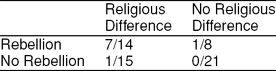
The main findings are that suicide terrorist campaigns are more likely when a national community is: occupied by a foreign power; the foreign power is of a different religion; the foreign power is a democracy; and ordinary violence has not produced concessions. Out of nine communities that have generated suicide terrorist campaigns, 8 had all four conditions, and the last, the Kurds in Turkey, had three of the four. Further, of the 14 nationalist rebellions against a democracy with a different religion since 1980, these four conditions account for the presence or absence of suicide terrorism in all 14—suicide terrorism occurred in 7, while the rebels were able to gain concessions without resorting to suicide terrorism in the other 7. By contrast, only 1 of 22 nationalist rebellions that did not meet all four criteria produced a suicide terrorist campaign—again, the Kurds in Turkey. The next two chapters add robustness to the theory by tracing the causal effects of the three key variables through numerous important cases, including Al Qaeda.
To test my theory, I employ a methodology that combines the features of focused-comparison and statistical-correlative analysis using the universe of foreign occupations, 1980–2003. Correlative analysis of this universe enhances confidence that my theory can predict future events by showing that the patterns predicted by the theory actually occur over a large class of cases. Detailed analysis of five cases enhances confidence that the correlations found in the larger universe are not spurious; that is, that my theory accurately identifies the causal dynamics that determine outcomes.
This study investigates the universe of foreign occupations in which a democratic state controlled the homeland of a distinct national community (other than the majority in the democratic state) for the period 1980 to 2003, 58 cases in all. The definition of “occupation” is deliberately broad. The analysis does not restrict the domain of “occupation” to cases in which a democratic state moved military forces across an internationally recognized boundary to govern the homeland of another community. It also includes the far larger number of cases in which a democratic state controlled the homeland of a distinct national minority within its own borders.
Using this broad definition of “occupation” provides a strong test of the role of religious difference in determining the degree of self-sacrifice by rebel groups. First, it enhances confidence that the findings are not due to the effect of selecting a narrow class of cases, because it tests the theory against all instances in which a local community could plausibly view itself as under foreign occupation. Second, it also allows the analysis to control for the effect of prior rebellion on the onset of suicide terrorism. Because rebellion is common in response to a foreign occupation preceded by a military invasion but less so when a distinct minority is ruled by different majority community in a state, including both situations enhances confidence that the study can determine whether the presence or absence of a nationalist rebellion is a prior condition for suicide terrorism. Finally, the broad definition of occupation enhances the robustness of my study by reducing the likelihood that there are a great number of missing cases that would contradict my findings.
To select cases and code the independent variables, I relied mainly on the Minorities at Risk database. This database already codes every country in the world for almost the entire period for the concentration of distinct minorities within states, level of rebellion by the minorities, and existence of religious difference between the minority and majority in the states. I supplemented this database with a list of foreign occupations due to invasion during the period as well as with additional material to bring the database up to the present.
The key question in assessing the significance of correlations between independent and dependent variables is how they compare to chance. There are two possible outcomes, a suicide terrorist campaign and no suicide terrorist campaign and four possible combinations of independent variables: religious difference and rebellion, religious difference and no rebellion, no religious difference and rebellion, and no religious difference and no rebellion. Accordingly, we can readily determine whether the suicide terrorist campaigns did or did not occur along with these combinations of independent variables and whether these results are higher than would be obtained by simply flipping a coin.
The nationalist theory of suicide terrorism expects that suicide terrorism would occur only in one of the combinations of independent variables, ie, when there is both a religious difference and rebellion. This theory correctly predicts 49 of 58 cases, a result that is statistically significant at the highest common benchmark of .01, meaning that it could be achieved by chance less than once in a hundred times.
Further, the predictive value of the nationalist theory of suicide terrorism is even higher once we consider the role of concessions in limiting the rise of suicide terrorism. In 7 of the 14 cases involving a rebellion and a religious difference, the rebels were able to gain concessions without resorting to suicide terrorism. In the other seven cases, prior concessions were either not made or were quickly withdrawn, and the rebels went on to use suicide terrorism in an attempt to gain concessions they otherwise could not get. This means that if we expand the conditions of suicide terrorism from the initial three—foreign occupation, by a democratic state, with a religious difference—to include the presence of concessions to rebellion alone, the nationalist theory of suicide terrorism correctly accounts for 14 of 14 cases in which all four conditions were met and 56 of 58 cases overall, results that could be reached by chance less than one in a thousand times.” (Pape Reference Pape2005, selections from ch. 6).
Suicide Terrorism and Democratic Occupations, 1980–2003
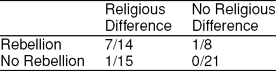
Source: Robert A. Pape, Dying to Win: The Strategic Logic of Suicide Terrorism
(New York: Random House, 2005) for cases and coding of variables.
These passages should make clear that my work on suicide terrorism goes to great lengths to evaluate the role of foreign occupation versus other possible causes of suicide terrorism in a manner that does not sample on the dependent variable.
WHAT ABOUT THE ORIGINAL ARTICLE?
One might still wonder whether the article is flawed by sample bias because it considered systematically only actual instances of suicide terrorism. The answer is no, for two reasons.
First, the article did not sample suicide terrorism, but collected the universe of suicide terrorist attacks worldwide from 1980 through 2001. It is the first database of its kind; United States, British, and Israeli officials tell me that they do not have comparably complete data. There is no such thing as sample bias in collecting a universe.
Second, although it is true that the universe systematically studied did not include suicide terrorist campaigns that did not happen, and that this limits the claims that my article could make, this does not mean that my analysis could not support any claims or that it could not support the claims I actually made.
Specifically, the universe that I studied made it possible to assess whether occupation is a necessary condition for suicide terrorism; it appears that it is. I could not, however, on the basis of the data in the article, have made claims about whether occupation is a sufficient condition for suicide terrorism, and did not.
The article also made a limited claim about the likelihood that the apparent association of occupation with suicide terrorism represents a real effect. This finding is based on the fact that there were 16 suicide terrorism campaigns from 1980 to 2001. All 16 are associated with military occupations; none with non-occupation. Compared to chance (i.e., a coin flip between occupation and non-occupation), this result would occur less than 1 in 55,000 trials, far less than the .05 level of significance that is the standard benchmark in statistical studies.
Following publication of the article, many asked if we could deepen the research to explore a wider set of data in order to explain why some occupations lead to suicide terrorism but others do not. Dying to Win represents, as I hope readers will agree, significant progress on that question.



Comments
No Comments have been published for this article.