INTRODUCTION
We report radiocarbon (14C) dates for charcoal cave paintings at Cova Eirós in northwest Iberia. These results support a Paleolithic/Epipaleolithic ascription, providing direct dates for the paintings as well as a minimum age for an engraving located underneath paintings. We used plasma oxidation and accelerator mass spectrometry (AMS) to address important methodological challenges associated with dating rock art (Steelman and Rowe Reference Steelman and Rowe2012). At Cova Eirós, contamination from medieval fires highlights the importance of taking background control samples of unpainted rock directly adjacent to collected pigment samples. We also conducted environmental scanning electron microscopy with energy dispersive X-ray spectroscopy (ESEM/EDS) and Fourier transform (FT) Raman spectroscopy to confirm the presence of charcoal pigment in the black figures so that small samples (<5 mg) could be collected with minimal impact upon the art.
The combination of plasma oxidation with AMS has been used to date rock paintings worldwide (Russ et al. Reference Russ, Hyman, Shafer and Rowe1990; Rowe Reference Rowe2001; Steelman et al. Reference Steelman, Carrera-Ramírez, Fábregas-Valcarce, Guilderson and Rowe2005; Rowe Reference Rowe2009; Steelman and Rowe Reference Steelman and Rowe2012; Baker and Armitage Reference Baker and Armitage2013; McDonald et al. Reference McDonald, Steelman, Veth, Mackey, Loewen, Thurber and Guilderson2014). Rock art samples present a challenge to traditional 14C sample preparation methods (acid-base-acid pretreatment followed by combustion), as only a trace amount of organic material is surrounded by an inorganic matrix. The primary advantage of the plasma technique is that the inorganic rock substrate does not decompose during plasma exposure, making extensive acid washes used to remove carbonates prior to combustion unnecessary. Plasma temperatures (<150°C) are below the decomposition temperatures of carbonates and oxalate minerals so that only organic material is extracted for 14C measurement (Russ et al. Reference Russ, Hyman and Rowe1992). Avoiding acid washes minimizes sample loss during wet chemical pretreatment, allowing the analysis of smaller samples. In addition, plasma oxidation is preferable because acid washes may not completely remove oxalates, carbon-containing minerals commonly associated with rock surfaces (Hedges et al. Reference Hedges, Bronk Ramsey, van Klinken, Pettitt, Nielsen-March, Etchegoyen, Fernandez Niello, Boschin and Llamazares1998; Armitage et al. Reference Armitage, Brady, Cobb, Southon and Rowe2001). While oxalate mineral accretions can provide minimum and maximum ages for paintings, their inclusion in a dated paint layer would skew results (Steelman et al. Reference Steelman, Rickman, Rowe, Boutton, Russ and Guidon2002).
Cova Eirós
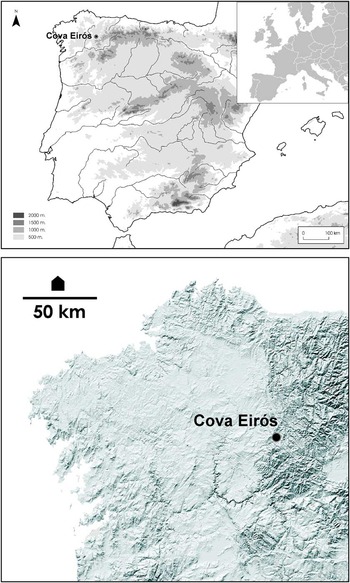
Cova Eirós is located in Cancelo (Triacastela, Lugo, Galicia, Spain) on the northwest Iberian Peninsula (Figure 1). Despite being the westernmost area of the Franco-Cantabrian region, northwest Iberia has traditionally remained aloof from Paleolithic art research due to an alleged absence of rock art and scarcity of mobiliary (portable) finds. However, the recurring presence of Upper Paleolithic hunter-gatherer communities in eastern Galicia, evidence of long-range contacts, and the discovery of open-air rock art in Northern Portugal highlighted this anomaly (Fábregas and de Lombera-Hermida Reference Fábregas Valcarce and de Lombera Hermida2010; Fábregas et al. Reference Fábregas Valcarce, de Lombera-Hermida, Viñas Vallverdú, Rodríguez Álvarez and Soares Figueiredo2015). In Galicia, the search for cave art is constrained to narrow bands of limestone formations in the Eastern Ranges with less-developed karst systems compared to other Iberian regions (de Lombera-Hermida Reference de Lombera2011). Since no systematic, archaeologically supervised effort to find parietal art has been undertaken in Galicia, we cannot rule out the existence of Paleolithic art even in previously known caves, perhaps containing hardly visible carvings or much-weathered paintings, as happened with recent discoveries in the Cantabrian region (i.e. Montes et al. Reference Montes Barquín, Muñoz Fernández and Morlote Expósito2005; Gárate et al. Reference Gárate, Ruiz-Redondo, Rivero and Rios-Garaizar2014).
Location of Cova Eirós in NW Iberia.

At Cova Eirós, archaeological excavation at the cave entrance revealed the existence of several Middle and Upper Paleolithic occupations, as well as Neolithic and Medieval ones (Rodríguez et al. Reference Rodríguez Álvarez, De Lombera Hermida, Fábregas Valcarce and Lazuén Fernández2011; Rey-Rodríguez et al. Reference Rey-Rodríguez, López-García, Bennàsar, Bañuls-Cardona, Blain, Blanco-Lapaz, Rodríguez-Álvarez, de Lombera-Hermida, Díaz-Rodríguez, Ameijenda-Iglesias, Agustí and Fábregas-Valcarce2016). Upper Paleolithic sequences at Cova Eirós range from the Aurignacian (Level 2, 31,690±240 BP, Beta-254280) to the end of the Final Magdalenian (Level B, 12,060±50 BP, Beta-308859). Portable art found in these older levels suggested that Paleolithic parietal cave art might also be found at this site.
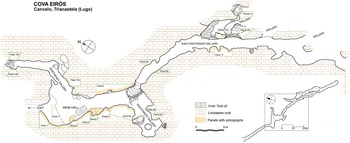
During the 2011 field season, we discovered cave art in Cova Eirós. An initial survey of the walls revealed paintings and engravings, stylistically related to the Final Upper Paleolithic/Epipaleolithic (de Lombera and Fábregas Reference de Lombera-Hermida and Fábregas Valcarce2013; Fábregas et al. Reference Fábregas Valcarce, de Lombera-Hermida, Viñas Vallverdú, Rodríguez Álvarez and Soares Figueiredo2015). Since then, our research team has conducted a systematic review of the walls and documented 13 panels with 93 motifs: 50% paintings; 46% engravings; and 4% natural rock formations possibly altered to represent zoomorphic silhouettes. Although art has been found everywhere within the cave, images are primarily concentrated on the west wall (Panels I–VI) of the Hall of the Mammoth (Main Hall), the largest chamber at 15 m long by 5 m high. Black charcoal pigment is dominant, with only one instance of red spots on Panel II. On Panel III, the more complex motifs and associations are found, including the concurrence of black paintings and engravings (Figure 2). At other locations in the cave, images are found in alcoves as well as in the southeast gallery (Viñas et al. Reference Viñas Vallverdú, de Lombera Hermida, Rubio Mora, Cortón, López, Carrera Ramírez, Rivas Brea, Rodríguez Álvarez and López De Silanes2013).
Plan of the cave, location of pictograph panels, and the inner test-pit.

Motifs are usually small, constrained by limited available space on cracked and weathered surfaces, but this seems to reflect a stylistic choice as well. Preservation is poor, either from deterioration (maybe explaining isolated spots or lines) or obstruction by modern graffiti, a blackish film of natural accretions, dust deposition, and smoke from hearths. Engravings are usually thin and shallow, at times forming dense clusters.
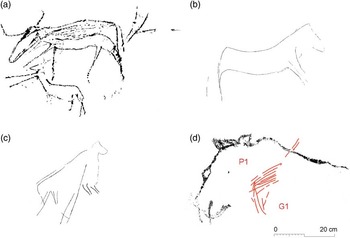
As to themes, dots or simple strokes of paint are common and usually placed lower on the panels. These kinds of marks or tracings can be interpreted as either prehistoric graphisms or otherwise unintentional marks, such as evidence of reviving a torchlight, accidental scratches, or topographic signals (Diaz Reference Díaz1993), whose creation may have continued until historic times (García and Gonzalez Reference García Díez and González Morales2003). Also frequent are thin grooves, again isolated or in groups, often appearing as a maze that covers much of the surface. Lastly, there are clearly painted and carved animal representations, generally incomplete (bovids, deer, horses, etc.) (Figure 3).
Zoomorphic representations from Cova Eirós. (a) cervid and bovid (Panels I-P5 and P6); (b) equid (Panel XI-G1); (c) bovid (Panel IV-G3); (d) superpositioning of the painted and engraved motifs in Panel III (Panels III-P1 and G1). Sample MD01 comes from the upper trace of the motif Panel III-P1.

Preliminary analyses allow us to put forward a working hypothesis about the chrono-cultural framework of Eirós cave art (de Lombera and Fábregas Reference de Lombera-Hermida and Fábregas Valcarce2013). Aside from certain multiple and convergent carvings (V- and X-shaped) that might belong to earlier time periods (Gravetian/Solutrean), the more diagnostic examples suggest a final Upper Paleolithic chronology. The two black-painted zoomorphs from Panel I and the engraved motif from Panel III (PIII-G1) with elongated and schematic bodies filled-in with thin lines and simplified representation of the extremities are consistent with the terminal Magdalenian or transition to the Epipaleolithic, as reported elsewhere in Iberia (Alcolea and Balbin Reference Alcolea González and Balbín Berhmann2006; Bueno et al. Reference Bueno Ramirez, Balbín Berhmann and Alcolea González2009; Viñas et al. Reference Viñas, Rubio and Ruiz2010; Collado and García Reference Collado Giraldo and García Arranz2010) (Figures 3b and 3d). These traits are also found in the painted figures from the Sala de las Pinturas at Cueva Palomera (Burgos, Spain), AMS dated to 11,470±110 BP and 10,950±100 BP (Corchón et al. Reference Corchón, Valladas, Bécares, Arnold, Tisnerat and Cachier1996), on the engraved plaquettes recovered from the top of level 4 at Rock #1 from Fariseu (Foz Côa, North Portugal), dated by their stratigraphical context between 11,500 and 9800 BP (García and Aubry Reference García Díez and Aubry2002; Aubry et al. Reference Aubry, García Díez, Sampaio, Plisson, Chauvière, Tymula, Calame and Dechanez2009; Mercier et al. Reference Mercier, Valladas, Aubry, Zilhão, Joron, Reyss and Sellami2006; Aubry and Sampaio Reference Aubry and Sampaio2009), and on the zoomorphic representation from Abrigo do Passadeiro (Miranda do Douro, North Portugal), ascribed to the Epipaleolithic (Sanches and Teixeira Reference Sanches and Teixeira2014). These stylistic features are part of the process of geometrization of the figurative component often observed at the Final Magdalenian/Epipaleolithic transition in Iberia (Bueno et al. Reference Bueno Ramírez, de Balbín Behrmann and Alcolea González2007; García Reference García Díez2013: 505–509).
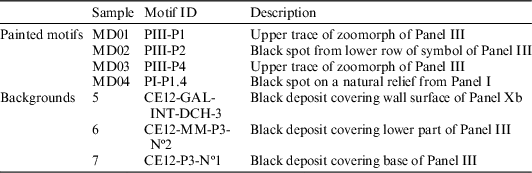
Radiocarbon samples were collected from Panels I and III (Table 1). On Panel III, a black painting of a zoomorph (PIII-P1, MD01) was drawn on top of an engraved ungulate (PIII-G1) (Figure 3d), suggesting multiple art production events. The stratigraphy and stylistic parallels of the engraving are consistent with a final Magdalenian chronology, reported at the cave entrance (Level B). However, the actual execution of the graphic representations could have a complex history, not necessarily related to the settlement sequence of the site.
Description of parietal art and background samples.

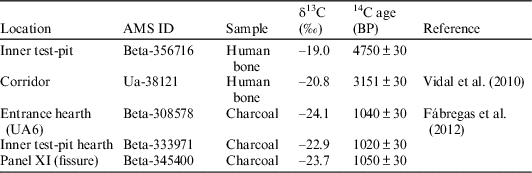
Archaeological excavation inside the cave has revealed intense use in later prehistoric and medieval times (Table 2). Human remains were recovered from the inner galleries and are most likely related to burial practices during the Neolithic and Bronze Age (Fábregas et al. Reference Fábregas Valcarce, de Lombera Hermida, Serna González, Vaquero Rodríguez, Pérez Rama, Grandal D´Anglade, Rodríguez Álvarez, Alonso Fernández and Ameijenda Iglesias2012). A test pit in the Hall of the Mammoth retrieved the remains of a bonfire dated to 900–1000 AD—just beneath Panel III, coeval with charcoal recovered deeper in the cave from a Panel XI fissure. A hearth and two storage structures at the entrance of the cave also have a similar age (Teira et al. Reference Teira Brión, Martín Seijo, de Lombera Hermida, Fábregas Valcarce and Rodríguez Álvarez2012), pointing to intense occupation and exploitation of the cave during this historical period. As there are multiple occupations over long time periods, the aim of this study was to obtain direct dates for the Cova Eirós cave art—within the constraints of extremely small sample sizes that may have been contaminated by medieval fires.
Radiocarbon dates obtained from excavations.

METHODS
ESEM/EDS and FT-Raman Spectroscopy
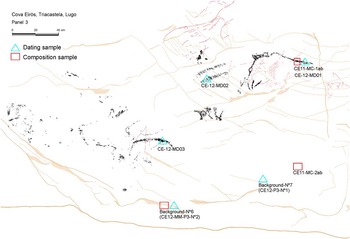
Paint and unpainted rock samples were analyzed with ESEM/EDS and FT-Raman spectroscopy to characterize pigment composition as well as identify possible contaminants and organic materials in the unpainted rock substrate (Serveis de Recursos Científic i Tècnics, URV, Tarragona, Spain) (Viñas et al. Reference Viñas Vallverdú, de Lombera Hermida, Rubio Mora, Cortón, López, Carrera Ramírez, Rivas Brea, Rodríguez Álvarez and López De Silanes2013). Most samples were from Panel III, which has the largest number of painted and engraved motifs (Table 1, Figure 4). An FEI Quanta 600 ESEM/EDS instrument was used for imaging and elemental analysis, so that no conductive coating was required. Using a Renishaw inVia FT-Raman instrument, the 514 nm line of an argon ion laser was employed for Raman excitation.
Tracing of painted (black) and engraved (red) motifs from Panel III and location of the samples collected for this 14C study. (Colors refer to online version.)

Plasma Oxidation and AMS Radiocarbon Dating
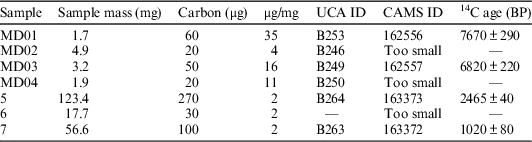
A custom-built radio frequency (RF) plasma oxidation apparatus converted organic material in paint samples to carbon dioxide for AMS 14C measurement. See McDonald et al. (Reference McDonald, Steelman, Veth, Mackey, Loewen, Thurber and Guilderson2014) for a detailed procedure of rock art dating methods employed by the University of Central Arkansas laboratory. We analyzed four black paint samples for dating and three unpainted rock samples as backgrounds to investigate contamination levels of organic material in the rock substrate (Table 1). Paint samples collected for 14C dating were less than 5 mg, whereas unpainted backgrounds were at least 10 times larger (Table 3). Samples were observed under a stereoscope at ×40 magnification prior to analysis. Paint samples were black particles with minimal associated rock substrate and no apparent mineral accretion layer. There were also no visible contaminants such as fibers or rootlets observed under magnification. As samples were small, they were ground to a fine powder prior to base pretreatment. All samples were soaked in 1 Molar sodium hydroxide for 1 hr in a 50±5°C ultrasonic water bath. After rinsing with deionized water and drying at 110°C, samples were loaded into the glass sample chamber of the plasma instrument. Prior to plasma oxidation, samples were treated with sequential argon plasma exposures at 1 torr argon and 40 W RF for 1 hr to remove adsorbed gases. Then, samples were oxidized with an oxygen plasma exposure at 1 torr oxygen and 100 W RF for 1 hr to convert organic material to carbon dioxide and water. Collected carbon dioxide was sent to the Center for Accelerator Mass Spectrometry (CAMS) at Lawrence Livermore National Laboratory for graphitization and AMS 14C measurement.
Uncorrected 14C results.

RESULTS AND DISCUSSION
ESEM/EDS and FT-Raman Spectroscopy
For the paint samples in this study, no charcoal fragments were observed with ESEM and EDS spectra were inconclusive (Viñas et al. Reference Viñas Vallverdú, de Lombera Hermida, Rubio Mora, Cortón, López, Carrera Ramírez, Rivas Brea, Rodríguez Álvarez and López De Silanes2013:46–8). In addition, no mineral accretion layer was observed. For charcoal pigment, it is sometimes possible to identify small charcoal fragments in SEM analyses, usually measuring on the order of 10 μm (see Arias et al. Reference Arias, Laval, Menu, González Sainz and Ontañón2011; Clottes et al. Reference Clottes, Menu and Walter1990; Tomasini et al. Reference Tomasini, Siracusano and Maier2012 for examples). Otherwise, when the pigment is heavily mashed/pounded or when soot is used, those fragments cannot be observed as was the case for the dated samples in this study (Olivares et al., Reference Olivares, Murelaga, Castro, Garate, Hernando and Corchón2009).
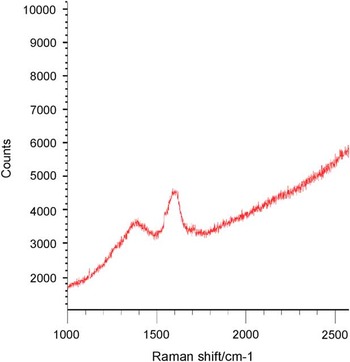
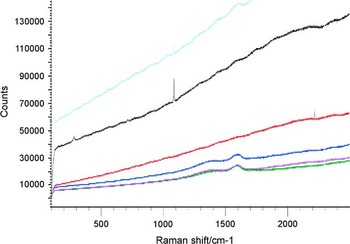
However, FT-Raman of the black paint samples confirmed the use of charcoal as pigment. The FT-Raman spectrum for an aliquot of MD01 clearly shows broad bands at 1340 cm–1 (D band) and 1597 cm–1 (G band), related to amorphous carbon of organic origin (Hernanz et al. Reference Hernanz, Ruiz-López, Gavira-Vallejo, Martin and Gavrilenko2010) (Figure 5). The absence of a band at 961 cm–1, related to phosphate, discards the possibility of burnt bone pigment (Smith et al. Reference Smith, Bouchard and Lorblanchet1999), which is also corroborated by the absence of hydroxyapatite in FTIR spectra (Tomasini et al. Reference Tomasini, Siracusano and Maier2012). FT-Raman of background samples show a higher concentration of calcite, as well as the presence of organic material and some charcoal particles (Viñas et al. Reference Viñas Vallverdú, de Lombera Hermida, Rubio Mora, Cortón, López, Carrera Ramírez, Rivas Brea, Rodríguez Álvarez and López De Silanes2013:46–8) (Figure 6).
FT-Raman spectrum of sample CE11-MC1ab.

FT-Raman spectra from background sample CE11-MC2ab. Note the bands at 285 cm–1, 711 cm–1 and 1085 cm–1, related to calcite in the upper spectra. The lower ones show the broad bands 1340 cm–1 and 1597 cm–1, related to carbon in the background sample. The red spectrum shows the high fluorescence of the clays, related to the weathering of the background limestone. (Colors refer to online version.)

Plasma Oxidation and AMS Radiocarbon Dating
Paint Samples
Uncorrected age results are shown in Table 3. The δ13C values were assumed to be –25‰, the value assumed by 14C laboratories for wood charcoal as carbon samples were too small to split for stable isotope measurements. Only two of the black paint samples from Panel III had sufficient carbon for dating, whereas the others were too small for reliable AMS measurement. During plasma oxidation, the black color of paint samples turned to white ash, further confirming that the paints were made with charcoal. If the pigment had been an inorganic mineral such as manganese dioxide, the black color would have persisted.
Process Blanks
As age results were younger than expected for these small samples (50 and 60 μg C), we 14C dated USGS coal samples to test accuracy of results. Our laboratory routinely processes standards of known age in the same manner as paint samples to determine the extent of modern contamination incorporated during laboratory procedures. USGS Coal is a “dead” 14C standard that is millions of years old with virtually no measureable 14C remaining—an ideal blank for 14C studies. Frequent evaluation of blanks is necessary in order to determine variability arising from different laboratory techniques and equipment. As sample sizes decrease, the effect of contaminant carbon on blanks is potentially more problematic. From two base-treated USGS coal samples analyzed within a week after the dating of the Cova Eirós paint samples as well as USGS standards regularly analyzed over the past 10 years in our laboratory (40–250 μg C), we introduce ≤1 μg modern carbon during chemical pretreatment, plasma oxidation, graphitization, and AMS measurement. This low background level suggests that minimal modern carbon is introduced during laboratory processing. The average of the two concurrent plasma-oxidized USGS coal samples (CAMS 163261: 48,270±270 BP; CAMS163263: 48,330±190 BP) were used as processes blanks for the AMS laboratory mass balance correction of the ages reported in Table 3.
Unpainted Rock Backgrounds
Unfortunately, carbon levels in unpainted rock backgrounds were not negligible suggesting that extracted carbon is a mixture of charcoal from the paint samples and contamination in the rock substrate (Table 3: Samples 5–7). However, paint samples did contain significantly more organic carbon per sample mass. We used the ratio of the μg amount of organic carbon extracted per mg amount of solid sample as normalized levels of organic carbon present in analyzed samples. For example, all background samples had a μg/mg ratio of 2. Using these μg/mg values to calculate percent contamination, sample MD01 contained 6% contamination (2/35=6%), whereas levels were higher for MD03 at 13% (2/16=13%).
This is not surprising as soot from medieval fires was suspected to be present on the cave walls. As stated before, there are two 14C dates from medieval charcoal inside the cave (Table 2). Charcoal from a small fissure in Panel XI was dated to 1050±30 BP (Beta 345400, –23.7‰). Charcoal from a hearth directly in front of Panel III, where the charcoal paintings were sampled, was dated to 1020±30 BP (Beta 333971, –22.9‰). Interestingly, carbon in the unpainted rock of background Sample 7 collected from Panel III was 14C dated to 1020±80 BP (Table 3). This date is statistically indistinguishable from the other two medieval dates for charcoal found in the cave. Using the R_Combine function of the computer program Oxcal, the weighted average of all three medieval dates is 1034±21 BP (980–1030 cal AD) and corresponds to an A x =0.8792.
Background Sample 5 was collected from Panel Xb (in the inner part of the cave) and was dated to 2465±40 BP. This disparate result for another unpainted rock sample shows the variability of organic contamination along the cave expanse and demonstrates the necessity of studying contamination on unpainted rock in as close proximity as possible to dated paintings.
Contamination Correction
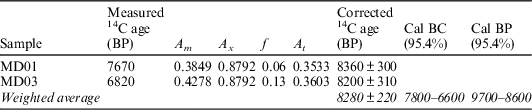
A mass balance calculation was performed to correct 14C results for the medieval contamination on Panel III, as this is the same location as dated samples MD01 and MD03. The age and contamination equations are A=A o e –t/8033 and A m =fA x +(1–f)A t , where A is the 14C activity at time t, A o is the modern 14C activity, A m is the measured 14C activity, A x is the contaminant 14C activity, A t is the true sample 14C activity, and f is the fraction of contamination. These calculations are summarized in Table 4.
Mass balance contamination and calibration calculations.

Using 1034 BP (A x =0.8792) as the contamination age for Panel III, sample MD01 has a corrected age of 8360±300 BP and sample MD03 has a corrected age of 8200±310 BP (Table 4). These results are statistically indistinguishable, with a weighted average of 8280±220 BP being the best age estimate for the Panel III paintings in the Main Hall. At 95.4% probability (2σ), the calibrated age range is 7800–6600 cal BC or 9700–8600 cal BP (Table 4). Calibration was performed using the OxCal computer program version 4.2.4 (Bronk Ramsey Reference Bronk Ramsey2009, Reference Bronk Ramsey2014) with IntCal13 curve data from Reimer et al. (Reference Reimer, Bard, Bayliss, Beck, Blackwell, Bronk Ramsey, Grootes, Guilderson, Haflidason, Hajdas, Hatte, Heaton, Hoffmann, Hogg, Hughen, Kaiser, Kromer, Manning, Niu, Reimer, Richards, Scott, Southon, Staff, Turney and van der Plicht2013). The associated error for results is large due to the small size of the samples (≤60 μg carbon from <5 mg-sized samples), as well as the antiquity of the ages.
While this contamination correction is not completely satisfactory, this is the data we have—admittedly on small samples from a contaminated site. We are in an unfortunate situation where we cannot collect larger samples without damaging the art and there is known contamination from medieval fires at the site. In spite of these challenges, the remarkable agreement between the corrected ages of MD01 and MD03 suggests that this type of background correction may be an appropriate solution for providing an age estimate in this situation.
Minimum Age of Cova Eirós Engraving
Radiocarbon dates for charcoal paintings also provide a minimum age for an engraving that is directly underneath one of the dated paintings. The age result for motif PIII-P1 (MD01) is consistent with its superimposition over the carving PIII-G1, stylistically ascribed to the Final Magdalenian/Epipaleolithic transition, or V Style (Bueno et al. Reference Bueno Ramírez, de Balbín Behrmann and Alcolea González2007, Reference Bueno Ramirez, Balbín Berhmann and Alcolea González2009).
CONCLUSIONS
To overcome challenges in 14C dating rock art at Cova Eirós, we utilized an integrated approach: (1) employing SEM/EDS and FT-Raman spectroscopy to identify charcoal as the black pigment; (2) using plasma oxidation combined with AMS 14C dating; (3) correcting 14C ages with dated contamination in the unpainted rock substrate to overcome inherent contamination within the paint samples themselves; (4) systematic rock art recording to understand the relationship between paintings and engravings; and (5) stylistic comparisons of the most representative figures at Cova Eirós.
We have recorded 13 decorated panels inside the cave with painted and engraved motifs. Although contamination complicates the dating of these pictographs, the charcoal paintings at Cova Eirós have been shown to be ≥9000 yr old. Raw 14C ages were corrected for the percentage of medieval contamination assumed to be present in the paint samples. A weighted average of 8280±220 BP represents the best age estimate for the paintings. Calibration provides a 95.4% probability age range of 7800–6600 cal BC or 9700–8600 cal BP. These results suggest an Epipaleolithic time frame for the two dated paintings at Cova Eirós, consistent with the stylistic ascription of the underlying motif and the most representative/diagnostic images (Style V). Superimpositioning and imagery elsewhere within Cova Eirós suggest that other representations might be much older.
The plasma oxidation method arises as a promising technique to overcome challenges associated with Paleolithic rock art studies. These results are only the second instance that plasma oxidation has been used to date non-Holocene aged materials. Ilger et al. (Reference Ilger, Dauvois, Hyman, Menu, Rowe, Vézian and Walter1995) obtained 12,180±125 BP (AA-9465, –25.5‰) and 11,600±150 BP (AA-9766, –24.3‰) for charcoal images at La Grotte du Portel in France. A rock art dating intercomparison program based on samples from the Upper Paleolithic site of Chauvet-Pont d’Arc Cave is highly desirable (Quiles et al. Reference Quiles, Valladas, Geneste, Clottes, Baffier, Berthier, Brock, Bronk Ramsey, Delque-Količ, Dumoulin, Hajdas, Hippe, Hodgins, Hogg, Jull, Kaltnecker, de Martino, Oberlin, Petchey, Steier, Synal, Van der Plicht, Wild and Zazzo2014). In addition, Pace et al. (Reference Pace, Hyman, Rowe and Southon2000) and Armitage (Reference Armitage1998) demonstrated that base-treated plasma oxidation ages statistically overlap with ABA combustion ages.
Finally, the paintings of Cova Eirós are important because it is the second cave site, along with Cueva Palomera, with Final Magdalenian/Epipaleolithic rock art on the entire Iberian Peninsula. These results are important in establishing a chronological framework for Style V art, which is identified on portable art that has been dated based on indirect stratigraphical methods. The rock art dates for Cova Eirós (>9000 cal BP) provide an ante quem terminus for the more recent evidence of that style. It is also the westernmost cave with Paleolithic art on the Iberian Peninsula and a crucial link between those well-known cave sites from the Cantabrian region and the recently discovered open-air sanctuaries in NE Portugal. With this find at Cova Eirós, there are opportunities for new discoveries not only in Galician caverns, but also in other rock shelters or open-air outcrops in the region similar to those in nearby territories of the interior of Iberia which have provided akin cultural evidence (valleys of Côa and Sabor, Siega Verde, etc.) (Baptista and Reis Reference Baptista and Reis2009). A systematic survey of sites using modern recording technology (digital photography and enhancement) is necessary in order to record previously unnoticed parietal art. Using an integrated approach to the analysis of Upper Paleolithic hunter-gatherer societies in NW Iberia, our understanding of cultural and socioeconomic relationships and cultural territories in the North Iberia and Cantabrian regions during the Final Upper Paleolithic will be significantly improved.
Acknowledgments
Fieldwork and research at Cova Eirós were funded by the Xunta de Galicia, the Spanish Ministerio de Economía y Competitividad (MINECO, project HAR2010-21786/HIST) and the Triacastela Council (Lugo, Galicia). We want to thank Mercé Moncusí for the FT-Raman analysis (Serveis de Recursos Científics i Tècnics, URV, Tarragona), Teresa Rivas for the FTIR analysis (Universidade de Vigo), and Andreu Ollé and Josep María Vergès (Universitat Rovira I Virgili) for the ESEM analyses. A. de L-H has enjoyed a pre-doctoral grant from the Atapuerca Foundation. We thank Tom Guilderson at the Center for Accelerator Mass Spectrometry, Lawrence Livermore National Laboratory under contract DE-AC52-07NA27344.
SUPPLEMENTARY MATERIAL
To view supplementary material for this article, please visit https://doi.org/10.1017/RDC.2017.4