Introduction
Dementia is one of the leading causes of burden of disease in developed countries, and the number of dementia patients is expected to rise further in the coming decade (Ferri et al., Reference Ferri2005). Treatments that cure or stop progression of dementia have not yet been found (Mangialasche et al., Reference Mangialasche, Solomon, Winblad, Mecocci and Kivipelto2010). Consequently, optimizing quality of life of both patient and caregiver is the most important treatment goal.
Psychosocial interventions aim to improve quality of life and psychological and social functioning, and to maximize function in the context of existing deficits (American Psychiatric Association, 2007; Moniz-Cook et al., Reference Moniz-Cook, Vernooij-Dassen, Woods and Orrell2011). The scientific evidence for the effectiveness of psychosocial interventions in dementia care is growing (Kverno et al., Reference Kverno, Black, Nolan and Rabins2009; O'Connor et al., Reference O'Connor, Ames, Gardner and King2009; Olazarán, et al., Reference Olazarán2010). Dementia guidelines of various countries consider this type of intervention to be the first choice of treatment for various symptoms of the disease (American Psychiatric Association, 2007; Abbey et al., Reference Abbey, Palk, Carlson and Parker2008; Hogan et al., Reference Hogan2008; Vasse et al., Reference Vasse2012). In other countries, however, the inclusion of evidence on psychosocial interventions in dementia guidelines seems limited (Vasse et al., Reference Vasse2012). In addition, psychosocial interventions were found to be recommended far less often by physicians than pharmacological treatments at the time of diagnosis (Rimmer et al., Reference Rimmer, Wojciechowska, Stave, Sganga and O'Connell2005).
The use of psychosocial interventions in dementia care is not automatic and an additional tool in the form of quality indicators (QIs) is needed to further facilitate the implementation process. Quality indicators are measurable elements of practice performance focusing on the structures, processes, or outcomes of care (Donabedian, Reference Donabedian2005). Indicator elements are explicitly defined and act as building blocks in the assessment of care (Campbell et al., Reference Campbell, Braspenning, Hutchinson and Marshall2002; Reference Campbell, Braspenning, Hutchinson and Marshall2003). A set of QIs for psychosocial interventions in dementia care representing the key elements of effective psychosocial care would enable dementia care professionals to check and improve the quality of the psychosocial care they provide in daily practice.
To our knowledge, sets of QIs that have been developed and published for dementia mainly focus on diagnostics, screening, and pharmacological interventions, but they include very few indicators for psychosocial interventions (Saliba et al., Reference Saliba2005; Amin et al., Reference Amin2007; Drasković et al., Reference Drasković, Vernooij-Dassen, Verhey, Scheltens and Rikkert2008; Perry et al., Reference Perry2010). Our objective was to develop valid QIs for psychosocial interventions in dementia care that apply to various countries and settings. The set should help dementia care services and professionals implement evidence-based psychosocial care for dementia patients and their caregivers.
Methods
The QIs were developed as part of the European Collaboration on Dementia project (EuroCoDe, 2006–2008), which was initiated and led by Alzheimer Europe (Vasse et al., Reference Vasse2008). The working group that developed the QIs consisted of seven members of the Interdem network (Early Detection and Intervention in Dementia Group). The method the working group used to develop the QIs included the following four steps (Figure 1):
1. Selecting recommendations from systematic reviews and guidelines.
2. Expert panel rating of the recommendations.
3. Constructing a set of potential QIs.
4. Consensus meeting on the final set.
Stepwise procedure to develop quality indicators for psychosocial care in dementia.
*General practitioner, neurologist, occupational therapist, working in a memory clinic, a nursing home, or for an Alzheimer society. Be = Belgium; De = Denmark; Fi = Finland; Fr = France; Ge = Germany; GP = General practitioner; Gr = Greece; It = Italy; Ne = The Netherlands; No = Norway; OT = Occupational therapist; Po = Poland; Sl = Slovakia; Sp = Spain; Tu = Turkey; UK = United Kingdom.

Steps 1–3 were part of a RAND-modified Delphi procedure to achieve content and face validity of the QIs (Campbell et al., Reference Campbell, Braspenning, Hutchinson and Marshall2002; Reference Campbell, Braspenning, Hutchinson and Marshall2003). This procedure combined expert opinion with evidence from literature and guideline recommendations and included two expert panels, of which one was the working group itself. The aim of the fourth step was to discuss measurability and applicability of the potential QIs with dementia experts from various countries and to reach consensus on a final set of QIs.
After consensus was reached, the feasibility was studied of using the final set of QIs in different countries and settings by extracting data from patient records.
Selecting recommendations
The first step of development consisted of the selection of recommendations for psychosocial interventions by the working group. Evidence-based recommendations were gathered from relevant systematic reviews in the literature and European dementia guidelines (Vasse et al., Reference Vasse2008). The working group discussed all the recommendations that were obtained in this way in a face-to-face meeting. Recommendations were selected for the second step if they were based on scientific evidence and covered aspects of psychosocial care for people with dementia or their caregivers.
Rating the recommendations
The aim of the second step was to reach consensus among dementia experts on a key set of recommendations for psychosocial care. The selected recommendations were unequally divided into eight categories and presented to a European expert panel in two postal questionnaire rounds. The experts were professionals involved in dementia care and included researchers and medical and care professionals.
Three strategies were used to include experts from as many countries as possible: (1) approaching experts at the Alzheimer Europe conference in Estoril, Portugal, in 2007, (2) emailing requests to Alzheimer center coordinators in European countries, and (3) using the personal networks of working group members.
Experts were asked to rate each recommendation twice on a 9-point Likert scale in the first questionnaire round. Recommendations were rated for usefulness in contributing to the improvement of quality of dementia care on a scale of 1 (not useful) to 9 (most useful), and the priority it should be given in the expert's own country on a scale of 1 (lowest priority) to 9 (highest priority). Experts were also asked to list their personal top five recommendations for each category, starting with the recommendation they found most useful for improving the quality of dementia care within the category.
All recommendations included in the first round were also included in the second round. The same experts who took part in the first round were then asked to rate each recommendation for feasibility of implementation in their own countries within five years on a Likert scale of 1 (not feasible) to 9 (most feasible).
Constructing a set of potential quality indicators
The third step consisted of two face-to-face meetings. In the first meeting, the working group discussed the results of the first questionnaire round. A recommendation was selected for the key set when it scored high on average for contributing to the improvement of quality of dementia care: a median score of 8 or 9. The experts also had to agree, meaning that at least 75% of the experts had to rate the recommendation within the highest tertile (a score of 7–9) to add it to the key set (Fitch et al., Reference Fitch and Fitch2001).
If these scores did not differentiate the recommendations well enough, the top five listings of each category were used. The overall ranking of the top five recommendations was calculated for each category. Each recommendation that an expert ranked first in its category was awarded five points, each recommendation ranked second was awarded four points, and so on.
During the second meeting, the working group constructed a potential set of QIs on the basis of the set of key recommendations and the results of the second questionnaire round. Key recommendations that scored a median of 6 or less for feasibility of implementation were rejected as QIs unless the working group agreed that they covered a basic principle of psychosocial care in dementia and were, therefore, essential for improving quality.
Consensus meeting on the final set
The fourth and final step consisted of a consensus meeting, which was preceded by a pilot study using a convenience sample of dementia patients’ records. The aim of this pilot study was to test whether the potential QIs could be applied to dementia patients and their caregivers in various countries and settings, and whether data were available in patient records.
Members of the Interdem network, including the working group members, were invited to a two-day conference. Before the conference, the members were asked to gather QI data from patient records within the organizations in which they work. A form was constructed in English to enable the extraction of data.
The results of this pilot study and the complexity of formulation of each QI were discussed at the conference. Afterward, the potential set of QIs was adjusted on the basis of the feedback from the conference participants and circulated one more time to reach consensus on the final set of QIs.
Feasibility study
A retrospective cohort study was conducted to assess the feasibility of using the final set in day care centers, hospitals, and nursing homes in Spain and The Netherlands.
Managers at each setting selected dementia patients. The inclusion criteria were age 65 years or older, diagnosed with any type of dementia at least six months earlier, first visit to the hospital or day care center at least six months ago, living in the nursing home for at least six months. Informed consent was obtained from each patient or their caregiver before data were collected.
After the data were collected, they were entered in a database using the Statistical Package for the Social Sciences (SPSS 16.0 for Windows, SPSS Inc., Chicago, IL, USA). A QI was considered adhered to if it was fulfilled. In case of multiple items, all items had to be fulfilled. Quality indicators subitems were considered not applicable if irrelevant to the patient or the caregiver.
Results
Selecting recommendations
Seventeen systematic reviews that met the inclusion criteria were analyzed (Vasse et al., Reference Vasse2008). The inventory of dementia guidelines across Europe showed that eight dementia guidelines from five countries included one or more recommendations for psychosocial interventions (Vasse et al., Reference Vasse2008).
The working group discussed all the recommendations collected from these sources and wrote a questionnaire for the second step. Complex recommendations that included multiple items or more than one statement were split up, so that there were 104 recommendations with a single statement or item to be rated (Figure 1).
Rating the recommendations
About 80 questionnaires were handed out to dementia experts attending the Alzheimer Europe Conference in Estoril, Portugal, in May 2007. The questionnaire was also emailed to the Alzheimer center coordinators of 34 European countries in October 2007. Nineteen questionnaires were completed and returned. About 60 questionnaires were sent by regular mail to Interdem contacts in European countries. Thirty of the questionnaires were completed and returned. In total, we received 49 completed questionnaires.
The 49 experts who participated in the first round were sent an email in May 2008 requesting them to fill in the second questionnaire, which was attached with the email. Fourteen experts returned the questionnaire.
Constructing a set of potential quality indicators
The working group discussed the results of the first questionnaire round in May 2008. These results showed that for usefulness 84 recommendations and for priority 59 recommendations scored a median of 8 or higher and received 75% or more of the ratings within the highest tertile. Because the statistical results did not differentiate the recommendations well enough, the overall top five rankings were calculated by category. All recommendations in the overall top five rankings also scored a median 8 or 9 and received 75% or more ratings within the highest tertile for usefulness. The working group therefore decided that the set of key recommendations would be based on the results of the top five listings. For the two categories with fewer than ten recommendations, only the top three recommendations were included. One category had only two recommendations, which the experts ranked as equally important and both were included. The working group discussed a total of 33 recommendations to compose the key set. They merged recommendations wherever possible, excluded the ones where the content overlapped with others, and rephrased them if necessary. This resulted in a set of 17 key recommendations.
During the second meeting (October 2008), the working group discussed expert ratings for the feasibility of implementation. Six of the initial 33 recommendations scored a median of 6 or less, but none of the 17 key recommendations were excluded or changed because of these ratings. Finally, the working group constructed 15 QIs. They excluded four of the 17 key recommendations during this phase because of difficulties in turning them into measurable elements, and they split two recommendations into two separate QIs each.
Consensus meeting on the final set
Twenty-five Interdem members from ten European countries attended the two-day conference “Quality indicators for psychosocial care in dementia” in September 2009. The conference participants of eight countries extracted data from patient records and provided feedback for the set of 15 QIs based on this exercise. The other conference participants who were not in a position to extract data provided feedback on the basis of their knowledge of dementia care services in their own countries.
The feedback was used afterward to improve the feasibility of the set of QIs. Of the 15 potential QIs, three were not changed, seven were reformulated, four were merged and reformulated into two QIs, and one was excluded from the set because the conference participants agreed that it covered basic medical care rather than a psychosocial principle of dementia care.
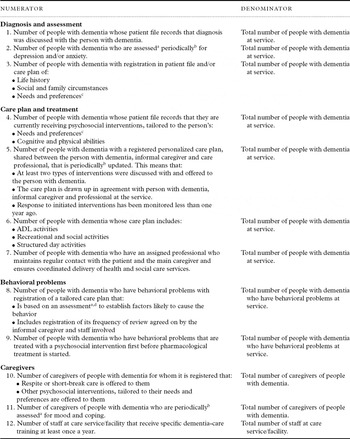
Finally, the conference participants were asked for their consent for these adjustments by email, and consensus was reached on a set of 12 QIs for psychosocial care in dementia. This final set consists of nine process indicators for people with dementia, two process indicators for informal caregivers, and one structure indicator for formal caregivers (Table 1).
Quality indicators for psychosocial care in dementia

a A structured and systematic approach to examine a certain condition. This means using validated scales/questionnaires or at least a standardized method that is used for all similar patients/persons within the organization/service.
b At least once a year.
c Important to person with dementia, related to the quality of life.
d In case of behavioral problems, the assessment ideally includes physical health, depression, undetected pain or discomfort, side effects of medication, individual biography, including beliefs, spiritual and cultural identity, psychosocial factors, physical environmental factors, and specific behavioral and functional analysis.
Feasibility study
We extracted data from 153 patient records to assess the feasibility of the 11 QIs for dementia patients and their informal caregivers. We obtained data for the QI for formal caregivers from care managers in The Netherlands and care staff in Spain. The subitem about caregivers being offered respite or short-break care (QI 10) was not applicable in the nursing home setting, so we excluded it when calculating adherence in this setting.
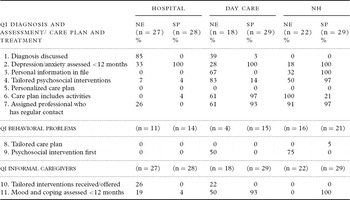
The mean adherence (±standard deviation) to the 11 QIs for patients and informal caregivers was 26.3% (±36.6%). Adherence per patient record ranged from 0% to 89%, and per setting from 11% (Spanish hospital) to 50% (Spanish nursing home). Table 2 shows the adherence to each QI by setting and country.
Percentage adherence to the 11 quality indicators for patients with dementia and informal caregivers, based on documentation in medical records in Spanish and Dutch hospitals, day care centers, and nursing homes

Ne = The Netherlands; NH = nursing home; QI = quality indicator; Sp = Spain.
The Spanish settings rated higher for assessing depression/anxiety and mood/coping (QIs 2 and 11) than the Dutch settings, with the exception of mood/coping in the hospital setting. The hospitals in both countries showed 0% adherence for more than half of the QIs for patients.
The indicator for assessing the depression/anxiety of dementia patients received the best adherence across all settings (68%). However, this adherence varied widely from 100% for the Spanish settings to 18%–33% for the Dutch settings. In general, adherence varied widely, although for each QI at least one of the settings rated 75% or more except QIs 5, 8, and 10. This indicates that it is possible to provide psychosocial care in line with these QIs. The low adherence to QIs 5 and 8 was mainly due to the subitems about offering/discussing at least two different interventions (QI 5) and the frequency of review (QI 8), of which no note was found in most patient records. Offering interventions to caregivers (QI 10) was documented in 28 cases (18%) – all but one from Dutch settings – but information about tailoring was lacking here.
One-hundred-eight patients (71%) received psychosocial interventions, but patient records often lacked information about how these were tailored to the person (QI 4). Of the 81 dementia patients (53%) who showed behavioral problems, 14 (17%) had documentation of being treated with a psychosocial intervention first (QI 9). There were records of 58 patients (72%) receiving a pharmacological intervention for behavioral problems.
In both countries, staff needed to have basic psychogeriatric training specific to the setting to work there. Overall, staff members had received training in the preceding year, although ongoing staff training was not obligatory in all settings.
Discussion
We have developed a set of 12 content- and face-valid QIs that represent the key elements of effective psychosocial care in dementia. To our knowledge, this set is the first that aims exclusively at psychosocial interventions in dementia care. It is applicable to various countries and settings, with the exception of the subitem on respite and short-break care being offered to caregivers. This subitem is meant to be excluded when the set is used in the nursing home setting.
The EuroCoDe project offered a timely and unique opportunity to reach consensus with a large number of dementia experts from different disciplines and countries about the very essence of evidence-based psychosocial care in dementia. The result is a set of generic QIs covering the minimal standard of psychosocial care. The QI content assists healthcare professionals to individualize and tailor psychosocial care, to empower the patient and caregiver, and to provide social inclusion and continuity of care. Empowerment of the patient and caregiver means enabling them to control certain situations, providing care options, and creating new meaning in their lives (Holmström and Röing, Reference Holmström and Röing2010). The QIs reflect this by giving informed choices (QI 5), promoting and enhancing strengths and abilities (QI 4), and taking into account needs and preferences (QIs 3 and 10). Important dimensions of social inclusion are being accepted and recognized as an individual beyond the disease and being able to participate in social activities (Hall, Reference Hall2009). Care professionals being aware of the social and family circumstances (QI 3), discussing care options with both patient and caregiver (QI 5), and offering participation in recreational and social activities (QI 6) contribute to the social inclusion of the dementia patient and caregiver. As dementia is an ongoing disease process, the provision of care must also be ongoing. Continuity of care ensured by frequent review of the care plan (QI 8), monitoring response to initiated interventions (QI 5), and periodical assessment of depression and coping (QIs 2 and 11) is essential to quality psychosocial dementia care.
All healthcare professionals involved in dementia care, regardless of their nationality or discipline, can use this set of QIs. International collaboration for developing QIs has considerable benefits, but transferring QIs from one country to another is not easy (Marshall et al., Reference Marshall, Shekelle, McGlynn, Campbell, Brook and Roland2003). Differences between developed countries exist in the availability and accessibility of dementia care services (Moise et al., Reference Moise, Schwarzinger and Um2004; Alzheimer Europe 2006). Our feasibility study shows that the set applies to Spanish and Dutch dementia patients in hospitals, nursing homes, and day care centers, and that there is considerable room for improving psychosocial dementia care in these settings. Nonetheless, it is likely feasible to use the QIs in similar settings in other developed countries as well.
Although the EuroCoDe project focused on dementia care in European countries, the method for developing this set of QIs included evidence from the international literature. Furthermore, recommendations for psychosocial interventions in European dementia guidelines do not differ from those in non-European dementia guidelines (National Guideline Clearinghouse, 2006; American Psychiatric Association, 2007; Abbey et al., Reference Abbey, Palk, Carlson and Parker2008; Hogan et al., Reference Hogan2008; Vasse et al., Reference Vasse2012). Therefore, using the QIs is not limited by country or continent.
Despite these strengths, there are some limitations that should be taken into account. First, validity should be further tested, and especially the discriminatory capacity should be assessed, both across and within the various countries. Second, we did not measure interrater reliability in our study, but it should be assessed to allow accurate comparison of adherence scores between countries and settings when more than one person collects data. Third, although the set of QIs is, in theory, applicable to people with dementia and their caregivers living at home, this setting was not included in the feasibility study. For those who receive care from home care services, family physicians, or case managers, it is likely that case records documenting these activities exist. Future studies that access such records in order to check our proposed set of QIs are required. Fourth, the use of written records as a data source has some disadvantages, one of which is that most case records are incomplete. This leads to underestimation of the actual care delivered (Peabody et al., Reference Peabody, Luck, Glassman, Dresselhaus and Lee2000; Powell et al., Reference Powell, Davies and Thomson2003). The use of additional data sources, such as interviews with care managers or caregivers, should be investigated in further studies. Finally, as was the case with the subitem related to respite and short-break care in the nursing home setting, other QIs may not be applicable to specific settings or disease stages. For instance, discussing the diagnosis is probably not relevant to people and caregivers in the final stages of dementia. Although discussing palliative care approaches might represent quality psychosocial care in these final stages, we have not included this subject in the current set. The content we outline is the first step toward establishing a broad set of QIs, which are not fixed but should evolve in line with the developing knowledge base. However, we suggest that this be underpinned with an equivalent systematic methodology before future refined QIs are disseminated widely.
In an ideal world, everyone with dementia and his/her caregiver would have access to the best quality of care. In the real world, many obstacles hamper this access. The use of evidence-based guidelines and QIs in dementia care can lead to substantial improvements in the quality of care (Vickrey et al., Reference Vickrey2006; Reuben et al., Reference Reuben2010). The introduction of quality improvement cycles using the QIs for psychosocial care can generate important progress toward ideal dementia care. Professionals and services could use this set of QIs as a starting point to implement and improve evidence-based psychosocial care on a local level.
Conflict of interest
None.
Description of authors' roles
Emmelyne Vasse was a member of the EuroCoDe work group, designed the study, collected and analyzed the data, wrote the first draft of the paper, and was responsible for revisions. Esme Moniz-Cook was a member of the EuroCoDe work group, commented on the study design and data analysis, composed the potential set of QIs, and commented on the paper. Marcel Olde Rikkert was a member of the expert panel that rated the recommendations, contributed to the data collection and commented on the data analysis of the retrospective cohort study, and contributed to the drafting of the paper. Inge Cantegreil was a member of the EuroCoDe work group, commented on the study design and data analysis, composed the potential set of QIs, and commented on the paper. Kevin Charras was a member of the EuroCoDe work group, commented on the study design and data analysis, composed the potential set of QIs, and commented on the paper. Pascale Dorenlot was a member of the EuroCoDe work group, commented on the study design and data analysis, and commented on the paper. Georgina Fumero collected and analyzed the data and contributed to the drafting of the paper. Manuel Franco was a member of the EuroCoDe work group, commented on the study design and data analysis, composed the potential set of QIs, contributed to the data collection of the retrospective cohort study, and commented on the paper. Bob Woods was a member of the EuroCoDe work group, commented on the study design and data analysis, composed the potential set of QIs, and commented on the paper. MyrraVernooij-Dassen was a member of the EuroCoDe work group and work package leader, contributed to the study design and data analysis, composed the potential set of QIs, contributed to the data collection of the retrospective cohort study, and contributed to the drafting of the paper.
Acknowledgments
This paper was produced in the framework of the Alzheimer Europe project “European Collaboration on Dementia”. (EuroCoDe), which received financial support from the European Commission, under its program for community action in the field of public health (2003–2008). Neither the European Commission nor any person acting on its behalf is responsible for any use that might be made of the following information. The authors thank Fondation Médéric Alzheimer for cofinancing and for the coordination of EuroCoDe.
The authors also thank the Robert Bosch Stiftung for hosting and financing the two-day conference which was held in Berlin, Germany, September 21 and 22, 2009. They also thank the Interdem members who took part in this two-day conference and provided feedback on the set of QIs.