Introduction
Lathyrus sativus Linnaeus (Fabaceae), commonly known as khesari, is a winter pulse crop cultivated for production of seeds in India (Gaur and Maloo Reference Gaur and Maloo2011). It is also a popular pulse crop in Bangladesh, China, Nepal, Pakistan, and Ethiopia (Girma and Korbu Reference Girma and Korbu2012). Due to easy and low-cost cultivation, and resistance to drought, salinity, and stress properties, the farmers cultivate this pulse crop for seed as well as fodder (Gaur and Maloo Reference Gaur and Maloo2011). Callosobruchus maculatus (Fabricius) (Coleoptera: Chrysomelidae: Bruchinae) is an important cosmopolitan polyphagous pest of stored legumes including khesari seeds in tropics and subtropics (Utida Reference Utida1972; Fox et al. Reference Fox, Bush and Messina2010) and genetic diversity of this insect pest was found among populations even in the same environment (Tuda et al. Reference Tuda, Chou, Niyomdham, Buranapanichpan and Tateishi2005, Reference Tuda, Ronn, Buranapanichpan, Wasano and Arnqvist2006, Reference Tuda, Kagoshima, Toquenaga and Arnqvist2014). The adult female lays eggs on the khesari seed surface and the newly hatched larvae of C. maculatus continue feeding for four instars in the seeds to complete their larval development within 12–16 days, and finally the adults emerge from the seeds (Adhikary and Barik Reference Adhikary and Barik2012). Infestation by this insect reduces nutritional quality of seeds including viability of the seeds.
Lathyrus sativus has an ambivalent reputation due to presence of β-ODAP (β-N-oxalyl-L-α, β-diaminopropionic acid) as a neurotoxic amino acid in the seeds. A review by Singh and Rao (Reference Singh and Rao2013) demonstrated that presence of both homoarginine and β-ODAP in L. sativus seeds make it a potentially important functional food of great value to human health in areas of cardiovascular physiology, hypoxia, and nutrition as well. Lathyrus sativus seeds were no longer used as a staple food because of neurotoxins are making a comeback as a health food because of new plant varieties (Rao Reference Rao2011; Singh and Rao Reference Singh and Rao2013). The most effective strategy adopted by farmers against insect pests remains the application of insecticides (pyrethroids, organophosphates) for control of C. maculatus populations in the khesari seeds. The literature indicates that the “active” and “normal” morphs of C. maculatus represent adaptations to field and seed store environments, respectively (Utida Reference Utida1972, Reference Utida1981; Messina and Renwick Reference Messina and Renwick1985a; Fox Reference Fox1993; Appleby and Credland Reference Appleby and Credland2001; Zannou et al. Reference Zannou, Glitho, Huignard and Monge2003; Fox et al. Reference Fox, Bush and Messina2010; Arnold et al. Reference Arnold, Stevenson and Belmain2012). The active form plays an important role in dispersal of populations from stores to the field due to its greater flight activity than normal form. Active females lay eggs on the maturing pods in the khesari, cowpea (Vigna unguiculata (Linnaeus) Walpers (Fabaceae)), and pea fields during the winter season. The larvae complete their development in the seeds and, one month later, adults of normal morph emerge in the fields or in the storage after pod harvesting. These adults reproduce for four to five generations in seed storages. The active form begins to appear after five to six months in seed storages and increases in proportion in successive generations in response to increase in temperature, lower seed water content, or increased larval density (Utida Reference Utida1972; Fox Reference Fox1993; Appleby and Credland Reference Appleby and Credland2001). The active form, in reproductive diapause induced during post-embryonic development, leaves the stores and feeds on pollen and nectar in nature (Zannou et al. Reference Zannou, Glitho, Huignard and Monge2003). Feeding on the host-plants’ flowers leads to termination of the reproductive diapause, and production of mature oocytes in the active forms.
The main objective of this study was to obtain a better understanding the bionomics of C. maculatus on four varieties of khesari seeds (two cultivars, Bio L 212 Ratan and Nirmal B-1 currently grown by farmers and WBK-14-7 and WBK-13-1 being considered for commercialisation) to enhance control strategies of this economic pest. This research also investigated the possible impact of different levels of nutritional factors (carbohydrates, proteins, lipids, nitrogen, and amino acids) and antinutitional factors (β-ODAP, phenol content, and trypsin inhibitor activity) present in these four varieties of khesari seeds on the natural history of C. maculatus populations.
Materials and methods
Seed materials
Four varieties (Bio L 212 Ratan, Nirmal B-1, WBK-14-7, and WBK-13-1) of khesari seeds were collected from Pulses and Oilseeds Research Station, Behrampore (24°6' N, 88°15' E), West Bengal, India. Seeds were sowed during late October and grown in the fields (33–35 plants/m2) of the research station with nitrogen: phosphorous: potassium at 20:40:40 per ha, organic matter 5.1±0.2% and pH 6.6 (data sourced from research station).
Test insects and experiments
The insect, C. maculatus used in this study was collected from local stores containing khesari seeds in 2011. Stock cultures of insects were maintained on each variety of khesari seeds for at least 25 generations in 2.5 L glass jars covered with fine-mesh nylon nets at 27±1 °C, 70±5% relative humidity (RH), and 14:10 light:dark photoperiod in a “BOD” incubator (ADS Instruments and Technology, Calcutta, India). Newly emerged females and males were separated into normal and active individuals (Utida Reference Utida1972). Normal females are more pigmented, heavier, longer body, abdomen extending well beyond the elytra end, and rounded posteriorly, and with pubescence forming a distinct cross pattern across the elytra whereas active females have lower body weight, shorter body, abdomen narrower and pointed exteriorly, and grey appearance caused by diffuse pubescence on the elytra. The normal males are characterised by a tan cuticle across the whole of the elytra whereas active males’ cuticle has several dark brown patches and the elytra may also appear very dark brown. Males show no obvious difference in body shape.
Experiment 1–25 insects of each newly emerged morph for each variety of khesari seeds (male and female) were weighed on a monopan balance (±0.01 mg) after drying in a hot air oven at 50±1 °C for 72 hours. Newly emerged active/normal male and female were also paired in glass jars containing 20 khesari seeds of each variety. The glass jars were lined with coarse grade emery paper to prevent oviposition on their walls. Twenty-five pairs of normal/active individuals were setup for each variety of khesari seeds to quantify egg-laying duration. The number of eggs per seed was counted and the seeds in each glass jar were replaced with uninfested ones, daily, until female death. The seeds with eggs were examined for up to 12 days to determine if larvae had successfully penetrated the seed cases (as indicated by the presence of white frass). Emergence and time of death were recorded for each insect.
Experiment 2–40 virgin normal females collected within 12 hours of emergence were placed each with a single virgin normal male collected from the same variety of khesari seeds in a 60 mm Petri dish for mating. After a single copulation, normal females were transferred individually to a 15 cm (length)×8 cm (diameter) glass jars each containing 20 khesari seeds of the variety from which they emerged and removed from the glass jar after 24 hours. Five hundred seeds of each variety containing newly laid eggs were placed in sterilised glass jars (20×10 cm) and maintained at 27±1 °C, 70±5% relative humidity, and 14:10 light:dark photoperiod in BOD incubators. The eggs were observed daily to record duration of egg development (incubation period). Fifteen seeds containing instars were randomly sampled and dissected daily to observe survival and developmental time until adults emerged. There were five replicates per variety.
Experiment 3 – The nutritional quality of four varieties of khesari seeds (Bio L 212 Ratan, Nirmal B-1, WBK-14-7, and WBK-13-1) was established by subjecting 40 g of uninfested seeds of each variety to various biochemical analyses: total carbohydrates (Dubios et al. Reference Dubios, Gilles, Hamilton, Rebers and Smith1956), total proteins (Lowry et al. Reference Lowry, Rose Brough, Farr and Randall1951), total lipids (Folch et al. Reference Folch, Lees and Solane-Stanley1957), total nitrogen (Humphries Reference Humphries1956), total amino acids (Moore and Stein Reference Moore and Stein1948), total phenols (Bray and Thorpe Reference Bray and Thorpe1954), β-ODAP content using the o-phtalaldehyde method of Rao (Reference Rao1978) as modified by Briggs et al. (Reference Briggs, Parreno and Campbell1983), and trypsin inhibitor activity (TIA) by Kakade et al. (Reference Kakade, Rackis, McGhee and Puski1974). Each biochemical analysis was replicated five times.
One gram of each variety of khesari seeds was placed separately in a hot air oven at 50±1 °C for 72 hours. Seeds were weighed on a monopan balance (±0.01 mg) until they reached constant dry weights. Differences in the fresh and dry weights were used to determine the per cent water content of each variety of khesari seeds. The test was repeated five times.
Statistical analysis
The data on fecundity, egg laying duration, and eggs hatched (reached to first instar) of Experiment 1 were subjected to Kruskal–Wallis nonparametric analysis of variance (ANOVA) to compare the treatment effects of each variety of khesari seeds (Sarkar et al. Reference Sarkar, Mukherjee and Barik2015). If found significant for Kruskal–Wallis test, Steel–Dwass–Critchlow–Flinger multiple pair wise comparisons test at α=0.05 was applied using XLSTAT (Sarkar et al. Reference Sarkar, Mukherjee and Barik2015). The data on active and normal male and female longevity and weight of Experiment 1 were subjected to two-way ANOVA to compare the effects of the varieties of khesari seeds. If significant, the data were subjected to Tukey’s test using SPSS software (SPSS 16.0; SPSS Inc., Illinois, United States of America). The data on larval and pupal duration of C. maculatus reared on four varieties of khesari seeds of Experiment 2 were log (x+1) transformed before ANOVA analysis followed by Tukey test using SPSS. All the data on biochemical analyses of four varieties of khesari seeds of Experiment 3 were analysed using one-way ANOVA. Means associated with all the data for each biochemical parameter were separated using Tukey’s test when significant values were obtained (Zar Reference Zar1999).
Results
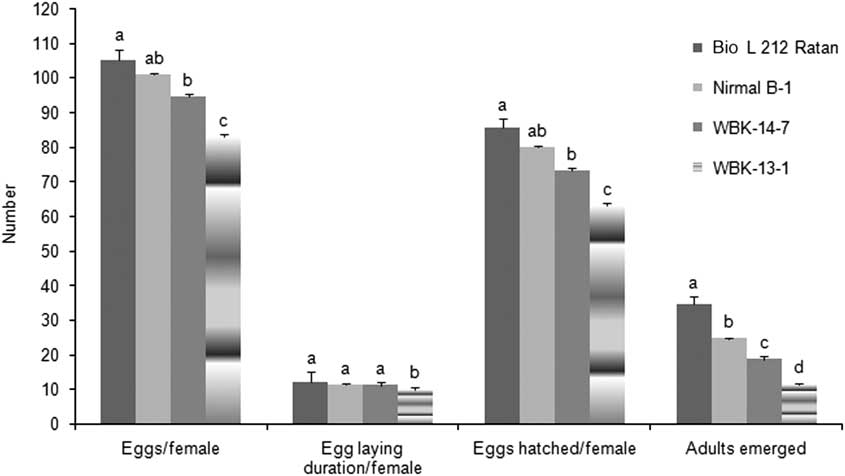
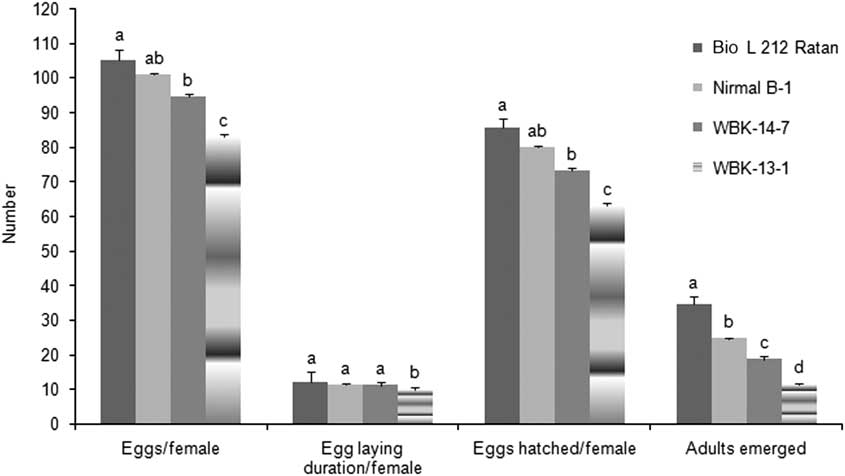
Experiment 1 – active males and females lived more than twice as long as normal forms (Table 1). Females also seemed consistently longer lived than males. Normal males and females lived significantly longer on Bio L 212 Ratan than on most of the other varieties. Active males lived longer on Bio L 212 Ratan and Nirmal B-1 than WBK-14-7 and WBK-13-1; whereas active females lived longer on Bio L 212 Ratan, intermediate on Nirmal B-1 and WBK-14-7, and least on WBK-13-1. Fecundity (W ij 0.05, 3=31.072, P<0.0001), duration of egg laying (W ij 0.05, 3=22.757, P<0.0001), number of eggs hatched (W ij 0.05, 3=31.787, P<0.0001), and number of adults emerged (W ij 0.05, 3=84.043, P<0.0001) varied significantly among varieties (Fig. 1). Fecundity was significantly higher on Bio L 212 Ratan than on WBK-13-1. The number of eggs hatched was significantly highest on Bio L 212 Ratan and Nirmal B-1 and least on WBK-13-1. Egg-laying duration was similar on all varieties except WBK-13-1 where it was shortest. The number of adults emerged was highest on Bio L 212 Ratan seeds and declined significantly more and more on Nirmal B-1, WBK-14-7, and WBK-13-1 (Fig. 1). The dry weight of newly emerged females was heavier than males, and normal males and females were heavier than active males and females (Table 2). The dry weight of newly emerged normal males and females decreased significantly more and more when reared on Bio L 212 Ratan, Nirmal B-1, WBK-14-7, and WBK-13-1 (Table 2).
Mean fecundity, duration of egg laying period, number of eggs hatched and adult progeny of normal type Callosobruchus maculatus on four varieties of khesari seeds. For each variable means followed by different letters are significantly different according to Steel–Dwass–Critchlow–Flinger multiple pair wise comparisons test with α=0.05.
Longevity of normal and active male and female Callosobruchus maculatus emerged from four varieties of khesari seeds.

Mean±SE of 25 observations. Within the row means followed by same letter(s) are not significantly different by Tukey’s test.
Mean dry weight of normal and active male and female Callosobruchus maculatus newly emerged from four varieties of khesari seeds.

Mean±SE of 25 observations. Within the row means followed by same letter(s) are not significantly different by Tukey’s test.
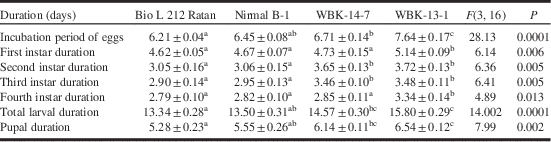
Experiment 2 – the duration of larval and pupal development of the progeny of normal C. maculatus varied significantly between varieties (Table 3). Total developmental time was significantly higher on WBK-13-1 and WBK-14-7 khesari seeds than on Bio L 212 Ratan seeds (Table 3). The length and width of eggs was 0.62–0.66 and 0.41–0.46 mm, respectively. The length, width, and head capsule width of first instar was 0.51–0.54, 0.20–0.33, and 0.22–0.25 mm, respectively; whereas the length, width, and head capsule width of the second instar measured from 1.62–1.71, 0.68–1.05, and 0.41–0.45 mm, respectively. The length, width, and head capsule width of the third instar varied from 2.51–2.62, 1.34−1.80, and 0.41–0.43 mm, respectively; whereas the length, width, and head capsule width of fourth instar were 3.42–3.58, 1.65−2.05, and 0.35–0.38 mm, respectively. The pupal length and width was 3.54−3.63, and 2.01–2.65 mm, respectively.
Larval and pupal duration of normal Callosobruchus maculatus reared on four varieties of khesari seeds.

Mean±SE of 5 observations. Within the row means followed by same letter(s) are not significantly different by Tukey’s test.
A similar test was attempted with active forms. Despite constant access to food and water, 17, 15, 11, and 9 active females (out of 25 pairs each) laid only one or two eggs for a total of 31, 21, 13, and 10 eggs on Bio L 212 Ratan, Nirmal B-1, WBK-14-7, and WBK-13-1 khesari seeds during their life time, respectively. The length and width of eggs varied from 0.35–0.39, and 0.17–0.21 mm, respectively, indicating that eggs laid by active females were smaller than eggs laid by normal females. The first instar was formed within the eggs hatched from normal female prior to penetrating the seed coat with visual marker signalling that embryonic development was nearly complete. But, none of the eggs laid by active females hatched, suggesting that these eggs were infertile.
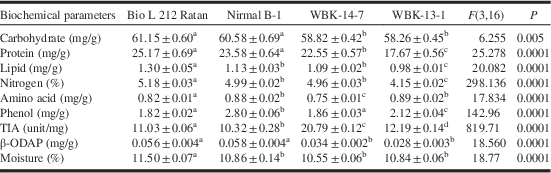
Experiment 3 – all biochemical parameters tested differed significantly between varieties (Table 4). Total carbohydrates were higher in Bio L 212 Ratan and Nirmal B-1 than WBK-14-7 and WBK-13-1. Total proteins were higher in Bio L 212 Ratan and Nirmal B-1 followed by WBK-14-7 and WBK-13-1. Lipid content and total nitrogen were highest in Bio L 212 Ratan, intermediate in Nirmal B-1 and WBK-14-7, and least in WBK-13-1. Total amino acid content was highest in Nirmal B-1 and WBK-13-1, least in WBK-14-7, and intermediate in Bio L 212 Ratan. Phenol concentration was highest in Nirmal B-1 followed by WBK-13-1, and lowest in Bio L 212 Ratan and WBK-14-7. Trypsin inhibitor activity (TIA) was highest in WBK-14-7 followed by WBK-13-1, Bio L 212 Ratan, and Nirmal B-1. The β-ODAP content was higher in Bio L 212 Ratan and Nirmal B-1 than WBK-14-7 and WBK-13-1. Bio L 212 Ratan seeds had the highest water content of the four varieties.
Biochemical analysis of four varieties of khesari seeds.

Mean±SE of 5 observations. Within the row means followed by same letter(s) are not significantly different by Tukey’s test.
Discussion
The nutritional quality frequently determines the lifetime fitness of seed eating insects because the concentrations and proportions of nutrients differ greatly among and within seed species (Giga and Smith Reference Giga and Smith1983; Hagstrum and Milliken Reference Hagstrum and Milliken1988; Messina Reference Messina1991; Cope and Fox Reference Cope and Fox2003). The significant differences in developmental time, longevity, fecundity, and survival of the cosmopolitan C. maculatus on khesari seeds were similar to the range of differences reported on other host seed species (Giga and Smith Reference Giga and Smith1983; Messina and Renwick Reference Messina and Renwick1985b; Radha and Susheela Reference Radha and Susheela2014). The mean fecundity of C. maculatus ranged between 82.96±10 and 105.24±3.09, and differed significantly between Bio L 212 Ratan and WBK-13-1 khesari seeds. Overall, Bio L 212 Ratan had the highest nutritional value for the insect (Fig. 1). The fecundity of C. maculatus on khesari seeds was within the range found by others on different food plants. The fecundity of different strains of C. maculatus on green pea (Pisum sativum Linnaeus (Fabaceae)), horse gram (Dolichos biflorus Linnaeus (Fabaceae)), cowpea, black gram (Vigna mungo (Linnaeus) Hepper), and green gram (Vigna radiata (Linnaeus) Wilczek) averaged 45.5, 118.75, 135.5, 108.5, and 121, respectively (Radha and Susheela Reference Radha and Susheela2014). Wasserman (Reference Wasserman1988) recorded 80–100 eggs on beans over a week; whereas Timms (Reference Timms1998) recorded 110–115 eggs over a life time on green gram beans. Also, the fecundity of populations of C. maculatus from different areas has been reported to vary according to the species and cultivar of host seeds (Utida Reference Utida1972; Credland et al. Reference Credland, Dick and Wright1986; Credland Reference Credland1987; Credland and Wright Reference Credland and Wright1989; Tuda et al. Reference Tuda, Chou, Niyomdham, Buranapanichpan and Tateishi2005). Our study demonstrated that the similar variation in nutritional quality among varieties of khesari seeds also affects the fecundity of the insect. Some studies have demonstrated that genetic diversity among populations, even in the same environment, have an effect on their fecundity (Bieri and Kawecki Reference Bieri and Kawecki2003; Tuda et al. Reference Tuda, Kagoshima, Toquenaga and Arnqvist2014). The effect of khesari seeds on the longevity of adult C. maculatus is in line with earlier reports of an impact of nutrition on the longevity of normal adults during larval feeding, and adult weight and size (Utida Reference Utida1972; Credland et al. Reference Credland, Dick and Wright1986; Fox Reference Fox1993; Messina and Slade Reference Messina and Slade1999).
Several studies have shown that the nutritional quality of seeds of other plant species affect growth and development of C. maculatus from egg to adult (Credland Reference Credland1987; Credland and Wright Reference Credland and Wright1989; Thanthianga and Mitchell Reference Thanthianga and Mitchell1990). In our study, the higher larval survival rate, shorter developmental time, and higher number of adult C. maculatus emerging from Bio L 212 Ratan suggest that it is the khesari variety with the best nutritional value. Other studies have shown that the development of the insect reproductive system is dependent on nutrients accumulated during their life time (Southgate Reference Southgate1979; Huignard et al. Reference Huignard, Leroi, Alzouma and Germain1985; Slansky and Scriber Reference Slansky and Scriber1985). This study indicates that normal C. maculatus feeding on Bio L 212 Ratan allocated more nutrients to egg production than rest of the varieties. Khesari seed varieties of low nutritional value for C. maculatus such as WBK-13-1 would probably require longer feeding relative to other three varieties and lead to higher seed material consumption.
Low water content is another factor limiting food consumption and therefore insect growth (Scriber and Feeny Reference Scriber and Feeny1979; Hagstrum and Milliken Reference Hagstrum and Milliken1988). The lower amount of water in WBK-13-1 seeds might explain the long developmental time of C. maculatus fed WBK-13-1 seeds. Several studies using other seed species indicated that production of active forms of C. maculatus is limited by high temperature, constant light and darkness, low water content of seeds, and population density of larvae (Sano Reference Sano1967; Utida Reference Utida1972; Sano-Fujii Reference Sano-Fujii1984; Denlinger Reference Denlinger1986; Lenga et al. Reference Lenga, Thibeaudeau and Huignard1991; Appleby and Credland Reference Appleby and Credland2001). It has been suggested that laboratory populations of C. maculatus might lose the capacity to produce active forms due to these controlled rearing environments, including limited amount of host seeds. As a result, the proportion of normal and active males and females may not be entirely relevant to the field situation (Credland et al. Reference Credland, Dick and Wright1986; Messina Reference Messina1987; Messina and Slade Reference Messina and Slade1999; Zannou et al. Reference Zannou, Glitho, Huignard and Monge2003). Active forms of laboratory populations remain in reproductive diapause as they are unable to synthesise vitellogenin including production of a specific diapause protein (Zannou et al. Reference Zannou, Glitho, Huignard and Monge2003). The reproductive diapause would explain why the active forms of this study did not produce fertile eggs (Zannou et al. Reference Zannou, Glitho, Huignard and Monge2003; Arnold et al. Reference Arnold, Stevenson and Belmain2012). Normal females are the primary target of growers for the management of infestations of khesari seeds because they are the principle egg layers. However, active morphs should not be overlooked because they might be key pioneers to starting new populations (Messina and Renwick Reference Messina and Renwick1985a; Arnold et al. Reference Arnold, Stevenson and Belmain2012).
Seed eating insects are adapted to the nutrient composition of host seeds and their growth and reproduction is likely to reflect their ability to ingest food and convert it into body tissue (Slansky and Scriber Reference Slansky and Scriber1985; Nation Reference Nation2001). Emergence of adults from eggs laid by C. maculatus was highest and lowest on Bio L 212 Ratan and WBK-13-1 fed insects, respectively, suggesting that nutrient quality in terms of carbohydrates, proteins, and lipids was better on Bio L 212 Ratan seeds than WBK-13-1 seeds. Lipids, for example, stored during the larval stages provide the energy source required during pupal and adult stages of holometabolus insects (Downer and Matthews Reference Downer and Matthews1976). The higher concentration of lipids in Bio L 212 Ratan seeds than WBK-13-1 seeds might have been a factor in explaining the lower longevity of adult C. maculatus on WBK-13-1 seeds.
High phenol content of food can reduce adult longevity, adult fecundity, and larval growth of insects (Nation Reference Nation2001; Harborne Reference Harborne2003; Roy and Barik Reference Roy and Barik2013). The low level of phenol could explain why C. maculatus did better on Bio L 212 Ratan and WBK-14-7 than on the other two varieties in this study. The higher reduction in female longevity and fecundity, and longer period of larval growth of C. maculatus on WBK-13-1 could have resulted from the lower carbohydrate, protein, lipid, and nitrogen content of WBK-13-1 seeds than on Nirmal B-1.
Trypsin inhibitors are naturally occurring compounds that interfere with nutrient availability (Liener and Kakade Reference Liener and Kakade1980). Inhibition of trypsin causes inadequate digestion of protein which results in fewer amino acids for growth (Wang et al. Reference Wang, Warkentin, Briggs, Oomah, Campbell and Woods1998). The higher amount of TIA in WBK-14-7 and WBK-13-1 than Bio L 212 Ratan seeds could have played a role in the reduction in the number of adults emerging and their shorter longevity. The greater longevity of adults and higher emergence of adults on Bio L 212 Ratan in spite of its higher level of TIA might be explained by higher levels of lipids, nitrogen, and moisture including lower level of phenol than in Nirmal B-1.
Because most insects require nitrogen during the adult stage for egg production (Mattson and Scriber Reference Mattson and Scriber1987; Nation Reference Nation2001), the higher concentration of nitrogen in Bio L 212 Ratan than WBK-14-7 and WBK-13-1 might have been responsible for the higher fecundity of the insects on that variety. Although some insects express phagostimulatory responses to L-amino acids (Oppert et al. Reference Oppert, Morgan, Culbertson and Kramer1993; Harborne Reference Harborne2003), the performance of adults in this study was not related to the level of amino acids in different varieties.
The present study demonstrated that WBK-14-7 and WBK-13-1 khesari seeds with their lower β-ODAP content and lower carbohydrate and protein than Bio L 212 Ratan and Nirmal B-1 should be most acceptable for human nutrition and most resistant to infestations of C. maculatus. It is widely known that differences in soil fertility can affect quantity and quality of seeds. Hence, additional research will be needed to determine if khesari grown at different locations with different soil fertility will retain the same chemical profile.
Acknowledgements
The authors thank two anonymous reviewers for many helpful comments on an earlier version of the manuscript. The financial assistance from the Department of Science and Technology (DST) (SR/WOS-A/LS-106/2011), India as a Women Scientist Scheme, DST–Promotion of University Research and Scientific Excellence, and DRS Special Assistance Programme for providing necessary instrumental facilities are gratefully acknowledged.