Introduction
Autism spectrum disorder (ASD) is a common, complex neurodevelopmental disorder characterized by persistent impairments in social communication and interaction, and restricted/stereotyped behaviors (American Psychiatric Association, 2013) with long-lasting functional impairment across the lifespan (Steinhausen, Mohr Jensen, & Lauritsen, Reference Steinhausen, Mohr Jensen and Lauritsen2016). Executive dysfunction theory is one of the main cognitive theories of ASD (Baron-Cohen & Swettenham, Reference Baron-Cohen, Swettenham, Cohen and Volkmar1997; Hill, Reference Hill2004). Indeed, executive function deficits have been consistently found in individuals with ASD in early studies (Hill, Reference Hill2004; Robinson, Goddard, Dritschel, Wisley, & Howlin, Reference Robinson, Goddard, Dritschel, Wisley and Howlin2009) and summarized in several recent meta-analyses (Demetriou et al., Reference Demetriou, Lampit, Quintana, Naismith, Song, Pye and Guastella2018; Lai et al., Reference Lai, Lau, Lui, Lok, Tam, Chan and Cheung2017; Landry & Al-Taie, Reference Landry and Al-Taie2016; Olde Dubbelink & Geurts, Reference Olde Dubbelink and Geurts2017; Wang et al., Reference Wang, Zhang, Liu, Cui, Wang, Shum and Chan2017). Executive dysfunction is further associated with specific impairments in ASD including theory of mind (Pellicano, Reference Pellicano2007), social impairment (Leung, Vogan, Powell, Anagnostou, & Taylor, Reference Leung, Vogan, Powell, Anagnostou and Taylor2016), restricted and repetitive symptoms (Lopez, Lincoln, Ozonoff, & Lai, Reference Lopez, Lincoln, Ozonoff and Lai2005), and decreased quality of life (de Vries & Geurts, Reference de Vries and Geurts2015).
A wide range of executive functions has been studied in individuals with ASD including working memory (Barendse et al., Reference Barendse, Hendriks, Jansen, Backes, Hofman, Thoonen and Aldenkamp2013; Wang et al., Reference Wang, Zhang, Liu, Cui, Wang, Shum and Chan2017), cognitive flexibility (set-shifting) (Landry & Al-Taie, Reference Landry and Al-Taie2016; Sinzig, Morsch, Bruning, Schmidt, & Lehmkuhl, Reference Sinzig, Morsch, Bruning, Schmidt and Lehmkuhl2008; Yerys et al., Reference Yerys, Wallace, Harrison, Celano, Giedd and Kenworthy2009a), planning (Olde Dubbelink & Geurts, Reference Olde Dubbelink and Geurts2017), and inhibition (Corbett, Constantine, Hendren, Rocke, & Ozonoff, Reference Corbett, Constantine, Hendren, Rocke and Ozonoff2009; Lai et al., Reference Lai, Lau, Lui, Lok, Tam, Chan and Cheung2017). Inflexibility is one of the prominent behavioral problems observed in the everyday life of individuals with ASD (Geurts, Corbett, & Solomon, Reference Geurts, Corbett and Solomon2009). The Wisconsin Card Sorting Test (WCST) (Landry & Al-Taie, Reference Landry and Al-Taie2016) and Intra-dimensional/Extra-dimensional Shift (I/ED) task in the Cambridge Neuropsychological Test Automated Battery (CANTAB) are among the most commonly used set-shifting tests (Van Eylen, Boets, Steyaert, Wagemans, & Noens, Reference Van Eylen, Boets, Steyaert, Wagemans and Noens2015). Despite consistent findings based on the WCST (Landry & Al-Taie, Reference Landry and Al-Taie2016), previous studies using the I/ED task revealed mixed findings in children with ASD. Some studies reported no set-shifting deficits in ASD, i.e. in stages completed, the number of trials, the number of errors in intra-dimensional and extra-dimensional shift (Goldberg et al., Reference Goldberg, Mostofsky, Cutting, Mahone, Astor, Denckla and Landa2005), and the number of trials in extra-dimensional shift (Happé, Booth, Charlton, & Hughes, Reference Happé, Booth, Charlton and Hughes2006). Others suggested that children and adolescents with ASD, relative to controls, made more errors only in the stages of the extra-dimensional shift but not in other stages (Ozonoff et al., Reference Ozonoff, Cook, Coon, Dawson, Joseph, Klin and Wrathall2004; Yerys et al., Reference Yerys, Wallace, Harrison, Celano, Giedd and Kenworthy2009a).
Regarding working memory, a recent meta-analysis of 28 studies using tasks such as Digit Span, Forward and Backward Block Span, and Spatial Working Memory (SWM) in CANTAB revealed medium to large effect sizes of impaired spatial and verbal working memory in individuals with ASD (Wang et al., Reference Wang, Zhang, Liu, Cui, Wang, Shum and Chan2017). Such working memory deficits increased as the working memory load (i.e. task difficulty) increased (Kercood, Grskovic, Banda, & Begeske, Reference Kercood, Grskovic, Banda and Begeske2014). Similarly, impairment in planning ability in ASD has been consistently reported in past research. A meta-analysis of 50 studies across a wide age range from childhood to adulthood showed that ASD, relative to controls, performed worse in tasks involving planning skills, with a medium effect size (Olde Dubbelink & Geurts, Reference Olde Dubbelink and Geurts2017). Such planning difficulty in ASD is consistently reported across the lifespan (i.e. age was not a significant moderator), types of planning tasks, and levels of intelligence (Olde Dubbelink & Geurts, Reference Olde Dubbelink and Geurts2017). However, such deficit no longer exists after excluding subjects with comorbid attention-deficit/hyperactivity disorder (ADHD) (Lai et al., Reference Lai, Lau, Lui, Lok, Tam, Chan and Cheung2017), suggesting that the ASD-related impairment in planning may be accounted for by ADHD.
Literature has documented executive dysfunction in ASD (Chen et al., Reference Chen, Chien, Wu, Shang, Wu and Gau2016; Chien et al., Reference Chien, Gau, Shang, Chiu, Tsai and Wu2015; Lai et al., Reference Lai, Lau, Lui, Lok, Tam, Chan and Cheung2017; Landry & Al-Taie, Reference Landry and Al-Taie2016; Olde Dubbelink & Geurts, Reference Olde Dubbelink and Geurts2017; Wang et al., Reference Wang, Zhang, Liu, Cui, Wang, Shum and Chan2017); however, the etiology involving genetic mechanisms that mediate such dysfunction remains unclear. The complex genetics underlying the disease makes the clinical phenotypes of ASD heterogeneous (Folstein & Rosen-Sheidley, Reference Folstein and Rosen-Sheidley2001). As an intermediate connection between the phenotypes and genes, endophenotype is defined as characteristics that are associated with the illness, heritable, primarily state-independent, and found in both unaffected and affected family members (Gottesman & Gould, Reference Gottesman and Gould2003). Unaffected siblings of youths with ASD, who share half the genetic components with the probands and thus may have the broad autism phenotype, are ideal candidates for this type of investigation. However, previous studies on executive functions in unaffected siblings of ASD reported mixed findings. Some studies suggested no significant executive function deficits in IQ-matched unaffected siblings compared to healthy controls (McLean, Johnson Harrison, Zimak, Joseph, & Morrow, Reference McLean, Johnson Harrison, Zimak, Joseph and Morrow2014; Wong, Maybery, Bishop, Maley, & Hallmayer, Reference Wong, Maybery, Bishop, Maley and Hallmayer2006). In contrast, other studies revealed impaired executive functions including spatial working memory, set-shifting, planning, and inhibition in IQ-matched unaffected siblings of children and youths with ASD compared to controls (Hughes, Plumet, & Leboyer, Reference Hughes, Plumet and Leboyer1999; Van Eylen et al., Reference Van Eylen, Boets, Cosemans, Peeters, Steyaert, Wagemans and Noens2017; Warren et al., Reference Warren, Foss-Feig, Malesa, Lee, Taylor, Newsom and Stone2012). Furthermore, some other studies found that unaffected siblings were not significantly different from either the ASD or control groups when IQ was matched or controlled for (Brunsdon et al., Reference Brunsdon, Colvert, Ames, Garnett, Gillan, Hallett and Happe2015; Rosa et al., Reference Rosa, Puig, Lazaro, Valles, Lera, Sanchez-Gistau and Calvo2017; Sumiyoshi, Kawakubo, Suga, Sumiyoshi, & Kasai, Reference Sumiyoshi, Kawakubo, Suga, Sumiyoshi and Kasai2011). The mixed findings may be explained by the wide age range examined in the past studies which varied from childhood to adulthood (see the next paragraph for a discussion of the age effect on executive functions), the varied sample sizes (ranging from 51 to 439), and the different neuropsychological tasks employed. Therefore, the present study used the unaffected sibling design and a large sample (N = 627) to test executive functions as potential cognitive endophenotypes for ASD while controlling for important covariates such as age.
Several factors may account for the different levels of executive dysfunctions in ASD. First, greater severity of ASD symptoms may be associated with poorer executive functions (Kenworthy, Black, Harrison, della Rosa, & Wallace, Reference Kenworthy, Black, Harrison, della Rosa and Wallace2009; Van Eylen et al., Reference Van Eylen, Boets, Steyaert, Wagemans and Noens2015). Kenworthy et al. (Reference Kenworthy, Black, Harrison, della Rosa and Wallace2009) reported that verbal fluency performance was negatively associated with communication impairment; semantic fluency and auditory divided attention were positively related to social functions; inhibition control and flexibility were negatively related to restricted/stereotyped behavior severity. Van Eylen et al. (Reference Van Eylen, Boets, Steyaert, Wagemans and Noens2015) found that social impairment is more likely than restricted/stereotyped behavior to be correlated with some executive functions. Second, executive dysfunctions in ADHD are well documented (Lin & Gau, Reference Lin and Gau2019). ADHD symptoms (Leyfer et al., Reference Leyfer, Folstein, Bacalman, Davis, Dinh, Morgan and Lainhart2006) and diagnosis (Gjevik, Eldevik, Fjæran-Granum, & Sponheim, Reference Gjevik, Eldevik, Fjæran-Granum and Sponheim2011) are commonly observed in youths with ASD with rates ranging from 30 to 50% (Chiang et al., Reference Chiang, Kao, Chou, Chou, Chiu, Wu and Gau2018). ASD individuals with ADHD, relative to those without ADHD, performed worse in tasks assessing inhibition and flexibility but not working memory or planning (Sinzig et al., Reference Sinzig, Morsch, Bruning, Schmidt and Lehmkuhl2008). Therefore, the presence of ADHD symptoms needs to be considered when examining the link between ASD and executive dysfunction. Third, the development of executive function is ongoing until young adulthood (Huizinga, Dolan, & van der Molen, Reference Huizinga, Dolan and van der Molen2006). The rapid maturation of executive skills occurs during early and middle childhood, followed by a slowing and relatively flat developmental trajectory during late childhood and early adolescence (Anderson, Anderson, Northam, Jacobs, & Catroppa, Reference Anderson, Anderson, Northam, Jacobs and Catroppa2001). This suggests that developmental maturation (age as a proxy) also needs to be accounted for. Lastly, IQ has been reported to be associated with executive function tasks (Liss et al., Reference Liss, Fein, Allen, Dunn, Feinstein, Morris and Rapin2001), although a recent meta-analysis revealed no significant associations between IQ (or age) and working memory (Wang et al., Reference Wang, Zhang, Liu, Cui, Wang, Shum and Chan2017).
Despite the well-documented executive dysfunction in ASD, the sample sizes of most past studies were relatively small, and little is known regarding executive dysfunction as a potential endophenotype of ASD and how ASD symptoms are related to executive dysfunction, as well as the influence of potential confounding factors such as ADHD comorbidity. To address these issues, we conducted this study using a large sample (N = 627) to compare youths with ASD, unaffected siblings of ASD youths, and typically developing control (TDC) youths in multiple components of executive functions and to examine the associations of executive functions with autistic symptoms, age, IQ, and ADHD symptoms. We used a well-validated computerized neuropsychological test (i.e. CANTAB) to assess executive functions. We hypothesized that (1) multiple components of executive functions would be impaired in youths with ASD compared to controls; (2) unaffected siblings of ASD youths would show deficits in some indices of the executive function tasks such as working memory, indicating that some components in executive functions might be candidate cognitive endophenotypes for ASD; (3) impaired executive functions would be associated with autistic symptoms including impairments of social interaction, impairments of verbal and nonverbal communication, and restricted/stereotyped behaviors. We also hypothesized that the findings would hold after controlling for age, IQ, and ADHD symptoms.
Methods
Participants
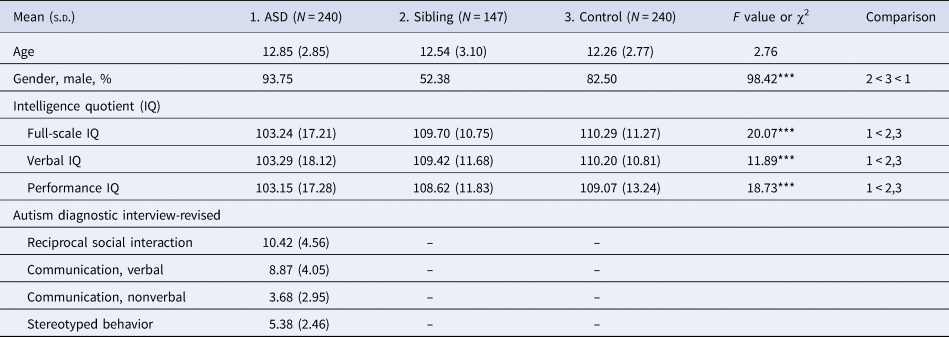
We recruited 240 youths with ASD, aged 6–18 years [mean ± standard deviation (s.d.), 12.85 ± 2.85], 147 unaffected siblings of ASD youths (Mean ± s.d., 12.54 ± 3.10), and 240 TDC youths (mean ± s.d., 12.26 ± 2.77). The TDC group was recruited according to the age and sex distribution of the ASD youths. ASD youths were clinically diagnosed according to the DSM-IV diagnostic criteria for autistic disorder or Asperger's syndrome by senior board-certified child psychiatrists at the child psychiatric clinic of the National Taiwan University Hospital, Taipei, Taiwan and further confirmed by the Chinese version (Gau et al., Reference Gau, Chou, Lee, Wong, Chou, Chen and Wu2010a) of the Autism Diagnostic Interview-Revised (ADI-R) (Lord, Rutter, & Le Couteur, Reference Lord, Rutter and Le Couteur1994) conducted with the parents. Their siblings were recruited and evaluated clinically by board-certified child psychiatrists to confirm that they did not meet either full or subclinical ASD diagnostic criteria based on the DSM-IV. If two or more unaffected siblings were in the families of the ASD group, we recruited one unaffected sibling whose age was closer to the ASD youth. The TDC youths were referred by school teachers according to the gender and age distribution of the ASD group. The TDC youths also went through clinical interviews to ensure that they did not meet any diagnostic criteria.
Procedure
All participants received clinical evaluations based on the DSM-IV criteria, conducted by board-certificated child psychiatrists and neuropsychological assessments, including tests for IQ and executive functions. Executive functions were assessed by the Digit Span test and four tasks in the CANTAB. For those with a clinical diagnosis of ASD, their parents received an ADI-R interview to confirm the diagnosis of ASD. All the parents of the participants and a proportion of the participants went through a semi-structured psychiatric interview using the Chinese Kiddie Schedule for Affective Disorders and Schizophrenia-Epidemiological version (K-SADS-E) for psychiatric diagnoses (Chen, Shen, & Gau, Reference Chen, Shen and Gau2017). Of 240 youths with ASD, 36 (15%) were also clinically diagnosed with ADHD by the corresponding author and confirmed by the K-SADS-E interview. All participants had a Full-scale IQ (FSIQ) >70, assessed using the Wechsler Intelligence Scale for Children, 3rd edition (WISC-III) for children aged 16 and younger, and the Wechsler Adult Intelligence Scale, 3rd edition (WAIS-III) for those older than 16. The Research Ethics Committee of National Taiwan University Hospital approved the study before the recruitment of participants (approval number, 201201006RIB; ClinicalTrials.gov number, NCT01582256).
Measures
Instruments assessing ASD diagnosis and other psychiatric disorders
The ADI-R (Lord et al., Reference Lord, Rutter and Le Couteur1994) is a standardized, comprehensive, semi-structured diagnostic interview conducted with subjects' parents or primary caregivers (Le Couteur et al., Reference Le Couteur, Rutter, Lord, Rios, Robertson, Holdgrafer and McLennan1989) covering most developmental and behavioral aspects of ASD, including reciprocal social interaction, communication, and repetitive/stereotyped behaviors, for children with a mental age from about 18 months to adulthood. The diagnostic algorithm is based on the diagnostic criteria of ICD-10 and DSM-IV and focuses on reciprocal social interaction, communication, and restricted/stereotyped behaviors. We developed the Chinese ADI-R with approval from the Western Psychological Services (WPS) in June 2007 for research use in Taiwan (Gau et al., Reference Gau, Chou, Lee, Wong, Chou, Chen and Wu2010a, Reference Gau, Lin, Shang, Liu, Chiu and Soong2010b, Reference Gau, Ni, Shang, Soong, Wu, Lin and Chiu2010c). The internal consistency in this sample was 0.70 for reciprocal social interaction, 0.62 for verbal communication, 0.71 for nonverbal communication, and 0.46 for stereotyped behaviors. Four interviewers reached an inter-rater agreement of >90% (mean ± s.d. ranging from 98.25 ± 1.91 to 99.38 ± 1.06) against the ratings of each item in the ADI-R by qualified ADI-R trainers (YY Wu and SS Gau) before the study initiation. The inter-rater reliability among YY Wu and the four interviewers on 10 subjects was satisfactory with generalized kappa for each diagnosis ranging from 0.86 to 1.00.
The Chinese version of the K-SADS-E was also developed by our team for assessing the DSM-IV diagnoses (Gau, Chong, Chen, & Cheng, Reference Gau, Chong, Chen and Cheng2005) and had been widely used in clinical (Shang, Lin, Tseng, & Gau, Reference Shang, Lin, Tseng and Gau2018) and epidemiological (Gau et al., Reference Gau, Lin, Shang, Liu, Chiu and Soong2010b) studies in Taiwan. Details about the psychometric properties (Gau et al., Reference Gau, Chong, Chen and Cheng2005) and the interviewers' training process (Gau et al., Reference Gau, Ni, Shang, Soong, Wu, Lin and Chiu2010c) have been described elsewhere.
Digit Span
The Digit Span test is used to evaluate verbal working memory with supported validity and reliability (Mott & Baker, Reference Mott and Baker1995). Participants were instructed to recall a series of numbers verbally in the forward and backward orders. The number of digits increased until the participants failed to repeat. The number of both forward and backward digits successfully recalled were used in the analyses (Gau & Shang, Reference Gau and Shang2010), given that previous studies suggest different memory and attention processes involved in forward and backward recalls (Reynolds, Reference Reynolds1997).
Cambridge neuropsychological test automated battery
CANTAB is a set of computerized tests to assess non-verbal neuropsychological functions with good psychometric properties across different ages (Fray, Robbins, & Sahakian, Reference Fray, Robbins and Sahakian1996; Gau, Chiu, Shang, Cheng, & Soong, Reference Gau, Chiu, Shang, Cheng and Soong2009; Luciana & Nelson, Reference Luciana and Nelson2002). The validity of CANTAB has been supported by numerous studies in different psychiatric populations including autism (Fray et al., Reference Fray, Robbins and Sahakian1996; Gau & Shang, Reference Gau and Shang2010; Kim, An, Kwon, & Shin, Reference Kim, An, Kwon and Shin2014; Luciana, Reference Luciana2003) as well as imaging studies showing a brain-behavior relationship (Chiang, Chen, Shang, Tseng, & Gau, Reference Chiang, Chen, Shang, Tseng and Gau2016; Fan, Shang, Tseng, Gau, & Chou, Reference Fan, Shang, Tseng, Gau and Chou2018; Ozonoff et al., Reference Ozonoff, Cook, Coon, Dawson, Joseph, Klin and Wrathall2004; Shang, Lin, & Gau, Reference Shang, Lin and Gau2020). Therefore, CANTAB is a sensitive tool to examine neuropsychological functions as well as brain dysfunction, which was associated with cognitive deficits (Luciana, Reference Luciana2003). In this study, we used the I/ED, Spatial Span (SSP), SWM, and Stocking of Cambridge (SoC) to examine different components of executive functions.
The I/ED task was used to evaluate mental flexibility (set-shifting). It assessed one's ability to maintain attention to stimuli within a relevant dimension (intra-dimensional shift) and then shift to a previously irrelevant dimension (extra-dimensional shift). Participants were asked to select one of the two stimuli of unfamiliar shapes and lines without any rules. Then, the feedback was given to build up the particular rules. Participants had to make the right choice depending on the changing rules. Two indices were used in the analyses: (1) extra-dimensional shift errors (e.g. errors made during shifting from one dimension to the other dimension), and (2) adjusted total errors (measuring the participant's efficiency in attempting the task).
The SSP task was used to assess visuospatial working memory. In this task, nine fixed-located white boxes changed colors one after another. Participants were asked to recall the sequence of the color-changing boxes in the same order. Two indices examined in this task included span length (the most extended sequence that participants recalled correctly) and total usage errors (the number of times participants selected a box, not in the sequence being recalled).
The SWM assessed one's ability to retain spatial information and manipulate the information in working memory. Participants were asked to find hidden ‘blue tokens’ by touching the boxes shown on the screen. They had to remember the location of the previously-found box and not to search the same box again (the tokens would not appear in the previous location within a single trial). Strategy utilization and total errors were analyzed. Errors in the 4-, 6-, and 8-box problems were used in the examination of the group by task difficulty interaction. Strategy utilization refers to the number of times the participant begins a new search with the same box. High scores indicate poorer use of the efficient strategy.
The SoC examined one's ability to plan strategically (Hill, Reference Hill2004). Participants were instructed to move three stocked balls in different colors in the lower part to match the arrangement of the upper part. The index used in this study was problems solved in minimum moves for overall planning ability. The indices of moves required to solve the 2–5-move problems were used in the examination of the group by task difficulty interaction.
Statistical analyses
We used SAS 9.2 (SAS Institute Inc., Cary, NC, USA) for data analyses. Three comparison groups were the ASD, unaffected siblings, and TDC groups. For results on the demographics and clinical ratings, frequency and percentage are presented for categorical variables, and the mean and standard deviation are presented for continuous variables (Table 1). Because of the between-group differences in sex and IQ and the potential associations of ADHD symptoms and age with executive functions, we controlled for these variables (sex, IQ, ADHD symptoms, and age) in the following model. The MIXED procedure was used to compare task performances between groups. Because ASD youths and their unaffected siblings came from the same family, we used a mixed model with random and fixed effects for dealing with data interdependence and unbalanced data. Bonferroni correction was used to adjust p values for multiple comparisons (ASD, unaffected sibling, and TDC groups) in post hoc analyses. For those tasks with different difficulty levels (SWM and SoC), we examined the interaction of group by task difficulty because previous research suggests that working memory deficits in ASD increase as task difficulty increases (for a review, see Kercood et al., Reference Kercood, Grskovic, Banda and Begeske2014). To examine the associations of executive functions with autistic symptoms, assessed by ADI-R, and ADHD symptoms, we conducted hypothesis-driven analyses in the ASD group using a linear regression model. We also conducted linear mixed models in the whole sample to examine the associations between age or FSIQ and executive functions. To correct for multiple testings, we used a false discovery rate (FDR) to adjust p values in the analyses of between-group differences in executive functions (Table 2) and the associations between autistic symptoms and executive functions (Table 3).
Demographics and IQ profiles of youths with ASD, their unaffected siblings, and the controls

Note. Group comparison significant at the 0.05 level with Bonferroni correction.
***p < 0.001.
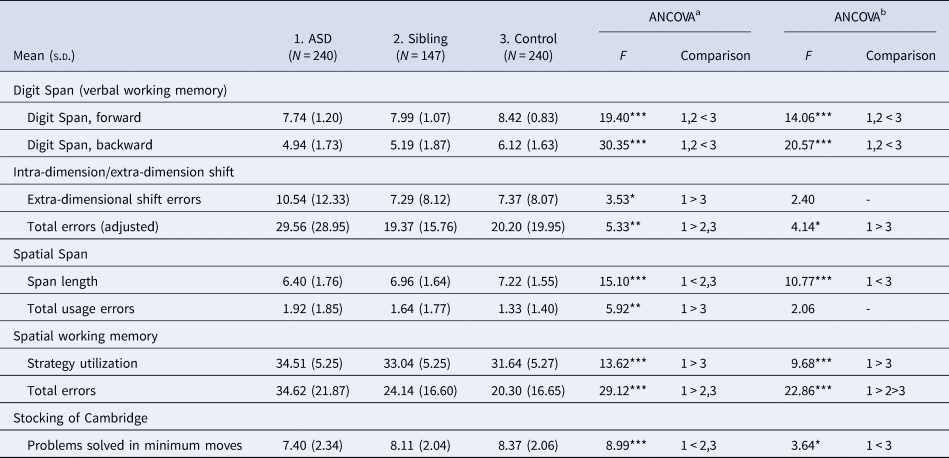
Group differences in performance on the executive function tasks

ANCOVA, Analysis of covariance.
Note. Group comparison significant at the 0.05 level with Bonferroni correction for multiple comparisons and further adjusted for multiple tests using the FDR.
*p < 0.05; **p < 0.01; ***p < 0.001.
a Controlling for age, sex, and Full-scale IQ.
b Controlling for age, sex, Full-scale IQ, and symptoms of attention-deficit/hyperactivity disorder.
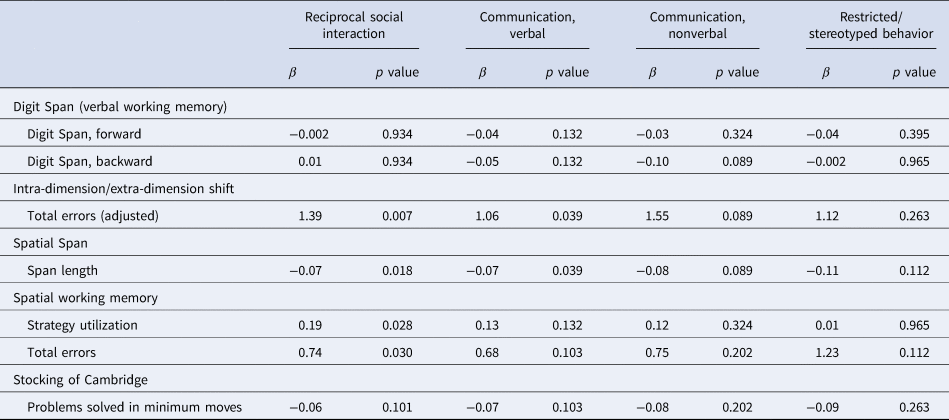
Associations between autistic symptoms and executive functions

Note. β = regression coefficient estimate; p values adjusted for multiple testing using false discovery rate.
Results
Demographics and IQ profiles
There were no significant between-group differences in age. The unaffected sibling group had a lower percentage of males than the ASD and TDC groups. IQ in the ASD group was significantly lower than that in the other two groups (Table 1).
Executive functions
All the results presented herein regarding executive functions were controlled for age, gender, FSIQ, and ADHD symptoms. For Digit Span, the ASD and sibling groups recalled significantly fewer digits than the TDC group in both forward and backward orders (Table 2).
For the I/ED task, the ASD group made more adjusted total errors than the TDC group, while the sibling group showed no significant differences compared to either the ASD or the TDC group in this index (Table 2).
For the SSP task, the ASD group had a shorter span length than the TDC group; the sibling group did not differ from either the ASD or the TDC group. There were no significant group differences in total usage errors (Table 2).
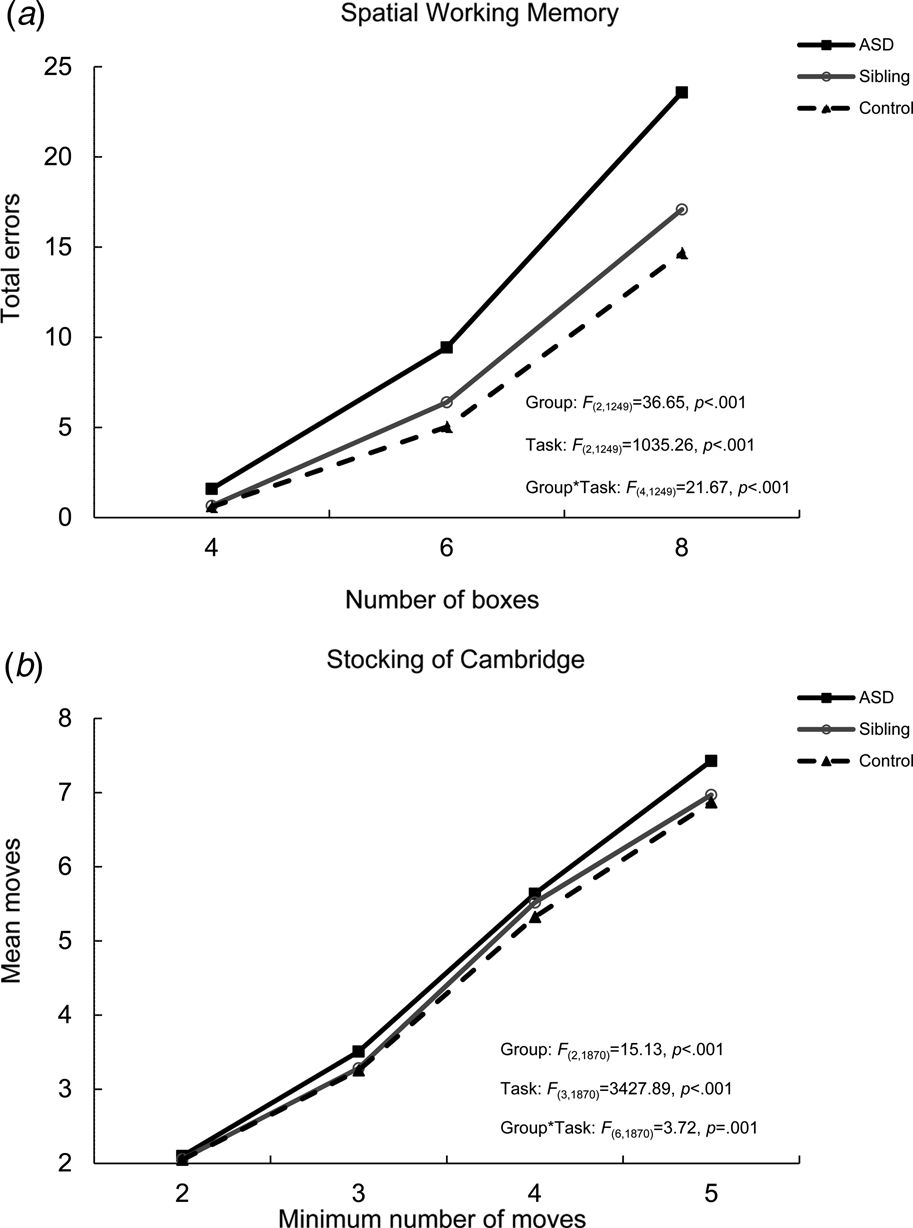
For the SWM task, the ASD group had poorer strategy utilization (i.e. a higher number of search sequences starting with a novel box in the difficult problems) than the TDC group. In contrast, the sibling group did not differ from the ASD or the TDC group. Unaffected siblings, however, made more total errors than the TDC group but less than the ASD group (Table 2). There was a significant group by task difficulty interaction (Fig. 1a). That is, the magnitude of the between-group differences in total errors increased as the task difficulty (i.e. the number of boxes: 4-box, 6-box, and 8-box problems) increased (Fig. 1a).
(a) Total errors in the 4-box, 6-box, and 8-box problems of the Spatial Working Memory task and (b) mean moves in the 2-move, 3-move, 4-move, and 5-move problems of the Stocking of Cambridge task for youths with ASD, unaffected siblings, and the controls.

For the SoC task, the ASD group solved significantly fewer problems in the specified minimum number of moves than the TDC group (Table 2). The group by task difficulty interaction was significant (Fig. 1b). The magnitude of the between-group difference in the number of moves increased as the task difficulty (i.e. the minimum number of moves in 2-move to 5-move problems) increased (Fig. 1b).
We also conducted the same analyses presented in this section without controlling for IQ (please see online Supplementary Table 1S), and the results were similar.
Associations between autistic symptoms and executive functions
Table 3 presents the associations between executive functions and ASD symptoms measured by the ADI-R. The severity of impaired reciprocal social interaction was significantly associated with indices in the I/ED (more adjusted total errors), the SSP (shorter span length), and the SWM (poorer strategy utilization and more total errors). Verbal communication impairment was significantly associated with indices in the I/ED (more adjusted total errors) and the SSP (shorter span length).
Associations of age, IQ, and ADHD symptoms with executive functions
Online Supplementary Table S2 presents the regression coefficients and statistics for the associations of age, IQ, and ADHD symptoms, which were controlled for in all the models in the main analyses, with executive functions. In summary, age and IQ were significantly associated with indices in the Digit Span and the CANTAB tasks in the whole sample as expected, while ADHD symptoms in the ASD group were not associated with any indices in the Digit Span and CANTAB. Specifically, older age was associated with better performance on backward digit recall (i.e. more digits recalled), I/ED (fewer adjusted total errors), SSP (longer span length and fewer total usage errors), SWM (better strategy utilization and fewer total errors), and SoC (more problems solved in the specified minimum number of moves). Higher IQ was associated with better performance on all the indices examined.
Discussion
This study aimed to identify specific executive functions that may be potential cognitive endophenotypes for ASD, using one of the largest samples of unaffected siblings reported to date and a well-validated, comprehensive measurement (CANTAB) to assess a wide range of executive function components. Our results lend evidence to support our first hypothesis such that youths with ASD, relative to TDC youths, showed impairments in executive functions measured by a verbal working memory task (Digit Span) and four visuospatial tasks (i.e. I/ED, SSP, SWM, and SoC). Our second hypothesis was only partially supported by our finding that unaffected siblings of ASD youths showed impairment on verbal and spatial working memory compared to TDC youths; unaffected siblings did not differ from the ASD youths in verbal working memory, but performed better in spatial working memory than ASD youths. Thus, verbal and spatial working memory may represent a potential endophenotype for ASD, after accounting for the associations with IQ, age, gender, and ADHD symptoms. We also found that the severity of ASD symptoms (impairment in social reciprocity and verbal communication but not nonverbal communication or restricted/stereotyped behaviors) were significantly associated with executive dysfunctions.
Our finding of poorer executive functions in youths with ASD, relative to healthy controls, is in line with previous studies (Chen et al., Reference Chen, Chien, Wu, Shang, Wu and Gau2016; Hill, Reference Hill2004) suggesting impairments in multiple components of executive functions including working memory (both verbal and visuospatial), set-shifting, and planning. In verbal working memory (assessed by Digit Span), ASD youths recalled significantly fewer digits in both forward and backward orders, compared to healthy controls. In set-shifting, youths with ASD, relative to healthy controls, made more adjusted total errors in the process of completing the task, suggesting that youths with ASD had difficulty adapting to new rules. In spatial working memory, youths with ASD, relative to controls, showed poorer strategy utilization and committed more errors, reflecting poor ability to adopt an efficient and systematic searching strategy to complete the task. In planning, the impairment in the ASD youths manifested as fewer problems solved. Moreover, impairments in spatial working memory and planning in ASD appeared to worsen as task difficulty increased compared to the other groups. This finding is consistent with previous studies indicating that deficits in executive functions associated with ASD are more pronounced when the cognitive demands are higher (Chen et al., Reference Chen, Chien, Wu, Shang, Wu and Gau2016; McGonigle-Chalmers, Bodner, Fox-Pitt, & Nicholson, Reference McGonigle-Chalmers, Bodner, Fox-Pitt and Nicholson2007).
Investigations of neurocognitive endophenotypes in ASD using comparisons of unaffected siblings, who share half the genetic components as the probands, could inform the genetic mechanisms of ASD (Chien et al., Reference Chien, Chou, Chiu, Chou, Wu, Tsai and Gau2017). We found that both ASD youths and unaffected siblings had impaired verbal working memory (Digit Span forward and backward). This finding is different from the two previous studies examining the performance on Digit Span in unaffected siblings (Oerlemans et al., Reference Oerlemans, Droste, van Steijn, de Sonneville, Buitelaar and Rommelse2013; Rosa et al., Reference Rosa, Puig, Lazaro, Valles, Lera, Sanchez-Gistau and Calvo2017). Specifically, Rosa and colleagues found no significant differences between unaffected siblings and either youths with ASD or controls in a verbal working memory factor derived from several neuropsychological tests (including Digit Span) (Rosa et al., Reference Rosa, Puig, Lazaro, Valles, Lera, Sanchez-Gistau and Calvo2017). Similarly, Oerlemans et al. (Reference Oerlemans, Droste, van Steijn, de Sonneville, Buitelaar and Rommelse2013) reported no significant differences between youths with ASD, siblings, and controls in Digit Span backward. Of note, one of these studies had a small sample for the sibling group (n = 22) (Rosa et al., Reference Rosa, Puig, Lazaro, Valles, Lera, Sanchez-Gistau and Calvo2017); the other study had a different IQ inclusion criterion (i.e. 60 in Oerlemans et al.'s study v. 70 in ours) and a sibling group with a different cut-off of Social Communication Questionnaires (10 in Oerlemans et al.'s study v. 15 in ours); our study ruled out full and subclinical ASD diagnosis for the sibling group. These factors may explain the discrepancy between the current study and the previous ones.
Similarly, our finding of deficits in visuospatial working memory in unaffected siblings was not observed in previous studies (Van Eylen et al., Reference Van Eylen, Boets, Cosemans, Peeters, Steyaert, Wagemans and Noens2017; Wong et al., Reference Wong, Maybery, Bishop, Maley and Hallmayer2006). These past studies did not use CANTAB, had smaller sample sizes, or used different first-degree relatives as the comparison group (Hughes et al., Reference Hughes, Plumet and Leboyer1999; Van Eylen et al., Reference Van Eylen, Boets, Cosemans, Peeters, Steyaert, Wagemans and Noens2017; Wong et al., Reference Wong, Maybery, Bishop, Maley and Hallmayer2006). For example, comparisons were made between the first-degree relatives of youths with ASD (including siblings and parents) and controls (Van Eylen et al., Reference Van Eylen, Boets, Cosemans, Peeters, Steyaert, Wagemans and Noens2017), between siblings of children with ASD and siblings of controls (Wong et al., Reference Wong, Maybery, Bishop, Maley and Hallmayer2006), and between siblings of children with ASD, siblings of children with developmental disorder, and controls. Different first-degree relatives as the comparison group may explain the inconsistent findings in the literature. For example, the cognitive profiles between parents and unaffected siblings may be slightly different, even though both parents and unaffected siblings share genetics with the ASD probands. Indeed, Wong et al. (Reference Wong, Maybery, Bishop, Maley and Hallmayer2006) examined executive functions measured by CANTAB in unaffected siblings, parents, and controls (Wong et al., Reference Wong, Maybery, Bishop, Maley and Hallmayer2006) and found different patterns of performances in parents and unaffected siblings. The differences may stem from greater familiarity with computerized tasks and greater variability in cognitive profiles in younger siblings, more pronounced cognitive deficits with increased age in parents, and more parental responsibility or parental psychiatric conditions (Wong et al., Reference Wong, Maybery, Bishop, Maley and Hallmayer2006). Therefore, it is important to take into consideration the use of different first-degree relatives as the comparison group. In contrast to the studies with negative results, our findings, based on a much larger sample of unaffected siblings, provide strong evidence to support that verbal and visuospatial working memory may be cognitive markers that are sensitive to familial risk for ASD. The finding is compatible with our previous age-stratified study in which spatial working memory deficit persisted into late adolescence, reflecting a stronger genetic contribution toward impairment in this area (Chen et al., Reference Chen, Chien, Wu, Shang, Wu and Gau2016).
Of note, all the group differences were found after covarying IQ (and other covariates). Some argue that covarying IQ in neurodevelopmental disorders is inappropriate as IQ might be an attribute of the disorder or is intrinsic to the condition (Dennis et al., Reference Dennis, Francis, Cirino, Schachar, Barnes and Fletcher2009). However, the contrary view concerns that if IQ effects are not statistically controlled for, one may risk introducing type I error (Hazlett et al., Reference Hazlett, Poe, Gerig, Smith, Provenzale, Ross and Piven2005) e.g. finding significant group differences that might be related to IQ differences rather than ASD per se. Also, IQ may moderate the group differences in executive functions such that ASD youths with above-average IQ, but not those with below-average IQ, are more impaired compared to IQ-matched controls (Rommelse et al., Reference Rommelse, Langerak, van der Meer, de Bruijn, Staal, Oerlemans and Buitelaar2015). Given the significant associations between IQ and executive functions in the current sample (online Supplementary Table S2), we included IQ as a covariate in the analyses. Thus, it is unlikely that our main findings are attributable to IQ.
Our analyses included ADHD symptoms as a covariate, despite no significant associations between ADHD symptoms and executive functions, or high correlations between ADHD and ASD symptoms in our ASD sample (rs = 0.00–0.13). Previous studies suggested that ADHD may have an ‘additive effect’ on cognitive function in ASD (Sinzig et al., Reference Sinzig, Morsch, Bruning, Schmidt and Lehmkuhl2008; Yerys et al., Reference Yerys, Wallace, Sokoloff, Shook, James and Kenworthy2009b). That is, the presence of ADHD diagnosis or ADHD symptoms may exacerbate the impairments of executive functions in youths with ASD especially verbal working memory (Yerys et al., Reference Yerys, Wallace, Sokoloff, Shook, James and Kenworthy2009b), flexibility, and inhibition control (Sinzig et al., Reference Sinzig, Morsch, Bruning, Schmidt and Lehmkuhl2008). Thus, our main results controlled for ADHD symptoms. However, results without covarying ADHD symptoms were also presented. Overall, the two sets of results are similar, suggesting that most of the observed executive function deficits in youths with ASD are robust to ADHD symptoms. Only two indices (i.e. extra-dimensional shift errors in the I/ED and total usage errors in the SSP) may be attributable to ADHD symptoms, given that not ASD-related deficits were found in these indices when ADHD symptoms were controlled for.
Our third hypothesis is that impaired executive functions would be associated with ASD core features. Our results partially support this hypothesis in that impaired social reciprocity and verbal communication symptoms, but not nonverbal communication symptoms and restricted/stereotyped behaviors, were positively associated with executive function deficits. The link between executive functions and social communication/interaction and related area such as social cognition (e.g. joint attention, the theory of mind) has been documented in ASD (McEvoy, Rogers, & Pennington, Reference McEvoy, Rogers and Pennington1993; Ozonoff, Pennington, & Rogers, Reference Ozonoff, Pennington and Rogers1991; Pellicano, Reference Pellicano2007). In a recent study in ASD children, unaffected siblings, and controls, Oerlemans et al. (Reference Oerlemans, Droste, van Steijn, de Sonneville, Buitelaar and Rommelse2013) found that executive functions and social cognition tend to co-segregate, suggesting a shared familial underpinning of executive functions and social cognition.
In contrast, we found that executive functions were not related to restricted/stereotyped behaviors. This is surprising given that several studies have reported the link between stereotyped behaviors and executive functions (including cognitive flexibility, working memory, response inhibition) (Kenworthy et al., Reference Kenworthy, Black, Harrison, della Rosa and Wallace2009; Lopez et al., Reference Lopez, Lincoln, Ozonoff and Lai2005; South, Ozonoff, & Mcmahon, Reference South, Ozonoff and Mcmahon2007; Yerys et al., Reference Yerys, Wallace, Harrison, Celano, Giedd and Kenworthy2009a). It should be noted that restricted/stereotyped behaviors are a heterogeneous group of behaviors ranging from lower-order motor actions (e.g. repetitive manipulation of objects) to higher-order behaviors (e.g. insistence on sameness, circumscribed interests) (Lewis & Kim, Reference Lewis and Kim2009). Much of the previous work suggests that executive function deficits are related to higher-order repetitive behaviors in ASD (Lewis & Kim, Reference Lewis and Kim2009; Lopez et al., Reference Lopez, Lincoln, Ozonoff and Lai2005; Mosconi et al., Reference Mosconi, Kay, D'Cruz, Seidenfeld, Guter, Stanford and Sweeney2009), although other research also reported a link between lower-order motor repetitive behaviors and executive dysfunction (Lemonda, Holtzer, & Goldman, Reference Lemonda, Holtzer and Goldman2012). We did not distinguish between higher- and lower-order repetitive behaviors because it is beyond the scope of our study. Future research is needed to examine whether and how these two groups of repetitive behaviors are differentially related to aspects of executive functions. Of note, various assessments and methodologies have been used to probe the association between repetitive behaviors and executive functions, including neuropsychological tasks and questionnaires. To our knowledge, the only study using similar measures reported a significant correlation between I/ED and restricted/stereotyped behaviors assessed by the ADI-R, only when IQ was not controlled for (Yerys et al., Reference Yerys, Wallace, Harrison, Celano, Giedd and Kenworthy2009a). This suggests that IQ, as well as other covariates such as age, gender, ADHD (which we controlled for in our analyses), may explain our null finding.
The strengths of this work are large sample size, well-characterized phenotype, standardized neuropsychological assessments, and careful control of confounding factors. However, the current study has some limitations. First, we did not examine response inhibition (e.g. stop signal), which was reported to be impaired in ASD and related to autistic symptoms (Chien et al., Reference Chien, Chou, Chiu, Chou, Wu, Tsai and Gau2017; Christ, Holt, White, & Green, Reference Christ, Holt, White and Green2007; Schmitt, White, Cook, Sweeney, & Mosconi, Reference Schmitt, White, Cook, Sweeney and Mosconi2018). Response inhibition will be included in our next step to test as a potential cognitive endophenotype for ASD. Second, this study may suffer from selection bias due to excess male subjects in the ASD and TDC groups and the inclusion of ASD youths whose IQ >70. Male is predominant in the ASD population, and we did not oversample females with ASD in this study. Although we recruited the TDC group according to the age and sex distributions of the ASD group, the unaffected sibling group had equal sex distribution. Despite controlling for sex in the models, the selection bias stemmed from unequal sex distribution in the ASD group cannot be completely ruled out. Given that our ASD group was mostly male and that there were gender/sex differences in executive functions associated with autism (Lai, Lombardo, Auyeung, Chakrabarti, & Baron-Cohen, Reference Lai, Lombardo, Auyeung, Chakrabarti and Baron-Cohen2015), our group results involving the ASD group may not be generalized to females with ASD. Moreover, to ensure that participants can complete the CANTAB tasks, we only recruited ASD youths whose IQ >70. Hence, the current findings may not generalize to the populations of ASD with IQ <70. Third, the unaffected siblings included in this study were free of ASD or subclinical ASD. Future research is necessary to determine if our findings hold when siblings with the broader autism phenotype (i.e. subclinical ASD-traits) are included. Finally, the relatively wide age range of our sample (ages 6–18 years) may have obscured some associations that are age- or developmentally-dependent, especially given the prolonged maturation process of the prefrontal cortex supporting executive functions. Thus, an interesting avenue for future research would be to examine age as a potential moderator. Relatedly, longitudinal studies are needed to examine executive dysfunction over time and across development and situations to establish executive dysfunction as potential endophenotypes that are stable and state-independent.
In conclusion, findings from this large-scale study with unaffected sibling design investigating potential neurocognitive endophenotypes for ASD support impaired executive functions (verbal and spatial working memory, set-shifting, and planning) in youths of ASD. Results are not independent of the associations with age, gender, IQ, and ADHD symptoms. Importantly, we found that impaired verbal and spatial working memory in unaffected siblings may be candidate cognitive endophenotypes for ASD and that ASD core features, particularly impaired reciprocal social interaction and verbal communication, are associated with executive function deficits in ASD.
Supplementary material
The supplementary material for this article can be found at https://doi.org/10.1017/S0033291720001075.
Financial support
All the authors report no financial relationships with commercial interests
Acknowledgments
This work is supported by grants from the Ministry of Science and Technology, Taiwan (NSC98-3112-B-002-004, NSC99-2627- B-002-015, NSC100-2627-B-002-014, NSC101-2627-B- 002-002, NSC 101-2314-B-002-136-MY3), National Health Research Institute, Taiwan (NHRI-EX104-10404PI, NHRI-EX105-10404PI), Chen-Yung Foundation, and AIM for Top University Excellent Research Project (10R81918- 03101R892103, 102R892103). The authors thank all the participants and their parents for their participation in this study. ClinicalTrials.gov number, NCT01582256.