

Introduction
In 1971, the South African Scientific Committee for Antarctic Research started a research project ‘to obtain a better insight into the interesting food cycles of the ecosystem of the oceanic island Marion’ (Van Zinderen Bakker Reference Van Zinderen Bakker1973) and, to my intense delight and with three other newly-graduated biologists, I was appointed to carry out research over three summers on this sub-Antarctic island. My focus would be on the island's terrestrial ecosystem.
At that time the International Biological Programme's (IBP) Biome Project (1967–1974) dominated ecological studies worldwide. Two sub-Antarctic islands (Macquarie Island and South Georgia) were formally included in the IBP Project's Tundra Biome component. The objectives of this study were ‘to measure net primary production of the main types of terrestrial ecosystems in the Tundra Biome’, ‘to define the relationships between production and the main factors influencing it’ and ‘to describe the main patterns of distribution of nutrients (N, P, and K) within these ecosystems’ (Heal Reference Heal, Bliss, Heal and Moore1981). The new research project at Marion Island was heavily influenced by the IBP's systems approach, but for compelling political reasons it was not part of the IBP tundra study. However, over the next few years I avidly followed the progress of several participants in, and visited some of the sites of, the IBP project.
The publication of word models of ecosystem structure and function for the IBP tundra sites (Rosswall and Heal Reference Pratt and Lewis Smith1975), which Cragg (Reference Cragg, Bliss, Heal and Moore1981) later regarded as having been an ‘important first step’ in the understanding of tundra ecosystem structure and function, stimulated me to draw up a word model for the island, which was published 30 years ago in this journal (Smith Reference Smith1977). Rosswall and Heal (Reference Rosswall and Heal1975) described their word models as
. . .verbal descriptions which emphasise the functional characteristics of the ecosystem and its components, concentrating on major causal relationships which represent a series of causal hypotheses based on data and experience. The idea of a word model is that it is a first stage in the development of a more rigorous mathematical simulation of the ecosystem which can be used to explore the dynamics of the system.
My 1977 contribution was entitled ‘A qualitative description of energy flow and nutrient cycling in the Marion Island terrestrial ecosystem’ and it included a trophic flow diagram of what were thought to be the important energy and nutrient transfers in the ecosystem. It also contained several speculative statements that formed the focus of subsequent ecological function studies, such as the transfer of energy and nutrients from the ocean to the island, vegetation primary production and nutrient acquisition, and decomposition processes. Here, I review the results of those studies in a more quantitative account of energy flow and nutrient cycling at the island, and some of the threats to these processes are addressed.
The island's biota
Like all the sub–Antarctic islands, Marion Island is far from (and has never been connected to) any continent so its indigenous terrestrial biota (plants and non marine–based animals) is species poor. Only 35 vascular plant species occur on the island, 12 of which were introduced by man. The bryophyte flora is richer, comprising 134 moss or liverwort species. Other components of the island's biota also have a low species diversity: there are no indigenous land mammals or freshwater fish, one land bird species and only 19 indigenous insect species. In the word model of the island's ecosystem functioning (Smith Reference Smith1977), it was pointed out that the absence of important trophic groups in the indigenous fauna (there are no native vertebrate herbivores or predators and few insect herbivores or predators) has implications for ecosystem functioning. However, how far–reaching are the implications, especially the susceptibility of the ecosystem to human introduced organisms able to fill the vacant niches in the primary and secondary consumer levels, was entirely unsuspected.
Ocean-island nutrient interactions
Nutrients are transferred from the ocean to the island predominantly through precipitation and ocean-feeding animals that visit it. The nutrient composition of precipitation at the island is overwhelmingly dominated by that of the ocean so that rainwater there is simply a very dilute solution of seawater, with the same ionic concentration order (Cl− > Na+ > SO42− > Mg2+ > Ca2+ ≈ K+) as seawater. The total ionic concentration (Cl− + Na+ + SO42− + Mg2+ + Ca2+ + K+) in rainwater decreases from 400–700 mg l−1 about 15 m from the shore to 100–200 mg l−1 800 m from the shore and does not decline appreciably further inland (Grobbelaar Reference Grobbelaar1974, Reference Grobbelaar1978). NH4–N and NO3–N also occur in rainwater, the former probably from ammonia volatilised from penguin rookeries and seal wallows on the coast (see later) and the latter from aerosols of seawater (Smith Reference Smith1987a). Up to 0.03 mg PO4–P l−1 occurs in the seawater (Allanson and others Reference Allanson, Hart and Lutjeharms1981) and phosphate readily forms aerosols but, surprisingly, PO4–P has never been detected in the island's rainwater. The importance of rainwater to the nutrient budgets of some plant communities is discussed later.
Three seal and 28 seabird species visit the island to breed and moult and high densities of these animals occur in the lowland regions, especially during summer. They feed in the sea and deposit nutrients and energy rich organic substrates, in the form of excreta, moulted feather or fur, eggshells and carcasses, on land. Their manuring effect is very striking and is manifested by patches of vegetation with enhanced vitality, luxuriance and colour that are obvious even to a ship-bound observer. From early times biologists have been intrigued by the relationship between sea going animals and soil fertility and vegetation structure and growth on sub-Antarctic islands (Moseley Reference Moseley1892; Werth Reference Werth1906; Taylor Reference Taylor1955; Chastain Reference Chastain1958; Gillham Reference Gillham1961; Van Zinderen Bakker Reference Van Zinderen Bakker1967). This received considerable attention in the word model of the Marion Island ecosystem (Smith Reference Smith1977) and was identified as a key issue in the geoecology of the island (Van Zinderen Bakker Reference Van Zinderen Bakker, Troll and Lauer1978). Consequently, much effort in the research programme, especially in its early part, was directed at quantifying the nutrient input by these animals to the island's terrestrial ecosystem and its effect on soil and plant nutrient status.
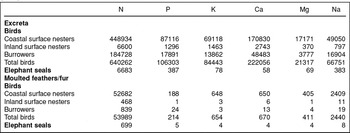
Information was fairly easily obtained for the surface nesting birds like penguins, albatrosses, gulls etc. but it has been far more difficult to census the burrowing petrel and prion species and measure their contributions of guano, feathers, eggs and carcasses to the island's ecosystems. Table 1 presents estimates of the nutrients added to the island ecosystem by all the surface nesters and all the burrowers, based on the sizes of the bird population the last time a census was taken (2002–2003). The inputs of surface nesters that breed on the coast close to the shore (king, macaroni and rockhopper penguins, Crozet shag, sooty albatross) are given separately from those that breed further inland (kelp gull, sub-Antarctic skua, wandering albatross, greyheaded albatross, light mantled sooty albatross, southern and northern giant petrel, gentoo penguin). There is little information on the distribution of the burrowing bird species on the island, so their inputs could not be separated into coastal and inland areas.
Nutrients added via excreta and moult (kg y−1) of seabirds and seals to the Marion Island terrestrial ecosystem. The values are for the bird population in 2002–2003 and are in kg y−1. Guano inputs by surface nesting birds were calculated from the bird population sizes given in Crawford and others (Reference Crawford, Cooper, Dyer, Greyling, Klages, Ryan, Petersen, Underhill, Upfold, Wilkinson, deVilliers, Plessis, Toit, Leshoro, Makhado, Meson, Merkle, Tshingana and Ward2003) and guano nutrient concentrations in Smith (Reference Smith1976), Burger and others (Reference Burger, Lindeboom and Williams1978), Lindeboom (Reference Lindeboom1979) and also unpublished nutrient data. For burrowing birds, guano nutrient inputs were calculated from population size estimates given by Ryan and Bester (Reference Ryan, Bester, Chown and Froneman2007) and guano nutrient concentrations in Fugler (Reference Fugler, Siegfied, Condy and Laws1985) and unpublished data. Feather nutrient inputs were calculated from surface nester population sizes in Crawford and others (Reference Crawford, Cooper, Dyer, Greyling, Klages, Ryan, Petersen, Underhill, Upfold, Wilkinson, deVilliers, Plessis, Toit, Leshoro, Makhado, Meson, Merkle, Tshingana and Ward2003), burrow nester population sizes in Ryan and Bester (Reference Ryan, Bester, Chown and Froneman2008), and feather masses and nutrient concentrations in Brown (Reference Brown1985), Williams (Reference Williams1978) and Williams and Berruti (Reference Williams and Berruti1978). Smith and Froneman (Reference Smith, Froneman, Chown and Froneman2008) give guano and feather inputs of N, P and Ca for individual bird species. For elephant seals the values are kg nutrient added by the moulting population between November 1980 and February 1981, from Panagis (Reference Panagis1984).

Seabird guano represent an annual input of 640 tonnes N, 106 tonnes P, 84 tonnes K, 222 tonnes Ca, and 21 tonnes Mg to the island's terrestrial ecosystem. Moulted feathers add another 54 tonnes N but their contribution to the inputs of P, K and Ca is small, less than 4% of what is added as guano. Elephant seals add 74 tonnes N and 4 tonnes P to the ecosystem during their breeding and moulting period (November to February), as excreta and moulted fur. Some elephant seals also occur on the island outside the breeding/moulting period but excreta production at that period has not been measured. The island's fur seal population has increased markedly since the 1960s and in 2003–2004 there were about 16,000 sub-Antarctic fur seals and 760 Antarctic fur seals (Hofmeyr and others Reference Hofmeyr, Bester, Makhado and Pistorius2006). The fur seal biomass is considerably greater than the elephant seal biomass (Ryan and Bester Reference Ryan, Bester, Chown and Froneman2008) and the fur seals move further inland than do elephant seals. Fur seals might therefore be expected to influence a greater area of vegetation through manuring than do the elephant seals, but there is no information on the amount or nutrient concentration of their excreta.
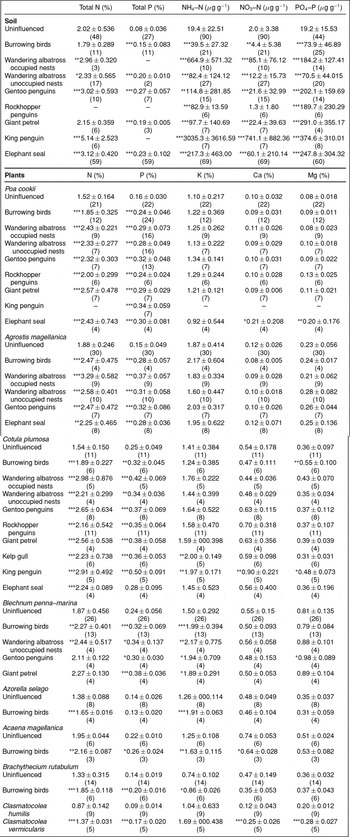
Seals and seabirds enhance soil nutrient status to a very marked extent (Table 2). Especially, concentrations of plant-available forms of N (NH4-N and NO3-N) and P (PO4-P) are increased, often 10 fold or more, compared with unmanured soils. The animals also enhance total N and P levels in the soils. The single exception in Table 2 is that burrowing birds are indicated as having no effect on total N, but this is probably due to the fact that many of the soils in the uninfluenced group were highly organic peats whereas most of those in the burrowing bird group were more mineral soils, and total N and organic matter are closely correlated. King penguins are indicated as having by far the greatest influence on soil inorganic N and P (also total N), but some of the soil samples were eutrophic mud/guano slurries from sites close to rookeries that were devoid of vegetation.
Effect of seabird or seal manuring on nutrient status of soils and plants. Values (mean ± standard deviation) are on a dry mass basis and the number of samples is given in brackets. ‘Uninfluenced’ means the samples were from non–manured sites. The rest of the samples were influenced by the species indicated (‘burrowing birds’ indicates burrowing petrels and prions). In the case of the wandering albatross, influenced samples occurred around occupied or unoccupied nests. Asteriscs indicate that the influenced soil/plant mean differs from the uninfluenced soil/plant mean by ***P ≤ 0.001, **P ≤ 0.01 or *P ≤ 0.05. Information from Smith (Reference Smith1976, Reference Smith1978, Reference Smith1979), Panagis (Reference Panagis1984), Russell (Reference Russell1987) and unpublished data.

In almost all instances, animal manuring causes higher N and P concentrations in the plants, and for some species also higher K concentrations (Table 2). Where vegetation does occur at sites heavily influenced by king penguins, it consists of nitrophilous species that can accumulate especially high amounts of N (mean, up to 2.9%) and P (mean, up to 0.5%) in their leaves. Few moss species occur at manured sites. Brachythecium rutabulum has significantly higher frond N, P and K concentrations in bird influenced tussock grasslands than in non-influenced sites (Table 2). Liverworts are even rarer in manured areas, and none occur at both manured and non-manured sites. Clasmatocolea vermicularis occurs only in coastal mires influenced by both saltspray and manuring. This species has higher frond concentrations of N, P, Ca and Mg than does the very similar C. humilis which occurs in unmanured coastal mires (Table 2).
Thus, seals and seabirds are important sources of nutrients for the island's terrestrial ecosystem as whole, and they greatly enhance soil and plant nutrient status and stimulate ecological functioning processes in the localities where they occur. However, their importance to the nutrient budgets of the island's plant communities in general is less clear. Only about 560 ha of the island's surface is directly influenced (occupied and manured by) by birds or seals (estimated from Table 4 in Smith and others Reference Smith, Steenkamp and Gremmen2001) This is only 4% of the area below 300 m, the upper limit of plant communities with a closed vegetation cover. In fact, most of the nutrient input occurs in a very narrow coastal zone: even the surface nesters indicated as being inland in Table 1 mostly occur within a few hundred meters of the coast. Most (76%) of guano production and feather moult (98%) occurs in king penguin, macaroni penguin and rockhopper penguin rookeries and, especially in the case of the first two, guano and feathers are deposited on bare beaches and much washes down to the sea.
Little is known about the fate of the introduced nutrients, or to what extent they are redistributed further inland. Lindeboom (Reference Lindeboom1979, Reference Lindeboom1984) monitored the fate of guano N produced by macaroni and king penguins at the island's largest rookery, Kildalkey Bay on the southeastern coast. The birds produce 600 kg N in their guano per day, only 16 kg of which is deposited in vegetated areas, the rest falls onto bare surface. About 80% of the guano N is in the organic form (uric acid and proteins). About 24 kg of the organic N washes down directly to the sea and the rest is mineralised to NH4–N. Some (11 kg N) of the NH4–N is nitrified to NO3–N (which is probably quickly denitrified to N2) and some (10 kg N) washes to the sea. The rest (about 430 kg N) volatilises as ammonia. Based on the ocurrence and duration of the different wind directions, it is estimated that 370 kg of the NH3–N is blown out to sea and about 60 kg blown inland. If all the inland–blown NH3–N is deposited somewhere on the island, together with the guano deposited directly onto the vegetation surrounding the rookery, about 12% of the N produced at Kildalkey Bay influences the island's soils and vegetation. A similar situation probably occurs at the island's other large penguin rookeries, since they all occur on the island's north, south and east coasts and for most of the time the prevailing wind is westerly. However, it is still not known how important wind blown nutrients from heavily manured localties such as penguin rookeries and seal wallows are for the inland vegetation. Evidence will be presented later that suggests they are not particularly important.
As well as receiving nutrients from the surrounding ocean, the island in turn influences the nutrient concentration and productivity of the ocean. Runoff freshwater is retained over the shallow shelf between Marion Island and neighbouring Prince Edward Island, about 20 km away. Its dilution effect stabilises the water column, increases the retention of nutrients washed off the islands and leads to periodic phytoplankton blooms. These low-salinity, high-nutrient pockets of water are picked by passing downwelling cyclonic, and upwelling anticyclonic eddies, to become foci of nutrient sequestration and biological production which decay and reform as wind-induced currents carry them further from the island, a process known as the ‘island mass effect’ (Allanson and others Reference Allanson, Boden, Parker, Duncombe, Siegfied, Condy and Laws1985). In this way the island's nutrient effect on the ocean may extend for a considerable distance. Elevated concentrations of ammonia and urea have been detected up to 80 km away (Pakhomov and Froneman Reference Pakhomov and Froneman1999).
Primary production
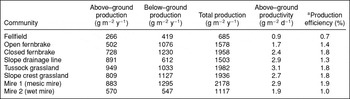
At the outset of the programme, it was already suspected that the island's vegetation was highly productive. Measurements of plant standing crops (the amounts of living and/or dead plant material per unit area) carried out on the island in the mid 1960s showed that some plant communities support very high standing crops, leading to the suggestion that annual net primary production on the island was accordingly high (Huntley Reference Huntley1972). This was increasingly supported by information from other sub-Antarctic islands (for Macquarie Island in Jenkin and Ashton Reference Jenkin, Ashton and Holdgate1970; for South Georgia in Walton Reference Walton, Bliss and Wielgolaski1973 and Walton and others Reference Walton, Greene and Callaghan1974). In the 1970s and 1980s the seasonal changes in plant biomass and standing crops were monitored in seven of the most common plant community types on the island, by harvesting quadrats of vegetation fortnightly or monthly. Annual primary productions (ANPs) for the various communities were calculated from the seasonal changes in plant biomass and standing crop as described by Smith (Reference Smith1987b) and the values are given in Table 3.
Annual net primary production (g m−2 y−1) for seven of the common plant communities on Marion Island. From Smith (Reference Smith1987b, Reference Smith1987c, Reference Smith2008).

aBased on the energy contents of the produced plant material (above- and belowground) and the photosynthetically active component of the radiation received during the growing season.
The values confirm that sub-Antarctic island vegetation is highly productive on an annual basis. Excepting for the fellfield, total ANPs of the island communities (685–2178 g m−2 y−1) are higher than at all the northern hemisphere (Arctic, sub-Arctic and alpine) sites investigated in the IBP Tundra Biome Project (7–837 g m−2 y−1; Wielgolaski and others Reference Wielgolaski, Bliss, Svoboda, Doyle, Bliss, Heal and Moore1981). They are also mostly greater than at the temperate alpine grasslands and oceanic moorlands and bogs (496–1518 g m−2 y−1; Doyle Reference Doyle, Bliss and Wielgolaski1973; Forrest and Smith Reference Forrest and Smith1975; Perkins and others Reference Perkins, Jones, Millar, Neep, Heal and Perkins1978) that were also considered part the IPB tundra study. Even compared with temperate plant communities, ANPs of the island's plant communities are high. For instance, they are mostly higher than the maximum ANP (1425 g m−2 y−1; Sims and Singh Reference Sims and Singh1978) found for temperate north American grasslands and are in the upper part of the range (918–2187 g m−2 y−1; Bernard and Gorham Reference Bernard, Gorham, Good, Whigham and Simpson1978; Reader Reference Reader, Good, Whigham and Simpson1978; Whigham and others Reference Whigham, McCormick, Good, Simpson, Good, Whigham and Simpson1978) reported for temperate wetlands and marshes; vegetation types that are considered to be particularly productive.
The island's climate is consistently wet, without a dry season or even short periods of drought. Although summers are cool, winters are not as bitterly cold as they are in the more continental Arctic and sub-Arctic tundras. The growing season (at least for the low altitude parts of the island where the production studies were carried out) is thus long; about 300 days for vascular plants (Huntley Reference Huntley1970) and the whole year for bryophytes (Smith Reference Smith1987b). This long growing season, and not any intrinsic capacity of the plants for rapid growth, leads to the high annual primary production. Productivity (that is the daily rate of production, and considering only the aboveground growth) of the island's vegetation is, in fact, quite low (between 0.9 g m−2 day−1 and 3.1 g m−2 day−1; Table 3). This is partly due to the cool summers experienced at the island. In contrast, sub-Arctic shrub– or dwarf shrub dominated tundras and tundra meadows have a growing season that, although short, is thermally more favourable for plant growth and they mostly have higher aboveground productivities, between 2.2 and 10 g m−2 day−1 (Wielgolaski and others 1981).
Another reason for the low production rates of the island's vegetation is low irradiance. Almost incessant cloud results in the daily radiation receipt at ground level being only about half of that at the top of the atmosphere. This is considerably less than at most northern hemisphere tundra areas, where days during the growing season are sunnier (because the sites are continental, rather than oceanic as is the case on the island) and longer (because the sites occur at higher latitudes than the island). Production efficiency (energy fixation as a percentage of energy received in the incident photosynthetically active radiation during the growing season) of the island's vegetation is between 0.7% and 1.9% (Table 3), in the range (0.7%–2.4%) for alpine, sub-Arctic and Arctic tundras (Wielgolaski and others 1981). Thus, the island vegetation might grow more slowly during the growing season but it uses the incident radiation as effectively as does northern hemisphere tundra.
Nutrient cycling
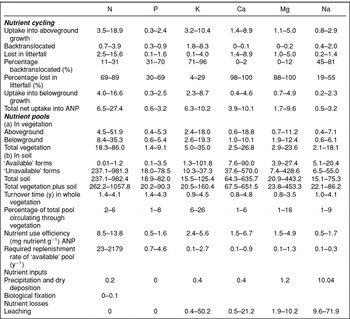
The island's vegetation has a substantial requirement for nutrients to support its high ANP: up to 27.4 g N, 3.2 g P, 10.2 g K, 10.1 g Ca and 9.6 g Mg per square meter per year (Table 4). In many instances the annual uptake of elements is almost as large as the amount contained in the vegetation (uptake of K, Ca and Mg at one of the mires was slightly more than their amounts contained in the vegetation). This suggests fast circulation rates through the vegetation. Nutrient turnover times in the whole (that is above plus belowground) vegetation are, in fact, short, from slightly less than a year to nearly 5 years (Table 4). This is in the lower part of the range of nutrient turnover times (0.9 to 17.5 y) reported for tundra vegetation (Dowding and others Reference Dowding, Chapin III, Wielgolaski, Kilfeather, Bliss, Heal and Moore1981; van Cleve and Alexander Reference Van Cleve, Alexander, Clark and Rosswall1981). Despite the large amounts of nutrients taken up in the ANP, only small fractions (<10%) of the total pools of N, P, Ca and Na circulate annually through the vegetation (Table 4). Larger proportions of the K pool (up to 26%) and the Mg pool (up to 16%) circulate annually.
Nutrient pools (g m−2) at, nutrient cycling (g m−2 y−1) through, and nutrient inputs (g m−2 y−1) to, the seven plant communities. ‘Available’ K, Ca, Mg and Na are the exchangeable forms plus the amounts in the soil solution. ‘Available’ P is resin–extractable inorganic P. ‘Available’ N includes extractable NH4–N, NO3–N and NO2–N and the amounts of these inorganic N forms dissolved in the soil solution. ‘Unavailable’ forms of these nutrients are bound up mostly in organic matter but in some instances also in mineral matter. The seven plant communities were close (<50 m) to each other and nutrient input through precipitation and dry deposition was measured at four positions amongst them. The mean input of the four positions was taken to be the input for each community (Smith Reference Smith1987a). Information on nutrient uptake, translocation, litter loss, soil pool size, turnover time, nitrogen fixation and leaching loss is from Smith (Reference Smith1988b, Reference Smith2008) and unpublished data.

The island vegetation uses nutrients particularly efficiently for its growth, as is shown by the nutrient use efficiencies (the amount of N, P, K, Ca, Mg or Na needed to produce 1 g of plant material) in Table 4. Total nutrient use efficiencies (the sum of N, P, K, Ca, Mg, Na, Si, Fe and Mn needed to produce 1 g of plant material, also called total nutrient cost of production) have been calculated for other types of vegetation, but only for the aboveground component. Total nutrient costs of the aboveground ANP for the island vegetation (17–40 mg nutrients g−1 ANP; data not shown) are very much in the lower part of the range of values (18–135 mg g−1 ANP) found for a wide variety of vegetation types, from tundra to tropical forest. Boreal forests are considered to be particularly efficient at maintaining appreciable primary production levels under severe nutrient limitation, with total nutrient costs between 18 and 25 mg g−1 (Swift and others Reference Swift, Heal and Anderson1979). Fellfield (24 mg nutrients g−1) and mires (17 to 22 mg g−1) on the island are as efficient in maintaining their productivity at a low unit nutrient uptake. Nutrient costs of the ANP for two other sub-Antarctic islands (South Georgia and Macquarie) can be estimated from published information on primary production (Jenkin and Ashton Reference Jenkin, Ashton and Holdgate1970; Clarke and others Reference Clarke, Greene and Green1971; Jenkin Reference Jenkin, Rosswall and Heal1975; Lewis Smith and Walton Reference Lewis Smith, Walton, Rosswall and Heal1975; Lewis Smith Reference Lewis Smith and Laws1984) and plant nutrient concentrations (Jenkin Reference Jenkin1972; Walton and Lewis Smith Reference Walton and Lewis1980; Pratt and Lewis Smith 1982; Lawson Reference Lawson, Siegfried, Condy and Laws1985). This gives approximate values of 29–44 mg nutrients per g ANP, similar to those for Marion Island vegetation.
Surprisingly, the high nutrient use efficiency of the island's vegetation seems not to be due to efficient backtranslocation of nutrients from senescing tissue into perennial organs; hence the short turnover times of nutrients in the vegetation. Only 11–31% of the N taken up aboveground by the vascular plants was retranslocated to storage organs (leaf sheaths, stem bases, rhizomes and roots), the rest was lost in the litterfall (Table 4). For most of the communities, less than half of the P taken up was retranslocated; the exception was at fellfield and mire communities where up to 69% was retranslocated. This inefficient recycling of N and P contrasts with tundra vegetation where commonly more than 50%, and up to 90%, of the aboveground N and P is retranslocated to perennial storage organs prior to senescence (Berendse and Jonasson Reference Berendse, Jonasson, Chapin, Jefferies, Reynolds, Shaver and Svoboda1992).
Most of the Ca and Mg taken up into the aboveground vascular vegetation was lost in the litterfall. In contrast, most of the K taken up was estimated to have been backtranslocated. However, K is a highly mobile, soluble nutrient and any amount that leached out of the senescing tissue would have been included in the estimate of backtranslocation, due to the way it was calculated (Smith Reference Smith1988b). Up to 81% of the Na taken up is estimated to have been backtranslocated. Na is also highly mobile and water–soluble but, unlike K, is not considered an essential nutrient (at least not for the island's plants, which all possess the C3 photosynthetic pathway). Possibly, much of the Na indicated as having been backtranslocated (up to 81% of that taken up) was actually lost by leaching out of the plant tissue, and this might also be true for K. Leaching experiments with the island's plants (intact, freshly collected leaves were rinsed with distilled water) showed that N, P, K, and Ca are not readily leached from leaves. Na is leached from many of the species, and Mg is leached from two shore zone plant species, neither of which occurred in the communities reported on here. The relevance of these results to actual leaching losses in the field is not known. However, since any leaching would have resulted in an overestimation of the extent to which a nutrient was backtranslocated prior to senescence, this strengthens the contention that the high nutrient use efficiency of the island's vegetation is not due to efficient retranslocation out of senescing organs. Rather, it is achieved by being able to maintain growth at low tissue nutrient concentrations. For example, the island plants have substantially lower N, P and Ca concentrations than do northern hemisphere tundra plants (Smith Reference Smith1987d, Reference Smith1987e) but, as was shown above, they are able to convert sunlight energy into growth just as efficiently as tundra plants.
Total nutrient pools (the amounts of nutrient in the vegetation and soils) in the island's plant communities are given in Table 4. The greater part of the total pool occurs in the soil. The smallest soil nutrient pools are found in fellfields (because of low soil nutrient concentrations and shallow soils) and mires (because of low soil concentrations and low bulk densities). Total N pools at the island (262–1058 g N m−2) are similar to those found for northern hemisphere tundras and oceanic moorlands and bogs (309–1075 g N m−2). Total pools of P (20–90 g m−2) and K (20–160 g m−2) at the island are in the lower part of the ranges (9–461 g P m−2 and 16–474 g K m−2) reported for tundras, moorlands and bogs. (See Smith Reference Smith1987f, Reference Smith1988a for citations of the sources of nutrient pool sizes at the tundra, moorland and bog sites).
Graminoid and/or bryophyte dominated communities on the island have significantly smaller pools of Ca and Mg than do dicot or fern dominated communities. Within the two types, Ca pools at the island are much smaller than in their corresponding northern hemisphere tundra counterparts. For instance, the two mire communities (which are dominated by both graminoids and bryophytes) have total pools of 67–73 g Ca m−2, compared with 134–750 g Ca m−2 for tundra sedge meadows and tundra grasslands. Similarly, the fellfield and slope communities (dicot and fern dominated) have Ca pools (378–652 g Ca m−2) that are mostly lower than in shrub and heath tundras (537–1219 g Ca m−2). There is little information on tundra Mg pool sizes. Wielgolaski and others (Reference Wielgolaski, Kjelvik and Kallio1975) report values for five Fennoscandian tundra communities, where the same graminoid/bryophyte versus dicot distinction occurs. The total Mg pool in a wet Fennoscandian tundra meadow (110 g Mg m−2) is considerably higher than for the island's mires (23.8–24.5 g Mg m−2). Mg pools in dicot–dominated Fennoscandian tundra communities are between 750 and 1600 g Mg m−2, considerably more than the 120–453 g Mg m−2 contained in the island's fellfield and slope communities.
Despite the fact that the greater part of the total nutrient pool in the island's plant communities is found in the soil, levels of plant available forms of nutrients in the soils are very low, especially in the case of N and P (Table 4). Available K levels are also lower than suggested by the range of values given in the table, which includes a tussock grassland that is influenced by manuring by burrowing birds (Smith Reference Smith1976) and has relatively high available K levels in the soil (101.8 g K m−2). For the rest of the plant communities the pools of plant–available K were much lower (1.3–21.8 g K m−2).
An indication of how just how low are the amounts of available N is that the soil pool sizes of between 0.01 and 1.2 g available N m−2 in Table 4 translate into volumetric concentrations of between 0.004 and 4.68 μg N cm−3, considerably lower than the range (17 to 43 μg N cm−3) reported for sub-Arctic and Arctic tundra mire peats, which are considered to be ultra–oligotrophic (Gersper and others Reference Gersper, Alexander, Barkley, Barsdate, Flint, Brown, Miller, Tieszen and Bunnel1980; Rosswall and Granhall Reference Rosswall, Granhall and Sonesson1980). Similarly, available P pools in the island's soils (0.1 to 3.5 gm P m−2) equate to volumetric concentrations of 0.4 to 14 μg P cm−3, in the lower part of the range for tundra soils (0.1 to 101.4 μg P cm−3; Brown and Veum Reference Brown, Veum, Holding, MacLean and Flanagan1974; Everett and others Reference Everett, Vassiljevskaya, Brown, Walker, Bliss, Heal and Moore1981).
The substantial annual requirement for N, coupled with the low levels of plant available N in the soil, implies rapid turnover of the available N pool. It needed to be replenished from 23 to 2179 times per year to meet the vegetation's annual N requirement (Table 4). The P pool needed to be replenished less often, 0.7 to 4.6 times per year. Available pools of Ca and Mg at the communities were equal to, or larger than, the vegetation's annual requirement and so needed to be replenished only every 1 to 10 years. At fernbrakes and fellfield (where fern fronds and a cushion plant take up substantial amounts of K), the available K pools needed to be replenished 1.7–2.7 times per year, but K pools at the other communities were at least equal to the annual requirement.
Because the available N pool had to be turned over far faster (4 hours to 16 days) than the available P, K, Mg or Ca pool (80 days to 10 years), N might be the most limiting element for primary production. N input through precipitation and dry deposition to the communities amounted to 0.21 g N m−2 y−1, or only 1–3% of the vegetation's annual requirement for N. Precipitation supplied only 4–11% of the K, 4–22% of the Ca, and 13–75% of the Mg needed for the annual plant growth. No P occurred in the precipitation.
The communities represented in Tables 3 and 4 are typical of the vegetation that occurs away from the coastal strip (with its high densities of animals) and up to about 300 m a.s.l. This represents an area of about 140 km2. Other than a tussock grassland, the communities studied were not directly influenced by manuring. Most of the N coming in via rain and dry deposition will have come from penguin rookeries and seal wallows in the coastal zone, about 500 m away. The fact that the N input was so small compared with the requirements of the vegetation, and that there was no input of P through rain and dry deposition, suggests that although animal manuring very strongly enhances soil fertility at and close to sites used by animals, it is relatively unimportant for the greater part of the island's vegetation.
As far as is known, none of the island's plants have N fixing rhizobia but nitrogen is fixed by heterotrophic soil bacteria (Smith Reference Smith, Siegfied, Condy and Laws1985) and cyanobacteria (the latter in algal mats on the soil surface and as epiphytes on mosses; Smith and Russell Reference Smith and Russell1982). However, biological N fixation adds a maximum of only 0.1 g N m−2 y−1 to the communities studied (Table 4), less than 2% of the amount taken up by the vegetation. The source of inorganic N and P for plant growth at the communities will be described in the next section.
Nutrient losses from the communities are poorly understood. The amounts of nutrients leached from the communities through drainage were estimated as the product of the mean soil solution concentrations of the nutrients and the difference between annual precipitation and potential annual evapotranspiration. Probably, the leaching losses given in Table 4 should be regarded as ‘potentially leached values’ rather than definite amounts leached. Inorganic N and P seem not to be lost from any of the communities by leaching, since no NH4–N NO3–N or PO4–P ever occurred in the soil solution. Organic N and P in the soil solution were not measured since the soil solution was filtered before it was chemically analysed. The water draining from the communities in drainage lines, creeks and surface runoff was always exceptionally clear, so it is thought unlikely there is significant export of N and P as water carried particulate matter.
The amounts of K, Ca, Mg and Na estimated as being leached were mostly larger than the corresponding inputs through deposition and dry fallout, suggesting that either the input amounts or leached amounts were incorrectly estimated, or that the difference is made up by weathering of basaltic volcanic ash in the soils. The precipitation inputs are thought to be reasonably accurate, since they agree very closely with inputs measured by Grobbelaar (Reference Grobbelaar1978) at the nearby meteorological station (see also Smith and Froneman Reference Smith, Froneman, Chown and Froneman2008). Rates of basalt chemical weathering have not been measured and the uncertainty of the amounts leached has been mentioned. Of course, if the K, Ca. Mg and Na outputs really are greater than their inputs, mineralisation of nutrients from litter and soil organic matter could make up the differences. But such internal recycling would not prevent nutrient depletion over a longer term and the effect would be peat degradation, rather than accumulation, which was the pattern at all the communities.
N might be lost from the communities through denitrification. The waterlogged mire peats, especially, have large organic matter concentrations and low partial pressure of O2, both factors that promote denitrification. Also, some of the peats have fairly substantial plate count numbers of denitrifying bacteria (Smith and Steyn Reference Smith and Steyn1982). Against this, all the soils are acidic, which would tend to suppress denitrification. However, there is no quantitative information on denitrification, or on any other gaseous losses of N, at the island.
Wind blown plant litter almost certainly represents a significant export of nutrients from the communities. It cannot be assumed (as is often done when estimating community nutrient input-output balances) that ‘what comes in goes out’. While a community may be a source as well as a sink of wind blown litter for any other community, the surrounding ocean is a net sink for the island as a whole. This certainly extends down to the community level; that is the net effect of wind movement of litter is a loss to all of the island's plant communities. An important exception might be the polar deserts and fellfields of the island's interior, which have extremely low autochthonous production of litter and which might be a net sink for litter blown in from the well-vegetated lowlands.
Decomposition and decomposition processes
Plant litter in mesh bags placed in the litter layer lost 13 to 59% mass over the first year (Smith Reference Smith, Chown and Froneman2008). Angiosperm litter mass loss was 33–59% per year, higher than most angiosperm litter mass losses (4–42%) reported for Arctic and sub-Arctic tundras and more similar to loss rates of litters in oceanic bogs, mires and moorlands (16 to 57%; Heal and others Reference Heal, Flanagan, French, MacLean, Bliss, Heal and Moore1981). Similarly, tensile strength losses of standardised cotton strips buried in the island's soils are at the upper extreme of the range of tensile strength loss values found for tundra. At manured sites tensile strength loss rates are an order of magnitude greater than those in tundra (Smith and others Reference Smith and Steenkamp1993). In fact, seal and seabird manuring, by adding not only nutrients but also energy rich organic substrates, is the most important determinant (even more than temperature or moisture content) of the rate of a whole suite of decomposition processes, such as the size and activity of soil microorganism populations (Smith and Steyn Reference Smith and Steyn1982; French and Smith Reference French and Smith1986), soil enzyme activity (Grobler and others Reference Fugler, Siegfied, Condy and Laws1987), and soil respiration rate (Smith Reference Smith2003, Reference Smith2005). But even at sites not influenced by manuring, decomposition processes are cardinal to maintaining high rates of ecological functioning processes such as primary production and nutrient recycling.
In contrast to the small pools of plant available N and P, there are large amounts of organic N and P in the island's soils (up to 981 g N m−2 and 79 g P m−2; Table 4). Mineralisation of nutrients from decomposing organic matter is the main process replenishing available nutrient pools, but microbial activity is impeded in the continuously cold, waterlogged soils. The low nutrient status of the ANP also leads to low quality plant litter that is resistant to decomposition. Consequently, an important bottleneck in nutrient cycling and primary production for most of the island's plant communities is the mineralisation of nutrients by decomposition (Smith Reference Smith1988a).
Nitrogen mineralisation rates were studied using various soil incubation techniques, all of which gave very low estimates of N mineralisation rates. For example, in vivo mineralisation studies at a mire community yielded a maximum rate of 48 mg N m−2 day−1, only about 15% of the rate needed to meet the mire vegetation's daily requirement (about 336 mg N m−2 d−1 Smith and Steenkamp Reference Smith and Steenkamp1992a) during the midsummer period of maximal growth. However, this rate represents only N mineralisation by free–living soil microorganisms and ignores the role of the soil fauna and its gut microorganisms. Many of the island's habitats have high densities of soil macro and mesofauna, mainly detritivorous and/or microbivorous moth and weevil larvae, earthworms and snails. In the qualitative account of energy and nutrient pathways at the island (Smith Reference Smith1977) it was suggested that these animals might be important agents of decomposition processes, but it was only after several years of painstaking study that it was realised just how crucial they are. Using a microcosm approach it was shown that they greatly stimulate rates of nutrient release from peat and litter (Smith and Steenkamp Reference Smith and Steenkamp1992b, Reference Smith and Steenkamp1993). At the mire community referred to earlier in this paragraph, macroinvertebrates cause the release of 345 mg N m−2 day−1 (Smith and Steenkamp Reference Smith and Steenkamp1992c), sufficient to account for the midsummer maximum N uptake by the vegetation.
Soil fauna also markedly stimulates the mineralisation of P and K from plant litter and peat in microcosms, but in contrast to N, studies enabling the microcosm P and K results to be extrapolated to the field situation have not been carried out. However, Smith (Reference Smith, Chown and Froneman2008) provisionally estimated that 5.5 g P is mineralised per year by macroinvertebrates at the mire community, about three times the annual requirement of the mire vegetation. It is thus clear that soil invertebrates play a cardinal role in nutrient cycling on Marion Island.
Extinct and extant threats to energy flow and nutrient cycling processes
Domestic cats (Felis catus) were introduced to the island in 1949, to combat house mice in the newly erected meteorological station. They quickly became feral and speculation about their role as the island's chief terrestrial predator featured strongly in the word model description of the trophodynamics at the island (Smith Reference Smith1977). Since then much was learnt about the cats. For example, Van Aarde (Reference Van Aarde1980) estimated that the 1975–1976 population of about 2150 cats killed about 460 000 burrowing birds per year just to meet minimum energy requirements. This must have drastically affected the bird populations, as evidenced by a decrease in the occurrence and area of coastal and inland tussock grasslands, community types maintained by burrowing birds (Gremmen and Smith Reference Gremmen, Smith, Chown and Froneman2008). An intensive eradication effort, first through the introduction of feline panleucopaenia virus and then by hunting, trapping and poisoning, lead to the extermination of the cats in 1991 (Bester and others Reference Bester, Bloomer, Bartlett, Muller, Van Rooyen and Buchner2000). This has lead to a greater breeding success of two species (great-winged petrels and blue petrels; Cooper and others Reference Cooper, Marais, Bloomer and Bester1995) but not yet to the reestablishment of significant inland colonies of burrowing birds. In fact, the area covered by tussock grasslands has declined most since the cats were eradicated and there are other indications of a decline in the numbers of burrowing birds. For instance, the numbers of burrows in all vegetation sites where there were burrows in the 1970s has declined sharply: in most cases there are now no burrows. A striking example is the slopes around the Tafelberg basin, an area of about 8000 m2, which in 1974 was occupied by great-winged petrels in winter and several other burrowing species (blue petrels were probably the most common) in summer. In 1974 there were, on average, nearly two burrow entrances per m2 and the slopes were one of the best examples of inland tussock grassland on the eastern side of the island. By 1982 there were only 0.3 burrow entrances per m2 and some of the tussock grassland was replaced by Acaena magellanica herbfield. In 2005 there were only 0.1 burrows per m2 and the tussock grassland had disappeared. On the island's west coast tusssock grassland occupied many hectares in the 1970s, occurring on what the expedition members referred to as ‘easter egg’ earth since when walking on it one broke through the surface into the burrows underneath. In 2005 there was not a single extensive example of tussock grassland on the west coast and the only examples of easter egg earth were at a few small localities occupied by Cotula herbfield. The only monitoring study on a burrowing species since cats were eradicated has been for white-chinned petrels. The number of ‘active’ burrows in a ca.15 ha area on the eastern coastal plain declined by 34% between 1976 and 2000; the decline was attributed to long line fishing (Nel and others Reference Nel, Ryan, Crawford, Cooper and Huyser2002).
The eradication of cats was associated with an increase in the island's house mouse (Mus musculus) population (Ferreira and others Reference Ferreira, Van Aarde and Wassenaar2006). An ameliorated climate might also have contributed to the increase (Van Aarde and Jackson Reference Van Aarde and Jackson2007; see also Smith Reference Smith2002 for a detailed description of climate change and its ecological implications at the island, particularly regarding the mouse population). In the 1977 account the occurrence of accumulations of broken land snail shells under rocks in the higher altitude parts of the island was noted and tentatively ascribed to house mouse predation. It was speculated that ‘it is possible that mice are of some importance at the primary carnivore level’ (Smith Reference Smith1977). Together with the discovery that the soil fauna is crucial to nutrient cycling, the discovery that the house mouse predates heavily on soil macroinvertebrates and the elucidation of the degree to which this influences terrestrial ecosystem functioning is possibly the most significant finding to have come out of the island research programme (Gleeson and van Rensburg Reference Gleeson and Van Rensburg1982; Rowe–Rowe and others Reference Rowe–Rowe, Green and Crafford1989; Crafford Reference Crafford, Kerry and Hempel1990; Smith and others Reference Smith, Avenant and Chown2002). The mice can annually consume up to six times the standing biomass of a particular macroinvertebrate prey species (Smith and others Reference Smith, Avenant and Chown2002). Soil macroinvertebrate densities declined markedly over the same period that the mouse population increased (Hänel Reference Hänel1998).
The mouse's preferred prey species are moth larvae, weevil larvae, weevil adults and earthworms, the same detrivores and microbivores that facilitate litter and peat decomposition. Mouse predation on those invertebrates leads to decreased rates of nutrient mineralisation, which in turn lowers both the quantity and quality (nutrient status) of the ANP (Smith Reference Smith, Chown and Froneman2008) and results in plant litter that is even more recalcitrant toward decomposition. The consequence is a changed equilibrium between peat accumulation and decay, which through its effect on the hydrological regime is the most important factor governing vegetation succession at the island (Smith and others 2001). Mice also affect peat accumulation and soil formation when they tunnel in the large, long lived cushions of Azorella selago. These cushions accumulate large quantities of organic matter and are the prime initiator of vegetation succession and soil formation on the island (Gremmen and Smith Reference Gremmen, Smith, Chown and Froneman2008). When mice tunnel in a cushion (we suspect they are foraging for invertebrates) they chew through the stems and often cause its death.
The house mouse at Marion Island is a particularly good example of how insidiously an alien invasive species can affect ecosystem structure and function at an oceanic island, especially if the invader is able to occupy a trophic niche or niches (in this instance, terrestrial herbivore and insectivore) that are vacant, or only partially filled. Other examples of the effects of introduced organisms on the island's ecology are a European slug Deroceras panormitanum, a chironomid midge Limnophyes minimus and a porcellionid isopod Porcellio scaber. All three are detritivores and the slug is also a herbivore. The midge has been shown to ingest large quantites of detritus in some communities (even more than the indigenous macroinvertebrates; Hänel and Chown 1998), and the large bodied isopod probably also processes appreciable quantities of litter (Slabber and Chown Reference Slabber and Chown2002). Slugs markedly stimulate rates of nutrient mineralisation from litter (Smith and Steenkamp Reference Smith and Steenkamp1992b). The mice do not eat the slugs or isopods and the small size of the midge probably disqualifies it from being a significant prey species. These introduced invertebrates can thus potentially replace the mouse's indigenous prey species as nutrient recyclers but probably not without consequences for ecological functioning. For instance, Smith (Reference Smith2007) showed that slugs cause inorganic nutrient release rates from litter that, relative to rates of carbon release, are different to those caused by indigenous invertebrates. This leads to different carbon:nutrient ratios in the decomposing substrate and ultimately affects peat nutrient quality, decomposition rate and primary production.
Perhaps predation by mice on the island is not confined to small animals like insects and earthworms. In 1982 the author assisted in a project on the chemical composition of blue petrel chick guano. Steven Fugler and Ian Newton, who collected the guano, commented on the fact that they sometimes found chicks with fresh wounds, especially on the belly near the tail and also on the shoulders. They subsequently noted that dead chicks were often scavenged by mice and also that . . .’mice may have predated some eggs and small chicks. One chick carcass had deep wounds on the back of the neck, probably made by a mouse’ (Fugler and others Reference Fugler, Hunter, Newton and Steele1987). This was never followed up, although an examination of the contents of 836 mouse stomachs in 1992–Reference Smith, Steenkamp and French1993 showed feathers to be a frequent item in the stomachs, especially at sites occupied by burrowing birds (Smith and others 2002). Again, this was put down to scavenging and no one has seriously considered that mice actually predate on birds at the island. We may have to reconsider. Conclusive proof has recently been produced that house mice on Gough Island (South Atlantic) attack and kill Tristan albatross chicks and atlantic petrel chicks. Video evidence was obtained of several mice crawling over a living albatross chick ‘eating almost at will from holes through to its abdominal cavity . . . the attacks continued relentlessly . . . the following morning the chick was dead’ (Wanless and Angel Reference Wanless and Angel2007). Those authors estimate that about 1000 albatross chicks on Gough Island succumbed to mice in the breeding season. Wanless and others (Reference Wanless, Angel, Cuthbert, Hilton and Ryan2007) cite unpublished information from Marion Island that ‘since 2004, several wandering albatross chicks have succumbed to wounds consistent with mouse attacks’. One wonders if the slow reestablishment of burrowing bird species on Marion Island following the eradication of cats might be due to mouse predation.
Quo vadis?
After more than 30 years of quite intensive research, we have barely started to understand the Marion Island terrestrial ecosystem. We have defined the major ecological forcing variables and have some quantitative information on how ecosystem functional process, such as production, nutrient cycling and decomposition, are related to the forcing variables. We poorly understand several important components of nutrient cycling, such as leaching, wind-blown litter and chemical weathering of parent rock and scoria. We need to understand the island's house mouse population much better, especially whether the mice are significant predators of birds.
The island's polar desert habitat, which occupies about 109 km2, or about 40% of the total surface area, has never been studied. Is the habitat, which has an extremely sparse vegetation (over hundreds of thousands of square meters only a few moss cushions may occur), functionally as quiescent as it seems? If so, how do flightess moths and land snails, and more especially house mice, which have been found even on the highest peaks, survive in it?
At the start of the project in 1971 the island was considered to represent a wonderful opportunity for ecosystem structure and function studies. It has a small flora and fauna and a seemingly simple ecological structure with few trophic levels, none of which are occupied by organisms like large mammals and trees which, due to their size and long life-cycles, are difficult subjects for energetic and nutrient studies. The island is also largely free from complicating factors (for example past or present agriculture and industry, or other forms of human interference) that make the results of ecological functioning studies in most other areas so difficult to interpret.
We now know that the ecosystem is not as ‘simple’ as we once thought. Even the basic tenet, held so long that it has almost become a maxim in our thinking about ecological functioning at the island, that the detritus chain totally predominates the grazing chain in energy flow through the terrestrial ecosystem, may prove false. We are increasingly realising that small things matter on the island: small organisms like nematodes, enchytreids, mites and collembola, and probably also even smaller ones like protozoa (and certainly fungi and bacteria) are cardinal to the spatial and temporal dynamics of the island's terrestrial communities. There are thus cryptic and unsuspected, but in all likelihood extremely important, herbivore-consumer, and predator-prey, trophic interactions occurring in the island's terrestrial ecosystem. It is up to us to discover, quantify and marvel at those interactions. The island remains a superb laboratory for ecological research.
Dedication
This account is dedicated to the memory of Eduard Meine Van Zinderen Bakker who, after 13 years of lobbying the South African authorities, initiated the biological research programme at Marion and Prince Edward Islands. His fascination with all aspects of biology and love of the islands inspired many young biologists. It was my good fortune to have been one of those biologists and I am still discovering the extent to which he influenced my life.