

1 Introduction
1.1 Motivation and aims of this study
The present work was prompted by the rediscovery in 2008 of a number of long-unheard recordings of the notable British linguist J. R. Firth (1890–1960). They were encountered during the cataloguing of a large collection of gramophone records, dating largely from the years between the two World Wars, which had been preserved at UCL and subsequently accessioned into the British Library as ‘The UCL Phonetics Collection’. Three records of English language teaching materials, titled English Spoken Here (1932) feature Firth alongside Daniel Jones (DJ) in scripted conversations. These are of particular interest since the two linguists are widely believed to have been fiercely antagonistic on various matters (Abercrombie Reference Abercrombie1991: 2). Collins & Mees (Reference Collins and Mees1999: 321, 335–337) comment that DJ's relationship with Firth ‘had never been a happy one’, and deteriorated into a ‘feud’ by the mid-1940s.
Quite apart from the initial curiosity aroused by hearing the two men cooperating in role-play, we quickly became aware that though both speakers were nominally using the ‘Received Pronunciation’ (RP) of the 1930s, there were some apparent differences in their accents. When we played excerpts from the recordings in conference presentations in Britain, we found that other observers confirmed our perceptions, and some also shared our impression that – from a modern point of view at least – Firth's speech sounds somewhat hypercorrect.
We therefore set out to analyse and quantify differences in the RP used by the two men, and to link such differences to what is known about the sociolinguistic backgrounds of the two speakers and about variation within RP of the period, specifically the sociolinguistic and stylistic correlates of the variants identified. The aims of the study are therefore specifically as follows: (i) to document selected phonetic differences in the speech of two very similar speakers and to examine whether the auditory impressions are quantifiable and correspond to acoustic correlates; and (ii) to investigate whether the discrepancies between the two interlocutors correspond to sociolinguistic variables, and explore the sources of the noted variation.
1.2 General background
1.2.1 RP in general
In this paper ‘Received Pronunciation’ (RP) is taken to refer to a regionally neutral, though sociolinguistically unusual accent of British English functioning as a standard (Trudgill Reference Trudgill2011). For a discussion of the changing meaning of the term (i.e. narrowing its scope to indicate a socially marked subvariety), its social status and age related subtypes, see Cruttenden (Reference Cruttenden2014: 74–85).
RP has long been a reference variety in textbooks and dictionaries of British English and with the growth of radio it became the first choice in broadcasting. As a variety with no regional colour, but associations of education and social class, the accent is sometimes adopted in adulthood for social or professional purposes by speakers of a different native variety. An account of phonetic traits of native users and adult adopters of the accent is offered by Wells (Reference Wells1982: 279–285).
Contemporary social and age-related stratification within the accent is well documented (Cruttenden Reference Cruttenden2008: 75–83; Hawkins & Midgley Reference Hawkins and Midgley2005; Hannisdal Reference Hannisdal2006; for a detailed account produced a generation earlier see also Wells Reference Wells1982: 279–301). There has also been much work on historical developments within RP, but synchronic variability within RP of the past has received relatively little attention, and this may have led to an impression of the accent being more uniform in the past. At the time of writing we have not found systematic acoustic studies of the accent attempted with material older than the 1950s (Harrington, Palethorpe & Watson Reference Harrington, Palethorpe and Watson2000).
1.2.2 RP as a model for EFL
The term ‘Received Pronunciation’ and the abbreviation ‘RP’ only came into wide use from 1926 (Collins & Mees Reference Collins and Mees1999: 166–167), but under other names the variety was already established as a prestige accent by the beginning of the 20th century. DJ had at first used ‘Public School Pronunciation’ and the abbreviation PSP (Jones Reference Jones1917: viii).
That this variety should be used as the British model in teaching English as a foreign language (EFL) was essentially unquestioned. The benefits of adopting it are explained thus in early editions of DJ's English Pronouncing Dictionary: ‘Many foreigners will no doubt consider RP a suitable pronunciation for them to acquire, for the practical reasons that it is widely understood in the English-speaking world and that there are numerous books dealing with it’ (Jones Reference Jones1926: x). Even those who came to the task of EFL teaching as non-RP speakers themselves did not hesitate to adopt it. Upton (Reference Upton and Hickey2012: 56) reports that in his first academic post at the University of Uppsala (1924–1928) the notable dialectologist Harold Orton (1898–1975) ‘was deliberately to lose all vestiges of his Durham accent upon becoming a lector, specifically so as not to harm his students’ prospects (Orton, personal communication)’. Orton's term for the prestige pronunciation he adopted was ‘Received Standard English’ (Orton Reference Orton1933: x), no doubt following the usage of H. C. Wyld (1870–1945), who was Orton's tutor at Oxford, and used the term himself throughout his career (e.g. Wyld Reference Wyld1920: 2). There is little doubt that Firth similarly took for granted that the learner of English would aim at a ‘standard’ pronunciation. Appendix A of Firth & Singh (Reference Firth and Singh1929) contains a list of polysyllabic words re-spelled to provide guidance on stress and certain other aspects of pronunciation, and the explanatory text specifically mentions the word ‘standard’: ‘R is also italicised where it is not pronounced in standard English’ (Firth & Singh Reference Firth and Singh1929: 251).
1.2.3 The speakers
The speakers considered in this study are of interest in that they have some factors in common in terms of social background, but are at the same time arguably different in certain crucial respects relating to origins and education. An extensive biography of DJ is provided by Collins & Mees (Reference Collins and Mees1999). There are various shorter biographies of Firth, among which Plug (Reference Plug2008) is the most recent and detailed.
The two men were roughly contemporary, with only nine years’ difference between them. DJ was born into the relatively privileged background of a wealthy London family; his father was a barrister. Before beginning his academic career at UCL, Jones had a public school education and attended University College School for a time at the end of his school years. He subsequently studied mathematics at Cambridge and also had opportunities to study abroad in France and Germany (Collins & Mees Reference Collins and Mees1999). Quickly establishing himself as the most prominent English phonetician of his day, he was largely responsible for the codification of RP, which remained unchallenged for the rest of the 20th century. His Pronunciation of English appeared in 1909, the English Pronouncing Dictionary in 1917, and Outline of English Phonetics in 1918. All went through numerous editions and remained standard works for generations.
J. R. Firth came from a lower middle class family and was born and raised in Yorkshire, where he attended grammar school and studied history at Leeds University. After a spell in the army and in India he worked for ten years as a Senior Lecturer in Daniel Jones's Department of Phonetics at UCL. He then moved to the School of Oriental and African Studies in London, where he afterwards became the holder of the first Linguistics Chair in Britain and one of the seminal figures of the field (Plug Reference Plug2008).
The different circumstances of the two men's early lives may be considered to be potential contributors to their speech. Given that Firth was born into a less socially advantaged and affluent family than Jones was, it might be suspected that RP was not his native accent but one acquired later in life for professional purposes. However, while it is a reasonable guess that Firth's parents were not RP speakers, one cannot conclusively establish how late in his life he adopted the accent, or indeed rule out the possibility that he used it from a relatively young age. Acquisition of a variety is governed by factors other than just parents’ speech and a young person is substantially more likely to be influenced by peer networks than an older one.
Even though hindsight and the well-known later alleged feud between the two phoneticians might encourage a view that DJ must have been the initiator of the English Spoken Here recordings and Firth a mere subsidiary, pressed into service (perhaps reluctantly) as one of the few male speakers in a female-dominated department (Collins & Mees Reference Collins and Mees1999: 201), it is arguably unwise to make such an assumption. Whereas DJ's importance in the field of EFL is obvious and widely-recognized, Firth is not primarily remembered for the relevance of his work to English language teaching. Surveys of his work (e.g. Love Reference Love and Harris1988) tend to focus exclusively on the later development of Firth's influential linguistic theories. This overlooks the fact that during the 1930s Firth actually led the English language-teaching efforts of the UCL Phonetics Department, and appears to have approached the task very seriously. Chapter 8 of Firth's popular work Speech (Firth Reference Firth1930) presents a subtle and wide-ranging analysis of the role of English as an international language, and of the selection of suitable models in teaching. He also published a selection of English language texts for learners in India (Firth & Singh Reference Firth and Singh1929). In the three successive academic years 1932–3, 1933–4 and 1934–5 (and thus around the time of the recordings under consideration), Firth offered a UCL course (S35) with the title ‘Principles of Speech Training’, which was listed specifically under ‘Linguistics’ lecture courses, suggesting that it tackled theoretical issues (e.g. UCL 1933: 60). The contents of Firth's course are unknown, but the correspondence with the title of Avery, Dorsey & Sickels (Reference Avery, Dorsey and Sickels1928) is suggestive. That work presents a comprehensive account of articulatory phonetics, sound classification and voice production followed by extensive vocal and performance exercises, thus aiming to combine ‘a solid foundation of scientific facts’ with an ‘aesthetic’ and ‘practical approach’ (page xxx). It is easy to imagine that the book might have appealed to Firth in that it ambitiously attempts to link a detailed treatment of general articulatory phonetics with psychological and sociological factors (‘In grappling with the problems of speech training, teachers have received much help from the newer schools of psychology and pedagogy’ – page xxiv). As indicated by the bibliography in Firth (Reference Firth1930) and by Firth's own book reviews, during the late 1920s and early 1930s Firth was reading widely in (chiefly American) works on psychology, sociology, anthropology and language acquisition and pathology (Laguna Reference Laguna1927, Markey Reference Markey1928, Pillsbury & Meader Reference Pillsbury and Meader1928, Firth Reference Firth1934). There is thus every likelihood that his involvement in English language teaching had a very broad context. Indeed, Collins & Mees (Reference Collins and Mees1999: 321) take the view that Firth had in part been appointed to replace H. E. Palmer (1877–1949), a pioneer and innovator in English language teaching, who had moved to Japan in 1922 (Smith Reference Smith2005).
Overall, therefore, we suggest that at the time of recording, the two men were equals in fitness for the task, and appeared to share a genuine concern to create good materials accessible to learners. It is worth emphasizing this point since an attempt is made in the paper to substantiate some interspeaker differences and identify potential reasons behind them. Factors such as an unequal power relationship between them, or differing motivations (if they existed) might then be thought relevant considerations.
1.2.4 The genre
All of the recordings in our corpus are scripted dialogues of everyday prose for EFL purposes, which was already by this time a long-established genre. There exist abundant recordings of RP teaching materials dating back to the earliest days of commercially-produced disc recordings. For example, an extensive set of recordings was issued of the conversations in Baumann (Reference Baumann1905) – and in fact one of those records was among the material analysed in an early work of DJ (Jones Reference Jones1909a).
Being based on scripted dialogues, such recordings represent the formal end of the stylistic continuum, comparable to the ‘reading passage’ style data frequently gathered in sociolinguistic studies (Labov Reference Labov1972a, b; Di Paolo & Yaeger-Dror Reference Di Paolo, Yaeger-Dror, Di Paolo and Yaeger-Dror2011: 11). Coupled with the fact that the material itself is intended to serve as a pronunciation model for a non-native audience, the circumstances of the recording may tend to trigger a degree of conscious attention to one's speech.
Overall, we have to concede that the data can represent only a part of the stylistic repertoire of the speakers analysed. Nonetheless, there is every reason to believe that material of this type will be entirely reliable for the vowel formant data utilized in this study.
2 Corpus
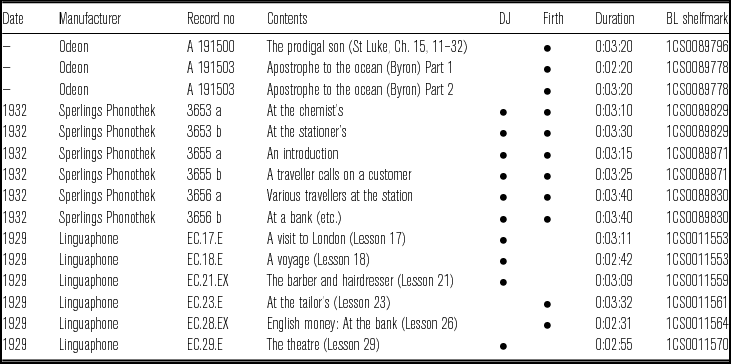
All of the recordings used in this study are from the electric era of recording (post-1925), using fairly good quality microphones and reliable speed regulation. Therefore, while well short of modern recording fidelity, they can still yield very satisfactory acoustic analyses. The full set of recordings is shown in Table 1.
The corpus of recordings (BL = British Library; ● indicates that the speaker is heard in the recording; durations are shown in the format hours:minutes:seconds).

Our auditory impressions of Firth's pronunciation have been gathered from every recording of Firth that we have been able to locate (11 items), and Table 1 thus serves incidentally as an attempt at a complete discography for Firth. But though Firth's pronunciation appears to us entirely consistent throughout, his (undated) readings for the Odeon company of the ‘Parable of the Prodigal Son’ and Byron's ‘Apostrophe to the Ocean’ were excluded from the comparative acoustic analysis to guard against possible mismatches in style, date, and recording technology. Instead, the acoustic analysis utilizes the joint Firth/DJ recordings plus, for each speaker, all relevant items from a Linguaphone ‘English Conversation’ course of 1929. Other RP speakers in the Linguaphone recordings, whose speech has not been analysed in the present study, include H. C. Wyld (1870–1945) and J. R. R. Tolkien (1892–1973).
The total duration of the material used for the auditory analysis (15 record sides) is somewhat more than 47 minutes. The annotated subsection of the corpus used in the acoustic analysis (12 record sides) amounts to 38 minutes and 40 seconds.
The English Spoken Here dialogues, and Firth's solo Odeon recordings, were obtained as 44.1 kHz wav files specifically transferred for this study. The Linguaphone recordings are publicly available from the British Library (BL) at http://sounds.bl.uk/Oral-history/Early-spoken-word-recordings, from where they were obtained as 128 kbps mp3 files. It should be noted that the BL webpage wrongly identifies Firth as a speaker on two further recordings (‘The dressmakers and milliners’, Lesson 24, EC. 24.E, and ‘Time’, Lesson 25 EC.25.E), and similarly Jones on three further records (‘Commerce and industry’, EC.27. EA, ‘The doctor and the chemist’, EC.22.E and ‘The motor car’, EC.28.EX). These identifications are not supported by the names given on the labels of the original records, nor by our auditory judgement. Other than by means of the shelfmarks shown in Table 1, the original Linguaphone records are difficult to locate in the BL catalogue, since the catalogue entries appear to give no titles or speakers for the items.
2.1 Auditory observations
The first pass analysis involved an auditory survey of the speakers’ accents, leading to the identification of a number of points of similarity and difference between the two men, covering both vowels and consonants. Lexical-distributional choices (Wells Reference Wells1982: 79) were also noted. Throughout this study we have used Wells's standard lexical sets (Reference Wells1982: 122–124) to identify vowels.
Among vowels, both speakers display a range of conspicuous differences from present-day RP. For example, both have a markedly diphthongal realization of words in the square lexical set and a trap quality much higher than its modern day equivalent. Overall, what we observe concerning vowel realization qualities is in line with historical descriptions of the variety (Cruttenden Reference Cruttenden2014). Differences in consonantal variables include noticeably less aspiration (shorter VOT) on /p t k/ than is usual for modern speakers (Przedlacka Reference Przedlacka, Esquibel and Wojtyś2012) and a considerably clearer quality for coda /l/ than the dark (velarized) variants of the present day, particularly in Firth's speech.
The two speakers are also unlike modern users of RP in their treatment of the cloth set (Wells Reference Wells1982: 136–137). Both (DJ in A visit to London, Firth in At the tailor's) use the more conservative thought vowel quality in off rather than the lot quality which is universal today in all but highly-marked ‘U-RP’ (Wells Reference Wells1982: 281–282). In his recording of the parable of the Prodigal Son, Firth similarly chooses the long vowel in the word lost, though by the fourth edition of his English Pronouncing Dictionary (Jones Reference Jones1937b), DJ was describing such choices as ‘old-fashioned’ and reversed his earlier preference-ordering of the variants indicated for lost and more than a dozen other common cloth words. We see here a hint that although Firth was the younger man, his treatment of the cloth set may have been, if anything, somewhat more conservative than DJ's (see Ross Reference Ross1954: 40).
Importantly, though the speakers are alike in many respects, the auditory analysis also indicates the existence of inter-speaker variation. We were struck particularly by apparent discrepancies in phonetic realization of the vowels of trap and price between the two men. Firstly, we judge Firth as having a particularly high trap vowel, with a quality which could be impressionistically placed within the [ɛ̝ ~ ɛ] range, and often seeming to be inside dress territory. We noticed this for instance in an utterance of the phrase sent back for repair. With instances of dress and trap appearing in consecutive lexical items, the auditory impression is of the two vowel phonemes having very similar [ɛ]-like realization.
Secondly, Firth's price diphthong appears in several instances to have a conspicuously front and raised onset in the [a̝]-region (as heard in price, lifetime, nineteen) when compared to Jones's seemingly unremarkable quality of the low front-to-central [a̱] type.
Thirdly, though we had not originally noted it, one of the reviewers of this paper, who had located and listened to many of the recordings, additionally called our attention to the fact that in many instances ‘Firth seems to have a closer realization of dress than Jones’. As will be seen later, this is an especially interesting observation in view of the results of the acoustic study presented below. On re-listening, we likewise detect dress tokens that are conspicuously close in quality – though unlike the reviewer we do not find that they are most notable only before /n/. For example, we are struck by an example where Firth's pronunciation of the second word in travellers’ cheques might pass for present-day RP chicks.
3 Aim and method of acoustic study
The acoustic study set out to investigate and quantify specifically the vowel realizations of the two speakers, and began from the hypothesis that their realizations of most vowel categories should be closely similar, but differences should be evident for at least trap and price, matching our auditory observations.
All monophthongal vowel qualities were investigated in the acoustic analysis, plus the onset of price. No other diphthongs showed conspicuous auditory differences and hence none were included in the present study. The purpose of the analysis was to obtain mean estimates of the first two formants (F1 and F2) of tokens from all vowel categories, since it is widely accepted that the frequencies of the two formants correspond approximately with auditory vowel height (F1 inversely) and frontness (F2).
The audio signals in our corpus are generally of good quality, with a relatively low level of background noise. As a result, acoustic analysis of the files did not entail cleaning or signal enhancement. In the first step, all files were downsampled to 10 kHz, as recommended for the formant analysis algorithm to be employed. The formant frequencies of all the recordings were then tracked in SFS (Huckvale Reference Huckvale2013) using the formanal program, a formant tracker based on LPC polynomial roots and dynamic programming.
All relevant vowel tokens throughout the corpus were then manually annotated. Only tokens in syllables judged to have primary or secondary degrees of stress were included.
A single annotation point was selected for each token. For monophthongs, if a steady state was clearly reached, annotations were placed at that position. But for the most part the vowel tokens, being taken from connected speech, are shorter than those encountered in studies of single word utterances, whether read or elicited (Wright Reference Wright, Local, Ogden and Temple2003, Hawkins & Midgley Reference Hawkins and Midgley2005, Wikström Reference Wikström2013) and the steady state is therefore not necessarily reached. In cases without a steady state the annotation was placed at the temporal midpoint. For price, a single annotation was placed in the first part of the diphthong at the point where F1 was at a maximum (representing the moment of maximum opening).
Annotations were never placed within the first 25 ms or last 25 ms of the vowel interval, so as to minimize the influence of the flanking consonants. As a result, only vowel tokens greater than 50 ms in overall duration could be employed.
The performance of the formant tracker at each annotation point was visually monitored, using the waveform and spectrogram in conjunction with the formant tracker output to ensure that the values obtained at the annotation point had not been affected by surface noise on the record and that the formant estimates obtained at that point were orderly and within reasonable limits. A small number of tokens were rejected – for example because of contextual nasalization which caused the formant tracker to make evident errors. In no cases were the automatically derived estimates manually modified or replaced with measurements obtained in some other way.
The formant frequency estimates from all the annotation points were then collected and aggregated for analysis by means of a script written in SML (Huckvale Reference Huckvale2013). The NORM suite (Thomas & Kendall Reference Thomas and Kendall2015) was found useful in plotting results, and for the later application of normalization algorithms.
4 Results
4.1 Mean formant frequencies
Results are shown in Table 2, and presented in the form of an F1/F2 plot in Figure 1. In order to provide some auditory landmarks in F1/F2 space, the mean positions of certain Cardinal Vowels have also been plotted. They are CV2 [e], CV3 [ɛ], CV4 [a] and CV5 [ɑ]. The formant frequencies for these were newly determined from DJ's 1956 recording of the Cardinal Vowels, using the same measurement procedures as detailed for our Firth/DJ corpus. It was felt necessary to include these vowels since in cases where F1 and F2 are close together the model which has been applied here leads to considerably lower estimates of F1 than have previously been quoted, and the projection of the Cardinal Vowel space on to the F1/F2 plane appears roughly as a triangle – not a quadrilateral as has been widely stated and believed. The older determinations of formant frequency were made without an explicit model of the spectrum and involve rough-and-ready visual approximations (Ladefoged Reference Ladefoged1967: 81–86). For example (after conversion from the mel scale which he used) Ladefoged's estimates of DJ's F1 in CV5 range over 711–877 Hz (1967: 89); similarly, Butcher's (Reference Butcher and Crystal1982) estimates of F1 in CV5 for DJ and other male speakers are in the range 700–850 Hz. By contrast, our mean estimate of F1 in CV5 is 600 Hz. Findings closely similar to ours are reported by Lindsey (Reference Lindsey2013) using the formant tracker incorporated in Praat; Lindsey's estimate for F1 in CV5 is 627 Hz.
Summary of results of the formant analysis. N indicates the number of tokens analysed. Vowels are listed in rank order of d, the Euclidean distance between the two speakers’ mean vowel positions after normalization (see Figure 2). Vowels at the top of the table can thus be expected to show the most noticeable differences. Beneath each pair of means is a summary indication of the significance of the difference, assessed by the Mann–Whitney U test (ns p > .05; *p ≤ .05; **p ≤ .01; ***p ≤ .001).

Mean frequencies (in Hertz) of F1 and F2 for the RP vowels of Firth and DJ. The ellipses enclose one standard deviation around the means. The positions of Cardinal Vowels 2–5, determined from DJ's 1956 recording, are also shown.

A non-parametric test of difference between means (Mann–Whitney U) was applied separately to F1 and F2 estimates for all the vowel qualities considered. In accordance with the hypothesis, the detected auditory differences between the qualities of the speakers’ vowels are found to correspond with clear differences in formant means. For trap, both F1 and F2 differ with p < .001; for dress the F1 means differ with p = .003, and F2 means differ with p < .001. Furthermore Figure 1 confirms that the ranges of realizations for trap and dress overlap in Firth's speech, accounting for the auditory impression of the two vowels having in some cases the same realization in his speech. By contrast, the distributions for DJ's trap and dress are relatively distinct.
As expected, a difference between the means of the two speakers was also found for the onset of the price diphthong. As seen in Figure 1, Firth's vowel is displaced from DJ's approximately along the vertical dimension. In auditory terms, therefore, Firth's vowel is likely to be heard by a trained listener as somewhat raised from the fully open position. The corresponding difference in F1 means is significant with p = .032.
No significant difference in speaker means is found in F1 of the monophthongs of lot, goose, strut, foot and nurse, or F2 for any of the monophthongs of fleece, kit, lot, thought, goose, strut or foot. However, there are relatively small but significant differences between the speakers in F1 of fleece (p < .001), kit (p = .041) and thought (p = .015) and a difference in F2 for start (p = .003) and nurse (p = .035). These did not correspond to any conspicuous quality differences noted in the auditory analysis, and it is likely that at least some of them are simply due to intrinsic speaker differences. For instance, F1 of fleece is effectively a Helmholtz resonance of the whole tube configuration, and potentially sensitive to difference in vocal tract length.
Figure 2 shows that after normalization using the Watt & Fabricius algorithm (Fabricius, Watt & Johnson Reference Fabricius, Watt and Johnson2009) the peripheral vowels fleece, goose, thought, lot and start are well aligned, as are the internal vowels kit, foot and strut.
Results after normalization using the Watt & Fabricius algorithm. The connecting lines draw attention to the overall similarity of the two speakers’ vowel spaces, and suggest parallels in the differences evident in dress, trap and price. Ellipses around dress and trap show one standard deviation.

As expected, differences remain in the trap, price and dress qualities, and calculation of Euclidean distances in the normalized space confirms that the quality differences are ranked in the order trap > price > dress, matching their relative salience in the auditory analysis.
It will be recalled that the auditory difference in dress had not at first caught our attention. It is noticeable in Figure 2 that a line passing through the two dress locations would pass close to the nurse vowel, so that the auditory difference between the two versions of dress may originally have been interpreted by us as a difference in degree of mid-centralization rather than a difference in vowel location (in the sense of angular location relative to the centroid; see Watt & Fabricius Reference Watt and Fabricius2011).
4.2 Possible sources of bias
The present findings might be open to the objection that the F1 and F2 values were determined in non-identical sets of words for the two speakers and might therefore have been unrepresentatively biased by the differing sets of co-articulatory contexts which the words happen to contain. For example, in the case of dress or trap, a contextual factor or factors tending to raise F2 might have been disproportionately represented in the words spoken by Firth, and/or a factor or factors tending to lower F2 in the words spoken by DJ. All estimates of vowel formant frequency made from natural rather than artificially-controlled materials are potentially open to the same objection, though the use of a relatively large number of tokens from running speech (as in the present study) will in itself diminish the likelihood of bias.
To estimate the likely effects of bias, the left and right segmental contexts for all dress and trap tokens were classified and compared. Three contexts were investigated for the vowels: adjacent to velar, before dark /l/, and following a rounded consonant.
An adjacent velar consonant will tend to raise F2 of the vowel. DJ has 10 out of 139 dress tokens adjacent to a velar, which amounts to 7%, while Firth has 11 out of his 104 dress tokens adjacent to a velar, amounting to 10%. Jones has 32 out of 113 trap tokens adjacent to a velar (28%), while Firth has a similar proportion of trap tokens in the same context i.e. 20 out of 76 (26%). Any bias, if present, would therefore operate against the direction of the significant difference found in the data.
An adjacent dark (velarized) /l/ has a lowering effect on the F2 of a vowel. The relevant numbers are: for DJ, 14 out of 139 dress tokens (10%); for Firth, 15 out of 104 dress tokens (14%). Again, therefore, any bias, if present, would operate against the direction of the significant difference found in the data. There were no tokens of trap before dark /l/.
Co-articulatory lip-rounding in vowels following the labial and labialized consonants [w ɹ tʃ dʒ] could have a lowering effect on both F1 and F2. The figures are: for trap, DJ has four tokens out of 109 (4%), Firth has five out of 76 (7%); for dress DJ has 12 out of 139 (9%) following rounded consonants while Firth has 19 out of 104 (18%). Yet again, any bias, if present, would operate against the direction of the significant difference found in the data.
Overall, the analysis of contexts shows (i) that the proportions of relevant contexts are generally similar between the speakers, and (ii) in no case is the slight imbalance which is present a plausible source of bias.
At the prompting of a scrupulous reviewer, we conducted a further check concerning the price quality. In a number of varieties of English the quality of the price onset is noticeably more centralized before voiceless as against voiced consonants. This phenomenon, while familiar as ‘Canadian price raising’ (Wells Reference Wells1982: 68), is not limited to English spoken in Canada. Though no such tendency has been reported for Yorkshire accents generally (or for RP), something resembling it was reported in nineteenth century dialect studies in Hull, a city in East Yorkshire about 80 miles distant from Firth's birthplace (Williams & Kerswill Reference Williams, Kerswill, Foulkes and Docherty1999: 147). If the raising were present to some degree in Firth's speech, but absent in DJ's, Firth's mean price location would be biased upwards by the 42% of his tokens which occur in a pre-voiceless context. To eliminate this potential bias, we compared F1 estimates obtained from pre-voiced tokens only. Far from diminishing under these conditions, the difference between the two speakers is even more marked: DJ's mean F1 is 834 Hz, Firth's is 771 Hz; p (by Mann–Whitney U) < .001. Therefore the possibility that the raised quality of Firth's price onset might have been affected by the vicinity of voiceless segments can safely be ruled out.
4.3 Summary of results
Overall, results from the acoustic analysis lend systematic support to all the auditory observations already offered in relation to vowel qualities. For trap and price, the two categories where Firth's realizations were most saliently different from DJ's in listening, significant differences in mean formant frequencies are found. Firth's trap has lower F1 and higher F2 than DJ's, and the starting point of Firth's price has a higher F1 than DJ's. Additionally, the acoustic investigation confirms that the two speakers’ dress qualities differ in a manner which closely parallels the difference seen in trap, though this had initially been less apparent in the auditory analysis. Leaving aside trap, price and dress, normalization has the effect of aligning the speakers’ remaining vowel qualities very effectively, supporting the contention that DJ and Firth are speaking essentially the same variety (RP) but differ in the values they employ for certain vowel variables within the system.
5 Discussion
5.1 The variables
In the first part of this discussion section, taking the variables trap, price and dress in turn, we call attention to evidence that each has a long prior history of variation within RP (and its antecedent), show that in each case one extreme of the range of variation has been socially and/or stylistically marked over a long period (and to an extent remains so today), and document how the variables attracted the specific attention of phoneticians and elocutionists in the first part of the twentieth century, and called forth advice not to over-do the ‘refined’ end of the spectrum.
5.1.1 trap
Evidence for trap variants spanning a range from [a] (Cardinal Vowel 4) to [ɛ] (Cardinal Vowel 3) extends back to the eighteenth century (MacMahon Reference MacMahon and Romaine1998: 453–454). As early as 1773 the higher, [ɛ]-like realizations (as well as diphthongal variants gliding towards [ə]) were ridiculed by William Kenrick: ‘But who, except flirting females and affected fops, pronounce man, and Bath, as if they were written maen, baeth, or like Mary, fair, &c.’ (Kenrick Reference Kenrick1773: 40). About a hundred years later years later A. J. Ellis similarly linked the high end of the vowel's range with ‘very delicate speakers, especially educated ladies from Yorkshire’ (MacMahon Reference MacMahon and Romaine1998: 454).
In a speech training manual contemporary with the recordings used in this study, Bennett (Reference Bennett1930: 110–111) comments on the frequent confusion of trap and dress, remarking that many speakers ‘seeking an effect of refinement use ɛ instead of æ’.
Considering the two speakers’ trap qualities from a contemporary perspective, DJ appears overall to have a more open variant than Firth, and thus in some measure his realization is somewhat more like contemporary RP. But to put this into context, Figure 3 shows mean F1 in trap as a function of birth year for 28 male speakers born between 1880 and 1980. The points plotted for DJ and Firth are the trap F1 means obtained in this present study. The other data is from the collation assembled by Fabricius (Reference Fabricius2007), representing measurements made separately by herself, Deterding (Reference Deterding1997), and Hawkins & Midgley (Reference Hawkins and Midgley2005). The birth years of the subjects used by Hawkins & Midgley are not specified exactly and points have therefore been plotted at the middle of each of the age-ranges they employed.
Mean F1 in trap as a function of birth year for 28 male speakers born between 1880 and 1980. The frequency scale has been plotted downwards, to suggest opening.

While the present study shows that DJ has a trap quality which is reliably more open than Firth's, Figure 3 reveals that the difference between them is small compared with the lowering which is evident in speakers born since WW2. DJ's trap is still conspicuously high in relation to the range of values heard at the present day. From Figure 3 it appears that a relatively high trap may have been maintained in RP (with some variation) for birth years up to the 1930s, followed by an extensive lowering in the post-war period, exactly in line with the judgments given in late 20th century impressionistic accounts (Gimson Reference Gimson1980, Wells Reference Wells1982). In interpreting both Figure 3 and Fabricius (Reference Fabricius2007), on which it draws, it should be borne in mind that caution is required when combining results from previous formant studies which were made with differing methodologies and tools, since the various algorithms employed, and the settings used within them, will have a material effect on the formant frequency estimates obtained (Harrison Reference Harrison2013).
5.1.2 price
The wide range of variation evidenced for the first element of price from the eighteenth century to the modern period is extensively discussed by MacMahon (Reference MacMahon and Romaine1998: 462–464). As early as 1836, Benjamin Smart identifies a central starting point (i.e. presumably [ɐ]) as the pronunciation heard from ‘well-bred Londoners’, a front starting point as ‘northern’, and a back starting point as ‘still more rustic’ (1836: iv).
Sensitivity to the social and regional connotations of various price onsets around the time of our recordings is amply documented. Cautions are repeated on all sides to avoid the back (or back rounded) starting point characteristic of Cockney, but equally there is a danger of going too far in the other direction. Bennett (Reference Bennett1930: 120) warns against ‘the æɪ, even ɛɪ, of the too-refined’.
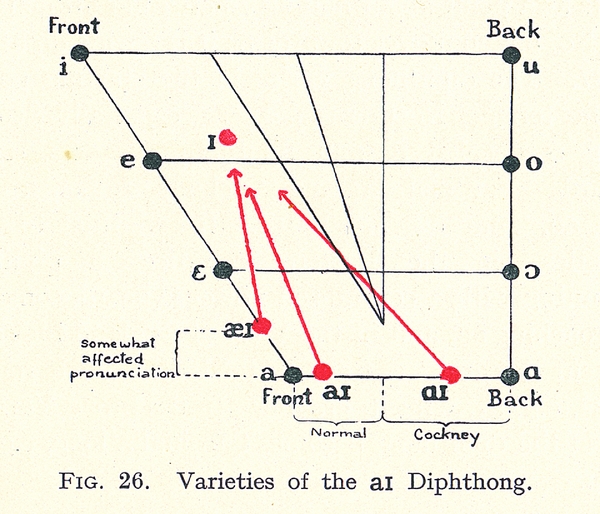
In a widely-used introduction to English phonetics (Ward Reference Ward1929), DJ's UCL colleague Ida Ward (1880–1949) comments on a range of realizations of the price diphthong in British English, focusing on their connotations. She notes that ‘æɪ is often considered affected, while ɑɪ, ɑːɪ, and ɒɪ are generally associated with Cockney pronunciation’ (Ward Reference Ward1929: 100). The use of a front starting point avoids Cockney, but awareness of [æɪ] as a hypercorrection drives southern speakers back in the direction of [ɑɪ]: ‘Another variety of London diphthong is æɪ, which is considered ultra “refaned” by many people, and it is possible that ɑɪ is a reaction against this pronunciation’ (Ward Reference Ward1929: 101). Distorted spellings (such as the word ‘refined’ itself written as ‘refayned’, ‘refaned’ or ‘refained’) are plainly intended to suggest similarity with the face diphthong in speech influenced by the affectation of a raised starting-point in price. Ward goes on to illustrate trajectories of price variants (Figure 4).
Varieties of the price diphthong as represented by Ward (Reference Ward1929). The range of variation in the starting point is divided into ‘Cockney’, ‘normal’ and ‘somewhat affected’.

Ward's observations are in agreement with those of DJ himself (Jones Reference Jones1932: 100–101), who remarks that ‘different speakers of Received English do not pronounce ai in the same way. . . . With some speakers the diphthong begins at a point between Cardinal a and Cardinal ɑ, while with others the beginning is at a point between a and æ’. When advising how to teach the pronunciation of English as a foreign language, he cautions against the ‘dialectal’ [ɑɪ]: ‘To correct this mistake, the learner should make the diphthong sound more like æi’ (ibid.). Earlier, he had expressed this more explicitly: ‘In the best pronunciation of ai, the a should err on the side of æ rather than on the side of ɑ’ (Jones Reference Jones1909b: 37). These quotations reveal DJ acknowledging a range of variation within the ‘Received’ accent, while the terms ‘dialectal’, ‘mistake’ and ‘best’ show that value judgements are being made against a (presumably social) scale.
5.1.3 dress
The dress quality is another variable with a long history in RP. Pointing out evidence for realizations which span a range from [e] to [ɛ], MacMahon (Reference MacMahon and Romaine1998: 452) writes: ‘Statements by various phoneticians and writers in the nineteenth century indicate not only the amount of variation to be heard in the realizations of /e/ [=dress] but also (in Britain at least) the social implications of particular realisations’. Ellis (Reference Ellis1874: 1108) indicates that in his time, ‘the tendency of educated pronunciation’ [his italics], was to prefer the higher realization. MacMahon goes on: ‘Not only has this range of realisations (from approximately Cardinals [e] to [ɛ]) continued throughout the RP of the twentieth century (see Jones Reference Jones1962: 64; Gimson Reference Gimson1994: 102), but the social and, as far as one can judge, the regional implications of a closer [=higher] pronunciation have remained the same’ (the more open realization was linked, for example, with a northern accent such as Yorkshire). Remarks by Bennett (Reference Bennett1930: 112) similarly link the more open vowel to the north (he specifically instances Lancashire).
5.1.4 Summary of connotations
Enough has been said to establish that at the time of the recordings used in this study, trap price and dress were variables carrying social and stylistic connotations within RP. Particularly for trap and price those giving advice on speech felt it necessary to caution RP-adopters against moving too far towards the ‘refined’ end of the ranges – which plainly implies that many of those attempting to modify their speech must have done exactly that, with humorous or ridiculous results.
In a detective novel exactly contemporary with the recordings analysed in this study, and appropriately set in a (fictional) public school, the author ridicules an unsympathetically portrayed science master, Mr Starky, by giving him dialogue spelled so as to suggest laughable overcompensation for an underlying (apparently northern) non-RP accent:
“Mix yourself a drink, Starky,” said Mr. Holt, who despised and detested him.
“Thenks,” said Mr. Starky. “Very naice of you. Must say I ken do with it.”
(Woodthorpe Reference Woodthorpe1932: 25).
For trap, alongside thenks and ken (for ‘thanks’ and ‘can’) we find on the same page chet, repped, med, metch (= ‘chat’, ‘rapped’, ‘mad’, ‘match’) and elsewhere beng, ges, gless (‘bang’, ‘gas’, ‘glass’) and more. For price, the spelling naice (‘nice’) is paralleled (page 211) by haighly and vaiolence (‘highly’, ‘violence’) (see Ross Reference Ross1954; see also Upton Reference Upton2007).
5.2 Reasons for Firth's choices
In this second part of the discussion section, we consider the possible roles of social background and avoidance of regional features in moulding the RP Firth is using in the recordings, and put forward an explanation of why Firth's speech may strike a modern observer as somewhat hypercorrect, while pointing out that it can hardly have been entirely outside 1930s norms.
5.2.1 Social and regional factors
The present study indicates that around 1930 Firth's typical realizations of trap, price and dress were all further towards the ‘refined’ end of their respective ranges than DJ's. It seems unlikely that this can have arisen simply as a result of their birth and upbringing.
After all, DJ himself was towards the middle, rather than the top, of the social strata associated with RP, and almost certainly would not qualify as ‘U’ (= upper class) in the classification of Ross (Reference Ross1954). Jones describes himself as a native RP speaker in a number of his publications (e.g. 1932, 1937a), and there is no indication in the recordings that he is making an effort to conform to any perceived ideal of speech. But he happily admits to having been criticized by his contemporaries as having ‘the speech of costermongers and servant girls’ and a ‘nauseating London simper’ (Jones Reference Jones1935: 29). Directed at the man whose publications effectively codified RP on the model of his own speech, these criticisms appear surprising. They should probably be read not as meaning that DJ exhibits obvious London features (he doesn't), but rather that he does not display markers of the ‘U-RP’ of his day (Wells Reference Wells1982: 280–283) which some of his critics evidently thought he should.
Firth's parentage, upbringing and education were clearly even more remote from the ‘U’ end of the social scale than DJ's, yet paradoxically his choices for values of trap, price and dress are all further towards the upper-class ends of the variable ranges. This seems to indicate either that a uniform one-dimensional social scale might be an inadequate simplification (Firth had spent time in colonial India and in the Army, contexts which might well have had their own RP norms), or that his pronunciations had been consciously or unconsciously modified, perhaps in order to distance them further from the regional characteristics of his native Yorkshire.
There is anecdotal evidence that Firth had (or at least liked to think he had) native-like competence in the Yorkshire dialect of Skipton and surrounding areas where he passed his early life (personal communication by M. A. K. Halliday in a letter dated 26 June 2010 to M. K. C. MacMahon). This is suggestive, but of course need not imply that his standard English and associated RP was acquired or developed later in life. He could in principle have acquired both dialects at the same period. But at the very least, native-like command of a variety very different from RP must have given Firth a set of reference points which were denied to DJ.
In the 1920s and 1930s, although it was widely believed that ‘standard’ speech should be taught in schools, and that agreement could be reached over what it should be like, actual definitions of this problematic entity were commonly in negative terms. An influential report recommended ‘a pronunciation free from provincialisms and vulgarisms’ (Newbolt Reference Newbolt1921: 66). A person wishing to adopt the standard accent needed to move away from socially stigmatized local varieties, rather than towards a clearly defined target. Firth's dress and trap realizations could perhaps be a case in point. Yorkshire accents are characterized by a more open dress, and a more open and retracted trap, as described by Wells (Reference Wells1982: 356): ‘all five [short vowels] tend to be somewhat opener than in RP. In particular /a/ is not of the [æ] type, but a fully open vowel somewhere between front and central [a ~ a̱]’. Firth's realizations may thus plausibly be interpretable as examples of hyperaccommodative behaviour, in an attempt to assert his status as an RP speaker by moving away from localized variants.
5.2.2 Lexical-distributional (selectional) choices
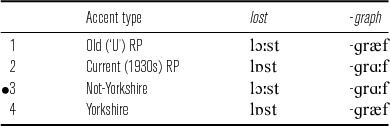
It was pointed out above that Firth retains the already ‘old-fashioned’ long [ɔː] vowel in certain cloth words, including off and lost. A second relevant lexical-distributional choice concerns certain bath words, and we note a difference between the speakers in the dialogue At the stationer's, where Firth pronounces /ˈfəʊtəɡrɑːf / alongside DJ's /ˈfəʊtəɡræf/. The older RP preference was for /-ɡræf/, and that is the version given first in the first edition of DJ's English Pronouncing Dictionary (Jones Reference Jones1917). By the fourth edition of 1937, DJ recognizes /-ɡrɑːf/ as first choice (though as the recordings reveal, he retained /-ɡræf/ himself).
While the evidence is admittedly meagre, Firth's combination of choices for lost and -graph may throw some light on the relative importance of social and regional factors in shaping his speech, since different outcomes are predicted for followers of older and newer RP models and for one seeking to maximize the difference from northern speech, as Table 3 shows. Firth's choices match the ‘not-Yorkshire’ row.
Predicted combinations of 1930s RP variants for lost and -graph (in photograph) for (from top), (1) a speaker using older (and hence upper-class) RP, (2) a speaker following general RP trends of the 1930s (as documented by DJ), (3) a speaker seeking to maximize the differences from Yorkshire speech, and (4) a speaker making RP choices which resemble those in Yorkshire speech. The mark ● calls attention to the row containing the combination of pronunciations actually used by Firth.

5.2.3 The possible role of hypercorrection
One might attempt to account for aspects of Firth's speech by invoking the sociolinguistic concept of hypercorrection. Hypercorrection is a documented by-product of social insecurity (Labov Reference Labov1966, Reference Labov1972b), i.e. when there exists a mismatch between a person's native speech and the variety they strive to imitate. Trudgill (Reference Trudgill2003: 59) defines the concept as ‘a form of hyperadaptation in which speakers of a lower prestige variety, in attempting to adopt features of a higher prestige variety, incorrectly analyse differences between the two varieties and overgeneralize on the basis of observed correspondences’. The phenomenon covers a range of accommodative behaviours, but the main distinction is between quantitative and qualitative. The former, also termed Labov-hypercorrection (Wells Reference Wells1982: 27) refers to a type of collective behaviour, where members of a social group, in an attempt to imitate the speech of another group, use an element ‘with a frequency different from that with which the members in another social group natively use this element’ (Janda & Auger Reference Janda and Auger1992: 212). Perhaps the best-known example of quantitative hypercorrection is Labov's (Reference Labov1966) seminal study of the socially stratified use of postvocalic /r/ in New York City, where in the most formal styles lower middle class speakers employ a higher frequency of postvocalic /r/s than the social class above them. This cross-over phenomenon, i.e. the use of a linguistic variable more than is characteristic of the group being emulated, demonstrates both linguistic insecurity and target overinterpretation.
The latter, qualitative type, which would have to be assumed to be the mechanism behind the differences found in the present study, refers to the behaviour of an individual and is illustrated by Wells (Reference Wells1982: 113–116) with two examples from British English, i.e. a hypothetical Northerner adjusting their speech towards RP. This manoeuvre requires the addition of the strut vowel, absent from Northern English, to the inventory, keeping the /ʊ/ in words such as pull, wood, bush but replacing it with strut in the set including dull, blood, hush. In other words, knowledge of lexical distribution is required. The other example offered by Wells refers illustrates upward social mobility, where a hypothetical Londoner, wishing to sound more ‘refayned’ attempts to move away from broad London [ɒɪ] value in price.
Both group and individual hypercorrection overgeneralize a rule for the target variety without restricting the environment. In the former type, a given feature is present in both the native and emulated variety. Incorrect modelling of the intended target therefore does not produce new elements, but consists in an overuse of a speech element used natively. By contrast, qualitative hypercorrection results in the rise of innovative forms that would not be produced by a native user of the target variety. Regarding the social aspects of the phenomenon, while hypercorrection away from the standard or towards a prestigious local norm is certainly not unknown (Petyt Reference Petyt1985; Rampton Reference Rampton1995, Reference Rampton1999), the modification is more generally in the direction of a variety considered more overtly prestigious, which is usually some form of a standard.
But Firth's speech can hardly have been noticeably hypercorrect by the standards of the 1930s, or he would not have been selected as a suitable speaker for recordings of this type. It is not plausible that DJ and H. C. Wyld, both of them authorities on English pronunciation, would have consented to making recordings alongside a speaker who sounded like Woodthorpe's fictional Mr Starky. Besides, though the detailed empirical evidence remains to be collected, it is plain that there are many other speakers in these and in other contemporary recordings who seem to resemble Firth rather more than they do DJ (their notable UCL colleagues Ida Ward and Lilias Armstrong are examples). Furthermore DJ made recordings with Firth on at least two occasions – and put him in charge of the English language teaching efforts within the department he directed, which was by this stage the most prestigious phonetics department in the world, known particularly for its work on English.
For Firth the situation is therefore more complicated than can be explained as simple hypercorrection. While it is not impossible that he may at some stage have been motivated by the same considerations that could lead towards hypercorrection, the values he settled on for the variables must have remained within then-current RP ranges (though they may have been pushed towards the ends of those ranges rather than tending to the middle). The modern observer's (probably mistaken) impression of hypercorrection in Firth's speech is then explained by assuming that the dimensions of variation (e.g. trap height) remain current carrying class connotations (so that we remain sensitive to them), while the limits to the range of acceptable values have shifted over time, so that specific realizations cannot be assessed without knowledge of 1930s norms.
6 Conclusions and future work
Our study indicates that in the mid-1930s, when the status of RP as a ‘standard’ accent was essentially unchallenged, the accent exhibited considerable variation in certain vowel qualities, and to some extent in lexical-distributional choices. Differences between the vowel realizations used by Firth and DJ are clearly audible, and robustly supported by acoustic analysis. The vowel variables identified all have a long history, and all have both class associations and the potential to be affected by regional factors. Various explanations can be advanced for the particular choices evident in Firth's speech, though it seems impossible to decide conclusively among them on the evidence available so far. In our own further work, already under way, we will widen the study to include other speakers who are heard in the recordings from which our corpus is taken. The acoustic analysis reported above, with recordings as old as 1929, presented no particular difficulties. Since similar electric recordings began in 1925–1926, this opens the prospect of acoustic studies of speakers with birth years as early as the 1850s.
Acknowledgements
We are grateful to three anonymous reviewers for detailed criticism and advice, and to Rosy Hall for comments and suggestions on a draft. We also wish to thank Mike MacMahon for sharing the contents of a letter from M. A. K. Halliday with recollections of J. R. Firth. For technical work on the digital transfer of the recordings we are grateful to Steve Nevard (formerly at UCL), and to the British Library Sound Archive.