


Introduction
In the early intervention field, a focus of study has been on the detection of individuals considered to be at clinical high risk (CHR) of developing psychosis (Addington and Heinssen, Reference Addington and Heinssen2012). Recently reported conversion rates indicate that approximately 29% of these individuals will transition to full-blown psychosis within 2 years (Fusar-Poli et al., Reference Fusar-Poli, Bonoldi, Yung, Borgwardt, Kempton and Valmaggia2012). Given that the majority of these individuals will not develop full-blown psychosis (Addington et al., Reference Addington, Cornblatt, Cadenhead, Cannon, McGlashan and Perkins2011), concerns have been expressed regarding the potential of stigma when labelling someone “at-risk”. In early psychosis, beliefs about illness, or how one makes sense of their illness, have been shown to impact one's quality of life (Theodore, Johnson and Chalmer-Brown, Reference Theodore, Johnson and Chalmer-Brown2012) and to contribute to the development of post-psychotic depression (Iqbal, Birchwood, Chadwick and Trower, Reference Iqbal, Birchwood, Chadwick and Trower2000). For those at CHR, there is evidence that these young people fear negative reactions from others (Byrne and Morrison, Reference Byrne and Morrison2010). Additionally, it has recently been shown that “prodromal” psychotic symptoms elicit the same negative stereotypes as schizophrenia labels and that the “at-risk” label elicits more negative stereotypes when compared to non-psychotic disorders (Yang et al., Reference Yang, Anglin, Wonpat-Borja, Opler, Greenspoon and Corcoran2013). Thus, negative stereotyping may impact a young person's beliefs about their early sub-threshold experiences.
The most commonly used tool to assess beliefs about illness in people with psychosis is the Personal Beliefs about Illness Questionnaire (PBIQ; Birchwood, Mason, MacMillan and Healy, Reference Birchwood, Mason, MacMillan and Healy1993). Recently, this scale has been adapted to be more suitable for a CHR population, and is called the Personal Beliefs about Experiences Questionnaire (PBEQ; Morrison et al., Reference Morrison, Birchwood, Pyle, Flach, Stewart and Byrne2013). Assessments using the PBEQ have shown that internalized stigma is associated with depression and social anxiety, as well as with the distress associated with unusual psychological experiences and suicidal ideation (Pyle et al., Reference Pyle, Stewart, French, Byrne, Gumley and Birchwood2013).
The aim of the current study was to explore the beliefs about unusual experiences in a large sample of young people at CHR for psychosis using the PBEQ. We expect that holding more negative beliefs will be related to severity of clinical symptoms and that those who later develop psychosis may have more negative beliefs.
Method
Sample
The sample consisted of 153 individuals at CHR for psychosis (87 males, 66 females). Of those included in this sample, 27 transitioned to psychosis. All participants were part of a 2-year longitudinal NIMH funded study entitled “Enhancing the Prospective Prediction of Psychosis” (PREDICT) that was conducted at the University of Toronto, University of North Carolina, and Yale University to determine predictors of conversion in individuals at clinical high risk of developing psychosis. All CHR individuals met the Criteria of Prodromal States (COPS) based on the Structured Interview for Prodromal Symptoms (SIPS) (McGlashan, Walsh and Woods, Reference McGlashan, Walsh and Woods2010). Among the CHR sample in this study, 151 (98.7%) CHR participants met attenuated positive symptom syndrome (APSS) criteria, which includes the emergence or worsening of non-psychotic level disturbances in thought content, thought processes or perceptual abnormalities over the past year, four (2.6%) participants met criteria for genetic risk and deterioration (GRD), which required either a first degree relative with a psychotic disorder or the subject having schizotypal personality disorder (SPD) plus at least a 30% drop in functioning on the General Assessment of Functioning (GAF) scale in the past 12 months, and two (1.3%) participants met both APSS and GRD.
Participants were excluded if they met criteria for any current or lifetime axis I psychotic disorder, prior history of treatment with an antipsychotic, IQ< 70, or past or current history of a clinically significant central nervous system disorder that may confound or contribute to clinical high-risk symptoms. Participants were excluded if they were using antipsychotics at baseline. Furthermore, antipsychotics were not used at any later points in this study.
Measures
Criteria for a prodromal syndrome and criteria for conversion to psychosis were determined using the Structured Interview for Prodromal Syndromes (SIPS; McGlashan et al., Reference McGlashan, Walsh and Woods2010) and symptoms were assessed with the Scale of Prodromal Symptoms (SOPS), which consists of 19 items in 4 symptom domains: positive, negative, general and disorganized. The Structured Clinical Interview for DSM-IV (SCID-I; First et al., Reference First, Spitzter, Gibbon, Williams and Williams1995) was used to determine the presence of any axis I disorders. Depression was assessed using the Calgary Depression Scale for Schizophrenia (CDSS) (Addington, Addington and Maticka-Tyndale, Reference Addington, Addington and Maticka-Tyndale1993).
Beliefs about experiences were assessed using the Personal Beliefs about Experiences Questionnaire (PBEQ) (Morrison et al., Reference Morrison, Birchwood, Pyle, Flach, Stewart and Byrne2013; Pyle et al., Reference Pyle, Stewart, French, Byrne, Gumley and Birchwood2013). The PBEQ is a revised version of the Personal Beliefs about Illness Questionnaire (PBIQ; Birchwood et al., Reference Birchwood, Mason, MacMillan and Healy1993). The PBIQ-R (a revised version of the PBIQ) is a 16-item scale developed on the basis of stigma theory and was designed to assess five constructs related to peoples’ appraisals of psychotic illness, control over illness, self as illness, illness as impediment to the attainment of goals, humiliation and guilt, and need for social containment (Birchwood, Jackson, Brunet, Holden and Barton, Reference Birchwood, Jackson, Brunet, Holden and Barton2012). The PBEQ has 13-items. Three items were removed as they were specific to chronic illness and did not pertain to the CHR population. Additionally, the word “illness” from the original PBIQ has been substituted with the word “experiences”. Each item of the PBEQ is a statement of stereotypical social and scientific beliefs, which the respondent rates in relation to the degree to which he or she endorses the statements as true about him or herself. Each item is rated on a 4-point scale (1–4): “strongly disagree”, “disagree”, “agree”, “strongly agree”.
Procedures
Raters were experienced research clinicians who demonstrated adequate reliability at routine reliability checks. Gold standard posttraining agreement on the critical threshold for determining initial eligibility and subsequent conversion status was excellent (kappa = 0.90). The PI, psychiatrist or psychologist at each site conducted a comprehensive clinical assessment to determine if entry criteria were met. Inter-rater reliability for the SCID was determined at the start of the study and annually by 100% agreement on the diagnosis and at least 80% agreement for symptom presence. JA chaired weekly conference calls to review criteria for individuals admitted to the study. The study protocols and informed consents were reviewed and approved by the ethical review boards of all three-study sites. The PBEQ was administered to participants at the baseline assessment.
Statistical analyses
Four sub-scores were determined based on the previously created sub-scores from the PBIQ-R. The range on each item was as follows: (1) “control over experiences”, three items, range = 3–12; (2) “self as experiences”, four items, range = 4–16; (3) “stigma”, five items, range = 5–20; and (4) “social containment”, one item, range = 1–4. Since items had been removed there was no sub-score equivalent to appraisal of psychotic illness. Pearson correlation for continuous variables (total SOPS positive, SOPS negative and CDSS scores) were used to determine associations with belief scores. An independent samples t-test was used to compare those who transitioned to psychosis compared to those who did not. An average mean score was created for each of the sub-scores in order to display the average response (i.e. from “strongly disagree” to “strongly agree”).
Results
Demographics
The average age of participants was 19.82 (SD = 4.48, range 14–31). The majority were white (77.2%), male (57.7%) and never married (95.3%). Approximately 42% had not completed high school, most likely due to the young age of the sample. Age was unrelated to beliefs with the exception of a small but significant correlation between older participants and higher ratings on the “self as experiences” sub-scale. There were no significant differences between males and females on any of the beliefs.
Mean scores for each of the sub-scores were as follows: “control over experiences” (mean = 2.44, SD = 0.64); “self as experiences” (mean = 2.60, SD = 0.58); “stigma” (mean = 2.38, SD = 0.53); and “social containment” (mean = 1.98, SD = 0.74). CHR participants’ most common response was to “agree” to statements on “self as experience” and to “disagree” on all other statements regarding “control over experiences”, “stigma” and “social containment”.
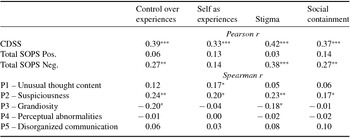
As displayed in Table 1, all of the sub-scores were significantly related to the CDSS and to SOPS negative symptoms with the exception of “self as experiences”, which was unrelated to negative symptoms. The relationships between negative symptoms and beliefs remained significant after controlling for depression (control: r = 0.17, p < .05; stigma: r = 0.29, p < .0001; social containment: r = 0.17, p < .05; total beliefs: r = 0.21, p < .01). There were no associations between beliefs and total positive symptoms. Since an association was expected between attenuated positive symptoms and beliefs, this area was explored further by testing to see if any individual attenuated positive symptom was associated with beliefs. Results showed that those who rated high on severity of suspiciousness had more negative beliefs on all sub-scales and those who evidence higher levels of grandiosity had significantly less negative beliefs, particularly on “control over experiences” and “stigma”. Additionally, unusual thought content was positively correlated with “self as experiences”. The relationships between suspiciousness and beliefs remained significant on all items after controlling for depression (control: r = 0.22, p < .01; self as beliefs: r = 0.17, p < .05; stigma: r = 0.20, p < .05; social containment: r = 0.16, p < .05).
Associations between baseline PBEQ and clinical symptoms

*p < .05, **p < .01, ***p < .0001
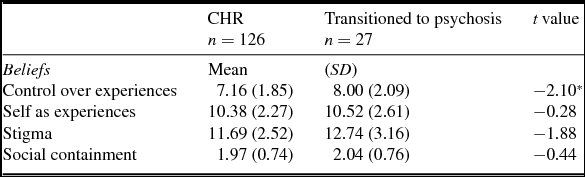
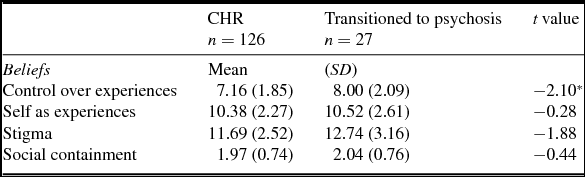
Comparisons of beliefs were made between those who transitioned to psychosis and those who did not. As shown in Table 2, those who transitioned to psychosis agreed more to statements concerning a lack of “control over experiences” (t = −2.10, p < .05).
Comparison of beliefs at baseline between those who transitioned to psychosis (N = 27) and those who did not (N = 126)
*p < .05
Discussion
In a large sample of individuals at CHR for psychosis, beliefs about experience were examined using a newly adapted scale. As a group these CHR participants were most consistent with respect to agreeing with negative statements on the “self as experiences” items such as: “there is something about my personality that causes these experiences”, and “there must have always been something wrong with me to cause these experiences”. Morrison and colleagues (Reference Morrison, Birchwood, Pyle, Flach, Stewart and Byrne2013) considered these items to fall under a category they called “negative appraisals of experiences” and found that through cognitive therapy did improve over time.
As predicted, we found that holding more negative beliefs was associated with increased severity in depression and negative symptoms. Although the SOPS attenuated positive symptom score was not associated with beliefs, when we examined the individual attenuated positive symptoms, more severe suspiciousness was associated with increased negative beliefs. Although it has been reported that the most anxious and depressed individuals have the highest levels of paranoid thinking (Freeman et al., Reference Freeman, Dunn, Fowler, Bebbington, Kuipers and Emsley2013), our results showed that those who had more severe levels of suspiciousness had higher levels of negative beliefs, independent of level of depression. This might suggest that targeting negative beliefs or appraisals regardless of level of depression is an important objective for the improvement of attenuated symptoms of suspiciousness. Interestingly, those who reported higher levels of grandiosity reported lower levels of negative beliefs. It is possible that those with higher levels of grandiosity may have had a more inflated sense of self and thus less negative beliefs, a finding that should be cautiously interpreted, but considered for future research. We observed no associations between beliefs and perceptual abnormalities. Unusual thought content was only associated with “self as experiences”. It is possible that these symptoms at the attenuated level, although worrisome in that these young people are seeking help, are not yet having an impact on their self-perceptions. It is possible at this early stage they feel that these anomalies may not be longstanding. Their impact on beliefs may occur once the attenuated symptoms become more severe and/or longstanding.
The only difference in beliefs between those who later transitioned to psychosis and those who did not was that those who transitioned agreed significantly more with statements regarding a lack of “control over experiences”. Examples of these statements include items such as: “my experiences frighten me”; “I find it difficult to cope”; “I am powerless over my experiences”. This is consistent with Birchwood and colleagues’ (Reference Birchwood, Mason, MacMillan and Healy1993) earlier work that showed that depression following an acute episode of psychosis was associated with a lower perceived control over the illness. These findings also provide further support for research into locus of control, which investigates the way in which individuals believe they can control events that affect them and for which there is a suggestion of its role in the development of psychosis (Thompson et al., Reference Thompson, Sullivan, Lewis, Zammit, Heron and Horwood2011) and in differentiating CHR individuals from healthy controls (Thompson, Papas, Bartholomeuz, Nelson and Yung, Reference Thompson, Papas, Bartholomeuz, Nelson and Yung2013).
There are limitations to our study. First, we did not examine the change in beliefs over time. This and the correlational nature of our research do not allow us to make any causal interpretations. Additionally, although the PBIQ has proven to be a reliable measure, the adapted version used in this study (the PBEQ) still requires validation in this population. Nonetheless, we were still able to find several significant relationships, some of which are consistent with previous reports in the literature. Our finding that those who eventually transition to psychosis feel less in control of their experiences would support a cognitive behavioural therapy (CBT) approach specifically aimed at addressing their beliefs or as part of a CBT approach that also addresses their attenuated psychotic symptoms.
Acknowledgements
NIMH grants U01MH066134 to J. Addington, U01 MH066069 to D. Perkins, U01MH066160 to S. Woods.



Comments
No Comments have been published for this article.